
The President of the Kyrgyz Republic, Sadyr Zhaparov, has today visited the Alley of Martyrs in Baku, Report informs via AZERTAC.
Day: April 24, 2024
Church, Entire Village ‘Erased’ In Azerbaijan’s Recaptured Nagorno-Karabakh Radio Free Europe / Radio Liberty
On April 17, 2024, Armenia’s Prime Minister Nikol Pashinyan, at a meeting with the residents of Kirants village in the Tavush region, said that for the past 30 years, the residents have lived “in the conditions of lawlessness, and the time has come to put an end to this, to establish a rule of law” in the region. The PM added: “Our idea is for you not to say Azerbaijan is 50 meters away, but to say, wow, it is good that Azerbaijan is 50 meters away. We will trade there. We will build the economy there. Maybe we will build another checkpoint. Cars will come and go and pay the Republic of Armenia.” He later continued: “Now you can say to me: Do you 100-percent guarantee that you will do this? I will answer, I don’t guarantee 100-percent, but I know that by taking step by step, we will reach 90-percent or even more.”
Azerbaijan insists that there are four bordering villages near Armenia’s Tavush and Azerbaijan’s Qazax region that must be ceded to Azerbaijan. Baku argues that these villages were taken by Armenian forces in the early 1990s. Armenia’s PM told Tavush residents that the villages of Baghanis Ayrum, Ashaghi Akipara, Kheyrimli and Ghizilhajili are de jure located on the territory of Azerbaijan. The villagers argued that if these bordering villages are handed over, then their own villages would be surrounded by Azerbaijani border guards, which would make agricultural life difficult.
On April 19, the eighth meeting of the Commission on Delimitation and Border Security of the State Border between Armenia and Azerbaijan agreed on the following:
In the first phase, the sides have agreed to readjust the borderline of the villages: Baghanis (Armenia)-Baghanis Ayrum (Azerbaijan), Voskepar (Armenia)-Ashaghi Akipara (Azerbaijan), Kirants (Armenia)-Kheyrimli (Azerbaijan) and Berkaber (Armenia)-Ghizilhajili (Azerbaijan).
The delimitation process will be based on the Alma-Ata Declaration of 1991. The issue of enclaves and exclaves is to be addressed at a later stage.
The agreement was welcomed by many regional actors. EU’s Special Representative for South Caucasus Toivo Klaar tweeted: “Encouraging news today regarding the work of the Armenia-Azerbaijan border commissions and the start of a delimitation process based on legal documents and the 1991 Almaty Agreement. EU fully supports the process of negotiations and the aim of a comprehensive and lasting settlement.”
Turkey’s Foreign Ministry also welcomed the agreement: “We are pleased to welcome the agreement reached at the meeting of the Azerbaijani-Armenian border delimitation commission on April 19, 2024, on the return to Azerbaijan of four villages occupied for 30 years and the continuation of delimitation work. This positive development achieved through direct negotiations is an important step towards signing a final peace agreement.”
Iran’s ambassador to Armenia said that Armenia previously informed Iran about the border delimitation in Tavush.
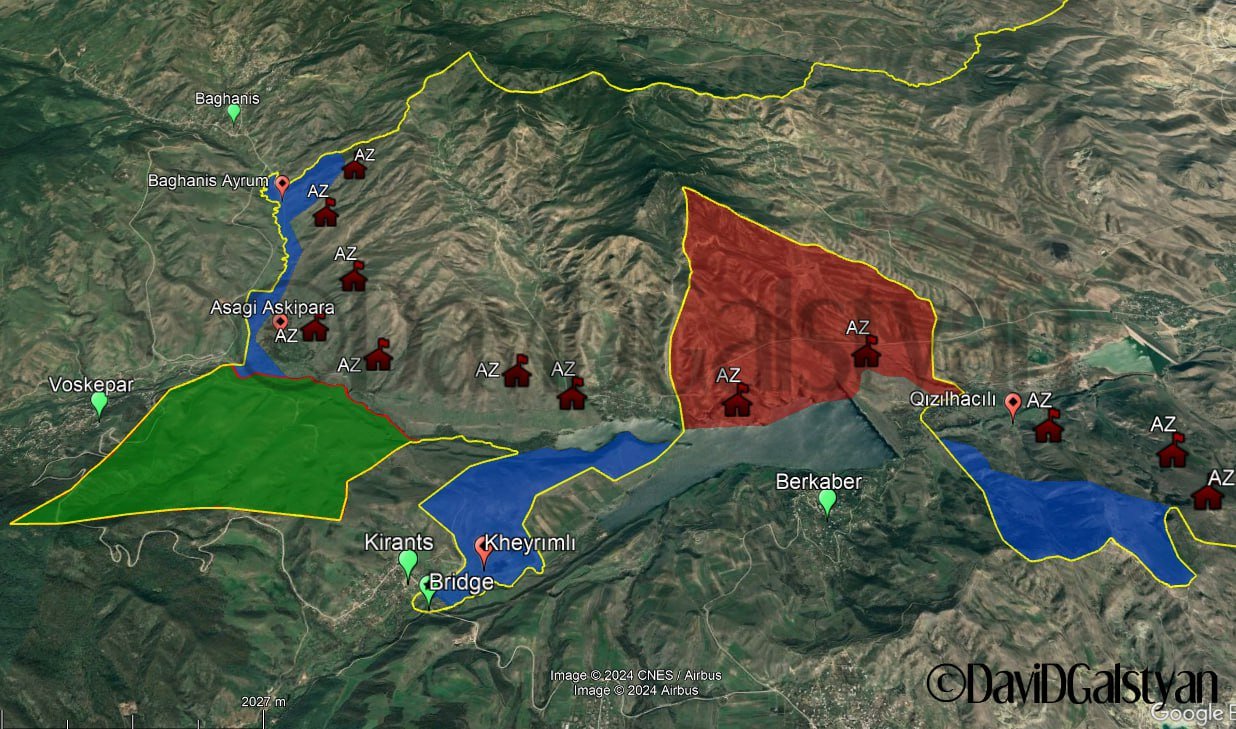 Map by David Galstyan
To simplify the readjustments, journalist David Galstyan tweeted about the actual status of the villages and the territories to be handed over in the Tavush region through a detailed map. According to this map, the blue zone represents territory from which the Armenian Armed Forces will withdraw near Baghanis, Kirants and Berkaber. The green zone near Voskepar will remain under Armenian control. The territory of Berkaber shown in red, which was captured by Azerbaijanis in the early 1990s, will remain under Azerbaijani control.
According to Galstyan, the territory of the green area covers around 4.5 sq km, through which the Yerevan-Tbilisi road passes. The red section covers around 6.5 sq km. The bridge near Kirants, part of the Yerevan-Tbilisi road, will remain under Armenian control.
Theoretically, an observer can argue that this is a mutual compromise and a “good option” to avoid a war, but it also contains risks…
- First, Armenia is giving up a defensive line built in the early 1990s. This area constitutes the most secure and fortified one along the Armenian-Azerbaijan border, without firing a shot.
- Second, Azerbaijan will control the high altitude, allowing it much greater fire control deep inside Armenia using basic artillery or machine fire.
- Third, the gas pipeline will come under the direct line of sight and fire control of Azerbaijan. Those from the region remember the pipeline explosions in the early 1990s very well. According to Benyamin Poghosyan, the Russia-Georgia-Armenia gas pipeline passes through the area. “In light of the Azerbaijani precedent of cutting the gas supply to Nagorno Karabakh as soon as Azerbaijan took control of part of the Armenia-Nagorno Karabakh gas pipeline in the summer of 2022, chances are high that Azerbaijan will use the same tactics as leverage to put additional pressure on Armenia for further concessions,” Poghosyan said. Though it is possible to construct a new section of gas pipeline to circumvent these areas, it will require time and resources.
- Fourth, several Armenian villages, including Kirants, will come under semi-encirclement or full encirclement, similar to Nerkin Hand in Syunik, which is now isolated on three sides.
- Fifth, Armenia will lose the pumping station on Joghaz reservoir, which prior to the 1990s supplied water to almost 30 Armenian and Azerbaijani villages.
- Finally, transit along Armenia’s strategic North-South Highway, which is part of the ambitious Black Sea-Persian Gulf Corridor (backed by India and Iran), will be threatened, and the whole project may be jeopardized if Azerbaijan engages in provocations near the border.
Moreover, there were differences in the announcements made by both sides:
The Information and Public Relations Department of the Armenian PM’s Office told Armenpress: “For the sake of accuracy, let’s record that Azerbaijan receives two and a half villages belonging to it, because the entire territory of the village of Qizilhachili, a significant part of the territory of the village of Ashagh Askipara, was under the control of Azerbaijan. And in this process, the Republic of Armenia gets a reduction of risks related to security and border delimitation.”
While Azerbaijan’s MFA spokesperson said: “Armenia has agreed to return four villages of Azerbaijan that were under occupation since early 1990s.”
So, whom to believe? While Armenia has classified the agreement as a mutual compromise, Azerbaijan argues that it is a complete victory and the end of “30 years of occupation.” With the concern to avoid another war, Armenian authorities are engaging in a “quick fix” solution to address problems with Azerbaijan. Yet this often has a backfire effect on the negotiation process, as Baku is getting unilateral concessions from Yerevan. This was the case at the Prague summit in 2022, where Armenia recognized the territorial integrity of Azerbaijan, thereby recognizing Nagorno-Karabakh as part of Azerbaijan and ultimately losing the region in September 2023, which led to the depopulation of the entire Artsakh population from its homeland. Moreover, since November 2020, all agreements signed with Baku have been violated by the Azerbaijani side. What will guarantee that Aliyev will not violate this agreement too? It is worth mentioning that this agreement is bilateral and does not have Western or Russian guarantees (although Baku has also violated trilateral agreements, such as the November 2020 and Prague 2022 agreements).
To be clear, I am in favor of mutual compromise and territorial swaps, as this is the only realistic solution for border demarcation. However, given the post-November 2020 experience, Aliyev has proven that he is not sincere in building peace. Instead, Azerbaijani authorities, backed by regional actors, are pursuing a policy of forced capitulation by Armenia and have not shown any genuine interest in peace and reconciliation. Will Baku respect its commitments this time or further pressure Yerevan to receive unilateral concessions, ultimately getting a “corridor” through Syunik? Most importantly, demarcation is not being done in the framework of international law, as the Azerbaijani side is gaining territories without withdrawing from the Armenian territories it occupied during the 2021 and 2022 incursions. To reach a sustainable peace between two peoples, the entire peace process and agreements must be based on the principles of justice and mutual compromise.
Author information
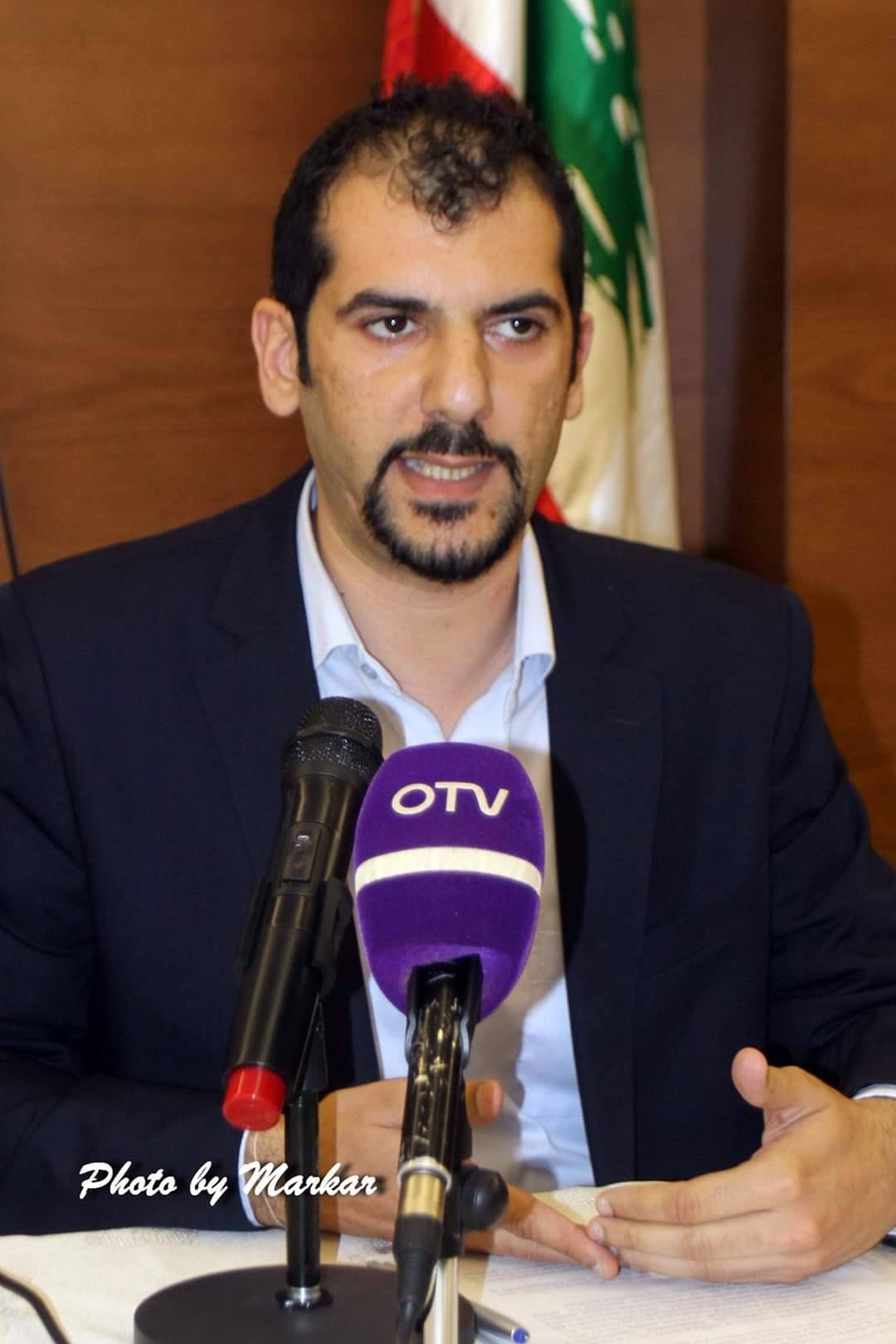
Yeghia Tashjian
Yeghia Tashjian is a regional analyst and researcher. He has graduated from the American University of Beirut in Public Policy and International Affairs. He pursued his BA at Haigazian University in political science in 2013. In 2010, he founded the New Eastern Politics forum/blog. He was a research assistant at the Armenian Diaspora Research Center at Haigazian University. Currently, he is the regional officer of Women in War, a gender-based think tank. He has participated in international conferences in Frankfurt, Vienna, Uppsala, New Delhi and Yerevan. He has presented various topics from minority rights to regional security issues. His thesis topic was on China’s geopolitical and energy security interests in Iran and the Persian Gulf. He is a contributor to various local and regional newspapers and a presenter of the “Turkey Today” program for Radio Voice of Van. Recently he has been appointed as associate fellow at the Issam Fares Institute for Public Policy and International Affairs at the American University of Beirut and Middle East-South Caucasus expert in the European Geopolitical Forum.
| Twitter |
The post Border readjustment in Tavush, what’s next? appeared first on The Armenian Weekly.
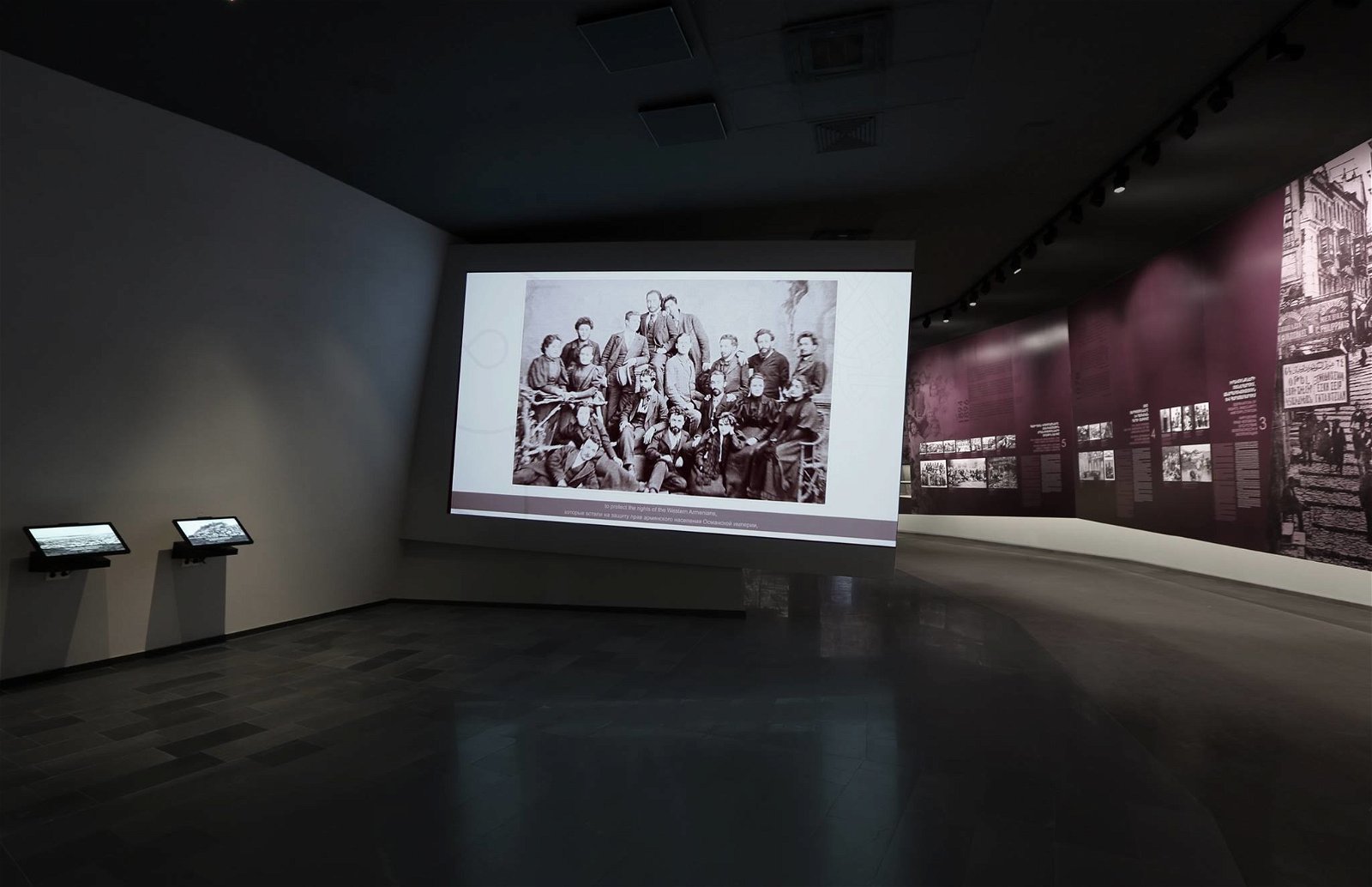 Armenian Genocide Monument and Museum
Armenian Prime Minister Nikol Pashinyan and his equally incompetent underlings have been making anti-Armenian statements for months. He started with denigrating Mount Ararat and then went on to criticize the Republic of Armenia’s constitutionally-protected official symbols: the national anthem and coat of arms.
Pashinyan also suggested that Armenia needs to adopt a new constitution deleting its references to Artsakh and the Armenian Genocide, which are enshrined in the Declaration of Independence. He repeatedly makes the artificial distinction between “historical Armenia” and what he calls “real Armenia,” meaning today’s Republic of Armenia, which is a small part of the Armenian homeland.
Pashinyan has also been obsessed with begging for peace from hostile Azerbaijan, which has no interest in making peace with Armenia. Pres. Ilham Aliyev’s only goal is the total destruction of Armenia, a country whose existence he rejects, calling it “Western Azerbaijan.” Regrettably, Pashinyan makes the excuse for all of his defeatist and compromising statements, using the scare tactic that if Armenia doesn’t comply with Azerbaijan’s demands, it would start a new war!
Through one of his obedient servants, Pashinyan is now questioning the veracity of the Armenian Genocide, under the guise of confirming the real facts of the genocide. The latest scandal began with a highly questionable statement by Antranik Kocharyan, chairman of the Parliament’s Defense and Security Committee and senior member of Pashinyan’s ruling Civil Contract party. Delving into subjects that are unrelated to his office, Kocharyan cast doubt on the facts of the Armenian Genocide. Naturally, the Azeri and Turkish media were extremely pleased with his statement.
In an interview with Radio Free Europe Armenian Service on April 14, Kocharyan said that Pashinyan’s goal is to build “real foundations” related to the Genocide and to “make the list of compatriots subjected to genocide more objective.” Furthermore, he stressed that it is necessary to have the names of all Armenians subjected to genocide and verify “where, how and under what conditions” they were killed. Insisting on his misguided statement, the very next day he repeated it during a press briefing in Parliament.
Nevertheless, after coming under harsh criticism, Kocharyan claimed that he was expressing his personal views, not those of his political party, thus shielding Pashinyan from his irresponsible words. However, it is clear that Kocharyan would not have dared to make such a controversial statement without the prior approval of his boss, the prime minister, who single-handedly makes all governmental decisions. Besides, Kocharyan himself referenced Pashinyan in his statement about the Genocide.
“This is a simple goal for us to know the addresses and locations of each of our 1.5 million compatriots. It is very important for the building of our relations [with Turkey] in the future as well,” Kocharyan said. “April 24 is approaching. Was it 1.5 million, two million or less? It should be strictly addressed. But if we don’t record it, the other side [Turkey] can always say that no such thing happened. And until today they have been saying so,” he added.
This is a very dangerous statement to be made by a high-ranking Armenian official. It is nothing less than parroting the Turkish denialist thesis, which has for decades minimized the number of Armenian victims, saying that it is far fewer than 1.5 million and cynically asking, where are the bodies of the dead? Now comes a member of Armenia’s ruling party giving credence to Turkish denials.
Seeking to verify the number of Armenian Genocide victims is problematic for other reasons. One hundred and nine years after the genocide, Kocharyan has come up with the ‘brilliant’ idea of counting the number of the victims. It is impossible for anyone to go back in time and document the names and locations of all 1.5 million Armenian victims. There are no graves and no traces of the victims. Entire families with all their relatives were wiped out.
Secondly, if Kocharyan goes ahead with his shortsighted suggestion, I doubt that it would be possible to come up with more than a couple of hundred thousand names of victims. This will be the greatest gift anyone can give to denialist Turks. The minute that relatively small number of victims is collected and announced, Turkish denialists will declare that Armenians just proved that there was no genocide and nowhere close to 1.5 million victims. The Turkish government will tell the world that it has been saying for a century that the Genocide is a big lie, and Armenians finally proved it.
Neither Kocharyan nor denialist Turks have the slightest notion about the United Nations’ definition of genocide, which is based on the intent to kill a particular group of people, “in whole or in part,” without specifying the minimum number of victims. So the whole exercise is not only a waste of time, but also counterproductive.
I have a better idea. I wrote a column years ago suggesting that Armenians set up a “Wall of Shame” and list on it all those who have denied the Armenian Genocide since 1915, including denialist Turks and non-Turks as well as some Armenians.
To make matters worse, Zareh Sinanyan, Armenia’s Chief Commissioner for Diaspora Affairs, in a TV interview last week shockingly welcomed Kocharyan’s unwise words, stating that he “likes the idea very much.” We should not be too surprised since, contrary to his title, Sinanyan has made several statements that are contrary to Armenia’s and the Diaspora’s interests.
If Pashinyan continues making his anti-Armenian statements, what will he announce next? The outlawing of the burning of the Turkish flag on April 24 in Yerevan or closing down the Genocide Monument and Museum, using his usual scare tactic that otherwise Turkey will attack?
It is sad that on the eve of the anniversary of the Armenian Genocide, we have to deal with Armenians who are serving the cause of Turkish genocide denialists rather than advancing our just demands from Turkey.
Author information

Harut Sassounian
California Courier Editor
Harut Sassounian is the publisher of The California Courier, a weekly newspaper based in Glendale, Calif. He is the president of the Armenia Artsakh Fund, a non-profit organization that has donated to Armenia and Artsakh one billion dollars of humanitarian aid, mostly medicines, since 1989 (including its predecessor, the United Armenian Fund). He has been decorated by the presidents of Armenia and Artsakh and the heads of the Armenian Apostolic and Catholic churches. He is also the recipient of the Ellis Island Medal of Honor.
|
The post What will Pashinyan do next, demolish the Genocide Museum? appeared first on The Armenian Weekly.
Categories