
Azerenergy OJSC generated 6.371 billion kWh of electricity in January-March 2024, down 672.4 million kWh, or 9.5%, from the previous year, Report informs, citing the Ministry of Energy.
Day: April 23, 2024
Executive Summary:
-
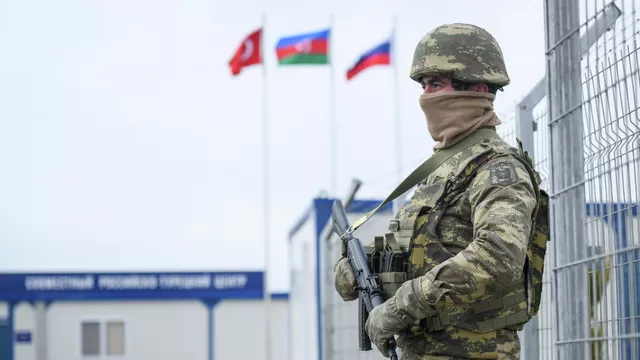
On April 16, Russia began withdrawing its peacekeeping troops from Karabakh—18 months before their deployment officially ends.
-
This marks one of the first instances that Russian armed units have left the territory of a post-Soviet state voluntarily and earlier than officially planned.
-
The Kremlin’s withdrawal from its peacekeeping mission highlights the conclusion to the Karabakh conflict and the cessation of the “Karabakh card” as leverage for Moscow’s dealings with Baku.
On April 16, Russia’s peacekeeping units—deployed temporarily to the Karabakh region by the November 2020 trilateral agreement between Russia, Armenia, and Azerbaijan—commenced their withdrawal from the area. Under the agreement, Russia’s peacekeeping mission was meant to be limited to 1,960 motor rifle troops with light weapons and armored personnel carriers, though both the number of troops in this contingent and its military equipment soon exceeded the limits (Interfax, November 12, 2020; TASS, December 2, 2020, see EDM, January 22, 2021). Russia’s peacekeeper withdrawal marks a significant turning point in Russian influence in the South Caucasus, as Russia will not have its involvement in mediating the Karabakh conflict as leverage over Azerbaijan and Armenia.
The three parties never reached an agreement concerning the overall mandate of the peacekeeping force. Statements from the Armenian side point to a document that was proposed by Russia and approved by Armenia to define the legal framework of the peacekeeping. This document consisted of a peacekeepers’ mandate, which Armenian Foreign Minister Ararat Mirzoyan claimed was a part of the trilateral statement between the leaders of Russia, Armenia, and Azerbaijan, which described the five-year peacekeeping term. Mirzoyan pointed out that Azerbaijan, however, did not sign the document and questioned the effectiveness of the peacekeeping mission (Armenian Ministry of Foreign Affairs, September 1, 2021). Baku was never pleased with the presence of Russia’s troops on its territory and often criticized the mission for its failure to ensure the withdrawal of Armenian troops from Karabakh, as envisioned under the trilateral statement (see EDM, September 22, 2021).
According to Azerbaijani media sources, the Russian peacekeeping forces had already transferred control of the Khudavang monastery in the Kalbajar region to Azerbaijani law enforcement several days before publicly announcing their withdrawal on April 16 (Apa.az, April 16). The peacekeeping contingent departed from Azerbaijan through Dagestan, whereas they had entered Karabakh via the Lachin road from Armenia in November 2020. The withdrawal comes 18 months before the mission’s scheduled conclusion in November 2025, despite the trilateral statement allowing for a possible extension of another five years (President.az, November 10, 2020).
Hikmet Hajiyev, foreign policy advisor to Azerbaijani President Ilham Aliyev, told the media that “the early withdrawal of Russian peacekeepers … has been decided by the leaders of both countries” (APA, April 17). Aleksey Zhuravlev, first deputy chairman of the Russian State Duma’s Committee on Defense, stated that the mission of the peacekeeping contingent could be considered “fully accomplished.” He stressed that, since there are currently no warring parties in Karabakh, there is no more need for the peacekeeping mission (RIA Novosti, April 17).
This was followed by an announcement from the Turkish Defense Ministry about the closure of the joint Russian-Turkish monitoring center that had been established in the region by a January 2021 trilateral agreement (APA, April 18). The center was created to monitor the ceasefire regime and prevent violations of law in the Karabakh region. Overall, it had minimal impact and failed to prevent violations of the ceasefire regime, which led to Azerbaijan’s unilateral move to remove the separatist entity in September 2023 (see EDM, September 20, 28, October 4, 2023.
The departure of Russian peacekeepers from Azerbaijan is a significant development for the South Caucasus. It marked one of the first times Russian armed units left the territory of a post-Soviet state voluntarily and prematurely. Many analysts in the region contemplate the reasons behind this unexpected and unprecedented event, raising questions about how the two countries (Russia and Azerbaijan) agreed on this (Jam News, April 18). The realities on the ground have changed radically over the past three and a half years since the peacekeeping contingent’s deployment in November 2020. The conditions that would have necessitated the peacekeepers’ mission collapsed following the removal of the Armenian separatist entity in Karabakh and the exodus of the local Armenian population in September 2023 (see EDM, September 20, 2023).
Russian President Vladimir Putin indirectly announced the possibility of withdrawing the peacekeeping units a few weeks after the collapse of the separatist regime in Karabakh. In October 2023, Putin told reporters that it would soon be necessary to determine, in a dialogue with partners, what to do with the Russian peacekeeping unit in Karabakh, as the situation changed following Armenia’s recognition of this region as part of Azerbaijan (Interfax.ru, October 13, 2023).
The timing of the withdrawal raises questions. Less than two weeks before the announcement, the head of the Azerbaijan National Agency for Mine Action announced at a briefing on April 4 that negotiations have been ongoing with Moscow regarding the involvement of the Russian peacekeeping contingent in demining operations. “They are already undergoing accreditation. Technicians, dogs, and manpower will soon start the demining process in Khojaly,” he said (Modern.az, April 4). Whether this plan is in force or was canceled following the latest events remains unclear.
Russia’s withdrawal of its peacekeeping mission signifies a considerable strategic development that underscores the resolution of the Karabakh conflict and the cessation of the “Karabakh card” as leverage for Moscow’s dealings with Baku. The removal of foreign forces from its soil has significantly strengthened Azerbaijan’s geopolitical standing. Baku avoided a diplomatic scandal or military stand-off in reasserting its sovereignty and territorial integrity, opening the door for regional peace and for Azerbaijan to become a more influential regional player.
https://jamestown.org/program/russias-peacekeeping-contingent-leaves-karabakh/
“Become Igi” – read one of the many banners of a massive demonstration in Tbilisi late on April 17. On that day, the foreign agents bill, reintroduced by the ruling Georgian Dream party despite its defeat last year, passed its first hearing in parliament, bringing a particularly large number of protesters to Rustaveli Avenue. The banner appears in front of Tbilisi’s First Classical Gymnasium, a historic building to the right of the parliament, and a gathering place for the youth whenever they feel that someone is hijacking their future. But who is “Igi” – or who should become one?
Here is Nini and the Dispatch newsletter, to talk about rebellious youth, their literary inspirations, and bad real-life examples.
Igi (read: ˈi-ɡ-i’) is the main protagonist of a short story of the same name, which is set in prehistoric times. Written in a simple and purposefully primitive language by the famous Georgian writer Jemal Karchkhadze (1936-1998) and illustrated with iconic minimalist drawings by Kote Sulaberidze, Igi tells the story of an archaic man living with his tribe.
Like his fellow archaic humans, the man, Igi, duly follows the brutal rules and traditions of his tribe. But he is slowly thrown out of his comfort zone as unfamiliar sensations begin to overwhelm him. Igi feels hard-to-name changes taking place inside him and is confronted with love, sadness, loneliness, creativity, and other complicated emotions. The change then becomes visual – in a tribe where everyone crouches like question marks, Igi suddenly stands upright. He is different; he is noticed, and in the end, he has to pay for it: like other outcasts, Igi has to jump into the “throat of the Great Sleep” to his death. But not without first inspiring others. Not without leaving behind a small but meaningful legacy.
Most young people have read that story because it is a part of the school curriculum. The short story is one of those works of literature with the tropes of painful transformation and the conflict of the individual against society, all following the path once blazed by the revered Georgian poet Vazha Pshavela. These are often the stories that, despite their obligatory curricular background, manage to win the hearts of rebellious youth. This is how Igi became a cult work of literature.
Those who are still in school or have just graduated still carry in their hearts and minds the ideas and emotions evoked by such stories. Good for them – because outside of the books, all they have seen these past years are the stories of reverse and perverse transformations. And these are the stories of those who once walked among us.
Reverse Igis
They were our lecturers who taught constitutional principles and EU foreign policy. They were diplomats who claimed that they were protecting Georgia’s chosen foreign policy course. They were public defenders who said they cared about human rights. Some knew them from school, others through family connections. They were those respected, well-paid consultants or project managers who spoke some inner-circle bureaucratic language – the ones who actually qualified for those vacancies in international organizations that required fifteen years of experience in a job you never knew existed (facilitating something sustainable within some scope of some input-output…etc., etc…).
Some met them at routine project meetings (which could have been an email) and found them among the well-polished, well-dressed, opinionated men and women who spoke fluent English. Others were CC-ed in their emails, the emails full of acronyms that ordinary people had never heard of, the emails that took all the precautions, used inclusive language, respected everyone’s privacy, those very emails that were supposed to find us well. Then they got bored, or someone approached them, and they began to appear among what the parties proffered as “fresh faces” before the elections.
 A protester holds an illustrated banner reading “Become Igi,” Tbilisi, April 17, 2024. Photo: Nini Gabritchidze/Civil.ge
Years have passed, and unlike Igi, they may have missed the moment when something inside them began to shift. Now they are the ones who use language and enact laws to exclude and destroy others. They’ve become lawmakers or government leaders who have violated every principle they once stood for. They vote for laws that declare their former colleagues as foreign agents and undermine the agreed foreign policy course. They have no problem labeling young people as perverts and “Satanists.” They dutifully jot down the proposals to introduce “gayness checks” in civil service, and they do not blink; they do not retort. There seems to be no moral line they won’t cross.
What happened? Were they ruthless careerists from the start? Was it their long-held hatred that blinded them and got the better of them? Or were it those small compromises that silently led them to the point of no return? If the latter is the case, it could be the survival instinct—it’s not just our bodies that can adapt. Our minds, too, can be altered for our comfort. Evolution—at least when human society is concerned—can go both ways.
Of Chicks and Foxes
Whatever happened to them, they now face a major challenger: youthful innocence. The first wave of protests against the Foreign Agents Bill left some activists exhausted and others apathetic. Unlike last year, the ruling party seems better prepared. The struggle is going to be long, and you have to conserve your energy. You need to recharge. But the younger ones aren’t having it.
For the past few days, groups of teenagers and students have been marching in the streets of Tbilisi, keeping the resistance alive with their lively, energetic, and creative protests every night. Their stamina continues to amaze (I confirm – the average recovery time for an aging millennial who dares to follow their routine for a single day is three days).
The ruling party responds by promising them concerts and internships on the one hand and accusing them of being brainwashed by NGOs and the opposition on the other. But will the addressees get these messages? Because they seem to speak a different language – a naive but kind and innocent one, like that of Igi.
They may also find it difficult to understand these reverse transformations, just as they don’t want to believe that the police – whom they look into the eyes during the rallies – will hurt them. Aren’t these policemen, some of them young and some of them the same age as their parents, people too? Will they become Igis – or will their human eyes disappear again, and the demonstrators will find themselves defenseless on the ground, trampled under their feet?
Apparently, what they do not teach enough in school is that a policeman may be human, but a monstrosity, too, is human. It shouldn’t be hard to find enough teaching material – there are plenty of examples in real life, literature, the history of Georgia, and the world. If it happened to someone else, it can happen to us.
Yet there is also an argument to be made for their innocent ignorance. A teacher, Teona Bekishvili, recalled on social media another Georgian tale about a “teacher fox.” The wily fox trains and raises chicks, only to eat them when they grow up. But for some reason, the fox forgets to train and teach the last chick, and it is that last chick that ends up eating the fox—because the chick “never knew that chicks can’t eat foxes.”
“It is not always the time for contemplation. Sometimes it’s time for divine ignorance,” Bekishvili concluded.
Categories
Dispatch – April 23: Igi
“Become Igi” – read one of the many banners of a massive demonstration in Tbilisi late on April 17. On that day, the foreign agents bill, reintroduced by the ruling Georgian Dream party despite its defeat last year, passed its first hearing in parliament, bringing a particularly large number of protesters to Rustaveli Avenue. The banner appears in front of Tbilisi’s First Classical Gymnasium, a historic building to the right of the parliament, and a gathering place for the youth whenever they feel that someone is hijacking their future. But who is “Igi” – or who should become one?
Here is Nini and the Dispatch newsletter, to talk about rebellious youth, their literary inspirations, and bad real-life examples.
Igi (read: ˈi-ɡ-i’) is the main protagonist of a short story of the same name, which is set in prehistoric times. Written in a simple and purposefully primitive language by the famous Georgian writer Jemal Karchkhadze (1936-1998) and illustrated with iconic minimalist drawings by Kote Sulaberidze, Igi tells the story of an archaic man living with his tribe.
Like his fellow archaic humans, the man, Igi, duly follows the brutal rules and traditions of his tribe. But he is slowly thrown out of his comfort zone as unfamiliar sensations begin to overwhelm him. Igi feels hard-to-name changes taking place inside him and is confronted with love, sadness, loneliness, creativity, and other complicated emotions. The change then becomes visual – in a tribe where everyone crouches like question marks, Igi suddenly stands upright. He is different; he is noticed, and in the end, he has to pay for it: like other outcasts, Igi has to jump into the “throat of the Great Sleep” to his death. But not without first inspiring others. Not without leaving behind a small but meaningful legacy.
Most young people have read that story because it is a part of the school curriculum. The short story is one of those works of literature with the tropes of painful transformation and the conflict of the individual against society, all following the path once blazed by the revered Georgian poet Vazha Pshavela. These are often the stories that, despite their obligatory curricular background, manage to win the hearts of rebellious youth. This is how Igi became a cult work of literature.
Those who are still in school or have just graduated still carry in their hearts and minds the ideas and emotions evoked by such stories. Good for them – because outside of the books, all they have seen these past years are the stories of reverse and perverse transformations. And these are the stories of those who once walked among us.
Reverse Igis
They were our lecturers who taught constitutional principles and EU foreign policy. They were diplomats who claimed that they were protecting Georgia’s chosen foreign policy course. They were public defenders who said they cared about human rights. Some knew them from school, others through family connections. They were those respected, well-paid consultants or project managers who spoke some inner-circle bureaucratic language – the ones who actually qualified for those vacancies in international organizations that required fifteen years of experience in a job you never knew existed (facilitating something sustainable within some scope of some input-output…etc., etc…).
Some met them at routine project meetings (which could have been an email) and found them among the well-polished, well-dressed, opinionated men and women who spoke fluent English. Others were CC-ed in their emails, the emails full of acronyms that ordinary people had never heard of, the emails that took all the precautions, used inclusive language, respected everyone’s privacy, those very emails that were supposed to find us well. Then they got bored, or someone approached them, and they began to appear among what the parties proffered as “fresh faces” before the elections.
A protester holds an illustrated banner reading “Become Igi,” Tbilisi, April 17, 2024. Photo: Nini Gabritchidze/Civil.ge
Years have passed, and unlike Igi, they may have missed the moment when something inside them began to shift. Now they are the ones who use language and enact laws to exclude and destroy others. They’ve become lawmakers or government leaders who have violated every principle they once stood for. They vote for laws that declare their former colleagues as foreign agents and undermine the agreed foreign policy course. They have no problem labeling young people as perverts and “Satanists.” They dutifully jot down the proposals to introduce “gayness checks” in civil service, and they do not blink; they do not retort. There seems to be no moral line they won’t cross.
What happened? Were they ruthless careerists from the start? Was it their long-held hatred that blinded them and got the better of them? Or were it those small compromises that silently led them to the point of no return? If the latter is the case, it could be the survival instinct—it’s not just our bodies that can adapt. Our minds, too, can be altered for our comfort. Evolution—at least when human society is concerned—can go both ways.
Of Chicks and Foxes
Whatever happened to them, they now face a major challenger: youthful innocence. The first wave of protests against the Foreign Agents Bill left some activists exhausted and others apathetic. Unlike last year, the ruling party seems better prepared. The struggle is going to be long, and you have to conserve your energy. You need to recharge. But the younger ones aren’t having it.
For the past few days, groups of teenagers and students have been marching in the streets of Tbilisi, keeping the resistance alive with their lively, energetic, and creative protests every night. Their stamina continues to amaze (I confirm – the average recovery time for an aging millennial who dares to follow their routine for a single day is three days).
The ruling party responds by promising them concerts and internships on the one hand and accusing them of being brainwashed by NGOs and the opposition on the other. But will the addressees get these messages? Because they seem to speak a different language – a naive but kind and innocent one, like that of Igi.
They may also find it difficult to understand these reverse transformations, just as they don’t want to believe that the police – whom they look into the eyes during the rallies – will hurt them. Aren’t these policemen, some of them young and some of them the same age as their parents, people too? Will they become Igis – or will their human eyes disappear again, and the demonstrators will find themselves defenseless on the ground, trampled under their feet?
Apparently, what they do not teach enough in school is that a policeman may be human, but a monstrosity, too, is human. It shouldn’t be hard to find enough teaching material – there are plenty of examples in real life, literature, the history of Georgia, and the world. If it happened to someone else, it can happen to us.
Yet there is also an argument to be made for their innocent ignorance. A teacher, Teona Bekishvili, recalled on social media another Georgian tale about a “teacher fox.” The wily fox trains and raises chicks, only to eat them when they grow up. But for some reason, the fox forgets to train and teach the last chick, and it is that last chick that ends up eating the fox—because the chick “never knew that chicks can’t eat foxes.”
“It is not always the time for contemplation. Sometimes it’s time for divine ignorance,” Bekishvili concluded.