Categories
South Caucasus News

Belgian FM commemorates honors the memory of Armenian Genocide victims


On the eve of Armenian Genocide Memorial Day, we honor the memory of lives lost, Belgian Minister of Foreign Affairs, European Affairs, Foreign Trade and the Federal Cultural Institutions Hadja Lahbib said in a post on X.

“This dark chapter in history reminds us of the need to fight discrimination and violence, and to promote peace and tolerance,” she said.

Hadja Lahbib joined Armenian Ambassador to Belgium Tigran Balayan and representatives of Armenian community to commemorate of the Armenian Genocide anniversary.

On the eve of Armenian Genocide Memorial Day, we honour the memory of lives lost.

This dark chapter in history reminds us of the need to fight discrimination and violence, and to promote peace and tolerance.#Tsitsernakaberd pic.twitter.com/90vZpLvMo9

— Hadja Lahbib (@hadjalahbib) April 23, 2024


Categories
South Caucasus News

April 24, 2024, a day of remembrance and resolve


During World War I (1914-1918), the Ottoman Empire, ruled by the Young Turks (Ittihad Ve Teraki), suffered great territorial losses. Defeated on every front, Turkey was forced to surrender to the victors. On the Armenian front, Catholicos of All Armenians Kevork V (1911-1929) appointed an Armenian National Delegation under the leadership of Boghos Noubar Pasha to appear before the European governments and see that Armenian reforms in Turkey were enacted. The Turks were infuriated that the Armenian Question was being brought up again. 

World War I provided the best pretext for Turkey to “solve” the Armenian Question, eradicating international opposition or any interference in its internal affairs. As it was, the Turks had been considering ridding themselves of the Armenian Question for many years and had secretly prepared a special plan to eliminate the Armenian people. In April 1915, they reviewed that plan once more, during which they listed the reasons why the Armenians had to be eliminated. Among others, they listed the following:

  1. That the Armenians were prepared for a widespread uprising, in order to attack the Turkish army from the rear and make a Russian advance easier.
  2. That for centuries the Armenians had been the reason for European nations’ interference in Turkey’s internal affairs, and had humiliated the Turkish people in front of foreigners.
  3. That the Armenians were an obstacle to the realization of their pan-Turkic plan.
  4. That as long as Armenians lived on Turkish soil, Turks would not be free and independent in their own country.
  5. That a weaker nation must be sacrificed for the crucial needs of a larger nation.
  6. That the Armenians of the Caucasus had organized volunteer brigades to fight against Turkey.
  7. That after the war, an autonomous Armenian nation might be created on Turkey’s eastern border and that Turkey would have another enemy like Bulgaria and Serbia.
  8. That if Turkey emerged victorious from the war, no one would be able to demand an accounting from it, but if it was defeated, Turkey would lose everything.

Listing many similar justifications, the meeting of Ittihadists unanimously decided that the Armenian race had to be eradicated using the most efficient means.

In 1915, the Ittihadists formed a special committee to implement the elimination of the Armenians. First, they arrested Armenian ecclesiastical leaders serving in different regions and brutally massacred them. Then, on the evening of April 24, both in the capital and in the provinces, they took the intellectuals – scholars, teachers, physicians, important lay people and clergy leaders – and arrested, exiled and murdered them. Parallel to this, by government order they transferred the Armenian soldiers serving in the Turkish army to remote, deserted locations and murdered them. After the beheading of the intelligentsia and the slaughter of the Armenian soldiers, the Turks implemented the program of forcible deportation of the Armenian people. They decided to fool the Armenians by describing this relocation as a way of protecting them. They prohibited travel from region to region. They released infamous criminals from prisons so that they would slaughter innocent and defenseless people. They instigated the Turkish mobs and declared jihad (holy war) against the Armenian Christians.

The Armenian deportations of 1915 began in the month of April, when they gathered Armenians in small groups and deported them in the direction of the Syrian and Mesopotamian deserts. Hundreds of thousands of Armenians – women, boys, girls, infants and elderly, arranged in caravans, under the whip, hungry, thirsty and practically half-dead – were driven towards the desert. They were subjected to attacks, plundering and rape. Der el-Zor, Raqqa, Meskené, Ras ül-’Ain and many other cities, towns and villages were converted into deportation centers, then horrible human slaughterhouses.

Continuously for a few years, the uprooted Armenian people walked paths of blood and tears, and during this period altogether around one and a half million Armenians lost their lives. Approximately 1,800 churches, 200 monasteries, hundreds of schools, innumerable cultural centers, libraries, publishers and artistic works were seized or destroyed. This horrific educational, spiritual, economic, cultural and especially human loss is extremely difficult to describe, but not difficult to feel.
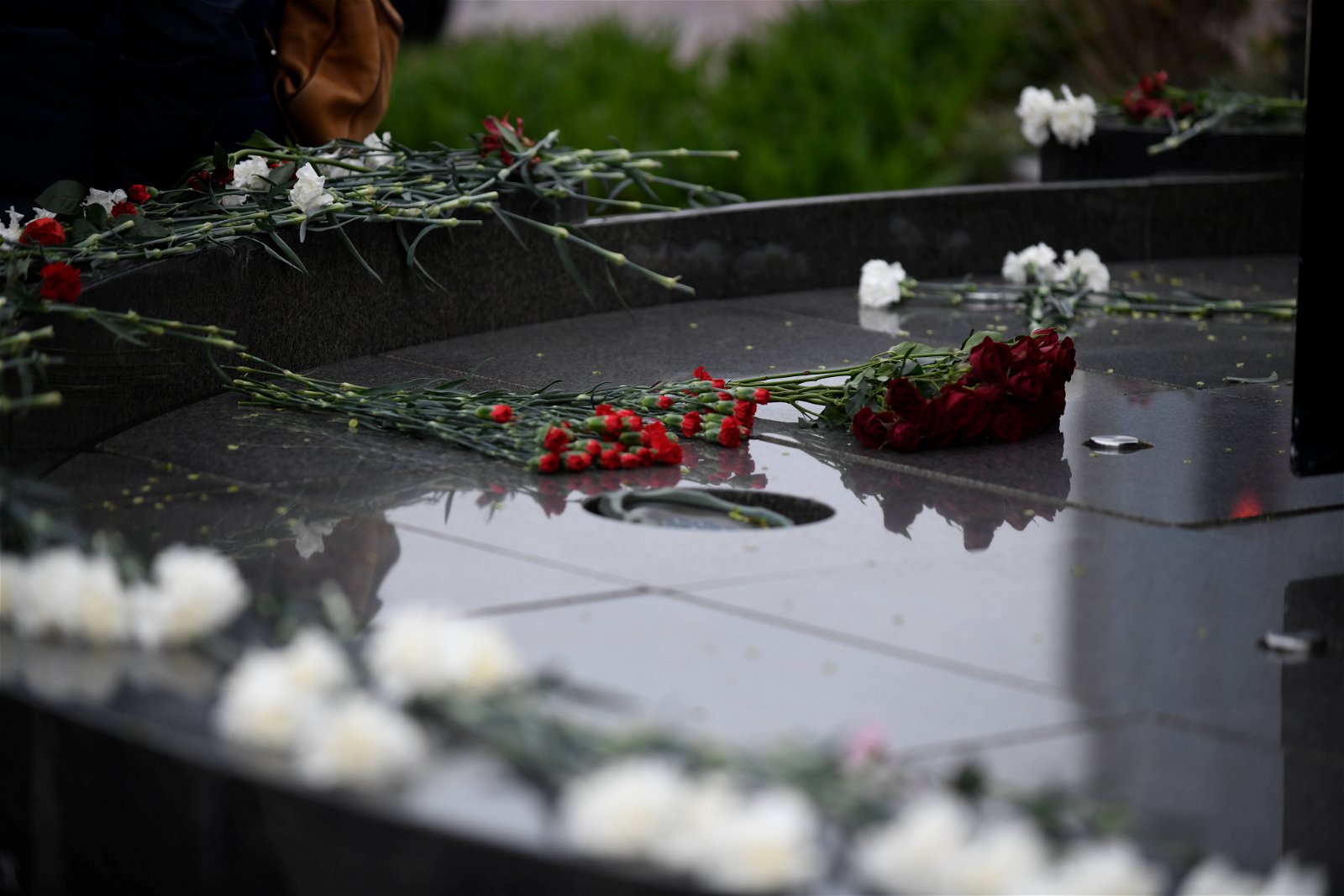
Flowers laid at the Armenian Genocide memorial at Heritage Park in Boston, April 20, 2024 (Photo: Ken Martin)

Decades later, on every April 24, Armenians all over the world congregate in solemn meditation to pay tribute to the memory of their martyrs and to pledge loyalty to the causes for which they met death.

April 24 is the anniversary of the Armenian martyrdom; however, it must serve a constructive purpose. It should not serve as an occasion to rouse emotions or to fill our hearts with grief and our eyes with tears. The world must find evidence of our determination to live, to create and to thrive spiritually, intellectually, morally, physically and economically, both in Armenia and in the Diaspora.

That is a challenge we must meet with courage, conviction, enthusiasm and understanding. We must pool our resources, coordinate our efforts and economize our existing and potential powers. Disharmony, disunity, refusal or failure to cooperate because of personal and partisan preferences would endanger and provoke irreverence to the memory of our martyrs. 

Furthermore, as descendants of the Armenian martyrs, we are called to support the Armenian Cause with utmost dedication. That means demanding the return of Armenian territories usurped from 1915 to 1923 to their rightful owners, the Armenian people. Turkey occupied Western Armenia and forcibly vacated its native Armenian people. These occupied territories should be returned to Armenia. 

Each Armenian has a responsibility to support the efforts of all institutions and organizations dedicated to that cause. Every Armenian should be involved in a meaningful and concerted manner.

May the souls of our millions of martyrs rejoice from heaven in our determination to revere their memory by unequaled devotion to the ideals and principles for which they gave their lives. May the memory of the just and the innocent be blessed forever and ever.

Author information

Rev. Dr. Vahan Tootikian

Rev. Dr. Vahan Tootikian

Rev. Dr. Vahan H. Tootikian is the Executive Director of the Armenian Evangelical World Council.

|

The post April 24, 2024, a day of remembrance and resolve appeared first on The Armenian Weekly.


Categories
South Caucasus News

Germany encourages Azerbaijan, Armenia to carry on with peace process – Trend News Agency


Germany encourages Azerbaijan, Armenia to carry on with peace process  Trend News Agency

Categories
South Caucasus News

Azerbaijan hoping to attract more Chinese investors amid closer economic relations – Global Times


Azerbaijan hoping to attract more Chinese investors amid closer economic relations  Global Times

Categories
South Caucasus News

Armenia and Azerbaijan begin demarcation of common border – CGTN


Armenia and Azerbaijan begin demarcation of common border  CGTN

Categories
South Caucasus News

@emin_bred: Authoritarians like Ilham Aliyev must be defeated


Authoritarians like Ilham Aliyev must be defeated https://t.co/oKQuSw3iF7

— Emin Bred (@emin_bred) April 23, 2024


Categories
South Caucasus News

Azerbaijani President: COP29 will create opportunities for at least consultations among three Southern Caucasian … – APA


Azerbaijani President: COP29 will create opportunities for at least consultations among three Southern Caucasian …  APA

Categories
South Caucasus News

Russian MFA talks on attempts by West to destabilize South Caucasus – Trend News Agency


Russian MFA talks on attempts by West to destabilize South Caucasus  Trend News Agency

Categories
South Caucasus News

New Border Posts Installed in Tavush as Armenia Starts Land Handover to Azerbaijan


YEREVAN (Azatutyun.am)—The Armenian government began handing over border areas to Azerbaijan on Tuesday amid continuing protests staged by residents of adjacent communities in Armenia’s northern Tavush province concerned about their security.

“On the basis of geodetic measurements at the border of the Republic of Armenia and the Republic of Azerbaijan, the first border post was installed within the framework of coordinate adjustment works. The work of expert groups of the two countries is continuing,” the government said in a statement issued late in the afternoon.

It also released photographs of the post apparently placed near Baghanis, one of the four Tavush villages that will be seriously affected by Yerevan’s latest territorial concessions to Baku.

Early in the morning, the Armenian military started de-mining the area which was due to be placed under Azerbaijani control. Road police closed a nearby section of a highway leading to the three other affected villages as well as Tavush’s capital, Ijevan. The National Security Service essentially acknowledged that this was done to prevent locals from trying to disrupt the mine clearance.

The de-mining operation sparked an angry demonstration in the nearby town of Noyemberian, which forms a single community with Baghanis and another affected village, Voskepar. A large group of local residents blocked for a few hours the same highway passing through the town. They reopened it after a standoff with riot police.

The protesters were joined by several leaders of a continuing protest at another section of the highway running from the Georgian border to Yerevan. It is located just outside the Tavush village of Kirants. That key road section is also due to be handed over Azerbaijan under the terms of a controversial border delimitation deal announced by Baku and Yerevan last Friday.

The deal calls for Armenian withdrawal from a total of four border areas that were controlled by Azerbaijan in Soviet times and occupied by Armenian forces in 1991-1992. For its part, Azerbaijan seized at the time large swathes of agricultural land belonging to several Tavush villages. Baku has refused to give any of that land back to Armenia.

Many residents of the Tavush villages close to the contested border areas are strongly opposed to the unilateral handover, saying that they would lose access to their existing agricultural land, have trouble communicating with the rest of the country and be far more vulnerable to Azerbaijani armed attacks. Hundreds of them have been blocking traffic through the Kirants road section in protest since Saturday. The blockade continued on Tuesday.

The nonstop protest was joined by people from other parts of Armenia, among them Yerevan-based opposition activists. Also, small groups of other Armenians have briefly blocked other national highways in recent days in a show of support for the Tavush protesters.

Local government officials have also spoken out against Prime Minister Nikol Pashinyan’s decision to make yet another significant concession to Baku. It emerged on Tuesday that seven of them pulled out of a 11-member “working group” formed by Pashinyan’s government at the weekend to deal with practical modalities of the land handover.

In a statement, the Noyemberian community administration said that it will not be involved in the border delimitation efforts because it believes they “carry extremely dangerous risks.”

“In particular, the new border would make important parts of the community’s territory vulnerable and thus pose a significant danger to the community’s population,” it said,
The mayors of the two Noyemberian villages as well as Kirtans and Berkaber discussed the matter with Deputy Prime Minister Mher Grigorian the previous evening at a meeting in Yerevan that lasted for several hours. They came away from the meeting dissatisfied.

“I am very upset with all this,” the Kirants mayor, Kamo Shahinian, told fellow villagers on Tuesday morning.

Not surprisingly, the villagers continued to oppose the border “delimitation” announced by Pashinyan. As one of them put it, “Our school would be just 10-20 meters from the Azeris. How can you send your kids to the school after that?”


Categories
South Caucasus News

Armenia and Azerbaijan move closer to normalizing ties as the first border marker goes up – Yahoo News UK


Armenia and Azerbaijan move closer to normalizing ties as the first border marker goes up  Yahoo News UK