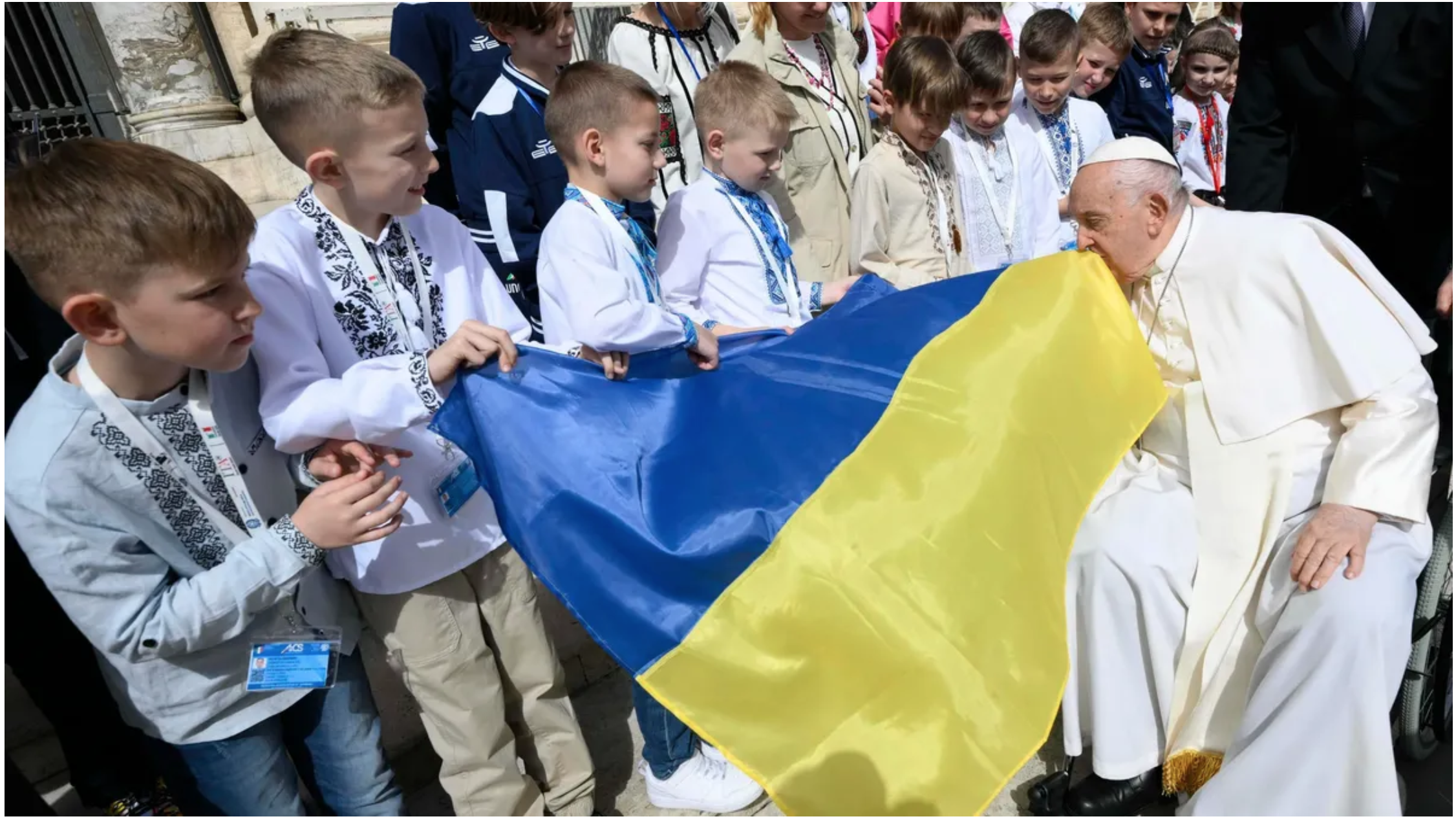
 Pope Francis kisses a Ukrainian flag carried by a group of Ukrainian children attending his weekly general audience in St. Peter’s Square at the Vatican April 10, 2024. The pope prayed during the audience for peace in Ukraine, in the Holy Land and in Myanmar. (CNS photo/Vatican Media)
The Vatican is once again intensifying its efforts on the “Ukrainian track.” “Novaya-Europe” has managed to learn the details of the events planned for May in the Vatican and compare the “Pope’s peace plan” with a corresponding initiative from China.
All Brothers
The Fratelli Tutti Foundation (meaning “All Brothers,” an expression of St. Francis of Assisi, which Pope Francis used as the title of his “programmatic” social encyclical) is hosting the Second World Meeting of Human Brotherhood in Rome on May 11. The main goal of the meeting and seminar is to seek a “creative solution” to end the military actions in Ukraine, in line with the “peace plan of Pope Francis.”
Recently, he has once again been nominated for the Nobel Peace Prize: influential Norwegian politician Dag Inge Ulstein put forward the Pope’s candidacy. Francis has been nominated for this award four times before, but each time the Nobel Committee has favored other candidates. Throughout history, only two Catholic figures have received the Nobel Peace Prize: Mother Teresa in 1979 and Bishop Carlos Belo from East Timor in 1996.
Following the first World Meeting held by the Fratelli Tutti Foundation on June 10 last year, a group of Nobel laureates signed the Declaration of Human Brotherhood, which includes the words: “Together with Pope Francis, we want to affirm that authentic reconciliation does not arise from conflict but overcomes conflict through dialogue and open, honest, and patient negotiations.”
The document bears the signature of Maria Ressa, a Filipino journalist and human rights activist who received the Nobel Peace Prize in 2021 alongside Dmitry Muratov, the chief editor of Novaya Gazeta. According to “Nova-Europa,” Muratov himself is expected to participate in this year’s World Meeting in the Vatican, and his presence is awaited with particular interest.
The events in Rome in May are viewed by the leadership of the Catholic Church as a kind of alternative to the international conference on peaceful resolution in Ukraine, scheduled for June 20-24 in Bürgenstock, Switzerland.
The Fratelli Tutti Foundation has a special mandate that allows it to take on rather delicate functions. On the one hand, it was established personally by the Pope and is headed by his General Vicar for the Vatican City, Cardinal Mauro Gambetti.
On the other hand, it accumulates funds from private donors, which are used to create new platforms to promote Francis’s foreign policy initiatives bypassing Vatican bureaucracy and without the direct involvement of the Vatican state. Peacekeeping meetings in Rome or in countries directly involved in military actions are among such initiatives.
“The courage of the white flag” in the hands of the pope
Despite criticism of the head of the Russian Orthodox Church’s position regarding the Ukrainian Autocephalous Orthodox Church (UAOC), which Francis has spoken out against, the Pope periodically expresses his desire to meet with Kirill. Against this backdrop, various rumors emerge, akin to a planted story from the “Minsk Dialogue” initiative, affiliated with the Lukashenko regime, suggesting that Francis and Kirill may meet this summer in Mogilev. Most analysts agree that such a meeting is unlikely, but the insertion of this narrative fits organically into Lukashenko’s tactic of positioning himself as a mediator between Putin and Zelensky and luring the Pope to Belarus.
After meeting with Putin in Moscow on April 11, Lukashenko stated: “If it is necessary to intervene and mediate in the conversation between Moscow and Kiev, we can help in this regard. But I don’t see the point in you [Moscow] trying to talk to them [Kiev].”
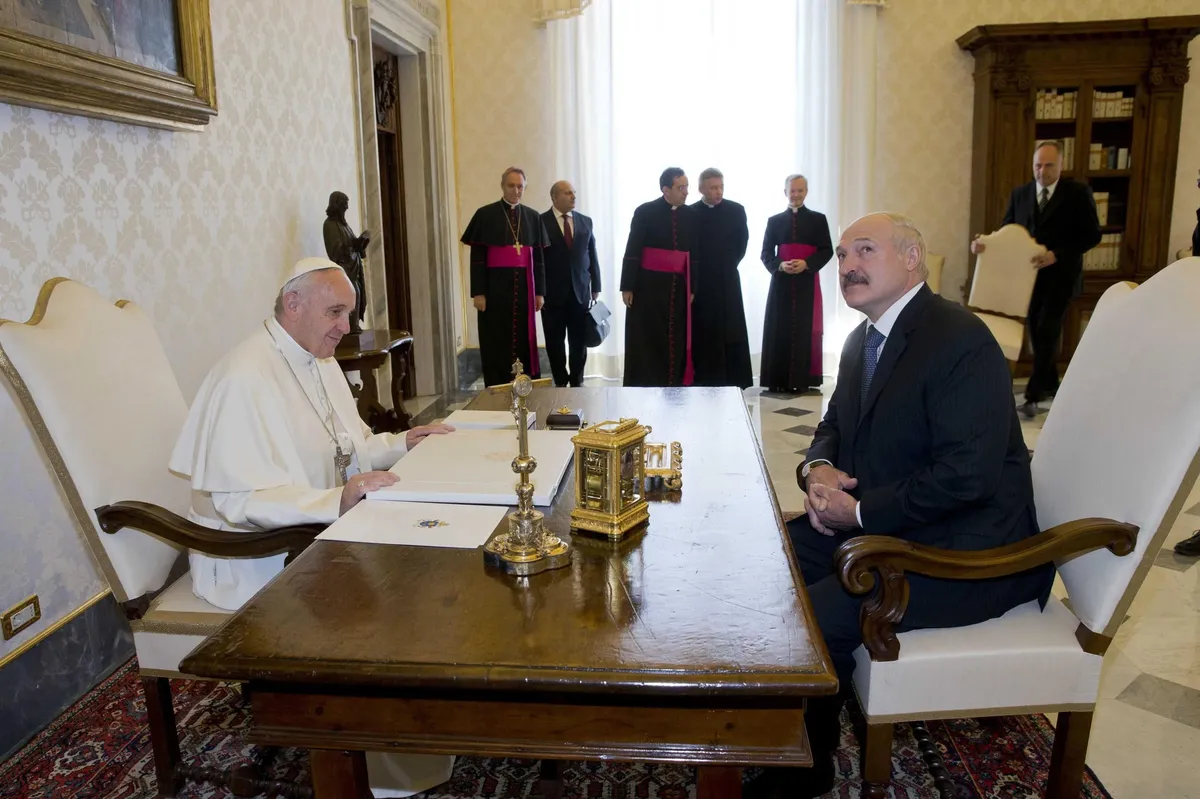 Pope Francis talks with Belarusian President Alexander Lukashenko during a private audience in the Pontiff’s studio at the Vatican on May 21, 2016. Photo by Andrew Medichini / EPA
However, over the past few years, Lukashenko has visited the Vatican twice and met with Popes Benedict XVI and Francis. Almost annually, he invites the pontiff to visit “Orthodox-Catholic” Belarus. But if an ordinary visit at the invitation of the dictator is impossible—despite all his unorthodox ways, Francis is unlikely to suddenly strengthen Lukashenko’s legitimacy—using Belarus as the “only possible” European venue for a meeting between the Pope and the Patriarch is an option the Holy See is ready to discuss.
The radicalization of the rhetoric of the Russian Orthodox Church (ROC), whose representatives, led by the Patriarch, called at a recent congress of the World Russian People’s Assembly to escalate the “special military operation” to the level of a “holy war,” seriously complicates the preparation for such a meeting. Despite Francis’s reverence for Russian culture, such rhetoric is definitely not to his liking.
An even more serious problem is that the Pope is now no longer seen as a mediator in Kiev. His admiration for the “great Russian culture” and statements that people who studied Dostoevsky in school are incapable of doing what happened in Bucha or Mariupol have long been puzzling there.
The Pope’s words from an interview with the Swiss radio and television company RSI about the losing side needing the “courage of the white flag” resonated particularly dramatically in Ukraine. Ukrainian Ambassador to the Holy See Andrii Yurash reminded the Pope in response: “Ukraine is a victim. This is a state that cannot under any circumstances accept the model of raising the ‘white flag,’ because for us, it is a matter of life and death, of our identity.”
Dr. Robert Moynihan, editor-in-chief of Inside the Vatican magazine, recounted to “Nova-Europa” a fragment of Pope Francis’s letter from April 9 to his informal peace envoy in Moscow, the head of the World Union of Old Believers, Leonid Sevastyanov.
The Pontiff indicates that the call for the “white flag” applies to both sides, as his concept is based on the impossibility of achieving victory through military means. Military victory, the Pope once said, “is defeat, because it generates a new chain of conflicts and contradictions.” Based on this concept, he calls on the parties to resume the Istanbul negotiation process “from the point where it was interrupted” at the end of March 2022.
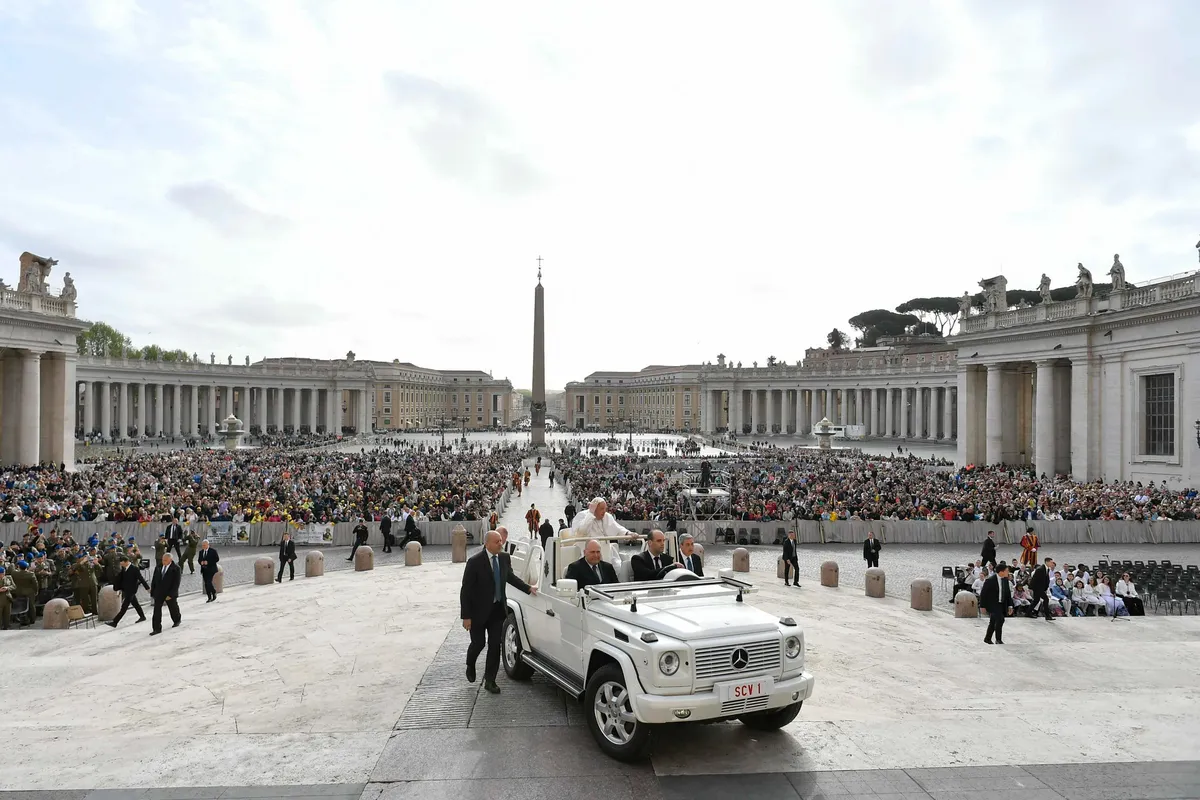 Pope Francis arrives for his weekly audience in Saint Peter’s Square at the Vatican on April 10, 2024. Photo by Vatican Media Pool / EPA-EFE
Is the Vatican an ally of China?
During a meeting with a delegation of Kazakhstani politicians and religious figures in the Vatican on April 4, Pope Francis hinted once again at his anti-Western stance, deeply rooted in Latin American origins: “The rhetoric of war is back in fashion, and it’s repulsive. At a time when words of hatred are spreading, people are dying in cruel conflicts. But we are called to speak about peace, to dream about peace, to fill expectations of peace with creativity and concreteness.”
A source from “Novaya-Europe” in the Vatican revealed that the pope’s special representative for peace in Ukraine, Cardinal Matteo Zuppi, and the Fratelli tutti foundation are making efforts to initiate a new “Vatican peace process” with a meeting mediated by the pope between Ukrainian representative Mykhailo Podolyak and Russian presidential aide Yuri Ushakov.
Moscow and Kiev have not yet confirmed receiving such invitations, but Cardinal Zuppi did visit both capitals and met with the aforementioned representatives. According to Leonid Sevastyanov, as cited by the chief editor of Inside the Vatican, the pope’s dream is to sign a ceasefire agreement at the tomb of St. Peter in the main basilica of the Vatican or at the tomb of St. Paul in the Roman temple named after him. In his opinion, the involvement of the foremost apostles of Christianity will contribute to overcoming the crisis of trust between Russia and Ukraine (and the West in general) that has developed in recent years.
Vatican sources acknowledge a certain similarity between the pope’s peace plan (which has never been fully disclosed, and we can only judge it by individual details revealed by Francis himself) and the Chinese plan unveiled in February 2023.
In particular, both plans acknowledge the unacceptability for Russia of the idea of NATO expansion, and they envision the construction of a joint security system along the Europe-Russia-China axis.
Deputy Permanent Representative of China to the UN Security Council Dai Bing, speaking at a Security Council meeting on April 11, almost echoed Francis’s formula: “In conflicts and wars, there are no winners, dialogue and negotiations are the only real way out of the Ukrainian crisis.” Earlier, Russian Foreign Ministry spokeswoman Zakharova, citing Putin, claimed that Chinese proposals “are in line with Russian approaches,” while Russian Ambassador to the Vatican Ivan Soltanovsky assured that “Russia welcomes the initiatives of the Roman pope aimed at achieving peace in Ukraine.”
As the strength and resources of direct participants in the hostilities wane and the “fatigue” of world public opinion grows, efforts to “pressure the parties” into peace negotiations are intensifying. However, today the positions of the West, China, or Turkey regarding the starting positions for such negotiations are quite different — often diametrically opposed.
The Vatican, relying on its specific status and religious influence, is trying to balance these positions, to find some compromise. But has it not become a victim of the “crisis of trust” that Pope Francis so often talks about, at least from Ukraine’s perspective?