
Day: April 19, 2024
Detained Former Karabakh Separatist Official Begins Hunger Strike, Says Family Radio Free Europe / Radio Liberty
The Armenian pavilion at the 2024 Venice Biennale officially opened to public on April 18.
Attending the official opening ceremony were Daniel Danielyan, Armenia’s Deputy Minister of Educaton, Science, Culture and Sports, Armenia’s Ambassador Extraordinary and Plenipotentiary to Italy Tsovinar Hambardzumyan, Armenia’s Honorary Consul in Venice Sargis Sarukhanyan, sponsors of the pavilion, Vigen Badalyan, Executive Director of the Cafesjian Museum Foundation, and Vigen Badalyan, founder of the Fastex company.
Welcoming the attendees, Deputy Minister Daniel Danielyan emphasized the importance of Armenia’s participation in the Venice Biennale. “This platform is one of the cultural arteries of Europe, where interesting projects are presented. The work of artist Nina Khemchyan is not only about the spiritual, but also about the cosmic, human nature and perception of the world. Nina Khemchyan invites us to think about the past, present and future.”


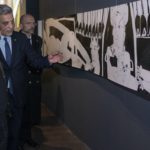

The “Echo” exhibition at the National Pavilion of the Republic of Armenia, conceptualized by Paris-based Armenian artist Nina Khemchyan, melds Medieval Armenian heritage with universal spiritual principles, reconsidered in the realm of nowness. It features two main artworks, deeply interconnected. Influenced by Mesrop Mashtots, the creator of the Armenian alphabet and a key cultural figure, Khemchyan’s work reflects a profound engagement with his legacy.
A crucial element is her encounter with singer Hasmik Baghdasaryan- Dolukhanyan, whose renditions of Mashtots’ fifth-century “sharakans” (sacred chants of repentance) inspired the creation of eleven blue ceramic spheres, each adorned with golden incrustations featuring the texts of these chants. These spheres, alongside Baghdasaryan-Dolukhanyan’s a capella performance, blend sculpture with music, transforming words into visual codes.
The exhibition also includes Khemchyan’s “Seven Deadly Sins,” a 50-metre paper roll divided into segments representing each sin, using black ink on white paper to symbolize moral dichotomy. This work invites meditative reflection, complementing the “Echo” project in exploring themes of human sin and spiritual redemption, which are especially essential and vital nowadays.
Azerbaijanis have completely destroyed the St. John the Baptist Church in Shushi, commonly known as the “Kanach Zham” church.
The Caucasus Heritage Watch, which has been tracking Azerbaijan’s destruction of Armenian religious and cultural monuments reported on its social media page that between December 28 of last year and April 4, the 177-year-old landmark in occupied Shushi was systematically destroyed.
The CHW called the destruction “Azerbaijan’s most egregious violation yet of a December 2021 ICJ order.”
 The Kanach Zham Church before its destruction
As part of an far-reaching ruling the International Court of Justice on December 7, 2021 ordered that Azerbaijan, in accordance with its obligations under the International Convention on the Elimination of All Forms of Racial Discrimination, must “take all necessary measures to prevent and punish acts of vandalism and desecration affecting Armenian cultural heritage, including but not limited to churches and other places of worship, monuments, landmarks, cemeteries and artifact.”
Built by Armenians in 1847, the church, also known as Kanach Zham (Green Chapel), was damaged during the 2020 war. In the aftermath of the war, the Baku diocese of the Russian Orthodox Church laid claim to the building and pledged restoration. Nevertheless, the church is now gone.
At the entrance to the belfry, building inscriptions in Armenian read: “St. Hovhannes Mkrtich Church was built by Shusha townsman baron Hovhannes and Baba Stepanyan Hovnanents in memory of their deceased brother Mkrtich in the year of 1847.”
The United States said that a “military document” prominently featured by Azerbaijan’s state-run Azertac agency is “pure disinformation.”
Azertac published a document of a purported military agreement reached between Armenia, the U.S. and the European Union, Prime Minister Nikol Pashinyan met with Secretary of State Antony Blinken and European Commission President Ursula von der Leyen in Brussels on April 5.
Azertac and later other Azerbaijani media claimed that the alleged document outlined providing military assistance to Armenia by the EU and the U.S.
“This document is pure disinformation,” the State Department said Thursday in response to a request for comment by Azertac.
“Security issues were not on the agenda. We would direct you to the joint press release we put out along with the EU and Armenia following the April 5 trilateral meeting in Brussels,” the State Department added.
“The Brussels meeting with the EU and Armenia focused solely on Armenia’s economic resilience as it works to diversify its trade partnerships and address humanitarian needs, and support for Armenia’s ongoing reforms, including in areas such as democracy and rule of law,” the State Department statement explained.
Armenia’s foreign ministry on Thursday called the purported document featured in Azerbaijan press a “fake.”
Foreign Ministry spokesperson Ani Badalyan said Thursday that there was no “hidden agenda” at the Brussels meeting.
“The meeting held in Brussels was focused on the resilience of Armenia and the diversification of its economy. Too much has been unnecessarily voiced around this topic, and it does not correspond to reality,” she said.
“The complete agenda of the topics discussed in Brussels is set out in the joint press release distributed following the meeting. Any statement made outside the agenda of the press release is false. There was no hidden agenda at the Brussels meeting. The Brussels process has been completely transparent and will remain so,” Badalyan added.
The EU’s foreign affairs spokesperson Peter Stano also dismissed the Azerbaijani media publications, telling Armenia’s Public Television that “the implications made in relation to an alleged document published by some Azeri media are absolutely wrong and inadequate.”
“I can only reinforce what our U.S. and Armenian partners said already on the topic: The trilateral EU-US-Armenia meeting in Brussels on April 5 was about our bilateral cooperation with Armenia with the focus on economic issues. Security was not on the agenda of that meeting. The only official outcome of the meeting is the joint press statement of the participants published afterwards,” Stano said.
Шольц: война в Украине может затянуться еще на несколько лет. При этом, добавил канцлер ФРГ, “ему (Путину) это не должно сойти с рук”. Олаф Шольц подтвердил, что Германия продолжит передавать Киеву военную помощь, но при этом обратил внимание на важность дипломатических усилий.… pic.twitter.com/Wy1rB0qpn0
— DW на русском (@dw_russian) April 19, 2024
