NPR News: 04-18-2024 2PM EDT
Learn more about sponsor message choices: podcastchoices.com/adchoices
 The South Caucasus News - SouthCaucasusNews.com
NATO Secretary General Jens Stoltenberg welcomed the Prime Minister of the Netherlands, Mark Rutte, the Prime Minister of Denmark, Mette Frederiksen, and the Prime Minister of Czechia, Petr Fiala, to NATO Headquarters on Wednesday (17 April 2024).
The leaders discussed the situation in Ukraine and agreed that NATO should have a greater role in coordinating security assistance and training for Ukraine over the longer term. The Secretary General highlighted the important contributions of the Netherlands, Denmark and Czechia: “Yesterday, Denmark announced a major new package of aid. The Netherlands has just announced 4 billion euros in additional military support and the Czech-led initiative is receiving hundreds of millions of euros for more artillery shells for Ukraine.”
Mr Stoltenberg said that this support comes on top of the unprecedented aid already being provided, including F-16s from Denmark and the Netherlands. He welcomed that Germany is also sending an additional Patriot system to Ukraine: “I am also encouraged by indications that the U.S. Congress may take up further aid to Ukraine in the coming days.”
The Secretary General said that Ukraine needs even more from NATO and delays in support have consequences on the ground every day: “That is why if Allies face a choice between meeting NATO capability targets and providing more aid to Ukraine, my message is clear: Send more to Ukraine.”
Bangladesh’s Foreign Minister Dr. Hassan Mahmud and his Greek counterpart, George Gerapetritis, convened a bilateral meeting on Tuesday (April 16, 2024). The meeting took place at the Stavros Niarchos Foundation Cultural Center in Athens, coinciding with the 9th Our Ocean Conference held from April 15 to 17. During this significant gathering, both ministers affirmed their dedication to bolstering bilateral cooperation across various domains, encompassing migration and mobility, trade and investment, shipping, manpower and recruitment, as well as the development of renewable and alternative energy infrastructure.
Greece extended recognition to Bangladesh on March 11, 1972, following the return of Bangabandhu Sheikh Mujibur Rahman, the Father of the Nation, in January of the same year. The two nations share common perspectives on various regional and global issues, fostering a longstanding friendly relationship. Bangladesh and Greece have traditionally maintained amicable ties, with a deep understanding of Greek history and culture prevalent among Bangladesh’s intelligentsia and academia.
Currently, the bilateral relationship between Bangladesh and Greece is significantly influenced by the presence of a substantial number of Bangladeshi expatriates residing and working in Greece. Despite the recent economic downturn in Greece, Bangladeshi nationals continue to contribute to sectors such as agriculture and hospitality, albeit amidst a decreased demand for labor. Over the years, several bilateral visits have taken place between the two countries, aimed at strengthening ties and exploring avenues for cooperation. These visits include engagements by high-ranking officials such as ministers of various portfolios, signifying the commitment of both nations to fostering closer relations. Noteworthy among these interactions was the meeting between H.E. Sheikh Hasina, Hon’ble Prime Minister of Bangladesh, and the former Prime Minister of Greece, Mr. Antonis C. Samaras, during the ASEM summit in Milan in October 2014. During this meeting, discussions centered on enhancing trade and commerce for mutual benefit, with both leaders expressing appreciation for the historical ties between their countries.
Bilateral trade between Bangladesh and Greece has witnessed steady growth, with Bangladesh primarily exporting ready-made garments, frozen food, chemicals, ceramics, jute, and leather products to Greece. Despite existing trade agreements, such as the Agreement on Economical and Technical Cooperation signed in February 1987 and the Protocol on Political Consultations inked in April 2010, there remain opportunities for further enhancing bilateral trade and commerce. Negotiations are also underway for an Agreement on Cultural and Educational Cooperation, with the Greek side proposing an Agreement on Readmission of undocumented Bangladeshis, currently under review by Bangladesh.
In 2022, Greece exported goods worth $64.8 million to Bangladesh, including Raw Cotton, Textile Processing Machines, and Integrated Circuits. Over the past 27 years, Greek exports to Bangladesh have exhibited an annualized growth rate of 8.98%, highlighting the strengthening economic relationship between the two nations. Conversely, Bangladesh exported goods valued at $110 million to Greece in 2022, with notable items being Knit T-shirts, Non-Knit Men’s Suits, and Knit Sweaters. The annualized growth rate of Bangladeshi exports to Greece during the same period stands at 8.19%, underscoring the mutual benefits derived from trade relations. The Bangladeshi community in Greece plays a significant role in contributing to the Greek economy, with many engaged in businesses and small-scale entrepreneurship. Renowned for their discipline and adherence to laws and regulations, Bangladeshi workers in Greece have earned a favorable reputation, leading to their integration into Greek society. Their commitment to learning the Greek language further facilitates their assimilation into the local community.
As Bangladesh endeavors to graduate from the status of a Least Developed Country (LDC) and diversify its economic portfolio, Greece emerges as a pivotal partner in this journey.
However, recognizing the potential synergies between their economies, both ministers on 16 April expressed satisfaction with the existing cooperation and bilateral relations. Furthermore, the Greek Foreign Minister graciously accepted an invitation extended by Dr. Mahmud to visit Dhaka, highlighting the prospect of inaugurating the Greek Diplomatic Mission in Bangladesh’s capital. Acknowledging the significance of this diplomatic gesture, the Greek government reiterated its commitment to establishing a Diplomatic Mission in Dhaka, signifying the importance attributed to bilateral ties.
During the deliberations, Bangladesh’s Foreign Minister emphasized the importance of encouraging Greek businesses to import high-quality Bangladeshi products while urging facilitation of exports from Bangladesh. In response, the Greek Foreign Minister acknowledged the untapped potential in bilateral trade and investment and pledged to explore strategies to stimulate growth in these areas. Both ministers recognized the critical role of the shipping sector in fostering mutually beneficial cooperation and committed to building a robust legal framework to support collaboration in this domain.
Both Bangladesh and Greece occupy strategic positions for maritime trade. Bangladesh sits on the Bay of Bengal, a vital link between Southeast Asia and the Middle East. Greece, with its numerous islands and Aegean Sea access, is a historic maritime hub connecting Europe, Africa, and Asia. This strategic positioning suggests potential for collaboration in transshipment (reloading cargo between vessels) and creating efficient shipping routes. Besides, Bangladesh’s exports are set to sail smoothly with Greece as a partner. Greece controls a whopping 31% of the world’s oil tankers, 25% of bulk carriers, and significant shares in other cargo ships (LNG: 22%, Chemical/Product: 15%, LPG: 11%) (UGS data). This expertise can transform Bangladesh’s shipping industry, allowing them to compete more effectively in global trade.
Furthermore, the meeting underscored the significance of migration and mobility agreements between the two countries. Dr. Mahmud expressed gratitude for Greece’s efforts in legalizing the status of over 10,000 Bangladeshi nationals residing in Greece under the Migration and Mobility Memorandum of Understanding (MoU). He emphasized the importance of smooth implementation of the MoU’s second phase, which is integral to ensuring the welfare of Bangladeshi expatriates in Greece. In response, the Greek Foreign Minister highlighted the contributions of Bangladeshi professionals to Greece’s economy and affirmed Greece’s commitment to recruiting skilled Bangladeshi workers across various sectors, including agriculture, tourism, hospitality, and construction.
The bilateral meeting between Bangladesh and Greece reaffirmed the commitment of both nations to deepening their cooperation across multiple fronts. From trade and investment to migration and mobility, the discussions underscored the mutual benefits derived from collaboration and the shared commitment to harnessing the full potential of their partnership. As both countries continue to navigate the evolving global landscape, their concerted efforts to strengthen bilateral ties serve as a testament to the enduring friendship and strategic partnership between Bangladesh and Greece.
The China-Pakistan Economic Corridor (CPEC) is a flagship project of the One Belt and One Road (OBOR) initiative. It holds the potential to significantly boost Pakistan’s economic growth and development through infrastructure development, trade facilitation, energy projects, industrial cooperation, job creation, regional connectivity, and the development of Gwadar Port.
New Delhi has openly resisted CPEC given the apprehension that Pakistan may possibly use its improved financial assets to augment its military strength and China may employ Gwadar Port as its maritime base supporting its blue-water fleet and accessibility in the Indian Ocean Region along with its proximity to the Persian Gulf and Strait of Hormuz, which could hinder India’s global power ambitions. To India, CPEC is a strategic partnership that is breaching its territorial integrity in Gilgit-Baltistan, an Azad Jammu and Kashmir region, given India’s claim of the entire Kashmir as its integral part.
Tilak Devasher, an Indian ex-bureaucrat with expertise in security matters, authored “Pakistan-The Balochistan Conundrum” post-retirement, motivated by the plight of Balochistan’s people. The book gives insights into the Indian angle of CPEC by targeting its linchpin which is Balochistan. Released in 2019, coinciding with global attention on the region after the abrogation of Article 370 and 35A, the book delves into Balochistan’s historical, ethnic, and militant complexities, portraying it as a puzzle misunderstood by Pakistan’s leadership. It meticulously examines various facets of the Balochistan issue, framing it as a pressing concern akin to the past East Pakistan situation, from an Indian perspective.
Tilak views Pakistan as a military-led state who wants to tackle the Balochistan conundrum militarily ignoring the fact that insurgency is a political issue rather than an issue of law and order. It resembles the situation when a patient is treated by a butcher rather than a surgeon, the former knows one trick and sees things as black and white but the latter understands the complexities of a problem and deals sensitively. The insurgency in Balochistan is locally supported that can never be defeated by Pakistan’s military which can only sustain its control over the troubled province through hard power. In short, he concludes that Pakistan itself is responsible for the Baloch insurgency as the foreign powers and a meager amount of feudal cannot control the entire province.
Contrary to his views, India’s frantic activity against CPEC began in 2015 when RAW allocated over $500 million to a dedicated cell designed to disrupt CPEC projects, as revealed by General Zubair Mahmood Hayat. The very next year a serving Indian naval officer, Kulbhushan Yadav, was captured from the Saravan border area of Balochistan with Iran and confessed, “My purpose was to hold meetings with the Baloch insurgents and carry out terrorist activities with their collaboration.” In November of that year, another eight Indian embassy officials were found engaged in “espionage, subversion and supporting of terrorist activities” along with maintaining contacts with Tehreak-e-Taliban Pakistan (TTP).
Amidst India’s on-ground efforts to destabilize Pakistan, it also disseminated false information for a negative perception building against CPEC using virtual media. European DisinfoLab found Indian-employed clone global supranational organizations associated with UN human rights, pseudo local media outlets, and emulated global think tanks in 2020 generating negative discourse against Pakistan.
The month of March metamorphosed into another haunting chapter of terror, as the region became ensnared in a series of alarming incidents. Heavy clouds stayed in the Northwestern and Southwestern regions of Pakistan from March 16 to 26 with 3 suicide bombings in Khyber Pakhtunkhwa and 2 in Balochistan claiming eighteen lives. The main targets of these attacks were Chinese nationals and infrastructural projects by CPEC while the main suspects were Baloch separatist and Islamist groups.
BLA claimed the responsibility for March 20th (Gwadar Port Authority Complex Housing CPEC Project Offices) and 25th (Turbat Naval Base, Balochistan) attack while TTP and ISKP are the suspects for the March 26th (Shangla, KP) attack. Little do they know that they are just a part of the larger plan that is to hurt the economy of Pakistan. This is a test for the newly formed government of Pakistan where the US, out of its own rivalry with China, is continuously threatening Pakistan with a debt trap while India is sponsoring the twin insurgencies in the region out of its fear of a shift in the balance of power completely in favor of China. DisinfoLab disclosed Indian involvement in deploying Baloch separatist groups as a proxy for aggravating militant activities against Balochistan and CPEC. Indian involvement in state-sponsored terrorism in Pakistan indicates that it’s working on Kautilya’s theory of maximizing power where the vitality of moral principles minimizes among interstate relations.
The Indian lens as depicted by Devasher is a one-sided narration about the Balochistan issue where not even a single sign of hope was seen only to satisfy the thirst of anti-Pakistan elements. One might fear saying that the book was entirely fabricated but it was based on selected knowledge to feed hate for the Pakistan army, eliminating all positive aspects and developments that are happening in Balochistan under CPEC. The writer tactfully absolved the propaganda of external factors aggravating the insurgencies and concentrated on a vendetta against the Pakistani government. Indian narrative, like this book, is full of uninformed accusations portraying Balochistan as being enmeshed with Sectarians, Taliban, and Nationalists without any evidence-based statistics to reinforce the writer’s arguments.
Indonesians have long been an ally of the Palestinians, with the level of public support for Palestine remaining consistently high in light of the recent Israeli-Palestinian crisis. By contrast, the public perception of Russia’s military aggression in Ukraine reveals an entirely different picture, as a certain level of support for Russia was observed among Indonesian social media users.
Positive perception and support for Russia in the context of the Ukraine war stems partly from a coordinated disinformation effort depicting Russia as a cordial ally of Islamic countries, in opposition to Ukraine and the West, which are often portrayed as anti-Islam. These distorted narratives found fertile ground in Indonesia, where some people happen to be predisposed to interpret international conflicts through the lens of religious ideology.
In the context of the Israeli-Palestinian crisis, Russia has been known to exploit Indonesia’s longstanding commitment to supporting the Palestinians by amplifying propaganda that Russia is on the side of the Palestinians, while the Russian government’s official responses to the crisis are mixed. Volodymyr Zelenskyy’s Jewish background, which has already been emphasized to bolster pro-Russian narratives in Indonesia, further complicates this issue. Not surprisingly, some of the most popular pro-Russian narratives in Indonesia are unfortunately mixed with anti-Semitic prejudices. At this point, a counter-narrative is urgently needed.
To maximize the effectiveness of counter-narratives, we may begin by identifying those who are most susceptible to pro-Russian propaganda. Previous research found that those who hold anti-Semitic conspiracy beliefs, i.e., the idiosyncratic belief that a global Jewish conspiracy is working behind the curtain to orchestrate major world events, strongly support pro-Russian propaganda. Some experts suggest that Indonesians’ pro-Russian support emerges as an expression of anti-Western attitudes, but my research shows that participants’ negative feelings toward the “West” have contributed little to explaining their endorsement of pro-Russian narratives.
I wonder if intertwining pro-Palestine and pro-Ukraine stances might change public perceptions of the Ukraine war since pro-Palestine stance is a cause that resonates with Indonesia’s predominantly Muslim population.
I tested this idea by conducting an experiment to determine whether participants would be more likely to sign a petition for peace in Ukraine if the petition included a message of solidarity with the Palestinians.
I designed a simple between-groups experiment in which participants were randomly assigned to one of two groups. To this end, I conveniently recruited 403 Indonesians through social media and instant messaging services, but after quality checks, only 373 participants were included in the analysis. Next, participants were randomly assigned to one out of two experimental groups. One group of 192 participants was shown a petition poster for peace in Ukraine with an additional sentence expressing solidarity with the suffering of the Palestinians (“We also strongly condemn Israel’s atrocities against the Palestinian people”), while the other group of 181 participants was shown a petition poster without this statement.
Participants in both groups were then asked if they were willing to sign the petition, and then, I calculated the probability of signing the petition across the groups. I also measured their propensity to believe in anti-Semitic conspiracy beliefs, as I previously found that harboring this belief was associated with a stronger endorsement of pro-Russian narratives.
My analysis shows that a petition with a statement of solidarity was five times more likely to receive more signatures than one without. The solidarity message seems to work, but the most important question is: Was the solidarity statement persuasive enough for those who strongly hold anti-Semitic conspiracy beliefs? To answer this question, I looked closely at participants with a stronger tendency to endorse anti-Semitic conspiracy beliefs in both groups and compared their likelihood of signing the petition.
Further analysis reveals that for those with less belief in anti-Semitic conspiracies, the decision to sign a peace petition is not really affected by whether the petition mentions support for Palestine or not—most people are willing to sign either way. Yet, for those who strongly believe in anti-Semitic conspiracies, their willingness to sign changes significantly depending on the content of the petition. If the petition does not express support for Palestine, the likelihood of signing drops significantly. But if it does express solidarity with Palestine, they remain much more likely to sign, despite their higher tendency to believe in anti-Semitic conspiracy theories.
It is important to note that the participants in my study were recruited through convenient, non-random sampling. Therefore, my findings are limited to this sample, and generalization to the population may not be warranted. These findings suggest the importance of understanding the characteristics of target audiences and tailoring the message accordingly when countering disinformation. Russia’s propaganda machine has used this playbook by adding layers of local context to maximize the reach of its propaganda abroad. For instance, Russian officials denigrate Zelenskyy’s Jewish roots to elicit sympathy from Western audiences, while declaring their alleged support for Palestinians to persuade people in other countries who condemn Israeli military attacks.
Since last year, an initiative aimed at strengthening ties between Ukrainian and Indonesian Muslim communities has led to a significant development: a delegation from the Religious Administration of Muslims of Ukraine (RAMU) visited the Majelis ‘Ulama Indonesia (MUI), resulting in public support for the independence of Crimean Tatar Muslims. To effectively counter Russia’s strategy of eroding trust and creating division, this high-level collaboration should extend beyond formal visits and agreements. Based on these findings, the counternarratives emphasizing unity and solidarity with the Palestinians, whom Indonesians have traditionally long supported, may work as an effective counternarrative.
Moreover, the findings underscore the role that both the Ukrainian government and its Muslim communities can play in shifting Indonesian public opinion toward a more supportive stance on Ukraine. By tapping into Indonesians’ widespread solidarity with Palestine, Ukrainian Muslim communities can actively engage with their Indonesian counterparts, highlighting the shared values and experiences between Ukrainians and Palestinians, especially in their struggle for sovereignty and peace.
RAMU’s formal visit to MUI is a good start but should be followed by further joint initiatives and strategic communication efforts that showcase Ukraine’s diverse religious landscape and its support for Muslim rights, including those of the Crimean Tatars. By presenting Ukraine’s struggle in a light that resonates with the Indonesian public’s deep-rooted support for Palestine, these actions may pave the way for a broader understanding of Ukraine’s position, challenge pro-Russian narratives, and foster a sense of global Muslim solidarity.

Opening remarks at the Press Conference on the Regional Economic Outlook for Asia and Pacific
Good morning to everyone here in Washington DC, and good evening to everyone in Asia.
Thank you for joining our Press Briefing for Asia and the Pacific. Please allow me to make a few opening remarks.
Let me start with growth.
Growth surprised on the upside in the second half of 2023, as robust domestic demand fueled activity especially in emerging Asian economies. Malaysia, the Philippines, Vietnam, and, most notably, India recorded sizeable positive growth surprises.
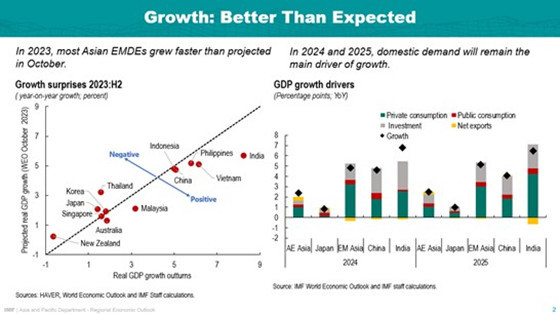
Growth for the region reached 5.0 percent in 2023—much stronger than the growth of 3.9 percent in 2022—and is 0.4 percentage points higher than what we had projected in the October 2023 Regional Economic Outlook.
The momentum carries over into 2024. We now project the region to grow by 4.5 percent in 2024—an upward revision of 0.3 percentage points relative to October. With this, Asia would contribute about 60 percent of global growth. The region is projected to grow by 4.3 percent in 2025.
Now what will drive growth? The answer depends on the country.
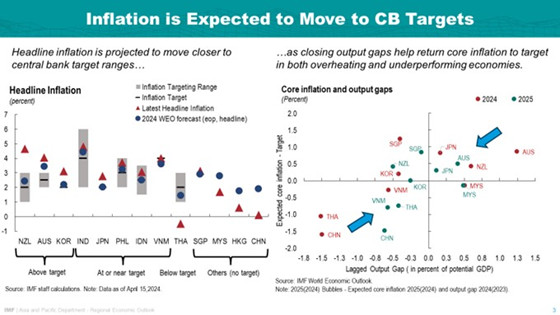
I next turn to inflation, where Asia is ahead of the curve compared to most other regions. Three groups have emerged during the disinflation process.
Going forward, we expect that inflation will converge to central bank targets. But this requires a differentiated policy approach: a tighter-for-longer stance in economies where inflation is elevated, and accommodative macro-policies in economies with sizeable slack.
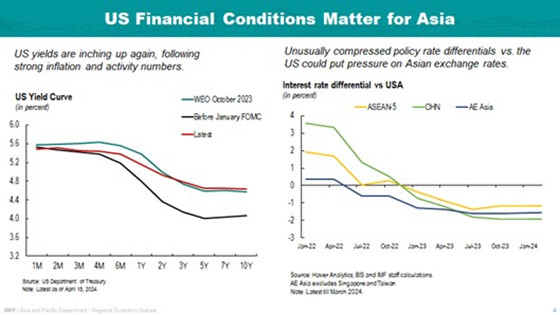
US monetary policy matters for Asia: IMF staff analysis shows that US interest rates have a strong and immediate impact on Asian financial conditions and exchange rates. Expectations about Fed easing have fluctuated in recent months, driven by factors that are unrelated to Asian price stability needs.
We recommend Asian central banks to focus on domestic inflation, and avoid making their policy decisions overly dependent on anticipated moves by the Federal Reserve. If central banks follow the Fed too closely, they could undermine price stability in their own countries.

China’s economy is critical for the region. Recent data have been mixed: GDP for the first quarter surprised on the upside, and March readings for the manufacturing and services PMI were quite strong, while the property sector remains subdued. Amid weak domestic demand, inflation turned negative in late 2023 and early 2024 although it has returned to positive territory in February.
A more protracted slowdown in China would be bad news for the region, for several reasons. One channel is shown in the right-hand chart. Chinese export prices fell in the second half of 2023. This not only puts pressure on the profit margins of China’s competitors, but IMF staff analysis shows that their export volumes can also suffer—especially for countries that produce similar goods to China, such as Vietnam or Korea.
But there is also an upside: robust policy support in China can be good news for the region. For this, not only the amount but also the nature of support matters. For example, measures that are aimed at addressing stresses in China’s property sector can go a long way in restoring consumer confidence and boosting domestic demand. By contrast, policies that boost China’s supply capacity would reinforce deflationary pressures and could provoke frictions.
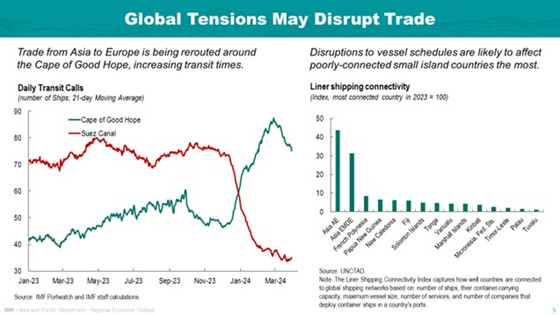
Frictions could also emerge through other channels. For example, global conflict can undermine trade.
As you will be aware, attacks on cargo ships in the Red Sea have forced a re-routing of vessels between Asia and Europe, driving up container prices. Shipping disruptions are particularly detrimental for Pacific Island Countries, which both depend heavily on imports and are poorly connected to global shipping networks.
Such frictions reinforce the impact of trade restrictions that continue to be implemented at a rapid pace, both in Asia and elsewhere. Few regions have benefitted as much from trade integration as Asia—hence geoeconomic fragmentation continues to be a large risk.
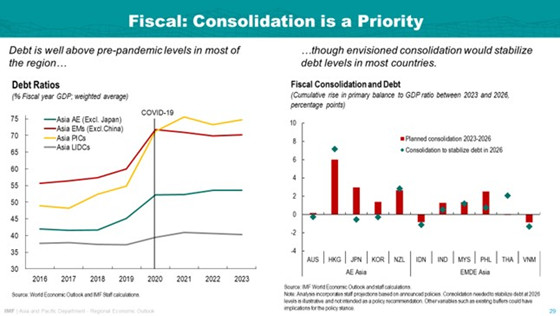
Finally, let me add a word on policies. I have already described the monetary policy challenge. For fiscal policy, we recommend that government focus on consolidation, to curb the rise in public debt and rebuild fiscal buffers.
Our forecasts show that on current fiscal plans, debt ratios would stabilize for most economies, provided governments underpin these plans with concrete policies and follow through on them. But even then, debt would remain significantly higher than before the pandemic.
To reduce debt levels and curtail debt service costs, governments need to collect more revenue and streamline expenditure. Having to pay less on debt would eventually free up budgetary space for spending on development needs, social safety nets, and climate mitigation and adaptation.
Let me close with announcing that our Regional Economic Outlook will be launched on April 30 in Singapore. I look forward to your questions.
