
Categories
South Caucasus News

Khatchig Mouradian’s Eulogy of Henry D. Astarjian


The following eulogy was delivered by Dr. Khatchig Mouradian at Dr. Henry D. Astarjian’s funeral services held at St. Stephen’s Armenian Apostolic Church on April 11, 2024.

When I conjure Dr. Astarjian, it always seems like he just walked to the stage to deliver a rousing speech, or he marched out of a history book—or is about to make history. He is invariably wearing a suit, a bowtie (or a tie), a handkerchief peeking from the pocket of his jacket and a pipe in his hand. (One might even imagine him barbecuing in his suit.) Every word he utters, every move he makes, seems measured and deliberate. Whatever space he steps into becomes his boardroom, his situation room, his banquet hall. 

Dr. Astarjian was always ready for the world. Perhaps it is more accurate to say for the worlds he traversed, and for the many lives he lived during his one lifetime: from Kirkuk and Baghdad to London, New York and New Hampshire; the world of his medical practice; the realm of Armenian, Kurdish and Middle Eastern political commentary; and the world of his family and close friends. 

Dr. Astarjian also led a parallel and no less rich life of the mind. He would spend hours reading in his favorite spot at the house, under his oil paintings depicting the citadel of his birthplace Kirkuk, which he painted in his early teens (in 1947!). For every word he uttered, he read a thousand. There were always several books and newspapers in Arabic, English and Armenian on the side table—history books, newspapers and almost always the biography of a leader. He counseled me to read biographies of prominent figures—he considered them invaluable for shaping one’s character and honing one’s leadership skills.
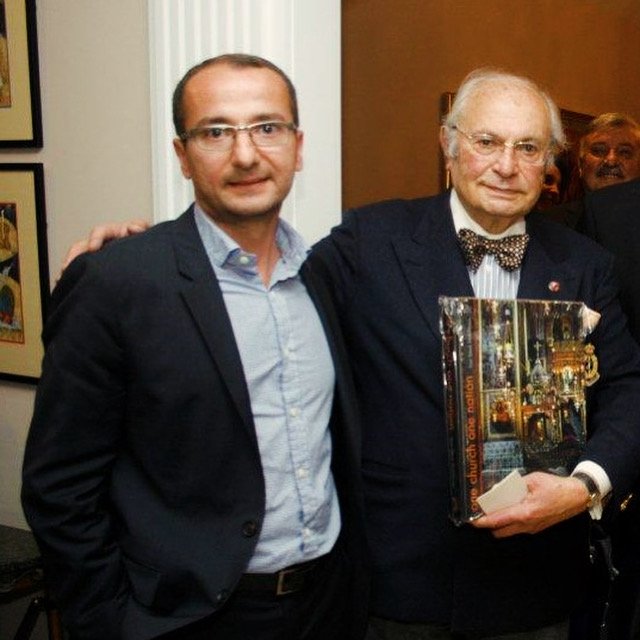
Dr. Khatchig Mouradian and Dr. Henry D. Astarjian

Neurologist, author (of the book The Struggle for Kirkuk: The Rise of Hussein, Oil, and the Death of Tolerance in Iraq, which has been translated twice into Arabic in Beirut and Iraqi Kurdistan), painter, polyglot, orator, three times a speaker in the Kurdish parliament in exile (about the Sevres Treaty and Armenian rights), Republican National Convention delegate from the state of New Hampshire in 1992, the first person to bring a CT scan to their medical practice in New Hampshire, political commentator and columnist (including for the Armenian Weekly), Astarjian was a veritable renaissance man. 

Many people view the world through the lens of losses they suffered, denied opportunities that went to people they deem less deserving, with a sense of victimhood clouding their vision. Not Dr. Astarjian. His time as a political prisoner in Iraq—he spent weeks in incarceration and was subject to terrible acts of torture there—the death of his brother Noreeg at the age of 23 at a checkpoint in Iraq (Noreeg took his last breath in Dr. Astarjian’s arms), and the many trials and tribulations he confronted in the decades since did not make him jaded and did not blunt his sense of humor and good cheer. They only strengthened his resolve.

A child of Armenian Genocide survivors who hailed from Marash, Dr. Astarjian refused to be defined by the crime, and, here too, never subscribed to narratives of victimhood. He believed in struggle, in unflinching demands for justice and had little patience for trifle pursuits that distracted leaders from core issues. Dr. Astarjian’s brand of leadership comprised big ideas and grand projects. He often criticized Armenian community leaders for busying themselves with municipal work—belediyyeyi kordz, he would call it combining Arabic and Armenian. He lamented the tendency among leaders to operate within comfort zones and spaces that offered limited room to maneuver. “This group is swimming on one side of the pool, the other group is swimming on the other side of it,” he would say, outraged by their reluctance to get out of the pool and step into the ocean!

Mind you, Dr. Astarjian did not just share these views with friends and family. He said it from the podium during public events and to the faces of people whose leadership he disapproved of. This should come as no surprise to most of us gathered here to honor his life and legacy. When Dr. Astarjian spoke, he spoke his mind. If you didn’t like what he had to say, tough luck! Sure, he was friendly and jovial in social settings, but conceit and flattery were not his thing. Many people respected him for his opinions, many others dreaded him, but those who tried to cajole him, sweet talk their way to his approval and bend him to their will, were often disappointed.

The Armenian Revolutionary Federation was near and dear to Dr. Astarjian’s heart—and he expected much from the organization. I was always amused by the fact that the license plates on his cars were ARF-1 and ARF-2. I have in my study one such license plate of his from 1991. I joked that he moved to New Hampshire only because the state motto is “Live Free or Die,” which echoes the ARF’s “azadutyun gam mah” (freedom or death)—a perfect combo for his car.
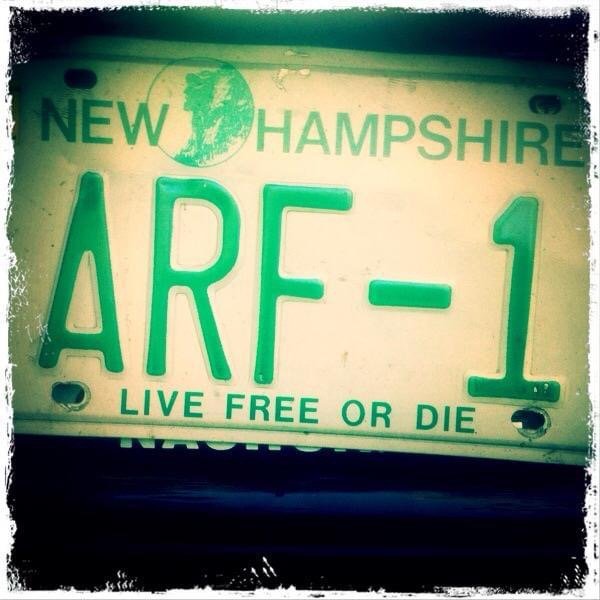
Dr. Astarjian’s license plate from 1991 in Dr. Mouradian’s study

I met Dr. Astarjian when I had just moved to the U.S. in my late 20s. Within weeks, we were fast friends. He (already in his 70s at that point) and his wonderful wife Arev embraced me as one of their own. “Arev is your aunt (morkour),” he declared once, and the title stuck. “Say hello to my aunt,” I would tell him every time before we hung up. 

Hardly a week passed when we didn’t meet for lunch or talk over the phone. “Izzeyyak ya daktor?” (How are you, doctor?) I would ask him cheerfully every time he picked up the phone—an Iraqi Armenian and a Lebanese Armenian greeting one another in Egyptian Arabic! “Zeyyiz zift” (Literally, like asphalt) he would joke with a hearty laughter. When he called, he always opened with “Ya varbed” (boss, in Armenian)—harkening back to the days when he served as a columnist for the newspaper I edited.

The morning Dr. Astarjian passed away, it dawned on me that he was the only person in my circle whom I have never called, or referred to, by their first name. When I spoke to others, he was Dr. Astarjian. When I spoke to him, he was ya Daktor.  

My last conversations with Dr. Astarjian were mostly about family: my personal life, the blessings he felt for having his family—his siblings, his kids and, of course, his wife Arev—around. 

The words Dr. Astarjian used in The Struggle for Kirkuk to describe the loss of his brother Noreeg would perhaps aptly describe what many of us gathered here feel today: Noreeg was no longer “a person whom I could hug, and kiss, and talk to, he was only a precious spirit, whom I could take with me anywhere I want!”

I do not know the dress code in the place from where Dr. Astarjian is watching us right now. But I imagine him, as always, wearing a suit, a bowtie (or a tie), a handkerchief peeking from the pocket of his jacket, and, most likely, a pipe in his hand.

For the memories, for the lessons you taught me, and for the inspiration, thank you, ya Daktor.

Author information
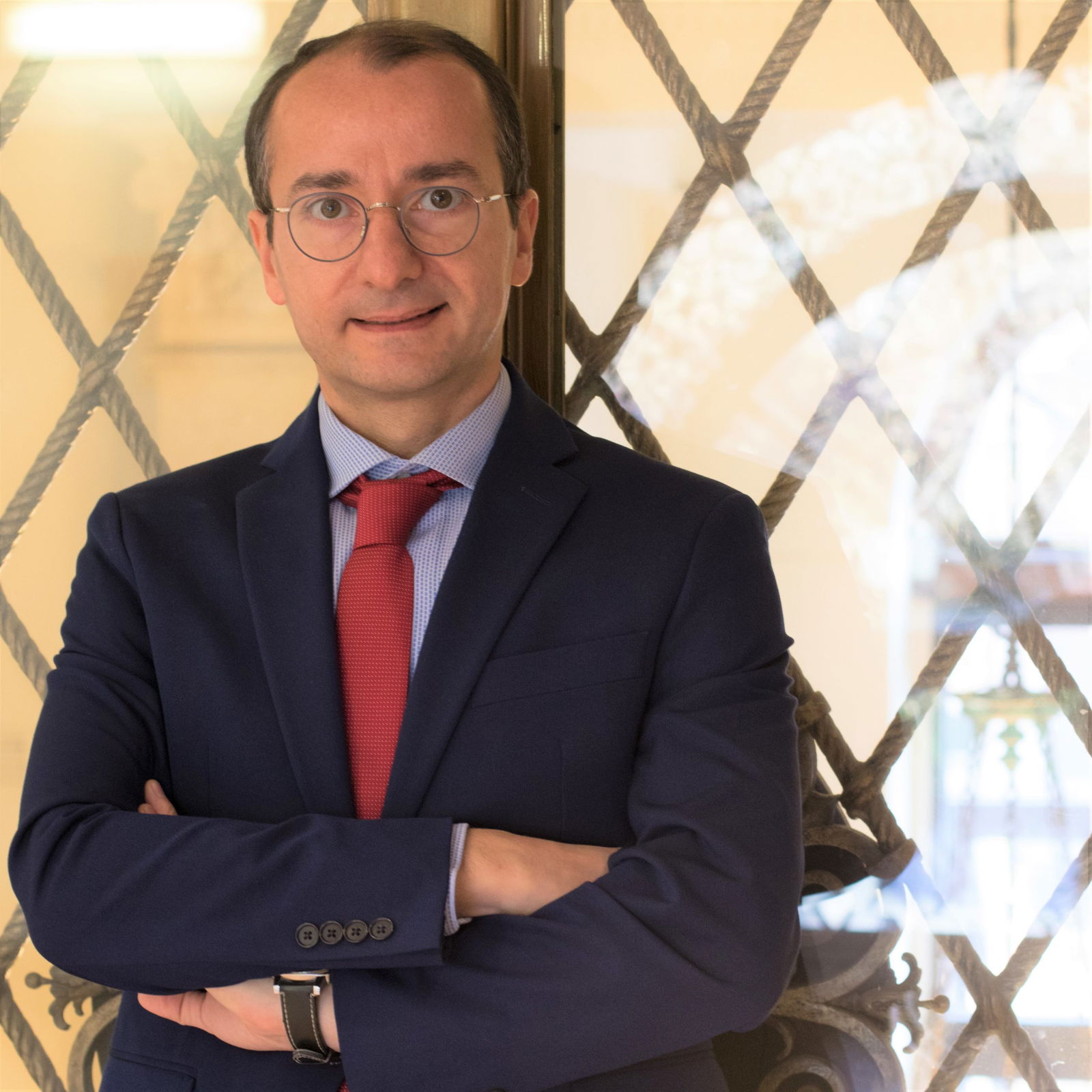
Dr. Khatchig Mouradian

Dr. Khatchig Mouradian

Khatchig Mouradian is the Armenian and Georgian Area Specialist at the Library of Congress and a lecturer in Middle Eastern, South Asian, and African Studies at Columbia University. He also serves as Co-Principal Investigator of the project on Armenian Genocide Denial at the Global Institute for Advanced Studies, New York University. Mouradian is the author of The Resistance Network: The Armenian Genocide and Humanitarianism in Ottoman Syria, 1915-1918, published in 2021. The book has received the Syrian Studies Association “Honourable Mention 2021.” In 2020, Mouradian was awarded a Humanities War & Peace Initiative Grant from Columbia University. He is the co-editor of a forthcoming book on late-Ottoman history, and the editor of the peer-reviewed journal The Armenian Review.

| Twitter |

The post Khatchig Mouradian’s Eulogy of Henry D. Astarjian appeared first on The Armenian Weekly.


Categories
South Caucasus News

“Israel-Azerbaijan relationship relies on unholy trinity of oil, arms and intelligence” – Armenian Weekly


“Israel-Azerbaijan relationship relies on unholy trinity of oil, arms and intelligence”  Armenian Weekly

Categories
South Caucasus News

Why Japan’s Noh theater is cool in Azerbaijan – Nikkei Asia


Why Japan’s Noh theater is cool in Azerbaijan  Nikkei Asia

Categories
Audio Review - South Caucasus News

Smartmatic, One America News settle election defamation lawsuit


Categories
South Caucasus News

Smartmatic, One America News settle election defamation lawsuit


Categories
South Caucasus News

Fourteen detained as protests continue over ‘Russian’ law in Georgia – Euronews


Fourteen detained as protests continue over ‘Russian’ law in Georgia  Euronews

Categories
South Caucasus News

Canada’s Representative Joins EU Monitoring Mission in Armenia


The European Union’s monitoring mission in Armenia welcomed the arrival of a representative from Canada, who joined the effort on Tuesday.

“Thrilled to welcome the first Canadian Expert Alexander Grushevskiy to the EUMA. Canada is the first Third Contributing State supporting the Mission,” the mission wrote in a post on the social media site X, thanking Canada for its “valuable cooperation.”

Canada’s Foreign Minister Mélanie Joly welcomed and applauded Grushevskiy upon his joining the EU mission.

“Returning from my trip last year, a key priority was to explore ways to ensure stability and security in the South Caucasus, including the respect of the territorial integrity of Armenia. We welcome the news of Alexander Grushevskiy as our first Canadian expert to EUMA,” Joly said in a post on X, referring to her visit to Armenia in July, 2023.

It was then that she pledged Canada’s willingness to take part in the EU mission, after having an opportunity to visit the monitoring efforts. At the time official Yerevan welcomed saying it “highly appreciates Canada’s contribution and presence in Armenia for the sake of peace and stability in the region.”

Canada has become the first non-EU country to join the mission.

In February, the EU decided to expand the mission from 138 observers to 209. Last month the Armenian parliament ratified an agreement with the EU on the status of its border-monitoring mission in Armenia, essentially granting diplomatic immunity to EUMA members.

Markus Ritter, the head of EU Monitoring Mission in Armenia meets with Catholicos Karekin II on Apr. 26
On a related matter, the head of the EU mission, Markus Ritter, met with His Holiness Karekin II, Catholicos of All Armenians in Etchmiadzin on Tuesday.

According to a statement from Etchmiadzon, Karekin II expressed his concern regarding the current tension and the security of the people in the border settlements, emphasizing that Azerbaijan’s encroachments and demands pose new security challenges for Armenia, and also endanger the peace negotiation process.

Ritter reportedly briefing the pontiff about the activities of the observation mission and the border situation, assuring that the mission will do everything possible to contribute to reducing border tension and establishing stability in the border regions of Armenia.


Categories
South Caucasus News

Armenia Urges World Court to Charge Azerbaijan with Ethnic Cleansing


Armenia on Tuesday urged the International Court of Justice to hold Azerbaijan responsible for ethnic cleansing of Armenians from Nagorno-Karabakh.

“After threatening to do so for years, Azerbaijan has completed the ethnic cleansing of the region and is now systematically erasing all traces of ethnic Armenians’ presence,” Armenia’s representative, Yeghishe Kirakosyan, said on the second day of hearings at the United Nations’ top court.

“There is no better example of racial discrimination, upsetting peace and security than Azerbaijan’s recent armed aggressions. which resulted in ethnic cleansing of all of Nagorno Karabakh,” he said.

“To the great regret of Armenia and the international community, not even this Court was able to stop Azerbaijan’s race of ethnic cleansing. In September 2023, after starving the ethnic Armenians of Nagorno Karabakh for nine months by blocking the Lachin corridor, in fragrance violation of the Court’s two orders on provisional measures, Azerbaijan launched an unprovoked attack killing hundreds and forcing over 100,000 ethnic Armenians to flee their ancestral homes,” Kirakosyan stated.

On Monday, Azerbaijan told the court that most of Armenia’s complaints related to the armed conflicts over Nagorno-Karabakh did not fall within the scope of the UN treaty.

It also accused Armenia of not genuinely engaging in negotiations before bringing the case to the ICJ.

Kirakosyan rejected these claims and emphasized that “Armenia negotiated with Azerbaijan in good faith and pursued discussions far beyond the point of utility.”

“Armenia has no claims on Azerbaijani territory and is committed to establishing conditions for genuine and enduring peace,” Kirakosyan said.

He declared that Azerbaijan’s efforts “are frivolous and cynical,” adding that Azerbaijan’s inability and difficulting in presenting evidence to the court stems from its non-existence, characterizing it as a “desperate attempt by Azerbaijan to establish equality.”

“History has taught us that genuine peace is built on justice, accountability, truth and reconciliation,” Armenia’s representative stated.

In his presentation, Kirakosyan reminded the ICJ that on September 16, 2021, Armenia initiated proceedings against Azerbaijan, citing the state’s implementation of “an egregious policy of racial discrimination against Armenians by nationality.”

“Azerbaijani children are instructed to hate and kill Armenians through school textbooks. State media actively spread hate speech, and government officials openly advocate for the complete extermination of Armenians. “It’s state-permitted racism,” emphasized Kirakosyan.

He explained that Azerbaijan’s long-standing state policy of racial discrimination reached its zenith when Azerbaijan initiated an aggressive war against the ethnic Armenians of Nagorno-Karabakh, with the stated objective of eliminating and expelling Armenians from their homeland.

Kirakosyan also quoted Azerbaijani President Aliyev’s recent remarks, where he stated that the hatred of the enemy—Armenians—is what propels Azerbaijanis forward.

“For 44 days, Azerbaijani soldiers killed and tortured ethnic Armenians, proudly filming their atrocities…,” Kirakosyan reminded the court. “This violence and intimidation were employed by Azerbaijan to ethnically cleanse the Armenians of Nagorno-Karabakh, resulting in the expulsion of at least 30,000 Armenians from their homeland.”

Kirakosyan added that following these events, Armenia invoked the UN’s convention on stamping out racial discrimination and petitioned the court to promptly safeguard the vulnerable ethnic Armenians who had not yet been killed or expelled from their homeland.

Kirakosyan also noted that the International Court of Justice had ordered Azerbaijan to open the Lachin corridor, but Azerbaijan failed to comply with the court’s decision.

Azerbaijan has not taken any measures to ensure the safe return of those who wish to go back to their homeland after these events,” Kirakosyan stated, referring to the potential return of forcibly displaced Armenians from Nagorno-Karabakh.

He reminded the court that Azerbaijan is systematically erasing the Armenian cultural heritage of Nagorno-Karabakh, underscoring that these circumstances were the basis for Armenia’s application to the court.


Categories
South Caucasus News

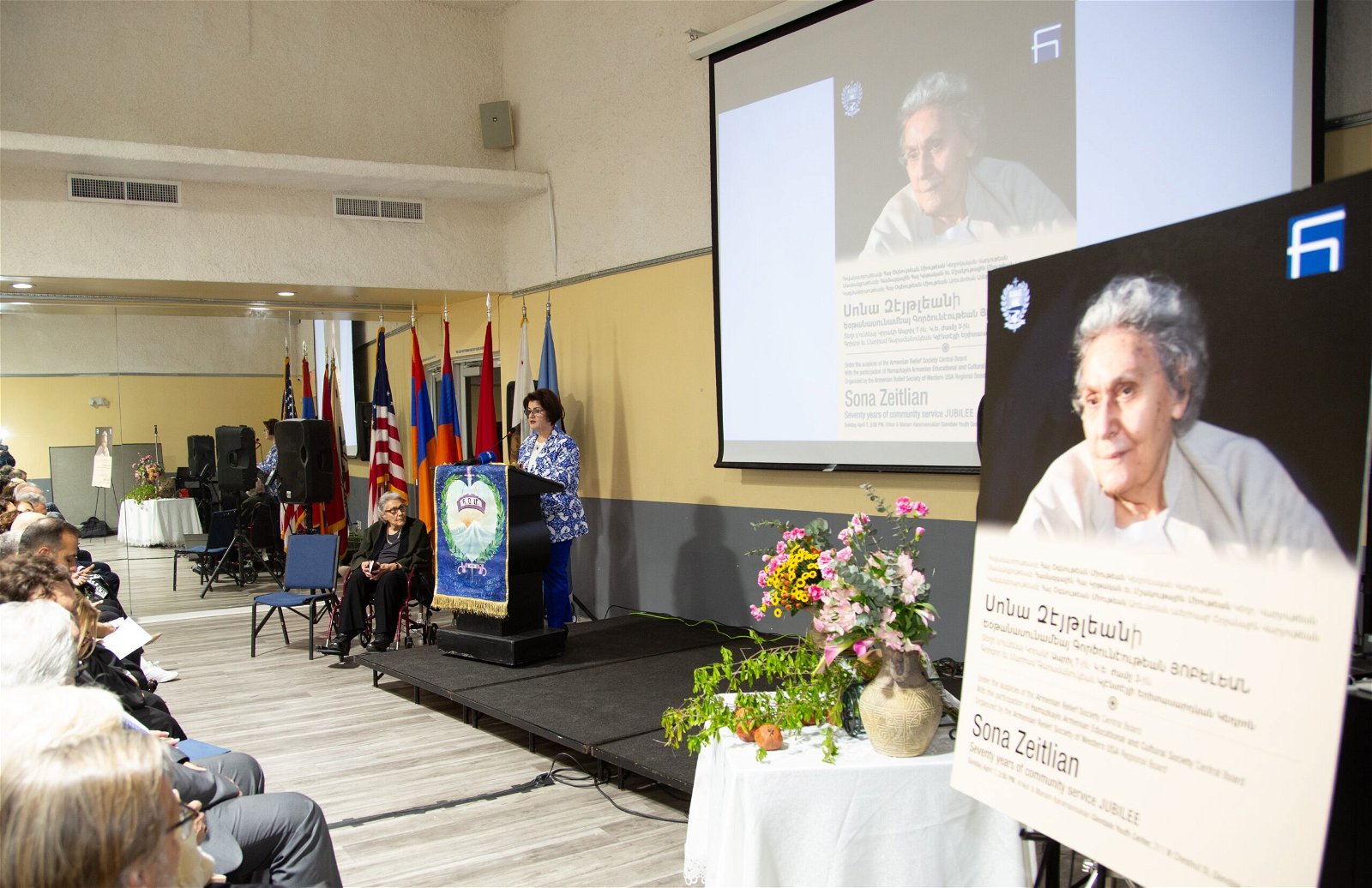
ARS & Hamazkayin celebrate Sona Zeitlian’s trailblazing 70 years of service jubilee


GLENDALE, Calif.—Sona Zeitlian (nee Simonian), educator, ethnographer, historian, award-winning author of Armenian women’s history, ARS member, Armenian women’s studies trailblazer and distinguished author of the history of the Armenians in Egypt, was honored for her 70 years of service jubilee by both Central Executive Boards (CEB) of the Armenian Relief Society (ARS) and the Hamazkayin Armenian Educational and Cultural Society during a program organized by the ARS of Western USA on April 7, 2024, at the Krikor and Mariam Karamanoukian Glendale Youth Center hall. 

Hundreds of attendees came to celebrate Zeitlian’s lifelong achievements, flocking from Egypt, Lebanon, Canada, the Eastern USA and from closer locations across California including Davis, San Diego and the Los Angeles/Orange County basin. The event not only brought the ARS and Hamazkayin families together, but also honoree’s family members, who provided their perspectives and recollections of being associated with an extraordinarily bright thinker who single-handedly preserved oral Armenian women’s history, pioneered the contributions of Armenian women and became herself a role-model heroine.

Opening remarks were made by ARS of Western USA Regional Executive chairperson Vicky Marashlian, who presented Zeitlian’s 70 years of service to the Armenian people as a role model with her wisdom, patience and dedication. Marashlian read a congratulatory letter from author Krikor Beledian of Paris, France. Later, she was joined by Arousyak Melkonian, ARS CEB chairperson, to present commendations from the newly-elected Mayor of Glendale (Calif.) Elen Asatryan and a certificate of recognition from Congressman Adam Schiff, who represents California’s 30th Congressional District.

Western Diocese of the Armenian Church Primate Archbishop Hovnan Derderian’s representative, Rev. Fr. Njdeh Keshishian, read His Eminence’s congratulatory remarks, reminding those present that HH Catholicos of All Armenians Karekin II awarded Zeitlian with a Pontifical Encyclical in 2015.

The program emcee Susanna Davtyan, secretary of the ARS of Western USA Regional Executive and principal of the ARS Glendale “Sepan” chapter “S. Hatsbanian” Saturday School
Sona Madarian, who serves on the Board of Regents of the ARS School, presented the honoree as a teacher, researcher, author and historian who documented the oral history of the elderly Musa Ler survivors who were living in Ainjar, Lebanon and published the first book on the role of Armenian women in the revolutionary movement. She noted that Zeitlian was a trailblazer for Armenian women’s studies, unearthing their historical roles and influence in the political and health realms. Madarian emphasized Zeitlian’s role as a faithful widow, mother and grandmother who persevered almost five decades ago after the loss of her husband, Sarkis, who was an ARF Bureau member.

Award-winning architect, poet and political observer Hraztan Zeitlian presented his mother’s unique qualities: her writings pursued a progressive feminist agenda to persuade others to follow her lead; her 1968 book about Armenian revolutionary women paved the way for the establishment of the Armenian women’s studies field; her research on Armenian women was a trailblazer pioneering work; her work presented Armenian women as agents of change, empowering women’s equity and equality; her work evolved into the intersection of women’s issues, community and civil society; her cultural ethnology studies were accessible and purposeful with social and political aims; and she advocated self-organization for the Diaspora communities for the development of the Armenian character.

The program was emceed by Susanna Davtyan and included soloist Haykuhi Babakhanian’s performance of two folk songs as well as a performance by a dozen of the ARS Sepan (Glendale) Chapter’s Salpe Hatzbanian Saturday School students of the “Grateful Animals,” a children’s story written by Zeitlian based on the oral traditions of the women of Musa Ler (Musa Dagh). A video message from Prof. Talar Chahinian of the University of California Irvine (UCI) Center for Armenian Studies explained how Zeitlan’s pivotal books and papers on Armenian women were the forerunners of Armenian women’s studies programs. She added that her public presentations and workshops have pioneered a model for advocacy for women’s rights and inclusion. Prof. Chahinian congratulated Zeitlian on her resourcefulness and tenacity in navigating institutional restrictions to accomplish her research advocating for women’s rights. 

Viggo Zeitlian, a high school senior and talented varsity football player, explained how his opinion of his doting grandmother evolved as he and his older brother Kyle became old enough to participate in discussions with her. He explained that her passion for learning and discussing was tangible and exciting, and he feels inspired as the recipient of her tenacity, wisdom and guidance. 

Prof. Heghnar Zeitlian Waternpaugh, an award-winning author who teaches art history at the University of California, Davis, recalled that as a child, she had little idea of her mother’s second life as a scholar. She saw her mother working on papers in the kitchen or at a desk; at the time, the honoree was writing a series of books for teenage readers on Armenian legends, such as Haig Nahabed and Ara Keghetsig. When Waternpaugh was old enough to read those stories, her mother wanted to know how her writing could connect with someone like her. While The Role of Armenian Women during the Revolutionary Movement had been published in 1968 before Waternpaugh was born, it was much later that she realized the importance of that book. When her mother first tried researching Armenian women, even the Armenian men in leadership roles discouraged her from pursuing her subject. While there were no readily available records about women’s role in history, her mother invented her research methods and writing style. 

Zakar Keshishian, CEB chair of the Hamazkayin Armenian Educational and Cultural Society, said that heroes are not just those who die on the front; they are also those who are asked to go to the front, who dedicate their lives to a mission for their community. He described Zeitlian as such a heroine. He asked the other Hamazkayin CEB member, Dr. Dikran Babikian, to join him in awarding Zeitlian with Hamazkayin’s medal of honor for her contributions to literature.

ARS CEB chairperson Melkonian remarked that as ARS volunteers, it is undoubtedly a proud moment to recognize someone like Zeitlian, a heroine in every sense of the word, the likes of whom will rarely come in the history of our nation. Melkonian remarked that Zeitlian has been an exemplary and outstanding ARS member with many years of tireless service to the organization. Her various literary, documentary and research works immortalized Armenian women’s virtues, courage, endurance and patriotism and validated the Armenian mother and grandmother’s role in preserving and disseminating national traditions. Zeitlian brought to life the unknown stories of countless heroines so that they would sound like ringing bell towers and light the paths for future generations. Zeitlian exemplified the embodiment of all those special virtues that she described in her own writings and inspired others to tackle present and future challenges.

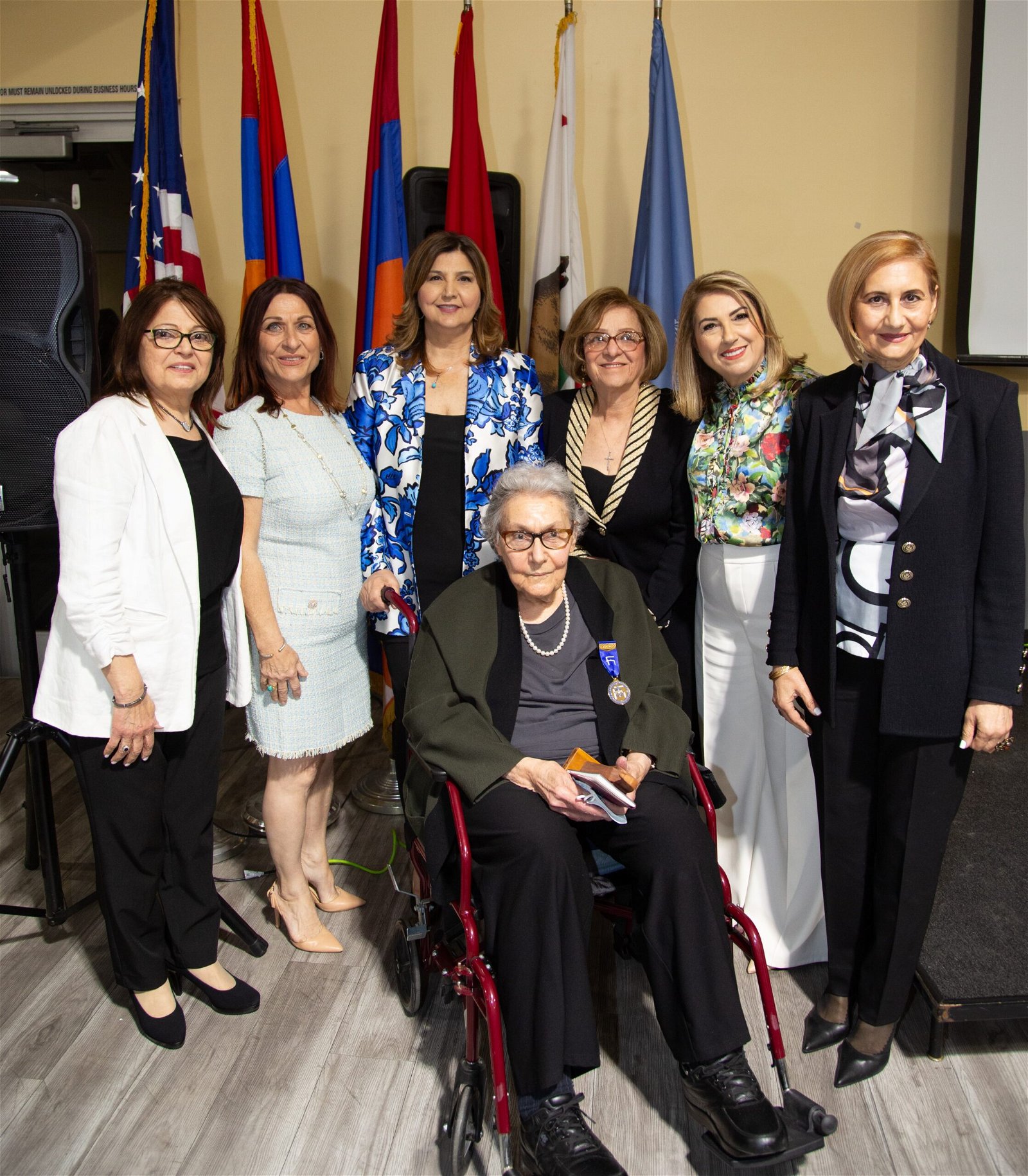
Honoree Sona Zeitlian pictured with (l. to r.) ARS CEB member Annie Keshishian (treasurer), ARS of Western USA Regional Executive members Haigo Barsamian (advisor), Vicky Marashlian (chairperson), Seda Khojayan (advisor) and ARS CEB members Arousyak Melkonian (chairperson) and Zharmen Mirzakhanyan (advisor)

ARS CEB members Annie Kechichian, treasurer, and Zharmen Mirzakhanyan, advisor, joined Melkonian to award Zeitlian the CEB certificate and the Michael Aram commemorative plate with the ARS logo.

Finally, it was time to hear from the honoree herself. Zeitlian thanked the ARS and Hamazkayin executives, her family members who came from far away to attend the gathering, the organizers, attendees and all those who expressed their congratulations in writing, including former students and sometimes their children from Egypt and Lebanon. She noted that throughout her life, from Cairo to Ainjar, from Beirut to North and South America, as well as Canada, she has tried to be helpful for the sake of the advancement of Armenian women and their vital role in Armenia’s heroic history, from the revolutionary movement through the First Republic of Armenia. When she was in Ainjar for the first time, she wrote down the stories that represented the values and beliefs of the people of Musa Ler who were displaced from their homeland. She aimed to communicate their legacy to the generations living away from the homeland, instilling pride in their identity. She got involved with women’s organizations by delivering lectures related to social and domestic issues and the protection of women’s rights in the homeland and diaspora. Her solitary work, which began in the 60s, has expanded as programs and courses have been established in women’s studies and the role of women has progressed. Zeitlian reaffirmed her belief that collectively Armenians can strive for the advancement of Armenian women and the common good. 

Following the program’s end, the excitement continued as attendees got a chance to meet with the honoree and congratulate her with smiles and bouquets of flowers.

Author information

Guest Contributor

Guest Contributor

Guest contributions to the Armenian Weekly are informative articles or press releases written and submitted by members of the community.

|

The post ARS & Hamazkayin celebrate Sona Zeitlian’s trailblazing 70 years of service jubilee appeared first on The Armenian Weekly.


Categories
South Caucasus News

Illinois communities hold flag raisings to commemorate Armenian Genocide


For the 109th commemoration of the Armenian Genocide, the cities of Waukegan and North Chicago in Illinois held flag raising ceremonies in solidarity with the Armenian community on Tuesday, April 9, 2024. The solemn ceremonies not only honored the memory of the victims of the Armenian Genocide, one of the first genocides of the 20th century, but also the recent genocide committed by Azerbaijan, with the help of Turkey, against 150,000 Armenians in Artsakh.

The ceremony in Waukegan saw the unfurling of the Armenian flag for the second time, symbolizing resilience and remembrance. The Haroian family members were honored as the godfathers to the flag raising event this year. The event gathered over two dozen individuals, including Mayor Ann Taylor.

Master of ceremonies Armen Alexanian led the proceedings, setting a tone of reverence and reflection. Ken Hachikian, representing the Armenian National Committee of Illinois, delivered a powerful address, highlighting the significance of acknowledging historical injustices and standing against all forms of genocide in the present.

Mayor Taylor echoed sentiments of support and solidarity, acknowledging the importance of honoring the memory of those lost to genocide and standing against present-day atrocities. She also expressed thanks for how Armenians have helped and continue to build the Waukegan community.

After the flag blessing by Rev. Fr. Samuel Ajemian and Rev. Fr. Andreas Garabedian, the Armenian flag flew high in Waukegan.

Click to view slideshow.

In North Chicago, approximately 20 individuals, including Mayor Leon Rockingham Jr., gathered to pay homage to those who perished in one of the darkest chapters of human history. Led by long-time community members Artin Dermenjian and Sarkis Peltekian, honored as the godfathers of the flag, the ceremony symbolized resilience and unwavering commitment to preserving the memory of the genocide’s victims.

Alexanian guided the proceedings as the master of ceremonies, and Hachikian from the ANC-Illinois offered his reflections. Mayor Rockingham Jr. read and delivered a proclamation reaffirming North Chicago’s commitment to upholding the values of justice and remembrance. 

The communities of Waukegan and North Chicago came together to commemorate, reflect and reaffirm their commitment to never forget. The flag raising ceremonies served as poignant reminders of the resilience of the Armenians who have endured unimaginable suffering. They underscored the need to confront the past while advocating for a future free from persecution and violence. As the Armenian flag flew high in Illinois, it served as a beacon of hope and resilience, reminding all present of the enduring spirit of those who have suffered and the importance of never forgetting and never again.

Author information

Guest Contributor

Guest Contributor

Guest contributions to the Armenian Weekly are informative articles or press releases written and submitted by members of the community.

|

The post Illinois communities hold flag raisings to commemorate Armenian Genocide appeared first on The Armenian Weekly.