Categories
South Caucasus News

Arman Tsarukyan earns biggest win of his MMA career


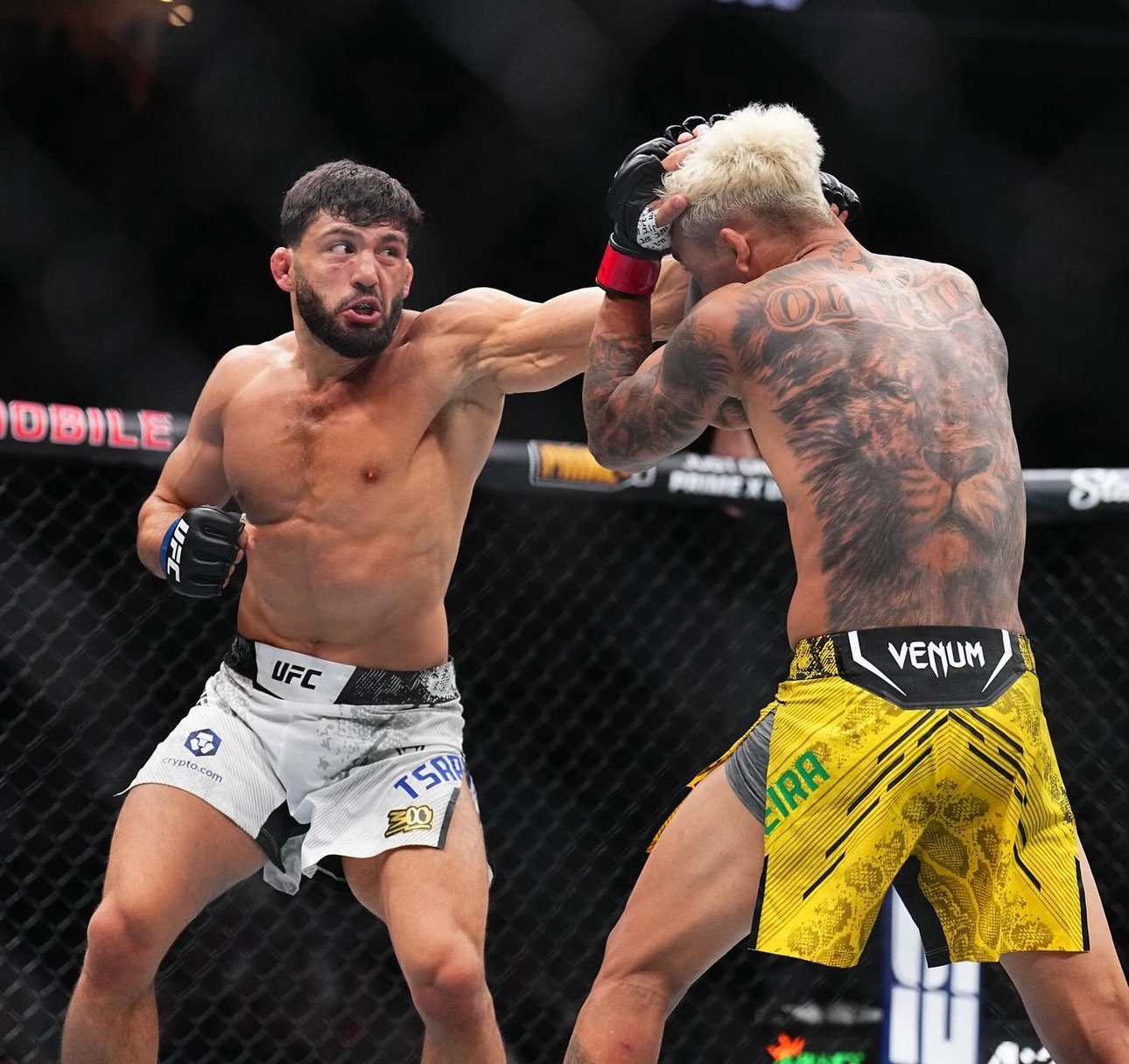
Arman Tsarukyan and Charles Oliveira in the octagon

Arman Tsarukyan has etched his name among the great Armenian mixed martial artists to have graced the Ultimate Fighting Championship.

27-year-old Tsarukyan, who was born in Georgia to Armenian parents and raised in Russia, earned a split decision win against former lighter champion Charles ‘Do Bronx’ Oliveira at UFC 300 in Las Vegas, Nevada on April 13.

The stage was set for a memorable night. Dubbed “the greatest card in combat sports history” by UFC President Dana White, UFC 300 was more than just an event – it was a spectacle. 21 of the 26 fighters on UFC 300 had previously headlined a UFC main event. 12 current and former UFC champions, along with 20 ranked fighters, all stepped into the octagon Saturday night.

Tsarukyan was among the fighters who walked out of Sin City victorious.

Tsarukyan’s fight was scheduled as the second fight of the main card. Following Bo Nikal’s second round submission win over Cody Brundage, Tsarukyan was slated to walk out to the octagon first. As Tsarukyan proceeded to the center of T-Mobile Arena, he appeared to lunge toward a member of the crowd after derogatory language was spewed his way. Tsarukayn was immediately restrained and swiftly continued towards the octagon. He took time to address the quick altercation during his post-fight press conference.

Even UFC President Dana White defended Tsarukyan’s actions: “Yeah you might not want to hang over the thing (rail) and grab people when they’re walking out. These guys are all (expletive) piped up and whatever, and I’m sure we’re probably going to get sued. We’ll deal with that on Monday too.”

The arena jumbotron depicted the Armenian flag, and Tsarukyan walked out to “Yarkhushta,” a traditional Armenian folk song. 20,067 fans filled the arena that night, and Armenian flags were found all over the stands. Despite a pro-Oliveira crowd (seven Brazilian fighters competed on UFC 300), chants of “Arman!” were noticeable from the media row located on the top floor of T-Mobile arena. 

Tsarukyan spoke about what it means to represent Armenia: “When I see Armenian flags, it motivates me a lot, you know, and I get excited. You can imagine how much I want to win when I see Armenian flags, because we are a small country and no one…was in that position where I am now, and I want to bring that belt (to) Armenia (for) the first time in their life.”

The three-round bout began with Oliveira on the attack, ultimately finding Tsarukyan in a headlock that had the rowdy crowd on its feet early. For what felt like an eternity, Tsarukyan was placed in a guillotine choke that turned his face red. Tsarukyan was able to roll off his back, pop his head out of the lock and continue the fight, even securing top position momentarily. Towards the end of round one, referee Mark Smith stopped the fight momentarily when Oliveira landed an up kick to Tsarukyan, until Tsarukyan shrugged off doctors and proceeded. Despite Tsarukyan’s persistence to avoid submission, all three judges scored the first round 10-9 in favor of Oliveira.

The level of respect both fighters had for one another was noticeable throughout the fight. Prior to each round, Tsarukyan and Oliveira embraced one another with a handshake and hug in the center circle before throwing down. Tsarukyan called Oliveira one of the most likable fighters in the UFC: “He is one of the most humble guys in our division. That’s why people like him a lot. I was thinking he was going to right away jump on me, you know, he’s not going to like shake my hand. But like yeah, he did, and he’s such a nice guy and a good fighter and a former champion.”

The second round was all Tsarukyan. To open the round, the fighters exchanged blows before Tsarukyan partially landed an impressive axe kick and followed with a takedown. Oliveira found himself on his back trying to avoid a myriad of combinations thrown by Tsarukyan with his fists and elbows. That offense proved to pay off with Oliveira sustaining a cut to his head. Tsarukyan used a mix of punches, elbows and grappling to keep Oliveira at bay. The three judges gave Tsarukyan a 10-9 advantage in the second round.

With both fighters accumulating 19 points from the judges, the third round would decide the victor (also known as the “championship round”). Tsarukyan and Oliveira put on a show for the thousands in attendance and the millions watching at home. Tsarukyan continued to dominate with his striking while Oliveira ended the final fraction of the fight holding Tsarukyan in another submission lock, sticking his tongue out in celebration of his assumed victory. 

The fight went the distance and landed in the judges’ laps to decide a winner. The judges did not come to a consensus in the final round, so a split decision was needed. Two judges scored the third round 10-9 in favor of Tsarukyan, granting him the biggest win of his MMA career so far. The only judge to score the third round 10-9 in favor of Oliveira was Mike Bell, an American-Armenian.

Immediately following Tsarukyan’s victory, he was offered the fight of a lifetime – a lightweight title shot against Islam Makhachev, the pound-for-pound best fighter in the UFC. 

However, during an interview on The MMA Hour, Tsarukyan explained why he turned down the fight on short notice: “When I left the octagon, right away Hunter [Campbell] came and said, ‘June 1. Islam [Makhachev].’ I said, ‘I got to think.’ Seven weeks left. I can’t jump too fast. I gotta rest a little bit and then have camp. If it was at the end of June, I would take that fight…I want to be ready, and I want to have a full training camp. Why, if I’m the number one contender, why I gotta take the risk?”

Tsarukyan is now 22-3-0 in his MMA career and has won nine out of his last 10 fights in the UFC. It remains to be seen if Tsarukyan will take a different fight in the summer to stay sharp in preparation for a lightweight title fight against the winner of Islam Makhachev vs. Dustin Poirier at UFC 302 in Newark, New Jersey. 

Author information

Jason Takhtadjian

Jason Takhtadjian

Jason Takhtadjian is a reporter, producer and weekend anchor at KCAU-TV in Sioux City, Iowa. Takhtadjian began college pursuing Mechanical Engineering with a focus on Aerospace until deciding to pursue a sports broadcast career after one semester at the University of Nevada – Las Vegas. While at UNLV, Takhtadjian worked on his own weekly radio show/podcast covering soccer and basketball, produced his own sports debate show, was part of the university’s weekly sports show “The Rebel Report” and was the play-by-play commentator for UNLV men’s and women’s soccer and basketball, to name a few. When the COVID-19 pandemic started, Jason was graduating college and had to pivot to the world of general news to land a job. Three years after accepting a job in the middle of the United States with no Armenian community, Takhtadjian accepted a reporter position at KSEE in Fresno, California. The 26-year-old also worked as a contributor for Armenian Sports News, helping grow the page by thousands of followers in less than a year of work.

|

The post Arman Tsarukyan earns biggest win of his MMA career appeared first on The Armenian Weekly.

Categories
South Caucasus News

Court papers show Sen. Bob Menendez may testify his wife kept him in the dark, unaware of any crimes – Boston Herald


Court papers show Sen. Bob Menendez may testify his wife kept him in the dark, unaware of any crimes  Boston Herald

Categories
South Caucasus News

Bob Menendez Poised to Blame His Wife in Bribery Case Defense – Bloomberg


Bob Menendez Poised to Blame His Wife in Bribery Case Defense  Bloomberg

Categories
South Caucasus News

Court papers show Sen. Bob Menendez may testify his wife kept him in the dark, unaware of any crimes – The Seattle Times


Court papers show Sen. Bob Menendez may testify his wife kept him in the dark, unaware of any crimes  The Seattle Times

Categories
South Caucasus News

NPR News: 04-16-2024 7PM EDT


NPR News: 04-16-2024 7PM EDT

Learn more about sponsor message choices: podcastchoices.com/adchoices

NPR Privacy Policy


Categories
South Caucasus News

Yerevan Gave ‘Assurances’ to Tehran, Iran’s Ambassador Says


YEREVAN (Azatutyun.am)—Iran says it has received assurances from Armenia regarding its concerns about the potential escalation of geopolitical competition in the South Caucasus stemming from the Armenian leader’s recent high-level discussions with officials from the United States and the European Union in Brussels.

The Islamic Republic’s ambassador to Armenia Mehdi Sobhani said in Yerevan on Tuesday that Tehran had a discussion with the Armenian authorities about Prime Minister Nikol Pashinyan’s April 5 meeting with U.S. Secretary of State Antony Blinken and European Commission President Ursula von der Leyen which the Western powers said was focused on helping Armenia increase its resilience and diversify its economy, which is still heavily dependent on Russia.

“The Armenian authorities have told us that it is not directed against any third country, that this is just to strengthen the economy of Armenia and to receive humanitarian aid and support for those displaced from Karabakh. Naturally, Armenia’s efforts to develop the economy and solve the problems of the people displaced from Karabakh are not the problem whose solutions we oppose. And this is Armenia’s right to look for ways to develop its economy and solve its problems,” the Iranian diplomat said.

“Our concern is that Armenia and the [South] Caucasus should not turn into an arena for geopolitical rivalry and that the development of Armenia’s foreign relations should not be at the expense of other countries. And the Armenian authorities have informed us that the diversification of their country’s foreign policy is not directed against Armenia-Iran relations,” Sobhani added.

At the press conference, the Iranian ambassador also addressed the question of which are the “extra-regional forces” whose intervention in the South Caucasus is considered dangerous by Tehran.

“If I am talking about extra-regional forces, I am talking about oversees countries, which are not related to any security or geopolitical issues [of the region]. That is, they come here from across the ocean and try to make decisions for the people of this region,” Sobhani said.

Asked whether members of the EU mission who have been monitoring the Armenian-Azerbaijani border since last year are among such “extra-regional forces”, the Iranian ambassador said: “Yes, some European countries and the United States are.”

Meanwhile, the Iranian diplomat said that Tehran’s “red lines” regarding borders in the South Caucasus have not changed.

“Iran has expressed its opposition to the change of internationally recognized borders at the highest level, at the level of the head of the country, and it cannot be ignored. We are categorically against the change of any geopolitical and internationally recognized borders. If there are problems on the border, they should be solved on the basis of dialogue, mutual understanding, with the sovereignty and territorial integrity of the countries respected,” Sobhani said.

The Iranian ambassador to Armenia also spoke about Israel, claiming that it is trying to create tensions between the countries of the region and Iran.

“It is also clear to everyone that one of the factors of instability in the South Caucasus is the Israeli regime. This regime, in addition to trying to develop militarism in the region, also attempts to create tension between the countries of the region and Iran. I believe that the peoples of the region are so prudent that they will never confront any country with such steps as the Zionist regime,” Sobhani claimed.


Categories
South Caucasus News

Armenia Urges World Court to Charge Azerbaijan with Ethnic Cleansing


Armenia on Tuesday urged the International Court of Justice to hold Azerbaijan responsible for ethnic cleansing of Armenians from Nagorno-Karabakh.

“After threatening to do so for years, Azerbaijan has completed the ethnic cleansing of the region and is now systematically erasing all traces of ethnic Armenians’ presence,” Armenia’s representative, Yeghishe Kirakosyan, said on the second day of hearings at the United Nations’ top court.

“There is no better example of racial discrimination, upsetting peace and security than Azerbaijan’s recent armed aggressions. which resulted in ethnic cleansing of all of Nagorno Karabakh,” he said.

“To the great regret of Armenia and the international community, not even this Court was able to stop Azerbaijan’s race of ethnic cleansing. In September 2023, after starving the ethnic Armenians of Nagorno Karabakh for nine months by blocking the Lachin corridor, in fragrance violation of the Court’s two orders on provisional measures, Azerbaijan launched an unprovoked attack killing hundreds and forcing over 100,000 ethnic Armenians to flee their ancestral homes,” Kirakosyan stated.

On Monday, Azerbaijan told the court that most of Armenia’s complaints related to the armed conflicts over Nagorno-Karabakh did not fall within the scope of the UN treaty.

It also accused Armenia of not genuinely engaging in negotiations before bringing the case to the ICJ.

Kirakosyan rejected these claims and emphasized that “Armenia negotiated with Azerbaijan in good faith and pursued discussions far beyond the point of utility.”

“Armenia has no claims on Azerbaijani territory and is committed to establishing conditions for genuine and enduring peace,” Kirakosyan said.

He declared that Azerbaijan’s efforts “are frivolous and cynical,” adding that Azerbaijan’s inability and difficulting in presenting evidence to the court stems from its non-existence, characterizing it as a “desperate attempt by Azerbaijan to establish equality.”

“History has taught us that genuine peace is built on justice, accountability, truth and reconciliation,” Armenia’s representative stated.

In his presentation, Kirakosyan reminded the ICJ that on September 16, 2021, Armenia initiated proceedings against Azerbaijan, citing the state’s implementation of “an egregious policy of racial discrimination against Armenians by nationality.”

“Azerbaijani children are instructed to hate and kill Armenians through school textbooks. State media actively spread hate speech, and government officials openly advocate for the complete extermination of Armenians. “It’s state-permitted racism,” emphasized Kirakosyan.

He explained that Azerbaijan’s long-standing state policy of racial discrimination reached its zenith when Azerbaijan initiated an aggressive war against the ethnic Armenians of Nagorno-Karabakh, with the stated objective of eliminating and expelling Armenians from their homeland.

Kirakosyan also quoted Azerbaijani President Aliyev’s recent remarks, where he stated that the hatred of the enemy—Armenians—is what propels Azerbaijanis forward.

“For 44 days, Azerbaijani soldiers killed and tortured ethnic Armenians, proudly filming their atrocities…,” Kirakosyan reminded the court. “This violence and intimidation were employed by Azerbaijan to ethnically cleanse the Armenians of Nagorno-Karabakh, resulting in the expulsion of at least 30,000 Armenians from their homeland.”

Kirakosyan added that following these events, Armenia invoked the UN’s convention on stamping out racial discrimination and petitioned the court to promptly safeguard the vulnerable ethnic Armenians who had not yet been killed or expelled from their homeland.

Kirakosyan also noted that the International Court of Justice had ordered Azerbaijan to open the Lachin corridor, but Azerbaijan failed to comply with the court’s decision.

Azerbaijan has not taken any measures to ensure the safe return of those who wish to go back to their homeland after these events,” Kirakosyan stated, referring to the potential return of forcibly displaced Armenians from Nagorno-Karabakh.

He reminded the court that Azerbaijan is systematically erasing the Armenian cultural heritage of Nagorno-Karabakh, underscoring that these circumstances were the basis for Armenia’s application to the court.


Categories
South Caucasus News

AP Headline News – Apr 16 2024 19:00 (EDT)


28013281


Categories
South Caucasus News

“Israel-Azerbaijan relationship relies on unholy trinity of oil, arms and intelligence”


The Israeli newspaper Haaretz published on April 11 a revealing article about the extensive high-level links between Azerbaijan and Israel, titled: “How Strategic Relations with Azerbaijan Became the Business of the Lieberman Family.” The article was written by investigative reporter Gur Megiddo.

Avigdor Lieberman is a high-ranking Israeli government official who has made multiple trips to Baku, more than any other Israeli politician, meeting each time with Pres. Ilham Aliyev and other high-ranking Azeri leaders. He served twice as deputy prime minister of Israel and became minister successively at six different ministries: National Infrastructure, Transportation, Strategic Affairs, Foreign Affairs (twice), Defense and Finance.

Lieberman is not the only Israeli official who has traveled to Azerbaijan. Israel’s defense ministers Benny Gantz and Yoav Gallant have also visited Baku, in addition to Prime Minister Benjamin Netanyahu in 2016 and President Isaac Herzog in 2023.

Megiddo stated that “the Israel-Azerbaijan relationship relies on an unholy trinity of oil, arms and intelligence. Israel buys oil from Azerbaijan (about half of Israel’s crude oil originates there), and sells it advanced military equipment. In return, Azerbaijan reportedly gives it access to its land and sea border with Israel’s number one rival: Iran.”

Azerbaijan was victorious in the Artsakh wars of 2020 and 2023, “thanks in no small part to game-changing weaponry supplied by Israel,” including the Israeli Hermes and Harop drones and other sophisticated weapons bought for billions of dollars. “Azerbaijan purchased some of these drones while Lieberman was Defense Minister,” the article says.

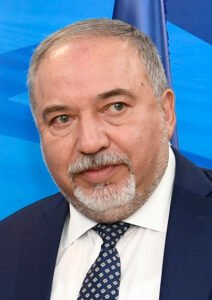
Israeli politician Avigdor Lieberman, 2018 (Wikimedia Commons)

During Lieberman’s visit to Baku in 2012, he was asked about a Foreign Policy magazine article that quoted a senior U.S. government official as saying, “The Israelis have bought an airfield, and the airfield is called Azerbaijan. The names of several former Soviet air force bases were mentioned that, according to the magazine’s sources, were or would be placed at Israel’s disposal in anticipation of a possible airstrike” on Iran. Lieberman called the story “science fiction” that has “no connection to reality.” However, The Times of London reported that the “Israeli espionage agency Mossad has a base in Azerbaijan.”

“By any standard, Azerbaijan is a dictatorship” ranked 130th out of 167 countries by the Economist Intelligence Unit in 2023. A delegation of four Israeli Knesset members led by Lieberman went to Azerbaijan ostensibly to oversee the presidential elections. They dismissed the reports of irregularities in the elections that Aliyev won with a whopping 85-percent. They falsely described Azerbaijan as “the only democracy in the Middle East.” Lieberman called Aliyev’s victory “a good lesson for some forces who, unjustly, criticize Azerbaijan.”

When Israeli-Russian blogger Alexander Lapshin was arrested and jailed in Baku for visiting Artsakh, his family asked then-Defense Minister Lieberman to intervene, but he did not lift a finger, even after Lapshin was attacked by the prison security personnel, trying to kill him. Lapshin believes that the Russians ultimately helped secure his release.

Megiddo reported that Lieberman’s two sons – Amos and Kobi – have a “deep business relationship” with Azerbaijan’s government. “The Lieberman brothers, it turns out, spend a lot of time in Baku, where they are considered intermediaries who know how to open doors to the government. In recent years, Lieberman’s sons have marketed a number of Israeli high-tech products to the government of Azerbaijan: a cyberoffense product made by the cybersecurity company Candiru; a big data system for improving tax collection by another cybersecurity firm, Rayzone; and water desalination technologies by the Israeli company IDE. The potential commissions from brokering these three ventures alone could reach millions of dollars. Additionally, until recently, the Lieberman brothers represented Azerbaijan Airlines (the national flag carrier controlled by the state) in Israel.”

Several Israeli firms like Pegasus and Candiru sold spyware to Azerbaijan to hack the phones of the regime’s opponents. Today, 18 Azeri journalists are in jail. The Candiru sale was mediated by Lieberman’s two sons in exchange for a commission “estimated at hundreds of thousands of dollars.” From a deal with cyber firm Rayzone, they earned “a commission of about $200,000,” according to ‘TheMarker,’ published by Haaretz. Lieberman’s office stated that “he is not involved in his children’s businesses.”

Lieberman’s children also represented IDE Technologies, which is planning on building a large water desalination facility in Azerbaijan. This is “a project whose cost may reach hundreds of millions of dollars – and the commission for the Lieberman brothers would presumably rise accordingly,” Megiddo wrote.

Megiddo wondered: “Do you think the two sons would have attained such significant status with the Azerbaijan government if not for their family connection?” A businessman was quoted as saying: “I can say about the Azerbaijanis that they’re the kind of people who know how to say thank you. If you do good things for them and they appreciate you – they know how to say thanks, both in words and deeds.”

Megiddo concluded: “There’s probably no one within the Israeli establishment who would dispute the many benefits Israel derives from its ugly but perhaps vital relationship with Azerbaijan. But there is no contradiction between these two statements: the warm relations with the morally dubious rule of President Ilham Aliyev can be part of an Israeli national security strategy, and at the same time also part of the Lieberman family’s business strategy.”

Author information

Harut Sassounian

Harut Sassounian

California Courier Editor

Harut Sassounian is the publisher of The California Courier, a weekly newspaper based in Glendale, Calif. He is the president of the Armenia Artsakh Fund, a non-profit organization that has donated to Armenia and Artsakh one billion dollars of humanitarian aid, mostly medicines, since 1989 (including its predecessor, the United Armenian Fund). He has been decorated by the presidents of Armenia and Artsakh and the heads of the Armenian Apostolic and Catholic churches. He is also the recipient of the Ellis Island Medal of Honor.

|

The post “Israel-Azerbaijan relationship relies on unholy trinity of oil, arms and intelligence” appeared first on The Armenian Weekly.


Categories
South Caucasus News

The 115th anniversary of the Adana Massacre


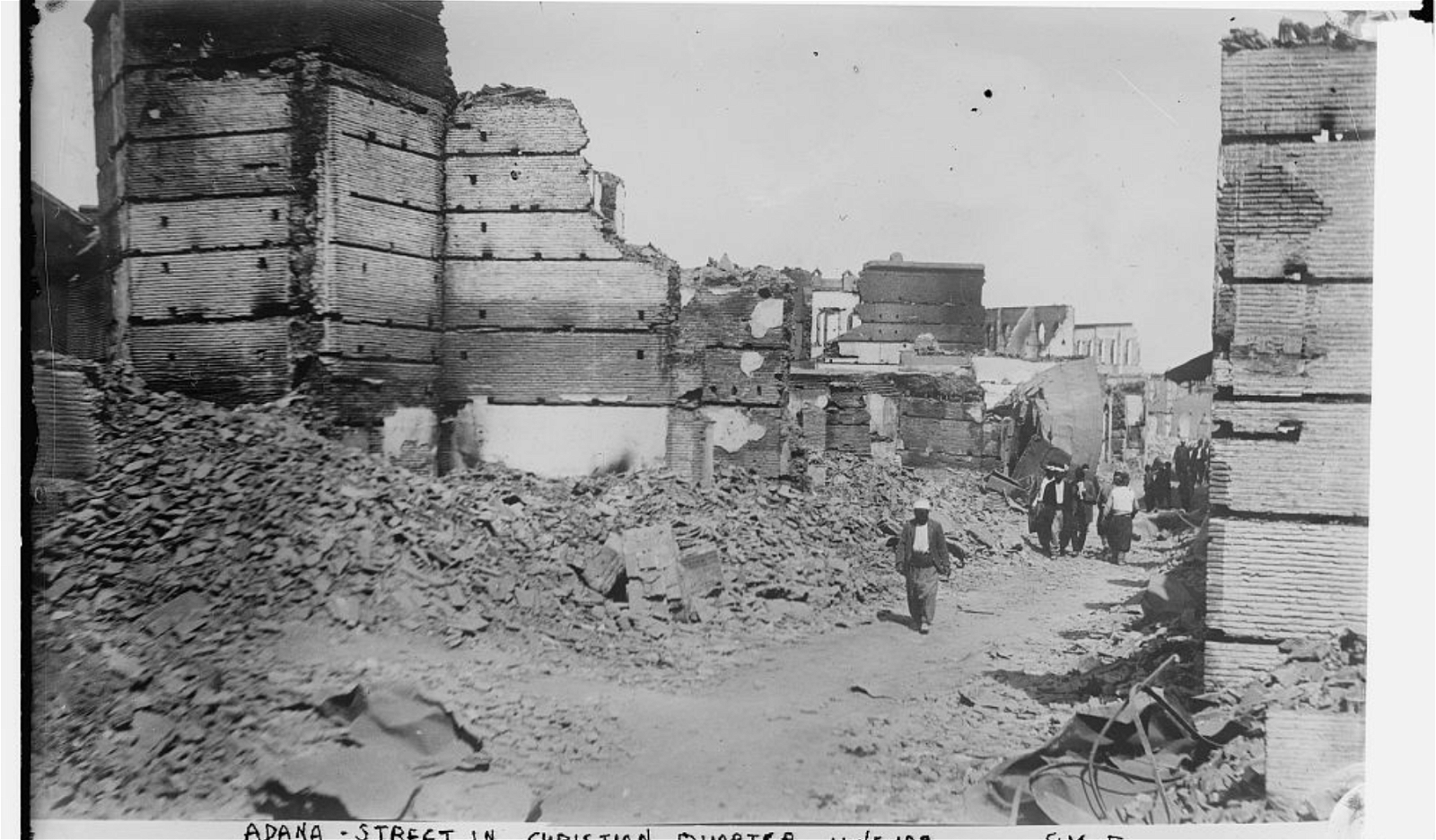
April 2024 is the 115th anniversary of the Adana Massacre, when an estimated 30,000 Armenians were brutally slaughtered.

Prior to the Armenian Genocide of 1915-1923, this was the first large-scale massacre of Armenians in the Ottoman Empire in the 20th century. It started in the province of Adana in April 1909. The atrocities coincided with the counter-revolution staged by the supporters of Sultan Abdul-Hamid II, “The Red Sultan” (1876-1909), who had been forced to restore the Ottoman Constitution as a result of the 1908 Young Turk Revolution led by the Committee of Union and Progress (CUP).

The province of Adana was one of the rich and fertile regions of Cilicia. The most important city of the province was the city of Adana, after which the entire province took its name. Armenians constituted the majority of the city.

The violence was most severe in the city, where about 5,000 Armenian dwellings were torched.  The violence spread throughout the province, and Armenians in smaller outlying towns and villages were slaughtered. All across the Cilician plain, villages were attacked and plundered.

The intensity of the carnage and the strong protest by the surviving Armenian leadership prompted the Turkish government to open an investigation. The Investigation Commission was chaired by Hagop Babigian, a community leader and member of Turkish Parliament. Before the official report was released, Babigian was found dead in his house under mysterious circumstances. The unofficial reports, however, implicated not only the sympathizers of Sultan Hamid II but also the Young Turks. The Young Turks denied the charge, blaming reactionary elements that strove to discredit their regime.

The Christian Quarter in Adana, 1909. Source: George Grantham Bain Collection (Library of Congress)
What was the underlying cause of the massacre? In a nutshell, it was anti-Armenian sentiment nurtured by the Ottoman government. For many years, Armenians in the Ottoman Empire were denied basic human rights of life and liberty.  They openly lamented their plight, appealing to the European nations to intercede with the Ottoman government. The government made promises for reform but did not comply with them. When in 1876 Sultan Abdul-Hamid II ascended to the throne, he abrogated the Ottoman Constitution and introduced a reign of tyranny. 

On June 10, 1908, when members of the Committee of Union and Progress (Ittihad vé Térakki) toppled the Sultan, all minorities in the Ottoman Empire, including Armenians, breathed a sigh of relief. When the Young Turks declared “Liberty and Equality” to all, the Armenians believed that a new day had dawned. The Armenian political parties excitedly welcomed the new regime, some of which wholeheartedly supported it.

Alas, Armenians were naively deceived by the false promises of the Young Turks. The intoxicating enthusiasm generated by the Ittihadist Movement did not last long. Eventually the masks fell, and in the end, the truth revealed that the Young Ittihadist Turks were, in essence, no different than the fanatical Ottoman Turks. The Ittihadists secretly adopted a policy of establishing a Pan-Turanic [Turkish] Empire—a plan that strove towards assimilating into the Turkish mainstreams all the ethnic groups within the empire and forming a centralized government. So, while the tightrope-walking Ittihadists preached liberty and equality on the one hand, they were, on the other hand, formulating plots against the Armenians and other Christian subjects of the empire.

Indeed, not even a full year had elapsed since the Young Turks assumed power when, on April 1, 1909, groups of frenzied mobs attacked Armenians all over Cilicia. Turkish soldiers who were supposed to stop the murderers joined them instead. Within a few weeks, 30,000 Armenians were mercilessly slaughtered. 

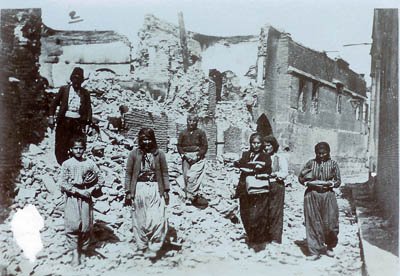
Armenians of all persuasions suffered great losses. Besides human loss, churches, schools, clubs and even homes were burned and plundered. 

Armenian survivors of the Adana massacres at the ruins of their houses. (Photo: The Armenian Genocide Museum-Institute)
Unfortunately, the government of the Young Turks did not deal with the massacre seriously; it simply went through the motions. The fact is that the government was implicated in this terrible catastrophe. No wonder this pogrom became only a prelude to the Armenian Genocide of 1915-1923.

Today, 115 years have passed since the tragic events of the Adana Massacre, and we still remember and commemorate this sad event. Why? We remember our martyrs, because the suffering of our people is an integral part of our identity that cannot be erased. We remember them to emphasize the fact that acts of violence will not be forgotten, and we, the living, have a responsibility to speak out on the wrongs of the past as well as the wrongs of the present.

Furthermore, remembering our martyrs, we, the descendants of the survivors of the Adana Massacre, are determined not to allow the tyrants to escape the judgment of history. We struggle for justice and demand the Turkish government to admit its responsibility for the crimes committed against Armenians, render reparations to the Armenian people and return the usurped lands to its rightful owners, the Armenian people.

Author information

Rev. Dr. Vahan Tootikian

Rev. Dr. Vahan Tootikian

Rev. Dr. Vahan H. Tootikian is the Executive Director of the Armenian Evangelical World Council.

|

The post The 115th anniversary of the Adana Massacre appeared first on The Armenian Weekly.