
https://t.co/FLt7zMtqsf – The News And Times#NewsAndTimes #NT #TNT #News #Times#World #USA #POTUS #DOJ #FBI #CIA #DIA #ODNI#Israel #Mossad #Netanyahu#Ukraine #NewAbwehr #OSINT#Putin #Russia #GRU #Путин, #Россия #SouthCaucasus #Bloggershttps://t.co/O0SIgLVWzM…
— Michael Novakhov (@mikenov) April 10, 2024
Day: April 10, 2024
Armenian Ambassador briefs Irish lawmakers on Crossroads of Peace initiative – Public Radio of Armenia Public Radio of Armenia – Official Web site
Los Angeles County proclaims Armenian Genocide Remembrance Day – Public Radio of Armenia Public Radio of Armenia – Official Web site
10:16 AM 4/10/2024 – Tweets https://t.co/3JQc6SRWt6 pic.twitter.com/JzkKg2m0P3
— Michael Novakhov (@mikenov) April 10, 2024
Background
On March 27, 2024, a high-level group named “Friends of Armenia Network” headed by the former Danish Prime Minister and NATO Secretary General Anders Fogh Rasmussen published a white paper aiming to “galvanize support for democratic Armenia and promote peace in South Caucasus.” The title of the paper is “Deepening EU-Armenia Relations: More Europe in Armenia; More Armenia in Europe,” and the authors include former prime ministers, European parliamentarians and diplomats.
“Armenia is pivoting to the West,” the paper argues, and the EU has a strategic and value-based interest in supporting this pivot. To succeed, both Yerevan and Brussels need to make a “substantial, long-term strategic commitment in terms of resources, security cooperation, trade relations, and political engagement.” To make this pivot “irreversible,” the EU must grant Armenia “EU candidate status,” which would match Yerevan’s strategic orientation, back up its geopolitical commitments and minimize the impact of Moscow’s reaction to Yerevan by increasing the latter’s resilience.
According to the paper, the EU’s support for Armenia should be divided into three phases:
- First offering candidate status. In parallel, Armenia and the EU must review and update the Comprehensive and Enhanced Partnership Agreement (CEPA) that was signed in 2017. CEPA entered into force in March 2021 with the aim to strengthen democracy, rule of law and human rights and engage in socio-economic reforms in Armenia.
- Second, once Armenia reaches an adequate level of resilience, the EU should deepen its economic ties by negotiating a Deep and Comprehensive Free Trade Area (DCFTA) with Yerevan. Similar agreements have been signed with Georgia, Moldova and Ukraine. The aim of DCFTA is to help countries assess the European Single Market in selected sectors and grant EU investors the same regulatory environment as they have in EU member states. It also offers the country the “four freedoms” of the EU Single Market: free movement of goods, services, capital and people (in the form of a visa-free regime for short-stay travel). If applied, this would help Armenia shift its economy closer to the EU, but in return, Armenia would have to leave the Russian-led Eurasian Economic Union (EAEU), which Armenia is benefiting from for the time being as it builds economic ties with India.
- Third, EU accession negotiations should start to fully bring Armenia into the European club.
For these steps to happen, the EU should offer security cooperation to Armenia, notably through the European Peace Facility and enhanced border management. The main objective is to “increase Armenia’s deterrence, both against Azerbaijan launching another attack and against Russian hybrid attacks.”
The paper also argues that, as Russia’s influence is waning in the region, the EU’s role is expanding, an opportunity the EU should not miss. But this is not an easy task, as the paper identifies three challenges: possible new attacks by Azerbaijan, Armenia’s economic dependence on Russia and increasing hybrid attacks on Armenia. To minimize pressure on Armenia, the EU should act in four areas: security cooperation, border management, the CEPA and resilience.
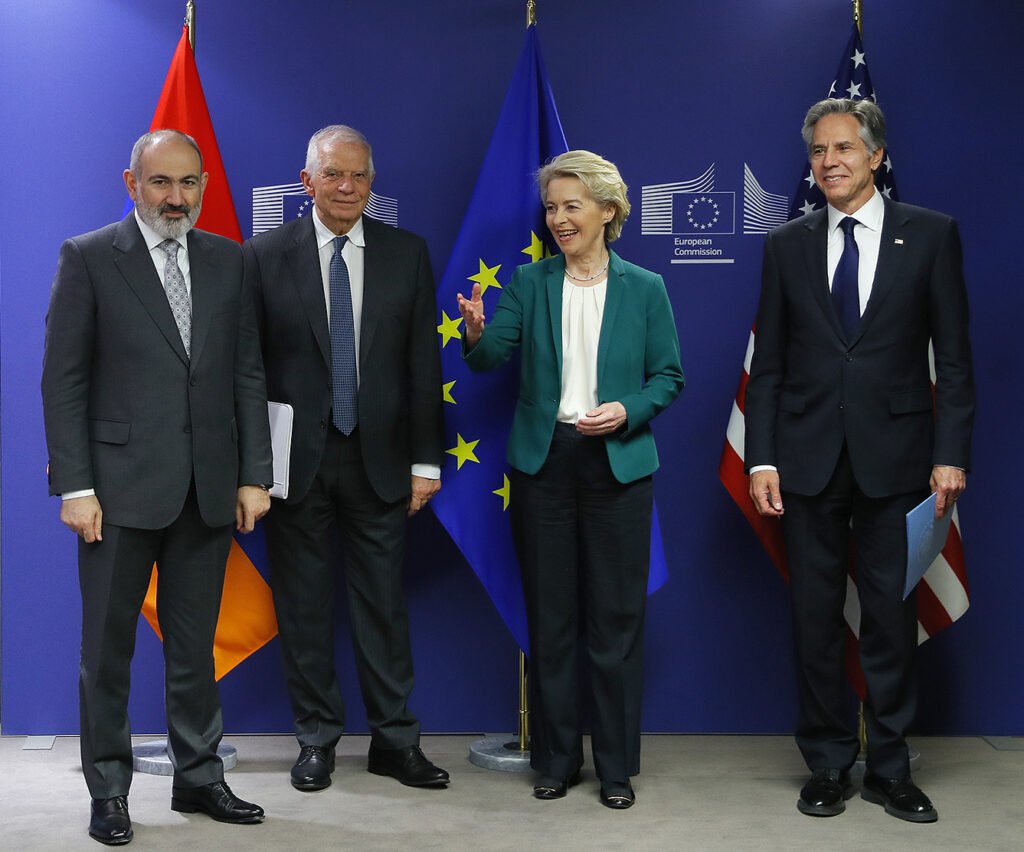 Prime Minister of the Republic of Armenia, Nikol Pashinyan, EU High Representative/Vice-President, Josep Borrell, President of the European Commission, Ursula von der Leyen and U.S. Secretary of State, Antony Blinken meet in Brussels (Photo: RA Prime Minister’s office, April 5, 2024)
Security cooperation
When it comes to security cooperation, the paper argues that Azerbaijan remains the main threat to Armenia, as Aliyev has territorial claims and an appetite for new incursions. Moreover, Turkey has a critical role to play in the “stability and security dynamics of the South Caucasus,” and relations with Armenia “should be raised at the highest levels in Turkey.” The paper adds that the CSTO is inactive in its support for Armenia’s territorial integrity, Armenia’s armed forces need modernization to improve operational and tactical planning, and Russia’s 102nd military base in Gyumri has “no advantage” (quoting PM Nikol Pashinyan) for Armenia. The paper argues that there is a “risk that Russia could try to insert its troops, in the event of an Azerbaijani attack on Armenia, to create a land corridor to Nakhichevan.”
The paper recommends that the EU should provide dual-use and non-lethal equipment to Armenia to increase its deterrence and decrease its dependence on Russian equipment. Such a step would send a signal to both Ankara and Baku that any attack is unacceptable and will be met with additional military assistance from the EU. The authors suggest organizing joint military exercises between European and Armenian armed forces, and the EU should deploy a “Common Security and Defense Policy” (CSDP) advisory and training mission to reform Armenia’s civilian and military security sectors. Finally, the EU must facilitate direct engagement with Turkey to open the border with Armenia and normalize relations, and a high level of dialogue is needed between Yerevan and Ankara, as Turkey’s “interests align but are not identical to those of Azerbaijan” in the region.
Border management
The paper mentions that Armenia’s border management is dependent on the Russian Federal Security Service (FSB), who control the country’s border with Turkey and Iran, which it calls a “major vulnerability for Armenia and a limitation on its sovereignty.” Opening the border with Turkey would “remove the main justification for (Russia’s) military presence.” The European Union Mission in Armenia (EUMA) could play a vital role in the future, while supporting the “Crossroads of Peace” proposed by PM Pashinyan through substantial investment in railways, roads and border infrastructure. The paper argues that the absence of a peace agreement should not hinder such investments.
The paper argues that the EU and Frontex should immediately launch a “comprehensive program to support Armenia in establishing control over its border management.” Frontex officers could work alongside Armenian border guards to carry out surveillance and checks at border crossing points. This would be temporary until Armenia can exercise full and effective control over its borders (a similar approach has been adopted in Moldova). The authors also propose that the EUMA should expand its mission with additional monitors, field offices, technological means (surveillance UAVs, detention radars, cameras and sensors) and geographic scope along the border and close to territory occupied by Azerbaijan.
Strengthening Armenia’s resilience
The paper argues that Armenia’s geopolitical position is exacerbated by external attacks from Azerbaijan, its dependence on Russia and hybrid threats. Providing additional resilience will help Yerevan maneuver and “bolster its pivot Westward.” The paper highlights Armenia’s dependence on Russia in the energy sector (gas and nuclear power plant), transport (Armenia’s railway is managed by a Russian company) and food security (Armenia imports most of its wheat from Russia). Moscow could weaponize trade with Armenia by blocking Armenian products at the Russian border or increasing energy prices.
To increase Armenia’s resilience, the authors forward the idea of inviting Yerevan to become a member of the European Energy Community to accelerate its integration into the European energy market. The EU should help the country invest in green energy and diversify its energy imports and sources, subsidize the food imports headed to Armenia and assist Armenia in being self-sufficient in wheat and critical agricultural products.
Comprehensive and Enhanced Partnership Agreement (CEPA)
The paper argues that Armenia’s membership in the EAEU and its extensive trade with Russia are clear obstacles to deepening EU-Armenia relations. Meanwhile, CEPA can encourage Armenia to adopt judicial and public sector reforms that align with European values. To send a clear signal to Armenia that the EU is committed to its position, Brussels must indicate that it is ready to offer Armenia “candidate status” and deepen economic ties with Yerevan by negotiating DCFTA. In parallel, Armenia should withdraw from the customs union of the EAEU and, eventually, from the block, as membership with the EAEU is incompatible with DCFTA. A final phase in this process would be accession negotiations between the EU and Armenia.
This process will be full of risks, and the EU should be ready to prepare Armenia for a transitional phase when leaving the EAEU by providing a free trade agreement with the EU to reorient Armenia’s economy. Meanwhile, launching an EU-Armenia dialogue on visa liberalization is an important step towards deepening ties and creating additional mutual trust. The paper suggests all these processes must be launched without delay, and “tangible results should be delivered before the European elections and next Commission is established.”
Conclusion and reflection
The main theme of the white paper is that the EU should recognize Armenia’s “strategic shift” or “pivot” towards the West and offer the prospect of EU membership. From a security angle, it also suggests that the EU should prioritize security cooperation, strengthen Yerevan’s deterrence against future attacks launched by Azerbaijan and reorient Armenia’s political and economic relations away from Russia.
But is Armenia pivoting towards the West? Political analyst Gevorg Melikyan argued on CivilNet that the ruling party in Armenia is not shifting the country’s foreign policy vector toward the West, but rather aiming to appease the West by taking an “anti-Russian” attitude to consolidate its rule. The analyst argued that changing a foreign policy vector needs concrete steps far from populist slogans. On the other hand, experts close to the ruling elite suggest that Armenia is indeed pivoting to the West, and Russia’s retaliation against Yerevan would be limited after the loss of Artsakh.
However, regardless of whether or not Armenia is pivoting toward the West, we need to analyze certain gaps in the paper. The arguments made in the paper may seem appealing; however, how realistic is it for Armenia to take such a step, and are the risks calculated? Irrespective of our political position and whether we seek to see Armenia become a member of the European family, such steps will have a crucial impact on the political trajectory of Armenia. Armenia’s decision-makers should not be naïve in fantasizing about theories and concepts and should instead be practical and critically assess every step.
The paper gives importance to Turkey’s active role in the region and suggests engaging in direct dialogue with Armenia to normalize relations and open borders. Refreshing our memory, we should remember that one of the reasons for the failure of the “Armenian-Turkish Protocols” was not only Russia’s opposition but also the lack of EU’s leverage on Turkey, which was unwilling to continue with the process due to the pressures from Azerbaijan and internal political calculations. After almost a decade and a half, we should again ask: does the EU have enough leverage to exercise on Turkey? What would Turkey gain in return? Would Turkey endanger its relations with Russia, Syria, Africa and elsewhere just to please Pashinyan’s government and give oxygen to tiny Armenia? Will opening the border with Armenia compensate for the billions Turkey is making by engaging with Russia?
Of course, Turkey would be happy to fill the Russian vacuum in the region, but is Ankara ready to directly confront Moscow and Tehran in the South Caucasus to please the West? EU’s special representative for the South Caucasus Toivo Klaar mentioned during the recent Antalya Summit that Turkey is a leading country in the South Caucasus that can help establish regional peace. But is Ankara ready now to take this role? For Ankara (and Baku) the main objective is opening the “Zangezur corridor” and connecting both countries with a direct road, without Armenian control. This strategic objective has a geo-economic but also geopolitical background. Is the West able to convince Turkey to step back from this condition? We always assume that we know the answer, but we don’t, and even European leaders don’t.
The paper provides important recommendations for arming the Armenian military and increasing Armenia’s resilience against external threats. This is crucial and, of course, welcome. But again, a critical assessment is needed beyond idealistic emotions and illusions. Modernizing an army, training on new weapons and changing the military education and mentality take time. This is not something that can happen in a few months or a few years. It took Azerbaijan two decades to transform its Soviet-style army into a modern Turkish-standard army. Most importantly, parallel to modernizing its army, Baku established a balanced relationship with its immediate neighborhood, even with Russia and Iran (despite the tense relations with Tehran). Simply, Azerbaijan understood the regional balance of power. You don’t need to be a geopolitical expert to understand that you cannot detach your country from your neighborhood. These are your neighbors, and they will remain your neighbors. What you can do is increase your defense capabilities without antagonizing major regional powers, in this case Russia. As the Europeans have made clear, no army will come to defend an inch of Armenian territory, and no one owes us anything.
Finally, the EU accession talks may take years and even decades. A clear example is Turkey. We should not be very enthusiastic about the EU Commission’s decision to provide candidate status to Georgia. Instead, we have to carefully evaluate every step taken by the EU and Georgia in this matter, as Armenia cannot join the EU before Georgia since it has no border with any EU country. In comparison to Armenia, Georgia has a sea and can communicate with the EU directly. What Armenia can do for the time being is continue diversifying its security and economic relations with the EU and the East. Armenia’s value is in serving as a bridge between the East and West, which countries such as India and Iran appreciate. This idea will be even more attractive to Moscow in the post-Ukraine war era. Armenia’s accession to the EU will be viewed as a political step, given the sharp geopolitical global clash between the West and Russia. Why should Armenia take a side in this battle? Why open a new battlefront when we haven’t even extinguished the fire on our border?
To conclude, the white paper published by the “Friends of Armenia Network” contains important recommendations that need to be addressed and studied. However, some of the clauses contain risks that should be navigated for the time being, given the complex regional and global geopolitical dynamics. Diversifying foreign policy and trade does not mean detaching a country from a certain neighborhood. Instead, what Armenia needs is to balance regional and global competitors and build bridges between traditional and emerging powers. Foreign policies are not guided by idealism and fanciful theories but by realist and rational practices based on assessments of the regional and global balance of power. Ultimately, the aim of the state is to survive, and after the 2020 war, Armenia is waging a battle for its statehood.
Author information
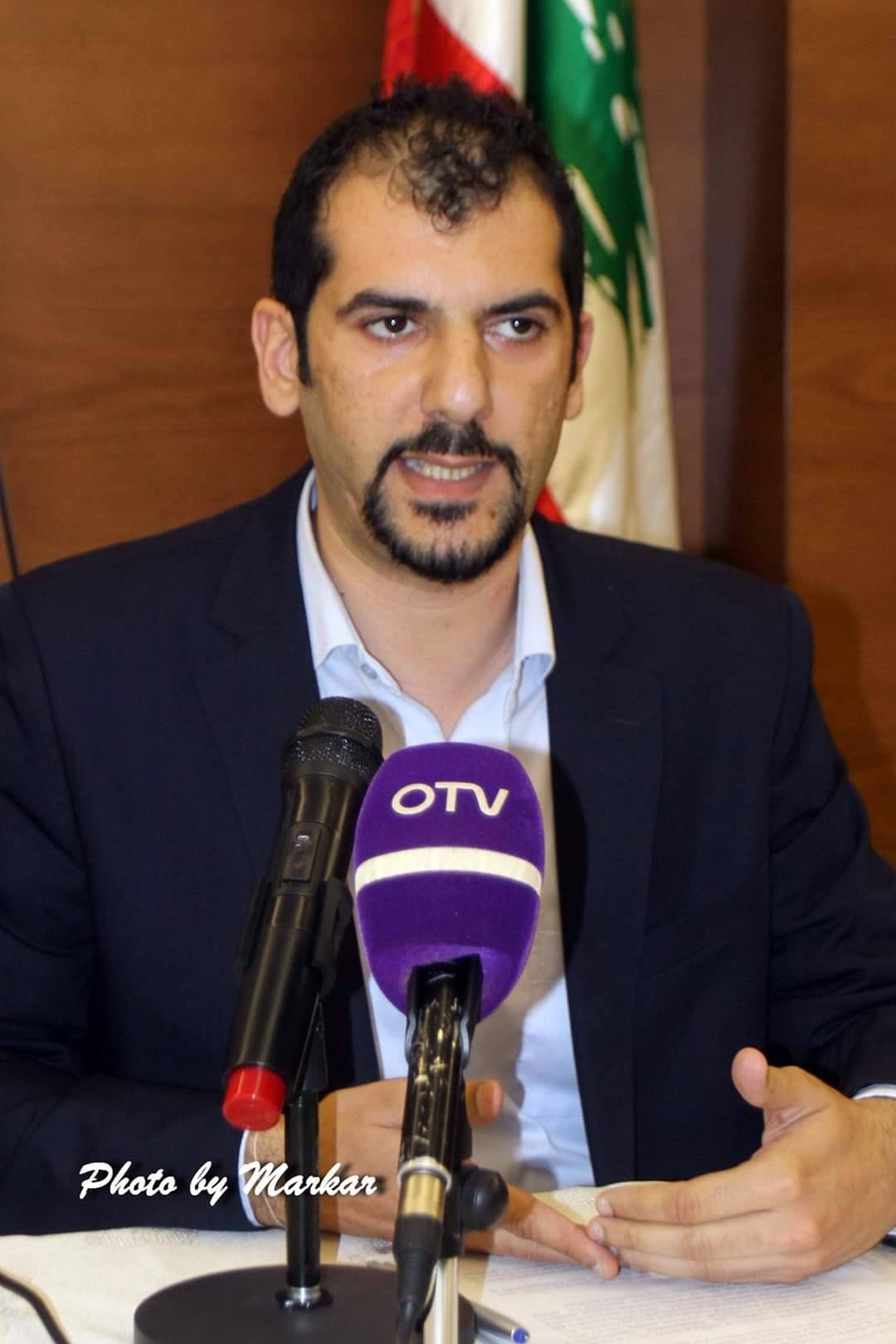
Yeghia Tashjian
Yeghia Tashjian is a regional analyst and researcher. He has graduated from the American University of Beirut in Public Policy and International Affairs. He pursued his BA at Haigazian University in political science in 2013. In 2010, he founded the New Eastern Politics forum/blog. He was a research assistant at the Armenian Diaspora Research Center at Haigazian University. Currently, he is the regional officer of Women in War, a gender-based think tank. He has participated in international conferences in Frankfurt, Vienna, Uppsala, New Delhi and Yerevan. He has presented various topics from minority rights to regional security issues. His thesis topic was on China’s geopolitical and energy security interests in Iran and the Persian Gulf. He is a contributor to various local and regional newspapers and a presenter of the “Turkey Today” program for Radio Voice of Van. Recently he has been appointed as associate fellow at the Issam Fares Institute for Public Policy and International Affairs at the American University of Beirut and Middle East-South Caucasus expert in the European Geopolitical Forum.
| Twitter |
The post A reflection on the “Friends of Armenia Network” white paper appeared first on The Armenian Weekly.
 President of the International Association of Genocide Scholars Dr. Melanie O’Brien
The Connecticut Genocide Commemoration Committee will observe the 109th anniversary of the Armenian Genocide on Saturday, April 27, 2024, at 10:00 a.m. at the historic Connecticut House Chamber at the State Capitol, 210 Capitol Avenue, Hartford CT. The program will honor the memory of the Holy Martyrs of the Genocide and survivors while celebrating the resilience of the Armenian spirit.
The keynote speaker will be Dr. Melanie O’Brien, president of the International Association of Genocide Scholars and associate professor of international law at the University of Western Australia, Perth. She will speak on “Human Rights Violations in the Armenian Genocide.”
Dr. O’Brien is visiting professor at the Center for Holocaust and Genocide Studies, University of Minnesota. Her most recent book is From Discrimination to Death: Genocide Process through a Human Rights Lens and includes extensive research on the Armenian Genocide conducted in Armenia and Turkey.
Dr. O’Brien’s work on forced marriage has been cited by the International Criminal Court. She has appeared before the ICC as an amicus curiae and been an expert consultant for several U.N. bodies. She received a 10-year service medal for volunteering with the Australian Red Cross and was awarded the Filon Ktenidis Award for her work on justice and recognition for victims of genocide. Dr. O’Brien has conducted research across six continents and was recently a Research Fellow at the Sydney Jewish Museum and a Visiting Fellow at the University of Loughborough.
Committee chairperson Melanie Kevorkian Brown stated that the committee is pleased to have someone with Dr. O’Brien’s credentials, breadth of knowledge and understanding of the Armenian Genocide join the commemoration this year.
The mission of the Armenian Genocide Commemoration Committee of Connecticut, in addition to honoring the memory of the one and a half million victims as well as survivors of the Armenian Genocide begun by the Ottoman government in 1915, is to support programs and events, itself or with other organizations, to inform the public and remember the Genocide. It is in the process of establishing a suitable permanent Genocide Memorial. The committee also assists in the legislative mandate to provide Genocide-related curricula in public schools. Additionally, the committee seeks to present information about developments in the Diaspora and in Armenia.
Attorney Harry N. Mazadoorian of Kensington, a longtime member of the committee, noted that this year’s commemoration will be particularly poignant because of continuing and escalated aggressions committed by the government of Azerbaijan in Artsakh, where 120,000 ethnic Armenians have been displaced and where a brutal ethnic cleansing is underway. “The current situation in the region of Artsakh is essentially a continuation of the Genocide as physical aggressions, human rights violations and cultural desecration against ethnic Armenians continue. To make matters even worse, if that is possible, Azerbaijan continues to issue threats against the Republic of Armenia itself,” Mazadoorian said.
Connecticut State Auditor John C. Geragosian of New Britain, a member of the committee, will serve as master of ceremonies at the commemoration. He stated, “While the commemoration remembers atrocities of the past, it also involves condemning genocidal acts of today and averting such actions in the future.”
The program will conclude with the Martyrs’ Service, which was created in 2015 on the occasion of the centennial of the Genocide and the canonization of the Martyrs. Clergy from Armenian churches in Connecticut will participate in the service.
A reception will follow the commemoration. For questions, call 860-651-0629.
Dr. O’Brien will also participate in a program sponsored by the Yale University Program on Genocide Studies on The Genocide Convention in International Courts in New Haven on April 26.
Author information

Guest Contributor
Guest contributions to the Armenian Weekly are informative articles or press releases written and submitted by members of the community.
|
The post International Association of Genocide Scholars President Dr. Melanie O’Brien featured speaker at Connecticut commemoration appeared first on The Armenian Weekly.
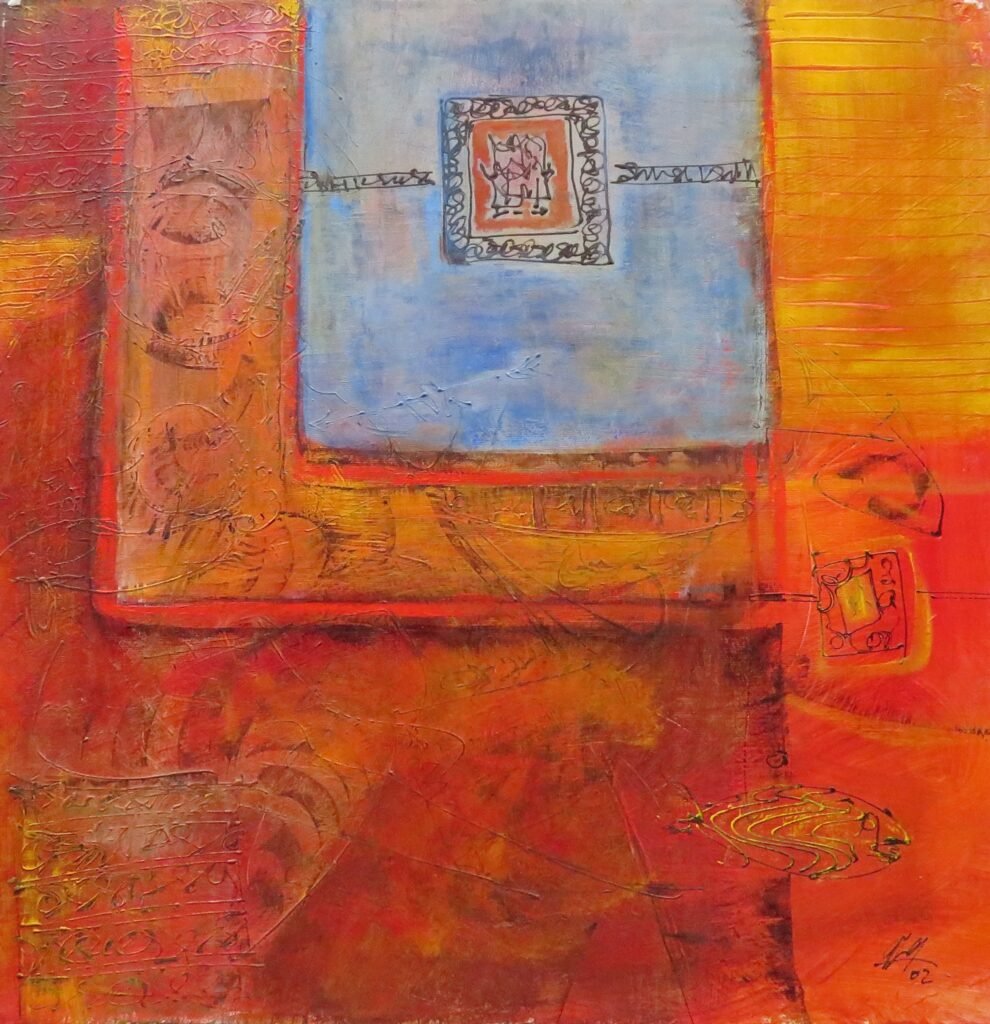 Kevork Mourad (b. 1970), “The Age of the World,” 2002, acrylic on canvas, 18×18, donated by Berge Zobian
WATERTOWN, Mass.—The Armenian Museum of America in Watertown has recently opened its latest exhibition in the Adele and Haig Der Manuelian Galleries, “Gandzaran! Notable Selections from Our Collection.” The show is curated by Ryann Casey and co-curated by Gary Lind-Sinanian and Elias Trout.
“Gandzaran!” showcases 39 works by 24 artists from around the world. It is scheduled to run through August 4, 2024.
In recent centuries, Armenian fine art often focused on illuminations, reliquaries and other pious objects, the most significant of which were secured and hidden in the gandzaran (գանձարան), or treasury, of a monastery. These treasure vaults were designed to protect religious works, which would be displayed periodically for the faithful, then returned to the vaults to be preserved for the ages.
“Drawing from the vaults of the Museum here in Boston, its own gandzaran of sorts, this exhibit highlights the development of Armenian art in the 20th and 21st centuries, from religious motifs to the Soviet period and its continuous reinterpretation among contemporary artists around the world,” Casey said.
“It’s a show full of diversity that demonstrates the breadth of history in Armenia and the Diaspora, featuring paintings, etchings and sculpture,” Casey added. Some of the artists include Minas Avetisyan, Maria Manukyan Batlle, Jean Carzou, Edgar Chahine, Felix Eghiazarian, Charles Garabedian, Sarkis Hamalbashian, Jean Jansem, Kevork Mourad, Reuben Nakian, Naomi Pridjian and Hovsep Pushman.
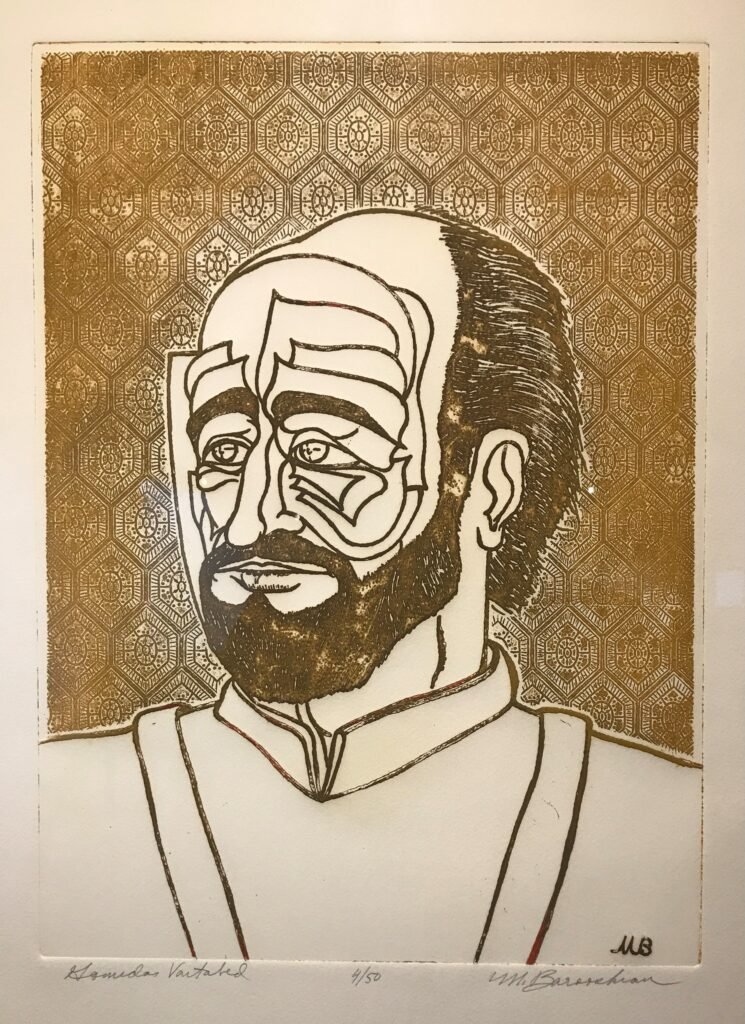 Martin Barooshian (1929-2022), “Gomidas Vartabed 4/50,” c. 1970-1979, signed color intaglio etching, 24×22, donated by Haig Der Manuelian
The show opened with a preview for Museum members on March 22. It was attended by more than 100 people including Museum Trustee Hapet Berberian, the family of the late Martin Barooshian, and the curator of his Trust, Michael J. Russo. Barooshian is an American-Armenian surrealist featured in the exhibition with two incredible etchings, including one of Gomidas Vartabed.
Executive Director Jason Sohigian noted at the opening, “We hope this exhibition gives visitors a glimpse of the range and complexity of our modern and contemporary art collection.” He went on to thank the artists who created these works, the donors who have gifted these pieces to the collection and the people who support the mission of the Museum as members.
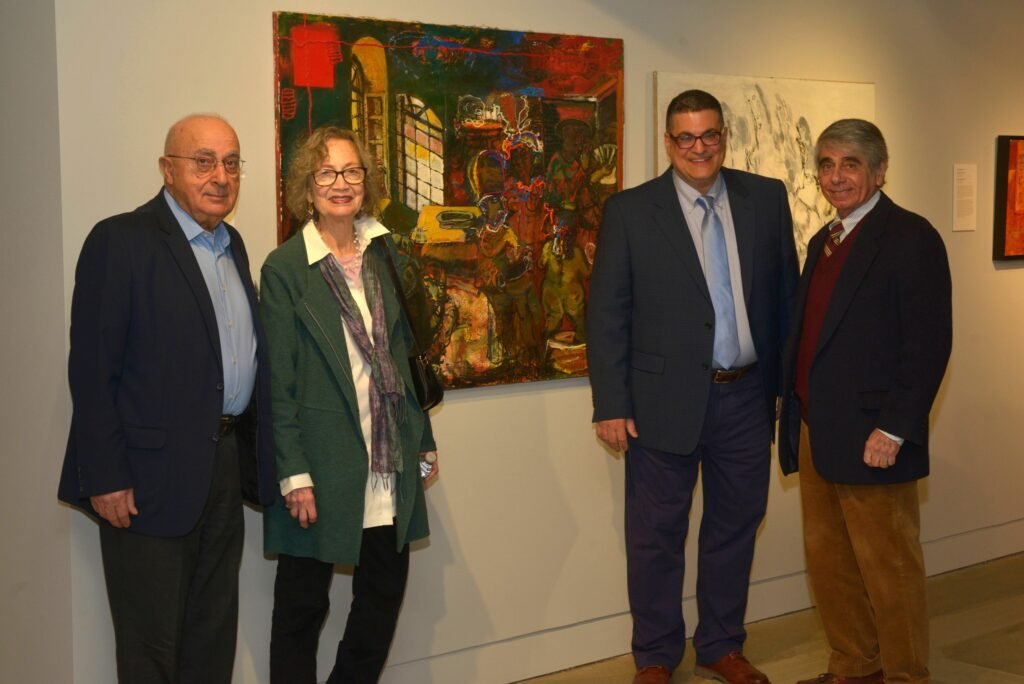 Museum Trustee Hapet Berberian (right) with Finance Director Berj Chekijian, Stephanie Berberian and Executive Director Jason Sohigian in front of a 2005 painting by Sarkis Hamalbashian from the collection of Norton T. Dodge
A section of the show reflects on collecting art. The first acquisitions outside of historic art in the collection of the Armenian Museum of America were primarily paintings donated by the founders, members and artists. With a growing reputation, the Museum gradually attracted the attention of art collectors, establishing itself as a hub of Armenian cultural production and as a contributor to the wider arts community. “Armenian art is a living tradition – it is the Museum’s duty to embrace that dynamism as we acquire new works,” concluded Sohigian. “Our collections now include emerging artists alongside nationally and internationally renowned Armenian artists, representing a wide array of mediums, movements and eras.”
Casey is a New Jersey based artist and educator. She holds a bachelor’s degree in photography from Stockton University and an MFA/MS in photography and art history from Pratt Institute. She currently works as the exhibition coordinator at the Stockton University Gallery and is an adjunct professor of photography, art history and critical theory.
The Armenian Museum of America is located at 65 Main Street, Watertown, MA. Its three floors of gallery space are open from Thursday to Sunday from 12 p.m.-6 p.m. For more information about this exhibition, please visit www.armenianmuseum.org/gandzaran.
Author information
Guest Contributor
Guest contributions to the Armenian Weekly are informative articles or press releases written and submitted by members of the community.
|
The post Gandzaran/Treasury exhibition spotlights art collection of the Armenian Museum of America appeared first on The Armenian Weekly.