
Categories
Audio Review - South Caucasus News

Ministers Reflect | Batu Kutelia (DMoD 2006-2008)


Ministers Reflect is an interview series on “how to be effective in government”, following a model developed by the Institute for Government in London. The series seeks to capture – in former ministers’ own words – what it takes to be an effective government minister, what challenges they face, and what broader lessons their experiences may hold. The interview was conducted on 12 December 2023, by Hans Gutbrod and Fredrik Fahlman. Robert Kotovi contributed to the preparation and editing.


Today’s Guest: Batu Kutelia was the Deputy Minister of Defense from December 2006 to December 2008, holding the position during the Russo-Georgian War. Prior to this, he held various top-level roles in politics and diplomacy, including as Head of the Foreign Intelligence Department and Deputy Minister of Foreign Affairs. From December 2008 to January 2011, Kutelia served as the Ambassador of Georgia in Washington, D.C., and after that as Deputy Secretary of the National Security Council of Georgia until September 2013. Kutelia is currently a Senior Fellow at the Foreign Policy Research Institute (FPRI), a member of the board of the Atlantic Council of Georgia, and is on X at @BKutelia.


To start with, what was it like to come into government? You had experience in various functions, so when you became Deputy Minister, what was new for you?

BK: Though my background is in Physics, the transition to government and policy was quite smooth. I was doing my PhD in Physics when I decided to join the Georgian-American Institute of Public Administration. GIPA is well-established now but it was a small and new project in the mid-1990s. GIPA introduced us to public administration and public policy, which nobody knew back then.

After graduating, I joined the Foreign Ministry in 1996. The Foreign Minister at that time, Irakli Menagarishvili, was on GIPA’s board. He offered me and some GIPA colleagues to help set up a new Political Military (Pol-Mil) Department. This department had several units: one for NATO, one for political-military relations with Russia and CIS countries, and another for bilateral relations, including with the United States and other Western partners. The fourth component was arms control and disarmament.

From 1996 until 2003, I spent most of my time on pol-mil issues, negotiating Russian military base withdrawals, the CFE treaty and other arms control regimes, NATO interoperability, and bilateral relations. My professional education had been in defense transformation, civil-military relations, crisis management and similar topics, as these were the courses that NATO and partner countries were offering to us starting from 1996.

At the same time, there was a political component to being a deputy minister. All the deputy ministers are political appointees. This was new for me. I had to take account of that political angle on issues which I had previously worked on professionally as a career diplomat before.

From 2003 onwards, it was a dynamic and exciting time. We had momentum because we started investing heavily in defense. Suddenly all these reforms that we had been working on since the Shevardnadze period became possible. Now we had the political will and the resources that we needed.

From 2003 onwards, it was a dynamic and exciting time. We had momentum because we started investing heavily in defense. Suddenly all these reforms that we had been working on since the Shevardnadze period became possible. Now we had the political will and the resources that we needed. Previously that had seemed unimaginable, though we had been preparing and drafting ideas.

When you became Deputy Minister, what were your priorities? Was it immediately clear to you what you wanted to do?

BK: When we came into office, we had a clear sense of what we wanted to do. With most of the reforms that started after the Rose Revolution, a lot of components had already been thought through beforehand. Though it might seem that way, it was not the case that the new team came in and then started thinking about the reforms.

For me, the priority list was immediately clear. First of all, we needed to standardize the defense planning process, in line with NATO standards. This meant introducing and implementing Threat-Based-Planning for the programming and budgeting system. At that time, we had an intensified dialogue and the Individual Partnership Action Plans (IPAP) mechanism with NATO. This was a great opportunity for us. We implemented this as a pilot and made medium-, short- and long-term plans, which previously had never been done before.

Secondly, you have to invest heavily in capabilities. Plans are not enough. We wanted to modernize infrastructure to NATO standards. We partnered with nations that were willing to contribute and to create a system that would absorb this assistance as institutional knowledge. Before, when the ministers and deputy ministers changed, all the knowledge went with them. After the Rose Revolution, we started building more of an institutional framework.

The third priority was bilateral cooperation with the United States. That was the most strategic and successful bilateral cooperation, even in the Shevardnadze period when the US launched the GTE     P (Georgia Train and Equip) program. At that time, we deployed our contingent in Iraq, coinciding with the surge that General David Petraeus introduced. We scaled up our participation to a brigade. Preparing this brigade and preparing for its deployment was an important priority, as well as capitalizing on this deployment and getting more training and more equipment for the other Georgian troops as well, to be prepared for potential threats.

And lastly, another key priority was, as part of this Strategic Defense Review and in partnership with the National Security Council, to start the threat analysis and then force planning based on it. With this, we wanted to complete the institutional pyramid of defense and security planning.

Building a good defense force involves a lot of people. How did you go about realigning and reorganizing personnel?

BK: The personnel was a major challenge, with its legacy and the lack of knowledge and experience. We decided to utilize the NATO template and assistance from the NATO partners. For example, for the training of non-commissioned officers (NCOs), we worked with Germany to establish an NCO school in Georgia, which was, in my view, a brilliant project. Their graduates were very good and high-quality NCOs.

For commissioned and higher-ranking military officers, we tried to utilize the slots of various military educational institutions in partner countries. We also made education a priority within the armed forces. If I remember correctly, we put in a budget clause that from the annual defense budget, almost 2% would be spent on education. For example, let’s say if the U.S. government provided two or three stipends for officer cadets at their West Point Academy, we would pay for three more from our own budget.

On top of all that, we had to figure out what to do with the personnel who were not up to their task for whatever reason – be it education, background, or background checks. That was a sensitive process, as some of these people had to be fired. In a typical defense hierarchy, there is a pyramid. You have a certain number of generals, colonels, and majors, with a thin top and a much wider base. In the legacy we inherited, we had a big belly with a lot of colonels and majors and some unqualified generals, too. We had to change that, and it was costly. Even if you let them go, you must pay their pensions or some of their annual salary.

It was quite a problematic process, but it had to be done. Sometimes you have to make tough decisions and sometimes you may not exactly follow the long process of every law or every process by the book. As with many reforms, there was a dilemma of either to follow the established rules or start changing the laws to make things move faster.

…When you do the fundamental transformation, you have to have immediate results. Immediate results are the political capital that you can again spend on the next waves of reform. It was a challenge, we had major successes, but we also had some problems.

All of this was also important because when you do the fundamental transformation, you have to have immediate results. Immediate results are the political capital that you can again spend on the next waves of reform. It was a challenge, we had major successes, but we also had some problems. The good thing was that NATO and the experience of NATO countries was very helpful in that regard – like a lighthouse in troubled waters.

What was your day to day like as a deputy minister? What did your typical week look like?

BK: Frankly, it was a 24-7 job, because there were so many things going on. One of the important things was to keep the morale up. Besides the office work, which was my primary responsibility, I traveled a lot to visit many different units. That was part of my responsibility as a political appointee. You cannot push the reforms only by just issuing directives or some kind of legal norms, you need physical presence on the ground.

I also started educating myself on the new defense systems, technologies, and NATO standard equipment. As a physicist, I enjoyed discovering new technologies. For example, Georgia was the first country to buy big strategic drones, such as the Israeli Elbit Hermes. One of them was shot down by Russian MIG 29 or 27 in the skies over Sukhumi in early 2008.

Hermes drones – or Israeli drones in general – were quite a novelty at the time. Now, drones have everyone’s attention. But at the time, it was a completely new and rapidly developing technology, even if getting and integrating live data was quite problematic back then. Overall, we started to have a certain edge, also by upgrading night vision.

We had a lot of old Soviet equipment, and modernizing this up to a NATO standard was a challenging process. It was hard for us to get licenses to buy new NATO standard equipment. We decided to modernize – as many Eastern European countries did – the Soviet platforms with modern battle management systems and integrate them with GPS, target acquisition, and night vision systems, all in an effort to have an edge against the potential adversary that we had identified as Russia, based on our doctrinal pyramid mentioned above: the National Security Strategy, the National Threat Assessment, and the Strategic Defense Review.

Some basic things took a long time. For example, it took us almost a year to get a license for M4 rifles from the United States, even though these M4 rifles were originally intended for our mission in Iraq. One of the reasons why we needed that rifle was because the U.S. had a problem with the logistics of different ammunition for its allies, such as ammunition for our original Kalashnikov rifles. Even though getting the M4 rifles aligned with American goals, it was still problematic for us to get licenses. That said, the overall modernization of the equipment was an interesting experience.

Working with the team was something we did all the time. We wanted to consolidate the team that would be able to talk to NATO in Brussels. At that time, our defense costs really went up, and that caused some questions. We reached a defense budget of around GEL 1.5bn. It was mostly a one-time investment to upgrade the infrastructure. But still, it was our political goal to make NATO aware of what we were doing and explain it in NATO language. Previously, only ministers or deputy ministers would go to Brussels to speak. My decision was that everyone, both military and civilian, should talk to their peers without me or any high-level officials present to make the process more dynamic.

Another part of the daily routine was communicating, as was my responsibility, with the Parliament as well as the Defense Security Committee. This process was not very streamlined at the time. I wish we would have had a better process in place, but it was one of the things that I was responsible for.

The M4 rifles marked a huge visual change. How important was such symbolism in how soldiers saw themselves was that an important part of that?

BK: The symbolism is hugely important as a part of what we now call strategic communication. At the time, it was a purely military concept and was not labeled as such. The M4 rifles boosted morale also.

The visual and conceptual change showed that we are not part of the post-Soviet military establishment. Kalashnikovs rifles were the equipment that our enemies had, and it did not make sense for us to stick with them. This was also in line with the NATO interoperability policy goals.

The visual and conceptual change showed that we are not part of the post-Soviet military establishment. Kalashnikovs rifles were the equipment that our enemies had, and it did not make sense for us to stick with them. This was also in line with the NATO interoperability policy goals.

There was a technical side, as you could add a night vision component to the M4 rifle. Night vision isn’t only symbolic – it significantly increased the self-confidence of the armed forces. We also received the first version of the Digital Soldier Systems, a digitalized system to maneuver troops with blue force trackers and integrated target acquisition systems, for our reconnaissance units, or the Israeli Spyder air defense systems with a totally new chassis. While these purchases were expensive, there was a strong emotional component to these systems in addition to their pragmatic value.

Next to the summer of 2008, what stands out as a major crisis that you had to face?

BK: It was a constant crisis. We had the full spectrum of incidents, starting with the big geopolitical dimension. We had incidents on the Russian-occupied territories all the time, with UN peacekeepers, the Kodori shelling, and the Tsitelubani incident when the village was bombed.

We had internal crises as well because there was a lot of Russian infiltration. They were trying to subvert processes, even the reforms, and damage the image of the Ministry of Defense.

We had internal crises as well because there was a lot of Russian infiltration. They were trying to subvert processes, even the reforms, and damage the image of the Ministry of Defense. There were also lower-scale crises. For example, we were building two new brigades, and there were some smaller incidents involving them.

There was a growing expectation that the Russians were brewing up a war. This presented a major dilemma for us. The dilemma was between accurate analysis and preparation and the politics of trying to get a Membership Action Plan at the Bucharest NATO Summit in 2008.

Our threat analysis process that we templated from NATO countries clearly showed that Russia was the number one threat. When we first presented this threat analysis at a closed NATO meeting in late 2006, showing the risks of a Russian military invasion of Georgia, people started criticizing that we could not do it that way, as it would create problems for us in terms of the Membership Action Plan.

Our threat analysis process that we templated from NATO countries clearly showed that Russia was the number one threat. When we first presented this threat analysis at a closed NATO meeting in late 2006, showing the risks of a Russian military invasion of Georgia, people started criticizing that we could not do it that way, as it would create problems for us in terms of the Membership Action Plan. So, we started redesigning our defense planning and did not attach a higher probability to a Russian military invasion – at least not on the paper that we submitted. In reality, nothing had changed because the threat was still high.    

But the bureaucracy within NATO was not happy to see us pointing at Russia as the main threat. That was a fine line to walk: on the one hand, we really had to prepare for a Russian invasion because that was the result of the process that we brought in from NATO. On the other hand, there was a political context of playing this threat down. We tried to make our actual modernization plans work under these conflicting imperatives.

Unfortunately, the first draft of defense planning and threat analysis that I had presented in Brussels in 2006 came true in August 2008 – with exact accuracy. If this sounds like a big claim, it was not rocket science to see what the Russians were preparing for, especially after Vladimir Putin’s speech at the Munich Conference in 2007. It was obvious that we were the prime target of opportunity, though many of our Western friends did not want to accept that. We were, of course, trying to get some of the capabilities that would allow us to resist in one way or another, but we only had three years of defense reform. That was the biggest crisis in my career.

In terms of crisis management, what were some of the biggest lessons that are maybe more broadly applicable for this kind of crisis management? Is there anything that stands out in particular?

BK: A key lesson is that preparation really can work. Earlier, we started to arrange the crisis management system using the NATO template. We got a lot of education and training on crisis management and developed a holistic approach to dealing with crises. We had started to implement the War Room concept, integrating all the data for any potential scenario in one room. The concept is not only just physically implementing the room, but bringing in all the different ministries and doing exercises with different scenarios, like General Staff exercises or integrating with the police and other components.

It is important to bring everything together. You are changing the decision-making system conceptually, not just physically integrating the data. Again, we got significant Western assistance for this War Room concept.

As these things go, because of the absence of the highly institutionalized system, some ad hoc political decisions that were made. In some cases, they were right, and in others, they were not serving the purpose directly. That was the nature of the reforms that we started in 2004. We were doing all this while being constantly in some kind of crisis. It was like building a ship in the middle of the sea, while learning how to sail – and then there were some people who were trying to sink it.

How did all these systems and preparations work in 2008 during the war with Russia? That was, presumably, a crisis of entirely new proportions, with all sorts of new factors, like lack of sleep.

BK: The war was an extraordinarily crazy five days, beyond any normal crisis. For me, the memory I have is of something like one big long day. I remember sleeping in some basement shelter near Tskhinvali when the bombs were falling.

The country woke up in a different mode. In this chaotic context, some of the existing institutional parts just disappeared. On the other hand, some parts also worked really well. During the war, the civilian staff of the Ministry of Defense, all these young men and women, did not leave their offices. They were sitting and doing their assigned jobs, whether it was writing letters or documenting everything. All the orders, decisions, international communication – everything was intact.

The war proved the resilience of the institutions where the personalities matter less, and the institutional process matters more.

This dedication was impressive. I have argued in case studies or teaching that the Ministry of Defense was the most Westernized – or reformed – institution, among Georgia’s security institutions. The war proved the resilience of the institutions where the personalities matter less, and the institutional process matters more.

One reason for this was that we had a template. With the NATO template, you were more or less sure what steps you would take. If you compare the Ministry of Interior and the Ministry of Defense, the former was more like a personality-oriented institution, and the latter more institutionalized with all processes in place. Every crisis is a test, and there were some very positive results, we saw that some of our reforms had made us much more resilient.

During these times of extreme crisis, what did decision-making look like from the people involved?

BK: At that time, we had a presidential system. The President was the commander- in- chief, and he had the National Security Council to work with. Most of the decisions were going through the National Security Council, which proved to be quite successful and effective. Now they changed it, but at the time, the National Security Council consisted of the relevant ministers or political actors.

Looking back, I think a decision could have been made to try to preempt Russia even earlier – but of course, given the time and the political mood, this would have resulted in more criticism from the West, in line with what we saw in the tendentious Tagliavini report.

In a crisis, in a way, there are no good or bad decisions. There are decisions that have consequences, and we either pay a price or get rewarded for them. But collective political responsibility and collective decision-making are important. The National Security Council was a useful institution to have a collective political responsibility for responding to Russian aggression. Fortunately, now history shows that these decisions were both right and constitutional. Looking back, I think a decision could have been made to try to preempt Russia even earlier – but of course, given the time and the political mood, this would have resulted in more criticism from the West, in line with what we saw in the tendentious Tagliavini report.

The good thing is that the after-action review showed that most of the decisions were made within the institutions, and at the national level, according to the existing international systems. The National Security Council was instrumental. Of course, there were some decisions that could have been disputed one way or another – but it was a crisis. Afterward, following a NATO procedure, we did an after-action review and analyzed the war. Here our American friends were very helpful. The EUCOM team (United States European Command, based in Stuttgart, Germany) came, and they did a very good analysis of particularly the military-political side, but also of the purely military side of the decision-making process.

Given how important defense was, did you interact much with the president?

BK: I didn’t interact too much with the President because that was the Minister’s job, but there were a few occasions when we had discussions on certain issues, especially concerning our cooperation and partnership, either in NATO or bilaterally, or when we met with high level delegations. It was very professional, and we were in sync on what needed to be done, and how.
 
It is sometimes said that one of the strengths of President Saakashvili was that he could really delegate. Did that stand out?

BK: In terms of defense, defense transformation, NATO cooperation or partnership with our partners, there was a wide delegation of responsibilities under President Saakashvili. I am sure it helped that I had the political trust of the President to speak with our partners when necessary, based on my experience.

There were some issues that the President was taking a more personal interest in, whether it was new defense capabilities, or modernizing of the armed forces into brigades, which also had a political aspect, but he was on the task all the time. In terms of implementation, there was a high degree of delegation of authority. That experience contradicts the perception that Saakashvili was deciding everything; maybe in some other fields, he was doing so. In our field, he delegated.

Some ministers have said that it can be surprisingly hard to get things done. Are there aspects that in retrospect, you found frustrating or difficult to make progress on?

BK: In some ways we were probably in a better position, because the policy was to make the Ministry of Defense an exemplary institution. We had a clear vision of NATO integration. The Ministry of Defense was the lead agency in bringing the country closer to NATO. For example, when we shifted to the planning, programming, and budgeting system, the rest of the institutions – including the Ministry of Finance – had to follow suit. That was an innovative concept for the Georgian public service at the time.

There was a lack of understanding or even support, externally, to move us forward with NATO. Another difficulty before the 2008 conflict was getting our partners to believe that the threat was real, that we were close to the war, and that we needed to be prepared for that scenario. And, of course, after the war, there was the challenge of fighting this propaganda war.

There were frustrations, of course. There was a lack of understanding or even support externally, to move us forward with NATO. Another difficulty before the 2008 conflict was getting our partners to believe that the threat was real, that we were close to the war, and that we needed to be prepared for that scenario. And, of course, after the war, there was the challenge of fighting this propaganda war. The biggest frustration was the Tagliavini report. In my view, that report was tailored to the political agenda of not irritating Russia. In retrospect, especially after the Russian invasions in Ukraine, it is even clearer how wrong that was

If you look back, is there anything additional that you want to highlight as an achievement during your time as a deputy minister?

BK: In addition to all the directions I have listed, I am happy that we broke this pattern of every new minister having to start everything from scratch. We created a core of professional staff and officers who were doing their jobs notwithstanding the political changes. Of course, there were some ups and downs there as well. Still, in general, we managed to put into place an institutional defense planning process, which works independently of the political leadership.

After your time at the Ministry of Defense, you were in Washington, DC at a pivotal time for Georgia. Was there anything that was surprising for you being in an ambassadorial role?

BK: I arrived in Washington in 2009 and came at a pivotal time. Being an ambassador was quite an experience. The American administration was just changing. I had developed good relations with the previous administration but they were gone and new people were now coming in. The Obama administration tried its so-called Reset policy with Russia.

I was the youngest ambassador in Washington in quite a conservative community in which age somehow plays a role. There is a perception that if you are an ambassador in Washington, you kind of have to be an old, seasoned diplomat. I was not old, but in terms of seasoning – yeah, I had probably seen more than my share. And my PhD in Physics helped a lot.

Finally, from your experience in government, what advice would you give to new ministers entering government? Is there something you learned you wish you knew beforehand?

BK: It depends a lot on experience, circumstances, and context. In brief, I think that if one is in charge, especially in those challenging times in government, my advice is that you have to have some kind of a vision of why you are there. It’s not just a technical and bureaucratic process. It’s always a challenge, but it’s important to find the proper balance between bureaucracy and moving toward the goals. An overly bureaucratized process sometimes kills a good idea and intention, and sometimes good intentions are the shortest way to hell. That‘s advice in a nutshell – but it’s just one of many lessons.

Categories
South Caucasus News

Ministers Reflect | Batu Kutelia (DMoD 2006-2008)


Ministers Reflect is an interview series on “how to be effective in government”, following a model developed by the Institute for Government in London. The series seeks to capture – in former ministers’ own words – what it takes to be an effective government minister, what challenges they face, and what broader lessons their experiences may hold. The interview was conducted on 12 December 2023, by Hans Gutbrod and Fredrik Fahlman. Robert Kotovi contributed to the preparation and editing.


Today’s Guest: Batu Kutelia was the Deputy Minister of Defense from December 2006 to December 2008, holding the position during the Russo-Georgian War. Prior to this, he held various top-level roles in politics and diplomacy, including as Head of the Foreign Intelligence Department and Deputy Minister of Foreign Affairs. From December 2008 to January 2011, Kutelia served as the Ambassador of Georgia in Washington, D.C., and after that as Deputy Secretary of the National Security Council of Georgia until September 2013. Kutelia is currently a Senior Fellow at the Foreign Policy Research Institute (FPRI), a member of the board of the Atlantic Council of Georgia, and is on X at @BKutelia.


To start with, what was it like to come into government? You had experience in various functions, so when you became Deputy Minister, what was new for you?

BK: Though my background is in Physics, the transition to government and policy was quite smooth. I was doing my PhD in Physics when I decided to join the Georgian-American Institute of Public Administration. GIPA is well-established now but it was a small and new project in the mid-1990s. GIPA introduced us to public administration and public policy, which nobody knew back then.

After graduating, I joined the Foreign Ministry in 1996. The Foreign Minister at that time, Irakli Menagarishvili, was on GIPA’s board. He offered me and some GIPA colleagues to help set up a new Political Military (Pol-Mil) Department. This department had several units: one for NATO, one for political-military relations with Russia and CIS countries, and another for bilateral relations, including with the United States and other Western partners. The fourth component was arms control and disarmament.

From 1996 until 2003, I spent most of my time on pol-mil issues, negotiating Russian military base withdrawals, the CFE treaty and other arms control regimes, NATO interoperability, and bilateral relations. My professional education had been in defense transformation, civil-military relations, crisis management and similar topics, as these were the courses that NATO and partner countries were offering to us starting from 1996.

At the same time, there was a political component to being a deputy minister. All the deputy ministers are political appointees. This was new for me. I had to take account of that political angle on issues which I had previously worked on professionally as a career diplomat before.

From 2003 onwards, it was a dynamic and exciting time. We had momentum because we started investing heavily in defense. Suddenly all these reforms that we had been working on since the Shevardnadze period became possible. Now we had the political will and the resources that we needed.

From 2003 onwards, it was a dynamic and exciting time. We had momentum because we started investing heavily in defense. Suddenly all these reforms that we had been working on since the Shevardnadze period became possible. Now we had the political will and the resources that we needed. Previously that had seemed unimaginable, though we had been preparing and drafting ideas.

When you became Deputy Minister, what were your priorities? Was it immediately clear to you what you wanted to do?

BK: When we came into office, we had a clear sense of what we wanted to do. With most of the reforms that started after the Rose Revolution, a lot of components had already been thought through beforehand. Though it might seem that way, it was not the case that the new team came in and then started thinking about the reforms.

For me, the priority list was immediately clear. First of all, we needed to standardize the defense planning process, in line with NATO standards. This meant introducing and implementing Threat-Based-Planning for the programming and budgeting system. At that time, we had an intensified dialogue and the Individual Partnership Action Plans (IPAP) mechanism with NATO. This was a great opportunity for us. We implemented this as a pilot and made medium-, short- and long-term plans, which previously had never been done before.

Secondly, you have to invest heavily in capabilities. Plans are not enough. We wanted to modernize infrastructure to NATO standards. We partnered with nations that were willing to contribute and to create a system that would absorb this assistance as institutional knowledge. Before, when the ministers and deputy ministers changed, all the knowledge went with them. After the Rose Revolution, we started building more of an institutional framework.

The third priority was bilateral cooperation with the United States. That was the most strategic and successful bilateral cooperation, even in the Shevardnadze period when the US launched the GTE     P (Georgia Train and Equip) program. At that time, we deployed our contingent in Iraq, coinciding with the surge that General David Petraeus introduced. We scaled up our participation to a brigade. Preparing this brigade and preparing for its deployment was an important priority, as well as capitalizing on this deployment and getting more training and more equipment for the other Georgian troops as well, to be prepared for potential threats.

And lastly, another key priority was, as part of this Strategic Defense Review and in partnership with the National Security Council, to start the threat analysis and then force planning based on it. With this, we wanted to complete the institutional pyramid of defense and security planning.

Building a good defense force involves a lot of people. How did you go about realigning and reorganizing personnel?

BK: The personnel was a major challenge, with its legacy and the lack of knowledge and experience. We decided to utilize the NATO template and assistance from the NATO partners. For example, for the training of non-commissioned officers (NCOs), we worked with Germany to establish an NCO school in Georgia, which was, in my view, a brilliant project. Their graduates were very good and high-quality NCOs.

For commissioned and higher-ranking military officers, we tried to utilize the slots of various military educational institutions in partner countries. We also made education a priority within the armed forces. If I remember correctly, we put in a budget clause that from the annual defense budget, almost 2% would be spent on education. For example, let’s say if the U.S. government provided two or three stipends for officer cadets at their West Point Academy, we would pay for three more from our own budget.

On top of all that, we had to figure out what to do with the personnel who were not up to their task for whatever reason – be it education, background, or background checks. That was a sensitive process, as some of these people had to be fired. In a typical defense hierarchy, there is a pyramid. You have a certain number of generals, colonels, and majors, with a thin top and a much wider base. In the legacy we inherited, we had a big belly with a lot of colonels and majors and some unqualified generals, too. We had to change that, and it was costly. Even if you let them go, you must pay their pensions or some of their annual salary.

It was quite a problematic process, but it had to be done. Sometimes you have to make tough decisions and sometimes you may not exactly follow the long process of every law or every process by the book. As with many reforms, there was a dilemma of either to follow the established rules or start changing the laws to make things move faster.

…When you do the fundamental transformation, you have to have immediate results. Immediate results are the political capital that you can again spend on the next waves of reform. It was a challenge, we had major successes, but we also had some problems.

All of this was also important because when you do the fundamental transformation, you have to have immediate results. Immediate results are the political capital that you can again spend on the next waves of reform. It was a challenge, we had major successes, but we also had some problems. The good thing was that NATO and the experience of NATO countries was very helpful in that regard – like a lighthouse in troubled waters.

What was your day to day like as a deputy minister? What did your typical week look like?

BK: Frankly, it was a 24-7 job, because there were so many things going on. One of the important things was to keep the morale up. Besides the office work, which was my primary responsibility, I traveled a lot to visit many different units. That was part of my responsibility as a political appointee. You cannot push the reforms only by just issuing directives or some kind of legal norms, you need physical presence on the ground.

I also started educating myself on the new defense systems, technologies, and NATO standard equipment. As a physicist, I enjoyed discovering new technologies. For example, Georgia was the first country to buy big strategic drones, such as the Israeli Elbit Hermes. One of them was shot down by Russian MIG 29 or 27 in the skies over Sukhumi in early 2008.

Hermes drones – or Israeli drones in general – were quite a novelty at the time. Now, drones have everyone’s attention. But at the time, it was a completely new and rapidly developing technology, even if getting and integrating live data was quite problematic back then. Overall, we started to have a certain edge, also by upgrading night vision.

We had a lot of old Soviet equipment, and modernizing this up to a NATO standard was a challenging process. It was hard for us to get licenses to buy new NATO standard equipment. We decided to modernize – as many Eastern European countries did – the Soviet platforms with modern battle management systems and integrate them with GPS, target acquisition, and night vision systems, all in an effort to have an edge against the potential adversary that we had identified as Russia, based on our doctrinal pyramid mentioned above: the National Security Strategy, the National Threat Assessment, and the Strategic Defense Review.

Some basic things took a long time. For example, it took us almost a year to get a license for M4 rifles from the United States, even though these M4 rifles were originally intended for our mission in Iraq. One of the reasons why we needed that rifle was because the U.S. had a problem with the logistics of different ammunition for its allies, such as ammunition for our original Kalashnikov rifles. Even though getting the M4 rifles aligned with American goals, it was still problematic for us to get licenses. That said, the overall modernization of the equipment was an interesting experience.

Working with the team was something we did all the time. We wanted to consolidate the team that would be able to talk to NATO in Brussels. At that time, our defense costs really went up, and that caused some questions. We reached a defense budget of around GEL 1.5bn. It was mostly a one-time investment to upgrade the infrastructure. But still, it was our political goal to make NATO aware of what we were doing and explain it in NATO language. Previously, only ministers or deputy ministers would go to Brussels to speak. My decision was that everyone, both military and civilian, should talk to their peers without me or any high-level officials present to make the process more dynamic.

Another part of the daily routine was communicating, as was my responsibility, with the Parliament as well as the Defense Security Committee. This process was not very streamlined at the time. I wish we would have had a better process in place, but it was one of the things that I was responsible for.

The M4 rifles marked a huge visual change. How important was such symbolism in how soldiers saw themselves was that an important part of that?

BK: The symbolism is hugely important as a part of what we now call strategic communication. At the time, it was a purely military concept and was not labeled as such. The M4 rifles boosted morale also.

The visual and conceptual change showed that we are not part of the post-Soviet military establishment. Kalashnikovs rifles were the equipment that our enemies had, and it did not make sense for us to stick with them. This was also in line with the NATO interoperability policy goals.

The visual and conceptual change showed that we are not part of the post-Soviet military establishment. Kalashnikovs rifles were the equipment that our enemies had, and it did not make sense for us to stick with them. This was also in line with the NATO interoperability policy goals.

There was a technical side, as you could add a night vision component to the M4 rifle. Night vision isn’t only symbolic – it significantly increased the self-confidence of the armed forces. We also received the first version of the Digital Soldier Systems, a digitalized system to maneuver troops with blue force trackers and integrated target acquisition systems, for our reconnaissance units, or the Israeli Spyder air defense systems with a totally new chassis. While these purchases were expensive, there was a strong emotional component to these systems in addition to their pragmatic value.

Next to the summer of 2008, what stands out as a major crisis that you had to face?

BK: It was a constant crisis. We had the full spectrum of incidents, starting with the big geopolitical dimension. We had incidents on the Russian-occupied territories all the time, with UN peacekeepers, the Kodori shelling, and the Tsitelubani incident when the village was bombed.

We had internal crises as well because there was a lot of Russian infiltration. They were trying to subvert processes, even the reforms, and damage the image of the Ministry of Defense.

We had internal crises as well because there was a lot of Russian infiltration. They were trying to subvert processes, even the reforms, and damage the image of the Ministry of Defense. There were also lower-scale crises. For example, we were building two new brigades, and there were some smaller incidents involving them.

There was a growing expectation that the Russians were brewing up a war. This presented a major dilemma for us. The dilemma was between accurate analysis and preparation and the politics of trying to get a Membership Action Plan at the Bucharest NATO Summit in 2008.

Our threat analysis process that we templated from NATO countries clearly showed that Russia was the number one threat. When we first presented this threat analysis at a closed NATO meeting in late 2006, showing the risks of a Russian military invasion of Georgia, people started criticizing that we could not do it that way, as it would create problems for us in terms of the Membership Action Plan.

Our threat analysis process that we templated from NATO countries clearly showed that Russia was the number one threat. When we first presented this threat analysis at a closed NATO meeting in late 2006, showing the risks of a Russian military invasion of Georgia, people started criticizing that we could not do it that way, as it would create problems for us in terms of the Membership Action Plan. So, we started redesigning our defense planning and did not attach a higher probability to a Russian military invasion – at least not on the paper that we submitted. In reality, nothing had changed because the threat was still high.    

But the bureaucracy within NATO was not happy to see us pointing at Russia as the main threat. That was a fine line to walk: on the one hand, we really had to prepare for a Russian invasion because that was the result of the process that we brought in from NATO. On the other hand, there was a political context of playing this threat down. We tried to make our actual modernization plans work under these conflicting imperatives.

Unfortunately, the first draft of defense planning and threat analysis that I had presented in Brussels in 2006 came true in August 2008 – with exact accuracy. If this sounds like a big claim, it was not rocket science to see what the Russians were preparing for, especially after Vladimir Putin’s speech at the Munich Conference in 2007. It was obvious that we were the prime target of opportunity, though many of our Western friends did not want to accept that. We were, of course, trying to get some of the capabilities that would allow us to resist in one way or another, but we only had three years of defense reform. That was the biggest crisis in my career.

In terms of crisis management, what were some of the biggest lessons that are maybe more broadly applicable for this kind of crisis management? Is there anything that stands out in particular?

BK: A key lesson is that preparation really can work. Earlier, we started to arrange the crisis management system using the NATO template. We got a lot of education and training on crisis management and developed a holistic approach to dealing with crises. We had started to implement the War Room concept, integrating all the data for any potential scenario in one room. The concept is not only just physically implementing the room, but bringing in all the different ministries and doing exercises with different scenarios, like General Staff exercises or integrating with the police and other components.

It is important to bring everything together. You are changing the decision-making system conceptually, not just physically integrating the data. Again, we got significant Western assistance for this War Room concept.

As these things go, because of the absence of the highly institutionalized system, some ad hoc political decisions that were made. In some cases, they were right, and in others, they were not serving the purpose directly. That was the nature of the reforms that we started in 2004. We were doing all this while being constantly in some kind of crisis. It was like building a ship in the middle of the sea, while learning how to sail – and then there were some people who were trying to sink it.

How did all these systems and preparations work in 2008 during the war with Russia? That was, presumably, a crisis of entirely new proportions, with all sorts of new factors, like lack of sleep.

BK: The war was an extraordinarily crazy five days, beyond any normal crisis. For me, the memory I have is of something like one big long day. I remember sleeping in some basement shelter near Tskhinvali when the bombs were falling.

The country woke up in a different mode. In this chaotic context, some of the existing institutional parts just disappeared. On the other hand, some parts also worked really well. During the war, the civilian staff of the Ministry of Defense, all these young men and women, did not leave their offices. They were sitting and doing their assigned jobs, whether it was writing letters or documenting everything. All the orders, decisions, international communication – everything was intact.

The war proved the resilience of the institutions where the personalities matter less, and the institutional process matters more.

This dedication was impressive. I have argued in case studies or teaching that the Ministry of Defense was the most Westernized – or reformed – institution, among Georgia’s security institutions. The war proved the resilience of the institutions where the personalities matter less, and the institutional process matters more.

One reason for this was that we had a template. With the NATO template, you were more or less sure what steps you would take. If you compare the Ministry of Interior and the Ministry of Defense, the former was more like a personality-oriented institution, and the latter more institutionalized with all processes in place. Every crisis is a test, and there were some very positive results, we saw that some of our reforms had made us much more resilient.

During these times of extreme crisis, what did decision-making look like from the people involved?

BK: At that time, we had a presidential system. The President was the commander- in- chief, and he had the National Security Council to work with. Most of the decisions were going through the National Security Council, which proved to be quite successful and effective. Now they changed it, but at the time, the National Security Council consisted of the relevant ministers or political actors.

Looking back, I think a decision could have been made to try to preempt Russia even earlier – but of course, given the time and the political mood, this would have resulted in more criticism from the West, in line with what we saw in the tendentious Tagliavini report.

In a crisis, in a way, there are no good or bad decisions. There are decisions that have consequences, and we either pay a price or get rewarded for them. But collective political responsibility and collective decision-making are important. The National Security Council was a useful institution to have a collective political responsibility for responding to Russian aggression. Fortunately, now history shows that these decisions were both right and constitutional. Looking back, I think a decision could have been made to try to preempt Russia even earlier – but of course, given the time and the political mood, this would have resulted in more criticism from the West, in line with what we saw in the tendentious Tagliavini report.

The good thing is that the after-action review showed that most of the decisions were made within the institutions, and at the national level, according to the existing international systems. The National Security Council was instrumental. Of course, there were some decisions that could have been disputed one way or another – but it was a crisis. Afterward, following a NATO procedure, we did an after-action review and analyzed the war. Here our American friends were very helpful. The EUCOM team (United States European Command, based in Stuttgart, Germany) came, and they did a very good analysis of particularly the military-political side, but also of the purely military side of the decision-making process.

Given how important defense was, did you interact much with the president?

BK: I didn’t interact too much with the President because that was the Minister’s job, but there were a few occasions when we had discussions on certain issues, especially concerning our cooperation and partnership, either in NATO or bilaterally, or when we met with high level delegations. It was very professional, and we were in sync on what needed to be done, and how.
 
It is sometimes said that one of the strengths of President Saakashvili was that he could really delegate. Did that stand out?

BK: In terms of defense, defense transformation, NATO cooperation or partnership with our partners, there was a wide delegation of responsibilities under President Saakashvili. I am sure it helped that I had the political trust of the President to speak with our partners when necessary, based on my experience.

There were some issues that the President was taking a more personal interest in, whether it was new defense capabilities, or modernizing of the armed forces into brigades, which also had a political aspect, but he was on the task all the time. In terms of implementation, there was a high degree of delegation of authority. That experience contradicts the perception that Saakashvili was deciding everything; maybe in some other fields, he was doing so. In our field, he delegated.

Some ministers have said that it can be surprisingly hard to get things done. Are there aspects that in retrospect, you found frustrating or difficult to make progress on?

BK: In some ways we were probably in a better position, because the policy was to make the Ministry of Defense an exemplary institution. We had a clear vision of NATO integration. The Ministry of Defense was the lead agency in bringing the country closer to NATO. For example, when we shifted to the planning, programming, and budgeting system, the rest of the institutions – including the Ministry of Finance – had to follow suit. That was an innovative concept for the Georgian public service at the time.

There was a lack of understanding or even support, externally, to move us forward with NATO. Another difficulty before the 2008 conflict was getting our partners to believe that the threat was real, that we were close to the war, and that we needed to be prepared for that scenario. And, of course, after the war, there was the challenge of fighting this propaganda war.

There were frustrations, of course. There was a lack of understanding or even support externally, to move us forward with NATO. Another difficulty before the 2008 conflict was getting our partners to believe that the threat was real, that we were close to the war, and that we needed to be prepared for that scenario. And, of course, after the war, there was the challenge of fighting this propaganda war. The biggest frustration was the Tagliavini report. In my view, that report was tailored to the political agenda of not irritating Russia. In retrospect, especially after the Russian invasions in Ukraine, it is even clearer how wrong that was

If you look back, is there anything additional that you want to highlight as an achievement during your time as a deputy minister?

BK: In addition to all the directions I have listed, I am happy that we broke this pattern of every new minister having to start everything from scratch. We created a core of professional staff and officers who were doing their jobs notwithstanding the political changes. Of course, there were some ups and downs there as well. Still, in general, we managed to put into place an institutional defense planning process, which works independently of the political leadership.

After your time at the Ministry of Defense, you were in Washington, DC at a pivotal time for Georgia. Was there anything that was surprising for you being in an ambassadorial role?

BK: I arrived in Washington in 2009 and came at a pivotal time. Being an ambassador was quite an experience. The American administration was just changing. I had developed good relations with the previous administration but they were gone and new people were now coming in. The Obama administration tried its so-called Reset policy with Russia.

I was the youngest ambassador in Washington in quite a conservative community in which age somehow plays a role. There is a perception that if you are an ambassador in Washington, you kind of have to be an old, seasoned diplomat. I was not old, but in terms of seasoning – yeah, I had probably seen more than my share. And my PhD in Physics helped a lot.

Finally, from your experience in government, what advice would you give to new ministers entering government? Is there something you learned you wish you knew beforehand?

BK: It depends a lot on experience, circumstances, and context. In brief, I think that if one is in charge, especially in those challenging times in government, my advice is that you have to have some kind of a vision of why you are there. It’s not just a technical and bureaucratic process. It’s always a challenge, but it’s important to find the proper balance between bureaucracy and moving toward the goals. An overly bureaucratized process sometimes kills a good idea and intention, and sometimes good intentions are the shortest way to hell. That‘s advice in a nutshell – but it’s just one of many lessons.


Categories
South Caucasus News

AP Headline News – Apr 08 2024 13:00 (EDT)


28013281


Categories
South Caucasus News

@haaretzcom: RT @haaretzcom: Regarding the hostage negotiations, Israel’s negotiators and the CIA know exactly how indispensably helpful the Qataris hav…


Regarding the hostage negotiations, Israel’s negotiators and the CIA know exactly how indispensably helpful the Qataris have been and how, according to Washington, they seemed much more interested in a deal than Netanyahu / @AlonPinkas https://t.co/3alxA0WGi9

— Haaretz.com (@haaretzcom) April 8, 2024


Categories
South Caucasus News

Georgian civil servants ‘pressured’ to promote foreign agent bill


The Georgian Government has been accused of using civil servants to deliver messages on social media supporting their controversial draft foreign agent law.

On Thursday and Sunday, iFact, a Georgian investigative outlet, published two reports describing how senior regional officials were forcing staff to share and write comments supporting the bill.

After Georgian Dream officially announced that it was reviving the draft foreign agent law on 3 April,  ‘public service employees swiftly took to social media platforms within the hour’, iFact reported.

On Sunday, iFact reported that at least 320 employees of 59 municipalities, municipal councils, and non-commercial legal entities were involved in the campaign.

‘The scheme is as follows: high-ranking officials from City Hall upload a photo on their Facebook page, and employees of the same city hall share from them’, they wrote.

iFact also published screenshots of what they said was a conversation between the employees of Ambrolauri Municipality and Gigi Natmeladze, the adviser to the municipality’s mayor. In the screenshots, Natmeladze appears to encourage employees to comment and react to posts about the ruling party’s draft foreign agent and queer ‘propaganda’ laws, which Georgian Dream submitted to parliament last week.

Natmeladze reportedly told iFact they had ‘incorrect information’ but refused to answer any additional questions.

Gela Mtivlishvili, the editor of online news site Mtis Ambebi also published screenshots of conversations he had with public servants who claimed to have been instructed to react to and share posts by the ruling party and its associates.

In the screenshots, the employees, whose identities were hidden, told Mtivlishvili they were ‘pressured’ into the scheme.

‘You know, I am caring for an orphan and if they fire me we will remain hungry’, said a public servant to Mtivlishvili.

Georgia’s foreign agent law would label any civil society or media organisation that received at least 20% of its funding from outside Georgia ‘organisations carrying out the interests of a foreign power’. Such organisations would be subject to ‘monitoring’ by the Ministry of Justice every six months, which lawyers have warned could include forcing them to hand over internal communications and confidential sources. Organisations that do not comply would be subject to large fines.

‘False information’ on social media

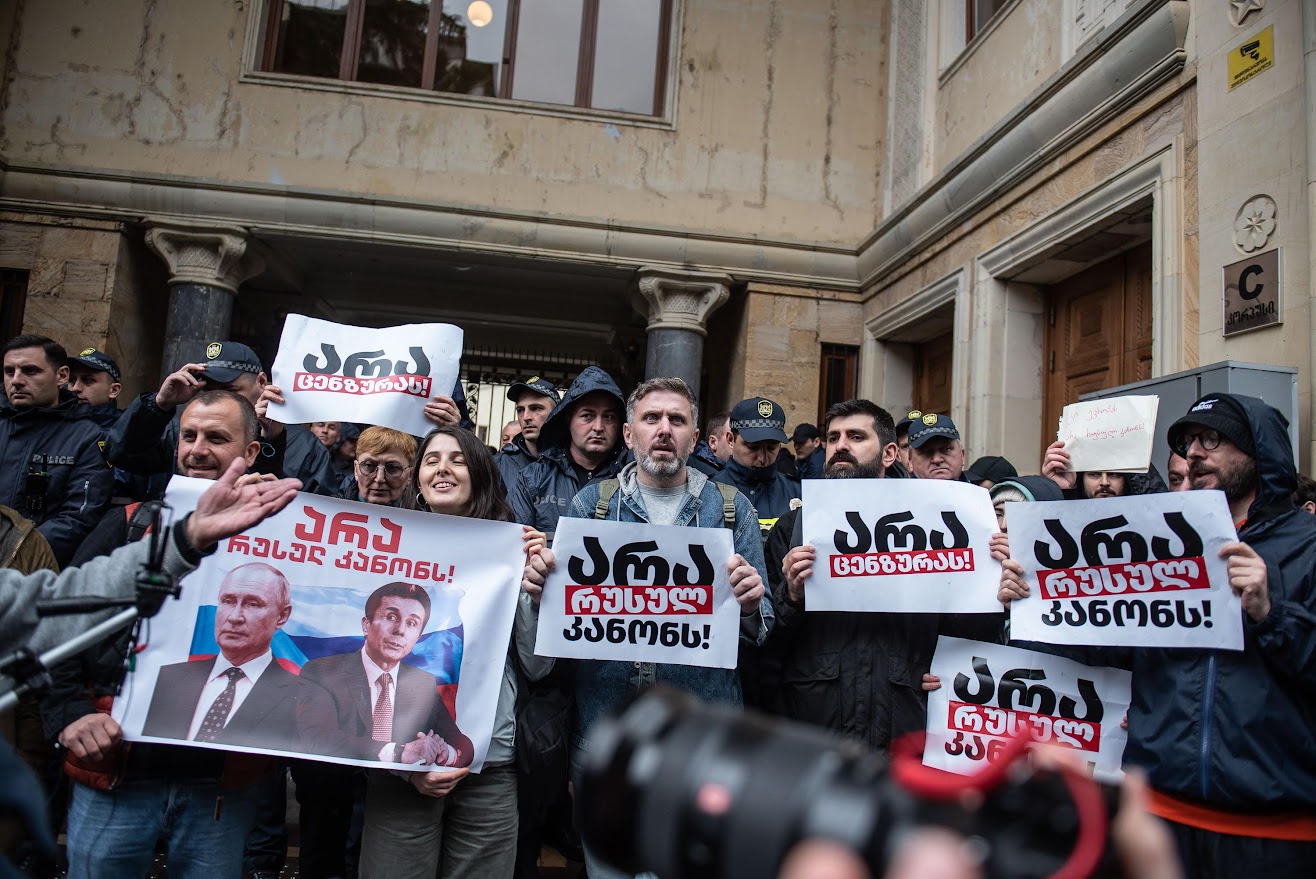
Georgian Dream’s reintroduction of the foreign agent law has prompted criticism domestically and internationally, with local civil society and opposition groups dubbing the bill the ‘Russian law’ due to its similarity to legislation adopted by Russia used to crush civil society and critical media in the country.

[Read more: Georgia’s foreign agents bill faces international condemnation]

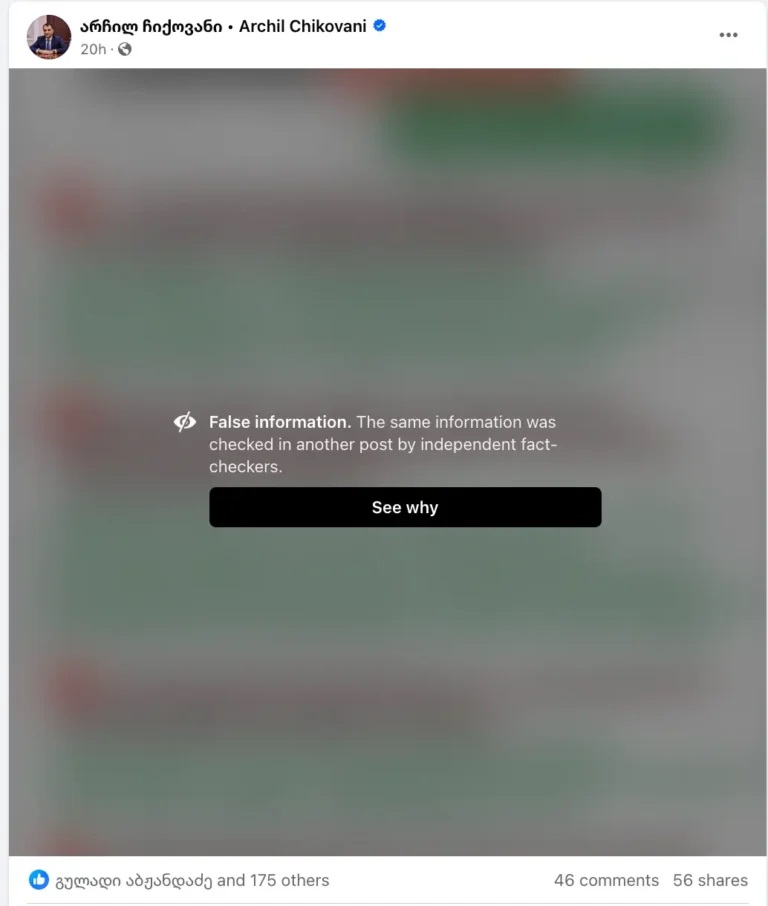
Members of the ruling party, their allies, and pro-government media began sharing a post ‘debunking’ claims that the law was inspired by Russian legislation, that it was anti-Western, and that it would cost Georgia its EU candidacy. Soon after, Facebook began flagging the posts as containing false information.

Batumi Mayor Archil Chikovani’s post about the foreign agent law was flagged as containing false information by Facebook. Image via iFact.
Facebook’s censorship of the post has drawn criticism from senior figures from the ruling party, including Prime Minister Irakli Kobakhidze, who on Monday accused the ‘so-called non-governmental organisations connected to our political opponents’ of censoring Facebook and social media.

Kobakhidze’s statement was echoed by Eka Sepashvili an MP from the parliamentary majority.

‘[Blocking social media posts] just showed that they [Georgia’s opposition and NGOs] seem to be tied to the Facebook headquarters in spreading this disinformation’, said Sepashvili.

Facebook flagged the posts as false information checked by FactCheck, a platform founded by Georgia’s Reforms Associates.

Tax relief and trips to Germany

As Georgian Dream braces for backlash against its reintroduction of the foreign agent law, the government has proposed several other seemingly more popular initiatives for discussion in parliament.

On Monday, Prime Minister Kobakhidze announced a ₾590 million ($220 million) tax debt relief for over 145,000 people.

Kobakhidze stated that the debt cancellation would cover tax obligations and penalties accumulated before 2021.

‘140,000 of our citizens will be able to actively participate in economic life, something that will benefit economic development’, said Kobakhidze.

Kobakhidze also ‘instructed’ the Ministry of Economy to provide additional direct flights to Dusseldorf and Hamburg to allow more Georgians to attend the 2024 European Football Championship. Georgia’s qualification for the tournament in March was met with massive celebrations.

The post Georgian civil servants ‘pressured’ to promote foreign agent bill appeared first on OC Media.


Categories
South Caucasus News

Georgian foreign agent bill passes first stage in parliament


Georgia’s draft foreign agent law has passed its first stage, with Parliament’s Bureau giving the legislation the go-ahead to proceed amidst noisy protests outside the building.

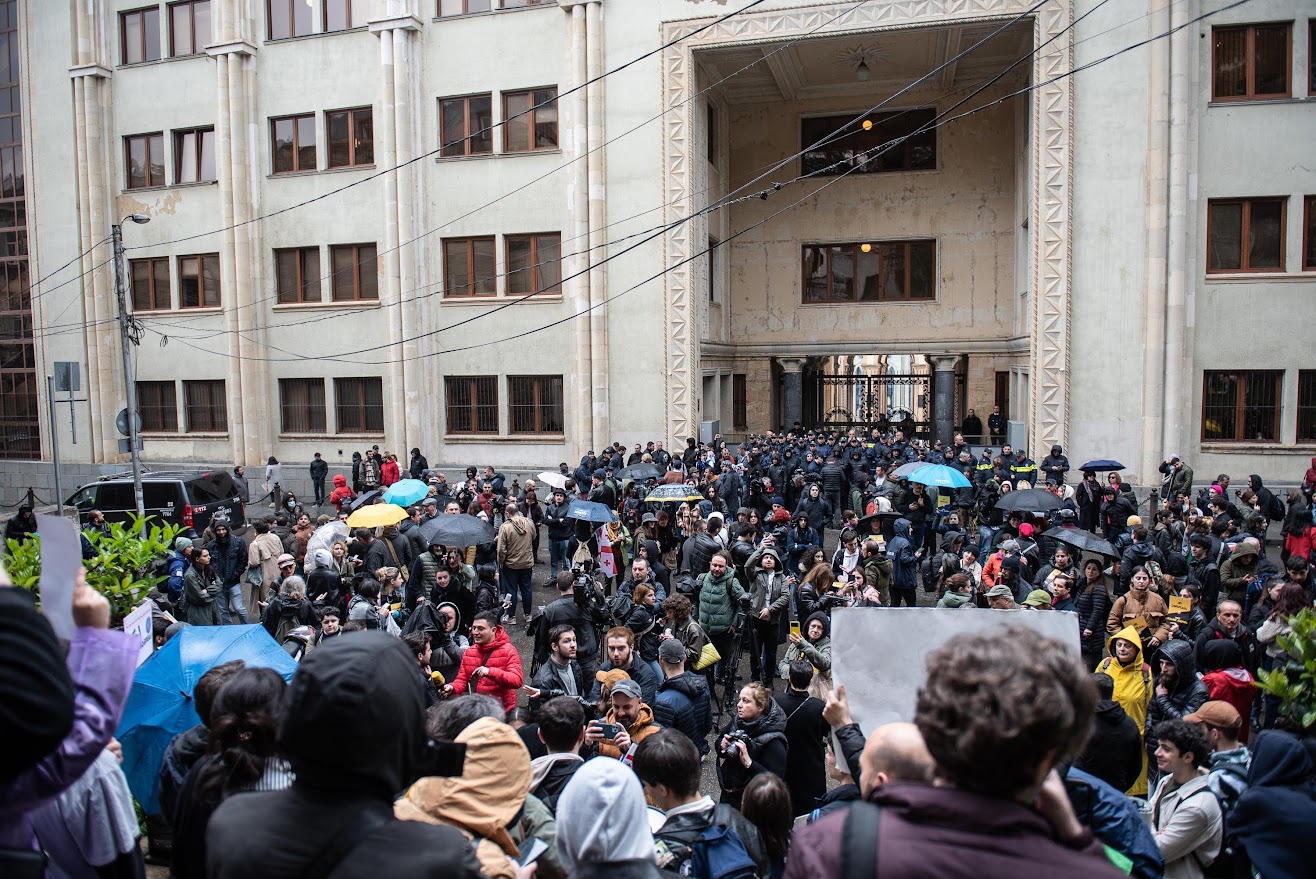
Hundreds gathered around the rear and sides of parliament on Monday in scenes resembling the early days of the protests that broke out when the bill was previously proposed in March 2023.

Following two nights of massive protests on 7–8 March 2023, the government was forced to drop the legislation, promising not to return it. On 3 April, the party announced they were bringing the bill back.

Hundreds attended the protest against the foreign agent law behind parliament on Monday. Mariam Nikuradze/ OC Media.
The bill’s next step will be committee hearings, with the Legal Affairs Committee due to discuss it on 15 April.

Monday’s Bureau session saw heated confrontations between government and opposition MPs.  Opposition Lelo party MP Ana Natsvlishvili said that the Bureau registering the draft law was a betrayal of the Constitution and Georgia’s ‘European future’.

A number of journalists were refused entry to parliament as the Bureau was considering the legislation, including from OC Media.

The protest behind parliament was attended by several journalists. Mariam Nikuradze/OC Media.
The legislation has faced a barrage of criticism both domestic and international.

On Monday, more than 400 Georgian civil society groups issued a joint statement warning that the bill was ‘a Russian authoritarian tool to suppress freedom of speech’ and that its adoption would preclude the country from opening membership negotiations with the EU at the end of the year.

The legislation has been widely referred to in Georgia as the ‘Russian Law’, due to its similarity to legislation used to crush dissent in Russia.

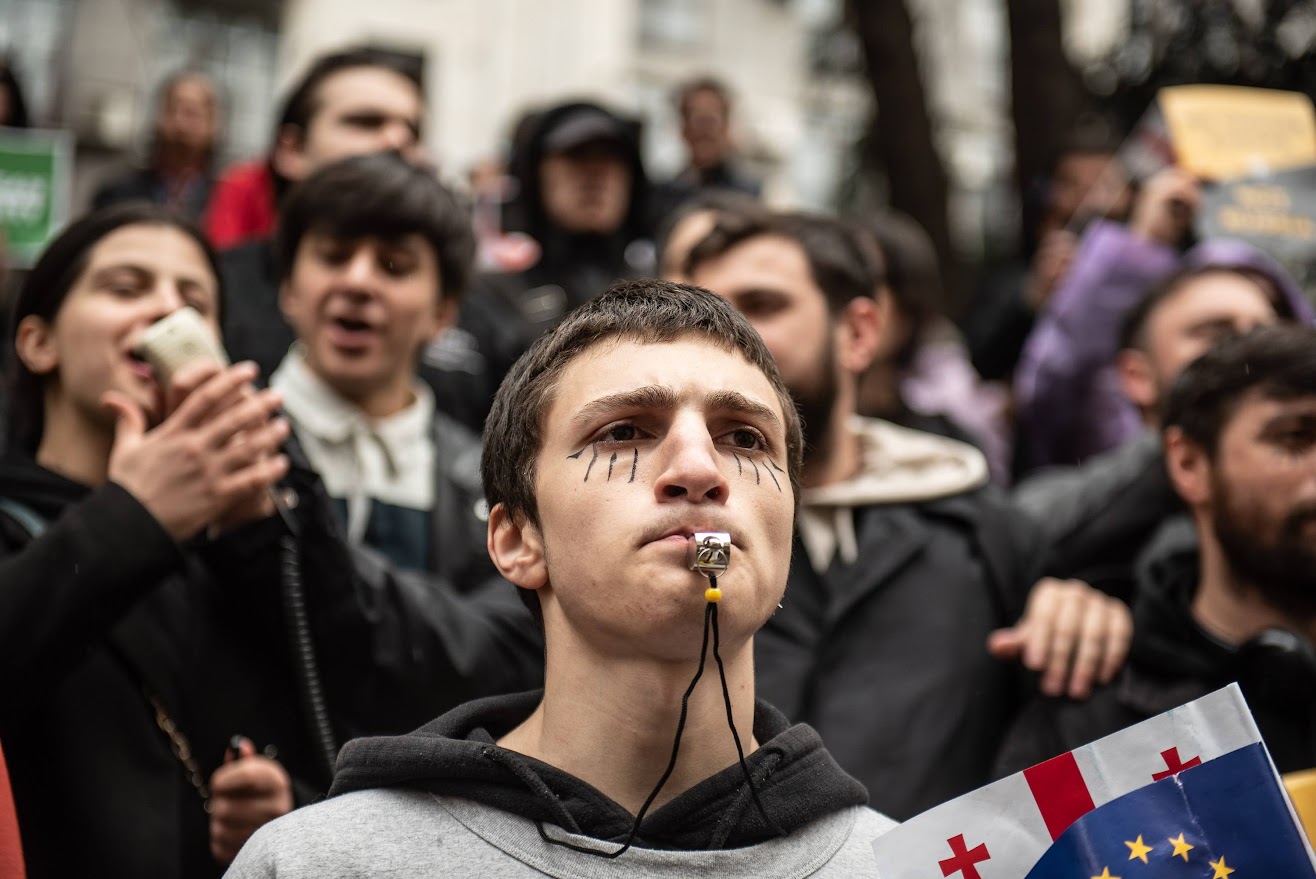
Several protesters wore makeup resembling Lazare Grigoriadis’ eye tattoos. Grigoriadis is facing criminal charges following his participation in last year’s protests against the foreign agent law. The closing statements in his trial coincided with the protests today. Mariam Nikuradze/OC Media.

Members of Georgian Dream have stated that the bill will be adopted before the end of the spring session of parliament, on 28 June.

Giorgi Mskhiladze, an adviser to President Salome Zurabishvili, was also present at the Bureau session. He said that if the law was passed, President Zurabishvili would veto it. Parliament has the ability to overrule a presidential veto.

The legislation would label any civil society or media organisation that received at least 20% of its funding from outside Georgia ‘organisations carrying out the interests of a foreign power’. Such organisations would be subject to ‘monitoring’ by the Ministry of Justice every six months, which lawyers have warned could include forcing them to hand over internal communications and confidential sources. Organisations that do not comply would be subject to large fines.

The post Georgian foreign agent bill passes first stage in parliament appeared first on OC Media.


Categories
South Caucasus News

🇦🇲 Armenia: Depi dasakan Yevratesil – Semi-Final Three Results – Eurovoix


🇦🇲 Armenia: Depi dasakan Yevratesil – Semi-Final Three Results  Eurovoix

Categories
South Caucasus News

Western Azerbaijan Community: We urge EU and U.S. to avoid steps that could aggravate regional situation – AZERTAC News


Western Azerbaijan Community: We urge EU and U.S. to avoid steps that could aggravate regional situation  AZERTAC News

Categories
South Caucasus News

Georgian PM presents newly appointed Intelligence Service Head to body


Categories
South Caucasus News

New deputy minister of energy appointed in Azerbaijan


By order of Azerbaijani President Ilham Aliyev, Orkhan Zeynalov has been appointed Deputy Minister of Energy