
Natia Sapanadze, “Painful Love”, Oil on canvas, 50 x 35 cm. #GeorgianArt – more: https://t.co/sdIWPftWsB pic.twitter.com/xdppZCbeCo
— Notes from Georgia/South Caucasus (Hälbig, Ralph) (@SouthCaucasus) March 19, 2024
Day: March 19, 2024
Araksya Karapetyan has been a staple of early morning news in Los Angeles since March 2012. Her captivating energy exudes through the screen and into the homes of viewers. You can catch her on Good Day LA from 9-11 a.m. PT and then switch over to Channel 13 at 11 a.m. PT to watch her host Good Day LA Plus.
Born in Gyumri, Armenia, Karapetyan moved to the United States when she was seven years old. She has fond memories of her childhood in Gyumri and Yerevan.
“I would go to the park twice a day. My grandparents would take me to the opera, the symphony, art galleries. I was always out and about,” Karapetyan told the Weekly.
Following the devastating earthquake in 1988, the demise of the Soviet Union and the brewing conflict with Azerbaijan, Karapetyan’s great-uncle George Tumanjan moved his two brothers Yasha and Rafik and their families to the United States, where they settled in the South Bay.
“Every day as I drive along the cliffs of Palos Verdes, I think about Jorja Papik. He is the reason I am where I am, doing what I am doing. I worked hard on my end to accomplish this, but without him laying the foundation and providing us with the opportunity, it would not have been possible. His generosity and love will benefit generations to come,” she reflected.
 Araksya Karapetyan on Good Day LA
Karapetyan graduated with a bachelor’s degree in International Relations and Broadcast Journalism from Syracuse University’s S.I. Newhouse School of Public Communications. After graduating, she worked in Idaho Falls, Idaho and Portland, Oregon as a reporter, photographer, editor, producer and anchor.
Her aspirations to be a journalist were born one summer when she was in Armenia. During that trip she decided she wanted to tell people’s stories and share their struggles and aspirations.
“Journalism is a community service. Sometimes there is so much negativity in the news, but then sometimes there are these moments, these glimmers of hope. News does take a physical and emotional toll on me. I’m incredibly sensitive and empathetic, which are important traits to have as a journalist. I take everything to heart, but I also am able to see other people’s points-of-views and their hardship,” she said.
I asked Karapetyan what advice she would give to someone getting into journalism.
“Work hard. Learn to take constructive criticism. Never come to a point where you feel like you’ve made it. Always be humble. If you’re humble, you will always analyze your work and work on yourself to improve yourself. I am always working on my craft. I am never satisfied, but that keeps me going,” she said.
When Karapetyan isn’t delivering the news or putting stories together for broadcast, she is busy giving her time to local charities and nonprofits or spending time with her tight-knit family. She has two girls, Sevan and Sona, who keep her very busy.
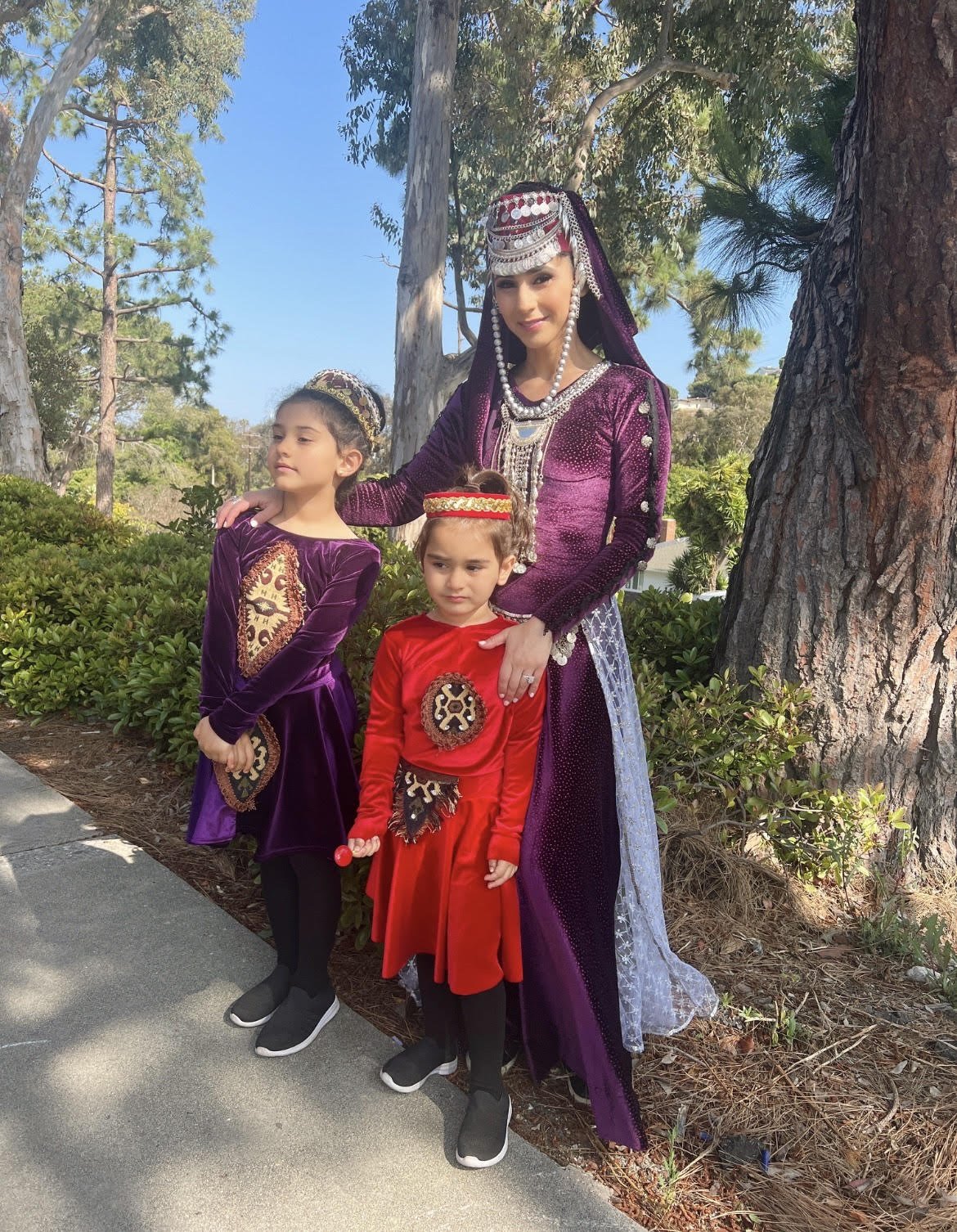 Karapetyan and her daughters in Armenian taraz
“Any time someone gets taken advantage of – the elderly, children, someone who doesn’t speak English – those stories hit me hard. When I come home and interact with my girls, who see the beauty in the smallest things, they remind me of innocence. They see the world in such an untainted way. This fills my soul. They replenish the negativity, and it is a blessing,” she said.
Karapetyan enjoys sharing her culture with others and representing the Armenian community. She has been doing it for years with her audience. She creates amazing features on Armenian culture and history, including a special each April called “Celebrating the Armenian Spirit.” Recently, her story on NBA Warriors coach Steve Kerr and his grandparents’ role in saving thousands of Armenian orphans during the Genocide earned her an Emmy and a Golden Mike nomination.
“I often try to explain to people that for me Armenia is a feeling, a connection I have. It’s almost inexplicable. I am American of course, and proud to be, but I am Armenian at my core. I try to balance it out. I know I’m not alone in sometimes feeling lost or out of place. I wish more people spoke more about this balancing act they may also feel,” Karapetyan reflected.
It is so refreshing to see how her colleagues and viewers engage and interact with Armenian stories.
“2020 was a terrible year for me. The viewers would email saying, we see sadness in your eyes. The viewers become interested in your life, and they follow you on social media. People do care. People are naturally good, even with all of the bad news. You have to find that light and hold on to it.”
Author information

Talar Keoseyan
Talar Keoseyan is a mother, educator and writer. Talar’s books “Mom and Dad, Why Do I Need to Know My Armenian Heritage?”, “Tigran’s Song and “Our Tigran” are available on Amazon. She has been an educator for 26 years and resides in Los Angeles, CA. She can be reached at talar725@gmail.com.
|
The post News anchor Araksya Karapetyan on “finding the light” appeared first on The Armenian Weekly.
The issue of defending the collective rights of the people of Artsakh, including their right to return to their homeland is a strategic goal, Artsakh’s former State Minister and Human Rights Defender Artak Beglaryan said Tuesday in an interview with News.am
“We should not allow the Armenian authorities to close this issue. It should be on the negotiating table with Azerbaijan. Without a clear position by the Armenian authorities, we will not achieve the result. They must emphasize that this does not mean territorial claims to Azerbaijan. The International Court of Justice made a relevant decision on the right of return of the Artsakh people,” Beglaryan said.
Beglaryan called the housing issue the most acute social problem for Artsakh residents.
“Based on these reasons, it is wrong to compare Artsakh residents with the residents of Armenia who are deprived of housing. Artsakh residents became displaced as a result of genocide due to the failure of Armenia to fulfill its commitments. Russia, France, the United States, and, in general, the whole international community also failed,” the former state minister explained.
“In addition, we have the status of refugees, for which Armenia has additional obligations. In our case, the source of funding is also different. Armenia should demand large sums of money from the international community to solve the social problems of the Artsakh people. Instead of that the Armenian authorities declare that they solve those problems in a spectacular way, giving a signal to the international community that there is no need for their support,” Beglaryan emphasized.
He explained that there is pressure on the Artsakh authorities from official Yerevan, saying this posturing is one of the reasons for the lack of public activity of Artsakh officials.
“This is related to different internal political fears of Armenian authorities, which becomes a reason for targeting Artsakh people and generating anti-Artsakh sentiments in the society.
Taking into account various risks, threats, and pressure, Artsakh officials behave with restraint in the public space,” Beglaryan explained.
Despite the lack of resources, which has slowed the ability for Artsakh authorities to operate. Despite this, however, Beglaryan said there have been contacts with foreign officials. He and former Artsakh Human Rights Defender Gegham Stepanyan were recently in Washington, where they held meeting with members of Congress and participated in panels that outline the current plight of the people of Artsakh.
Beglaryan also sounded the alarm that official Yerevan may give up pursuing the complaints against in various international legal circles, if there is no tangible public resistance.
He said that the Armenian authorities are constantly making concessions to Azerbaijan without getting anything in return. The same thing happened in the Artsakh issue. “It is strange that they are not learning lessons from these mistakes,” Beglaryan said.
“We are essentially abandoning an important deterrent legal and diplomatic avenue. Azerbaijan continues its policy of hatred toward Armenians and pursues a policy of occupation against Armenia. Therefore, if we refuse to complain, Baku will continue to commit new crimes. Today’s crimes are a consequence of impunity for previous crimes. Such a decision of the Armenian authorities will support the criminal regime in Azerbaijan,” Beglaryan stressed.
The former Artsakh State Minister reminded that lawsuits have been filed against Azerbaijan both in the International Court of Justice and the European Court of Human Rights.
“There is a need and possibility for filing new lawsuits with very strong factual and legal bases. As for the statements by the Armenian authorities that they will take such a step if Azerbaijan also drops its complaints, it is important to realize that these very complaints by Azerbaijan are groundless, unlike the Armenian cases. Baku filed a lawsuit to use it as a subject of political bargaining,” he explained.
He said he is actively cooperating with members of the Committee for the Protection of Fundamental Rights of the Artsakh People, headed by Armenia’s former foreign minister Vartan Oskanian.
“Active, effective co-operation is underway. I hope that the Committee will move to the stage of public activity. It is important that this Committee does not cast a shadow on Artsakh’s state institutions or take over their powers,” Beglaryan concluded.
Beglaryan announced that a rally will be held Wednesday, which will address the problems related to the needs of the people of Artsakh and will not be related to the internal political processes in Armenia.
The former state minister added that Artsakh authorities have declared their readiness to take part in the rally.
Beglaryan urged the Armenian authorities not to try to generate negative sentiments toward the people of Artsakh.
He noted that already since September 2023, “the propaganda machine of the Armenian authorities has been speculating that the Artsakh people have allegedly come to Armenia to carry out the change of power.”
In his assessment, this frankly hinders both the Artsakh people and the constructive internal political struggle in Armenia.
“It is necessary to fight for the state institutions of Artsakh to be preserved, and the Armenian authorities, as well as the international community, must reckon with them. The legitimacy of Artsakh’s state institutions must not be damaged. We will not pour water on this mill of the Armenian and Azerbaijani authorities,” Beglaryan concluded.
YEREVAN (Azatutyun.am)—Armenia must cede more territory to Azerbaijan to avoid another attack by its neighbor, Prime Minister Nikol Pashinyan told residents of Armenian border villages that would be gravely affected by that unilateral concession.
Pashinyan visited on Monday two of those villages in Armenia’s northern Tavush province, Voskepar and Kirants, that are adjacent to four deserted settlements occupied by the Armenian army in 1991-1992. He signaled last week his readiness to accept Baku’s demands for an unconditional Armenian withdrawal from those contested areas.
Pashinyan’s office released on Tuesday more excerpts from his comments made during meetings with local residents seriously concerned about the security of their families and communities. In a video publicized by the office, he essentially confirmed that in exchange for the Armenian withdrawal Azerbaijan would not liberate any Armenian territory occupied by it in the same area in the early 1990s.
“Our policy is that we must not allow the outbreak of a war,” Pashinyan told the villagers. “This is also a reason why we decided to opt for adjusting the border of Armenia at this section.”
“In this situation, it’s better for us to stand on our border and put forward demands for them to leave our territory than to stand beyond our border while knowing that they will use it as a target,” he said.
He claimed that failure to meet the Azerbaijani demands would “mean a war will break out at the end of the week.”
Many of the locals were unconvinced by that explanation. More of them said on Tuesday that they would lose access to their land, have trouble communicating with the rest of the country and be far more vulnerable from Azerbaijani armed attacks.
“[Pashinyan] said, ‘Here is my advice to you: we must settle this without fighting; or else, we will lose,’” one Voskepar resident told RFE/RL’s Armenian Service.
“The [old] border is only 80 meters from the village school. Five of its 55 students are from my household. How could I let them go there?” said the man.
“I won’t let my grandchildren go to school,” agreed another, female resident. “I will immediately get them out. If there is no school, there is also no village.”
“I didn’t go to the meeting [with Pashinyan,] but everyone who did came away from it very unhappy and disappointed,” said another woman.
The territorial concessions planned by Pashinyan have been strongly condemned by the Armenian opposition. Opposition leaders say they would not only have serious consequences for the security of the affected communities but also the country as a whole.
“Fulfilling Azerbaijan’s incessant demands by continuously threatening our people with war will not only not prevent Azerbaijan from making new demands but will also create fertile ground for new aggressive actions by the latter,” the main opposition Hayastan alliance said in a statement released on Tuesday. It said that Pashinyan will commit a “grave crime against the state” if he goes ahead with his plans.
The ruined villages claimed by Baku are strategically located along one of the two main Armenian highways leading to Georgia as well as the pipeline supplying Russian natural gas to Armenia via Georgia. Pashinyan said on March 12 that the local sections of that infrastructure must be rerouted “so that they pass through Armenia’s de jure territory.”
Seyran Ohanian, a former defense minister leading Hayastan’s parliamentary group, countered that building such bypasses would be very difficult and time-consuming.
Ohanian said the handover of the border areas would also breach the integrity of the Armenian army’s border defense fortifications in Tavush reinforced over the last three decades. Azerbaijani troops would pose a more serious security threat to this and another northern Armenian province, Lori, he told RFE/RL’s Armenian Service.
Pashinyan had already ordered unilateral Armenian troop withdrawals from contested border areas in the southeastern Syunik province in the wake of the 2020 war in Nagorno-Karabakh. That did not stop Azerbaijani forces from attacking Syunik and making territorial gains there in 2021 and 2022.
by Nini Gabritchidze
Georgian companies say they employ a growing number of foreign workers and want to attract more as the local workforce emigrates.
The trend follows longstanding concerns over labor shortages voiced by the representatives of various industries, with the construction and hospitality sectors particularly affected. The growing cost of living has pushed more Georgians to emigrate, leading local businesses to fill the resulting gap with workers from neighboring countries and Central Asia.
“The labor supply in the market is not keeping pace with the growing volume of construction, so [the problem] is getting worse over time,” Beso Ortoidze, general director of Arsi, a Georgian construction company, told Business Media Georgia in March.
Ortoidze said labor emigration and the construction boom have led companies to consider bringing in workers from Turkey, Uzbekistan, and Tajikistan, describing the trend as “normal.”
“If Georgians are going to Eastern Europe, and [those from Eastern Europe] are going to Western Europe, it’s logical that [workers] are coming here from Asia,” he argued.
Local employers started sounding the alarm about labor shortages as Georgia began to recover from the economic crisis caused by the pandemic. As restaurants reopened and tourism picked up, businesses increasingly complained that they were having trouble finding people to hire, including in the service sector. At the time, these complaints led to controversy as they contrasted with the perceptions of Georgian workers, who, in turn, complained of unemployment and poor working conditions. Currently, the official unemployment stands at 16.4 percent.
The shortage forced employers to raise salaries, but they say it was not enough to attract workers. They now think emigration is chiefly to blame.
While it used to be mainly Georgian women who migrated to Western European countries for care work, more and more young men are seeking and finding better-paying jobs in Eastern Europe, with Poland standing out as a particularly popular destination. Concerns have also grown over the fate of those who risk their safety by crossing illegally into the United States via Mexico.
Prior to the pandemic, Georgia was characterized by a negative net migration, a trend apparently boosted by visa-free travel to the EU from 2017. The pandemic and the influx of tens of thousands of Russians, Belarusians, and Ukrainians after Russia’s full-scale invasion of Ukraine partially distorted that picture. The official data show a decade-high of 125,269 people leaving the country in 2022 (the peak may be partly related to the opening of borders after the pandemic, however). Still, the net migration is positive, reflecting the war-related influx.
 Number of immigrants vs emigrants in Georgia in 2015-2022. Source: Geostat
“Aging population, workforce outflow, and low birth rate make labor shortage a long-term challenge,” warned TBC Capital, a Georgian think tank, in a report published in February. According to the report, labor inflows were “still expected from relatively lower-income neighboring countries” to work in areas such as construction, agriculture, and accommodation/food service.
Eventually, Georgian businesses confirmed that they were offering more jobs to foreigners. According to one account, foreigners made up 20-40 percent of the construction workforce in January. Construction industry representatives say they particularly struggle to plug the gap among skilled workers.
In Georgia, labor shortage appears to persist even though the average wage has been growing over the past years.
The latest official data show that the average nominal salary in construction climbed from GEL 2,536 (USD 935) in the last quarter of 2022 to GEL 3,063 (USD 1,130) in the same period of 2023 – higher than the overall average (USD 753). Median salaries, however, are lower, at GEL 1,500 (USD 553) in construction in 2022, as per the latest official data. And while the construction sector is one of the better-paid industries in Georgia, the median wage still falls short of what Fair Labor Platform, a Georgian watchdog, calculated to be a “living wage” in Georgia – currently at GEL 1,706 (USD 630).
Shortages and workforce emigration have also been attributed to poor working conditions. A recent study highlighted a worrying deficit of nurses, known to be one of the most overworked and underpaid groups of workers in the country.
A parallel rise in the cost of living has further undercut the effects of nominal wage growth. Inflation in Georgia peaked in 2021-2022, and despite moderating trends over the past year, life hasn’t gotten cheaper for many Georgians. Skyrocketing prices for food and housing have left many struggling to make ends meet.
As the general elections are looming in October, high prices and emigration are becoming hot topics in political discussions. The ruling Georgian Dream party has downplayed the emigration concerns, attributing the exodus to relaxed travel rules with more developed countries. In recent years, the Georgian government has even tried to promote legal employment opportunities for Georgians abroad, including in Germany.
But behind the scenes, the authorities may be growing increasingly worried over the effects of the workforce outflow. Germany’s Tagesschau news service reported last December that Georgia had rejected an offer to expand Georgian access to the German labor market.
“From the German perspective, a sensible move – but for Georgia, this idea was completely uninteresting,” Tagesschau wrote.
by Nini Gabritchidze
Georgian companies say they employ a growing number of foreign workers and want to attract more as the local workforce emigrates.
The trend follows longstanding concerns over labor shortages voiced by the representatives of various industries, with the construction and hospitality sectors particularly affected. The growing cost of living has pushed more Georgians to emigrate, leading local businesses to fill the resulting gap with workers from neighboring countries and Central Asia.
“The labor supply in the market is not keeping pace with the growing volume of construction, so [the problem] is getting worse over time,” Beso Ortoidze, general director of Arsi, a Georgian construction company, told Business Media Georgia in March.
Ortoidze said labor emigration and the construction boom have led companies to consider bringing in workers from Turkey, Uzbekistan, and Tajikistan, describing the trend as “normal.”
“If Georgians are going to Eastern Europe, and [those from Eastern Europe] are going to Western Europe, it’s logical that [workers] are coming here from Asia,” he argued.
Local employers started sounding the alarm about labor shortages as Georgia began to recover from the economic crisis caused by the pandemic. As restaurants reopened and tourism picked up, businesses increasingly complained that they were having trouble finding people to hire, including in the service sector. At the time, these complaints led to controversy as they contrasted with the perceptions of Georgian workers, who, in turn, complained of unemployment and poor working conditions. Currently, the official unemployment stands at 16.4 percent.
The shortage forced employers to raise salaries, but they say it was not enough to attract workers. They now think emigration is chiefly to blame.
While it used to be mainly Georgian women who migrated to Western European countries for care work, more and more young men are seeking and finding better-paying jobs in Eastern Europe, with Poland standing out as a particularly popular destination. Concerns have also grown over the fate of those who risk their safety by crossing illegally into the United States via Mexico.
Prior to the pandemic, Georgia was characterized by a negative net migration, a trend apparently boosted by visa-free travel to the EU from 2017. The pandemic and the influx of tens of thousands of Russians, Belarusians, and Ukrainians after Russia’s full-scale invasion of Ukraine partially distorted that picture. The official data show a decade-high of 125,269 people leaving the country in 2022 (the peak may be partly related to the opening of borders after the pandemic, however). Still, the net migration is positive, reflecting the war-related influx.
Number of immigrants vs emigrants in Georgia in 2015-2022. Source: Geostat“Aging population, workforce outflow, and low birth rate make labor shortage a long-term challenge,” warned TBC Capital, a Georgian think tank, in a report published in February. According to the report, labor inflows were “still expected from relatively lower-income neighboring countries” to work in areas such as construction, agriculture, and accommodation/food service.
Eventually, Georgian businesses confirmed that they were offering more jobs to foreigners. According to one account, foreigners made up 20-40 percent of the construction workforce in January. Construction industry representatives say they particularly struggle to plug the gap among skilled workers.
In Georgia, labor shortage appears to persist even though the average wage has been growing over the past years.
The latest official data show that the average nominal salary in construction climbed from GEL 2,536 (USD 935) in the last quarter of 2022 to GEL 3,063 (USD 1,130) in the same period of 2023 – higher than the overall average (USD 753). Median salaries, however, are lower, at GEL 1,500 (USD 553) in construction in 2022, as per the latest official data. And while the construction sector is one of the better-paid industries in Georgia, the median wage still falls short of what Fair Labor Platform, a Georgian watchdog, calculated to be a “living wage” in Georgia – currently at GEL 1,706 (USD 630).
Shortages and workforce emigration have also been attributed to poor working conditions. A recent study highlighted a worrying deficit of nurses, known to be one of the most overworked and underpaid groups of workers in the country.
A parallel rise in the cost of living has further undercut the effects of nominal wage growth. Inflation in Georgia peaked in 2021-2022, and despite moderating trends over the past year, life hasn’t gotten cheaper for many Georgians. Skyrocketing prices for food and housing have left many struggling to make ends meet.
As the general elections are looming in October, high prices and emigration are becoming hot topics in political discussions. The ruling Georgian Dream party has downplayed the emigration concerns, attributing the exodus to relaxed travel rules with more developed countries. In recent years, the Georgian government has even tried to promote legal employment opportunities for Georgians abroad, including in Germany.
But behind the scenes, the authorities may be growing increasingly worried over the effects of the workforce outflow. Germany’s Tagesschau news service reported last December that Georgia had rejected an offer to expand Georgian access to the German labor market.
“From the German perspective, a sensible move – but for Georgia, this idea was completely uninteresting,” Tagesschau wrote.