
Newly Elected Iranian Hardliners Try To Assert Their Influence ایران اینترنشنال
Day: March 17, 2024
Categories
NPR News: 03-17-2024 7AM EDT
By Deepika Saraswat
The moderates continue to be sidelined in Iran in the wake of the failure of their outreach to the West as conservatives have consolidated power amid an ongoing generational change in Iran’s political leadership. The exclusion of reformists and an insignificant presence of moderates in the new Assembly of Experts leaves no doubt that Ayatollah Khamenei’s successor will be a conservative figure.
On 1 March 2024, elections were held in Iran for the 290-seat Islamic Consultative Assembly and the 88-member Assembly of Experts that elects the Supreme Leader and oversees his performance. According to figures released by Iran’s Interior Ministry, over 25 million people cast their votes with a 41 per cent turnout rate.1 The election process and the outcome were in keeping with the trend since the last parliamentary election in 2020 when the moderates were sidelined in the wake of the failure of their outreach to the West as conservatives consolidated power amid an ongoing generational change in Iran’s political leadership.
Given the marginal participation of reformists and moderates, the parliamentary elections were primarily a competition among the conservative factions. However, the surprising outcome was the better performance of the candidates and newcomers belonging to the hardliner Front of Islamic Revolution Stability (known by its Persian acronym Paydari), in comparison to the traditional conservatives led by current parliament speaker Bagher Ghalibaf, who is a three-time presidential candidate, former mayor of Tehran and also a former commander of the Islamic Revolutionary Guard Corps (IRGC) Aerospace Force.
The Process
The 290 members of the Majlis represent Iran’s 207 electoral districts. Tehran with 30 seats is the largest multi-seat district and East Azerbaijan with six seats is the second largest. For multi-party districts, informal factions make lists of candidates to be elected, and seats are distributed to candidates in proportion to the number of votes received.2 Successful candidates are also required to get a minimum of 20 per cent of votes cast. As a result, several representatives in Tehran district are elected through runoff elections which will be held in coming months.
The Elections Supervisory Board headed by the deputy interior minister for political affairs does the initial vetting for the candidates who register for elections. Subsequently, the candidates are vetted by the 12-member Guardian Council, comprising six Islamic jurists selected by the Supreme Leader, and six jurists elected by the parliament from a pool of candidates nominated by the Chief Justice, who, in turn, is also appointed by the Supreme Leader.
The criteria on which the Guardian Council must base its decision to qualify or disqualify candidates are listed in Article 28 of the Elections Act of Islamic Consultative Assembly. However, in recent years, several prominent disqualified candidates have alleged political bias and demanded explanations for the Council’s decisions. The Assembly of Experts comprises 88 mujtahids or experts of Islamic jurisprudence, who are elected by direct public vote for eight-year terms from 31 electoral districts or administrative provinces in the country.3 To reduce costs and to increase voter participation, the last election for the assembly was postponed by one year and held together with the 2016 parliament elections.
Hardliners on the Rise
In Iran’s hybrid political system, the Supreme Leader leads the parallel state institutions including the Guardian Council and the judiciary, which play a vital role in preserving Iran’s Islamic system against challenges emerging from Iran’s republican institutions including the office of the president and the national parliament.4 Traditionally, during periods of confrontation with the United States and a deteriorating regional security environment, hardliners, many of them former commanders of the Islamic Revolutionary Guards, are able to claim political power as the guardians of the security of the nation. Further, as many of the leaders and movements who have dominated Iran’s politics for the last three decades are passing from the scene, the parallel state has seized the opportunity to create a cohesive political system populated by a younger generation of conservatives.
Given that the elections followed sustained nation-wide anti-regime protests triggered in September 2022 following the death of Mahsa Amini who was detained for ‘improper hijab’, the issue of popular participation dominated the election agenda. Traditionally, it is the reformists and moderates who have used polarising issues such as civil rights, as in the case of Mohammad Khatami, economy and improvement of relations with the United States in the case of Hassan Rouhani, to ride popular participation to victory.
As reformists and moderates are crowded out of the political system, the conservatives fall back on nationalist rhetoric to appeal for voter participation. Ayatollah Khamenei in a major speech in January stated that participation in elections is both a duty and people’s right.5 In another speech on 18 February, Khamenei stated that
‘elections are a manifestation of the republican system and this is why the Arrogant Powers and the US, who are opposed to both republicanism and the Islamic nature of the Islamic Republic, are against the elections and the enthusiastic participation of the people’.6
The trend of the Guardian Council disqualifying prominent reformist and moderate candidates, which started with the 2020 parliamentary elections, continued. Among the 26 sitting members of the parliament disqualified by the Guardian Council, several belong to traditional conservative camps who served in prominent positions under Rouhani. Gholamreza Nouri Ghezeljeh, a moderate-conservative from Bostanabad in East Azerbaijan who served as deputy speaker when Ali Larijani was the parliament speaker, was disqualified. He had made headlines last year when he claimed that Iran’s annual inflation rate was 120 per cent, much higher than figures reported by other government officials. “Downplaying economic problems will add to people’s distrust of the government,” he had said.7
Masoud Pezeshkian, who succeeded Ghezeljeh as deputy speaker, was also disqualified. Ahmad Alireza Beigi, who represented East Azerbaijan for two terms and was governor of the province under former President Mahmoud Ahmadinejad, was also disqualified. In 2023, he had alleged that the Minister of Industry, Mines, and Trade, Reza Fatemi Amin, had bribed several parliamentarians with SUVs so that they would withdraw their votes for his impeachment.8 Evidently, in addition to the traditional conservatives who had aligned with the Rouhani administration, candidates linked to Ahmadinejad, who had fallen out of favour with the Supreme Leader and the principlist camp during his second term, have been kept out of the race.
In January, while explaining the reformists’ decision not to field any candidate for parliament, Mahmoud Mirlohi, a member of the Reformists’ Supreme Council for Policymaking, said the young generation in Iran that finds itself at odds with the ruling principlists, does not view the reformists as the solution to the myriad of problems in the country either.9 Ali Motahari, who has represented Tehran from 2008 to 2020, led the reformist Voice of Iranians list in Tehran. While a Social Conservative on the key issue of hijab, he had contested the 2016 election as part of Rouhani’s Hope list and supported a nuclear deal with the West.10
Motahari has come to be regarded as a conservative-reformist after he repeatedly criticised Supreme Leader Khamenei’s decree on the house arrest of Green Movement leaders, former Prime Minister Mir Hossein Mousavi and former parliament speaker Mehdi Karroubi as contravening the constitution. His prominent lineage as a son of Ayatollah Morteza Motahhari, a close associate of Ayatollah Khomeini and a prominent ideologue who popularised the political theory of Shi’ism and religious leadership among Iranian youth in the years leading to the Islamic Revolution, has shielded him to some extent. He was physically attacked in 2015 by hardline elements.11 However, his list failed to gain any seats because of the low turnout among pro-reformist voters and the relative obscurity of its candidates.12
In Tehran, where in the past clerics have seldom emerged as top vote-getters, hardline clerics, Mahmoud Nabavian and Hamid Rasaee clinched first and third places respectively, and Amirhossein Sabeti, a young hardliner activist and a former political show anchor, came in second place.13 All three are linked to Paydari, but there were three separate hardline lists. Rasaee led his own list called Amana, Manouchehr Mottaki, the former foreign minister under Ahmadinejad headed the United Front list and controversial social media propagandist Prof. Ali Akbar Raefipour, who has a base of young followers, led ‘Dawn of Iran’ list, with Saeed Mohammad as a prominent figure.
Mohammad belongs to the younger generation of IRGC commanders. He had resigned from his position as the chief of the IRGC engineering arm and business conglomerate Khatam Al-Anbiya Construction Headquarters to run for the 2021 presidential elections.14 He had backed Raisi after his own candidacy was disqualified. His alliance with Raefipour came in the wake of his removal from the position of Secretary of the Supreme Council of Free and Special Economic Zones only a year after he was appointed by Raisi.
Bagher Ghalibaf led the traditional conservative SHANA (Persian acronym for Council for the Coalition of Revolutionary Forces). Ghalibaf, who had secured the highest votes in Tehran in 2020, lost two-thirds of his votes falling to fourth place. Out of the 14 candidates who secured seats in Tehran, only seven belong to SHANA. The remaining 14 representatives will have to be elected in the runoff.15 The reformist daily Sharq, analysing the election outcome, noted that “‘while all media affiliated with official institutions were behind the SHANA list, organised online networks were in the hands of SHANA’s rivals. This network was essentially formed around the discourse of ‘anti-Qalibaf’”.16
Notably, in both 2020 and the latest elections, Paydari and SHANA lists had common names. For instance, Nabavian, who received the highest votes in Tehran, was on several lists. But in the current elections, Paydari has emerged as the most powerful group within the principlists. As its leaders stake claim for the position of parliament speaker, putting pressure on Ghalibaf, Supreme Leader Khamenei has warned conservatives against infighting and divisions in the new parliament.17 Paydari has been fiercely critical of the reformist cause of social and cultural freedoms and diplomacy with the West and denounces them as ‘seditionists’ and ‘deviant’. With a combination of hardline clerics and ex-IRGC leaders, it has a securitised approach to both governance and Iran’s foreign policy.18
Assembly of Experts: Moderates and Reformists Excluded
The elections for the sixth Assembly of Experts were especially important given that the newly elected body during its eight-year term will be responsible for electing a successor to the current octogenarian Supreme Leader Ayatollah Khamenei. Of the 510 clerics who registered for 88 seats, only 144 (28 per cent) were deemed qualified. Former president Rouhani and Mahmoud Alavi, who served as his intelligence minister were among the prominent incumbents who were barred from running. Rouhani in a written statement noted that his disqualification is at odds with the demand of the leader of Iran’s Islamic Revolution for all efforts to pave the way for a huge turnout in the vote and added that the move confirms that what the “ruling minority” wants is a low popular turnout so that they will determine people’s future with their own decisions.19
Ayatollah Sadegh Amoli Larijani, former two-term judiciary chief and the head of the Expediency Council, lost his seat in the assembly after ranking fifth in the vote for four seats in Mazandaran. Analysts note that during his term in the judiciary, his severe crackdown on Supreme Leaders’ critique had created severe backlash from rival conservatives from the Ahmadinejad camp.20 In 2021, after his brother Ali Larijani was disqualified from the 2021 presidential elections, Sadegh Larijani had alleged interference by security organisations in the decision-making process and said that he has “never found its decisions so indefensible”. Amoli Larijani’s defeat underscores the diminished influence of Larijani family during the crucial transition period in country’s politics. President Raisi garnered 82 per cent votes in South Khorasan, where all rivals except one were disqualified by the Council.21
Conclusion
The recent elections underscore that the Islamic Republic of Iran increasingly resembles other ‘managed democracies’ such as Russia, where electoral institutions no longer yield to a meaningful contestation for power. A section of the elite through its control over elections is able to perpetuate and legitimise its hold on political power. The most significant outcome of the parliament elections is the rise of a younger generation of hardliners, whose ambitions and combative politics seems to belie the hopes that conservative consolidation will translate into political unity. The exclusion of reformists and an insignificant presence of moderates in the new Assembly of Experts leaves no doubt that Ayatollah Khamenei’s successor will be a conservative figure.
Views expressed are of the author and do not necessarily reflect the views of the Manohar Parrrikar IDSA or of the Government of India.
About the author: Dr Deepika Saraswat is an Associate Fellow at the Manohar Parrikar Institute for Defence Studies and Analyses.
Source: This article was published by Manohar Parrrikar IDSA
- 1.“Interior Ministry Discloses 41% Voter Turnout in March 1 Elections”, Tehran Times, 4 March 2024.
- 2.Mehrzad Boroujerdi, “Iran’s Faustian 2024 Elections: Statistics Tell the Story”, Stimson, 4 March 2024.
- 3.Farideh Farhi, “The Assembly of Experts”, The Iran Primer, 13 June 2011.
- 4.Mohammad Ayatollahi Tabaar, “Iran’s War Within Ebrahim Raisi and the Triumph of the Hard-Liners”, Foreign Affairs, 5 August 2021.
- 5.“Iranian Politician: Reformists Won’t Ban Elections, Not to Field Candidates Either”, Iran Front Page, 26 January 2024.
- 6.“Elections are Main Pillar of the Islamic Republic & In It People are the Owners of the Country”, Nournews, 18 February 2024.
- 7.“News Digest: Week of July 3”, The Iran Primer, 10 July 2023.
- 8.“Iranian MP: 300 SUVs Given to Lawmakers in ‘Criminal, Fraudulent’ Move”, Iran Front Page, 23 August 2023.
- 9.“Iranian Politician: Reformists Won’t Ban Elections, Not to Field Candidates Either”, no. 5.
- 10.Farzan Sabet, “Iran’s 2016 Elections: Change or Continuity?”, Carnegie Endowment For International Peace, 9 June 2016.
- 11.Emad Askarieh, “Attack on MP Motahari Outrageous: Rafsanjani”, Iran Front Page, 15 March 2015.
- 12.Sina Toossi, “Iran’s New Wave of Political Conservatives Is Here”, Foreign Policy, 7 March 2024.
- 13.Mehrzad Boroujerdi, “Iran’s Faustian 2024 Elections: Statistics Tell the Story”, Stimson, 4 March 2024.
- 14.Arash Azizi, “March 1 is the Upcoming Iranian Elections. The Terrain Looks More Divided Than Ever”, Atlantic Council, 28 February 2024.
- 15.Mehrzad Boroujerdi, “Iran’s Faustian 2024 Elections: Statistics Tell the Story”, Stimson, 4 March 2024.
- 16.Sina Toossi, “Iran’s New Wave of Political Conservatives Is Here”, no. 12.
- 17.“As Dust from Elections Settles, Iran’s Conservatives Clash Over Spoils”, Amwaj Media, 12 March 2024.
- 18.Ellie Geranmayeh, “Part 1: Reviving the Revolutionaries”, The Iran Primer, 14 July 2020.
- 19.“Iran’s Former President Rouhani Slams His Disqualification from Elections”, Iran Front Page, 25 January 2024.
- 20.“In Irony, Ahmedinezhad Calls For Free Elections in Iran”, Informed Comment, 22 February 2018.
- 21.“Raisi Wins Expert Assembly Election as Rivals Removed from Ballot: Iranian Press Review”, Middle East Eye, 5 February 2024.
On March 11, 2024, President Biden released his budget proposal for the U.S. government’s 2025 fiscal year. It’s a remarkable document because he seeks to permanently lock in the unsustainable spending that characterizes his administration’s fiscal policy.
The editors of Issues & Insights describe the Biden administration’s track record on fiscal policy as “a fiscal and economic disaster of epic proportions.” With the federal government now borrowing $10 billion daily to fund Biden’s spending, the evidence to support that point of view is mounting.
However, I&I’s editors did more than just state their viewpoint. They used President Biden’s budget proposals to back their case.
“So, we dug out Biden’s first budget—released in early 2021—to see what the administration said would happen if Biden did nothing. In other words, what would spending, revenues and deficits look like if all of President Donald Trump’s policies remained in effect. Let’s call this the Trump baseline.
“Then we compared that with the latest “Baseline” projection in Biden’s new budget—which assumes that all of Biden’s current policies remain in effect for the foreseeable future. We will call this the Biden baseline.
“What did we find?
“In his latest budget, Biden says that deficits over the next five years will total $9 trillion. Again, that’s assuming that the government is left on autopilot over that time. The Biden baseline puts us on course to borrow a total of $9 trillion from 2025 through 2029.
“But the Trump baseline would have produced deficits over these same years of $6.1 trillion.
“As a result, we now know that Biden’s policies have boosted projected deficits by $2.9 trillion from 2025 to 2029.“
The numbers recorded in Biden’s own budget proposals undermine his claim that his administration’s fiscal policies have reduced the federal government’s annual budget deficits.
However, that’s not the only data in President Biden’s budget proposal undermining his federal budget deficit reduction claims. CNBC’s Brian Sullivan took aim at the President’s claim that implementing his budget would reduce those deficits by $3 trillion over the next 10 years in a tweet:
DC strategist email note this morning lays it out well.
The budget deficit will growth another $16 TRILLION over next 10 years. Thats *with* the proposed massive tax hikes.
Without them the deficit will grow $19 trillion.
That’s why you will hear the “deficit is being… https://t.co/W5aideSUx1 pic.twitter.com/ELpg7vyeDM
— Brian Sullivan (@SullyCNBC) March 12, 2024
That’s some really bad deficit math! I wonder if anyone in Washington, D.C. notices you can get the same reduction by reducing the proposed spending by about $0.82 billion per day over 10 years. For an administration already borrowing $10 billion per day, that would be chump change!
The only problem is the government’s proposed deficit spending would still add up to $16 trillion over the next 10 years. Letting that spending run wild for another ten years is still an unsustainable fiscal policy.
By David Gordon and Wanjiru Njoya
Olúfẹ́mi O. Táíwò, who teaches philosophy at Georgetown University, has a very different view of justice from libertarians. We believe that justice is based on the libertarian rights of self-ownership and Lockean appropriation, expressed in laws that apply to everyone and do not discriminate between different races or classes of people.
Táíwò, by contrast, is a proponent of what Thomas Sowell calls cosmic justice. Sowell remarks:
However, unlike God at the dawn of Creation, we cannot simply say, “Let there be equality!” or “Let there be justice!” We must begin with the universe that we were born into and weigh the costs of making any specific change in it to achieve a specific end. We cannot simply “do something” whenever we are morally indignant, while disdaining to consider the costs entailed. . . .
Cosmic justice is not simply a higher degree of traditional justice, it is a fundamentally different concept. Traditionally, justice or injustice is characteristic of a process. A defendant in a criminal case would be said to have received justice if the trial were conducted as it should be, under fair rules and with the judge and jury being impartial. After such a trial, it could be said that “justice was done”—regardless of whether the outcome was an acquittal or an execution. Conversely, if the trial were conducted in violation of the rules and with a judge or jury showing prejudice against the defendant, this would be considered an unfair or unjust trial—even if the prosecutor failed in the end to get enough jurors to vote to convict an innocent person. In short, traditional justice is about impartial processes rather than either results or prospects.
Táíwò’s variant of cosmic justice combines a racialized version of Marxism with a “capabilities” theory of justice, similar to the approaches of Elizabeth Anderson, Martha Nussbaum, and Amartya Sen but extended over the globe rather than restricted to the citizens of a particular country. Táíwò calls for massive redistribution to third world countries, with programs to mitigate the effects of “climate change” foremost among them. The book consists of an introduction, followed by six chapters and two appendices. In what follows, we shall summarize and comment on a few points of interest in each of these chapters.
In the introduction, Táíwò notes that some blacks such as Coleman Hughes and Adolph Reed have questioned the value of many proposals for reparations. They ask: What good are apologies for slavery? How do they help blacks today? They argue that instead, we should concentrate on building a society that meets the redistributive requirements of “social justice.” Táíwò answers that reparations and social justice aren’t mutually exclusive: “The goal of Reconstructing Reparations is to argue for this perspective: the view that reparation is a construction project. Accordingly, I call this way of thinking about the relationship between justice’s past and future the constructive view of reparations” (emphasis in original).
This goal leads Táíwò to criticize some “woke” practices. Blacks must not make the mistake, he says, of trying to justify our existence to whites. Instead, blacks must concentrate on the constructive view—do it my way or else! He says:
An entire industry of racial commentary, from think pieces to blogs to academic studies and whole fields of researchers, centers upon convincing imagined skeptical whites or Global Northerners that the social sky is in fact blue. Most worrying, we spend so much time and energy responding to others’ mistakes that we lose the ability to distinguish their questions from ours. (emphasis in original)
After the introduction (chapter 1), Táíwò turns to “Reconsidering World History,” and the reconsideration is straight out of Karl Marx. According to Táíwò, capitalism was built on the back of slave labor from Africa and built from plunder. Readers of the famous section on “Primitive Accumulation” in the first volume of Das Kapital will learn little new here other than a list of later writers who have parroted Marxist dogma; these include Kwame Nkrumah, Eric Williams, and Oliver Cromwell Cox.
Here is a sample of his viewpoint:
In the beginning, the connection between racism, colonialism, and capitalism was obvious. The latter was built with political and juridical structures that explicitly mentioned race and empire and overtly managed the affairs of business in the context of both. As Karl Marx succinctly explains in The Poverty of Philosophy: “Direct slavery is just as much the pivot of bourgeois industry as machinery, credits, etc. . . . Slavery is an economic category of the greatest importance.’
It is apparent that Táíwò, like Marx before him, has conflated mercantilism and capitalism. The “Great Enrichment” that has taken place since the Industrial Revolution came about only when the market was released from the shackles imposed by mercantilism. Certainly, imperialism and colonialism continued after that. However, in examining the causation of a change—in this case, the greatly accelerated prosperity—it is necessary to ask, what causal factor was present that was not there earlier?
During the nineteenth century, the British sought to end slavery, using the ships of its Royal Navy—the greatest in the world—to patrol the seas for slave traders. Hundreds of thousands of captives bound for a life of slavery were freed by the Royal Navy West Africa Squadron, and thousands of British sailors died in this campaign. Does this show that capitalist Britain was not altogether dominated by the dark motives Táíwò ascribes to it? He doesn’t think so, writing:
By 1842, Southern elites were already convinced of what scholars argued decades later: that the supposed “humanitarian” project of imperial abolitionism was actually aimed at the empire’s material interests. They took it that the empire’s real goal was to disadvantage its slavery-reliant competitors and thereby gain an effective monopoly over the global supply of cotton and sugar.
Should we be equally dismissive of the moral arguments Táíwò offers for his “construction project”? Are these proposals to be viewed just as ways to advance the economic interests of the third-world people with whom he identifies?
So far, we have seen little in the way of analytic philosophy in the book. Does this change in the next chapter, “The Constructive View”? We fear the answer is that it does not. Táíwò simply presents his position but does not offer any arguments that people have the distributive rights he says they do. He says:
Since the world order is made out of distributive processes, the constructive view is a view about distribution. Because of past and present facts about how advantages and disadvantages have been distributed, they continue to accumulate unevenly and unjustly across different parts of the world, which is visible both at scales as small as individual differences (e.g., differences between white and Black workers) and as large as different political regions of the globe (Global North vs. Global South). The just world we are trying to build is a better distribution system, by apportioning rights, advantages, and burdens in a better manner than the one we’ve inherited from the global racial empire. It is also a view that looks to justly distribute the benefits and burdens of that transitional project of rebuilding.
The equation of “unevenly” with “unjustly” is telling.
Táíwò criticizes John Rawls for adopting a theory of justice in which a country’s obligations to its own citizens are much greater than its obligations to outsiders. The “construction project” would not have it so, but Táíwò ignores Rawls’s arguments for his position, principally that the citizens of a country are tied to one another by bonds of solidarity. We of course do not support Rawls’s theory, but our point here is that Táíwò has not considered the relevant issue. He says:
Rawls’s focus on domestic justice takes the artificial separation of countries a little too seriously. As a result, he consistently fails to consider what the world system as a whole has to do with justice in any particular one of its countries. Rawls assumes that the major institutions of society are determined and regulated internally, and thus that the justice of those institutions should be evaluated as though they are part of a closed system.
This is an ignoratio elenchi. If in fact an economic system is based on the exploitation of the Global South, that needs to be taken into consideration in evaluating the system’s justice. However, that is an external criticism that does not address reasons internal to Rawls’s theory for the two-tier view.
Matters improve somewhat in chapter 4, “What’s Missing?” Táíwò raises two important philosophical issues, but his answers to them aren’t satisfactory. The first of the issues is that the “constructive project” mostly rests on claims that the ancestors of whites living today mistreated the ancestors of blacks living today. However, why are people morally responsible for what their relations have done in the past? Táíwò slices though the problem. It doesn’t matter, he says, whether they are responsible; they are still liable for the damages to the descendants of the mistreated:
Responsibility is closely tied up with a web of related concepts like fault and cause. It is an important aspect of our moral lives, and the concept to which we often instinctively appeal when we make the case for why someone ought to give something to someone else . . . But these common features of our daily moral concepts aren’t built to respond to things on the scale of global racial empire. . . . It’s not, in the straightforward sense, the fault of present-day descendants of settlers or whites that other people’s descendants have a harder time of things. Nor was the world order founded centuries before their birth caused by their actions. There’s a better concept we can use in responsibility’s place: liability. Often liability is assigned on the basis of responsibility . . . but it is possible to create some distance between them: for example, on the view that to be liable is simply to be obligated (typically to pay a price or bear a burden). Many legal systems have a version of what legal scholars call “strict liability,” which obligates people and corporations to bear the costs of injuries in ways that bypass blame and fault-finding entirely. (emphasis in original)
Táíwò offers no arguments in support of the morality of strict liability. In sum, “I want the money, and I’ll take it from you.” We shall leave it to readers to judge whether this is acceptable.
The second issue is indeed philosophically interesting:
One particularly nasty complication with arguments about harm repair concerns what is termed the “non-identity objection” or the “existential worry.” . . . Even had reparation had been paid shortly after the abolition of slavery, how could one “repair” whatever harm was done to a child born into the condition of slavery? . . . Stated generally, it may be impossible to make sense of an individual “harm” claim if the action or process being charged with harm is also responsible for creating the harmed agent. According to this objection, there is no possible world or relevant counterfactual in which the agent is better off without the harming action, because every world in which the harming action does not exist is a world in which the agent who claims they were harmed does not exist either.
Readers should by now be able to guess Táíwò’s “solution”: We can ignore the problem. What we need to do is to redistribute resources to blacks, especially those living in the Global South. Again, we want money, and we want it now!
The remainder of the book requires little attention. In Táíwò’s opinion, “climate change” is the biggest danger to the Global South, and he and a collaborator present detailed suggestions on how to cope with this. We are not “climate scientists,” and an evaluation of this issue would be out of place here. We are inclined to think, though, that the danger is much exaggerated. An appendix offers an account of the Malê Revolt against slavery in Brazil, and in “The Arc of the Moral Universe,” Táíwò invokes the wisdom of his Yoruba ancestors to encourage those who despair that the task of establishing a new world system is too difficult: such changes take time, and we must do what we can to improve things, even though the full realization of our aims is a hope for the future.
We finish this book with a sense of relief, glad to emerge from its miasma into the clear and penetrating light of Ludwig von Mises and Murray Rothbard.
About the authors:
- David Gordon is Senior Fellow at the Ludwig von Mises Institute. He was educated at UCLA, where he earned his PhD in history. He is the author of Resurrecting Economics,An Introduction to Economic Reasoning, An Austro-Libertarian View (three volumes), and Resurrecting Marx. He is also editor of Secession, State, and Liberty and coeditor of H.B. Acton’s Morals of Markets and Other Essays.
- Wanjiru Njoya is an author, teacher, and libertarian.
Source: THis artile was published by the Mises Institute
Moscow has a long history of using border regions to expand Russian influence in neighboring countries, but in the case of Moldova, a country with which the Russian Federation does not share a border, it is expanding this policy and using Russian regions to promote separatism in Transnistria and Gagauzia.
Bryansk, Irkutsk and Kaliningrad oblasts have been working with the breakaway region of Transnistria for almost a decade; and now Krasnodar Kray and Pskov and Penza oblasts have committed themselves to doing the same with restive Christian Turkic Gagauzia (vedomosti.ru/politics/articles/2024/03/11/1024497-rossiiskie-regioni-nachinayut-sotrudnichestvo-s-gagauziei).
Russian analysts are skeptical that this policy will be effective given the lack of a common border, but Moscow likely favors it because using Russian regions in this way allows the Kremlin to work under the radar screen of many governments and to encourage the targeted regions in other countries to view Russian federalism as real.
To the extent that is the case, Moscow is likely to expand this policy innovation toward regions in Moldova to places in other former Soviet republics regardless of whether or not there is a common border between the Russian Federation and the countries of which they are now a part.
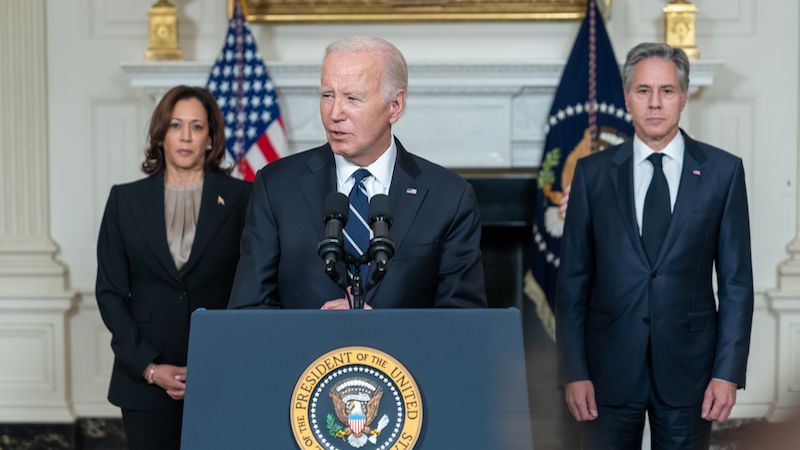
This year’s US presidential elections are not the only potential hurdle confronting President Joe Biden’s multi-pronged vision for a Middle East peace once the Gaza war ends.
So is Israeli intransigence, the prospect of a long-term insurgency in post-war Gaza, and increasing Saudi Chinese technological cooperation.
The Biden administration is pushing for a multi-pronged comprehensive Middle East deal that would not only end the war in Gaza but also produce a resolution of the Israeli-Palestinian conflict.
The deal would involve a reformed Palestine Authority governing Gaza and the West Bank, a credible pathway to an independent Palestinian state alongside Israel, and Saudi recognition of the Jewish state.
The plan doesn’t lack ambition but the odds of all the pieces coming together are almost insurmountable, certainly in the time left until the November US election, even if Saudi Arabia has bought into the concept, albeit with a high price tag.
Assuming the price is right, Saudi Arabia is interested in cutting a deal while Mr. Biden is in office. The kingdom is not sure that a second Donald J. Trump presidency would meet Saudi demands, particularly its insistence on a legally binding defense agreement with the United States.
Despite his catering to the Saudis during his presidency, Mr. Trump turned the moment the kingdom needed US assistance into a business opportunity.
In response to Yemeni Houthi attacks in 2019 on Saudi oil facilities that temporarily knocked out 50 per cent of the kingdom’s oil production capacity, Mr. Trump described the incident as a Saudi, not an American problem, and offered to retaliate on behalf of the Saudis if they were willing to foot the bill.
Saudi Arabia is not the only player putting a price tag on a Middle East deal.
The United States has indicated that Saudi Arabia would have to curtail its technological cooperation with China on return for a defence agreement.
Nevertheless, signalling interest in a deal, Saudi media, much like Al Jazeera, the pioneer in airing Israeli voices in Arab media and covering the Jewish state with correspondents on the ground, have increasingly included Israelis in their reporting on the Gaza war, despite the kingdom’s vocal condemnation of the Jewish state’s war conduct.
Even so, the war has raised the price Saudi Arabia insists on extracting from Israel and the United States in return for diplomatic recognition.
In contrast to vague Saudi references to a resolution of the Palestinian problem before the war, officials now insist on a “credible and irreversible” pathway to the creation of an independent Palestinian state.
Public opinion in the kingdom and across the Muslim world enraged by the Gaza war is one reason for the hardening Saudi position.
However, an incident earlier this week suggests that changing Saudi attitudes towards Israel and Jews may not happen overnight.
A delegation of the United States Commission on International Religious Freedom (USCIRF) curtailed a visit to the kingdom after the group’s chairman, Rabbi Abraham Cooper, was asked to remove his skullcap during a tour of a heritage site, despite Saudi Arabia’s projection of itself as a beacon of tolerant and ‘moderate’ Islam.
The Saudi embassy in Washington said, “This unfortunate incident was the result of a misunderstanding of internal protocols.” The embassy did not say what those protocols are.
The United Arab Emirates recently highlighted the sensitivity of relations with Israel when its state-owned Abu Dhabi National Oil Company (ADNOC) and multinational oil and gas giant BP suspended a US$2 billion bid to buy a major stake in Israel’s NewMed Energy company.
The UAE established relations with Israel in 2020 and has insisted it will maintain the relationship despite its criticism of Israel’s war conduct.
New Med, which owns a 45 per cent stake in Leviathan, Israel’s biggest gas field, and 30 per cent of Aphrodite, located off Cyprus, said the suspension was due to “uncertainty created in the external environment.”
To be sure, Israel is no less in need of a sea change in attitudes towards Palestinians for a pathway to a Palestinian state to be credible and irreversible. That too is not going to happen overnight and may not happen before Americans go to the polls.
Discriminatory attitudes towards Palestinians have always been ingrained in Israeli society but have been on steroids since Hamas’ October 7 attack.
In addition, opposition to a Palestinian state, particularly one that is not demilitarised, extends far beyond Israeli Prime Minister Binyamin Netanyahu’s Likud party and its ultra-nationalist and ultra-conservative coalition partners.
While implicitly highlighting the imperative of a political solution, this week’s US intelligence’s Annual Threat Assessment also implicitly suggested that Hamas will remain a player that will need to be taken into account in any peace process.
In effect, the assessment suggested that Israel would not achieve two of its three war goals: the destruction of Hamas and ensuring that Gaza no longer serves as a launching pad for armed Palestinian resistance.
Similarly, Israel’s third goal, the freeing of Hamas-held hostages is likely to be a product of negotiations rather than military action.
Hamas holds hostage some 136 people and bodies of captives killed in the war. Negotiations on a ceasefire and prisoner exchange have stalled.
“Israel probably will face lingering armed resistance from Hamas for years to come, and the military will struggle to neutralize Hamas’ underground infrastructure, which allows insurgents to hide, regain strength, and surprise Israeli forces,” the assessment predicted.
If correct, continued Palestinian resistance is likely to stiffen Israeli opposition to the creation of a Palestinian state.
In recognition of the likelihood that Hamas will remain a player, the Palestine Authority has insisted that the group would have to be part of the mainstream Palestinian polity, even if it is not represented in a post-war transition government.
The Authority’s insistence is one reason why Mr. Netanyahu opposes taking control of post-war Gaza. Instead, Mr. Netanyahu wants tribal and clan leaders to administer the Strip under Israeli tutelage.
In a first step, Israel was believed to be attempting to recruit Gazan clansmen to provide security for aid convoys entering Gaza.
Bowing to US and international pressure, Israeli military spokesperson Rear-Admiral Daniel Hagari said this week that Israel, accused of using “starvation as a weapon for war,” planned to “flood” the Strip with humanitarian supplies.
The website of Hamas’ Al-Majd intelligence and internal security forces indicated that the group was seeking to thwart Mr. Netanyahu’s plan by targeting Palestinians suspected of cooperating with Israel.
Earlier this week, Al-Majd warned Palestinians who cooperated with Israel that they would be treated as collaborators and handled with an iron fist. Hamas has a history of executing suspected collaborators.
Arab media reports said Hamas had killed in recent days the head of the powerful Doghmush clan and two others in their family compound in Gaza City. Hamas accused the unidentified leader of stealing humanitarian aid and maintaining contact with Israel.
With links to organised crime and the arms trade, Doghmush clansmen have clashed with Hamas in the past. Clan members have been associated with multiple Palestinian groups including Hamas, Palestine Authority President Mahmoud Abbas’ Al Fatah, and various Islamist organisations.
Dubbed the “Sopranos of Gaza City, the Doghmush gained notoriety for their involvement in the 2005 abduction of Israeli soldier Gilad Shalit and the 2007 kidnapping of British journalist Alan Johnston.
The killing is likely to persuade clans potentially willing to work with Israel to reconsider. Hamas this week welcomed a clans’ statement rejecting cooperation with Israel.
The statement “underscored the families’ and clans’ support for our resistance, government, police, and security services, and the rejection of the occupation’s attempts to sway Palestinian nationalism,” Hamas said.