
It is predicted that in 2025, the average daily oil production in Azerbaijan will be 60,000 barrels, Report informs referring to the March release of the Short-Term Energy Outlook report of the Energy Information Administration (EIA) of the US Department
Day: March 13, 2024
https://t.co/YHkLz8qoRB – Biden and Netanyahu’s deepening rift#NewsAndTimes #NT #TNT #News #Times#World #USA #POTUS #DOJ #FBI #CIA #DIA #ODNI#Israel #Mossad #Netanyahu#Ukraine #NewAbwehr #OSINT#Putin #Russia #GRU #Путин, #Россия#SouthCaucasus #Bloggers… pic.twitter.com/jgz8MGme6n
— Michael Novakhov (@mikenov) March 13, 2024
https://t.co/YHkLz8qoRB – Biden and Netanyahu’s deepening rift#NewsAndTimes #NT #TNT #News #Times#World #USA #POTUS #DOJ #FBI #CIA #DIA #ODNI#Israel #Mossad #Netanyahu#Ukraine #NewAbwehr #OSINT#Putin #Russia #GRU #Путин, #Россия#SouthCaucasus #Bloggers… pic.twitter.com/jgz8MGme6n
— Michael Novakhov (@mikenov) March 13, 2024
US President Joe Biden and his predecessor Donald Trump have both passed the delegate thresholds to clinch their parties’ nominations for the election in November, the BBC reports.
Four states, one American territory and Democrats living abroad held their primaries on Tuesday.
The result means US voters face a rematch of the 2020 presidential election in eight months’ time.
The nominations will be made official at party conventions this summer.
The 81-year-old president said on Tuesday evening that he was “honored” voters had backed his re-election bid “in a moment when the threat Trump poses is greater than ever”.
Citing positive economic trends, he asserted the US was “in the middle of a comeback” but faced challenges to its future as a democracy, as well as from those seeking to pass abortion restrictions and cut social programmes.
“I believe that the American people will choose to keep us moving into the future,” Mr Biden said in a statement from his campaign.
Incumbency gave Mr Biden a natural advantage and he faced no serious challengers for the Democratic nomination.
Despite persistent concerns from voters that his age limits his ability to perform the duties of the presidency, the party apparatus rallied around him.
Meanwhile, Mr Trump, 77, remains very popular with the Republican voter base, which has propelled him to victory in primary after primary over well-funded rivals.
Google has confirmed it is restricting the types of election-related questions users can ask its Artificial Intelligence (AI) chatbot Gemini, the BBC reports.
In a blog post, it said the policy had been rolled out in India, which will hold elections starting in April.
It comes as the firm aims to avoid more controversy over AI technology.
Gemini is essentially Google’s version of the viral chatbot ChatGPT. It can answer questions in text form, and it can also generate pictures.
A spokesperson for Google told the BBC that the latest move was part of plans announced last year around its approach to elections.
“As we shared last December, in preparation for the many elections happening around the world in 2024 and out of an abundance of caution, we’re restricting the types of election-related queries for which Gemini will return responses,” they said.
Elections are due to be held in countries around the world this year including the US, UK and South Africa.
Member of the House of Representatives Frank Pallone calls for the US to hold Azerbaijani President Ilham ALiyev accountable for his genocidal actions against Artsakh Armenians.
“I join
the Armenian National Committee of America (ANCA)
and human rights advocates in calling for the US to hold Aliyev accountable for his genocidal actions against Artsakh’s Armenian population,” Pallone said in a post on X.
“It is past time Congress takes action to sanction his regime and prevent any further security assistance to Azerbaijan,” he added.
I join @ANCA_DC and human rights advocates in calling for the U.S. to hold Aliyev accountable for his genocidal actions against Artsakh’s Armenian population. It is past time Congress takes action to sanction his regime and prevent any further security assistance to Azerbaijan.
— Rep. Frank Pallone (@FrankPallone) March 13, 2024
LONDON —

Russia has successfully relaunched its spy operations against the West after hundreds of its operatives were ejected following Moscow’s 2022 invasion of Ukraine, according to analysts. They warn that the Kremlin is using a network of proxies to infiltrate European nations and carry out a range of intelligence operations.
Infiltration
In a recent report, Britain’s Royal United Services Institute, or RUSI, warned that Russia’s military intelligence agency, the GRU, “is restructuring how it manages the recruitment and training of special forces troops and is rebuilding the support apparatus to be able to infiltrate them into European countries.”
The operations range from the killing of political opponents based overseas to interference in foreign elections, with the aim of undermining Western unity and support for Ukraine.
A recent high-profile case was the killing of Maxim Kuzminov, a Russian helicopter pilot who had defected to Ukraine in August 2023. Kuzimov moved to Spain and started a new life under a false identity. Last month, his bullet-riddled body was found in a parking lot in the southern Spanish town of Villajoyosa. A burned-out getaway car was found nearby.
A burned car allegedly used by the perpetrators of the murder of the Russian pilot Maxim Kuzminov to escape the scene is parked outside the Spanish Civil Guard barracks, in El Campello, Spain, Feb. 14, 2024.
in the killing, but the director of Russia’s foreign intelligence service has since described Kuzminov as a “moral corpse” for defecting to the West.
Spies ejected
Analysts say the killing is the latest example of how Moscow’s intelligence operations have been reinvigorated since European governments kicked out around 600 suspected Kremlin spies in the wake of Russia’s 2022 full-scale invasion of Ukraine.
“The Europeans had a sense of security that the Russian spies are not there anymore, that their capabilities have been significantly curtailed. But the problem is they have not been. They are mightier than ever,” said Marina Miron, an analyst at Kings College London’s Department of War Studies.
Russia last month intercepted a phone call between senior German air force officers discussing supplying long-range “Taurus” missiles to Ukraine. The recording was published by the state-owned broadcaster Russia Today, or RT, and was widely seen as an attempt to interfere in the German debate over arming Kyiv. Berlin has ruled out sending the weapons to Ukraine.
Ukraine warnings
Kyiv said it had warned Berlin of the dangers. “We have made multiple warnings to our German partners about the spy network of Russians that are very active in Germany. … It is well known that the Russians are listening to conversations of German officials, and we think it is not the last conversation they have [in their possession],” Ukraine’s national security adviser, Oleksiy Danilov, told The Times of London newspaper last week.
French intelligence services are investigating a Russia-backed campaign aimed at interfering in the June European elections, involving hundreds of websites promoting Russian propaganda and supporting pro-Kremlin candidates.
“We are going to step up our own efforts to expose a number of disinformation operations. And in this context, Russia is also attacking us. … Europe is under attack from an informational point of view,” French Foreign Minister Stéphane Séjourné told reporters on Feb. 17 after details of the operation were revealed.
Undermining democracy
With its army tied down in Ukraine, Russia is seeking to boost its “unconventional” operations overseas, according to the RUSI report.
Russia “has an active interest in destabilizing Ukraine’s partners, and with a slew of elections forthcoming across Europe, there is a wide range of opportunities to exacerbate polarization,” the report said.
“Moreover, with its conventional forces — so often used to coerce others — fixed by the fighting in Ukraine, the significance of unconventional operations as a lever of influence increases. This is especially important with the collapse of Russian overt diplomatic access across target countries.”
Those operations aim to disrupt democracies, according to Oleksandr V. Danylyuk, an associate fellow at RUSI and a co-author of the report.
The Russians “still invest billions into intelligence operations in Europe, developing capabilities which are designed for interference into elections; radicalization of different social, ethnic, religious groups, including minorities; investing billions into political proxies who can actually even come to power,” he told VOA.
Proxy operations
Moscow’s spy agencies are increasingly operating remotely, using non-Russian proxies to carry out operations, including organized criminals and foreign nationals.
“What is actually very important for special operations is the ability to deny the sponsorship of the government,” Danylyuk added.
Several spy networks have been uncovered in recent years. In Poland, 14 citizens from Russia, Belarus and Ukraine were convicted in December of belonging to a spy ring that was preparing acts of sabotage on behalf of Moscow, including plans to derail trains carrying military aid to Ukraine.
Trials of suspected Russian spies are ongoing in Britain, Germany, Norway and several other European countries.
“It’s not any more an ideological fight,” said Danylyuk. “It’s not like ‘communism fighting capitalism,’ like the Soviets would say. It’s that authoritarian countries are trying to subvert the West as a stronghold of democracy, freedom and human rights. And this is, for them, an existential fight.”
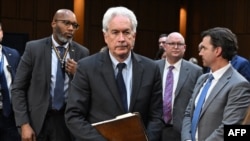
FILE – CIA Director William Burns departs after testifying during a Senate Select Committee on Intelligence on the “Annual Worldwide Threats Assessment” in the Hart Senate Office Building on Capitol Hill in Washington, March 11, 2024.
‘Recruiting opportunity’
Meanwhile, William J. Burns, director of the U.S. Central Intelligence Agency, said in January that Russia’s war on Ukraine has in turn presented an opportunity for the West to improve its intelligence capabilities.
“Disaffection with the war is continuing to gnaw away at the Russian leadership and the Russian people, beneath the thick surface of state propaganda and repression,” Burns wrote in Foreign Affairs magazine.
“That undercurrent of disaffection is creating a once-in-a-generation recruiting opportunity for the CIA. We’re not letting it go to waste.”
Categories
Russia Steps Up Spy War on West
LONDON —
Russia has successfully relaunched its spy operations against the West after hundreds of its operatives were ejected following Moscow’s 2022 invasion of Ukraine, according to analysts. They warn that the Kremlin is using a network of proxies to infiltrate European nations and carry out a range of intelligence operations.
Infiltration
In a recent report, Britain’s Royal United Services Institute, or RUSI, warned that Russia’s military intelligence agency, the GRU, “is restructuring how it manages the recruitment and training of special forces troops and is rebuilding the support apparatus to be able to infiltrate them into European countries.”
The operations range from the killing of political opponents based overseas to interference in foreign elections, with the aim of undermining Western unity and support for Ukraine.
A recent high-profile case was the killing of Maxim Kuzminov, a Russian helicopter pilot who had defected to Ukraine in August 2023. Kuzimov moved to Spain and started a new life under a false identity. Last month, his bullet-riddled body was found in a parking lot in the southern Spanish town of Villajoyosa. A burned-out getaway car was found nearby.
A burned car allegedly used by the perpetrators of the murder of the Russian pilot Maxim Kuzminov to escape the scene is parked outside the Spanish Civil Guard barracks, in El Campello, Spain, Feb. 14, 2024.
in the killing, but the director of Russia’s foreign intelligence service has since described Kuzminov as a “moral corpse” for defecting to the West.
Spies ejected
Analysts say the killing is the latest example of how Moscow’s intelligence operations have been reinvigorated since European governments kicked out around 600 suspected Kremlin spies in the wake of Russia’s 2022 full-scale invasion of Ukraine.
“The Europeans had a sense of security that the Russian spies are not there anymore, that their capabilities have been significantly curtailed. But the problem is they have not been. They are mightier than ever,” said Marina Miron, an analyst at Kings College London’s Department of War Studies.
Russia last month intercepted a phone call between senior German air force officers discussing supplying long-range “Taurus” missiles to Ukraine. The recording was published by the state-owned broadcaster Russia Today, or RT, and was widely seen as an attempt to interfere in the German debate over arming Kyiv. Berlin has ruled out sending the weapons to Ukraine.
Ukraine warnings
Kyiv said it had warned Berlin of the dangers. “We have made multiple warnings to our German partners about the spy network of Russians that are very active in Germany. … It is well known that the Russians are listening to conversations of German officials, and we think it is not the last conversation they have [in their possession],” Ukraine’s national security adviser, Oleksiy Danilov, told The Times of London newspaper last week.
French intelligence services are investigating a Russia-backed campaign aimed at interfering in the June European elections, involving hundreds of websites promoting Russian propaganda and supporting pro-Kremlin candidates.
“We are going to step up our own efforts to expose a number of disinformation operations. And in this context, Russia is also attacking us. … Europe is under attack from an informational point of view,” French Foreign Minister Stéphane Séjourné told reporters on Feb. 17 after details of the operation were revealed.
Undermining democracy
With its army tied down in Ukraine, Russia is seeking to boost its “unconventional” operations overseas, according to the RUSI report.
Russia “has an active interest in destabilizing Ukraine’s partners, and with a slew of elections forthcoming across Europe, there is a wide range of opportunities to exacerbate polarization,” the report said.
“Moreover, with its conventional forces — so often used to coerce others — fixed by the fighting in Ukraine, the significance of unconventional operations as a lever of influence increases. This is especially important with the collapse of Russian overt diplomatic access across target countries.”
Those operations aim to disrupt democracies, according to Oleksandr V. Danylyuk, an associate fellow at RUSI and a co-author of the report.
The Russians “still invest billions into intelligence operations in Europe, developing capabilities which are designed for interference into elections; radicalization of different social, ethnic, religious groups, including minorities; investing billions into political proxies who can actually even come to power,” he told VOA.
Proxy operations
Moscow’s spy agencies are increasingly operating remotely, using non-Russian proxies to carry out operations, including organized criminals and foreign nationals.
“What is actually very important for special operations is the ability to deny the sponsorship of the government,” Danylyuk added.
Several spy networks have been uncovered in recent years. In Poland, 14 citizens from Russia, Belarus and Ukraine were convicted in December of belonging to a spy ring that was preparing acts of sabotage on behalf of Moscow, including plans to derail trains carrying military aid to Ukraine.
Trials of suspected Russian spies are ongoing in Britain, Germany, Norway and several other European countries.
“It’s not any more an ideological fight,” said Danylyuk. “It’s not like ‘communism fighting capitalism,’ like the Soviets would say. It’s that authoritarian countries are trying to subvert the West as a stronghold of democracy, freedom and human rights. And this is, for them, an existential fight.”
FILE – CIA Director William Burns departs after testifying during a Senate Select Committee on Intelligence on the “Annual Worldwide Threats Assessment” in the Hart Senate Office Building on Capitol Hill in Washington, March 11, 2024.
‘Recruiting opportunity’
Meanwhile, William J. Burns, director of the U.S. Central Intelligence Agency, said in January that Russia’s war on Ukraine has in turn presented an opportunity for the West to improve its intelligence capabilities.
“Disaffection with the war is continuing to gnaw away at the Russian leadership and the Russian people, beneath the thick surface of state propaganda and repression,” Burns wrote in Foreign Affairs magazine.
“That undercurrent of disaffection is creating a once-in-a-generation recruiting opportunity for the CIA. We’re not letting it go to waste.”
U.S. President Joe Biden on Tuesday welcomed Polish Prime Minister Donald Tusk and President Andrzej Duda to the White House to mark the 25th anniversary of Poland’s accession to NATO, TURAN’s Washington correspondent reports.
“When we stand together, no force on earth is more powerful,” Biden told his guests —…