
A former Boeing staffer who once raised concerns about the company’s production standards has been found dead in the US
Day: March 12, 2024

The occurrence of a terror attack, whose toll of dead and injured represents an irreparable human loss and a gross human rights violation, should encourage everyone, from the media to government representatives, to refrain from an ideological reading of the facts, and to examine instead the circumstances, the reasons and the motives behind it, in order to understand the root causes and thus help to prevent future strikes.
Similarly, it should be generally acknowledged that a terror attack is the product of several factors, connected at a deeper level than the doctrinal or theological choices made by the perpetrators.
By presenting an analysis of my four-year ethnographical work with members of al Ghurabaa and the Saved Sect, two British Islamist parties banned for glorifying terrorism (Terrorism Act 2006, section 2), and partially involved in terrorist attacks in Britain and abroad, this article attempts to open up new lines of enquiry on Islamism, Islamists in Britain and the dynamics of radicalization among young Islamists, as members of a minority community in Britain.
By presenting an overview of the political agenda of al Ghurabaa and the Saved Sect, I analyse the two parties’ political discourse and practices, through the vocabulary of a fetishist desire for politics nurtured by their members.
I attempt to discuss the reasons that persuaded many young Islamists to believe in the apparent alternative of a better future, proposed by leaders like Anjoum Choudary and Abu Izzadeen, whom I define as an elite of grievances. I analyse the social and political factors that enabled their process of ideological radicalization and eventually contributed to the tragic choice taken by one of them, Khuram Butt, to carry out a terroristic attack on the 3rd of June 2017.
Al Ghurabaa and the Saved Sect: an overview
Al Ghurabaa and the Saved Sect were both the offspring of al Muhagiroun: their plan was to Islamize Britain and “to establish a Khilafa in Downing Street” (Abu Izzadeen, the Saved Sect, personal conversation with the author, June 6, 2006).
Al Ghurabaa was headed by Anjoum Choudary and the Saved Sect by Abu Izzadeen. They were banned in 2006 for “glorifying terrorism” (Terrorism Act 2006, section 2). Once the parties had been formally banned by the Home Office, Mr Choudary and Mr Izzadeen re-formed them under different names. They were banned again. This did not stop them from publicly declaring their allegiance to ISIS and the caliph al-Baghdadi or from spreading their message of an incumbent jihad to their young followers.
In September 2016, Mr Choudary was sentenced to 5 years and 6 months in jail, along with his acolyte Muhammad Rahman. They were both accused of funding and organizing terrorist acts.
In January 2016, Mr Izzadeen was sentenced to two years in jail for breaching the Terrorism Act and for leaving the UK illegally. I interviewed Mr Choudary and Mr Izzadeen several times.
Al Ghurabaa and the Saved Sect openly supported al-Qaeda, the 9/11 attacks, the 7/7 suicide bombers, hailing them as the “Magnificent 19” and “avenging heroes”, respectively, and they declared their allegiance to al Baghdadi and to the Islamic state of Iraq and the Levant.
Mr Choudary and Mr Izzadeen follow the ahl al Sunna wal Jamaa (ASWJ). That means that follow only the Quran and the Sunnah, in accordance with the understanding of the Companions and the family of the prophet Muhammad.
Overall, the syntax of my meetings, interviews, informal conversations with party members was political, not religious: they reported personal experiences of racism and violence, they spoke of practices of social and economic marginalization in the UK, they expressed hostility to British strategies in the Middle East. My interviewees regarded these as important grievances that led them to oppose the “persecution of Muslims in the UK and its aggressive foreign policy” (Ibrahim, the Saved Sect, personal conversation with the author, April 7, 2007) and to join parties such as Al Ghurabaa and the Saved Sect.
A detail that emerged from the qualitative research is that the epistemic representation of Islamist leaders as “evil forces”, “hate preachers”, routinely performed by UK officials and media outlets, paradoxically consolidated their popularity among their young followers.
In the realm of their political practice, my fieldwork revealed that that those parties’ leaders have developed a sort of fetishism for politics, one nurtured through their Islamist discourse of an “Islamic state where the political is at the service of the spiritual” (Anjoum Choudary, al Ghurabaa, personal conversation with the author, June 10, 2006). However, my fieldwork showed that, paradoxically, those leaders aimed at the exact opposite of the spiritualization of politics: the supremacy of politics over religion.
The day after al Ghurabaa and the Saved Sect were banned, on the 18th of July 2006, I interviewed Mr Choudary at his family home in Redbridge, East London. My first question to him was about his reaction to the decision taken by the Home Secretary John Reid to ban the parties. His view was that the action represented “a total failure of the British government and their capitalistic ideology. Al Ghurabaa and the Saved Sect are ideological movements and political movements for a future of radical justice. The Government rather than engaging in dialogue and discussion, they have tried to silence and repress our voices. I think this is a victory for us” (Anjoum Choudary, al Ghurabaa, personal conversation with the author, July 18, 2006). My next question was strictly related to my surprise at hearing the event being described as a victory and learning, for the first time in my long fieldwork, that al Ghurabaa and the Saved Sect were ideological and political movements. Those attributes were novel and mostly extraneous to the vocabulary and discourses of ASWJ Islamist movements, like al Ghurabaa and the Saved Sect. The fundamental core of their discourse, as Mr Choudary had declared many times previously, “is that Islam comprises all, the true path and it is not absolutely a mere ideology or vulgar politics” (Anjoum Choudary, al Ghurabaa, personal conversation with the author, June 10, 2006). Mr Choudary elaborated on why that was a victory, affirming that “when someone doesn’t have a good counter argument, the easy thing is try to ban the other voices”, but instead of explaining the use of the terms ideological and political, he reinforced that conceptualization by affirming that “if you start to stop people propagating their thoughts and ideas, you push them underground. Ultimately, I think that this will quicken the victory for Islam and the Caliphate, because when you ban something, people will become more interested in it” (Anjoum Choudary, al Ghurabaa, personal conversation with the author, July 18, 2006).
One could see that a discursive practice and a signifying practice were at work, which ultimately conformed to different audiences and contexts, and were schizophrenic in their content, to the point of utterly denying what had previously been advanced as absolute truth. There was an open play of sheer fascination with power and a preoccupation with taking power, free from any religious or spiritual connotation. My point is that al Ghurabaa and the Saved Sect practices and discourses developed under the constraint of a denial of what was ultimately desired but not expressed: the fetishism for politics. This contributed to their delegitimization as political actors and inflated their narratives of insecurity.
Another consideration that I reached in the course of my empirical research is that there seemed to be a sort of reflective dynamic between the institutional representation (in the anti-terror laws) of Islamist parties and their own self-representation. The outcome was an imaginary flux of projected knowledge between the two poles of the UK government and the extremist Islamist parties: a sort of meta-politics of a deflected political action.
Parties like al Ghurabaa and the Saved Sect, banned under the 2006 Terrorism Act, are labelled by the Home Office and the representatives of the UK Government as “terrorists” or “glorifiers of terrorism”. The dimension denied to them, by institutional power, is politics. That means that there is no possibility of having a political dialogue or clash with them.
On the other hand, those same parties refused the label of political, while pursuing a political discourse and practice, as the fieldwork revealed. Their official narrative was that their actions were religious, prevailing over politics (Anjoum Choudary, al Ghurabaa, personal conversation with the author, June 10, 2006). This is the reason––they affirmed––that they could not have “any meaningful relation or exchange with the UK political government, because representatives of an alien system” (Anjoum Choudary, al Ghurabaa, personal conversation with the author, June 10, 2006).
In both cases, the dimension excised was the political one and the main preoccupation has been with taking Power. In the specific case of leaders like Mr Choudary and Abu Izzadeen, the deep fascination with gaining the upper hand was also shown in relation to the young members of their parties, whose political hopes had been eroded by the top-down culturalist deployment of multiculturalism, carried out by the local councils, and a necro-politics performed by Islamist leaders like Mr Choudary and Mr Izzadeen. The latter exploited any serious issue of social and economic discrimination as a means to coalesce a group around their own leadership. This is what I call an elite of grievances: a segment that exploits grievances (experienced by their members) to eventually expand their constituency (by planning the institution of a dictatorial regime like the Caliphate) in order to keep their elite status.
It is crucial, in the light of this study, to reflect upon the circumstances that enabled eloquent leaders like Mr Izzadeen and Mr Choudary to be successful in attracting young people and in apparently radicalising them.
Young Islamists and their search for destructive forms of reparative justice
My empirical work with the young members of Al Ghurabaa and the Saved Sect revealed that it is paramount for local and national institutions to acknowledge the social and political grievances of some members of society; likewise, it is important to ascertain whether a social actor, who feels wronged, can successfully negotiate an institutional channel to gain justice. However, studies and national inquiries have too often revealed that, historically, British institutions and public bodies have been afflicted by forms of structural racism, which have favoured the concealment of racist behaviour, and prevented minority members from obtaining fair, equal treatment and from accessing justice.
My fieldwork has also suggested that it is vital for young activists to be able to express their grievances in social and institutional contexts, without fear of being censored, or belittled, or being involved in counter-terrorism measures and a system of surveillance that have promoted greater alienation of minority members, rather than their inclusion.
When I approached the young members of al Ghurabaa and the Saved Sect, they all shared with me their personal life stories: at what age they joined the party, what Islamism meant for them, and what the institution of the Khalifa would achieve for the global Muslim community.
From their accounts, it emerged that the reasons that led them to embrace Islamism as their political ideology, in the version propounded by Anjoum Choudary and Abu Izzadeen, were directly connected to their desire to avenge the racism and discrimination they had experienced in their lives, which “no one ever acknowledged” (Khuram Butt, Al Ghurabaa, personal conversation with the author, June 16, 2008). They were determined to attain “a form of justice that the Caliphate will constitute for the global Muslim community” (Khuram Butt, al Ghurabaa, personal conversation with the author, June 16, 2008).
Every young man, all members of those twin parties, told me that “every daily activity had the potentiality of turning into an incident of racism” (Ibrahim, the Saved Sect, personal conversation with the author, June 16, 2008), and they all reported experiencing at least one serious case of anti-Muslim racism. As someone recalled, there was never a “sorry or the intervention of the police to arrest the abuser and eventually heal the wound by taking us to a hospital” (Ali, the Saved Sect, personal conversation with the author, April 24, 2007).
After the racist attack, “you will see a bleeding young boy who would try to walk home and bear the brunt of the cuts and the injustice” (Jamal, al Ghurabaa, personal conversation with the author, May 7, 2006).
During my fieldwork, I collected many stories like the above, in which the circumstances and the pretext for the attack would vary. What remained constant, in their accounts, was the experience of feeling “humiliated, inferior and excluded” (Khuram Butt, al Ghurabaa, personal conversation with the author, May 7, 2006) from a social context, the colonial concept of race seemingly replaced by ones of culture and immigration.
When I asked my interviewees, if they had reported those attacks to the police or if they had consulted their imam or any other Islamist organization, such as the Muslim Council of Britain or the Muslim Association of Britain, their answer was negative on both counts.
They believed the police would have done nothing: they would have “downplayed the attacks as a brawl among young boys. They would have denied that it was racially motivated. They are useless and racist” (Khuram Butt, al Ghurabaa, personal conversation with the author, May 7, 2006). Their experience with the associations and imams was of “government puppets and chimpanzee to sold their beliefs to become MPs, judges, doctors and police chiefs” (Khuram Butt, al Ghurabaa, personal conversation with the author, April 6, 2006). When I asked them to explain what they meant, the most frequent response was mired in cultural talk. My interviewees clarified that every discourse about current affairs pronounced by their imams and the “big Islamist parties leaders” was delivered in relation to the framework of the “ignorance of the Muslim culture and the need to explain it to people who don’t know our culture”, which made them feel in a way ‘to blame for the racism we experience” (Majid, the Saved Sect, personal conversation with the author, April 18, 2006). The young Khuram was quite forthright in his comments, saying that even when he got beaten up for “being Muslim”, his local imam adduced the “ignorance of our culture” to explain the event (Khuram Butt, al Ghurabaa, personal conversation with the author, May 8, 2007). Khuram then added, with some vehemence, “F*** this culture, I want to be respected, I want to be important, I want my Islam to avenge the wrongs and not to blame Muslims for their culture. I don’t know what culture is. I am Muslim and I know Islam. Al Ghurabaa has helped me in finding my identity and it gives Muslims a future of justice. I will fight and do whatever necessary to establish the Khalifa in the world” (Khuram Butt, al Ghurabaa, personal conversation with the author, May 8, 2007).
Such comments, expressed so colorfully, were crucial to grasp the circumstances that led some young people, like my interviewees, to join parties like al Ghurabaa and the Saved Sect. Analysing my personal conversations with them offered an important framework to understand the development of a process of radicalization, one which occurred socially, before assuming any ideological character. Only later in their lives did the young Islamist activists interviewed decide to embrace a radical ideology, one that seemed to make sense of their daily struggles.
For a young man like Khuram Butt, guilty of the London Bridge attack, the process of radicalization was spun deep within the social fabric and in his life experience. His decision to embrace the version of Islamism offered by Anjoum Choudary and Abu Izzadeen should be considered a consequence of his feelings of humiliation, his experience of discrimination and his desire for revenge. The fact that he decided to act upon those emotional impulses, on the 3rd of June 2017, should not be related to the ideology he chose, but to the way he elaborated his life experience, where violence, in the absence of other institutional channels, would achieve a form of justice for him and the rest of the Muslim community.
Based on my numerous conversations with Khuram, I argue that what pushed him to embrace violence was the firm belief that the society he lived in was so corrupt that it legitimated and justified the discrimination he had experienced as a Muslim. The latter ranged from anti-Muslim racism to anti-terror policies, all of which seemed to target Muslims and their Muslimness.
It was not any specific theological or ideological discourse that radicalized an activist like Khuram, and led him to choose violence, but the combination of his social and political circumstances and his feeling of the “failure” of the society he lived in.
Radicalization models that fail to distinguish between radical beliefs and violent methods seem to assume that certain ideologies or theologies are inherently violent and to be blamed in a terror attack. On the basis of my empirical work, I argue that this is not demonstrated by the data. I also advance the idea that applying those models to counter-terrorism policies paradoxically promotes a dynamic of radicalization among Islamist activists, who feel discriminated, targeted and unable to express their discontent.
The young members of al Ghurabaa and the Saved Sect whom I met and talked to had, as minority members, too long experienced a sort of institutional discrimination related to culture, as a substitute for race. Policy making also contributed to preserving a status quo that made the idea of a post-racial society a “myth”.
Leaders like Anjoum Choudary and Abu Izadeen promoted a militant Islamist agenda, instead of the passive acceptance of their minority status and the rarefied understanding of Muslim culture proposed by imams and the various leaders of the more moderate Islamist parties.
Al Ghurabaa and the Saved Sect leaders offered the prospect of an Islamic state for Muslims, one that would avenge all their members’ grievances, grievances that had been sublimated and rarely addressed by national institutions. In this context, it is also important to remember that their perception of the War on Terror was of “a global war on Islam and Muslims” (Khuram Butt, al Ghurabaa, personal conversation with the author, June 9, 2007).
The young members of al Ghurabaa and the Saved Sect did not want to “talk any more about the need to understand society ignorance about Islam and the Muslim culture” (Khuram Butt, al Ghurabaa, personal conversation with the author, August 3, 2007); they wanted that the abuses they “had endured for too long were finally denounced and sanctioned, because no one would do that for us” (Khuram Butt, al Ghurabaa, personal conversation with the author, August 3, 2007).
Clearly, it was easy to inflame those young men’s hearts and minds with the prospect of revenge, omitting to state that the price they would pay for reprisal would be a substantial restriction on their rights. Such a restriction would be even greater if an Islamic state were instituted. In such a state, they would experience total submission to their leaders. Besides, in the existing order of things, by fighting the battle against the munafeqeen (the infidels) they would be sent to jail or eventually killed (like the young Khuram Butt).
If leaders like Anjoum Choudary and Abu Izadeen had a role in their radicalization, this was confined to their rhetorical ability in promising them forms of reparative justice, coalesced around the idea of an Islamic state for the Muslim community.
The members’ young age and their frustration at the wrongs they felt society unable to correct, were fertile soil for the advancement of a hegemonic plan of revenge, elaborated by an elite of grievances, like Anjoum Choudary and Abu Izadeen.
It goes without saying that elaborating a political plan for a future of radical justice should not be criminalized as a terror attack, even if the political plan itself (a Caliphate) rests on a non-Western ontology and is perceived as subversive of the current British political system.
Similarly, the public expression of such plans by some political actors should not be interpreted as a warning sign about an impending terror attack; rather, it constitutes an imperative, for policy makers, to analyse the circumstances and the factors contributing to forms of social and political injustice, which affect some members of society. Hence, policy makers should strive to find political and social strategies to rectify gaps in justice, in order to prevent future disruptions of the social fabric, like a terror attack.
Conclusions
Terrorism remains a real political threat, but one which could be dealt with more effectively by using better intelligence, by investigating active incitement, financing and the preparation of terrorist violence, by promoting less racist policy tools, and by not waging wars. Counter-terrorism strategies that imply that Muslims are prey to an inherent radicalism are faulty and counter-productive. They are based on a culturalist and Orientalist reading of Islam; above all, they contribute to marginalizing minority members, whose social experience, as my fieldwork shows, has already marked them as racialized, second class, immigrant children.
Terrorism, like racism, seems to be an ideological “scrounger”, as it has historically demonstrated its ability to “dress up” in various disparate ideologies, even as the irreparable and destructive effects of its practices on its victims remain the same.
What this should suggest is that, beyond ideologies and radical rhetoric, the spectre of violence seems to find fertile soil, to be endlessly regenerated, in the practices of those who feel entitled to discriminate and of those who feel wrongly discriminated against. My empirical work suggests that terrorists are people who look for a form of justice that the society they live in seems unable to provide.
For policy makers, it is imperative to elaborate security policies that consider forms of violence and social terror in a broader sense, reflecting that those who feel terrorised, as victims of violence and discrimination, without the prospect of obtaining justice from institutions, may eventually entertain the idea of employing disruptive means of bringing about a change, in a perpetual War of Terrors.
It is also reasonable to argue that a project of political and social justice for all should be the driving force behind an anti-terror campaign, to “win the hearts and minds of British Muslims” as Prime Minister Tony Blair declared, ironically, on the eve of the War on Terror.
- About the author: Dr. Danila Genovese has been researching on Islamism, Critical Race Theory, Gender Studies, Critical Terrorism Studies and Animal Ethics since 2006. After completing her PhD in Social Science at the University of Westminster, London, she held several research and teaching positions on Critical Terrorism Studies and Critical Race theory in the UK and in Italy. She is the author of many peer-reviewed academic articles and book chapters.
The views expressed in this article are the author’s own and do not necessarily reflect IFIMES official position.
Videos have emerged on social media in recent days that appear to show junta personnel providing military training to ethnic Muslim Rohingyas at a site in western Myanmar’s Rakhine state, amid reports of forced recruitment around the country.
On Feb. 10, the junta imposed a military draft law – officially called the People’s Military Service Law – prompting civilians of fighting age to flee Myanmar’s cities. Many said they would rather leave the country or join anti-junta forces in remote border areas than serve in the military, which seized power in a 2021 coup d’etat.
The junta has sought to downplay the announcement, claiming that conscription won’t go into effect until April, but RFA has received several reports indicating that forced recruitment is already under way.
Two videos emerged on Facebook over the weekend showing junta troops training a group of people wearing full military uniforms in the use of firearms and around 30 armed people wearing fatigues inside of a military vehicle. They were posted to the site with a description that identifies the subjects as Rohingyas.
A third video, posted on March 7, shows junta Rakhine State Security and Border Affairs Minister Co. Kyaw Thura visiting a warehouse where hundreds of people, believed to be Rohingyas, are seated in military attire.
RFA was unable to independently verify the content of the videos.
Reports suggest the junta has been forcibly recruiting Rohingyas in Rakhine in recent weeks, and residents told RFA Burmese that the video shows members of the ethnic group receiving training at a site in the north of the state, although they were unable to provide an exact location.
They said that junta personnel have detained and enlisted around 700 Rohingyas for military training from the Rakhine townships of Buthidaung, Maungdaw and Kyaukphyu, as well as the capital Sittwe, since the Feb. 10 announcement, with the goal of forming a militia.
In Kyaukphyu, the training has progressed to using firearms, said a resident who, like others interviewed for this report, spoke to RFA on condition of anonymity due to security concerns.
“It is known that the current training phase involves firearms practice,” the resident said Monday. “Gunfire has been heard over the past two or three days, although the training regimen varies daily.”
Many of the detainees are living at Kyaukphyu’s Kyauk Ta Lone camp for internally displaced persons, or IDPs, where on Feb. 29 junta authorities forcibly gathered 107 mostly ethnic-Rohingya Muslimsbetween the ages of 18 and 35 at the camp’s food warehouse, after collecting their personal information.
Former military captain Nyi Thuta, who now advises the armed resistance as part of the anti-junta Civil Disobedience Movement, questioned why the military regime is forcibly recruiting the Rohingya when it has refused to grant them citizenship.
“These people are being coerced and manipulated in various ways into fighting to the death for the junta, which is facing defeat in [the civil] war,” he said.
‘No way to escape’
Some 1 million Rohingya refugees have been living in Bangladesh since 2017, when they were driven out of Myanmar by a military clearance operation. Another 630,000 living within Myanmar are designated stateless by the United Nations, including those who languish in camps and are restricted from moving freely in Rakhine state.
Rights campaigners say the junta is drafting Rohingya into military service to stoke ethnic tensions in Rakhine, while legal experts say the drive is unlawful, given that Myanmar has refused to recognize the Rohingya as one of the country’s ethnic groups and denied them citizenship for decades.
Myanmar’s military is desperate for new recruits after suffering devastating losses on the battlefield to the ethnic Arakan Army, or AA, in Rakhine state. Since November, when the AA ended a ceasefire that had been in place since the coup, the military has surrendered Pauktaw, Minbya, Mrauk-U, Kyauktaw, Myay Pon and Taung Pyo townships in the state, as well as Paletwa township in neighboring Chin state.
On Feb. 28, the pro-junta New Light of Myanmar claimed that Rohingya had not been recruited for military service because they aren’t citizens. Attempts by RFA to reach Hla Thein, the junta’s attorney general and spokesperson for Rakhine state, went unanswered Monday.
Nay San Lwin, a Rohingya activist, condemned the coercion of members of his ethnic group into military service as a “war crime.”
“They wield power and resort to coercion and arrests,” he said, adding that he believes the junta’s goal is to “obliterate the Rohingya community.” “I perceive this as part of a genocidal agenda.”
Earlier this month, the shadow National Unity Government, or NUG – made up of former civilian leaders ousted in the coup – warned that Rohingya were being pressed into duty by the military “because there is no way to escape.”
Kachin youth fleeing recruitment
Meanwhile, residents of Kachin state said Monday that young people in the area are increasingly fleeing abroad or to areas controlled by the armed resistance to avoid military service. The draft law says males between the ages of 18 and 35 and females between 18 and 27 must serve in the military.
A draft-eligible resident of Kachin’s Myitkyina township said that he and others like him “no longer feel safe” in Myanmar.
“Since the conscription law was enacted, it has become quite difficult for us to realize our dreams,” he said. “It isn’t even safe to go out to a restaurant. We feel threatened daily.”
But even for those who have left the country, life can be difficult abroad.
A young Kachin named Ma La Bang who recently relocated to Thailand said he doesn’t have a visa to stay in the country legally, and told RFA that people like him worry about being forced to return home.
“Young people living in Thailand without any visa feel insecure, and it is also difficult for them to get jobs,” he said. “They are struggling to get a visa and any legal status for residency right now.”
La Sai, the chairman of the Kachin Refugee Committee in Malaysia, said that Kachin youths have been flooding the country since the enactment of the draft law.
Two weeks after the junta activated the conscription law, the number of people entering Malaysia from Kachin state has more than doubled, he said. “This kind of migration is also taking place at [Myanmar’s] Thai and Indian borders.”
‘Sacrificing their futures’
Win Naing, a member of parliament for Kachin’s Moe Kaung township for the deposed National League for Democracy, said the future of Myanmar’s youth is being lost because of the law.
“The conscription law … has directly interfered with the opportunities of young people for education and employment,” he said. “The youth are being made to sacrifice their futures.”
Junta spokesperson Major General Zaw Min Tun was quoted in pro-junta newspapers on Feb. 15 as saying that 50,000 soldiers will be recruited every year that the law is in effect.
Based on Myanmar’s 2019 interim census, at least 13 million people are eligible for military service. Those who refuse face five years in prison.

By Per Bylund
Artificial intelligence (AI) cannot distinguish fact from fiction. It also isn’t creative or can create novel content but repeats, repackages, and reformulates what has already been said (but perhaps in new ways).
I am sure someone will disagree with the latter, perhaps pointing to the fact that AI can clearly generate, for example, new songs and lyrics. I agree with this, but it misses the point. AI produces a “new” song lyric only by drawing from the data of previous song lyrics and then uses that information (the inductively uncovered patterns in it) to generate what to us appears to be a new song (and may very well be one). However, there is no artistry in it, no creativity. It’s only a structural rehashing of what exists.
Of course, we can debate to what extent humans can think truly novel thoughts and whether human learning may be based solely or primarily on mimicry. However, even if we would—for the sake of argument—agree that all we know and do is mere reproduction, humans have limited capacity to remember exactly and will make errors. We also fill in gaps with what subjectively (not objectively) makes sense to us (Rorschach test, anyone?). Even in this very limited scenario, which I disagree with, humans generate novelty beyond what AI is able to do.
Both the inability to distinguish fact from fiction and the inductive tether to existent data patterns are problems that can be alleviated programmatically—but are open for manipulation.
Manipulation and Propaganda
When Google launched its Gemini AI in February, it immediately became clear that the AI had a woke agenda. Among other things, the AI pushed woke diversity ideals into every conceivable response and, among other things, refused to show images of white people (including when asked to produce images of the Founding Fathers).
Tech guru and Silicon Valley investor Marc Andreessen summarized it on X (formerly Twitter): “I know it’s hard to believe, but Big Tech AI generates the output it does because it is precisely executing the specific ideological, radical, biased agenda of its creators. The apparently bizarre output is 100% intended. It is working as designed.”
There is indeed a design to these AIs beyond the basic categorization and generation engines. The responses are not perfectly inductive or generative. In part, this is necessary in order to make the AI useful: filters and rules are applied to make sure that the responses that the AI generates are appropriate, fit with user expectations, and are accurate and respectful. Given the legal situation, creators of AI must also make sure that the AI does not, for example, violate intellectual property laws or engage in hate speech. AI is also designed (directed) so that it does not go haywire or offend its users (remember Tay?).
However, because such filters are applied and the “behavior” of the AI is already directed, it is easy to take it a little further. After all, when is a response too offensive versus offensive but within the limits of allowable discourse? It is a fine and difficult line that must be specified programmatically.
It also opens the possibility for steering the generated responses beyond mere quality assurance. With filters already in place, it is easy to make the AI make statements of a specific type or that nudges the user in a certain direction (in terms of selected facts, interpretations, and worldviews). It can also be used to give the AI an agenda, as Andreessen suggests, such as making it relentlessly woke.
Thus, AI can be used as an effective propaganda tool, which both the corporations creating them and the governments and agencies regulating them have recognized.
Misinformation and Error
States have long refused to admit that they benefit from and use propaganda to steer and control their subjects. This is in part because they want to maintain a veneer of legitimacy as democratic governments that govern based on (rather than shape) people’s opinions. Propaganda has a bad ring to it; it’s a means of control.
However, the state’s enemies—both domestic and foreign—are said to understand the power of propaganda and do not hesitate to use it to cause chaos in our otherwise untainted democratic society. The government must save us from such manipulation, they claim. Of course, rarely does it stop at mere defense. We saw this clearly during the covid pandemic, in which the government together with social media companies in effect outlawed expressing opinions that were not the official line (see Murthy v. Missouri).
AI is just as easy to manipulate for propaganda purposes as social media algorithms but with the added bonus that it isn’t only people’s opinions and that users tend to trust that what the AI reports is true. As we saw in the previous article on the AI revolution, this is not a valid assumption, but it is nevertheless a widely held view.
If the AI then can be instructed to not comment on certain things that the creators (or regulators) do not want people to see or learn, then it is effectively “memory holed.” This type of “unwanted” information will not spread as people will not be exposed to it—such as showing only diverse representations of the Founding Fathers (as Google’s Gemini) or presenting, for example, only Keynesian macroeconomic truths to make it appear like there is no other perspective. People don’t know what they don’t know.
Of course, nothing is to say that what is presented to the user is true. In fact, the AI itself cannot distinguish fact from truth but only generates responses according to direction and only based on whatever the AI has been fed. This leaves plenty of scope for the misrepresentation of the truth and can make the world believe outright lies. AI, therefore, can easily be used to impose control, whether it is upon a state, the subjects under its rule, or even a foreign power.
The Real Threat of AI
What, then, is the real threat of AI? As we saw in the first article, large language models will not (cannot) evolve into artificial general intelligence as there is nothing about inductive sifting through large troves of (humanly) created information that will give rise to consciousness. To be frank, we haven’t even figured out what consciousness is, so to think that we will create it (or that it will somehow emerge from algorithms discovering statistical language correlations in existing texts) is quite hyperbolic. Artificial general intelligence is still hypothetical.
As we saw in the second article, there is also no economic threat from AI. It will not make humans economically superfluous and cause mass unemployment. AI is productive capital, which therefore has value to the extent that it serves consumers by contributing to the satisfaction of their wants. Misused AI is as valuable as a misused factory—it will tend to its scrap value. However, this doesn’t mean that AI will have no impact on the economy. It will, and already has, but it is not as big in the short-term as some fear, and it is likely bigger in the long-term than we expect.
No, the real threat is AI’s impact on information. This is in part because induction is an inappropriate source of knowledge—truth and fact are not a matter of frequency or statistical probabilities. The evidence and theories of Nicolaus Copernicus and Galileo Galilei would get weeded out as improbable (false) by an AI trained on all the (best and brightest) writings on geocentrism at the time. There is no progress and no learning of new truths if we trust only historical theories and presentations of fact.
However, this problem can probably be overcome by clever programming (meaning implementing rules—and fact-based limitations—to the induction problem), at least to some extent. The greater problem is the corruption of what AI presents: the misinformation, disinformation, and malinformation that its creators and administrators, as well as governments and pressure groups, direct it to create as a means of controlling or steering public opinion or knowledge.
This is the real danger that the now-famous open letter, signed by Elon Musk, Steve Wozniak, and others, pointed to: “Shouldwe let machines flood our information channels with propaganda and untruth? Should we automate away all the jobs, including the fulfilling ones? Should we develop nonhuman minds that might eventually outnumber, outsmart, obsolete and replace us? Should we risk loss of control of our civilization?”
Other than the economically illiterate reference to “automat[ing] away all the jobs,” the warning is well-taken. AI will not Terminator-like start to hate us and attempt to exterminate mankind. It will not make us all into biological batteries, as in The Matrix. However, it will—especially when corrupted—misinform and mislead us, create chaos, and potentially make our lives “solitary, poor, nasty, brutish and short.”
- About the author: Per Bylund, PhD, is a Senior Fellow of the Mises Institute and Associate Professor of Entrepreneurship and Johnny D. Pope Chair in the School of Entrepreneurship in the Spears School of Business at Oklahoma State University, and an Associate Fellow of the Ratio Institute in Stockholm. He has previously held faculty positions at Baylor University and the University of Missouri. Dr. Bylund has published research in top journals in both entrepreneurship and management as well as in both the Quarterly Journal of Austrian Economics and the Review of Austrian Economics. He is the author of three full-length books: How to Think about the Economy: A Primer, The Seen, the Unseen, and the Unrealized: How Regulations Affect our Everyday Lives, and The Problem of Production: A New Theory of the Firm. He has edited The Modern Guide to Austrian Economics and The Next Generation of Austrian Economics: Essays In Honor of Joseph T. Salerno.
- Source: This article was published by the Mises Institute
By Dave Patterson
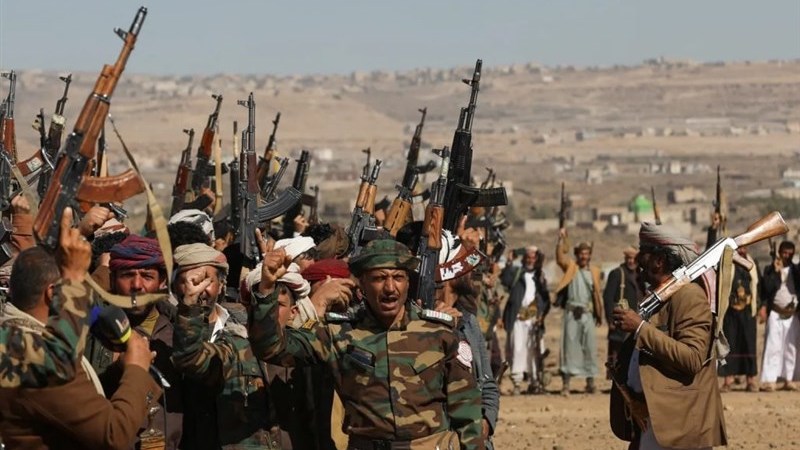
Despite the US and its allies attempting to provide safe passage in the Red Sea, the international waterway simply is not safe. In fact, it’s quite deadly – as the crew of the Barbados-flagged True Confidence unfortunately discovered Wednesday, March 6. The merchant vessel was set ablaze by a terrorist attack by Iran-backed Houthis in Yemen, and three sailors were killed.
The highly touted Operation Prosperity Guardian (OPG) is a US-sponsored effort to coordinate a multinational force to protect international merchant vessels transiting the Red Sea and the Bab al-Mandab strait. Yet Iran-backed Houthis in Yemen continue to attack innocent commercial shipping in the region. Evidence shows that these attacks are part of an Iranian strategy to build influence in the Gulf Region.
US Operations Ineffective Against the Houthis
OPG, in combination with occasional air attacks on Houthis in Yemen, is supposed to be effective in stopping the attacks on Red Sea shipping. Clearly, these military efforts are not effective. The Houthis continue to fly drones, fire ballistic missiles, and launch cruise missiles at non-combatant cargo and tanker vessels. Most recently, to absolutely no one’s surprise, the Iran-supplied Houthis have killed three innocent seamen. As US Central Command described the March 6 deadly attack:
“At approximately 11:30 a.m. (Sanaa time) Mar. 6, an anti-ship ballistic missile was launched from Iranian-backed Houthi terrorist-controlled areas of Yemen toward M/V True Confidence, a Barbados-flagged, Liberian-owned bulk carrier, while transiting the Gulf of Aden. The missile struck the vessel, and the multinational crew reports three fatalities, at least four injuries, of which three are in critical condition, and significant damage to the ship.”
This attack comes after numerous US and United Kingdom missile and fighter bomber attacks throughout Yemen against anti-ship ballistic missile sites, cruise missile in preparation for launching, and drone launchpads. American naval forces have attacked Houthis’ headquarters and weapons warehouses to no apparent impact on the Iran-supported Houthis and their capability to continue the attacks on Red Sea shipping. According to a Reuters report, “’The targeting operation came after the ship’s crew rejected warning messages from the Yemeni naval forces,’ the militia’s military spokesman Yahya Sarea said in a televised speech.”
The speech by the Houthi spokesman raises an interesting question: How is it that the Houthis still have any “naval” forces afloat? How do the Houthis have any sea-going vessels or dock facilities that US air attacks have not destroyed? If the US air attacks are going to be persuasive, they should destroy completely the Iran-backed Houthis’ capacity to wage hostilities. That would be a good strategy. But that raises an even more fundamental question: What is the Biden administration’s strategy in dealing with the Iran proxy? Unfortunately, it is becoming clear that Iran has a strategy that’s not nearly as opaque as our own.
“Iranian military and security leaders are increasingly discussing the need to expand the Iranian military presence around the Red Sea and the Mediterranean Sea,” the Institute for the Study of War (ISW) explained in its Iran Update, March 7, 2024. The Islamic Revolutionary Guard Corps Navy and Aerospace Force have been charged with expanding Iran’s strategic radius of action focus out to “5,000 kilometers,” including the Strait of Gibraltar.
Iran Has a Strategy for the Middle East; Biden Doesn’t
An Iranian senior military advisor to Iran’s supreme leader, Major General Yahya Rahim Safavi, portrayed “the Mediterranean Sea as part of Iran’s ‘strategic depth.’” The ISW reported, “Iran would probably use an expanding military presence around the Red Sea and the Mediterranean Sea to threaten commercial traffic, as Iran has long done so around the Persian Gulf and is currently supporting Houthi attacks on global commerce.” Through its proxies, Iran appears to be executing its strategic planning. The Houthis, mainly, are an effective instrument of Tehran’s long-range objectives. And the US is doing little to disrupt those plans.
Unless stopped, Iran will continue to advance its goals in the Middle East, including the Eastern Mediterranean Sea, the Persian Gulf, and the Red Sea. Tehran has a plan and strategy to achieve it. Iran’s proxies, including the Houthis, will continue to project Iran’s military influence into the Gulf Region unconstrained by the US. The ruling Islamic theocracy in Tehran already perceives the Biden administration as weak-willed. How could it not? Iran’s proxies have done the mullahs’ dirty work for them, leaving Iran unscathed. Iran-backed militias killed three American service members at the end of January, and now two Filipino seamen and one Vietnamese merchantman have lost their lives at the hands of Iran. As the US does nothing, Iran will grow bolder. What good can come of that?
The views expressed are those of the author and not of any other affiliation.
- About the author: National Security Correspondent at LibertyNation.Com. Dave is a retired U.S. Air Force Pilot with over 180 combat missions in Vietnam. He is the former Principal Deputy Under Secretary of Defense, Comptroller and has served in executive positions in the private sector aerospace and defense industry. In addition to Liberty Nation, Dave’s articles have appeared in The Federalist and DefenseOne.com.
- Source: This article was published by Liberty Nation