
Day: March 12, 2024
 Kevork Haig Tevekelian
Kevork Haig Tevekelian of Hopkinton, Massachusetts, formerly of North Chelmsford, MA and Watertown, MA, passed away peacefully on March 9, 2024, surrounded by family and friends.
Kevork was born in Cambridge, MA, on December 19, 1941, to Haig and Lucy (Tutunjian) Tevekelian. Along with younger brother Teddy, Kevork was raised in a loving environment in Belmont, surrounded by many Armenian friends and relatives. His fondest memories were of growing up and spending much time with his close-knit immediate and extended family, including his many cousins. Kevork was fiercely proud of his Armenian heritage and was happiest when enjoying Armenian music, dance, food and camaraderie, enjoying and listening to Armenian and Greek music until the day of his passing.
Kevork graduated from Belmont High School. He subsequently attended UMASS Amherst for a brief period and was a member of the Theta Chi Fraternity. He left college to work in his family’s dry-cleaning business in Belmont (Minuteman Cleaners), later operating his own business as well, most notably Lantern Cleaners in Woburn, MA. Kevork managed the family business, along with his Auntie Alice, for many years.
Kevork was a true gentleman who did not like conflict, never spoke negatively of others, and above all else, cared for his family and friends passionately. He was a voracious reader, could hold a conversation with anyone on most topics, enjoyed boating as a member of the Charles River Yacht Club and was a snappy dresser (100-percent cotton or 100-percent wool only!). His greatest achievements in his life were his children and he was a proud son, brother, father and grandfather.
Kevork loved his family unconditionally. Kevork is survived by his fiancée Sandra Boroyan, daughter-in-law Jennifer (Boudrot) Tevekelian, son Joshua Tevekelian and wife Diana, daughter Janeen (Tevekelian) Bazarian, daughter Alana (Tevekelian) Counts and her husband Roger, niece Dawn (Tevekelian) Keller and her husband Charles. He is also survived by his loving grandchildren Andrew, Derek and Kyle Tevekelian, Avo and Armen Bazarian, Devin and Izabella Counts, Aline Tevekelian and Max Levon Struble.
Kevork is also survived by his son-in-law Avo Bazarian and former spouse Carol (Sarkisian) Burnham.
Kevork was preceded in death by parents Haig Kevork Tevekelian, an Armenian Genocide survivor from Malatya, Armenia (present-day Turkey), and Lucy (Tutunjian) Tevekelian of Granite City, IL; brother Gregory “Teddy” Tevekelian, son Kevork Tevekelian, Jr. of Shrewsbury, MA; and grandson Greyson Counts of Morehead City, NC.
Funeral service will be at St. Stephen’s Armenian Church, One Artsakh Street, Watertown on Saturday, March 16 at 11:30 a.m. Visiting hours will be at church from 10:00-11:30 a.m., immediately prior to the funeral service. Family and friends are invited to join the service at the church. Interment will be private for family.
Kevork lost his eldest son, Kevork Jr., to multiple myeloma in 2013. It was a loss that affected him greatly. In lieu of flowers, memorial donations can be made in Kevork’s name to the St. Stephen’s Armenian Apostolic Church or the Multiple Myeloma Research Foundation, P.O. Box 414238 Boston, MA 02241.
Author information

Guest Contributor
Guest contributions to the Armenian Weekly are informative articles or press releases written and submitted by members of the community.
|
The post In Memory of Kevork Haig Tevekelian appeared first on The Armenian Weekly.
A coalition of twelve local civil society organizations met with representatives of political parties, with the exception of the ruling Georgian Dream party, which did not attend the meeting, to discuss the implementation of the nine conditions set by the European Commission for Georgia. The Coalition had earlier elaborated a detailed vision for the implementation of the nine conditions.
The first meeting with the political groups, held on March 12, was attended by the following parties: “Victory Platform”- a coalition of “United National Movement” (UNM) and “Strategy Aghmashenebeli”, “Girchi-More Freedom” and “Droa” political alliance, “Lelo for Georgia”, “For Georgia”, “Anna Dolidze – For the People”, “Ahali”, “Republican Party of Georgia” and an independent deputy – Teona Akubardia.
Meanwhile, the ruling GD members did not attend the meeting and even denounced it, calling it a “UNM-ish [style] meeting.”
“They had invited us and we did not go. Every time an NGO starts talking about the nine conditions and holds a meeting, if we run to attend these meetings, the nine conditions will remain unfulfilled,” said Mamuka Mdinaradze, the leader of the parliamentary majority, urging them instead to “go and work where the real work is being done.”
“We will not go to the ‘UNM-ish’ meetings, sorry,” he added.
The Coalition of twelve CSOs plans to hold more working meetings with “relevant stakeholders” in the future. According to the Coalition, the “goal of the working meetings is to share the vision of civil society and exchange opinions on the reforms that need to be implemented to fulfill nine steps.”
The meeting was held at the office of the Civil Society Foundation (former Open Society – Georgia Foundation). It was organized with the support of the Eastern European Centre for Multiparty Democracy (EECMD).
Also Read:
One of the signs that elections are coming is that politicians suddenly concern themselves with your children’s best interests. The Georgian Dream government, for example, wants to keep them safe from what they call “LGBT propaganda” by legislating another illiberal law. The announcement has left Georgian liberals depressed and wondering how the party is going to “protect” us from yet another non-existent threat. But since they got the ball rolling, a closer look revealed the government policies may still end up “protecting” children from one crucial thing: education.
Here is Nini and the Dispatch newsletter to talk about the politicians who want to protect us from everything except the single most immediate threat – themselves.
Queer fears
The Georgian Dream announcing the so-called anti-LGBT propaganda bill on February 29 didn’t come as much of a surprise. Rights activists felt it was a matter of when, not if, ever since Georgians forced the party into eating its hat seasoned with the “foreign agent laws” last March (and we do recommend the two op-eds on how it happened: here and here).
The ruling party is now seeking to rally conservative voters in the widely homophobic country by scapegoating and vilifying its queer citizens and is holding the opposition hostage to questionable morals. Go ahead and oppose it, GD dares its opponents, confident that not many are ready to take the risk. Observers fear there is little common denominator for the kind of public mobilization that barred the “foreign agent law.”
So far, the opposition has chosen to play down the (yet unseen) bill, framing it as a campaign distraction and trying to bludgeon the GD on economic problems, such as rising prices. The LGBTQ+ community is also surprisingly silent, given that it is directly concerned. This may yet change – both local and international critics seem to be postponing an awkward conversation until the text of the bill is made public.
But the ruling party is bent on keeping the issue afloat. And while ex-PM Garibashvili is on a campaign trail scaring villagers with imminent gay invasion (and not forgetting to accuse the opposition of sponsoring queers), it fell to Parliament Speaker Shalva Papuashvili, the distinguished gender-wrestler (remember this?), to become the media’s poster boy for “Gender Education.”
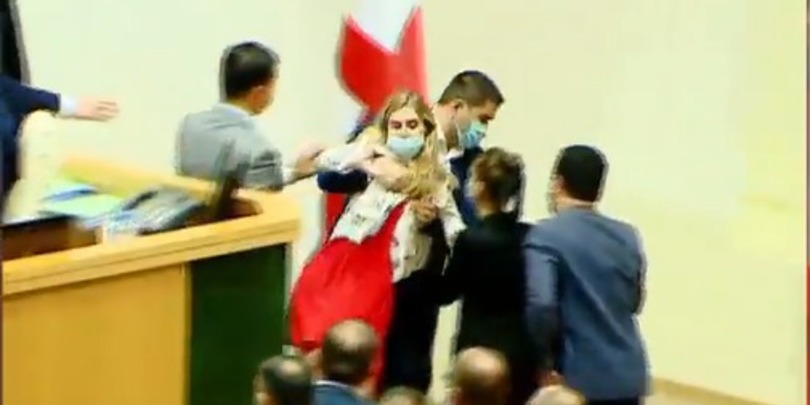
His advanced anatomy lectures on how a man is a man, a woman is a woman, and “biological markers are biological markers” were edifying. Mr. Speaker must indeed be glad to have found a new outlet for his overflowing powers of argumentation. We knew all along that he was bigger than his English-language tweets (or x-es?), which in turn were larger (in size) than the audience willing to read them. Men like him crave a larger audience – preferably the one that is not educated enough to see through the brainwashing tactics.
The government thus found a way to create such an audience through a reform that would put more focus on “national identity,” “patriotism,” and “family values” in general education. It started when one fine winter morning, then-PM Irakli Garibashvili woke up to the shocking realization that his government had spent the last decade using a curriculum drafted by their arch-enemies who – Garibashvili argued – had conducted “experiments” on Georgian youth through “pseudo reforms” launched in 2004.
Patriotism without style
Garibashvili changed chairs, but his legacy lives on. On February 26, the Ministry of Education unveiled the first two-page draft of the new educational goals – a document designed to define long-term teaching strategy – and magnanimously allowed less than two weeks for public feedback. A handful of experts scrambled to meet the tight deadline. And they found that… the document was so badly written, it hardly made sense.
The text “needs semantic and stylistic correction,” wrote Simon Janashia, a leading education expert. The document has been presented “in violation of stylistic, linguistic norms,” commented the Social Justice Center and the Education Coalition, lamenting that the way it was written made it hard to give sensible, structured commentary.
And if you looked into the document, like we did, you’d know what they meant. The draft looks like the Ministry just took things that looked like “values” from the previous document, mixed them in a large cauldron with whatever the GD talking heads now say are “the values en vogue” and scattered that mix liberally (wrong value alert!) throughout the text.
Still, the experts could figure out that shoehorning things like “national values” and “family traditions” into the text squeezed out some important things (besides syntaxis and coherence).
Janashia wrote in his assessment that the draft document has overtones “that are characteristic of contemporary right-wing populist party rhetoric.” While saying that updating the strategic goals of education policy after 20 years is a good thing, he worried that the focus and presentation make the document look like the GD’s election flyer rather than a policy document.
Worse, both critical assessments found the document portrays a student as a “product” or “passive recipient of education.” According to Janashia, the draft document views the teaching process in terms of the “transmission” of knowledge and values “rather than allowing students to actively build their knowledge, develop values, and comprehend them.”
He says the goals also make students see themselves as “subordinates” to the state and its institutions instead of “seeing the state as the expression of the will of the citizens.” And those goals are defined “from a nationalist perspective” – an ideology, Janashia fears, that has already infected the classrooms. The two watchdogs, the Social Justice Center and the Education Coalition, share these concerns.
But let’s not be too critical. The drafters undoubtedly had the children’s best interests at heart – with what little money and talent the government is investing in education, they will end up illiterate anyway, so let’s at least make them proud of who they are (or are not).
Who knows, all these nationalistic and “multi-phobic” sentiments the current political leaders are indoctrinating may one day advance their own political undoing. And while it may serve them right, it will hardly mean a happy ending for the country.
A coalition of twelve local civil society organizations met with representatives of political parties, with the exception of the ruling Georgian Dream party, which did not attend the meeting, to discuss the implementation of the nine conditions set by the European Commission for Georgia. The Coalition had earlier elaborated a detailed vision for the implementation of the nine conditions.
The first meeting with the political groups, held on March 12, was attended by the following parties: “Victory Platform”- a coalition of “United National Movement” (UNM) and “Strategy Aghmashenebeli”, “Girchi-More Freedom” and “Droa” political alliance, “Lelo for Georgia”, “For Georgia”, “Anna Dolidze – For the People”, “Ahali”, “Republican Party of Georgia” and an independent deputy – Teona Akubardia.
Meanwhile, the ruling GD members did not attend the meeting and even denounced it, calling it a “UNM-ish [style] meeting.”
“They had invited us and we did not go. Every time an NGO starts talking about the nine conditions and holds a meeting, if we run to attend these meetings, the nine conditions will remain unfulfilled,” said Mamuka Mdinaradze, the leader of the parliamentary majority, urging them instead to “go and work where the real work is being done.”
“We will not go to the ‘UNM-ish’ meetings, sorry,” he added.
The Coalition of twelve CSOs plans to hold more working meetings with “relevant stakeholders” in the future. According to the Coalition, the “goal of the working meetings is to share the vision of civil society and exchange opinions on the reforms that need to be implemented to fulfill nine steps.”
The meeting was held at the office of the Civil Society Foundation (former Open Society – Georgia Foundation). It was organized with the support of the Eastern European Centre for Multiparty Democracy (EECMD).
Also Read:
One of the signs that elections are coming is that politicians suddenly concern themselves with your children’s best interests. The Georgian Dream government, for example, wants to keep them safe from what they call “LGBT propaganda” by legislating another illiberal law. The announcement has left Georgian liberals depressed and wondering how the party is going to “protect” us from yet another non-existent threat. But since they got the ball rolling, a closer look revealed the government policies may still end up “protecting” children from one crucial thing: education.
Here is Nini and the Dispatch newsletter to talk about the politicians who want to protect us from everything except the single most immediate threat – themselves.
Queer fears
The Georgian Dream announcing the so-called anti-LGBT propaganda bill on February 29 didn’t come as much of a surprise. Rights activists felt it was a matter of when, not if, ever since Georgians forced the party into eating its hat seasoned with the “foreign agent laws” last March (and we do recommend the two op-eds on how it happened: here and here).
The ruling party is now seeking to rally conservative voters in the widely homophobic country by scapegoating and vilifying its queer citizens and is holding the opposition hostage to questionable morals. Go ahead and oppose it, GD dares its opponents, confident that not many are ready to take the risk. Observers fear there is little common denominator for the kind of public mobilization that barred the “foreign agent law.”
So far, the opposition has chosen to play down the (yet unseen) bill, framing it as a campaign distraction and trying to bludgeon the GD on economic problems, such as rising prices. The LGBTQ+ community is also surprisingly silent, given that it is directly concerned. This may yet change – both local and international critics seem to be postponing an awkward conversation until the text of the bill is made public.
But the ruling party is bent on keeping the issue afloat. And while ex-PM Garibashvili is on a campaign trail scaring villagers with imminent gay invasion (and not forgetting to accuse the opposition of sponsoring queers), it fell to Parliament Speaker Shalva Papuashvili, the distinguished gender-wrestler (remember this?), to become the media’s poster boy for “Gender Education.”
His advanced anatomy lectures on how a man is a man, a woman is a woman, and “biological markers are biological markers” were edifying. Mr. Speaker must indeed be glad to have found a new outlet for his overflowing powers of argumentation. We knew all along that he was bigger than his English-language tweets (or x-es?), which in turn were larger (in size) than the audience willing to read them. Men like him crave a larger audience – preferably the one that is not educated enough to see through the brainwashing tactics.
The government thus found a way to create such an audience through a reform that would put more focus on “national identity,” “patriotism,” and “family values” in general education. It started when one fine winter morning, then-PM Irakli Garibashvili woke up to the shocking realization that his government had spent the last decade using a curriculum drafted by their arch-enemies who – Garibashvili argued – had conducted “experiments” on Georgian youth through “pseudo reforms” launched in 2004.
Patriotism without style
Garibashvili changed chairs, but his legacy lives on. On February 26, the Ministry of Education unveiled the first two-page draft of the new educational goals – a document designed to define long-term teaching strategy – and magnanimously allowed less than two weeks for public feedback. A handful of experts scrambled to meet the tight deadline. And they found that… the document was so badly written, it hardly made sense.
The text “needs semantic and stylistic correction,” wrote Simon Janashia, a leading education expert. The document has been presented “in violation of stylistic, linguistic norms,” commented the Social Justice Center and the Education Coalition, lamenting that the way it was written made it hard to give sensible, structured commentary.
And if you looked into the document, like we did, you’d know what they meant. The draft looks like the Ministry just took things that looked like “values” from the previous document, mixed them in a large cauldron with whatever the GD talking heads now say are “the values en vogue” and scattered that mix liberally (wrong value alert!) throughout the text.
Still, the experts could figure out that shoehorning things like “national values” and “family traditions” into the text squeezed out some important things (besides syntaxis and coherence).
Janashia wrote in his assessment that the draft document has overtones “that are characteristic of contemporary right-wing populist party rhetoric.” While saying that updating the strategic goals of education policy after 20 years is a good thing, he worried that the focus and presentation make the document look like the GD’s election flyer rather than a policy document.
Worse, both critical assessments found the document portrays a student as a “product” or “passive recipient of education.” According to Janashia, the draft document views the teaching process in terms of the “transmission” of knowledge and values “rather than allowing students to actively build their knowledge, develop values, and comprehend them.”
He says the goals also make students see themselves as “subordinates” to the state and its institutions instead of “seeing the state as the expression of the will of the citizens.” And those goals are defined “from a nationalist perspective” – an ideology, Janashia fears, that has already infected the classrooms. The two watchdogs, the Social Justice Center and the Education Coalition, share these concerns.
But let’s not be too critical. The drafters undoubtedly had the children’s best interests at heart – with what little money and talent the government is investing in education, they will end up illiterate anyway, so let’s at least make them proud of who they are (or are not).
Who knows, all these nationalistic and “multi-phobic” sentiments the current political leaders are indoctrinating may one day advance their own political undoing. And while it may serve them right, it will hardly mean a happy ending for the country.
Categories