
Islamophobia, racism and restriction of religious freedoms are in the spotlight as one of the main problems of today. The international event “Embracing Diversity: Tackling Islamophobia in 2024” held in Baku discussed problems such as the intolerant approach to Islam and the restriction of people’s religious freedom, especially in Western countries. Azerbaijan joins the initiative to prevent the spread of a threat such as Islamophobia and takes joint steps with the countries of the world.
Day: March 9, 2024
Categories
NPR News: 03-09-2024 11PM EST
NPR News: 03-09-2024 11PM EST
Learn more about sponsor message choices: podcastchoices.com/adchoices
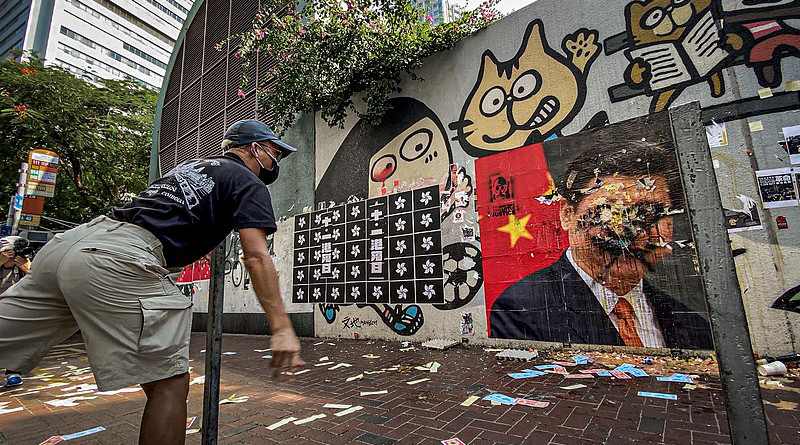
By June Teufel Dreyer
“This is how the world ends. Not with a bang but with a whimper.” The most famous line from T.S. Eliot’s “The Hollow Men” might fairly be applied to the fate of Hong Kong since 1997.
China’s slow strangulation of the fifty years of liberties it had promised to the Special Autonomous Region have been eroded by fits and starts while the democratic governments of the world look on but are painfully aware that they are powerless to affect the outcome.
The Rise and Fall of Jimmy Lai
The rise and fall of Jimmy Lai, now on trial for violating the National Security Law, mirrors the trajectory of Hong Kong itself: a population of hard-working entrepreneurial refugees creating a spectacularly successful economy under the largely benign influence of colonial British rule, then suffering perhaps irreversible downturns after it came under Beijing’s control. Lai, also known as Lai Chee-ying, was born in 1947 and arrived in Hong Kong as a penniless twelve-year-old stowaway. By dint of ingenuity and hard work he built his factory job into textile empire Giordano, with stores in an estimated thirty countries. The Tiananmen Massacre of 1989 led Lai to become politically active, founding Next magazine a year later. In 1994, Nextcalled Premier Li Peng a “son of a turtle egg”—a scathing insult in Chinese culture since turtles, hatched from eggs, do not know who their fathers are. The Chinese government then began closing Giordano stores and constricting operations in other ways, forcing Lai to sell the company. Undaunted and building on Next’s success, Lai founded Apple Daily, a tabloid whose critical reporting on China made the paper an instant commercial success. But in 2021, with its bank accounts frozen and unable to operate, the board of Next Digital, which managed the publication of the paper, announced the liquidation of the company.
Although the trial has dragged on since December 2023, the verdict is preordained. Even finding counsel was difficult: Senior British barrister David Owen was barred from representing Lai on grounds of national security risks. Since Lai is seventy-six, he is likely to spend the rest of his life in prison. In fact, this trial is only the most recent of several. Arrested in 2020, he was initially allowed bail, but it was later revoked due to fraud accusations. Lai has been held in solitary confinement since December of 2020, with even his son unable to visit. In the following year, Lai was sentenced to thirteen months in jail for having participated in a vigil marking the anniversary of the June 1989 massacre at Tiananmen Square in Beijing. Lai is a British citizen but attempts by UK Foreign Secretary David Cameron to obtain his release have been rebuffed.
The Prelude
As Beijing progressively tightened its control over Hong Kong, so did resistance among its citizenry. When in 2003 the government of then-Chief Executive Tung Chee-hwa announced plans to enact laws against vaguely defined crimes including treason, secession, and sedition, over half a million people joined a protest march, some holding slogans printed by Lai’s Apple Daily. Another large rally in 2004 urged the government to implement the universal suffrage that had been promised in the Basic Law of the Special Autonomous Region. Other protests followed in rough proportion to Beijing’s increasing restrictions. In 2014, China announced that Hong Kong could have elections in 2017, but only from a list of candidates pre-approved by Beijing. Large demonstrations against the decision erupted in Hong Kong. They became known as the Umbrella Movement, named after the umbrellas that the demonstrators used to protect themselves from tear gas fired by the police. The protestors managed to occupy the Special Autonomous Region central business district for over two and a half months before government pressure dispersed the crowds after warning of an economic disaster. No concessions were made, though umbrellas became an international symbol of peaceful resistance against the extinction of Hong Kong’s autonomy and freedom.
In 2019, the issue was the Special Autonomous Region government’s introduction of an extradition bill that would allow criminal suspects to be extradited to mainland China. Opponents feared it would expose political activists, journalists, and others to the unfair trials and violent treatment of the mainland’s justice system. After months of protests and violence against the protestors that included the use of live ammunition, the bill was withdrawn. But, by this time, the protestors had expanded their list of demands, including universal suffrage, amnesty for arrested protestors, and an inquiry into police violence. Following over a thousand arrests and a warning from Beijing’s representative in Hong Kong that mainland forces might intervene, the protests ended.
The Aftermath
In June 2020, China imposed its National Security Law on Hong Kong with neither public consultation nor the involvement of Hong Kong’s legislature. Penalties include punishment of up to life in prison for subversion, secession, terrorism, or collusion, as defined by the Chinese Communist Party and government.
Though Lai was the most prominent of those caught in Beijing’s attempt to bring its Special Autonomous Region to heel, he is scarcely alone. Tony Chung, unlike Lai, had advocated Hong Kong independence and served forty-three months in prison. After Chung was released, he was watched constantly and asked to report to national security authorities regularly to tell them whom he had spoken with and where he went. Still, Chung managed to get permission to visit Okinawa on holidays and from there he went to Britain where he is seeking asylum.
Pro-democracy activist Agnes Chow, a diminutive woman now in her late twenties, was arrested in 2020 but released on bail. She eventually left for Canada to study and publicly shared her fear of returning home. Hong Kong Chief Executive John Lee’s chilling response was that the government “will pursue her for life.” She and others like her are not necessarily safe from their self-imposed exiles: Hong Kong’s national security police have placed HK$ 1 million bounties on their heads, regardless of whether they have foreign citizenship. Nor are their families safe. The parents and two sisters of Simon Cheng, another dissident currently in exile in London, were detained for questioning.
Neither age nor fame protects from prosecution. In 2022, security police arrested ninety-year-old Cardinal Joseph Zen, Cantopop star Denise Ho, as well as prominent academic Hui Po-keung and former lawmakers Margaret Ng and Cyd Ho Hui Po-keung, all charged with endangering national security. They had been trustees of the 612 Humanitarian Relief Fund, which was set up in June 2019 to provide financial aid and legal advice for protesters who were injured or arrested. In one of the more poignant moments of the episode, Zen asked that his conviction not affect religious freedom. In the end, the five were sentenced to fines amounting to $510 each.
Other new laws bind Hong Kong as a whole more closely to China. Schools must teach love for China and reverence for Xi Jinping, prompting some education-conscious Hong Kong parents to send their children abroad for schooling. Secondary school textbooks now state that Hong Kong was never a British colony since the Chinese government did not recognize the unequal treaties that ceded the city to Britain. A new postage stamp showing students saluting the Chinese flag changed the color of their shirts from yellow to white, presumably since yellow was the color of many of the umbrellas wielded by the 2014 demonstrators. One man received a four-month sentence for importing children’s books deemed suspicious since they metaphorically portrayed Hong Kong residents as sheep defending their village from evil wolves allegedly representing the central government. Beijing’s crackdown has forced many prominent educators to leave.
The December 2023 election, the first held under new laws that stipulate that only patriots, as defined by the Chinese Communist Party, can run for office, resulted in a record low election turnout of 27.5 percent, as opposed to the record 71.2 percent during the height of anti-government protests in 2019, when the pro-democracy camp won a landslide victory. Chief Executive John Lee described the election as “good,” avoiding comparisons with the past, saying that attention should be focused on the fact that Hong Kong now had a constructive district council rather than what used to be a destructive one. Lee has confirmed his intention to tighten national security laws saying that the city “can’t afford to wait.” His government is moving forward with a $75 billion project in the ocean waters off the city that will see the creation of three new islands to be connected to the mainland. This will further erase the borders between Hong Kong and mainland China.
The reforms have returned Hong Kong to stability, but not to the vibrant job market it once enjoyed. The government issued about 2,600 work visas to overseas financial workers in 2021, down nearly 50 percent compared with 2019. According to the UN Population Fund, more than 140,000 residents of the Special Autonomous Region’s 7.5 million population emigrated from 2020 to 2022, mainly relocating in Britain, Canada, and Australia. Foreign professionals are among those who have departed, fearing for their safety, that of their clients, and their records under the National Security Law. In a three-month period, three British judges resigned from Hong Kong’s top court citing security law concerns. A fourth British citizen who was an ex-chief of the bar association left after hearing he had been summoned by police. When the staff of a prominent human rights lawyer notified him that someone believed to be from state-backed media was waiting for him at his office he went straight to the airport, where a phalanx of people met him at the check-in counter asking questions like “are you leaving because you are a traitor?” The concern for personal safety is such that an American who served on the Manila government’s legal team in the suit against China over the nine-dash line will not even transit through Hong Kong’s airport.
There has been an exodus of foreign capital as well, exacerbated by the declining mainland economy. January 2023 saw what London’s Financial Times called a punishing sell-off by international investors. Foreign investors, who by the end of 2023 had sold about 90 percent of the $33 billion of Chinese stocks they had purchased earlier in the year, have continued selling this year.
Foreign tourism has decreased markedly. Tourism as a whole is still not up to pre-pandemic level, and in 2023 78.7 percent of those who visited came from mainland China. This is despite the government initiating a worldwide “Hello Hong Kong” campaign that year that included 500,000 free airline tickets and consumption vouchers.
Ignoring these metrics, Beijing and Hong Kong governments declare that the new National Security Law has made the Special Autonomous Region a safer place to do business. The city’s luster as the “Pearl of the Orient” has only been enhanced and any statements to the contrary are “sour grapes” by the West. Veteran Hong Kong legislator Regina Ip dismisses the exodus, saying that as some leave, others will move in. That is true, but the government’s pronouncements that tourism is doing well with mostly visitors from China, and that mainland Chinese are filling professional jobs vacated by those who have relocated abroad, are belied by the “Hello Hong Kong” campaign and by the decision to cut the stamp tax for non-permanent residents by half to attract more foreign professionals. At the same time, Singapore, which had reaped the benefits of many international firms seeking to retain a presence in Asia, doubled its stamp tax from 30 to 60 percent in an effort to cope with rising prices from the new arrivals. Hongkongers and mainlanders alike have relocated to Singapore, the latter group including wealthy individuals hoping to shield their assets from Xi Jinping’s crackdown on major businesses. As another marker of the government’s desire to unduly avoid alarming foreigners, a long-term Caucasian resident of Hong Kong describes a sign that says in Chinese “be sure to report on terrorists; if you don’t, you may be the next victim,” but in English it says, “united we stand.”
The Future
Whether motivated by sour grapes or realism, the assessment of Hong Kong in Western and Japanese media is definitely downbeat. Metaphors abound. In one, Chris Patten, the last British governor of Hong Kong, wrote that the United Kingdom gave China the key to a Rolls Royce but instead of simply turning over the ignition, it took the car apart and removed its engine. A newspaper showed a photograph of a deflatedgiant rubber duck that met its end in Hong Kong harbor in June 2023, with the headline “nothing has changed except for everything.” Reinforcing the message, the accompanying story likened what is happening in Hong Kong to a scene from Dostoevsky’s The Brothers Karamazov in which large numbers of the faithful gather at the bier of a monk, expecting that his body was exempt from putrefaction. Although the odor of decay soon becomes sickening, believers in the new Hong Kong ignore it and pretend nothing is happening: the one country, two systems formula remains and the economy will soon return to its pre-COVID-19 vibrance.
Conclusions
A series of protests in the Hong Kong Special Autonomous Region against Beijing’s progressive erosion of the freedoms have resulted in failure and the imposition of stricter controls. Foremost among these was the enactment of a National Security Law in 2020, which resulted in a substantial exodus of tens of thousands of the city’s best and brightest and the erosion of legal standards. Business confidence has been undermined, with many corporations transferring their assets elsewhere. The absorption of Hong Kong into China is now essentially complete.
The United States can do little except protest. Great Britain has offered asylum for those who seek to leave. As Washington continues to seek better relations with China, the lessons of Hong Kong should be borne in mind: Treaties can be ignored or repudiated, as the Sino-British Joint Declaration of 1984 has been. Many Hong Kong advocates have sacrificed their careers and freedom for democracy. Lai’s rise and fall occurred in parallel with that of Hong Kong itself. Lai will be remembered as the foremost martyr to democracy, but the future of Hong Kong is far less certain.
The views expressed in this article are those of the author alone and do not necessarily reflect the position of the Foreign Policy Research Institute, a non-partisan organization that seeks to publish well-argued, policy-oriented articles on American foreign policy and national security priorities.
- About the author: June Teufel Dreyer, a Senior Fellow in the Asia Program at the Foreign Policy Research Institute, is Professor of Political Science at the University of Miami, Coral Gables, Florida.
- Source: This article was published by FPRI
By Luiz Claudio Ferreira
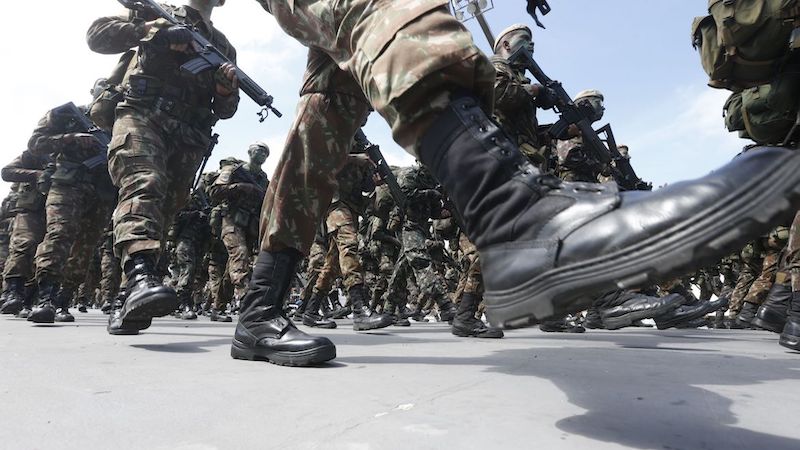
Almost 60 years after the 1964 military coup in Brazil, members of the country’s Armed Forces find themselves under investigation for an attempted coup d’état. In the opinion of three researchers interviewed by Agência Brasil, the Armed Forces are facing a deterioration in their image caused by unprecedented inquiries and the arrests of high-ranking military officers.

To the judgment of these experts, who study the role of the Armed Forces, the investigation conducted by the Federal Police into the coup attempt and the arrests authorized by the Judiciary are writing history—and sending a message to society on the respect owed to democracy.
This week, press outlets have drawn special attention to the testimonies given to the Federal Police by former commanders of the three branches of the military, who were heard as witnesses in the investigation into the attempted putsch. The Federal Police will not comment on ongoing investigations. Other military personnel have come under scrutiny for their possible involvement in this episode as well as other alleged crimes.
In the view of Professor Juliana Bigatão, coordinator of the Brazilian Observatory on Defense and the Armed Forces at the Federal University of São Paulo (Unifesp), these probes should have an impact on how Brazilians see the Armed Forces.
“It is necessary to consider that this type of investigation is unheard-of, including the preventive arrests of members of the Armed Forces. Brazil does not have a tradition of investigating and punishing the military for crimes against democracy,” she argued.
In the opinion of Professor João Roberto Martins Filho, from the Federal University of São Carlos (Ufscar), the unprecedented nature of the trial of military personnel by civil courts differs from another historical moment, shortly after the 1964 military coup, when over 6 thousand military agents were arrested and stripped of their posts.
“In that episode, these military agents, who opposed the coup, were investigated and tried by the military themselves,” he recalled.
He pointed out that the investigation of army generals—the highest rank in the army—raises the current episode to another level.
Justice
A member of the Defense and International Security Studies Group (Gedes), Professor Ana Amélia Penido said there are very few cases in which general-level officers are convicted, even within the military justice system. “In general, justice ‘works’ for the lower ranks,” said the professor from the State University of São Paulo (Unesp).
She believes that the investigation sends a message to society according to which alleged crimes committed by military personnel should be investigated, just as they are with civilians.
Investigations, Professor Bigatão argued, should be widely publicized and reach real conclusions, so there is no feeling of impunity. The experts noted that, because of the Amnesty Law (1979), no member of the Armed Forces was held accountable for crimes during the dictatorship.
Image
The researchers interviewed by Agência Brasil say it is still too early to gauge the exact impact of these episodes on the image of the Armed Forces.
“Historically, the military is well-regarded by people—not because of their duties, but because of the civil activities they end up carrying out,” Professor Penido remarked.
She recalls that the Brazilian military became well known for activities such as transporting basic food baskets and guaranteeing water for remote areas. She understands, however, that the anti-democratic attacks of January 8, 2023 have caused favorable opinion to fall.
Professor João Roberto Martins Filho stated that the Armed Forces are going through an image crisis, adding that commanders today have appeared willing to overcome the latest episodes. “There were legalist general officers who helped prevent a coup.”
When Operation Tempus Veritatis was launched by the Federal Police on February 8, the Army pledged to provide all the information required.
“This position was appropriate in a democracy,” Professor Bigatão affirmed. She noted that the Army has dismissed commanders who were targeted by the crackdown. “The representatives of the upper echelons of the Armed Forces are collaborating or backing the probes. That’s an important sign, and the attitude expected within a democratic regime,” she said.
In Professor Penido’s view, the military who resisted January 8 and the alleged coup attempt took a stance in favor of institutional values. “I think we need to find measures to bring a fresh air to the barracks. To make them more like society and what happens in it,” she went on to say.
Risks of politicization
The root of the problem, Professor Bigatão believes, was the politicization of the Armed Forces during former President Jair Bolsonaro’s government. “There were more military personnel in government positions than at the time of the military regime itself,” she pointed out.
Professor Penido defends the need to address military isolation in the barracks. In her opinion, the civilian and military worlds should be integrated, both in military training and in the intelligence, justice, and budget sectors. Politicization, she said, was not a specifically Brazilian issue.
For professor João Roberto Martins Filho, an important example is Germany, which does not allow the Armed Forces to be linked to political parties, as happened during the Nazi period. “Today, the Armed Forces there are more culturally open and democratic.”
The Ministry of Defense did not respond to requests for comment on the researchers’ assessment of the Armed Forces’ deteriorating image.
By James Anthony
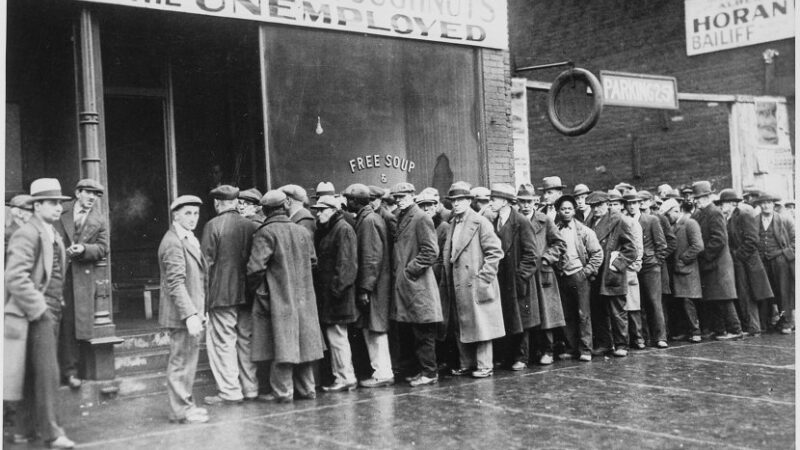
Comparing Great Depression I with the current Great Depression II, the cause has been the same, and the responses have been similar.
But it’s important to not take the parallels too far. The circumstances differ, so the impacts will differ.
First, the similarities.
Same Cause, Similar Responses
Both depressions, like recessions, originated with unsustainable booms. Great Depression I was preceded by the government and financial cronies creating 62 percent more money over eight years. Great Depression II was preceded by the government and financial cronies creating 303 percent more money over sixteen years.
In October, overall, the fraction of jobs to population was down 0.17 percent. Counting only the new jobs, both full time and part time, more than one in three were in governments.
As economist Daniel Lacalle recently pieced together, Fed credit is much costlier but still is inflating to keep zombie banks and lenders alive. Financiers’ credit to families and producers is much costlier and is contracting.
If the Fed holds rates constant or increases them, families and producers will contract further. If the Fed cuts rates, families and producers will still be hurting and won’t rebound and borrow like they had anytime soon. The Fed simply has, for now, used up its ability to take control actions that will make a difference.
(If the Fed’s people would realize this and take no action, that would be good. But when their control actions have made a difference, they have chosen to make most sectors’ numbers look deceptively good in the short term, at the cost of supporting massive waste in the long run.)
For now, families and producers are hostages to the financial sector. Financial zombies aren’t being allowed to die and fertilize productive companies because the Fed instead plays election-cycle politics and favors finance insiders. And yet, despite the Fed people’s culpability for their actions favoring big government politicians and cronies, in the overall system the Fed people aren’t the biggest culprits but rather are caught in the web of the strongest predators.
The problem is spending, and the apex predators are the big government politicians, who make up the majorities of both parties.
Our predecessors lived through a similar problem in Great Depression I. Back then, the direct, open impact of governments through spending was far overshadowed by the indirect, more-hidden impact of governments through regulation. A selectionby economic historian Robert Higgs of major regulatory acts, which were central to Great Depression I since they reduced or threatened property rights, totaled thirty-nine acts in seven years.
This regulatory storm was devastating. In 1929, net private investment had been $8.3 billion. In Great Depression I, under property rights uncertainty from big government politicians of both major parties, net private investment was −$3.1 billion total from 1930 through 1940; it recovered to $9.7 billion in 1941, was suppressed by wartime controls from 1942 through 1945, and only returned to satisfying families’ wants and needs at predepression rates starting in 1946.
Then and now, the same government money creation originated the depressions, and similar government regulation or spending held people down from working their way up and out of the depressions.
Now, though, some moving parts are different. Some of the news is good, but some serious risks could well be worse.
Different Circumstances
People are entering into Great Depression II considerably more productive. Gross domestic product per person, in 2022 dollars, was $14,000 in 1929 but $71,000 in 2022. More is more.
Still, as economist Sam Peltzman has called attention to, more income (memorably: “opulence”) fuels more regulation. Total revenues of governments in all jurisdictions as a fraction of gross national product through 1913 had never exceeded 8 percent, and as people entered Great Depression I still were only 13 percent. As we enter Great Depression II, the total spending of the governments in all jurisdictions as a fraction of gross domestic product is 38 percent. Bad government behavior has long been passed down to us and now seems normal. Now we must characterize not only the problem of the regulatory state, which Peltzman stressed, but also solutions to limit it.
At the same time, our governments are also entering into Great Depression II treating us as considerably more indebted. The US’s current national government burdens its people with slightly more debt now as a percent of the gross domestic product than the past national government ended up burdening its people with at the end of the sixteen years of Great Depression I, including the whole of the resulting total World War II—120 percent in peacetime now, versus 119 percent postwar then. So, where people entered Great Depression I with the US’s national government debt being only 44 percent of gross domestic product, we are entering Great Depression II with none of that same capacity to withstand massive error.
One changing but as yet unproven possible saving grace could be that there is far less tolerance for war by people in modern nations nowadays,including by people in our potential enemy, China.
Beauty contestants emblematically call for world peace but aren’t clear on how to achieve it. The path turns out to be simple, although not as easy as falling into instability and war: peacefully limit our governments, and steadily grow wealthier than potential enemies.
As Stein’s law observes, “If something cannot go on forever, it will stop.” We won’t be pushed down deeper into this pit forever. Our challenge is to put an end to this now—to overpower our captors by overcoming their party system and break free.
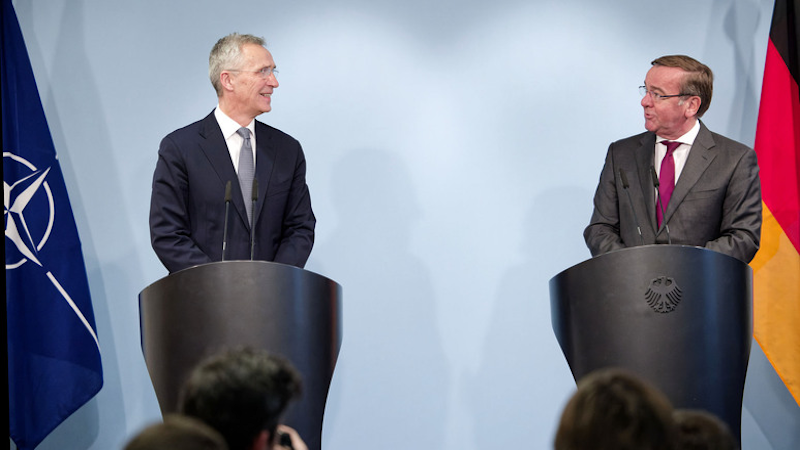
German military leaders may have bungled foolishly over their private discussions regarding operational plans against Russia. However, the security of their incompetent communication – while laughable – does not lessen the seriousness of what was being discussed.
Lt. General Ingo Gerhartz and his aides were earnestly weighing up the technical and propaganda means by which to strike Russia with long-range ballistic missiles. In short, a NATO member was caught red-handed hatching an act of war against Russia.
After Russian media published the audio of the conversation, the German reaction has been to dismiss it as a cerebral war-gaming exercise and as an attempt by Russian disinformation to undermine the government of Olaf Scholz.
This obfuscation by Berlin will not wash. The incontrovertible fact is that the German commanders were deliberating on how to “optimize” the Ukrainian offensive capability to hit Russian targets with the long-range German Taurus cruise missile. The weapon has supposedly not yet been supplied to the Ukrainian regime due to concerns among some German politicians that doing so would escalate the war with Russia. It is clear from the audio tape that the German military chiefs are frustrated by the politicians not ordering the supply of the Taurus.
Gerhartz, the head of the German air force, tells his subordinates in no uncertain terms: “We are now fighting a war that uses much more modern technology than our good old Luftwaffe.”
There you have it: the top German commander says unequivocally, “We are now fighting a war”.
He also goes on to disclose that the American, British, and French militaries are deeply involved in the logistics and planning of attacks by the Ukrainian forces.
We know from numerous other sources that the NATO militaries are involved on the ground in Ukraine fighting against Russian forces. American HIMARS and Patriot missile systems, and the British Storm Shadow and the French Scalp cruise missiles are operated with military expertise from these NATO members.
Still, what is highly damaging from the German military leak is the extent to which the commanders endeavor to conceal the involvement of Germany in a war with Russia. The tortuous conversation about how to avoid the imputation of the German military makes it clear that the German high command knows full well the gravity of what they are organizing. They are discussing the conduct of a covert war against Russia. This is tantamount to the crime of aggression and it runs the risk of starting a full-on war which would no doubt escalate into a nuclear conflagration.
At one point in the discussion with his interlocutors, Lt Gen. Gerhartz talks about the need to conceal direct military involvement by Germany in supplying the Taurus missiles to Ukraine.
He says: “I understand what you are talking about. Politicians may be concerned about the direct, closed connection between Büchel [German air base] and Ukraine, which could become direct participation in the Ukrainian conflict. But in this case, we can say that the exchange of information will take place through MBDA [the German manufacturer of Taurus], and we will send one or two of our specialists to Schrobenhausen. Of course, this is a trick, but from a political point of view, it may look different. If information is exchanged through the manufacturer, then this is not associated with us.”
This is self-incriminating evidence that the German high command is participating in a conspiracy to expand the war against Russia. The only reservation is not to be identified publicly in waging war acts. With utmost cynicism, the German military leaders are looking for a way to claim plausible denial after the crime.
Former Russian president Dmitry Medvedev, now deputy chairman of the National Security Council, called it correctly when he said of the leaked audio tapes that they show Germany is planning war against Russia.
Berlin dismissed Medvedev’s claim as “absurd”. Berlin is the one being absurd if it thinks that the conversation of its military leaders can be palmed off as simply idle banter and theoretical war gaming.
In the 38-minute discussion, the Luftwaffe commander and his underlings explicitly talk about supplying up to 100 Taurus missiles for Ukrainian regime forces to strike deep into Russia. The German top brass refer to the Taurus as a “super tool” and they specifically identify the destruction of an important bridge in the east, which is presumably the Kerch Bridge linking the Russian mainland to Crimea.
The German missile has a range of over 500 kilometers which is twice that of the British or French weapons.
It looks like the German military is taking on the task of leading deep strikes into Russia. London is reportedly urging Berlin to supply the Taurus missiles despite the embarrassment of the leaked private conversation.
This week it is reported that a railway bridge was destroyed in Russia’s southwest Samara province near the city of Chapaevsk. The location is further east than Moscow and is around 1,000 km from the NATO-backed Kiev regime’s front lines in Ukraine. The attack appears to have been a precision strike.
As the German commanders noted in their discussions, collapsing a bridge is one of the most difficult aerial operations that requires precision capability and sophisticated radar evasion. Their conversation took place on February 19. The leak was published last weekend. Media reports say the German government is opposed to signing off on supplying the missiles. But with so much going on behind the public’s back who knows if and when these weapons are released? Have they been already?
If it is confirmed that the bridge near Chapaevsk was hit by a missile then it would appear that the NATO war against Russia has reached a new ominous threshold.
Some Western media outlets commented that the Russian publication of the Luftwaffe audio tape last weekend was aimed at embarrassing the German Chancellor Olaf Scholz into definitely ruling out any supply of Taurus missiles to Ukraine. However, such speculation assumes that Scholz is in control of his military commanders. Most likely they don’t answer to him; they answer to the occupying power in Germany – the United States.
This article was published at Strategic Culture Foundation.
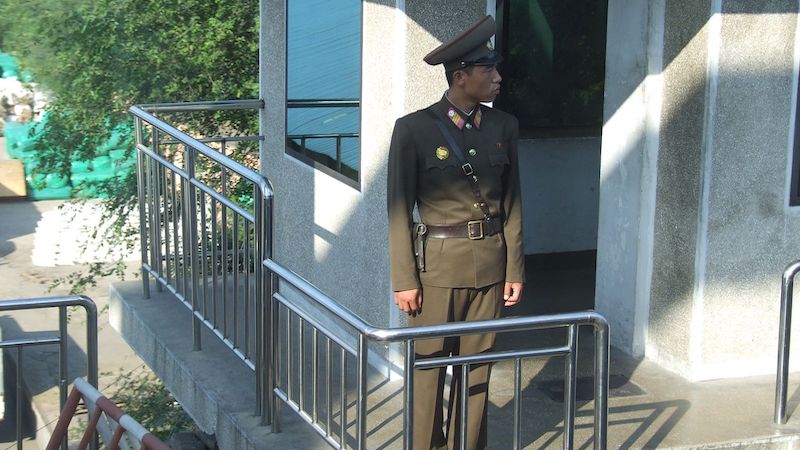
North Korea’s government under Kim Jong Un has effectively sealed its northern border with China, worsening an already grave humanitarian and human rights situation in the country, Human Rights Watch said in a new report.
The 148-page report, “‘A Sense of Terror Stronger than a Bullet’: The Closing of North Korea 2018-2023,” documents the Democratic People’s Republic of Korea’s (DPRK or North Korea) overbroad, excessive, and unnecessary measures during the Covid-19 pandemic, including quarantines and new restrictions on economic activity and freedom of movement. The government’s new measures have severely affected food security and the availability of products needed by North Koreans to survive that previously entered the country via formal or informal trade routes from China. United Nations Security Council sanctions from 2016 and 2017 limited most exports and some imports, harming the country’s economy as well as people’s ability to make a living and access food and essential goods.
“North Korea’s sealing of its border since 2020 and the unintended effects of UN Security Council sanctions since 2017 have increased hardships on the long-suffering North Korean people,” said Lina Yoon, senior Korea researcher at Human Rights Watch. “North Korean leader Kim Jong Un should end the policies that have essentially made North Korea a giant prison, reopen its borders for trade, relax internal travel restrictions, and allow monitored international emergency assistance.”
Concerned governments should urgently address the impact of North Korea’s increased isolation on the basic rights of North Koreans. Even before new restrictions were put in place, North Korea was among the most isolated and repressive countries in the world.
From 2015 through 2023, Human Rights Watch interviewed almost 150 North Koreans outside the country, including 32 North Korean escapees with knowledge or experience of relevant conditions in recent years. Human Rights Watch also made extensive use of satellite imagery, analysis of open-source videos and photographs, interviews with journalists and activists with contacts inside the country and in China, international trade data, media reports, and academic studies.
Cross-border activities decreased in late 2017 after UN Security Council sanctions in 2016 and 2017 led China to impose strict new trade and travel controls on its side of the border. Cross-border travel and trade decreased further during the Covid-19 pandemic.
After the start of the pandemic in 2020, the North Korean government sealed the country’s borders by constructing new and expanded fences and guard posts and strictly enforcing rules, including a standing order for border guards to “shoot on sight” any person or animal approaching the border without permission. The border crackdown compounded the negative effects of earlier UN Security Council sanctions.
North Korean authorities also clamped down on bribery and various forms of low-level unsanctioned economic activity, which since the 1990s had enabled people to maneuver around overbroad governmental controls. Many families need to engage in these vital activities to obtain money or food to survive. The government also further tightened restrictions on communication with the outside world and access to information, while intensifying other ideological controls to prevent unrest.
The new restrictions enabled the government to strengthen its grip on power and reimpose control where its dominance had weakened over the past 30 years: in particular, over the border, market activity, unsanctioned travel, and access to information.
Satellite images starkly reveal the increased security enforcement on the North Korean side of its northern border after early 2020. An in-depth analysis of six selected border areas, totaling 321 kilometers, shows that North Korean authorities fenced off almost all the analyzed areas by 2022 or 2023, with almost 500 kilometers of new fences.
Most of the areas that Human Rights Watch analyzed now have two, and in one small part three, layers of fences. Images also show upgraded primary fences in several areas, new or improved guard patrol paths, as well as new garrisons, watchtowers, and guard posts. In the areas analyzed, Human Rights Watch found a 20-fold increase in security facilities since 2019. A total of 6,820 facilities have been placed near new or improved fences, an average of one every 110 meters. The government’s expanded internal security at its northern border has made almost all unsanctioned domestic and international travel impossible, whether to conduct informal commercial activities or to escape the country.
Even before the Covid-19 pandemic, North Korea was one of the poorest countries in the world. The government has long struggled to ensure food security, adequate childhood nutrition, and access to medicine. For decades, the government has prioritized the development of nuclear weapons and missile programs over basic social services, diverting billions of dollars of revenues that could have been spent on social and public services and infrastructure to spur economic growth and promote economic and social rights.
The UN Security Council should urgently review current sanctions on North Korea, and the measures states take to enforce them, to evaluate their impacts on human rights and delivery of humanitarian aid, Human Rights Watch said. They should also seek more information from UN officials about the connections between North Korea’s weapons programs and its human rights situation.
“North Koreans have lived in deprivation and isolation for decades,” Yoon said. “The UN Security Council and concerned governments should press Kim Jong Un to end the country’s systematic human rights abuses and begin a dialogue to reopen the country to the outside world.”
Categories