
The International Monetary Fund (IMF) said Thursday that in the first two months of 2024, the transit trade volume through the Suez Canal dropped by 50% from a year earlier, while trade volume through the Panama Canal fell by 32% due to Houthi attacks in the Red Sea and drought, respectively, Azernews reports, citing Anadolu Agency.
Day: March 8, 2024
Categories
NPR News: 03-08-2024 10PM EST
NPR News: 03-08-2024 10PM EST
Learn more about sponsor message choices: podcastchoices.com/adchoices
seoul, south korea — North Korean leader Kim Jong Un guided an artillery firing drill by the Korean People’s Army, the country’s military force, state media KCNA reported on Friday.
The drill, carried out on Thursday, involved units near the border that are in firing range of “the enemy’s capital,” KCNA said, referring to Seoul, the South Korean capital of nearly 10 million residents, and added it “fulfilled important military missions for war deterrence.”
South Korea’s Joint Chiefs of Staff (JCS) said North Korea’s military test-fired multiple rocket launcher shells and self-propelled artillery shells toward the Yellow Sea between 11 a.m. and 5 p.m. local time on Thursday.
The JCS said it was monitoring the North’s military activities as joint drills conducted by South Korean and U.S. militaries are underway. The drills, known as the Freedom Shield exercises, began on Monday with twice the number of troops joining compared with last year.
North Korea has also made “multiple attempts” to jam GPS signals near the border in South Korea since Tuesday, the JCS said in a separate statement, adding no damage was caused but warning of consequences.
In Washington, a U.S. State Department spokesperson said the joint U.S.-South Korean drills were “routine and defensive in nature” and called on North Korea “to refrain from further provocative, destabilizing actions and return to diplomacy.” KCNA said Thursday’s artillery drill aimed to increase combat readiness and war capability.
Kim urged the military to push forward with preparations so the artillery sub-units could “take the initiative with merciless and rapid strikes at the moment of their entry into an actual war.”
“He stressed the need to train all the artillery men of the whole army into experts in artillery engagement … and set forth important tasks for rounding off the artillery war preparations,” the report said, referring to the leader of the reclusive state.
Photographs published by KCNA showed balls of flame from artillery fire and Kim dressed in a black leather jacket and flanked by soldiers watching from a dugout.
Seoul’s defense minister, Shin Won-sik, visited the Capital Defense Command on Thursday and ordered a firm response if North Korea made provocations aimed at the capital.
Earlier this week, North Korean state media said Kim inspected field training of troops at a major military operations base in the western region of the country.
seoul, south korea — North Korean leader Kim Jong Un guided an artillery firing drill by the Korean People’s Army, the country’s military force, state media KCNA reported on Friday.
The drill, carried out on Thursday, involved units near the border that are in firing range of “the enemy’s capital,” KCNA said, referring to Seoul, the South Korean capital of nearly 10 million residents, and added it “fulfilled important military missions for war deterrence.”
South Korea’s Joint Chiefs of Staff (JCS) said North Korea’s military test-fired multiple rocket launcher shells and self-propelled artillery shells toward the Yellow Sea between 11 a.m. and 5 p.m. local time on Thursday.
The JCS said it was monitoring the North’s military activities as joint drills conducted by South Korean and U.S. militaries are underway. The drills, known as the Freedom Shield exercises, began on Monday with twice the number of troops joining compared with last year.
North Korea has also made “multiple attempts” to jam GPS signals near the border in South Korea since Tuesday, the JCS said in a separate statement, adding no damage was caused but warning of consequences.
In Washington, a U.S. State Department spokesperson said the joint U.S.-South Korean drills were “routine and defensive in nature” and called on North Korea “to refrain from further provocative, destabilizing actions and return to diplomacy.” KCNA said Thursday’s artillery drill aimed to increase combat readiness and war capability.
Kim urged the military to push forward with preparations so the artillery sub-units could “take the initiative with merciless and rapid strikes at the moment of their entry into an actual war.”
“He stressed the need to train all the artillery men of the whole army into experts in artillery engagement … and set forth important tasks for rounding off the artillery war preparations,” the report said, referring to the leader of the reclusive state.
Photographs published by KCNA showed balls of flame from artillery fire and Kim dressed in a black leather jacket and flanked by soldiers watching from a dugout.
Seoul’s defense minister, Shin Won-sik, visited the Capital Defense Command on Thursday and ordered a firm response if North Korea made provocations aimed at the capital.
Earlier this week, North Korean state media said Kim inspected field training of troops at a major military operations base in the western region of the country.
The Houthis – whose flag proclaims, among other things, “Death to America, Death to Israel, a curse on the Jews” – operate from the chunk of west Yemen they have seized from Yemen’s internationally recognized government (IRG). It is a well-populated area which contains the capital Sana’a and a great length of coastline bordering the Red Sea, including the vital port of Hodeidah. For the past ten years the Houthis, intent on extending their grip to cover the whole country, have been locked in a civil war which, despite various well-intentioned peace brokering efforts, has so far resulted in a virtual stalemate.
As a result, recently their standing among the hard-pressed Yemenis had been on the slide, and they had been competing for popular support against the IRG and the other main protagonist in the contest for supremacy in Yemen – the so-called Southern Transitional Council (STC). Aidarus al-Zoubaidi, who founded the STC and is its president, has set his sights on establishing an independent state of South Yemen.
Hamas’s incursion into Israel on October 7, and the subsequent massacre, provided the Houthis with a totally unexpected political advantage.
As the news of the attack broke, the Houthis – needing little prompting from their Iranian paymasters – virtually declared war on Israel in support. It was no doubt at Iran’s behest that the Houthis went on to plan a series of assaults on Israel. Not all went according to plan. Three cruise missiles fired from Yemen on October 19 were intercepted by the US navy. A drone attack launched on October 28 apparently went off-course and resulted in explosions inside Egypt.
Since then, claiming they are acting to force the international community to halt Israel’s offensive in Gaza, the Houthis have begun a campaign of missile and armed drone attacks on commercial ships transiting the Red Sea. The maritime security coalition of more than 20 nations, Operation Prosperity Guardian, set up by the US in December has done nothing to deter them, nor has the deployment of EU and even Chinese maritime forces off the coast of Yemen.
In mid-January, following more than 20 Houthi attacks on commercial ships, the US and the UK led a 14-nation campaign to “degrade and deter” the Houthi attacks by striking Houthi missile and drone launch and storage facilities, extending this to associated targets such as radar and air defense installations. When this too proved ineffective, in late January they began attacking Houthi weaponry being prepared for launch against commercial shipping. By early February, US-led strikes had destroyed more than 100 missiles and launches, including anti-ship missiles, drones, radars, unmanned waterborne drones, and other equipment.
Whatever the effect of this on the Houthis’ total military capacity, there has been no appreciable reduction in their bellicose operations. They have, if anything, stepped up their aggressive activity. On February 18 they conducted their first strike against the crew of a commercial ship, forcing them to abandon it. Struck by a missile, the Belize-flagged, UK-registered vessel M/K Rubymar, sank in the Red Sea on March 3.
On March 6, a missile attack on a commercial ship, the M/V True Confidence, in the Gulf killed three of its crew members and forced survivors to abandon the vessel.
The Houthi attacks, threatening freedom of navigation and global commerce, have led many shipping lines to take the longer Europe-Far East route round South Africa, avoiding the Red Sea and the Suez Canal. Rerouting traffic around Africa’s Cape of Good Hope can add anything from 12 to 20 days to the journey.
In the first half of February, according to the UN, the Suez Canal experienced a 42% drop in monthly transits and an 82% decrease in container tonnage compared to its peak in 2023. Meanwhile commercial vessels have been rerouting to the Cape of Good Hope for nearly two months, leading to a near doubling of vessel transits in the region and a 75% increase in trade volume.
This failure of the world’s leading military powers to deter the Houthis still lacks a convincing explanation. There is not even evidence that the Houthis have been resupplied by Iran, followed the degradation in their military hardware from Western action. The US-led maritime coalition has intercepted numerous shipments from Iran, but whether additional deliveries to the Houthis are slipping through remains unknown. The Houthis’ original stockpile of weaponry may have been far higher than originally estimated.
How should the West proceed? One approach under consideration is to concentrate on reviving the peace talks between the warring parties in Yemen, pushing for a political settlement which would include an end to Houthi attacks on shipping in the Red Sea. Another is to escalate the attacks on the whole Houthi military machine and defeat them by overwhelming force. How Iran might act in such a scenario is the great unknown.
The respected US think tank and research body, the Soufan Center, believes that as of the end of February, calls in Washington for a significant escalation directly against Houthi forces in Yemen have been gaining momentum. Prominent experts and some former US officials, it says, “are calling for US support for ground combat operations against the Houthis as the only means of forcing the movement to alter its policies.”
The argument runs that the US and its allies will have to threaten something more valuable to the Houthis than the prestige they derive from attacking commercial shipping. The only thing that reaches that threshold is Houthi control of Yemeni territory. So consideration is being given to massively boosting the anti-Houthi forces engaged in the civil war. It is appreciated that supporting a direct attack on Houthi-held territory would entail a great many risks. Of greater significance is that it would add to the misery of the Yemeni population, already the victims of a massive humanitarian catastrophe.
Yet despite the negative consequences, the Soufan Center believes that the perceived threat the Houthis now pose to US and Western vital interests virtually guarantees that calls for an alternative to the current approach will continue to gather strength.
There is a chink of hope. When the Israel-Hamas conflict in Gaza comes to an end, as it must eventually do, the Houthis might seize the opportunity to withdraw from holding the world to ransom.
The head of the U.S. Strategic Command told Congress last week that a powerful set of countries is ganging up against the United States and World War III is on the horizon.
General Anthony Cotton’s testimony didn’t receive much attention from the U.S. press, other than some breathless coverage from conservative outlets eager to emphasize the weakness of the Biden administration and the necessity of boosting the U.S. military budget.
Though under-reported, the general’s comments are a useful window onto the Pentagon’s worldview. They reveal the increasingly Cold War thinking that is developing in Washington, which mirrors the hardening of attitudes in Moscow.
Such talk of “us versus them” is but the latest sign that the world has been thrown back to 1946. It was 78 years ago this week that former British Prime Minister Winston Churchill delivered his infamous “Iron Curtain” speech in Fulton, Missouri. At that time, an international community that had recently been conjured into existence with the formation of the United Nations was threatening to cleave into two spheres, Communist and non-Communist. Churchill, among others, pushed hard to reinforce this division.
Today, a similar chasm has opened up between what Vladimir Putin calls the “collective West” and his preferred axis of allies including China, Iran, North Korea, and Syria. But how united are these two respective spheres? Is war inevitable between them?
In 1946, irrevocable conflict between Moscow and Washington was not a foregone conclusion. Strategic diplomacy could have averted the Cold War, or at least, softened the confrontation. Perhaps lessons from the origins of that great twentieth-century divide can help the world avoid embarking on another decades-long global ideological slugfest.
What Cotton Said
In February, the chair of the House Intelligence Committee Mike Turner (R-OH) made a mysterious statement about a “serious national security threat” that generated a lot of media attention. It turned out to be information about a new Russian capabilityto attack U.S. satellites with nuclear weapons. Turner insists that he dropped his bombshell to wake up the Biden administration to a new threat, though it seems more likely that he was simply trying to prod his fellow House Republicans to support the most recent bill to provide military assistance to Ukraine.
General Cotton’s subsequent testimony came in part because Congress wants reassurance that Russia has not opened up a technological advantage over the United States. And indeed, Cotton went into great detail on what the United States is doing to maintain an edge. But not all of his words were reassuring:
Today, the United States, its Allies, and partners continue to be confronted by two major nuclear powers as strategic competitors and potential adversaries: the People’s Republic of China (PRC) and the Russian Federation. We are also faced with the growing nuclear threat posed by the Democratic People’s Republic of Korea (DPRK) and Islamic Republic of Iran’s continued expansion of its nuclear program. What’s more, our potential adversaries are increasing their level of coordination and cooperation with one another. This threat environment raises the possibility of near-simultaneous conflicts with multiple nuclear-armed, opportunistic adversaries.
Cotton went on to discuss military cooperation between Russia and China, the modernization of their nuclear arsenals, and the supply of ammunition from North Korea and Iran to Russia for its war in Ukraine. He expressed concerns over North Korea’s nuclear arsenal and the continued expansion of Iran’s nuclear program. He then sought to reassure Congress that the administration is undertaking its own modernization of the U.S. nuclear triad and upgrading capacities in such high-tech arenas as electromagnetic spectrum operations and hypersonic weapons.
But after getting the attention of members of Congress by raising the specter of the United States fighting wars simultaneously again multiple adversaries, Cotton didn’t give many examples of this increased “coordination and cooperation” among China, Russia, North Korea, and Iran. He cites a couple of joint military exercises and some arms deliveries.
That’s not exactly comparable to the Soviet moves to create an international, Communist alliance in the late 1940s and 1950s. So, is this new axis of illiberalism arrayed against the “collective West” just a fever dream of Vladimir Putin and/or a useful way of getting Congress to cough up more military dollars?
Russia and the Sovereignistas
The Russian economy is not doing so bad considering all the sanctions slapped on it. In 2023, it grew by 3.6 percent, largely as a result of government stimulus programs, like massive military expenditures. Many countries continue to buy Russian oil, natural gas, and coal. China has been the top customer, followed by India and Turkey. But European countries have also continued to buy Russian fossil fuel to the tune of $18 billion in 2023. So, obviously, consumers of Russian fossil fuels don’t necessarily share the Kremlin’s ideological agenda.
Putin’s far-right positions on religion, anti-LGBTQ “family values,” and illiberal political structures such as an unconstrained executive have some appeal outside of Russia. Viktor Orban, the prime minister of Hungary, cozies up to Putin on the basis of an ideological affinity. So do a number of other far-right actors in Europe and the United States. But Putin’s emphasis on Christianity doesn’t serve as the basis for a powerful bond with China, North Korea, or Iran.
It’s Putin’s emphasis on Russia’s sovereignty—the country’s right to do what it wants within its own borders regardless of the dictates of international law and international organizations—that appeals to other countries led by autocrats who are also defying global norms and institutions. That includes countries in the Global South as well: Daniel Ortega in Nicaragua, Abdel Fattah el-Sisi in Egypt, the military junta in Myanmar.
Let’s call this axis of defiant countries the Soveriegnistas. They may not agree with each other on everything, but they know what they don’t like: globalists telling them what to do. These globalists range from international human rights lawyers and officials from the International Monetary Fund to Eurocrats from Brussels and representatives from environmental NGOs.
In other words, not much really connects Russia, China, Iran, and North Korea. It’s an updated version of George W. Bush’s “axis of evil,” a bunch of countries thrown together that Washington policymakers generally find distasteful at the moment. They are an axis in the eye of the American beholder.
Take Russia and China. Despite increasing economic ties, Beijing is wary of Moscow, and always has been. Putin is an unpredictable actor who, from the Chinese point of view, has put the global economy at unnecessary risk because of his invasion of Ukraine. Of course, China prefers Putin to the alternative, which they fear is chaos or collapse. But his decision to continue fighting—for at least five years, no less—despite suffering a range of battlefield setbacks speaks not only to his stubbornness but his reluctance to take Chinese priorities into consideration.
China and North Korea, meanwhile, are said to be “as close as lips and teeth.” But Pyongyang has long chafed at Beijing’s superior attitude and efforts to push a particular agenda on its “younger brother:” don’t build nuclear weapons, pursue a more market-oriented economic reform, and so on. Iran supplies Russia with drones, but Russia recently angered Tehran by again siding with the UAE over three disputed islands. In response, Iranian commentators brought up all the past examples of Russia ignoring Iranian interests, such as its support for Iraq during the Iran-Iraq War.
And the “collective West”? It has come together, fitfully, to apply sanctions against Russia and supply Ukraine with weapons. But there is division here, too, with a number of EU leaders—Viktor Orban of Hungary, Robert Fico of Slovakia, Geert Wilders of The Netherlands—diverging from the European consensus. Even the United States is not really a reliable member of the “collective West,” with MAGA Republicans and Donald Trump himself taking Ukraine-skeptical positions.
Learning from 1946
The Cold War was not inevitable. After 1945, Stalin was not eager, at least initially, to confront the capitalist world directly. He certainly continued to be ruthless at home, but he eventually withdrew Soviet troops from Iran in 1946 as a result of Western pressure and from Austria in 1955 after assurances that the country would remain neutral. He was initially reluctant to back Kim Il Sung’s plan to invade South Korea in 1950.
But the United States in particular was convinced that there could be no lasting agreements with Stalin or, later, with Mao. Today, the Cold War seems like it was foreordained. But an alternative history might have been constructed out of provisional agreements with Stalin and then with Khrushchev during the Thaw. The extreme polarization of the Cold War era could have been avoided, or at least moderated.
It’s hard to imagine making deals with Putin today, though he seems as reluctant as Stalin was in 1946 to confront the “collective West” directly. Putin has threatened to use nuclear weapons if NATO directly enters the war in Ukraine, which speaks to his strong preference to avoid such a direct confrontation, and he has gone out of his way not to do anything like interdicting NATO weapons shipments for fear of such a confrontation.
But the most important lesson of 1946 is that the United States should do what it can to avoid pushing Russia and its allies closer together. They do not form a natural axis of ideological affinity, although anti-Western sentiment could supply the necessary glue to hold the axis together.
To avoid providing such glue, the United States should first and foremost stop the economic decoupling from China. The Chinese leadership needs to demonstrate that it can deliver economic growth, and the United States can still help ensure that outcome and prevent China from tipping fully into the anti-West camp.
Second, the United States must rescue the Iran nuclear deal from hospice and breathe new life into it. Iran is not a monolith. It has a strong middle class and a heterogeneous reformist bloc. Donald Trump’s cancellation of the Obama-era nuclear agreement all but guaranteed the victory of the current conservative leadership in Tehran by confirming their skepticism of engagement with the United States. The United States needs to mend fences as quickly as possible with Iran in the hopes that the reformists will return to power.
North Korea is the toughest nut to crack. But here, too, the United States can accomplish much by simply opening up negotiations and showing a little flexibility. It’s bad enough alienating a near-totalitarian state. It’s considerably worse pissing off one with nuclear weapons.
It took a long time before the United States figured out, during the Cold War, that it could drive a wedge between Beijing and Moscow, that it could cultivate relations with an increasingly independent Yugoslavia, that it could even form informal alliances with anti-Western mujahidin in Afghanistan (which turned out to be a lousy idea).
The lesson for today: the United States should moderate uncompromising attitudes that are ultimately self-defeating. Putin thinks that he is leading a powerful, united alliance against the “collective West.” Only the United States, in its misguided efforts to push those adversarial countries together, seems to take Putin seriously.
Let’s not wait a couple decades before realizing what smart diplomacy can achieve. Let’s learn the lessons of history now when they really count.
This article was published by FPIF
By Wei Hongxu
Gold price has been on a continuous rise recently, reaching a new record high in closing. In 2023, the international average gold price reached USD 1940.54 per ounce, breaking the historical record of USD 2135.4 per ounce set in December of the previous year.
Since the beginning of this year, it has remained stable above the USD 2000 per ounce mark. Since the end of February, the international gold price has once again risen rapidly, breaking through USD 2100 per ounce. On March 5, the London gold price reached a historic high of USD 2146 per ounce.
The price in RMB also hit a historical high, with the Shanghai Futures Exchange gold futures price closing at RMB 497.36 per gram on March 6, reaching a new high in the 16 years since its listing, approaching RMB 500 per gram. At the same time, with expectations of a possible interest rate cut by the Federal Reserve, many market institutions expect the future gold price to be even higher.
Citigroup stated that it could soar to USD 3000 per ounce in the next 12 to 18 months. It is stated that all of this depends on three possible catalytic factors: major central banks around the world significantly increasing gold purchases, global stagflation, or if there is a deep global recession, gold prices could rise by about 50%.
Chart: Changes in London’s Gold Prices (USD)
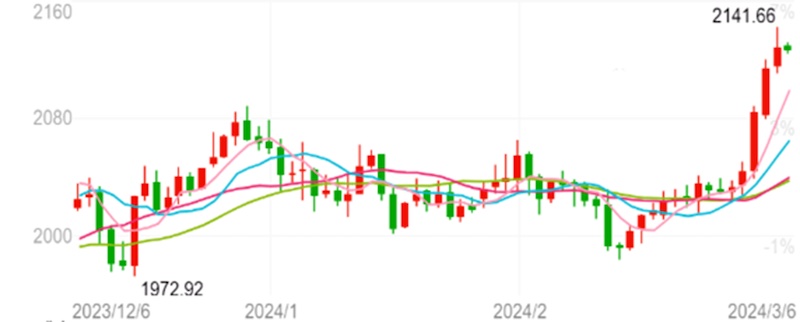 Source: Sina Finance.
Currently, the continuous rise in gold prices is attributed to several factors. Firstly, there is a strong expectation for the relaxation of monetary policy by the Fed, prompting investors to reconsider the hedging function of gold. According to the latest data from the CFTC, as of February 27, the proportion of net long positions in gold has increased to its highest level in three weeks, helping investors to fully rebound from the recent lows and bet bullish on gold as a safe-haven asset. Secondly, the trend of “de-dollarization” driven by central banks around the world purchasing gold in recent years is still ongoing.
According to data from the World Gold Council, due to global uncertainty and continuous purchases by central banks, total gold demand reached a historical high of 4899 tons last year. In 2023, central banks around the world continued to purchase gold at an “astonishing pace”, with purchases totaling 1037 tons, almost on par with the record set in 2022. Thirdly, financial market volatility has made investors worried about risks. In particular, the outbreak and continuation of risks in U.S. small and medium-sized banks have posed risks and uncertainties to the stability of the financial system.
Additionally, concerns about whether last year’s rapid recovery in the U.S. capital markets can continue have led investors to worry about the possibility of asset bubbles. These factors have led to adjustments in investors’ asset allocation. Fourthly, intensified international geopolitical risks have increased investors’ demand for purchasing gold as a hedge. On the one hand, the ongoing Russia-Ukraine conflict and financial sanctions against Russia by Europe and the U.S. have questioned the credibility of the U.S. dollar in emerging market countries, increasing the motivation for central banks to hold gold reserves.
On the other hand, the outbreak of the Israel-Palestine conflict and its continuation in the Middle East, as well as the resulting crisis in the Red Sea, all indicate an escalation of geopolitical risks, increasing the demand for gold as a safe haven. Since the outbreak of the Israel-Palestine conflict in September last year, the price of gold has only begun to rise significantly, increasing by nearly USD 300. In summary, these factors mainly stem from the increase in risk aversion due to heightened market risks and uncertainties, leading to renewed favorability of gold among investors.
Although the market currently holds a generally bullish sentiment towards gold, the recent rise in gold prices differs from the past. Historically, gold, as a safe haven investment, tends to move inversely with the value of the U.S. dollar. In situations where the Fed implements monetary easing, leading to a depreciation of the USD, gold prices, denominated in USD, typically rise. However, there are distinct differences in the current rise in gold prices. Despite the Fed not ending its quantitative tightening policy and U.S. interest rates remaining high, the USD continues to be strong, with the dollar index still exceeding 100. In this scenario, gold prices have surged to historic highs, a rare occurrence since the collapse of the Bretton Woods system.
Although the market anticipates the possibility of the Fed cutting interest rates starting in June, prompting some investors to position themselves ahead of time, the sustained high price of gold may indicate that USD liquidity is still in a relatively “loose” environment. Similar to the performance of gold, cryptocurrencies, which are currently considered “alternatives” to gold, have also begun to rise again, with Bitcoin recently rapidly reaching a historic high of USD 69,000. This situation is perplexing, as it suggests that gold prices are “decoupling” from the USD despite the tightening of the currency’s liquidity. This scenario may have implications for future international capital markets and the status of the USD as the primary international reserve currency.
It is worth noting that despite the Fed tightening monetary policy, fiscal policy in the U.S. remains expansionary. Therefore, even though the magnitude and speed of Fed rate hikes have reached unprecedented levels, the contraction of USD liquidity is not as strong as expected. According to data from the U.S. Treasury Department, since reaching USD 32 trillion in June 2023, U.S. debt has surpassed USD 33 trillion just three months later, and on January 4 this year, it broke through the USD 34 trillion mark.
Bank of America analyst Michael Hartnett suggests that the rapid expansion of U.S. debt has led to the devaluation of USD credit, which has contributed to the sharp increase in asset prices such as gold and bitcoin. Hartnett predicts that at the current rate of debt growth, U.S. debt will soon reach USD 35 trillion. The debt is expected to increase by USD 18 trillion over the next ten years, reaching USD 52 trillion by 2023. With debt expanding rapidly, credit devaluation trades are nearing historical highs, indicating that financial markets are increasingly expecting long-term depreciation of the USD.
In this regard, the weakening of USD credit can be seen as a significant reason for the decoupling of gold from the currency. Of course, from the perspective of geopolitical risks, given the continuous weaponization of the USD by the U.S. and Europe to impose financial sanctions on other countries, central banks and international traders purchasing gold do so not only to maintain portfolio stability or currency stability but also to mitigate the political risks associated with the USD. Therefore, as previously discussed by researchers at ANBOUND, the geopolitical marginalization of the international monetary system can be considered a long-term factor in the decoupling of gold from the USD.
Final analysis conclusion:
On March 5, the London gold price reached a historic high of USD 2146. The RMB gold price also hit a record high. The rapid rise in gold prices since the beginning of the year can be attributed to various factors, including increased expectations of a Fed rate cut, rising purchases by central banks worldwide, instability in financial markets, and escalating geopolitical risks. However, the continued increase in gold prices amid the Fed’s tightening of monetary policy and the strengthening of the USD is noteworthy. Under the influence of USD “credit devaluation” and geopolitical factors, gold has shown a tendency to decouple from the U.S. currency.
Wei Hongxu is a researcher at ANBOUND