Categories
South Caucasus News

The Cultural Day of Armenia at the College of Europe


It is a great honor to be studying at an institution that plays a crucial role in molding the political leaders of tomorrow and fostering cooperation within and beyond Europe. It is an honor to study in an environment full of bright, talented individuals who are graduates from some of the most prestigious universities in the world and to share rich knowledge, delicious meals and a promising future with them. But what’s even a greater honor for me is to see my culture shared and celebrated by so many smart and diverse people from all over the world. On February 16, 2024, the Armenian students studying at the College of Europe in Natolin organized the “Cultural Day of Armenia,” accompanied by numerous exciting events that filled the college with the energy and warm colors of Armenian culture. 

When I first applied to the College of Europe for a one-year Advanced Master of Arts in European Interdisciplinary Studies, I had very little knowledge about the institution’s remarkable past. I started doing more research about the institution after I was shocked by the number of high-level guests who visited our campus for talks and addresses on a regular basis. I came across numerous interesting facts that surprised me positively and made me realize the importance of my college, without having initially acknowledged the significance of my choice. 

Created in 1949 by important European figures such as Salvador de Madariaga and Winston Churchill, the College of Europe is a pioneering and unique institution of its kind, offering postgraduate studies and training in European affairs. Salvador de Madariaga advocated for the creation of a pan-European educational establishment, with the aim of building and maintaining peace in the post-World War II world by uniting smart and talented graduates from different European nations under the same roof. 

Click to view slideshow.

Over the years, the College of Europe has given to the world numerous distinguished alumni, such as President of the European Parliament Roberta Metsola, Denmark’s first female Prime Minister Helle Thorning-Schmidt, Finnish President Alexander Stubb, Professor of Law at New York University School of Law and HEC Paris Alberto Alemanno and many others. In September 2020, Federica Mogherini, former High Representative of the Union for Foreign Affairs and Security Policy, took on the role of rector at the college. 

It is by understanding this importance that the Armenian students at the College of Europe spared no effort in making the Cultural Day of Armenia as remarkable and memorable as it could possibly be. One of the events organized in the scope of the Cultural Day of Armenia was an interactive crash course titled “Discovering Armenia,” in which students from different corners of the world had the chance to learn about the Armenian alphabet, history and culture and get some intensive tongue exercise by pronouncing commonly-used Armenian words and phrases. 

Then, the students and staff at the College of Europe had the opportunity to get an authentically Armenian experience and taste some delicious foods, including dolma, gata and a beautifully organized Armenian dinner. During the dinner, the students were introduced to the Armenian toasting tradition (including a competition of toasts by students from different corners of the world), an unforgettable event led by esteemed guests including His Excellency Alexander Arzoumanian, the Armenian Ambassador to Poland. Ambassador Arzoumanian also met with the students and the academic staff of the College of Europe and answered questions related to Armenia’s foreign policy. 

Click to view slideshow.

The Cultural Day of Armenia also included an exciting chess tournament, the final round of which was accompanied with an Armenian brandy tasting led by the Ambassador himself, turning the game into a memorable experience of healthy competition, delicious degustation and interesting chats. 

Last, but definitely not least, the day ended with a series of remarkable performances revolving around Armenian culture. The cultural concert started with the song “Սիրո Հասակ [Siro Hasak]” (“Age of Love”)  performed by Armenian, Italian and Moldovan students in the Armenian language. Other performances such as “Յարը մարդուն յարա կուտա [Yare Mardun Yara Kuta],” a piano performance honoring the great Armenian composer Aram Khachaturian by a Spanish student, a traditional Armenian dance “Բալենի [Baleni]” by Armenian and Georgian students, a beautiful waltz performance with Aram Khachaturian’s “Masquerade” by Armenian, Georgian, Ukrainian and Polish students, and Aznavour’s “Emmenez-moi” in French and Armenian followed. At the end of the cultural evening, the entire student body performed the traditional Armenian folk dance “Karno Kochari,” a heartwarming moment that left a lasting mark in everyone’s minds and hearts, all of whom could feel the vibrant spirit of Armenian culture through the lively notes of the music. 

Such days and celebrations of culture emphasize each culture’s uniqueness while paradoxically also bringing them closer to each other, reminding us of our humanity, shared joy and the value of togetherness. Perhaps, years later, many of the students who attended the Cultural Day of Armenia will be high-level officials, presidents, prime ministers or ambassadors, representing different political sides and interests, but the moments that we shared will stay with us and mark the way we approach and treat other cultures and traditions. We will be filled with respect and love, as we have experienced it firsthand and acknowledged the value of difference. Perhaps, politics start (or should start) right there: sharing a meal, holding hands for a vibrant dance, speaking words in each others’ mother tongues and feeling the many notes, sounds, movements and emotions that tie us together.

Author information
Milena Baghdasaryan

Milena Baghdasaryan

Milena Baghdasaryan is a graduate from UWC Changshu China. Since the age of 11, she has been writing articles for a local newspaper named Kanch (‘Call’). At the age of 18, she published her first novel on Granish.org and created her own blog, Taghandi Hetqerov (‘In the Pursuit of Talent’)—a portal devoted to interviewing young and talented Armenians all around the world. Baghdasaryan considers storytelling, traveling and learning new languages to be critical in helping one explore the world, connect with others, and discover oneself. Milena currently studies Film and New Media at New York University in Abu Dhabi.

|

The post The Cultural Day of Armenia at the College of Europe appeared first on The Armenian Weekly.

Categories
South Caucasus News

Remembrance, Resilience And Renewal: Genocide Awareness through the Arts


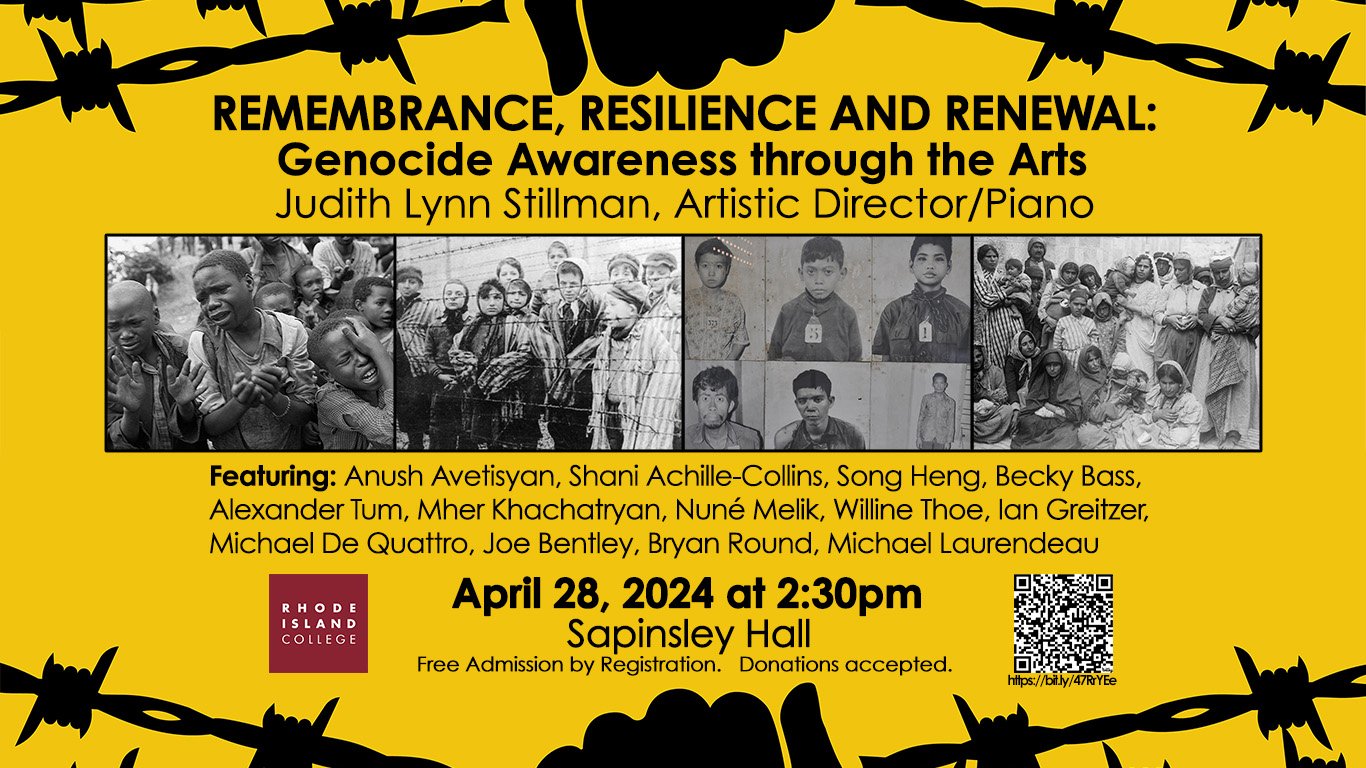
PROVIDENCE, R.I.—Judith Lynn Stillman, Rhode Island College’s Artist-in-Residence, serves as the artistic director, pianist and curator of “Remembrance, Resilience and Renewal: Genocide Awareness through the Arts,” a multidisciplinary program embracing the music, art, spoken word and dance of four extraordinary and resilient cultures that have faced the scourge of genocide. The event takes place during Genocide Awareness and Prevention Month on Sunday, April 28 at 2:30 p.m. in the Sapinsley Hall at Rhode Island College’s Nazarian Center for the Performing Arts in Providence, RI. 

Stillman has brought together multiple diverse multinational artists for a tour-de-force collaboration “to raise awareness about, and in condemnation of, the atrocity of genocide; to remember and honor those who were lost as a result of the inhumanity of humans to other humans; and to celebrate the resilience and fortitude of survivors, peoples and cultures,” says Stillman.

Genocide Awareness and Prevention Month is commemorated in April because the month contains many significant dates in the history of genocide. These include the beginnings of the Genocide against the Tutsi in Rwanda, the Armenian Genocide, the Cambodian Genocide and the Warsaw Ghetto Uprising against the Nazi regime/the Holocaust. The 20th century is often referred to as the “Century of Genocide.” Tragically, this trend has continued into the 21st century. 

The historic program includes celebrated Armenian-American soprano Anush Avetisyan and venerated Armenian violinist Nuné Melik performing iconic Armenian classical and folk music; Armenian painter Mher Khachatryan creating a work of art live on stage during musical performances; renowned Cambodian Pinpeat musician Song Heng – a survivor of the Cambodian Genocide – and his grandchildren performing traditional Cambodian music; Cambodian-American sculptor Alex Tum, a Rhode Island College student and a rising star in the art world; collaborative musical works in remembrance of the Holocaust with Rhode Island Philharmonic musicians Ian Greitzer and Willine Thoe; Rwandan poetry written by Haki Madhubuti, founder of the oldest independent Black publishing house; and the world premiere of “We Have No More Tears” – an original multidisciplinary work by Stillman based upon a traditional Rwandan folk melody, featuring African dance specialist and choreographer Shani Collins-Achille, narrator and steel pan virtuoso Becky Bass, vocals by Anush Avetisyan, the Silk Rhode Singers and Rhode Island College student, alumni and faculty musicians Michael Laurendeau, Bryan Round, Joseph Bentley and Michael De Quattro, with Stillman at the piano.

Stillman, an artistic visionary who uses her art to “give voice to the voiceless,” is reputed for her “true genius” as she leads audiences “on a journey through pain and loss, toward healing, solidarity and hope. Stillman reaches for the stars and succeeds brilliantly in transporting us through darkness toward life and growth.” (The Armenian Weekly)

Admission is free for the event and pre-registration is required. (Donations are welcome at the door.)

Judith Lynn Stillman enjoys a distinguished international career as a pianist, composer, music director, filmmaker and artistic visionary, using her creative platform to champion human rights, women’s rights and diversity and inclusion, further genocide education and give a voice to the voiceless. Hailed by Wynton Marsalis as “a remarkable virtuoso; a consummate artist,” she holds bachelor’s, master’s and doctoral degrees from The Juilliard School. Stillman is the Artist-in-Residence and a professor of music at Rhode Island College. She was named Honored Artist of The American Prize in Piano and Composition, awarded a first Pell Award for Excellence in the Arts, and is the winner of 20 competitions. Her many career highlights include music festivals such as Marlboro, Tanglewood, Grand Teton, Yale-at-Norfolk, Kol HaMusica (Israel) and Ravel Academy (France); performer at the GRAMMYs honoring Rostropovich; and world premieres at Avery Fisher Hall and Alice Tully Hall in Lincoln Center. Wynton Marsalis and Stillman’s acclaimed Sony duo album was on the Top Ten of the Billboard charts. Having collaborated with many notable musicians, Stillman’s compositions have received extensive national media coverage. Her unique “play-within-a-concert”™ productions have received accolades worldwide. Stillman was named Creative Services Industry Leader in PBN’s 2023 Business Women Awards.

Armenian-American soprano Anush Avetisyan has “proved to be a gifted singer and interpreter beyond her years” (German World Magazine). Avetisyan, along with Livermore Valley Opera, is a recipient of the American Prize in Opera for her 2021 performance of Lauretta in Gianni Schicchi, as well as Bianca in Zemlinsky’s “A Florentine Tragedy.” She was a recent two-time fellow at the Music Academy of the West and was awarded a Fast Pitch Awardee for her work in promoting Armenian classical music in the classical canon. 

Becky Bass is an award-winning actress, musician, vocalist, steel pannist, recording artist and theater and music educator. She received a B.A. in Theatre Arts and Performance Studies from Brown University and won the Best Caribbean Female Vocalist Award in the New England Urban Music Awards.

Shani Collins-Achille has been sharing her expertise and passion for dance at Connecticut College since 2009. Her practice and research over the past 14 years have led her to become a wealth of knowledge in many dance forms and disciplines, including West African dance, modern dance, choreography and dance history.

Michael DeQuattro is an eclectic artist known for fusing together acoustic, electronic and

improvisational elements. He is able to move freely among classical, jazz, popular and world idioms, often weaving these styles together in his compositions. He currently teaches percussion and digital audio and accompanies for dance at Rhode Island College. Previous accompaniment positions include The Boston Conservatory and 20 years of service for Roger Williams University. 

Ian Greitzer serves as associate professor in the Department of Music, Theatre and Dance at Rhode Island College, and as principal clarinetist of the Boston Pops Esplanade Orchestra, the Rhode Island Philharmonic and the Boston Classical Orchestra. He performs with the Boston Symphony, Cantata Singers, the Boston Modern Orchestra Project and Collage New Music. Greitzer holds both a Bachelor of Music and a Master of Music Degree from the New England Conservatory.

Master Cambodian musician Song Heng is devoted to keeping traditional Cambodian music alive. Heng and three of his grandchildren perform together on classical Khmer Pinpeat instruments including roneat ek, a xylophone, kong and a circle of bronze gongs. Heng is a survivor of the Cambodian Genocide who undertook a miraculous journey of resilience and survival.

Armenian born and New York-based artist Mher Khachatryan, known as “The Smoke Artist,” always had an interest in the beauty of smoke and fire, life and death. He escapes the limits of the real world through his art. As a youth, Khachatryan studied in Yerevan at the Art School of Hakob Kodjoyan. He began private art lessons at the age of five. He earned his BFA in drawing and painting at the Art College of Panos Terlemezyan and MFA at the Academy of Fine Arts in Yerevan, Armenia.

Nuné Melik is an artist who believes that art has no limitations. She has performed as solo violinist at Carnegie Hall and at the United Nations Headquarters. She was born in Siberia, studied in Moscow and is of Armenian, Georgian and Jewish heritage. Having initiated the Hidden Treasure International, she advocates the music of the Caucasus, concurrently performing with orchestras and in chamber groups all over the world.

Willine Thoe was raised in Hong Kong, attended the highly selective Hong Kong Academy of Performing Arts, received a Bachelor of Music in Viola Performance with high distinction from the Eastman School of Music, Master of Music with honors from the New England Conservatory of Music and Doctorate of Musical Arts from Boston University. She serves as assistant viola principal of the Portland Symphony and a member of the Rhode Island Philharmonic.

Alexander Tum grew up in Providence, Rhode Island, a child of Cambodian and American parents. Alexander is a Bachelor of Fine Arts candidate with a concentration in sculpture and digital media at Rhode Island College. His work has won awards from the Warwick Center for the Arts and the Providence Art Club. Tum’s work reflects a synthesis of cross-cultural perspectives, in which conventions of power dynamics, discipline and repression are examined through large-scale sculptural forms.

Author information

Guest Contributor

Guest Contributor

Guest contributions to the Armenian Weekly are informative articles or press releases written and submitted by members of the community.

|

The post Remembrance, Resilience And Renewal: Genocide Awareness through the Arts appeared first on The Armenian Weekly.


Categories
South Caucasus News

IAEA to help Japan establish protection of largest nuclear power plant from terrorist attacks


Experts from the International Atomic Energy Agency (IAEA) will help Japan establish protection against possible terrorist attacks at the Kashiwazaki-Kariwa nuclear power plant, the most powerful in the country and the world, located in Niigata Prefecture, Azernews reports, citing foreign media outlets.

Categories
South Caucasus News

Uzbekistan improves its position in WBL Index


The World Bank noted progress in the areas of equality in the workplace and marriage, Azernews reports, citing Kun.uz News Agency.

Categories
South Caucasus News

Egypt has always opened its doors to Armenians: Pope Tawadros II to PM Pashinyan – Foreign Affairs – Egypt – Ahram Online


Egypt has always opened its doors to Armenians: Pope Tawadros II to PM Pashinyan – Foreign Affairs – Egypt  Ahram Online

Categories
South Caucasus News

Problem on Facebook and Instagram is not local – Azerbaijani State Service (UPDATE) – Trend News Agency


Problem on Facebook and Instagram is not local – Azerbaijani State Service (UPDATE)  Trend News Agency

Categories
South Caucasus News

Financial system ready for sustainable development, economy financing, quality service: Central Bank Deputy Chairman


Categories
South Caucasus News

Chiden Inch: Watching “Armenia, My Home” – Armenian Weekly


Chiden Inch: Watching “Armenia, My Home”  Armenian Weekly

Categories
South Caucasus News

Chiden Inch: Watching “Armenia, My Home”


Armenia, My Home is simply a wonderful documentary – another Armenian-themed documentary by Andrew Goldberg. It is a beautiful testimony and tribute from an American-Armenian point of view to what it means to be Armenian and what Armenia means to all of us here in the diaspora.

Andrea Martin is the primary narrator. She had lots of help from Ronald Suny, Chris Bohjalian, Eric Bogosian, Herand and Yeraz Markarian, Salpi Ghazarian, Vahe Berberian, Dottie Bengoian, Michael Aram and Peter Balakian, an august cast of talking heads who offer their perspectives and heartfelt thoughts to this very well-crafted film. I would love for all my non-Armenian friends to see this film so they can better understand where my soul and heart are tethered. The sentiments of the narrators, for the most part, express what each and every Armenian might say. Beyond the narration, the soundtrack includes Armenian musicians Ara Dinkjian, Zulal (the trio that includes Yeraz Markarian) and Ara Topouzian and beautiful duduk and church music from Armenia.

There was a long and impressive segment on Mount Ararat and how central it is to the very concept of being Armenian. It is in our DNA. As noted in the film (and my previous article, Chidem Inch: The mountain once known as…), this mountain, our mountain, the symbol of our nation, lies just outside the border of our country.

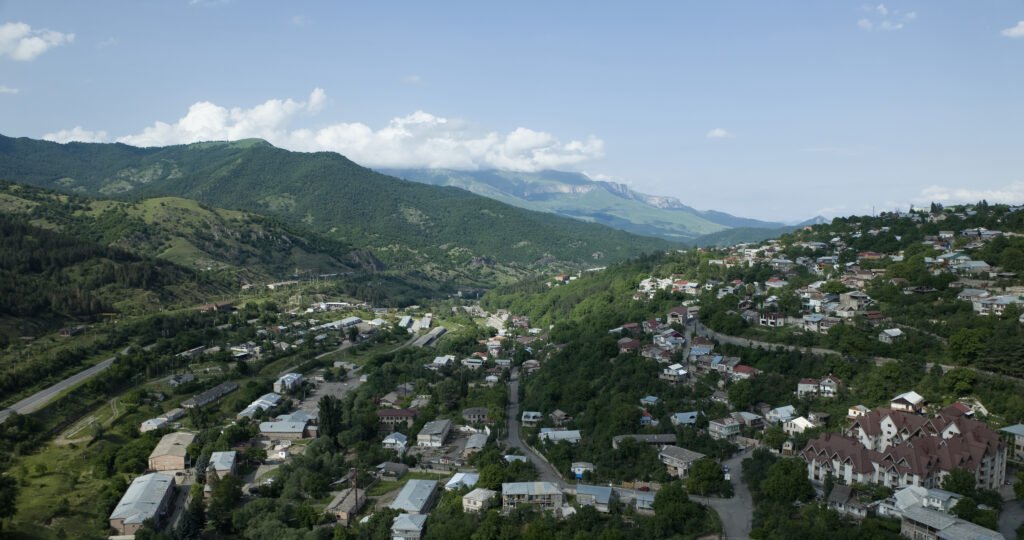
Aerial view of Dilijan Armenia (Photo: So Much Film)

The film is visually stunning. The camerawork shows the beauty of Armenian church architecture and the magnificent countryside from Sevan to Aragats and Yerevan. It even shows the humble homes of the countryside and poor neighborhoods of Yerevan. The use of drone photography gives movement and panorama to this beautiful film.

I would love for all my non-Armenian friends to see this film so they can better understand where my soul and heart are tethered.

Andrew Goldberg is a true friend of the Armenian people. His company, Two Cats Production, is based in New York. His documentaries are often aired on and sometimes in collaboration with PBS. This is not his first Armenian documentary. His previous films are: The Armenian Genocide (2000 and 2006), The Armenians, A Story of Survival (2001) and Images of The Armenian Spirit (2003). His other films include: A Yiddish World Remembered (2002), They Came to America (2003), Proud to Serve: The Men and Women of the U.S. Army (2004) and Jerusalem: Center of the World (2009).

When asked why he makes documentaries on Armenian themes, Goldberg said, “I love telling stories that are underreported and not being told…” He went on to note that the Armenians are a people who have fought through many difficulties to survive and have contributed to business, science and the arts. 

The film is very current and covers Artsakh, including the loss of Artsakh. It includes footage of bombed-out homes and the caravan of cars leaving their homes and a land now devoid of Armenians for the first time in over 1,000 years. 

I view this beautiful film, Armenia, My Home, and Goldberg’s other Armenian-themed films as Armenian national treasures. It is, somehow, more impressive when the auteur is not Armenian. This is not to take away from Armenian artists, but there is something special when we are honored and celebrated by a non-Armenian. If it were up to me, I would bestow honorary Armenian citizenship on Andrew Goldberg. 

This documentary is a must see.

Author information

Mark Gavoor

Mark Gavoor is Associate Professor of Operations Management in the School of Business and Nonprofit Management at North Park University in Chicago. He is an avid blogger and oud player.

|

The post Chiden Inch: Watching “Armenia, My Home” appeared first on The Armenian Weekly.


Categories
South Caucasus News

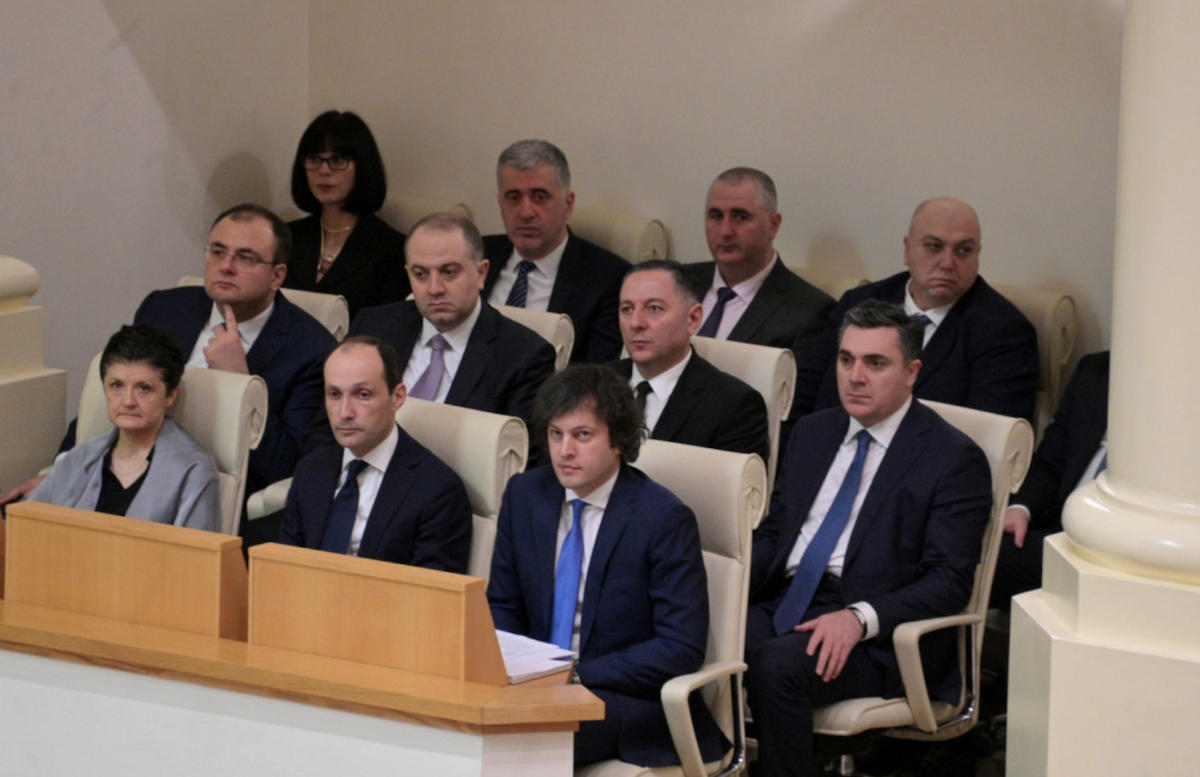
In Georgia, top officials’ salaries will rise ‘to prevent corruption’


Top officials’ salaries rise In Georgia

From 2025, salaries for Georgia‘s prime minister, all ministers, and the president will increase. The ruling party “Georgian Dream” has already introduced a bill for relevant amendments to the law in parliament.

Prime minister Irakli Kobakhidze explained this by saying that “to prevent corruption in public service, salaries must be rational.”

The “Georgian Dream” project proposes specific salary multipliers, significantly increasing top officials’ salaries.

The highest multipliers are set for the president and prime minister.

  • Their salaries will be the same: 160,000 GEL (about $28,000) a year.
  • The president’s salary will more than double by 75,000 GEL (about $28,000).
  • The prime minister’s salary will increase by almost 73%, adding 118,000 GEL (about $45,000) to his annual earnings.
  • Ministers’ salaries will on average double by 50,000-70,000 GEL (about $20,000-$26,000), amounting to an average of 136,000 GEL (about $50,000).

This change will not affect the current president Zurabishvili, as the decision will take effect after the elections.


Prime minister on “combating temptations”

To lessen a person’s temptations, you have to lower their chances. This means providing fair wages, especially to top officials. There’s always going to be speculation around these issues, but what’s important is that the government sets the right standards to prevent corruption,” stated prime minister Irakli Kobakhidze.