Categories
South Caucasus News

Memorial Service: Suhail Aslan


Suhail Aslan

SUHAIL ASLAN

A memorial service will be held to mark the 40th day of Suhail Aslan’s passing, on Saturday, March 9, 2024 at Evergreen Memorial Park, located at 204 N. Evergreen Ave., Los Angeles, CA 9033.

He is remembered by:
Wife, Azadouhie (Keghinian) Aslan
Son, Shant and Diana Aslan
Son, Leon and Anahid Aslan
Daughter, Rita Aslan
Grandchildren, Zabella and Alexander Aslan
Sister-in-law, Haigoush (Keghinian) Kohler and daughter, Christina
Aunt, Jackline and Adel Ghazale and family (Oregon)
Sister and brothers, Laurance and Aslan families (Florida and Iraq)
Masdik Keghinian and family
Dikran and Mani Keghinian and family
Sona Keghinian and Armen Grigorian and family
Nevrik (Chailarian) Jivelegian and family
Shahe and Ani Jivelegian and family
In-law, Sona (Vartoumian) Arakelian and family
In-law, Ines (Medina) Calle and family

And all relatives and friends.


Categories
South Caucasus News

Yerevan Says Normalization with Turkey Depends on Ankara’s ‘Political Will’ – Asbarez.com – Asbarez Armenian News


Yerevan Says Normalization with Turkey Depends on Ankara’s ‘Political Will’ – Asbarez.com  Asbarez Armenian News

Categories
South Caucasus News

Greece envisions successful collaboration with Armenia in innovative defense research – ARMENPRESS


Greece envisions successful collaboration with Armenia in innovative defense research  ARMENPRESS

Categories
South Caucasus News

Judge denies Sen. Menendez bid for a hearing to probe search warrants • New Jersey Monitor – New Jersey Monitor


Judge denies Sen. Menendez bid for a hearing to probe search warrants • New Jersey Monitor  New Jersey Monitor

Categories
South Caucasus News

NPR News: 03-04-2024 6PM EST


NPR News: 03-04-2024 6PM EST

Learn more about sponsor message choices: podcastchoices.com/adchoices

NPR Privacy Policy


Categories
South Caucasus News

Greece Open to Military Cooperation with Armenia that Includes France and India


Greece, which already has a military cooperation agreement with Armenia along with Cyprus, said it was open to expand that field by including India and France, the two other nations that have established military ties with Yerevan in recent months.

“We have established successful trilateral defense cooperation between Armenia, Greece and Cyprus. However, there may also be other trilateral or four-way relations with France and India, with significant countries, important powers, and very influential common allies of Armenia and Greece,” said Greek defense minister Nikolaos Dendias, who was visiting Yerevan on Monday.

Greece firmly believes that disagreements in the South Caucasus could be resolved peacefully, Dendias said during a join press conference with his Armenian counterpart, Suren Papikyan.

“We firmly believe that disagreements could be settled by peaceful means. We are categorically against any unilateral military operations in this region. We also support the conclusion of a peace agreement between Armenia and Azerbaijan within the framework of the international law,” Dendias said.

In his turn, Papikyan hailed Yerevan’s military cooperation with Athens, saying such ties in the defense sector were further bolstered by recent agreements between the two countries.

“During the recent meeting, we discussed matters related to military-technical cooperation. In particular, we emphasized revitalizing military-technical cooperation following the ratification of the agreement on military-technical cooperation between the governments of Armenia and Greece, signed during my visit to Greece in December 2023,” Papikyan said, referring to discussion held with his Greek counterpart prior to the joint press conference.


Categories
South Caucasus News

Antarctica’s Coasts Are Becoming Less Icy


Antarctica’s Coasts Are Becoming Less Icy

Antarctica CREDIT: Ceridwen Fraser

An increase in pockets of open water in Antarctica’s sea ice (polynyas) may mean coastal plants and animals could one day establish on the continent, University of Otago-led research suggests.

The research, published in the prestigious international journal Proceedings of the National Academy of Science, aimed at understanding where open water might allow coastal species to settle in the future.

Led by Research Fellow Dr Grant Duffy from Otago’s Department of Marine Science, the team found unexpected evidence the area of polynyas around Antarctica is increasing dramatically, and it follows an intriguing cycle, growing and shrinking roughly every 16 years.

“These trends are fascinating – and we haven’t noticed them before,” Dr Duffy says. “We’re not completely sure what is driving the cyclical pattern, but the ecological implications could be huge.”

Co-author Dr Ariaan Purich, a scientist at Monash University in Australia who studies ocean-atmosphere interactions, says the cyclical patterns appear to line up with atmospheric drivers including the Southern Annular Mode, a climate phenomenon that circles Antarctica and influences weather in New Zealand and Australia.

“Recent record low Antarctic sea ice coverage has been linked with ocean warming,” Dr Purich says.

“In coastal environments, large-scale atmospheric variability and trends can interact with changing ocean conditions to shape the extent of sea ice. These findings give us exciting insights that will help us predict coastal sea ice coverage in the future.”

The senior author on the study, Professor Ceridwen Fraser, also of the Department of Marine Science, says the results are also critically important for predicting what will happen to coastal ecosystems in Antarctica as the climate warms.

“We know that many non-native plants and animals can reach Antarctica, for example by rafting on floating kelp,” Professor Fraser says.

“At the moment, most of them can’t settle because of coastal ice scour. Less ice could create opportunities for some coastal plants and animals to establish – with big implications for native Antarctic coastal ecosystems.”

Dr Duffy agrees. “Our research shows that areas of open water along Antarctic coasts, in particular, are growing in area as the climate warms,” he says. “These changing coastal environments will mean ecosystems have to adapt and change.”

The study was supported by the Marsden Fund of New Zealand, and researchers involved in the work are part of the major national Antarctic programmes Securing Antarctica’s Environmental Future, Australia and Antarctic Science Platform, New Zealand.


Categories
South Caucasus News

Migrating Animals Learn By Experience


Migrating Animals Learn By Experience

A white stork flies in Germany, where researchers tracked the birds’ migrations and concluded that they incrementally straighten their migration routes to find more direct ways to move between destinations during the spring migration to summer breeding and nesting grounds. CREDIT: Christian Ziegler

Research led by scientists from University of Wyoming and Max Planck Institute of Animal Behavior shows that migrating animals refine their behavior as they get older, suggesting that experiential learning is an important part of successful migration.

While genetics and social behavior are important factors shaping animal migrations, information gained through individual experience also appears to help shape migratory movements, says a research team led by Ellen Aikens. Aikens, who has a joint faculty appointment with UW’s Haub School of Environment and Natural Resources, was among the first cohort of assistant professors hired in 2023 by UW’s new School of Computing. Aikens’ research at the intersection of animal behavior and data science is driven by new possibilities from advanced computing and data science.

The migration findings appear in Proceedings of the National Academy of Sciences, one of the world’s most prestigious multidisciplinary scientific journals covering the biological, physical and social sciences.

The study, which also involved researchers from the University of Konstanz, involved technically sophisticated tracking of over 250 white storks spread across five breeding areas in southern Germany and Austria between 2013 and 2020.

The tracking data collected by the researchers not only pinpointed the migration pathways of the storks, but it also measured the timing and pace of individual storks as well as estimating the amount of energy storks used while flying. The team found that while young storks took their time exploring new places during migration, their migrations become faster as they age.

“As the birds age and gain more experience, older individuals stop exploring new places and instead move more quickly and directly, resulting in greater energy expenditure during migratory flight,” wrote lead author Aikens, whose research in recent years has provided insights into the movement of big-game animals in western Wyoming. “During spring migration, individuals innovated novel shortcuts during the transition from early life into adulthood, suggesting a reliance on spatial memory acquired through learning.”

Individual storks incrementally straightened their migration routes to find more direct ways to move between destinations during the spring migration to summer breeding and nesting grounds, the researchers say. The findings could have implications for a variety of other species of migrating animals.

“Although information has largely been overlooked as a currency shaping migratory behavior, gaining information and using it to incrementally refine migration behavior through learning could play an important role in saving both energy and time,” the researchers wrote. “The landscapes that animals move through are complex and dynamic, requiring that migrants learn where and when favorable conditions that facilitate movement occur and how to exploit them efficiently.”

The researchers don’t discount the importance of genetics and “culturally inherited information” in animal migrations, but they say the new findings point to individual experience as another key factor.

“Whether the first migration is guided by genetics or results from following informed individuals, learning within a lifetime represents an additional and complementary mechanism shaping animal migration,” the paper says.


Categories
South Caucasus News

An Inside Look At Beech Tree Disease


An Inside Look At Beech Tree Disease

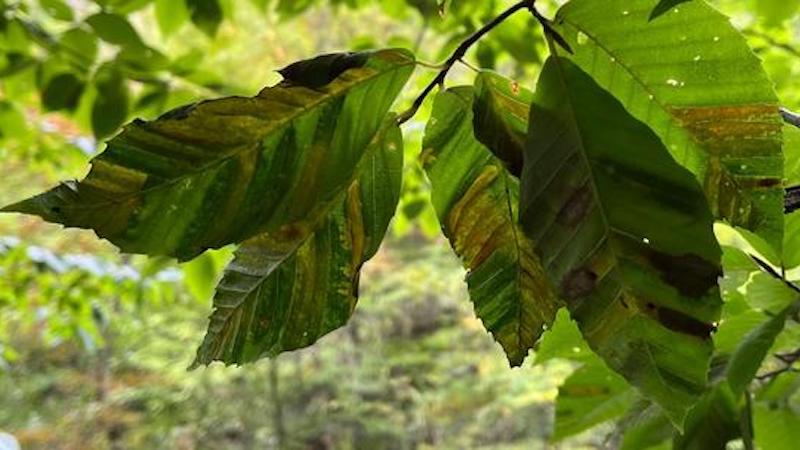
A leaf from a tree in West Rock Ridge State Park in New Haven shows symptoms of infection from Beech Leaf Disease. CREDIT: Craig Brodersen

Beech trees provide food for animals, timber for wood products, and sustenance for beech drop plants, but they are under threat from Beech Leaf Disease (BLD). The disease, first documented in 2012 in the Midwest, is associated with the nematode Litylenchus crenatae mccannii and is spreading rapidly throughout the central and northeast regions of North America.

A team of scientists led by Craig Brodersen, professor of plant physiological ecology, and Leila Fletcher, postdoctoral associate, at the Yale School of the Environment has uncovered new insights on how the disease is impacting leaves at the cellular level and provided a novel mechanistic explanation for the decline of the trees post-infection.

Brodersen first became interested in the disease after noticing the infected trees during a walk in the woods with his children.

“It’s a beautiful tree and an important part of the landscape. I wanted to do something with the tools we have to contribute to a better understanding of what the disease is doing to the tree. In order to come up with a solution, you have to come at it from as many angles as possible,” he said.

The team studied leaves collected from beech trees at Yale-Myers Forest, which hadn’t yet been infected by the nematode, and leaves from infected trees in New Haven’s West Rock Ridge State Park. The presence of the nematode influences the physical or hormonal regulation of leaf development, which leads to the distinctive dark green stripes on affected leaves, the research team said.

Cross section of an infected leaf (left) and healthy leaf (right) chemically stained with bleach shows that the veins are wider and less dense in symptomatic regions of the leaf.

This transverse cross-section of an infected beech leaf shows that the diseased portion (left) is 249% thicker than the healthy portion of the leaf (right).

After comparing the leaf structures at the cellular level, the scientists discovered that maximum photosynthetic rates were approximately 61% lower in symptomatic leaves and respiration rates increased as the percentage of affected leaf tissue increased. A combination of reduced leaf area for photosynthetic tissues, and stomatal deformation (stomata are pores in the leaf surface that provide for the exchange of gases) and reduced stomatal density likely led to the reduced photosynthetic rates observed in symptomatic leaves, the study, which was published in Forest Pathology, found.

“BLD, likely in combination with other foliar pathogens and canopy thinning, causes a reduction in carbon assimilation capacity, which can potentially lead to tree mortality by depleting the trees’ stored carbon,” the study’s authors concluded.

This information will further research on the disease, which is still in its early stages.

“We hope this leads to a better understanding of what the disease is doing to the tree and enable others to use that information to come up with new strategies to manage the disease,” Brodersen said.


Categories
South Caucasus News

Programs Intended To Reduce Health Insurance Premiums May Make Coverage Less Affordable For Middle Class


Programs Intended To Reduce Health Insurance Premiums May Make Coverage Less Affordable For Middle Class

dollar medicine hospital cost

Reinsurance programs, which were created to help lower premiums and increase enrollment in the Affordable Care Act’s health insurance marketplaces, may have had the opposite effects for many potential marketplace enrollees, according to a study by health policy researchers at the University of Pittsburgh School of Public Health, Duke University and University of Minnesota.

The study, published in Health Affairs, is the first to examine the effects of a post-American Rescue Plan Act reinsurance waiver on the affordability of coverage for enrollees who are receiving premium subsidies in the marketplaces.

Nearly a decade ago, when the ACA marketplace was created, premiums initially shot up for many new enrollees. In response, states used the Section 1332 waiver process to create state-funded reinsurance programs, a kind of “insurance for insurers” that shields insurers from very high claims. The hope was that the new waiver would enable insurers to reduce premiums—and it worked. To date, 16 states have used Section 1332 to implement reinsurance programs: Alaska, Colorado, Delaware, Georgia, Hawaii, Maine, Maryland, Minnesota, Montana, New Hampshire, New Jersey, North Dakota, Oregon, Pennsylvania, Rhode Island and Wisconsin.  

However, the authors note, for most enrollees in the ACA’s marketplaces, government subsidies are just as important as the costs of premiums.

The team looked at subsidized enrollees in counties along each side of Georgia’s borders from 2019 to 2023, with particular focus on 2022, the year the state implemented its reinsurance program. The researchers examined differences across the state line and found that, while lower-income marketplace enrollees saw no changes in their minimum cost of marketplace coverage, the picture was quite different for potential enrollees in the middle class—those with incomes from 251% to 400% of the federal poverty level.

Compared to the previous year, the minimum cost to gain coverage increased by about 30% for this population and, in turn, health-insurance enrollment went down by roughly one-third.

For example, a single person making $35,000 a year would see an additional cost of roughly $40 a month to get insurance.

The reason for the cost increase: when premiums decline, so do the subsidies available to enrollees to cover them. Premiums for lower-cost plans in Georgia did not decline enough to compensate for the decrease in subsidies, meaning enrollees were paying a higher net cost.

“People are less likely to buy insurance when it costs more, and being uninsured has been linked to an increase in mortality. These vulnerabilities weigh heavily on our minds when we see results like this,”said senior author Coleman Drake, Ph.D., assistant professor in the Department of Health Policy and Management at Pitt Public Health.

The authors note that unsubsidized enrollees do stand to benefit from reinsurance; however, this population has shrunk drastically nationwide. Just 10% of the individual market nationwide is unsubsidized, down from roughly 50% since the early days of the ACA.

The study calls into the question the methodology behind the creation of reinsurance programs.

“We checked 1332 waiver applications for every one of the 16 states that has created a marketplace reinsurance program, and every one of them projected there would be precisely zero impact on subsidized enrollees,” said Drake. “Unfortunately, our analysis suggests the story is more complicated than that. We hope these results cause state and federal policymakers to reevaluate how marketplace reinsurance programs are affecting the rapidly growing population receiving subsidized marketplace coverage.”

He adds that, by mandate, 1332 programs cannot cause a net decrease in statewide health insurance enrollment.

The team stresses that their findings do not necessarily imply that these programs should be eliminated. “There’s a lot of variability in Section 1332 reinsurance programs,” said David Anderson, doctoral candidate at the Duke University Department of Population Health Sciences and the study’s lead author. “For instance, Colorado uses its waiver to provide subsidies to enrollees who are not eligible for federal premium assistance. And in other states, it’s plausible they could lower the minimum cost of coverage by introducing ‘copper’ plans that have lower premiums and share the cost across more enrollees.” 

“Policy has been overly focused on raw premiums, and that needs to change,” said Drake. “Our analysis adds to mounting evidence that when considering how a policy is going to affect the affordability of coverage for subsidized enrollees, we need to be thinking about premiums paid after subsidies.”