
Categories
South Caucasus News

Rooted in resilience: A conversation with ATP’s Karen Aghajanyan of Artsakh


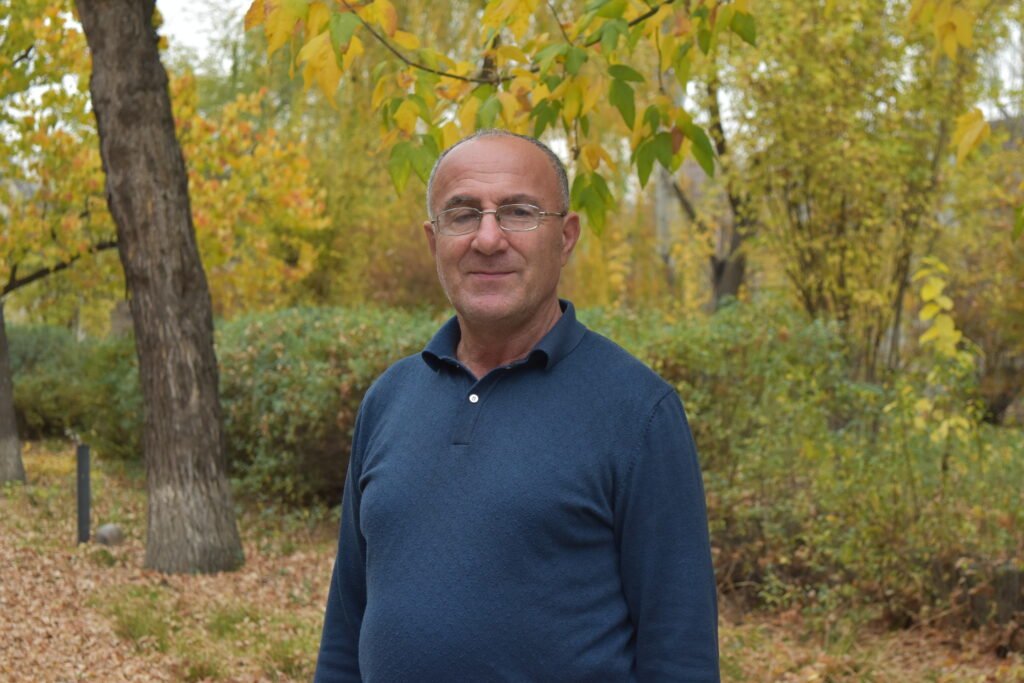
Karen Aghajanyan

In the Armenia Tree Project (ATP) office in Yerevan, which is filled with the comforting aroma of tea, we sit down with Karen Aghajanyan, a displaced Artsakh resident and now an ATP employee, to discuss his journey. Aghajanyan, among the 120,000 displaced, comes from Askeran. He now dedicates his skills to ATP’s Backyard Nursery Program. 

His profound connection to the land, which was cultivated through generations, faced a tumultuous turn when conflict swept through Artsakh, encircling it in a blockade. Our conversation explores the trials of life amid the blockade, subsequent war and exodus, and the resilience needed to rebuild after bidding farewell to one’s homeland. Drawing on his extensive background, including overseeing agriculture in Askeran and serving as the former Deputy Minister of Agriculture, Aghajanyan shares experiences and insights, notably his role in ATP’s impactful Backyard Greenhouse Project in his native region.

ATP: Can you describe your personal experiences during the blockade, particularly how you navigated the challenges and what impact it had on your life?

Karen Aghajanyan (K.A.): I was in Yerevan when the blockade started. I had come for a medical appointment on December 11, 2022, intending to return the next day. However, the roads closed, and I was stranded in Goris for 27 days. I joined a group of fellow Artsakhtsis, navigating a military-designed route through forests and rocky mountains to get back home. Despite the difficulty, the urgency to get to my family drove me forward, and thankfully, we were reunited.


Initially, we believed the blockade would be short-lived, but it persisted until the very end. Food shortages were severe. Villagers with stored provisions managed to endure, but city dwellers faced more dire circumstances. Urban living became increasingly challenging due to a shortage of fuel. The limited supply was used sparingly, mainly for essential agricultural tasks like harvesting.


The scarcity of bread became critical as our enemies actively prevented the harvesting of wheat fields, resorting to gunfire against field workers. Before the 2020 war, Artsakh produced over 100,000 tons of wheat, significantly impacting Armenia’s economy. The loss of Artsakh is not just an economic setback; it’s a huge blow to our security as well, with Azeris now not only at the border but also encroaching on Armenian territory.


For over a month, trucks carrying humanitarian aid from Armenia were stranded at the border, denied entry. On September 18, two Red Cross trucks from Azerbaijan were finally allowed into Stepanakert; however, war erupted the next day, prompting our evacuation. The Azeri forces approached populated areas, with Martuni and Martakert experiencing atrocities as their roads to Stepanakert were sealed. They entered villages, taking hostages, causing fatalities. They had completely encircled Artsakh, and while we resisted and inflicted damage, fighting to the end would have resulted in everyone’s demise, especially with no assistance from Armenia or any other country – no help was expected or received.

Did you ever foresee a situation where everyone would be compelled to leave?

If Artsakh wasn’t surrounded and if there had been an open corridor to Armenia, nobody would have left. The encirclement left us with no choice – either integrate or leave. Not even in our worst nightmares did we imagine the entire population leaving, but the circumstances forced us.


Of course, integration was out of the question due to the recent conflicts and atrocities. The vast difference in civility and society levels makes reconciliation impossible with Azeris. The brutal methods they employ, such as beheadings, mirror historical aggression against us. They undergo constant indoctrination and are taught from a young age that Armenians are enemies. Their leaders perpetuate distorted historical narratives, denying Armenians’ ancient heritage, which hinders any possibility of reconciliation.

The war and tragic gas depot explosion created an incredibly challenging situation. Many, like myself, have experienced every war since the 90s and have no desire for more. Witnessing the losses and tragedies, including fathers, sons and children in the same family, has made people reluctant to endure further conflict and to subject their descendants to such situations. The toll is too great.


Can you describe your displacement and arrival in Armenia?

We departed for Armenia on September 25, just a day after the road opened. It took us 30 hours to get here by car, with limited belongings – mainly clothing and some food. Our main concern was the future, pondering where we would live and how we would sustain ourselves. We faced no major issues on the road, although others weren’t as fortunate, encountering theft and interrogations by Azeri military. After a day in Goris and about 10 days in Abovyan, we settled in Yerevan, where we currently reside.


What was the hardest part? 

Abandoning our ancestral home, large enough for 20-30 people. In hindsight it becomes even more difficult, as we realize that we left behind the culmination of generations’ efforts, including the resting places of our forebears.


My grandmother used to share stories of escaping the Turkish attacks in 1918-1920, when they sought refuge in the next village. A similar pattern unfolded in the 90s. However, in the recent conflict, the Azeri military’s advanced weaponry eliminated any possibility of escape or hiding within villages. It’s painful that, for the first time in history, there’s no Armenians left in Artsakh, and with no way back.

What key factors are essential for displaced families to be able to rebuild a sustainable life here?

Many, like myself, wish to remain in Armenia. The primary challenge for displaced families is securing stable work and housing. Without government support, ongoing rent expenses make sustainability difficult. While there’s talk of programs or neighborhoods for Artsakhtsis, nothing concrete has materialized. If displaced Artsakhtsi families in Armenia can secure stable housing, it would significantly deter migration. Providing a home is often enough to encourage families to stay.

What led you to work with the Armenia Tree Project?

In early September 2021, I met with Jeanmarie (ATP Executive Director) to discuss the proposed Backyard Greenhouse Project in Artsakh. I had helped them build and manage the project. I met again with Jeanmarie in October 2023 to discuss the fate of the project and of Artsakh. During the meeting, they offered me a job with the NGO, and without much hesitation, I accepted. I was already familiar with the organization and its mission. Currently, I’m working on the Backyard Nursery Program, which aligns well with my profession. I appreciate the opportunity to visit provinces daily and meet people, many of whom have been refugees, so we share a unique understanding of each other’s experiences. Helping them becomes a way for me to find some peace and purpose.

Can you provide insights into your background and what life was like in Artsakh before?

I spent all my 60 years in Askeran, where I was born and raised. It had been home not just to me but also my parents and grandparents. We were four siblings – two sisters, two brothers. I remained in my father’s house. I graduated from the Armenian National Agrarian University in Yerevan and chose to return to Askeran immediately after, despite tempting offers to stay. Living in Artsakh offered favorable conditions for both life and work. The nature was incredibly abundant, with almost no winter in Askeran. After a few days of snow, warmth would return, making life there easy and enjoyable.


I was responsible for curating agriculture in Askeran District. Prior to that I worked in the Ministry of Agriculture as the Deputy Minister. I helped manage agricultural programs throughout Artsakh. The region’s milder climate allowed for diverse agricultural pursuits, although vegetable production traditionally lagged. Historically, Artsakhtsis mostly dealt with animal farming and viticulture, which was very much developed. There was huge potential and lots of progress being made.


In recent years, I collaborated with organizations like Armenia Tree Project and Green Lane NGO to establish 24 backyard greenhouses in Askeran, providing families with valuable training to cultivate vegetables. It was a crucial contributor to food security and self-sustainability within the community. I think it was in August of 2021 when ATP first came to us with the project. Our reaction was very positive, and in just a few months we started construction. It was a great experience for the families to start small. They were motivated and getting new ideas for adding crops and expanding, but of course, everything was disrupted. During the blockade, we received potato seeds, and the greenhouses emerged as a beacon of sustenance, providing nourishment to many when food was scarce.

Did you personally engage in cultivation, aside from your involvement in the greenhouse project?

I used my free time after work to grow a variety of crops, supplying my family and relatives. We had excellent apples all year round, particularly the delightful Pink Lady, a delicious variety that I brought from the U.S. I grew pears, persimmons, as well as staple crops like wheat, corn.

Could you share more details about your family and current living arrangements?

I have two sons; one of them is married and has my only grandchild, Karen Jr. They currently live with me as my son and his wife continue their job search. My grandson tells me, “Let’s go back to Askeran. I don’t like it here.” Unfortunately, there’s no space at the kindergartens and long waiting lists. Currently, we reside in a rented apartment in Komitas, Yerevan. Without our own home, the future is uncertain, and I can’t predict how long we’ll stay in our current situation or what lies ahead for us.

When you contemplate the future, what are your thoughts and aspirations?

My hope centers around my children, the youth. Having lived most of my life already, my primary concern is for them and their future, hoping they can stand on their own two feet.

As a concluding question, we always like to ask: Which tree holds a special place in your heart?

I’m especially fond of the platanus tree. It brings back memories of home in Askeran, where 60-70-year-old plane trees dotted the landscape and were visible from every corner. The longevity of the plane tree resonates with me, and in our region, we call it Tnjri.

Author information

Armenia Tree Project

Armenia Tree Project (ATP) is a non-profit program based in Woburn and Yerevan conducting vitally important environmental projects in Armenia’s cities and villages and seeks support in advancing its reforestation mission. Since 1994, ATP has planted and restored more than 6,000,000 trees, and hundreds of jobs have been created for Armenians in seasonal tree-related programs.

|

The post Rooted in resilience: A conversation with ATP’s Karen Aghajanyan of Artsakh appeared first on The Armenian Weekly.


Categories
South Caucasus News

NPR News: 02-01-2024 5PM EST


NPR News: 02-01-2024 5PM EST

Categories
South Caucasus News

AP Headline News – Feb 01 2024 17:00 (EST)


28013281


Categories
South Caucasus News

NPR News: 02-01-2024 4PM EST


NPR News: 02-01-2024 4PM EST

Categories
South Caucasus News

AP Headline News – Feb 01 2024 16:00 (EST)


28013281


Categories
South Caucasus News

Qatar Foreign Ministry: Israel has agreed to ceasefire, waiting for Hamas response


default.jpg


Categories
South Caucasus News

France faces shortage of food


Grocery stores in France are facing shortages of some goods due to disruptions in their delivery caused by traffic disruptions on national highways that are blocked by protesting farmers, Azernews reports, citing foreign media outlets.

Categories
South Caucasus News

Japan, USA conduct military exercises in Philippine Sea


The Japanese Self-Defense Forces conducted joint exercises with the US Navy in the Philippine Sea south of Okinawa, in which two American aircraft carrier groups, Theodore Roosevelt and Carl Vinson, took part, Azernews reports, citing the Japanese Maritime Self-Defense Forces.

Categories
South Caucasus News

Senators Markey and Cassidy Introduce Resolution Asserting Congressional Oversight over U.S. Military Assistance to Azerbaijan


More than 25 civil society organizations urge passage of 502B(c) resolution on Azerbaijan

WASHINGTON – Senators Ed Markey (D-MA) and Bill Cassidy (R-LA) have introduced a bipartisan resolution requesting a report on Azerbaijan’s human rights practices pursuant to Section 502B(c) of the Foreign Assistance Act.

The resolution requests information from the State Department on Azerbaijan’s human rights abuses both within the country, as well as during its sustained military assault against Nagorno-Karabakh (Artsakh) that last year resulted in the ethnic cleansing of its entire indigenous Armenian population. Senators Marco Rubio (R-FL), Gary Peters (D-MI), Elizabeth Warren (D-MA), Sheldon Whitehouse (D-RI), Bob Menendez (D-NJ) and Peter Welch (D-VT) have joined as original cosponsors.

The Armenian National Committee of America (ANCA) has launched a nationwide action campaign urging Senators to cosponsor and work toward passage of the Markey-Cassidy 502B legislation. To take action, visit: https://anca.org/502B

“The need to hold Azerbaijan’s government accountable and forge a peaceful path forward is long overdue,” said Senator Markey. “Military action has never been the solution to peace and stability in Nagorno-Karabakh. This resolution puts pressure on Azerbaijan’s government to uphold human rights and stop committing crimes against ethnic Armenians in the region. We must protect the will, the rights, and the bedrock freedoms of the people of Nagorno-Karabakh.”

“Azerbaijan has already been bulldozing holy sites and starving Armenian communities. This is the type of country the Biden administration wants supplying LNG to Europe instead of Louisiana natural gas?” said Dr. Cassidy.

A House version of the 502B(c) request on Azerbaijan – H.Res.735 – was introduced by Rep. Adam Schiff (D-CA) during Azerbaijan’s blockade of Nagorno-Karabakh last year.

“The Administration’s continuing support for the Aliyev regime, which regularly commits atrocities and human rights violations, simply isn’t in line with our values as Americans. Given Azerbaijan’s egregious military action against Artsakh on September 19, it is imperative that President Biden and Secretary Blinken reconsider our aid policies,” said Representative Schiff. “This resolution aims to gather information on human rights abuses and war crimes being committed by Azerbaijan and to halt future aid. As a country that champions human rights, we must ensure our foreign aid reflects our commitment to core values and does not contribute to further violence against the Armenian people in Artsakh. This resolution is a step towards aligning our international aid with the ethical standards and interests of the United States.”

“Azerbaijan’s ethnic cleansing of Artsakh’s entire indigenous Armenian population last year was a modern-day genocide the U.S. had every opportunity to prevent – but instead enabled through the reckless provision of effectively unconditioned military assistance to Baku’s authoritarian regime,” said ANCA Executive Director, Aram Hamparian. “The ANCA joins with coalition partners in welcoming the leadership of Senators Markey and Cassidy in restoring much-needed Congressional oversight of U.S. military assistance through the enforcement of Section 502B(c) of the Foreign Assistance Act – an underutilized statute that can help reassert human rights to its rightful place at the center of U.S. foreign policy.”

The Markey-Cassidy resolution will require the Department of State to provide a detailed description of widely documented human rights abuses perpetrated by Azerbaijan, including unlawful or arbitrary killings, torture of detainees, the displacement of ethnic Armenians from Nagorno-Karabakh, and the destruction of religious and cultural sites – in addition to violations of internationally recognized human rights including freedom of speech, assembly, political participation, and religious freedom.

The introduction of the Markey-Cassidy resolution comes just months after Azerbaijan launched a military assault on Nagorno-Karabakh that resulted in the ethnic cleansing of the region’s entire Armenian population of 150,000 people. This mass displacement of civilians followed a 10-month humanitarian blockade imposed by Azerbaijan along the Lachin Corridor – the only humanitarian lifeline connecting Nagorno-Karabakh’s Armenian-majority population with the Republic of Armenia – that deprived the region of food, fuel, medicine, and humanitarian access, and had devastating implications on water and energy security.

The Markey-Cassidy 502B(c) resolution on Azerbaijan will build on ongoing efforts to hold Azerbaijan accountable for its human rights violations – including the recent unanimous passage of S.3000, led by Senator Gary Peters (D-MI), which would prohibit the executive branch from exercising its waiver authority over existing restrictions on military assistance to Azerbaijan pursuant to Section 907 of the FREEDOM Support Act.

Section 502B(c) of the Foreign Assistance Act is a long-standing yet underutilized statute that prohibits U.S. security assistance to “any country the government of which engages in a consistent pattern of gross violation of internationally recognized human rights.”  If the Markey-Cassidy resolution passes, it will mark the first time that Congress has requested a report under Section 502B(c) since 1976.

Section 502B(c) is a potent tool to reassert long-overdue Congressional oversight and human rights standards on U.S. military assistance. As a privileged measure, Senators have the ability to discharge a 502B(c) report and force a vote on the Senate floor. Upon passage of the resolution, the State Department must provide a report within 30 days detailing a country’s human rights practices and the steps taken by the United States to prevent these abuses – or security assistance will automatically be suspended until such a statement is transmitted. Following the provision of the requested report by the State Department, Congress may then vote to terminate or restrict security assistance through a joint resolution of disapproval.

Over 25 civil society organizations have welcomed Senator Markey and Cassidy’s introduction of a 502B(c) request in Azerbaijan’s human rights practices, including: Amnesty International USA, Freedom House, Human Rights Foundation (HRF), the International Federation of Human Rights (FIDH), National Council of Churches (NCC), the Arms Control Association (ACA), Friends Commitee on National Legislation (FCNL), Center for Civilians in Conflict (CIVIC), Center for International Policy (CIP), Peace Action, Common Defense, Action Corps, Foreign Policy for America (FP4A), Center for Victims of Torture (CVT), Quincy Institute for Responsible Statecraft, Democracy for the Arab World Now (DAWN), National Iranian American Council (NIAC) Action, Women for Weapons Trade Transparency, Church of the Brethren Office of Peacebuilding & Policy, Global Ministries of the Christian Church (Disciples of Christ) and United Church of Christ, Churches for Middle East Peace (CMEP), the Hellenic American Leadership Council (HALC), In Defense of Christians (IDC), American Friends of Kurdistan (AFK), and the Anglican Office for Government & International Affairs.

“The Human Rights Foundation (HRF) supports the U.S. Senate resolution requesting the U.S. Secretary of State to produce a comprehensive report scrutinizing the dictatorial regime of Azerbaijan’s dismal human rights record… For three decades, the Aliyev dynastic dictatorship, which current tyrant Ilham Aliyev effectively inherited 20 years ago from his late father and former soviet Azerbaijani KGB head Heydar Aliyev, has systematically rigged elections and committed gross human rights violations, including the persecution and wrongful imprisonment of opposition figures and journalists, as well as the torture and extrajudicial killing of Armenian POWs and civilian detainees in the context of the armed conflict in the Nagorno-Karabakh region. It’s long overdue that the United States reassess its military assistance to the Aliyev regime, as this is likely to aid it in the commission of gross human rights violations.” – Javier El-Hage, Chief Legal and Policy Officer, Human Rights Foundation

“Amnesty International USA welcomes Senator Markey’s introduction of a resolution requesting information on Azerbaijan’s human rights practices pursuant to Section 502B(c) of the Foreign Assistance Act. Section 502B of the Foreign Assistance Act is one of the most powerful tools Congress has to exercise human rights oversight on the executive, including through mandating annual country reports on human rights practices. We appreciate the Senator is calling for information from the State Department on Azerbaijan’s human rights record that would allow elected representatives in Congress to have access to the best information available to consider whether U.S. taxpayers are funding violations of international law. We hope more Senators join as co-sponsors, and vote yes when it moves to the floor.” – Amanda Klasing, National Director of Government Relations and Advocacy, Amnesty International USA

“This resolution marks an important step toward Congress reclaiming its long-neglected civilian protection oversight responsibilities when it comes to US arms transfers and military aid. In too many conflicts around the world, US arms transfers have both contributed to and facilitated devastating civilian harm. In Nagorno-Karabakh, Azerbaijan’s blockade of the Lachin Corridor and subsequent armed attacks brought about a humanitarian crisis for tens of thousands of civilians as well as mass displacement. Congress is right to invoke Section 502B of the Foreign Assistance Act to ask serious questions about Azerbaijan’s human rights and civilian protection record and the impact of US arms transfers.” — Annie Shiel, US Advocacy Director, Center for Civilians in Conflict

“CIP applauds Senator Markey and his colleagues for seeking accountability for U.S. arms sales to Azerbaijan, whose government has an abysmal record of human right violations, including a military campaign resulting in the forced displacement of civilians in Nagorno-Karabakh. The U.S. Government must take the enforcement of its own arms laws and our security partners’ obligations under international humanitarian law seriously in order to achieve President Biden’s own stated goal of upholding human rights and a rules-based order in our foreign policy.” – Nancy Okail, President and CEO, Center for International Policy

“This resolution is an important effort to uphold US laws requiring an end to military aid to abusive governments like Azerbaijan. It’s imperative that our government consistently and comprehensively enforce its own laws to all recipients of US military aid.” — Sarah Leah Whitson, Executive Director, Democracy for the Arab World Now

“Women for Weapons Trade Transparency urges Congress to invoke section 502B(c) of the Foreign Assistance Act in light of Azerbaijan’s dismal record of human rights violations and war crimes. Congress must utilize its oversight powers to prevent U.S. assistance from being used in such violations and to ensure that U.S. weapons and funding are not hindering freedom of expression, threatening the operations of independent media, or aiding in arbitrary arrests and politically motivated prosecution.” – Lillian Mauldin, Board Member, Women for Weapons Trade Transparency.

  • The signatories have various mandates that may not cover the full scope of the resolution’s provisions.

Categories
South Caucasus News

Iran has started construction of a new nuclear power plant


default.jpg