
Education at the Turkish-Azerbaijani University at the first stage will be conducted in English and Turkish
Day: February 21, 2024
Georgia’s President Salome Zurabishvili has vowed to veto amendments to the electoral code that would allow the ruling party to heavily influence the makeup of the Central Election Commission (CEC), which Zurabishvili stated contradicted EU recommendations.
Zurabishvili vowed to veto the law hours after the parliamentary majority, led by the ruling Georgian Dream party, passed amendments to the electoral code on Tuesday afternoon.
The amendments would allow for a phased voting system in parliament’s election of the CEC’s chair and non-partisan members. Its members could previously only be elected for full five-year terms by 90 out of 150 MPs, but in recent years its members have instead served six-month terms, requiring only 76 MPs to vote them in.
However, under the new rules, if the parliamentary majority is unable to gather the 90 votes needed to elect the new chair, parliament can pass a motion to elect a chair with a simple majority of 76 votes.
If parliament fails to elect a chair in a second or third round of voting at the lowered threshold, Georgia’s president would personally select the CEC’s members from candidates chosen by the parliamentary speaker.
While Zurabishvili came to power in public elections, under changes introduced in 2017, her successor will be elected by 300 members of parliament and local councils. As a result, if the ruling party retains its parliamentary and regional majority, it will effectively be able to choose the president.
Georgian Dream currently controls at least 80 seats in parliament, allowing it to easily reelect Giorgi Kalandarishvili, the incumbent chair of the commission, through a second round of voting.
This is the most recent in a series of amendments to Georgia’s electoral legislation. In June 2023, the ruling party passed amendments giving the parliamentary speaker the authority to nominate all candidates for the CEC, and withdrew the president’s right to do so.
Against EU recommendations
In her statement announcing her intent to veto the amendments, Zurabishvili accused Georgian Dream of going against the nine recommendations laid out by the European Union and the Venice Commission, an advisory body of the Council of Europe, for Georgia to address before it begins its EU accession.
‘Instead of the head and members of the election commission being selected and elected by broad consensus, with the adopted changes, the process of staffing the CEC […] is only adjusted to the political interest of the ruling party’, read the statement.
Earlier on Tuesday, the EU’s High Representative for Foreign Affairs, Josep Borrell, praised electoral reforms that Georgian Dream had already implemented, and encouraged Georgia to finalise the reforms ‘well ahead of the upcoming elections’, particularly in relation to Venice Commission and ODIHR recommendations for holding ‘free, fair and competitive’ parliamentary elections.
In their report on the amendments in December, the Venice Commission and ODIHR described the changes to Georgia’s electoral code as ‘complicated and rather confusing’, and noted that ‘several outstanding recommendations’ had still not been implemented. The report also noted that the amendments had further departed from the electoral reforms plan set out in the April 2021 agreement between Georgia’s ruling party and opposition, brokered by the European Commission President Charles Michel.
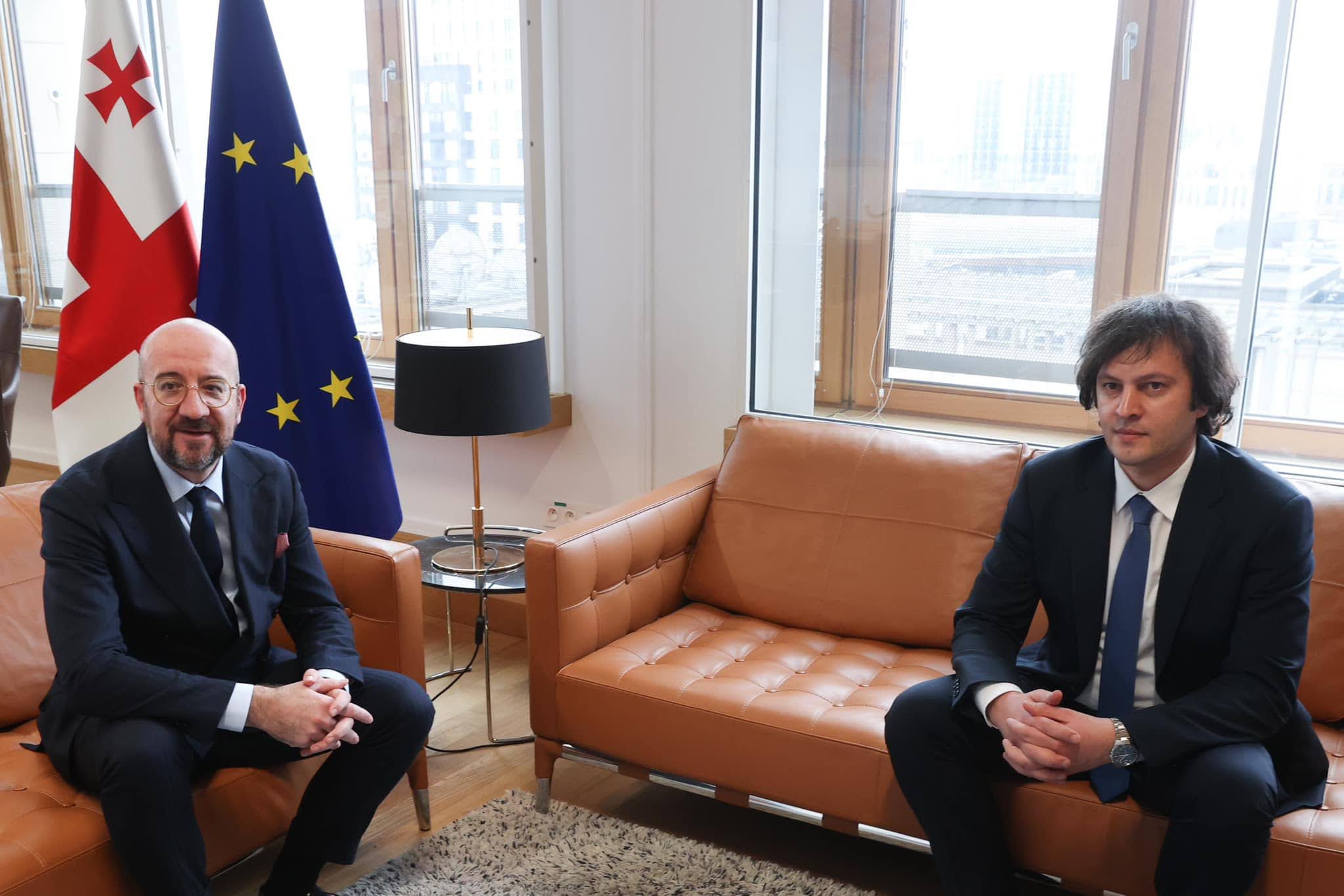 On the day Georgian Dream amended the electoral code, new PM Irakli Kobakhidze met European Council president Michel in Brussels. Image: Charles Michel/Facebook.
Prior to Zurabishvili’s announcement, members of the opposition called on the president to veto the amendments. Opposition MP Roman Gotsiridze, of the Euro-Optimists parliamentary group, accused the ruling party of tailoring the country’s electoral code to its interests at the expense of the reforms expected by the EU.
‘One of the nine preconditions, the one concerning electoral reforms, fails after these changes are adopted,’ warned Paata Manjgaladze of the parliamentary Reform group on Tuesday. ‘We cannot support changes that […] prevent Georgia from joining the European Union in an accelerated manner.’
Local election watchdogs also criticised the legislative change. The Georgian Young Lawyers’ Association warned that the amendments went against the Venice Commission’s recommendations, while the International Society for Fair Elections and Democracy (ISFED) noted that the decision ‘by the parliamentary majority’ did not contribute to Georgia’s moving towards EU membership.
Preparing for the general elections
The amendments were Georgian Dream’s first major legislative package since the appointment of Irakli Kobakhidze as prime minister after Irakli Gharibashvili’s abrupt resignation.
[Read more: Who is Irakli Kobakhidze, Georgia’s next Prime Minister?]
The amendments also came eight months before October’s parliamentary elections.
Georgian Dream has ruled out forming a coalition government, pledging instead to win a constitutional majority in late October. The ruling party appears poised to present itself as a guarantor of peace as it accuses both the West and the ‘radical opposition’ of seeking to drag Georgia into a war with Russia.
Georgia’s opposition groups are currently seeking to form coalitions, after suggestions to lower the 5% electoral threshold were rejected by the ruling party.
In recent months, the opposition has primarily focused on allegations of corruption amongst the ruling party’s leaders, and on questioning Georgian Dream’s ability to meet goals that would secure Georgia’s accession talks with the EU by the end of the year.
The post Georgia’s President to veto ‘anti-European’ amendments to electoral code appeared first on OC Media.
Yerevan has received another package of proposals on a peace treaty from Baku, Secretary of the Armenian Security Council Armen Grigoryan said at a briefing on Wednesday. On January 4, Armenia sent its version of the draft document, and at the end of the month, the Azerbaijani Foreign Minister promised…
Categories
NPR News: 02-21-2024 8AM EST
On February 20-21, the delegation led by Armenian Deputy Foreign Minister Vahan Kostanyan participated in the 11th Asia-Pacific Forum for Sustainable Development in Bangkok.
During the solemn opening ceremony of the Forum, Deputy Foreign Minister Vahan Kostanyan was elected Vice-President of the Forum.
At a panel discussion on “Eradication of poverty in the midst of multiple crises and strengthening the 2030 Agenda for Sustainable Development: Providing sustainable, resilient and innovative solutions in the Asia-Pacific region,” the Deputy FM presented the challenges Armenia has been facing in recent years, the ethnic cleansing of Nagorno Karabakh and the instability of the Armenia-Azerbaijan border, which created additional problems on the path of realization of sustainable development goals.
Deputy Foreign Minister Vahan Kostanyan also presided over the Forum’s session dedicated to the Future Summit, during which reference was made to the Future Pact to be adopted as a result of the summit.
Vahan Kostanyan had a number of bilateral meeting on the sidelines of the forum.