NPR News: 02-20-2024 7PM EST
Learn more about sponsor message choices: podcastchoices.com/adchoices
 The South Caucasus News - SouthCaucasusNews.com
When Azerbaijan began its attacks on Armenia in 2020, Vahe Poghosyan was one of many brave young men who volunteered to join the Armenian army to protect their homeland. He was sent to a border area constantly under heavy attack by Azerbaijan. During one of these attacks, a rocket hit the truck Poghosyan was riding in. Fourteen Armenian soldiers were killed that day; only three survived. One of those survivors was Poghosyan.
“I was covered in blood,” Poghosyan recalled. “I couldn’t see anything as there was shrapnel in both of my eyes.” He spent the next eight and a half terrifying hours lying on the battlefield, bleeding and unable to see, until it was possible for someone to rescue him.
With only a few minutes left to live, Poghosyan was rescued and rushed to a hospital in Yerevan, where he was treated for almost one month. His eyesight was gone, and all he could see was a sliver of light. Poghosyan thought he was going to be blind for the rest of his life. After escaping one traumatic experience of fighting in the war and losing his friends, Poghosyan faced another agonizing prospect – that he may never be able to see again.
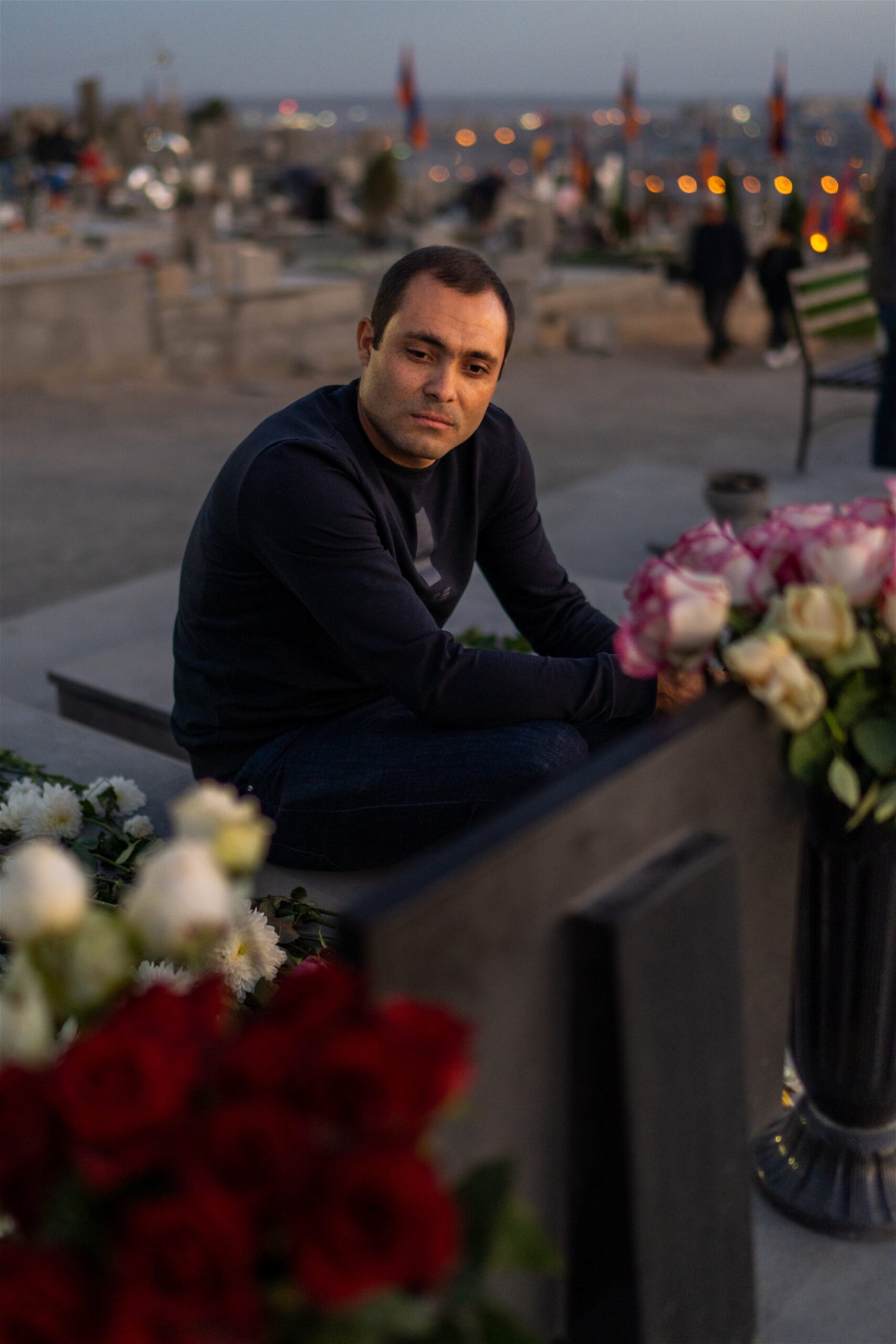 Vahe Poghosyan at Yerablur
“I remember so vividly the effects of the first Karabakh war in Armenia,” recalled Dr. Roger Ohanesian, founder and president of the Armenian EyeCare Project (AECP.) “It was the unrest during that time that led to the beginning of the Armenian EyeCare Project. Now, 30 years later, I am happy to say that because of the AECP’s emphasis on medical education and training, doctors in Armenia are capable of performing complex surgeries and offering top-of-the-line eye care to their countrymen.”
Dr. Georgi Grigoryan, one of AECP’s very first fellows, successfully performed two complex surgeries on Poghosyan’s eye, removing the shrapnel and replacing the lens. This allowed Poghosyan to see again. “I can see my daughter’s beautiful smile now,” said Poghosyan with immense gratitude. After regaining his sight, life has drastically improved for Poghosyan as he is now able to work, drive and support his family once again.
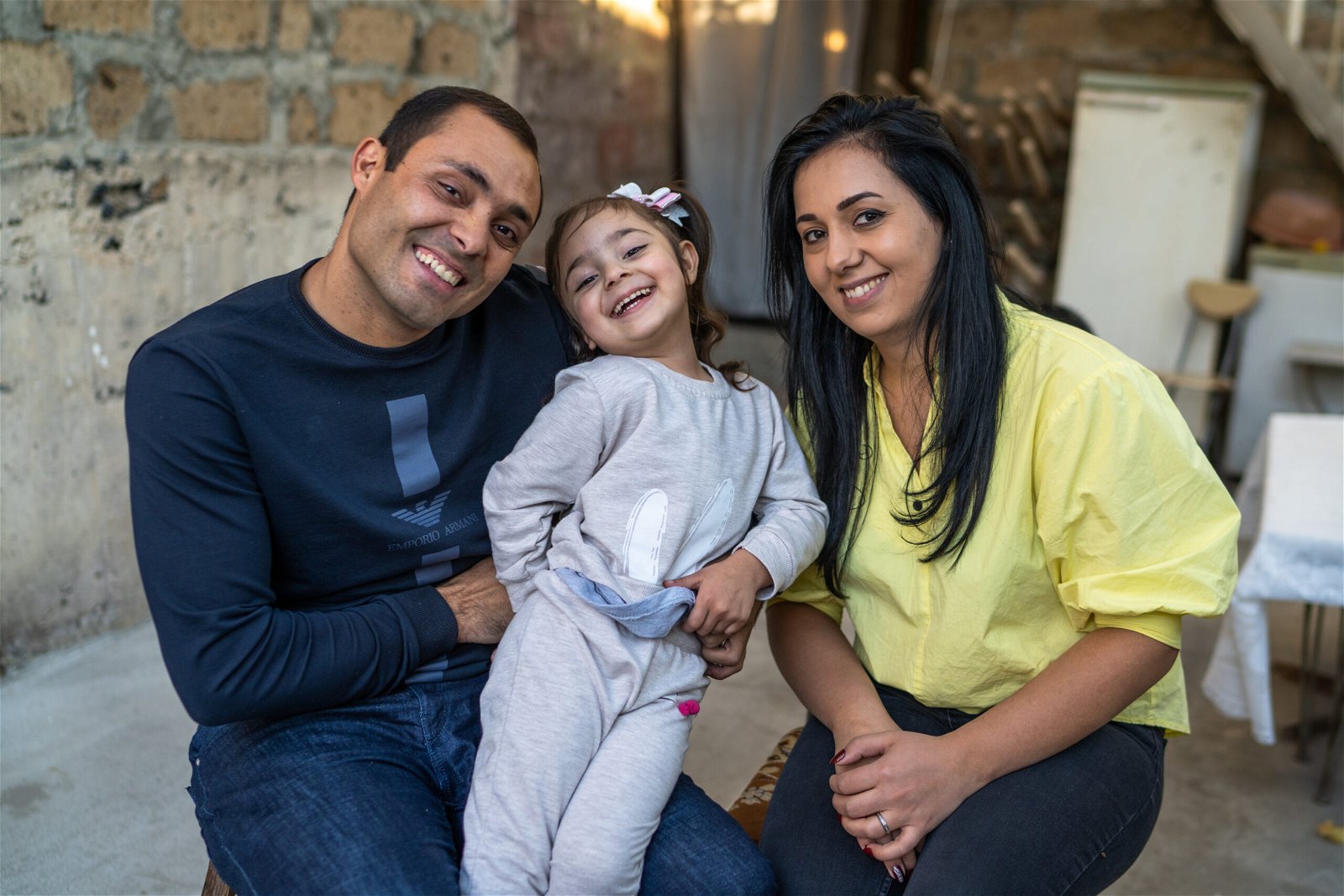 Vahe Poghosyan with his family
“I am deeply grateful to all the donors of the AECP for saving my sight and allowing me to see again, to raise my child, to grow my family and to reach all my dreams,” said Poghosyan with a smile.
As Poghosyan walked up the hill to Yerablur, the burial site of Armenian soldiers who died protecting their homeland, a song praising the bravery of his fallen friends could be heard far and loud. He joined in on singing along to the patriotic song, honoring his fellow soldiers and feeling grateful to be alive.

Guest contributions to the Armenian Weekly are informative articles or press releases written and submitted by members of the community.
The post Armenian soldier’s sight saved with help from AECP appeared first on The Armenian Weekly.
The polar and high mountain regions of the earth are warming at nearly twice the rate of Europe and two-and-a-half times the global average. This can have profound consequences on earth’s weather, including, for example, the supply of fresh water from melting snowcaps in places like Armenia. In April 2012, the Virtual Alpine Observatory (VAO), a networked collaboration of international research organizations operating high-altitude observatories and research stations, was established to study this situation. Cross-border cooperation has made it possible to study problems related to the atmosphere, biosphere, hydrosphere and cryosphere to determine environmental impact on human health and wellbeing. All these spheres are interlinked. Changes in one can affect the others. Participating are research institutes and observatories in Austria, Bulgaria, the Czech Republic, France, Germany, Georgia, Italy, Norway, Slovenia and Switzerland.
On October 26, 2023, Dr. Johannes Knapp, a scientist at the Deutsches Elektronen-Synchrotron (DESY) research center in Germany and member of the international board of directors of the Aragats Space Environment Center (ASEC) of the Yerevan Physics Institute’s Cosmic Ray Division (CRD), accepted CRD’s accession certificate from the chair of the VAO, Prof. Dr. Michael Krautblatter. The CRD is now a VAO associate member. The VAO is a subproject of the European Neighborhood Policy (ENP). A statement from the VAO indicates “that environmental and climate challenges are transboundary interdependent by nature, and therefore require a holistic approach to address them.”
CRD will participate in VAO’s interdisciplinary study of Alpine warming. Measurements of various parameters at different locations will be collected, put into formats according to international standards and shared. Moreover, analysis and visualization tools will be developed to access this data at VAO’s high performance computing centers. CRD operates two high altitude research stations on Mt. Aragats: Aragats station at 3,200 m (10,500 ft) and Nor Ambert at 2,000 m (6,560 ft). A large number of meteorological, geophysical and atmospheric processes are monitored, including electrical events in the atmosphere. Data from these measurements are put on the internet in near real time together with analytical tools.
Dr. Knapp is a professor at DESY, where he specializes in astroparticle physics. He is chairman of the Aragats Space Environment Center (ASEC) Board of Directors and is a frequent visitor to Armenia.
Guest contributions to the Armenian Weekly are informative articles or press releases written and submitted by members of the community.
The post Cosmic Ray Division joins Virtual Alpine Observatory appeared first on The Armenian Weekly.
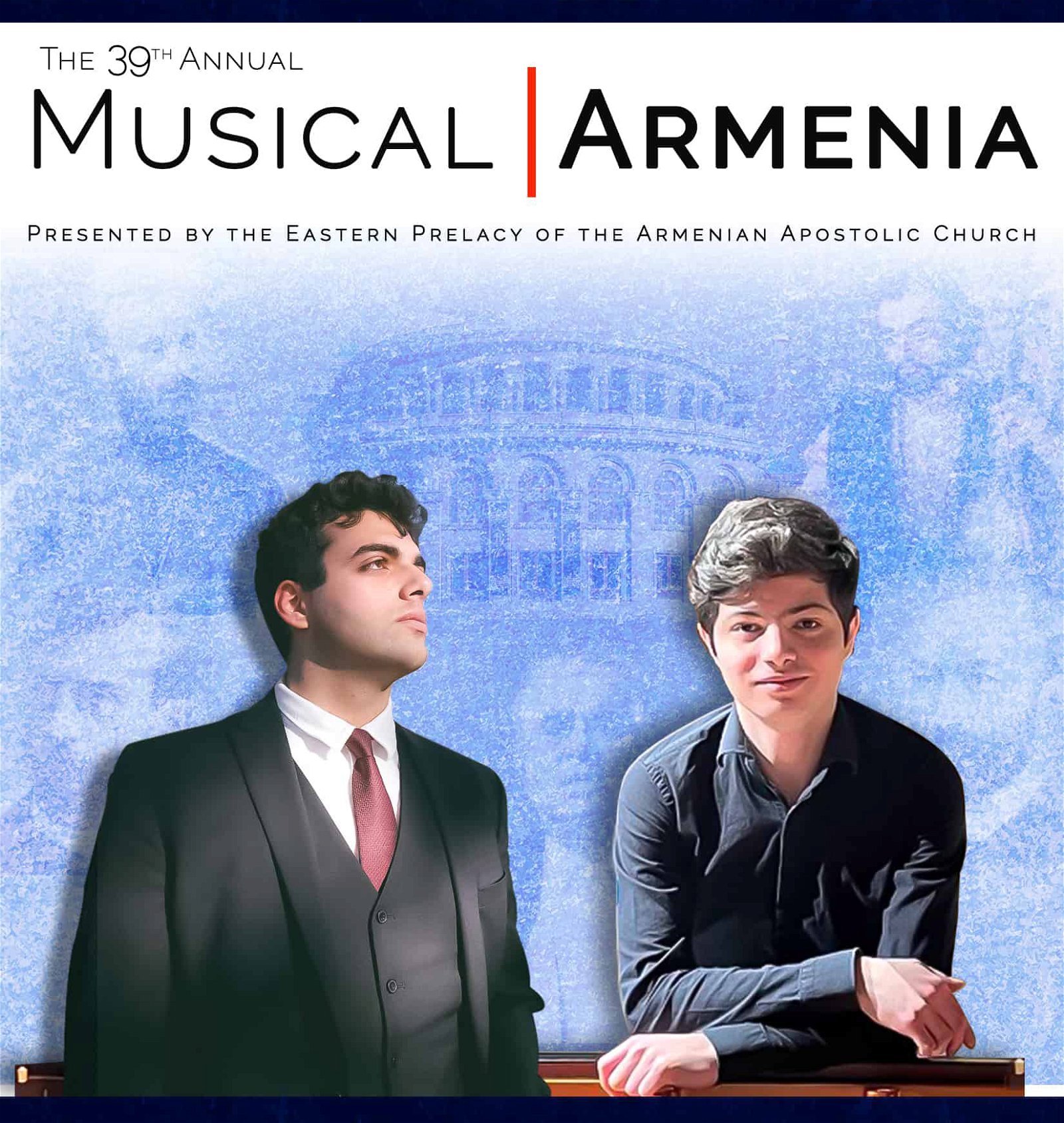
NEW YORK—The Armenian Prelacy is excited to announce the 2024 Musical Armenia Concert, the 39th event in the much-loved series that began in 1982. The concert will take place on Sunday, March 3, 2024, at 2:00 p.m. at Weill Recital Hall at Carnegie Hall.
The concert will feature two outstanding young artists: Grigori Balasanyan (b. Yerevan, 2004), a brilliant composer and pianist who will be presenting his original compositions solo and accompanied by a string quartet, and Tigran Mardanyan (b. Yerevan, 2003), an award-winning pianist.
Balasanyan’s compositional style strongly blends his Armenian cultural heritage with contemporary writing styles. A highlight of his career was his first ballet, recorded in 2019 by the Armenian State Symphonic Orchestra and premiered in 2021 at the Yerevan State Choreographic College. It is the first children’s ballet recorded in the history of Armenian music. Balasanyan has won multiple international competitions and released two recordings. He is currently a sophomore composition student at Boston Conservatory at Berklee studying under composer Marti Epstein.
Tigran Mardanyan currently studies at Boston Conservatory at Berklee with Professor Michael Lewin. Mardanyan has won several international competitions, including first prize at the Sviatoslav Richter International Piano Competition in South Korea, and was the winner of the Boston Conservatory at Berklee 2021-22 Concerto Competition, which led to his performance of Rachmaninoff’s first piano concerto with the Boston Conservatory orchestra.
Established by Archbishop Mesrob Ashjian and the Prelacy Ladies Guild, Musical Armenia is dedicated to promoting young Armenian artists and the performance of music by Armenian composers. Over the past 40 years, many of the program’s performers have established solid professional careers. The Prelacy is very appreciative of the important role that Musical Armenia’s devoted supporters have played in this artistic advancement.
Tickets to the concert are $25. To purchase tickets, go to https://www.carnegiehall.org or call CarnegieCharge at 212-247-7800 or the Prelacy at 212-689-7810.
The post 39th Musical Armenia concert to be held at Carnegie Hall appeared first on The Armenian Weekly.
