Categories
Selected Articles

U.S. Rejects Putin’s Latest Call for Ukraine Negotiations


  • Photos
  • Ukraine Goes on Defense
  • E.U. Deal to Fund Ukraine
  • Ukraine’s Combat Medics
  • How Russia Silences Dissent

Skepticism remains high about the Russian leader’s intentions after he told Tucker Carlson that the war in Ukraine could be settled with a peace deal.

  • Share full articleShare free access
President Vladimir V. Putin of Russia sitting at a table in a dark suit. He is holding papers.

“Despite Mr. Putin’s words, we have seen no actions to indicate he is interested in ending this war,” a National Security Council spokesman said of President Vladimir V. Putin of Russia.Credit…Alexander Kazakov/Sputnik

The Biden administration dismissed on Friday a call by President Vladimir V. Putin of Russia for negotiations to end the war in Ukraine, showing no sign that flagging political support for American military aid to Kyiv had made President Biden more inclined to make concessions to Moscow.

During his two-hour interview at the Kremlin with the former Fox News host Tucker Carlson, who now broadcasts independently online, Mr. Putin offered long defenses of his invasion of Ukraine in February 2022 but said he was prepared to settle the conflict diplomatically.

“We are willing to negotiate,” Mr. Putin told Mr. Carlson in the interview, which was released on Thursday. “You should tell the current Ukrainian leadership to stop and come to the negotiating table,” he added, referring to the U.S. government.

The Russian leader spoke at a moment of apparent leverage, following the failure of a vaunted Ukrainian summer counteroffensive to achieve substantial gains and as the Biden administration is struggling to win congressional approval for desperately needed additional military aid for Kyiv.

It is not the first time Mr. Putin has expressed willingness to negotiate over the fate of Ukraine, and Western officials have long been skeptical of his intentions. But because it was his first interview with an American media figure since the invasion, his call for talks has extra resonance, analysts said.

U.S. and Ukrainian officials say that the best Ukraine’s military can hope for in the coming year, especially without more American aid, is to defend its current positions. Even so, Biden officials say they are not entertaining the idea of pressing Ukraine’s president, Volodymyr Zelensky, to negotiate with Mr. Putin.

“Both we and President Zelensky have said numerous times that we believe this war will end through negotiations,” a National Security Council spokesman said in a statement. “Despite Mr. Putin’s words, we have seen no actions to indicate he is interested in ending this war. If he was, he would pull back his forces and stop his ceaseless attacks on Ukraine.”

U.S. officials had previously assessed that Mr. Putin had no intention of negotiating seriously until after the U.S. presidential election in November. Mr. Putin, they say, wants to wait to see whether former President Donald J. Trump might return to the White House and offer him more favorable terms.

Mr. Putin’s interview with Tucker Carlson was the Russian president’s first with an American journalist since the invasion of Ukraine.Credit…Rebecca Noble for The New York Times

In an interview last spring, Mr. Trump said the “horrible” conflict in Ukraine must come to an immediate end and that if re-elected, he would broker a deal to “end that war in one day.”

The Biden administration has supported Ukraine’s stated desire to reclaim territory that Russia has occupied since its invasion. Russia now occupies around 18 percent of Ukrainian land.

U.S. officials have also long insisted that, despite the more than $75 billion in aid the United States has supplied to Ukraine, it is not for Washington to dictate whether Kyiv engages in peace talks and what on terms. “Ultimately, it’s up to Ukraine to decide its path on negotiations,” the National Security Council statement said.

Many analysts were also skeptical of Mr. Putin’s intentions. Sergey Radchenko, a Russia historian at the Johns Hopkins School of Advanced International Studies, said Mr. Putin should not be trusted.

Mr. Radchenko said Mr. Putin might be engaging in what during Soviet times was known as a “peace offensive” — an insincere tactical feint whose goal, he said, was “to present a reasonable face to the outside world: ‘Oh yeah, of course we want peace — it’s just the other side that doesn’t want to talk.’”

Some Western officials believe Mr. Putin may also have his domestic audience in mind when he talks about a negotiated end to the war. Polls in Russia have shown that Russian citizens would welcome a settlement to end the conflict that has shaken their economy and produced tens of thousands of casualties.

Talk of peace could also win Mr. Putin favor among nations in the so-called global south — nations in South America, Asia and Africa, including India and South Africa, that are unaligned in the Ukraine conflict. Most of those countries have suffered from higher energy and food prices caused by the war.

Mr. Putin seemed to be exploiting Republican opposition to Mr. Biden’s funding request for Ukraine, echoing critiques made in recent weeks by some conservative members of Congress. “You have issues on the border, issues with migration, issues with the national debt — more than $33 trillion. You have nothing better to do, so you should fight in Ukraine?” Mr. Putin asked.

Alternatively, Mr. Radchenko said, Mr. Putin might be willing to make some unexpected concessions for a peace deal that leaves Russia with a foothold in eastern Ukraine, “and then use that as a basis for either further aggression against Ukraine, or as leverage to force a preferred government on Ukraine.”

Samuel Charap, a Russia analyst at the RAND Corporation, said it was possible that Mr. Putin had been bluffing all along about talks. But he said it was worth engaging the Kremlin in private to determine Mr. Putin’s actual demands.

“Nobody knows for sure — and nobody can know for sure unless they try,” Mr. Charap said. He added that it was notable that Mr. Putin had not told Mr. Carlson that he had preconditions for talks, such as the removal of Mr. Zelensky’s government.

Mr. Charap also noted that Russia and Ukraine were already negotiating on a number of matters, including prisoner-of-war swaps and Ukrainian exports from its Black Sea ports.

Regardless of Mr. Putin’s intentions, analysts and Western officials say that a major obstacle to potential talks is the unwillingness of Ukraine’s public to compromise with an invader that has committed atrocities in their country.

“Zelensky is worried about the domestic political consequences of pursuing a different tactic,” Mr. Charap said.

“Barring a Ukrainian demand signal” for peace talks, “there’s unlikely to be a push from Washington,” he said.

Michael Crowley covers the State Department and U.S. foreign policy for The Times. He has reported from nearly three dozen countries and often travels with the secretary of state. More about Michael Crowley

A version of this article appears in print on  , Section A, Page 9 of the New York edition with the headline: U.S. Rejects Russia’s Latest Request for Talks on War. Order Reprints | Today’s Paper | Subscribe
  • Share full articleShare free access

Categories
(@mikenov) / Twitter

@mikenov: U.S. Rejects Putin’s Latest Call for Ukraine Negotiations – The New York Times https://t.co/DwW8k9avw7


Categories
(@mikenov) / Twitter

@mikenov: Azerbaijan Must Show a Victor’s Wisdom – CEPA https://t.co/HftcidGS9d – South Caucasus #SouthCaucasus https://t.co/NE6AkDPvai


Categories
South Caucasus News

Spartak Ngjela recounts the conversation with Yuri Kim about SPAK! – Pamfleti.net


Spartak Ngjela recounts the conversation with Yuri Kim about SPAK!  Pamfleti.net

Categories
South Caucasus News

@Hayrapetyan_M: I received Kristina Kvien, Ambassador Extraordinary and Plenipotentiary of the #USA to #Armenia. I would like to thank the USA for its efforts towards the #peace agenda in the #SouthCaucasus, and for the steps aimed at reaching a new level of development in bilateral relations. https://t.co/BIGsFawPfS


I received Kristina Kvien, Ambassador Extraordinary and Plenipotentiary of the #USA to #Armenia. I would like to thank the USA for its efforts towards the #peace agenda in the #SouthCaucasus, and for the steps aimed at reaching a new level of development in bilateral relations. pic.twitter.com/BIGsFawPfS

— Mkhitar Hayrapetyan (@Hayrapetyan_M) February 10, 2024


Categories
Selected Articles

Former CIA analyst issues warning to Zelensky


Ukrainian President Volodymyr Zelensky‘s firing of his commander-in-chief Valerii Zaluzhny is fraught with risk, a former CIA director has said, amid divided opinion over the wisdom of the decision and its impact on Kyiv’s fight against Russia.

Tensions in the relationship between the pair had been reported in recent months. It intensified after Zaluzhny told U.K. publication The Economist in November, after a lack of success in Kyiv’s counteroffensive, that the war had reached a “stalemate”—an assessment that was rejected by Zelensky days later.

After much speculation, Zelensky announced on Thursday that Zaluzhny would be replaced by Oleksandr Syrsky, who has served as the Commander of Ukrainian Land Forces since 2019. The Ukrainian president said that “everyone must change and adapt to the new realities.” Newsweek emailed the Ukrainian Defense Ministry for comment on Saturday.

While there might be broad agreement domestically and among Kyiv’s allies with Zelensky’s assessment that the war’s tasks in 2022 when it started are different from those of 2024, the president’s decision is seen as having political reasons—as well as consequences.

George Beebe is a former director of Russia analysis at the CIA and ex-staff adviser to former Vice President Dick Cheney on Russian affairs from 2002 to 2004). He told Newsweek in emailed comments that the Zaluzhny decision could “erupt into a broader Ukrainian political crisis,” especially given the general’s popularity.

A poll in December by the Kyiv International Institute of Sociology (KIIS) found that Ukrainians’ trust in Zelensky had declined from 84 percent at the end of 2022 to 62 percent a year later, while 88 percent said they trusted Zaluzhny.

Ukrainian President Volodymyr Zelensky

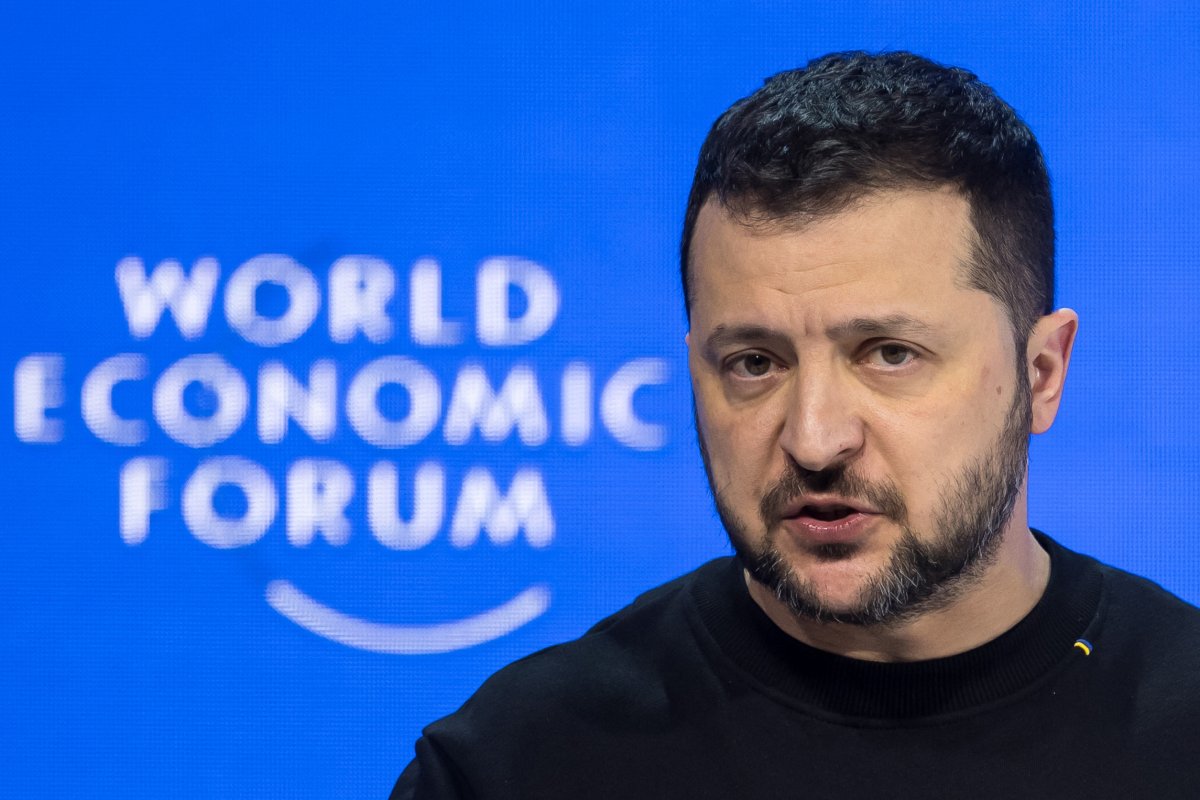
Ukrainian President Volodymyr Zelensky addresses the assembly at the World Economic Forum (WEF) annual meeting in Davos, Switzerland, on January 16, 2024. His announcement on February 8, 2024 that he had fired his commander-in-chief Valerii…
Ukrainian President Volodymyr Zelensky addresses the assembly at the World Economic Forum (WEF) annual meeting in Davos, Switzerland, on January 16, 2024. His announcement on February 8, 2024 that he had fired his commander-in-chief Valerii Zaluzhny has divided opinion. FABRICE COFFRINI/Getty Images

“Firing the military’s senior command in wartime is a sign of failure. It is something that states do when they are losing, not winning,” said Beebe, director of grand strategy at the Quincy Institute for Responsible Statecraft.

“Zelensky’s move is fraught with risk,” he added. “No new commander or tranche of military aid can reverse the difficult truth—Ukraine lacks the manpower, weapons and economic capacity to sustain a prolonged war of attrition against Russia.

“U.S. aid for Ukraine’s defense should continue in order to prevent a Ukrainian collapse and give Kyiv the best-possible hand at the negotiating table,” Beebe said.

Meanwhile, in an op-ed for the Carnegie Institute, Konstantin Skorkin, an independent researcher on the Donbas region, said that Zelensky was taking a major risk in replacing his commander-in-chief.

“Never before has he so blatantly defied the public consensus for the sake of his own political survival,” Skorkin wrote in the piece published Saturday.

However, U.S. Retired Vice Admiral Robert Murrett, professor of practice at Syracuse University’s Maxwell School in New York, told Newsweek that the shift in Ukrainian senior leadership “reflects a logical transition following two years of a country on a wartime footing.”

“This may be time for new approaches and positioning for adopting a long-term posture which would increase pressure on Russia, and demonstrate resolution and stamina to other international actors as well as the people of Ukraine,” Murrett said.

In his first public statement since his appointment, Syrsky said on Telegram that his priorities would be detailed planning of the actions of all military command bodies, units, and formations and solving issues with logistics and troop rotations.

Since Russia’s full-scale invasion, Syrsky has been credited with the defense of Kyiv from February to March 2022 and the counteroffensive in the summer and fall of 2022 that drove the Russians out of the Kharkiv region.

The new commander-in-chief is likely to act in line with the president’s wishes on drafting troops. “Zelensky badly wanted to shift responsibility for mobilization onto the military, and Syrsky will most likely take on the role of ‘bad cop’ in this situation,” wrote Skorkin.

Newsweek is committed to challenging conventional wisdom and finding connections in the search for common ground.

Newsweek is committed to challenging conventional wisdom and finding connections in the search for common ground.


Categories
South Caucasus News

Italian publication says Azerbaijan’s importance for Europe is more than supplying natural gas – AzerNews.Az


Italian publication says Azerbaijan’s importance for Europe is more than supplying natural gas  AzerNews.Az

Categories
South Caucasus News

NPR News: 02-10-2024 12PM EST


NPR News: 02-10-2024 12PM EST

Learn more about sponsor message choices: podcastchoices.com/adchoices

NPR Privacy Policy


Categories
South Caucasus News

President Ilham Aliyev congratulates Irakli Kobakhidze on commencement of his tenure as Prime Minister of Georgia – AZERTAC News


President Ilham Aliyev congratulates Irakli Kobakhidze on commencement of his tenure as Prime Minister of Georgia  AZERTAC News

Categories
South Caucasus News

Tehran ‘never sought’ to expand war in the region, Iran’s FM says – Al Jazeera English


Tehran ‘never sought’ to expand war in the region, Iran’s FM says  Al Jazeera English