
Day: February 9, 2024
The speaker of the Georgian Parliament has accused foreign-funded organisations of ‘meddling in politics’, continuing the ruling party’s rhetoric attacking civil society.
In a lengthy Facebook post on Friday, Georgian parliamentary speaker Shalva Papuashvili suggested such groups were ‘proxies for radical parties’ and were helping ‘undermine Georgia’s drive towards the EU’.
His comments come less than a year after the government was forced to drop controversial ‘foreign agents’ legislation following protests in the capital Tbilisi.
Papuashvili also connected the issue to parliamentary elections scheduled for October 2024, suggesting that organisations involved in election monitoring should have to disclose their funding. Most, if not all, major civil society groups are already transparent about the sources of their funding.
Papuashvili returned to rhetoric levelled around the time of the controversial foreign agent bills in 2023, stating that foreign funding ‘frequently lacks transparency’, and that civil society organisations retained responsibility to their donors rather than the public.
‘The donors cannot do away by simply putting a disclaimer on NGOs’ activities any more’, wrote Papuashvili. ‘A more serious approach is needed because civil society is an influential political force.’
Papuashvili’s statement came shortly after ten Georgian watchdog groups issued a joint statement denouncing the speaker’s decision to exclude them from the talks. Papuashvili cited their departure from the National Platform of Eastern Partnership Civil Society Forum, which includes over 190 local watchdog groups, as a reason behind his decision.
The format is dedicated to discussing nine key reforms the government is expected to implement before the EU opens accession talks to Georgia. Georgian Dream published an action plan to address those recommendations in late December, twelve days after the EU granted Georgia candidate status.
In his statement, Papuashvili claimed that a recent Eastern Partnership Index report was ‘unfairly biased’ against Georgia, and accused NGOs that had worked on the report of having earlier failed to join discussions between the ruling party and the National Platform.
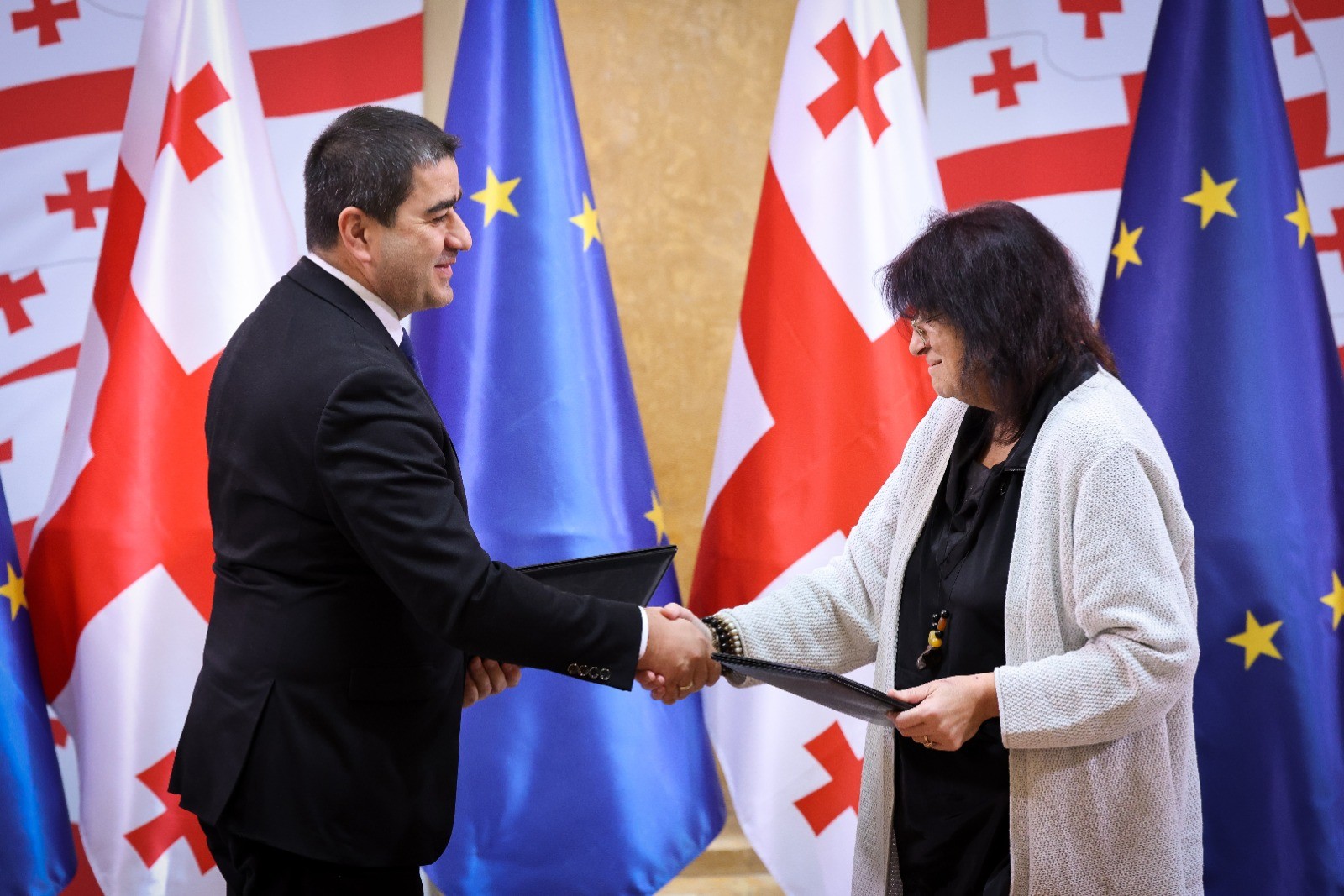 Speaker Shalva Papuashvili (left) and Nino Chkhobadze, chair of the National Platform, at the signing ceremony of the memorandum on cooperation on 23 October 2023. Image: Parliament of Georgia.
‘These NGOs claim they want to join the ongoing formal discussion, even if they […] abandoned the National Platform when they became displeased with the election results of the Platform’s leadership. Such actions […] show how some NGOs can become problematic for the democratic process’, wrote Papuashvili.
‘Meddling in politics’
Papuashvili also criticised donor organisations, alleging that they had allowed groups like the Liberty Institute, a libertarian advocacy group, and online outlet Tabula to become ‘branches’ of the opposition European Georgia Party, claiming that donations were also made to groups that functioned as proxies for opposition political parties.
‘The donors cannot do away by simply putting a disclaimer on NGOs’ activities any more’, wrote Papuashvili. ‘In these cases, foreign funding means direct foreign influence on political groups, which is blatantly unconstitutional’.
While no mention was made of reviving the controversial ‘foreign agent’ law, the rhetoric closely echoes that which he and other party leaders used to advocate for its introduction. Critics claimed that if passed, the package bill would have been used to suppress civil society groups, including the media.
After the bill was dropped in March 2023 following massive street protests, Georgian Dream leaders stated that they had no plans to revive the legislation, but following its failure, continued to praise the legislation’s principles and purported benefits.
Papuashvili also echoed long-running doubts raised by Georgian Dream regarding the objectivity and credibility of local election monitoring groups, an increasingly pressing issue in the run-up to Georgia’s elections in October 2024. In previous years, such groups have noted voting violations implicating the ruling party. On one occasion, such a violation was later found to be an error by a Georgian election watchdog.
‘Before elections, we could draw a public agreement that would require full disclosure of the funding and activities of any NGO that meddles in politics, either as an election observer or funder of activities related to elections’, wrote Papuashvili.
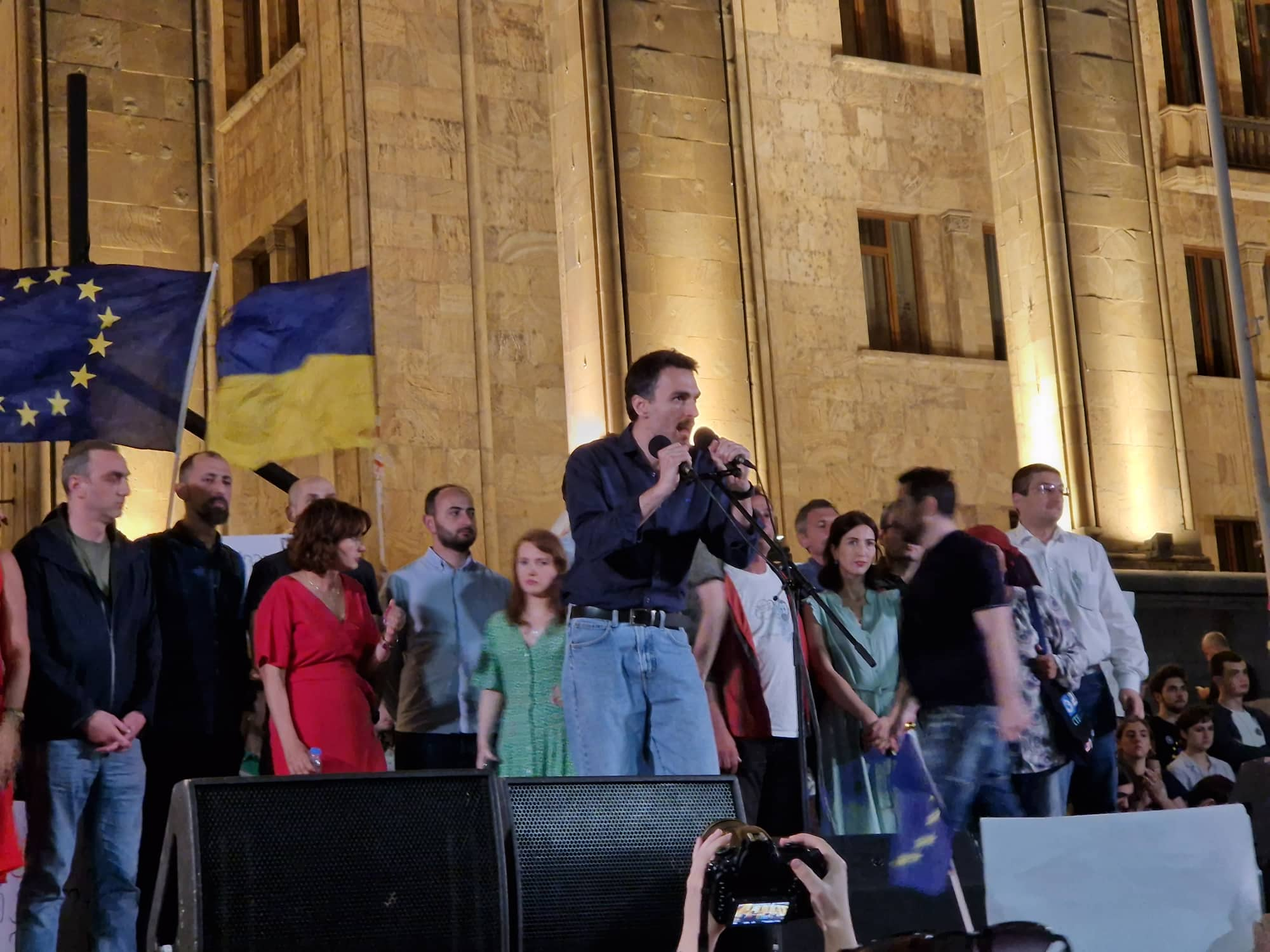 In summer 2022, a group of civil organisations leading pro-EU protests demanded the government step down in favour of a ‘technical government’. Image: Mariam Nikuradze/OC Media.
Caption: In summer 2022, a group of civil organisations leading pro-EU protests demanded the government step down in favour of a ‘technical government’. Image: Mariam Nikuradze/OC Media.
Georgian Dream’s criticism of local watchdog groups and their donor organisations for financing them has increased since Russia invaded Ukraine and Georgia applied for EU membership in early 2022.
Since the EU initially declined to grant Georgia candidate status, the party’s leadership has put forward a number of related theories, including claims that the country was pressured by Western powers and Ukraine to open a ‘second front’ of war with Russia, that the Georgian government was being unfairly represented by Western media, and that US and EU agencies were promoting ‘extremism’ and ‘polarisation’ in Georgia.
[Read more: Georgian Dream defends Kobakhidze’s record following OC Media report]
On Friday, the parliamentary speaker accused Georgian civil groups, without naming them, of distorting the findings of the January Eastern Partnership Index (EaP Index) report. Papuashvili described the report as ‘unfairly biased against Georgia’, in its assessment of Georgia’s progress towards democratic development and European integration.
Georgia was ranked third among the six countries in the most recent EaP Index report, which described the nation that scored the highest in 2010 as having a ‘significant downwards drift, if not a sharp plunge in many areas’.
In his statement, the speaker suggested that civil society organisations were ‘helping the radicals to undermine Georgia’s drive towards the EU’.
The post Georgian speaker criticises foreign-funded organisations for ‘meddling in politics’ appeared first on OC Media.
Categories