NPR News: 02-08-2024 6PM EST
Categories
 The South Caucasus News - SouthCaucasusNews.com
By Claude Barfield
As 2024 begins, the United States continues its retreat from its post-World War II role as leader of a rules-based global trading system. This retreat began in 2017 with the mercurial and destructive trade policies of former president Donald Trump and has continued since 2021 with the deeply conflicted trade policies of current President Joe Biden’s administration.
The resulting damage is strategic as well as economic with the rise of China’s authoritarian state-capitalist model combining heavy public subsidies with technology protectionism and unilateral economic coercion.
In November 2023, trade officials capped years of a trade policy vacuum by failing to reach an agreement on the trade portion of its signature economic initiative in Asia, the Indo-Pacific Economic Framework for Prosperity (IPEF). The embarrassing debacle only reinforced Asian views that the United States is an ‘unreliable’ economic partner.
While deeper social and economic shifts have contributed to the United States reaching a low point in trade leadership, the proximate political event was Trump’s election in 2016.
Abetted by advisers who either knew better or were ideological cranks, such as economic adviser Peter Navarro, Trump’s ‘America First’ trade policy was guided by the president’s personal whims and false longstanding conclusions about postwar US trade policy. These false conclusions include the notion that trading partners — rather than US consumers and businesses — pay for tariffs, trade policy is the main factor influencing the US trade balance or that the World Trade Organization (WTO) always rules against the United States.
Two decisions in particular were damaging for strategic and economic reasons: withdrawal from the Trans-Pacific Partnership and the spurious invocation of a national security rationale to levy tariffs on steel and aluminium imports, even against US allies.
US officials have refused to accept a WTO decision that the tariffs violated international trade rules. Meanwhile, in the Asia Pacific, nations have negotiated new regional agreements, such as the Comprehensive and Progressive Agreement for Trans-Pacific Partnership (CPTPP) and the Regional Comprehensive Economic Partnership agreement. These agreements have spurred increased trade flows and investment, leaving the United States behind.
Initially advanced by the United States, the CPTPP was the first major trade agreement to include an e-commerce chapter. Beijing is now pressing to join the CPTPP and though members can slow down the application, China may achieve its goal in the future.
Under Biden, the United States adopted a conciliatory tone toward US allies. Yet Biden continued many of Trump’s worst policies, including the so-called ‘national security tariffs’ and dawdling over proposals to restart the WTO dispute settlement process, which had been hampered by the Trump administration’s refusal to allow the appointment of new WTO Appellate Body judges — a stance continued by the Biden administration.
Arguing that traditional trade agreements negotiated under both Democratic and Republican presidents had sent jobs offshore and devastated local communities, US Trade Representative Katherine Tai promised a new ‘worker-centric’ trade policy that would be inclusive and equitable. During a major speech in April 2023, Jake Sullivan, Biden’s National Security Adviser, posited a ‘new Washington Consensus’ that eschewed free trade agreements and built upon new strategic industrial policy. Former director of the National Economic Council and former president Barack Obama’s top economic advisor, Lawrence Summers, strongly criticised the ‘aggressive economic nationalism’ and the statist emphasis in the speech.
The result of these policies is that while other nations, including major strategic competitor China, have moved forward with growth-enhancing trade pacts — with 36 agreements being notified to the WTO — the Biden administration’s only major international economic initiative — the IPEF — remains in limbo. IPEF is stymied by US refusal to offer market access concessions in exchange for its demands for politically difficult labour rights and environmental concessions.
Given the increasing centrality of the digital economy in the future, the most damaging policy reversal by the Biden administration is the decision to abandon longstanding US digital trade policies that championed the free flow of data, opposed forced data localisation and protected individual source code. In a triumph for misguided progressivism and trade union muscle, the United States Trade Representative officials withdrew from WTO e-commerce talks, asserting the need for more ‘policy space’. Even a Biden administration ally, US Senator Ron Wyden, labelled this move as a ‘win’ for China.
Trade policy is off the table until after the US presidential election. Even in 2025, the outlook is not good for renewed US leadership. Trump has vowed to cancel the IPEF and introduce across-the-board 10 per cent tariffs on all trading partners. There is no sign that Biden, if re-elected, would challenge the anti-globalists in his own party.
![Arakan Army forces display arms and equipment seized after the capture of the Myanmar army’s Light Infantry Battalion 540 in Minbya, Feb. 2, 2024. [AA Info Desk]](https://www.eurasiareview.com/wp-content/uploads/2024/02/a-65.jpg)
Arakan Army insurgents have captured two key military units in western Myanmar’s Rakhine state, giving the group effective control of Minbya township and putting it in a position to challenge junta control of the state capital Sittwe, according to an ethnic rebel alliance and regional sources.
On Tuesday morning, the Arakan Army, or AA, routed Light Infantry Battalions 379 and 541 – the two junta battalions that remained in Minbya after the ethnic rebels captured the 380th battalion on Jan. 28 – the Three Brotherhood Alliance, of which the AA is a member, said in a statement.
“All junta soldiers surrendered to the AA,” said a resident who, like others interviewed for this report, spoke on condition of anonymity due to security concerns. It wasn’t clear how many soldiers this entailed, but the latest estimates by military experts suggest most battalions in the Burmese Army have around 200 men.
The takeover means “the AA now controls Minbya,” he said. People are worried about possible airstrikes by the military and “don’t dare go outside.”
The capture of the two units are the latest in a series of victories for the Three Brotherhood Alliance, which launched a campaign in October on junta forces in the northern and western parts of the country.
In northern Rakhine and neighboring Chin state, the AA seized arms and ammunition during several attacks on junta positions in January.
The latest gains by the AA rebels followed their capture of a junta-affiliated Border Guard Police camp in Maungdaw township at the weekend that led to droves of BGP members abandoning their posts and fleeing across the border into neighboring Bangladesh.
As of late Thursday, as many as 330 BGP members who had crossed over, were sheltering in the southeastern Bangladesh districts of Bandarban and Cox’s Bazar as they waited to be repatriated by Myanmar’s military government.
On Jan. 16, nearly 300 junta troops surrendered to the AA after it took control of two major military junta encampments in Kyauktaw township. And on Jan. 24, the Three Brotherhood Alliance said in a statement that the AA had won full control of Pauktaw, a port city just 16 miles (25 kilometers) east of the Rakhine capital Sittwe.
The takeovers follow the AA’s occupation of the entirety of western Chin’s Paletwa region – a mere 18 kilometers (11 miles) from the border with Bangladesh – in November, after it ended a ceasefire that had been in place with the junta since the military’s Feb. 1, 2021, coup d’etat.
In a statement late Tuesday, the alliance claimed that the AA had now captured all but two of the 10 light infantry battalions under the aegis of the No. 9 Military Operations Command in Kyauktaw. They include the 379th, 380th and 541th battalions in Minbya; the 374th, 376th and 539th in Kyauktaw; and 378th and 540th in Mrauk-U township – the last two of which were also taken on Tuesday morning, the alliance said.
The two remaining light infantry battalions under the No. 9 Military Operations Command are 377th in Mrauk-U and 375th in Kyautaw, according to the Three Brotherhood Alliance, which added that the AA had also taken control of Artillery Battalion 377 in Kyauktaw.
The No. 9 Military Operations Command in central Rakhine’s Kyauktaw township is one of three junta command centers in the state, the other two being No. 5 in southern Rakhine’s Toungup township and No. 15 in northern Rakhine’s Buthidaung township.
A Rakhine-based military observer told Radio Free Asia (RFA) that the AA was focusing on taking control of No. 9 Military Operations Command so that it could launch offensives from the region against battalions under No. 5 and No. 15.
“If the AA can capture the [Operations Command] in Kyauktaw, then they will control the central area of the state,” the observer said. “This area is important for military offensives, so the AA could use it to launch strategic attacks on the military in other areas.”
The observer noted that the junta is ceding battalions and townships despite its use of the air force, navy and ground troops, suggesting that it no longer has the capacity to counter AA offensives.
He also suggested that if the AA was able to take complete control of Mrauk-U and Kyauktaw, it would likely push on to fight for control of the capital Sittwe and Ann township, where the junta’s Western Military Headquarters is located.
“If the junta loses these towns, it can be assumed that the next phase of battles will occur in Sittwe … and Ann,” he said. “It may then spread further to Buthidaung and Rathedaung townships.”
The AA had yet to issue any statements about the junta battalions they have captured, casualties suffered in the fighting, or the number of military troops who have surrendered.
Another resident monitoring the military situation in Rakhine told RFA that the AA could assume control of as many as five townships in the north of the state by the end of February, before advancing south.
“We earlier thought that the AA would proceed with attacks in southern Rakhine only in 2025, after first taking control of the north,” he said. “However, they have made significant gains in Ramree and Toungup townships in a short span of time. The junta soldiers have fled [across the borders] to Bangladesh and India, and more soldiers will surrender soon.”
In its statement on Tuesday, the Three Brotherhood Alliance said it also expected that the AA would fully capture the Taung Pyo Let Wei and Taung Pyo Let Yar border outposts north of Rakhine’s Maungdaw township along the border with Bangladesh, days after launching attacks on the two areas.
The alliance claimed that AA fighters had located the bodies of several members of the junta-affiliated Border Guard Forces killed in the fighting and confiscated a large cache of arms and ammunition, adding that “more than 200 junta soldiers fled the area to Bangladesh.”
Meanwhile, fighting remains fierce in Ramree township, where the AA launched attacks on a military outpost in December, residents of the area said. More than 10,000 civilians have fled the clashes and at least 60 homes were destroyed in military airstrikes and artillery attacks, they said.
The junta has yet to release any statements related to the military situation in Rakhine state.
Attempts by RFA to contact junta spokesman Maj. Gen. Zaw Min Tun and AA spokesman Khaing Thukha went unanswered Wednesday.
In the three months since the AA ended its ceasefire, more than 110 civilians have been killed and at least 250 injured in fighting in Rakhine state, according to data compiled by RFA.
By Simran Rathore
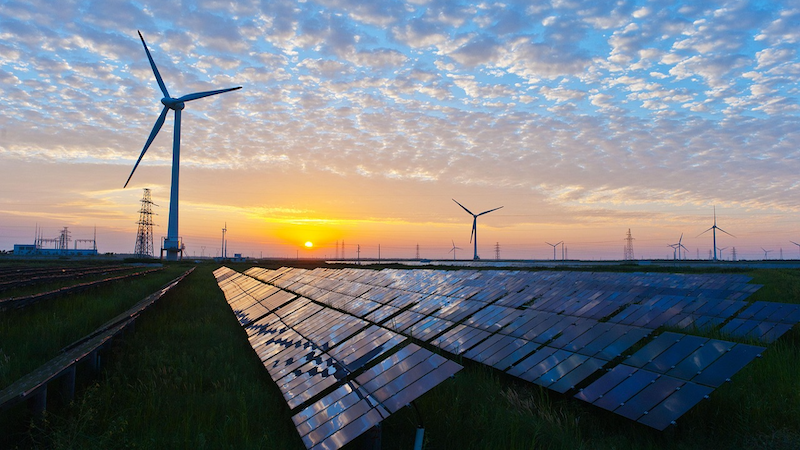
The US Department of Defense (DoD) has been fast-tracking clean energy advancements to bolster military safety, ensure energy security and cut costs. The 2011 Pew Charitable Trusts report, ‘From Barracks to the Battlefield: Clean Energy Innovation and America’s Armed Forces’, noted a 200 per cent surge in DoD clean energy investments from US$ 400 million to US$ 1.2 billion between 2006 and 2009.1
The US military’s efforts are geared towards addressing the impact of climate events on military infrastructure. The US military is also developing green fuels given that it is the largest institutional consumer of energy. These efforts also anticipate new security threats related to climate change, such as resource scarcity, migration and armed conflicts.2
The US Army’s Climate Strategy released in 2022 aims for a resilient and sustainable force, addressing climate change through mitigation and adaptation measures in line with modernisation. Goals include a 50 per cent GHG reduction by 2030, net-zero emissions by 2050, given security implications of climate change. The Army plans to aim for carbon-pollution-free power for critical missions by 2040. The US Army intends to integrate climate change mitigation into land management decisions, and incorporate the latest climate and environmental science into deployment choices.3
Similarly, the US Navy’s Climate Action 2030 plan prioritises preserving global naval dominance, establishing a climate-resilient force for national security, and improving military operations by addressing climate change impacts to enhance force capability and fortify systems, installations, and the well-being of personnel. It recognises climate success as crucial for mission success.4
The US Department of the Navy is also leading advanced battery research through the Federal Consortium for Advanced Batteries along with Department of State, Energy, Commerce and others to reinforce US industrial base. It seeks to upgrade the Marine Corps vehicle fleet for fuel efficiency, and commits to deploying nature-based solutions for shoreline protection. Energy resilience is a top priority, with cyber-secure microgrids and advanced technologies supporting critical missions, emphasising carbon pollution-free power and long-duration battery storage. 5
As for the US Air Force, Edwin Oshiba, the Assistant Secretary of the Air Force for Energy, Installations, and the Environment, emphasised that the climate plan and energy initiatives are driven by the goal of enhancing combat capability. The focus is on addressing challenges arising from the impacts of climate change. The Air Force aims to transition its entire non-tactical vehicle fleet to zero-emission vehicles by 2035.6 The Department of the Air Force is committed to prioritising infrastructure and facility modernisation, developing a climate-informed workforce, improving logistics and supply chain practices, reducing operational energy intensity, and incorporating alternative energy resources.7
The primary reason for shifting to renewables is the military’s vulnerability due to reliance on fossil fuels. US Secretary of Defense James Mattis’s 2006 ‘Future Fuels’ document therefore urged the Pentagon to break free from fossil fuel limitations.8 In April 2008, President George W. Bush mandated a reduction in fossil fuel reliance, aiming for 25 per cent renewable energy in military facilities by 2025.9
The US military emphasises that their climate actions align with the central goal of winning wars. Ray Mabus, former US Navy Secretary stated that the move to alternative fuels in the Navy and Marine Corps aims to enhance combat effectiveness.10 In 2023, Paul Farnan, the Principal Deputy Assistant Secretary noted that increased renewable energy production and long-term battery storage at Army bases can help tackle the climate change challenge and enhance the resilience of installations furthering the military forces’ capabilities.11
With the Pentagon leading progressive energy initiatives and backing renewable energy research, the US military seeks to transform climate change from a threat multiplier to a force multiplier, enabling the US military to operate more effectively abroad for extended durations.12
The Scientists for Global Responsibility (SGR) notes that global military carbon footprint contributes around 6 per cent of global greenhouse gas emissions.13 The US military is a leading emitter of greenhouse gases globally. From 1975 to 2022, its yearly emissions averaged 81 million metric tons of greenhouse hydrocarbons, surpassing the output of many nations. In fiscal year 2021, the U.S. Department of Defense reported its emissions at 51 million metric tons of carbon dioxide.14 A 2019 study estimated that the Pentagon’s greenhouse gas emissions amounted to 59 million tonnes, surpassing the combined emissions of Denmark, Finland and Sweden in 2017.15
Military decarbonisation though is challenging due to high energy needs of militaries worldwide. A global shift to 100 per cent renewables could require significant demilitarisation.16 Further, strategies aimed at reducing military emissions lack clear links to broader environmental goals.17 Activists note that wealthy nations pursuing green energy goals by exploiting resources elsewhere may intensify global disparities, risking inequality in energy resource control.18
The conflict in Ukraine has also highlighted the role of energy in global security. Post the Russian invasion of Ukraine, Western policymakers are speeding up energy transitions to bolster security and cut Moscow’s energy earnings through renewables and reduced consumption. Clean energy is seen as crucial for ‘security of supply’ and reducing dependence.19
Globally, the incorporation of emission reduction into defence strategies is limited, creating potential gaps as nations pursue climate goals at different rates within their armed forces. The interdependence of the fossil fuel and military-industrial complex in the extractive economy model raises concerns. The idea of low-carbon warfare raises concerns about potential impacts on conflict engagement. In essence, striving for low-carbon warfare could prolong the use of military force in a net-zero future.
Despite extensive investment in clean energy initiatives and strategies focused on enhancing readiness and reducing environmental impact, concerns persist about the underlying nature of military actions, their link to broader environmental goals, and the potential implications on global politics, economy, and security.
Views expressed are of the author and do not necessarily reflect the views of the Manohar Parrrikar IDSA or of the Government of India.
By Ahmad Syamsudin and Dandy Koswaraputra
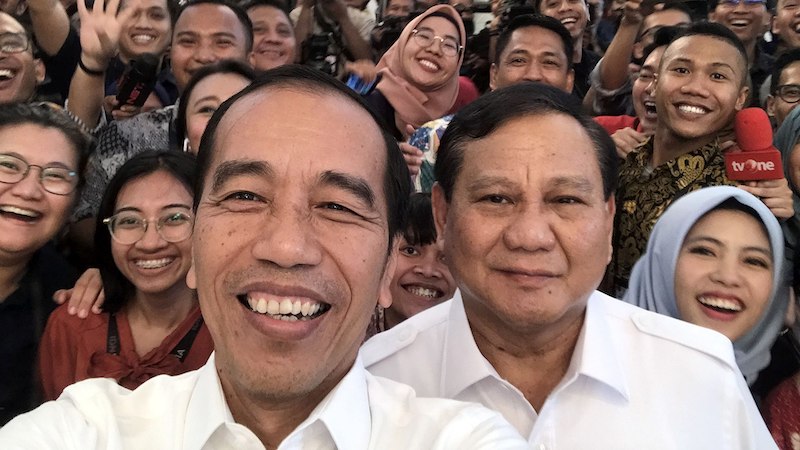
With only a week left until voters in Indonesia head to the polls to elect his successor, President Joko “Jokowi” Widodo is facing a political storm over allegations of meddling with the vote in this young democracy.
On Wednesday, hundreds of students gathered in Jakarta to denounce the president’s “intervention” in the electoral process, as more universities joined a chorus of academia urging him to stay true to democratic values.
Jokowi’s attempt to mollify them and other critics a day earlier by saying he wouldn’t interfere in the vote may not have been convincing. He had caused a furor last month by saying he was allowed to pick sides for the Feb. 14 election.
The election so far may not be tainted by the violent clashes and sectarian rhetoric that marked the last two, but it’s a race marred by controversies over partisanship, eligibility and ethical breaches.
To draw attention to the allegedly undemocratic developments, scores of university students marched from Trisakti University to the State Palace in the capital on Wednesday afternoon.
They held banners that read “Jokowi is deceitful,” and “Reject the unfair election,” local media and news agency Reuters reported.
“We are done with the president’s intervention in the 2024 election especially to help a human rights criminal win the election,” Tegar Afriansyah, who organized the protest, told Reuters.
He was referring to one of the three presidential candidates, Prabowo Subianto, who is also defense minister. Jokowi is ineligible for a third five-year term because of constitutional limits.
Prabowo is widely accused of grave human rights violations under the regime of former dictator Suharto, although he has never been tried in court.
In addition to voting for a new president, Indonesians will be electing hundreds of officials for the national legislature, provincial legislatures, governor’s offices as well as regency and city posts.
Prabowo’s running mate is Jokowi’s eldest son, Gibran Rakabuming Raka, 36, whose path to the contest was cleared by a highly controversial court decision in October.
This alliance has raised concerns among some Indonesians about dynastic politics and nepotism.
Critics, including faculty members from more than a dozen universities across the country, have accused Jokowi of straying from democratic principles and attempting to create a political dynasty by advancing his relatives.
“Our country has lost its way because of unethical and deceitful power struggles,” Harkristuti Harkrisnowo, a professor at the University of Indonesia, told a press conference in West Java last week, The Jakarta Post reported.
Earlier, Gadjah Mada University, Jokowi’s own alma mater in Yogyakarta, in a statement accused the president of “deviating” from democratic values.
Gibran, the mayor of Solo, has benefited from a controversial ruling by the Constitutional Court in October, which revised the minimum age for presidential and vice-presidential candidates from 40 to any age for those who have served as regional heads.
The court’s chief justice, Anwar Usman, who is married to Jokowi’s sister, was dismissed from his post in November by ethical violations linked to the ruling.
Although Jokowi has not officially endorsed any candidates, it is generally viewed that he will favor Prabowo and his son, Gibran. Jokowi defeated Prabowo in the last two elections in 2019 and 2014.
Ari Dwipayana, who coordinates Jokowi’s presidential staff, last week accused the president’s political enemies of orchestrating the wave of criticism against Jokowi, according to an article by Tempo.
“The strategy of partisan politics is allowed in political contestation,” Ari said.
Responding to the criticism, Jokowi said it was everyone’s democratic right to speak out, Kompas, another Indonesian news outlet, quoted him as saying.
“Yes, that is democracy, everyone is allowed to speak and express their opinions. Please do so,” Jokowi said.
Recent opinion polls show Prabowo leading the three-way race for the top job by a wide margin.
The latest survey, released Wednesday by Populi Center, found that 52.5% of the respondents favored Prabowo, followed by 22.1% for former Jakarta Gov. Anies Baswedan, and 16.9% for former Central Java Gov. Ganjar Pranowo.
The winning ticket would need to secure more than 50% of the national vote and 20% of the vote in half the provinces to avoid a runoff on June 26. The runoff would only require a candidate to secure more than 50% of the vote.
Populi Center said that the Prabowo-Gibran pair has managed to attract young voters who are looking for a fresh and dynamic leadership, as well as older voters who are loyal to Prabowo and Jokowi.
Prabowo’s popularity has been boosted by his campaign portrayal as a likable and relatable figure, using TikTok to attract young voters with humorous and fun content. Additionally, backing from groups such as the influential Muslim organization Nahdlatul Ulama has also helped, said Mada Sukmajati, a lecturer at Gadjah Mada University.
Nahdlatul Ulama has not formally said it backs Prabowo, but its leaders have voiced support for him.
“There’s also the use of state officials and resources, from ministers to village heads, to support his campaign, thanks to Jokowi’s intervention,” Mada told BenarNews.
Jokowi has also been accused of using populist measures, such as early handing out of social aid early, raising salaries for civil servants, police and the military, which critics say are aimed at boosting Prabowo’s chances.
One student at Wednesday’s march said people could see through such actions.
“If Jokowi dares to distribute social assistance and even says that a president can campaign, it means he has committed many violations. Jokowi is embarrassing us because he thinks people are stupid,” Kevin, a Trisakti University student, was quoted as saying in a report by local news magazine Tempo.
Allegations of irregularities in the upcoming polls rose on Monday, with the election ethics council reprimanding the General Election Commission for not changing age requirement rules before registering Gibran as a VP candidate. Though the rebuke did not affect Gibran’s eligibility, it added to the scandal surrounding his candidacy.
The election commission’s chief, Hasyim Asy’ari, was also found guilty of another election-related ethics breach last year for travelling with a politician whose party was subject to a verification process for eligibility to participate in the election.
Meanwhile, the campaign has also been tainted by allegations of foul play, such as Ganjar’s supporters being restrained by security officers during rallies, and their posters being taken down by authorities.
Anies faced an electricity blackout just as he was about to hold a rally in Madura, East Java, on Jan. 31 and was also forced to move campaign events several times after permits to use venues were withdrawn at the last minute.
Anies has criticized Jokowi’s handling of the economy, citing growing inequality and unemployment, and promised to improve public services, education and health.
He has also pledged to uphold the principles of pluralism, tolerance, and democracy, which they claim have been eroded under Jokowi’s rule
Ganjar has positioned himself as the moderate and progressive alternative, focusing on their achievements in governance, anti-corruption, and human rights.
Analysts said this year’s election poses a new challenge for Indonesia’s democracy, as it tests its institutions and the maturity of its political actors.
“The ethical violations have caused a serious erosion of democracy,” said Siti Zuhro, a researcher at the National Research and Innovation Agency (BRIN), in a discussion on Wednesday titled “Democracy on the Edge.”
Firman Noor, another political analyst, warned that the breaches and abuse of power could undermine the fairness and integrity of the elections.
“I’m afraid the (election) outcome would be invalid,” Firman said, meaning someone could challenge the result because of the ethical breaches.
“The government must follow the law, not twist it, and not create dynasties or let oligarchy take over.”

A comprehensive analysis of the Metaverse’s key challenges, threats and harms from a law enforcement perspective is outlined in a new INTERPOL White Paper.
Contributing towards a secure-by-design Metaverse, the document identifies current and potential Metacrimes, such as grooming, radicalization and cyber-physical attacks against critical infrastructure, as well as theft of 3D virtual/cultural property, trespassing in private virtual spaces, and robbery from an avatar.
A lack of standardization and interoperability; virtual worlds spanning multiple jurisdictions; and the added complexity of the Metaverse being accessed across multiple devices and systems: all are among the challenges currently faced by investigators.
Police may be faced with virtual crime scenes where there is no physical evidence to be collected – just digital interactions involving virtual assets such as cryptocurrencies and non-fungible tokens (NFTs).
Such online environments are dynamic, meaning evidence can easily vanish or appear altered.
Nevertheless, the INTERPOL paper also notes that the Metaverse holds opportunities for law enforcement, ranging from advanced simulation and virtual crime scene preservation, to immersive training.
The Paper also underlines the need for first responders, digital forensic specialists and the judicial system to understand the Metaverse and associated technology to ensure the safety and security of the virtual environment and protect individual rights.
“We are seeing the Metaverse and artificial intelligence provide new opportunities for criminal activities, for which the world is not fully prepared,” INTERPOL said, adding that it, “remains committed to being the voice of global law enforcement community to ensure the safety and security of the virtual world.”
Spanning multiple jurisdictions, dimensions, and organizations, a holistic approach involving multi-stakeholder engagements and cross-border collaboration is essential for an effective law enforcement response to Metacrime.
INTERPOL’s ambition is to help its member countries understand both the challenges and opportunities offered by new and emerging technologies, as well as ensure law enforcement has the tools and training to mount an effective response to this evolving crime landscape.