Categories
South Caucasus News

PM Pashinyan, Ambassador Kvien discuss Armenia-US strategic dialogue


Prime Minister Nikol Pashinyan received US Ambassador Extraordinary and Plenipotentiary to Armenia Kristina Kvien.

The Prime Minister emphasized the continuous development of Armenia-US cooperation and emphasized US support in the effective implementation of democratic reforms in our country. Nikol Pashinyan noted that the Armenian government highly appreciates the efforts of the US in the Armenia-Azerbaijan peace process and steps aimed at establishing stability in the region.

The interlocutors discussed issues related to the deepening of bilateral cooperation in different directions, Armenia-US strategic dialogue.

The sides exchanged thoughts on the processes taking place in the South Caucasus, the possibilities of unblocking regional infrastructures, the “Crossroads of Peace” project of the Armenian government.


Categories
South Caucasus News

Ruling party MP hails State Security Service after seizure of explosives allegedly sent from Ukraine – Agenda.ge


Ruling party MP hails State Security Service after seizure of explosives allegedly sent from Ukraine  Agenda.ge

Categories
South Caucasus News

Ukraine ruling party figure’s mention in alleged terrorist plot targeting Russia via Georgia “alarming”- ruling party MP – Agenda.ge


Ukraine ruling party figure’s mention in alleged terrorist plot targeting Russia via Georgia “alarming”- ruling party MP  Agenda.ge

Categories
South Caucasus News

Georgian President to submit annual report to Parliament – Agenda.ge


Georgian President to submit annual report to Parliament  Agenda.ge

Categories
South Caucasus News

“Ivanishvili is the main addressee of all questions” – Georgian president’s last report to parliament


Georgian President’s last report to the parliament

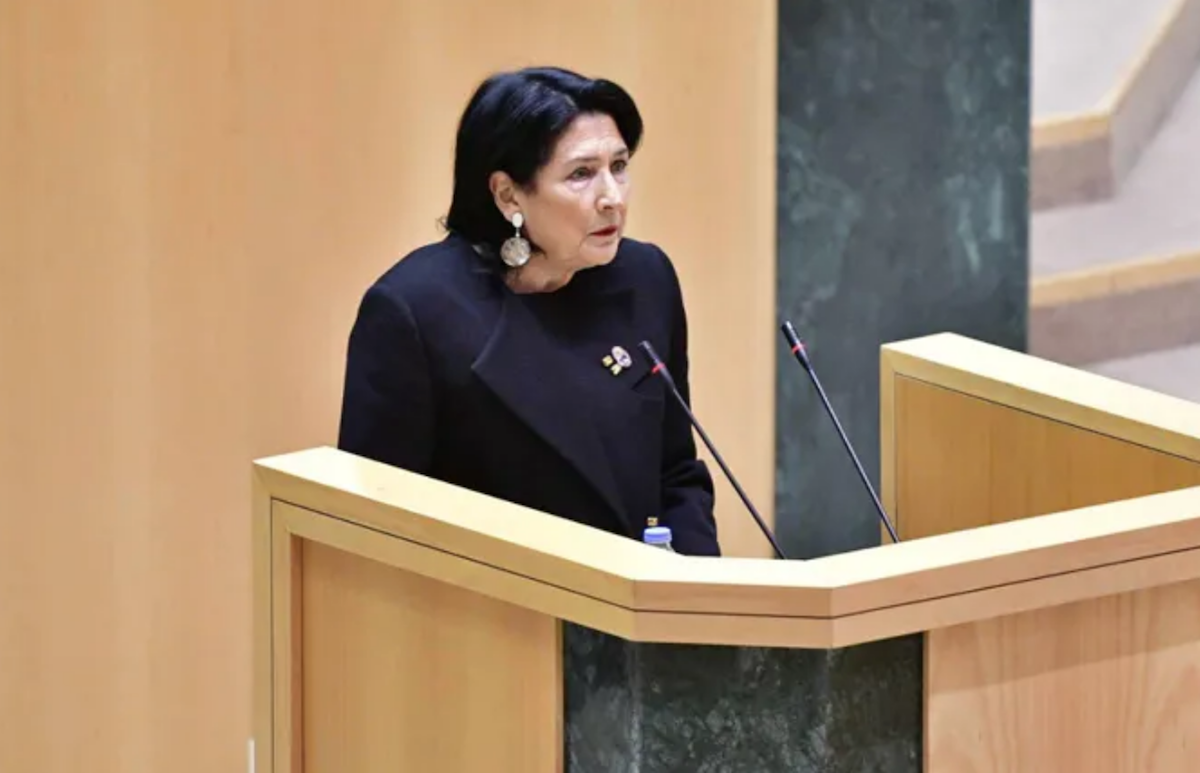
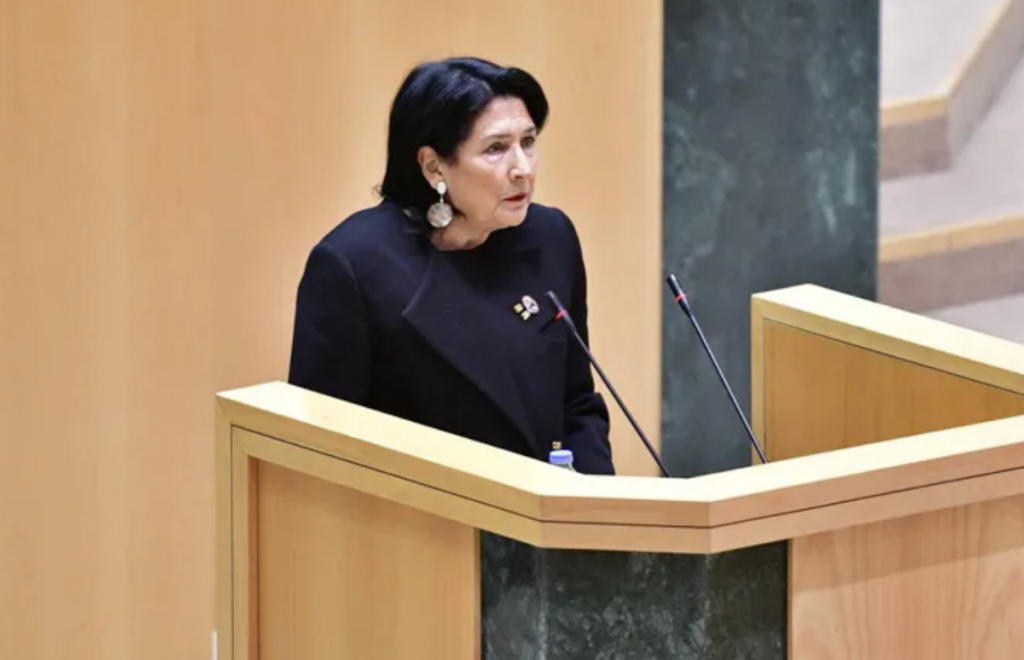
In her final report to Parliament today, February 6, Salome Zurabishvili, the President of Georgia, emphasized that questions concerning corruption, foreign policy, and the state of the judicial system are primarily directed at oligarch and honorary chairman of the ruling Georgian Dream party, Bidzina Ivanishvili, whom she stated “effectively runs the country.”

The Georgian president also directed remarks towards prime ministerial candidate Irakli Kobakhidze, linking him to “the arrival of [Russian MP Sergei] Gavrilov” and “anti-European rhetoric.” Salome Zurabishvili addressed corruption within the elite and highlighted future hybrid threats from Russia, stating that Russia’s hybrid strategy relies on provocations such as “the arrival of a Russian cruise liner in the port of Batumi or an icon depicting Stalin.”

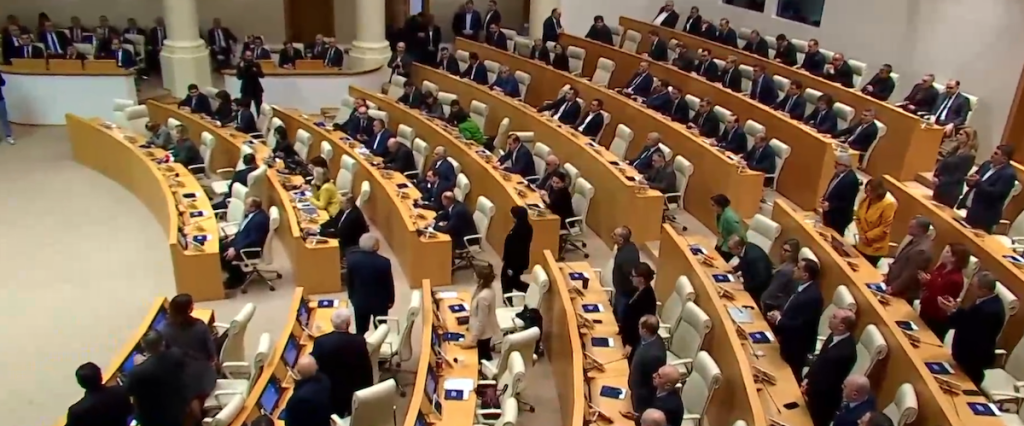
Upon entering the plenary hall, Georgian Dream MPs did not rise from their seats, marking the second occasion where members of the parliamentary majority did not greet the president. Previously, during the consideration of the president’s impeachment in October, the majority similarly remained seated.

“This is not the last time I will stand at this podium. Today, I stand here as the president of an EU candidate country for the first time. I congratulate everyone on this achievement. This is a significant victory,” Zurabishvili remarked at the beginning of her speech.

Salome Zurabishvili in Parliament

What the president of Georgia said

“In today’s context, the primary recipient of societal inquiries is not the Prime Minister, the Speaker of Parliament, or the ruling party, but the individual who truly wields influence over the nation. Therefore, I am directing my remarks to Bidzina Ivanishvili.

The public has a legitimate expectation to hear your perspective – what is the significance of the statements you made regarding corruption and the country’s foreign policy upon your return to political engagement?

As the public anticipates a transition towards a new European model of governance, they also seek clarity on your plans for transitioning from a single-party, autocratic, and top-down model to a democratic and European framework.

The public awaits your response – when do you intend to remove Murusidze and Chinchaladze [high-ranking lawyers targeted by U.S. sanctions]? On one hand, you claim to be combatting (or so you assert) the National Movement, yet on the other hand, no action seems to be taken against its remnants.”


You are associated with Gavrilov’s presence here and with anti-European rhetoric- Zurabishvili addressed Irakli Kobakhidze.

President Salome Zurabishvili also directed remarks towards prime ministerial candidate Irakli Kobakhidze:

“As the President of this country, I refrain from preemptively assessing either the previous or future Prime Minister. However, I feel compelled to address the concerns of the public and articulate the answers they seek. This transparency to the public is a fundamental tenet of democracy.

To the incoming or prospective Prime Minister, particularly one associated with Gavrilov’s presence in Parliament, the nullification of the Charles Michel document [referring to Georgia’s withdrawal from the Charles Michel Agreement of April 19], anti-European rhetoric, and impeachment: How do you propose to instill European values in our society? Furthermore, how do you plan to implement EU recommendations prior to the upcoming elections?”

“We witnessed the emergence of a liberated European youth.

“The country’s European orientation also encountered challenges – our longstanding trajectory gradually shifted focus: anti-European and anti-Western sentiments transitioned from fringe political circles to official rhetoric.

“Simultaneously, attitudes towards Russia noticeably softened. The escalating tensions with Ukraine, public divergence from the EU and the U.S. amidst international sanctions raised doubts about the resilience of our foreign orientation. With ambiguous rhetoric and actions, we placed the significant progress and accomplishments we had attained on the path of European integration at risk. Despite these obstacles, Georgia emerged victorious and secured candidate status!”

The society persevered, fought, and safeguarded its future. The resilience of the people demonstrated to everyone, both domestically and internationally, that our pursuit of European values is justified and the spirit of the Georgian people is unwavering in this endeavor. Our society has gained confidence in its abilities and determination to achieve its objectives. We have witnessed the presence of our liberated European youth, underscoring their significant role in shaping the nation’s future, and the youth has emerged as a beacon of hope.

Drawing upon our society’s experience, characterized by traditional tolerance, wisdom, and restraint, we navigated and resisted the provocations of Russian immigration and propaganda. Rather than engaging in confrontation with Russia’s hybrid tactics, our society upheld stability and maintained a steadfast pro-European stance.

Salome Zurabishvili's speech in ParliamentSalome Zurabishvili’s speech in Parliament

“The ambitions of the elites know no bounds

“Corruption has reached unprecedented levels, signaling that the appetites of the elite class are insatiable, and in reality, there is no oversight or accountability. Corruption within the elite ranks serves as the essential glue that binds the caste around centralized power.

“The idolization of authority is a direct legacy of the Soviet era, characterized by its hierarchical structure, single-party governance, autocratic leadership, culture of obedience, readiness to compromise integrity for survival, and the culture of denunciation. I am referring to the Soviet regime, with its mechanisms of compromising materials, surveillance, clan politics, and servitude.”

Since gaining independence, no government has managed to muster the strength and determination necessary to dismantle the entrenched power structure and restore a democratic equilibrium.

This system thrives on the suppression of opposition voices. It neither desires political adversaries nor welcomes critical viewpoints. Consequently, any alternative perspective is swiftly vilified, branded as treacherous, subversive, or radical, with no avenue for appeal: “Anyone who challenges my authority is betraying the nation.” Compromise is viewed as a tool for discrediting and undermining, while bribery serves as a more subtle form of coercion.


“The hybrid strategy relies on provocations, such as a Russian cruise ship docking in Batumi or the depiction of Stalin’s image on an icon in Sameba cathedral.”

“Along the occupation line, there persists a pattern of continuous intimidation, harassment, kidnappings, and killings. State-sponsored anti-Western propaganda, the promotion and funding of pro-Russian groups, and the escalation of cyber attacks on state institutions are indicative of what to anticipate during the upcoming elections.

Hybrid warfare tactics also encompass substantial Russian immigration, which directly impacts the economy and enhances the country’s reliance on Russian investment and markets, as well as the prevalence of Russian capital within the nation.

Moreover, the hybrid strategy entails various provocations, including the resumption of direct flights from Russia to Georgia, unhindered visits by Russian officials, the presence of a Russian cruise ship in Batumi’s port, and the display of a Stalin icon at Sameba Cathedral. These actions aim to sow discord, provoke confrontation, and instill a sense of societal destabilization.”

“Cease the internal strife, and come to consensus on our nation’s priorities,” the president addressed the opposition.

“We implore the opposition to recognize its own share of responsibility. The ceaseless infighting and discord only breed despair and cynicism among the populace.

While it’s not my role to dictate your actions – whether to unite or disband – I emphasize the importance of reaching consensus on fundamental national objectives. It’s imperative that you demonstrate to the public your capacity for dialogue and concerted effort toward achieving our shared European aspirations. The primary duty of the opposition is to mobilize and involve the public in advocating for our European path.”

“Let’s establish a roadmap for our collective future – a Unity Platform for Europe.

“Our shared objective is a European destiny, and to realize this vision, we must align on key priorities. This can be achieved through the establishment of a unified platform. Hence, we propose the creation of a roadmap for the future – a ‘Unity Platform for Europe’!

“I am prepared to shoulder the responsibility for spearheading this initiative and to establish, with the assistance of my administration, a coordinating body tasked with consolidating all concrete proposals regarding European priorities. Through dialogue and consensus-building, this center will facilitate the development of a collaborative document.

“To this end, I plan to convene representatives from the nation’s political landscape and stakeholders from civil society in the upcoming days. This inclusive approach underscores my readiness to engage with and listen to all voices.”

Georgian President’s last report to the Parliament


Categories
South Caucasus News

Authoritarian leadership in CIS countries: How presidents maintain decades-long power”


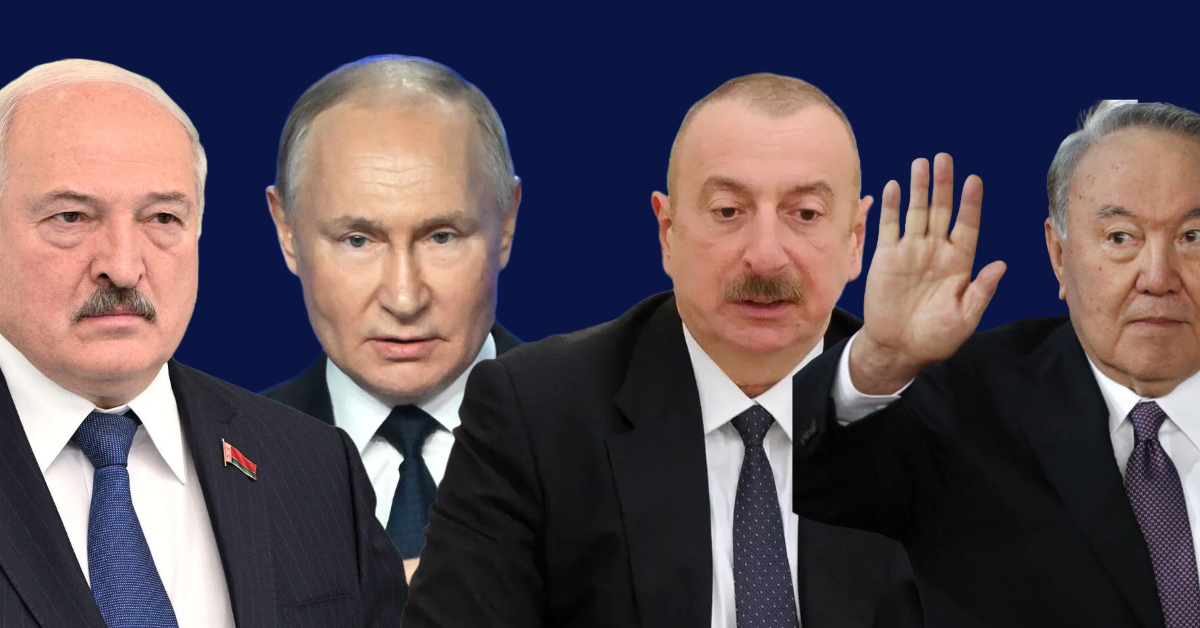
In anticipation of the upcoming presidential elections in Azerbaijan and Russia, we have compiled an overview detailing how authoritarian leaders in CIS countries have managed to maintain their grip on power. They have endowed themselves with extraordinary authority, nullified presidential term limits, inherited power dynastically, and consistently manipulated electoral processes through falsification.

Nazarbayev, the leader of the nation

Nursultan Abishevich Nazarbayev emerged as the earliest and longest-serving leader in Kazakhstan’s history. He held the position of president for three decades, making him the first and sole president of the nation for that duration. Notably, a law entitled “About the First President of RK – Yelbasy” was even enacted, designating him as the “leader of the nation,” as “Yelbasy” translates from Kazakh.

Nazarbayev ascended to leadership during the Soviet era when he was elected president of the Kazakh SSR by the Supreme Soviet in April 1990. Following the dissolution of the Soviet Union, on December 16, 1991, he assumed the presidency of an independent Kazakhstan. In a move to consolidate power, he dissolved the opposition-leaning Supreme Soviet of the republic in March 1995. Subsequently, in April of the same year, he orchestrated a referendum to extend his presidential tenure until 2000.

Before the expiration of his presidential term, Nazarbayev took deliberate steps to prolong his stay in power. Initially, in October 1998, he amended the constitution to extend the presidential term from five to seven years and abolished the age limit, which previously restricted individuals from holding the highest public office beyond the age of 60.

At the age of 58, Nazarbayev then called for a special presidential election on January 10, 1999, which he unsurprisingly won. The final maneuver involved nullifying his presidential term. In June 2000, the constitutional council declared that Nazarbayev’s second election as president in 1999 was technically his first presidential term de jure, as the preceding election had occurred under the old constitution.

Nursultan Abishevich was re-elected president for a second term in early elections on December 4, 2005. In May 2007, Nazarbayev amended the constitution for the second time, eliminating the limit on the number of terms he could serve. Initially, the basic law stipulated that a head of state could only be elected to the post for a maximum of two terms. However, Nazarbayev specified that this restriction did not apply to the first president.

Furthermore, the first president acquired a distinct political status, formalized in a separate constitutional law titled ‘On the First President of the Republic of Kazakhstan,’ as noted by Respublika.

These constitutional amendments also abolished the option of being elected to parliament through single-mandate constituencies, ensuring that parliamentary elections could only be conducted based on party lists. Subsequently, Nazarbayev dissolved the existing parliament and called for an extraordinary parliamentary election. The outcome of the vote led to the victory of the Nur Otan party, chaired by Nazarbayev himself. Consequently, the highest representative and legislative body of the country became monolithic, consisting solely of one party. Thus, the “first president” further consolidated his power.

As the end of his second presidential term approached, there were discussions about amending the constitution once again to extend Nazarbayev’s authority until 2020. The rationale was to avoid diverting the head of state’s attention from governance and to prevent the expenditure of budget funds on elections. Subsequently, amendments were made to the constitutional law “On the First President,” granting Nazarbayev the title “Leader of the Nation – Yelbasy” along with exclusive privileges for both him and his family members. A campaign was initiated to gather signatures in support of holding a referendum to extend presidential powers. While the parliament had drafted relevant amendments to the constitution, they were ultimately rejected by the constitutional council due to negative reactions from the international community.

The next presidential election was held early – on April 3, 2011. According to the CEC, 95.55 percent of votes were cast for the “leader of the nation”. Nursultan Abishevich was elected for his actual fifth term also early – on April 26, 2015. This time he beat his historic high of 97.75 percent of the vote.

On March 19, 2019, Nursultan Nazarbayev announced his resignation: “I have decided to terminate my powers as president. This year will mark 30 years of my highest office. The people gave me the opportunity to be the first president of independent Kazakhstan”.

Thus, the powers of the head of state passed to the speaker of the Senate of the Parliament Kasym-Jomart Tokayev. On June 9, 2019, Kazakhstan held extraordinary presidential elections, as a result of which the country finally had a second president. True, at that time, Nazarbayev’s departure was considered formal, as all the privileges and powers of the “leader of the nation” actually left power in his hands. For example, as head of the Security Council, Nursultan Abishevich could block any presidential action. As “Yelbasa” Nazarbayev sat in the Library of the First President. In fact, a dual power was formed in Kazakhstan; people used to say: “The “Library” sits over Akorda (White House).

Everything shifted following the protests in January 2022. The cult of personality surrounding Nazarbayev is gradually being dismantled: the “Day of the First President” is no longer observed as a public holiday, the capital, previously renamed Nur-Sultan at Tokayev’s suggestion, has reverted to its former name of Astana. Nursultan Abishevich has been stripped of all authority, exclusive privileges, and the title of “leader of the nation.” Furthermore, Nazarbayev’s relatives are either under investigation or have already been convicted in various criminal cases.

Belarus: Lukashenko sets the precedent for resetting presidential terms

Alexander Grigorievich Lukashenko holds the record as the longest-serving incumbent president among the CIS countries. July 10 marks the 30th anniversary since his election as president of independent Belarus in 1994. Just two years later, the nation encountered a political crisis when the parliament initiated impeachment proceedings against the president for constitutional violations. In response, Lukashenko called for a referendum to amend the constitution, seeking to consolidate presidential powers.

On November 24, 1996, following the referendum on constitutional amendments, Lukashenko’s presidential term was effectively reset, and his authority expanded as he dissolved the parliament. A new supreme representative body comprised of pro-presidential deputies was established.

During the second presidential election on September 9, 2001, Lukashenko secured victory once again, winning 75.65 percent of the votes according to calculations by the Central Election Commission (CEC). In 2004, he conducted another referendum on constitutional amendments, this time eliminating restrictions on the number of presidential terms in the country’s fundamental law. Subsequently, these restrictions were officially abolished in the 2006 law “On the President.” And thus, a precedent was set…

Lukashenko has consistently and predictably emerged victorious in all subsequent regular elections held in 2006, 2010, 2015 (where he garnered a maximum of 83.47 percent of the votes), and 2020. Following each presidential election (with the exception of the first one), protests erupted in Belarus, only to be brutally suppressed. In 2010, the number of protesters, as estimated by various sources, ranged from 10,000 to 60,000, with presidential candidates being imprisoned. The largest and most prolonged protests occurred in 2020, with ongoing persecution of individuals continuing to this day. The country currently holds nearly 1,500,000 political prisoners, some of whom are incarcerated for offenses such as insulting and defaming the president.

According to Euroradio, individuals have been imprisoned for actions as seemingly innocuous as “insulting” a government official or tearing down red and green flags. In addition to politically motivated criminal prosecutions, Lukashenko’s regime is notorious for its involvement in the mysterious disappearances and killings of his adversaries.

Recent amendments to the law “On the President” grant Alexander Lukashenko, in the event of resignation, with extraordinary privileges and guarantees, closely resembling those of his Kazakh counterpart, although lacking the official status of “Batka Natsiya.” The law prohibits the former head of state from being held accountable for actions “undertaken in connection with the exercise of his presidential powers,” extending the same protection to his family members.

According to Euroradio, “It will be impossible to arrest or confiscate housing, cars, personal archives, correspondence, and so forth from the former president. The financial support for the former president must be the same as during the presidency, regardless of any other sources of income. Additionally, the ex-president is exempt from income tax.”

Lukashenko has opted to “bequeath” power in the country to the Security Council of Belarus. In May 2021, he signed a decree outlining the transfer of power in the event of his violent demise.

Russia: Putin and the land of political prisoners

Vladimir Vladimirovich Putin stands as one of the enduring figures in the power structure of the CIS. March 26 will mark 24 years since his initial election as president of Russia in 2000. Succeeding Russia’s first president, Boris Yeltsin, Putin assumed the role of acting president following Yeltsin’s resignation. After completing his first term, Putin secured re-election in 2004. In 2008, he faced term limits, leading to a hiatus mandated by the constitution – a maximum of two consecutive terms. Consequently, the presidency was temporarily assumed by Dmitry Medvedev, while Putin assumed the role of Prime Minister of the Russian Federation.

Subsequently, Putin was re-elected president in 2012 and 2018. In the forthcoming presidential election scheduled for March 15-17, Putin is seeking a fifth term collectively. In 2020, Putin effectively reset his term limits through constitutional amendments. This reset was comprehensive – his presidential tenure until 2024 is regarded as a “zero” term. This innovation was proposed by State Duma deputy Valentina Tereshkova. Novaya Gazeta provides an in-depth analysis of how this came to pass and why the “space amendments” are deemed illegal.

To maintain his grip on power, Putin bypassed laws concerning himself and instead tightened legislative measures against all dissenters. This led to the introduction of the “Foreign Agents” law in Russia, which has broad applicability, potentially encompassing anyone. Further details about the law itself, its proponents, the process of its enactment, as well as its implications regarding disinformation and attempts to discredit opposition figures, are elaborated upon.

In earlier years, specifically in 2012 and 2014, amendments to the administrative code significantly heightened penalties for organizing peaceful demonstrations and protests. This included increases in fines, lengths of potential incarceration, and widened the scope of liability for organizers. Additionally, the formation of “Navalny clubs” was banned. By the end of 2020, regulations were implemented to monitor the financing of protests. This included restrictions on funds originating from abroad or labeled as coming from “foreign agents,” as well as anonymous donations. Organizers of rallies attended by over 500 individuals are now obligated to report their expenses to the authorities following the event. Subsequently, in February 2021, fines for illegal financing of protests were added to Article 20.2 of the Administrative Code.

Furthermore, in 2012, Russia implemented an updated law on rallies. While it did not deter participants from joining the March of Millions, a protest held in June to challenge Putin’s inauguration in 2012, the subsequent criminal cases stemming from the Bolotnaya Square protests and resulting prison sentences significantly impacted the protest climate in Russia.

The Memorial human rights organization has identified over 600 political prisoners on its list. These individuals face charges under various criminal statutes, including those related to “anti-war” activities and state treason. However, it’s important to note that this figure isn’t exact due to the secretive nature of criminal proceedings, making it difficult to identify all individuals affected. Memorial has maintained this list since 2019. Additionally, the human rights initiative “OVD-Info” has been compiling a database of politically motivated criminal prosecutions since 2012. As of November 2023, the total number of defendants exceeds three thousand individuals.

Azerbaijan: Aliyev inherits the presidential mantle

Ilham Heydar Oglu Aliyev has held the reins of power in Azerbaijan for 21 years, succeeding his father, Gaidar Aliyev. In the upcoming elections, Aliyev Jr. is seeking a fifth term in office.

Aliyev Sr. assumed the presidency of Azerbaijan on October 3, 1993, amidst the military conflict in Nagorno-Karabakh. On March 12, 1995, a revolt by a special police unit occurred in the country, but was swiftly quelled. With the internal political situation stabilized, Heydar Aliyev was re-elected for another term on October 11, 1998. In 1999, the Azerbaijani president suffered a heart attack, leading to the formation of opposition groups in the country while he received treatment in the United States. However, Aliyev maintained his grip on power. As the next presidential elections approached in 2003, Aliyev Sr. withdrew his candidacy in favor of his son, who was also undergoing medical treatment in the United States.

On October 15, 2003, Ilham Aliyev secured victory in the elections with 79.46 percent of the vote, according to the calculations by the Central Election Commission (CEC), while concurrently serving as the country’s prime minister.

“Tens of thousands of opposition activists who took to the streets during the pre-election period were subjected to police violence and brutal torture in police stations. Reports indicate that there were fatalities and severe injuries among them. However, following a power transition – contentious for the opposition but advantageous for the Aliyev family – Ilham Aliyev assumed the presidency on October 31, 2003,” as reported by Meydan.

In the spring of 2005, Ilham Aliyev assumed leadership of the ruling Yeni Azerbaijan Party, founded by his father.

“During the preparations for the 2005 parliamentary elections in Azerbaijan, opposition voices were harshly suppressed. Consequently, the ruling Yeni Azerbaijan party emerged victorious in the elections,” according to reports from Caucasian Knot.

Aliyev secured re-election for a second term on October 15, 2008. By March 2009, he had orchestrated a referendum on constitutional reform in the country. Naturally, term limits for the presidency were abolished, paving the way for Ilham Aliyev’s re-election for a third term on October 10, 2013. In 2016, he further amended the constitution, extending the presidential term from five to seven years.

According to Freedom House, Azerbaijan ranks 193rd out of 210 in terms of political and civil liberties, earning a “not free” designation, as reported by Novaya Gazeta Europe. Social discontent in Azerbaijan has long been met with harsh suppression.

Reportedly, there are over 200 political prisoners held in Azerbaijani jails.

“During Aliyev’s presidency, there have been suspicious deaths of critical journalists, along with the arrests of numerous media representatives. Towards the end of 2023, the crackdown on independent media intensified once again,” as highlighted by Meydan.

Furthermore, in 2022, Azerbaijan implemented the “On Media” law, significantly curbing media freedom.

“Many aspects of the law grant the government broad authority to curtail media coverage, thereby hindering criticism of the government,” according to JAMnews.

Zhanna Baitelova, Mediaset


Categories
Selected Articles

‘All about death’: Gazans shelter from Israeli attacks in cemetery – South China Morning Post


‘All about death’: Gazans shelter from Israeli attacks in cemetery  South China Morning Post

Categories
Selected Articles

Opinion All sides would benefit from regime change — in Israel


Ending the war between Israel and Hamas in Gaza and pursuing a larger vision of peace require regime change in at least three places. Hamas cannot continue to control Gaza from where it terrorizes both Israel and Palestinians. The Palestinian Authority must cast off Mahmoud Abbas’s sclerotic and corrupt regime to find credible leadership. And Israel must also undergo its own “regime change” — a repudiation of not only Prime Minister Benjamin Netanyahu but also his far-right government. Netanyahu and his government presided over what nearly became a civil war over democracy, left the country vulnerable to the worst slaughter of Jews since the Holocaust, propounded racist rhetoric that gave Israel’s enemies a toehold to accuse it of genocide in the International Criminal Court, failed to perform basic social services and lost the confidence of the country in management of the war.

A poll taken in January showed “the Likud Party would drop to an unprecedented low of only 16 seats if elections were held today,” the Jerusalem Post reported. Since then, protests against Netanyahu and the government have only increased.

As the Times of Israel reported, “Speeches at the weekly Tel Aviv rally demanding the return of hostages held in Gaza took a more strongly political tone than ever before on Saturday night, with speakers accusing the government of Prime Minister Benjamin Netanyahu of being indifferent to the hostages’ fate and Netanyahu of being guided by personal considerations and stalling to avoid investigations and elections.” Ronen Manelis, a reserves brigadier general and former Israel Defense Forces spokesperson, was quoted as saying, “The discourse taking place in recent days, the leaks, the manipulations, the lack of leadership, the inability to make difficult decisions, is leading to some difficult questions about the loss of commitment by the state to its citizens; [about whether] considerations outside this commitment are influencing the decision-making, or the absence thereof.”

Ousting Netanyahu and his even-more-extreme coalition partners (who have taken to condemning President Biden, who remains popular with Israelis for his self-described pro-Zionism outlook and support during the war) is no easy matter. As long as Netanyahu’s coalition sticks together, he will remain in power. The notion that he would step down voluntarily after Oct. 7 has faded. Even the harsh judgment of a postwar investigatory commission might not dislodge him.

Aside from a vote of no confidence, there are only a handful of mechanisms that would eject him from government. His corruption trial might result in a criminal verdict or a plea bargain that requires him to step down. The entire military and intelligence community leadership could resign, leaving him as the sole person responsible for Oct. 7 still in power. Alternatively, intensified public protests culminating in a general strike might finally force him to step down.

Follow this authorJennifer Rubin‘s opinions

There are serious limitations with each. None is likely to happen immediately, certainly not while the war is ongoing. Moreover, there is no guarantee that Netanyahu would leave voluntarily or that his coalition would crumble even if everyone else in the national security apparatus steps down and a general strike proceeds. And the progress of the much-delayed criminal trial remains uncertain.

The question then remains whether the United States can hasten Netanyahu’s removal. The U.S. record of ousting hostile regimes by military power or secret coup is atrocious, but the Biden administration and Congress can assist domestic forces in Israel to accelerate Netanyahu’s departure.

Cutting off aid to Israel is a poor tool to obtain this result. Such action would allow Netanyahu to play the victim and seek refuge with his far-right allies. However, slowing aid delivery could make clear that Netanyahu’s presence harms Israel’s essential relationship with the United States. NBC News recently reported, “After weeks of private administration requests produced fewer results than the White House wants … the U.S. is considering slowing or pausing the deliveries in the hope that doing so will prod the Israelis to take action, such as opening humanitarian corridors to provide more aid to Palestinian civilians.”

The report continued, “The effort comes after weeks of President Joe Biden and his national security team failing to convince Netanyahu and other Israeli officials to dramatically change tactics in Gaza and to take more steps to minimize civilian casualties, officials said. It marks a potential shift in Biden’s approach by going beyond rhetorical pressure, largely behind the scenes, and to making tangible policy changes aimed at getting Israel to act.” Making clear that Netanyahu’s policies necessitate this might sharpen the divide between him and military commanders.

The Biden administration also could increase consultation with and lift up the voices of opposition figures, hostage families and protesters (engaging in publicly announced meetings with them, for instance) to emphasize that the United States stands foursquare behind efforts to bring fighting to an end, obtain return of the hostages, prevent Israeli “resettlement” of Gaza and support regional peace efforts by Israel’s neighbors. And, conversely, the administration could step up criticism of the racist rhetoric from Netanyahu’s coalition partners and decline to block any Security Council resolutions condemning such remarks.

To be clear, Israel is a democratic country. Ultimately, the Israeli people select their leaders. But when the Israeli people overwhelmingly express desire for change, Biden should leave no doubt that we stand with them. He should be clear: The United States believes the future security of Israel and peace in the region hinge on deactivating Hamas (and constraining its patrons in Tehran), finding an alternative to the corrupt Palestinian Authority government and, yes, regime change in Israel. Israel and the region benefit from a pro-democracy, flexible and realistic Israeli government that understands that perpetual war is unacceptable.


Categories
Selected Articles

Opinion | All sides need regime change in Israel – The Washington Post


Opinion | All sides need regime change in Israel  The Washington Post

Categories
Selected Articles

Iran executes four men linked to alleged Israeli intelligence plot – Firstpost


Iran executes four men linked to alleged Israeli intelligence plot  Firstpost