Categories
South Caucasus News

IALA Announces New Armenian Literary Publications


New Armenian literary publications

The International Armenian Literary Alliance announced five new literary publications by Armenian authors, including Armen Davoudian’s “The Palace of Forty Pillars,” Leila Boukarim’s “Lost Words,” illustrated by Sona Avedikian, Tenny Minassian’s “Lucy Goes to The Gentle Barn,” illustrated by Agavny Vardanyan, stories about immigrant life in Little Armenia by Naira Kuzmich, and Manoug Hagopian’s “Life in the Armenian Community of Aleppo.”

Davoudian’s “The Palace of Forty Pillars” is a Publishers Weekly and The Rumpus’ most anticipated poetry book of 2024. According to poet Richie Hofmann, the book is “brilliant and deft and heartfelt.”

“In this formally radical debut, Armen Davoudian shows how rhyme enacts longing for a homeland left behind; how meter sings to a lost beloved; and how a combination of the two can map a self—or idea of the self—relinquished so that a new life, and all the happiness it deserves, can take shape,” said poet Paul Tran.

“Palace of Forty Pillars” book cover

Author Armen Davoudian. Photo credit: Matthew Lansburgh

Wry, tender, and formally innovative, Davoudian’s debut poetry collection, “The Palace of Forty Pillars,” tells the story of a self estranged from the world around him as a gay adolescent, an Armenian in Iran, and an immigrant in America. It is a story darkened by the long shadow of global tragedies—the Armenian genocide, war in the Middle East, the specter of homophobia. With masterful attention to rhyme and meter, these poems also carefully witness the most intimate encounters: the awkward distance between mother and son getting ready in the morning, the delicate balance of power between lovers, a tense exchange with the morality police in Iran.

In Isfahan, Iran, the eponymous palace has only twenty pillars—but, reflected in its courtyard pool, they become forty. This is the gamble of Davoudian’s magical, ruminative poems: to recreate, in art’s reflection, a home for the speaker, who is unable to return to it in life.

Davoudian has an MFA from Johns Hopkins University and is a PhD candidate in English at Stanford University. His poems and translations from Persian appear in Poetry magazine, the Hopkins Review, the Yale Review, and elsewhere. His chapbook, “Swan Song,” won the Frost Place Competition. Armen grew up in Isfahan, Iran, and lives in Berkeley, California.

You can now pre-order “The Palace of Forty Pillars” (to be published on March 19, 2024) from the IALA Bookstore powered by Bookshop. Keep an eye on IALA’s website and socials for their second annual Literary Lights reading featuring Davoudian in 2024.

Leila Boukarim new picture book “Lost Words,” illustrated by Sona Avedikian, tells an Armenian story of survival and hope.

“Lost Words” book cover

“It is difficult to find the words to describe the type of loss a Genocide can cause to a young child. I’ve been looking for something similar for my own son. This picture book is a good start to help explain loss and raise the many questions necessary to start the conversation,” said Serj Tankian, activist, artist, and lead vocalist for System of a Down.

Based on a true family story, this inspiring picture book about the Armenian Genocide shares an often-overlooked history and honors the resilience of the Armenian people.

What is it like to walk away from your home? To leave behind everything and everyone you’ve ever known? Poetic, sensitive, and based on a true family history, “Lost Words: An Armenian Story of Survival and Hope” follows a young Armenian boy from the day he sets out to find refuge to the day he finally finds the courage to share his story.

Boukarim writes stories for children that inspire empathy and encourage meaningful discussions. She enjoys reading (multiple books at a time), embroidering, nature walking, and spending time with people, listening to their stories and sharing her own. Boukarim lives in Berlin, Germany.

Author Leila Boukarim

Illustrator Sona Avedikian

Avedikian is an Armenian illustrator born in Beirut, Lebanon, and currently based in Detroit, Michigan. She loves creating vibrant work and often takes inspiration from Armenian art and architecture.

You can now pre-order “Lost Words” (to be published on March 26, 2024) from the IALA Bookstore powered by Bookshop. Keep an eye on IALA’s website and socials for their second annual Literary Lights reading featuring Leila Boukarim in conversation with Astrid Kamalyan in 2024.

Illustrated by Agavny Vardanyan, Tenny Minassian’s “Lucy Goes to The Gentle Barn,” based on a true story, follows Lucy, a rescue poodle-mix, as she goes on another adventure with her mom. This time they visit an animal sanctuary called The Gentle Barn.

“The Gentle Barn is a special place that not only rescues animals, but allows humans to heal by bonding with them. There is nothing more healing than hugging a cow,” said Tenny Minassian. “I wanted to share the story of our visit to The Gentle Barn because Lucy also rescued me. She saved my life when I was battling depression. I want children to know that even if we are different from each other, whether we are talking about humans or non-human animals, we can still be good friends.”

“Lucy Goes to The Gentle Barn” book cover

In 2015, a small poodle named Spring, was rescued from a shelter when she was pregnant with four puppies. Lucy was one of those puppies. Shortly after, she became an Emotional Support Animal (ESA) when her mom was struggling with her mental health. They saved each other!

Minassian is a vegan lifestyle coach, business consultant, and independent author living in Los Angeles, California with her Emotional Support Animal Lucy. She focuses on compassionate coaching and donates a portion of proceeds to nonprofit organizations helping animals, people, and the planet. She is an Armenian-American immigrant and came to the U.S. from Iran as a refugee with her family. Visit the website and follow on social media @VeganCoachTenny for more information on upcoming projects and events. Follow Lucy’s fun adventures on her Instagram account.

Vardanyan is an Armenian American character designer and prop artist based in Los Angeles, California. She’s a 2021 Summa Cum Laude graduate from Cal State Northridge with a BA in arts and concentration in animation. In addition to having recently worked as a full-time prop artist for HBO Max’s Fired on Mars, she’s also worked as a children’s book illustrator for GarTam Books and as print designer for New York Times and Indie Bestseller Allison Saft. She is currently working on her first graphic novel, “The Pomegranate Princess.” Learn more about Vardanyan here.

Author Tenny Minassian

Illustrator Agavny Vardanyan

You can now purchase “Lucy Goes to The Gentle Barn” from the IALA Bookstore powered by Bookshop or Abril Bookstore. Part of the proceeds of this book will benefit The Gentle Barn, a national nonprofit with locations in Santa Clarita, CA, St. Louis, Missouri and Nashville, Tennessee.

Naira Kuzmich’s “In Everything I See Your Hand” will capture your heart with 10 brilliant stories about immigrant life in Little Armenia.

“Her writing was rich with Armenian culture, with old blood and the glittering black eyes of strong and deeply feminine women. . . . Since her passing in the fall of 2017, Naira’s talent has inspired me to tell her story to others. She’s caught the fears of many a stalled writer. ‘Here’s the issue,’ she wrote to me. ‘My window is closing.’ In every writer I’ve encouraged to finish their novel, their memoir, their history, I see her hand,” said Roz Foster, Naira’s former literary agent.

What’s the difference between leaving the motherland and leaving the literal mother? When does the journey toward self-possession become something closer to self-exile? Living daily in the tension between assimilation, disillusionment, and desire, the Armenian-American protagonists of “In Everything I See Your Hand” struggle with the belief that their futures are already decided, futures that can only be escaped through death or departure—if they can be escaped at all.

“In Everything I See Your Hand” book cover

Naira Kuzmich

In these ten brilliant stories, Kuzmich spins variations of immigrant life in the Little Armenia neighborhood of Los Angeles. Kuzmich finished this collection before her death at age twenty-nine. Melding empathy, savvy, and candor through ardently wrought language, these stories are gifts that seduce, devastate, and shine.

Kuzmich was born in Armenia and raised in the Los Angeles en-clave of Little Armenia. Her fiction and nonfiction have appeared in West Branch, Blackbird, Ecotone, The O. Henry Prize Stories 2015, The Threepenny Review, The Massachusetts Review, The Cincinnati Review, and elsewhere. She passed away in 2017 from lung cancer.

“Life in the Armenian Community of Aleppo” book cover

You can now purchase “In Everything I See Your Hand” from the IALA Bookstore powered by Bookshop.

Manoug Hagopian’s memoir in stories, “Life in the Armenian Community of Aleppo,” describes Armenians’ joys, griefs, and daily efforts to survive after they fled the 1915 massacres in a land that accepted them with open arms.

The writer shows that Armenians who arrived in Aleppo at the turn of the twentieth century did not stay idle as refugees, but continued their lives as they did in the Armenian-populated cities, towns, and villages they were born in. Their offspring then carried the torch of their parents and built their lives in Aleppo and other countries that they migrated to. Today, hardly any country in the world does not bear the mark of Armenians.

Hagopian was born in Aleppo, Syria, in 1954. At sixteen, he moved to Beirut, Lebanon, and then to the United Arab Emirates, where he worked at the offices of various international companies. Hagopian and his late Cypriot wife, Rita, had two sons. Today, he lives with his sons in Nicosia, Cyprus.

The writer worked as a translator for about twenty-five years at various companies in the UAE and Cyprus. He originally wrote his book in the Armenian language and used his skills as a translator to translate his work into English. Both versions are available now.

Manoug Hagopian

Hagopian’s next book, “Life Within the Armenian Community of Cyprus,” in Armenian, will be published soon, to be followed by the English version. He will publish “Life Within the Armenian Community of the UAE,” both in Armenian and English.

You can now purchase “Life in the Armenian Community of Aleppo” on Amazon, and its original publication on Barnes & Noble.

Categories
South Caucasus News

Making art in wartime Lebanon


This article is the second in a four-part series, exclusively for the Armenian Weekly, on the making of Encounters and Convergences: A Book of Ideas and Art by Seta B. Dadoyan. 

PART TWO. Chapter III. Wartime art and aesthetic

In the spring of 1981, in addition to the ongoing fighting between militant factions, a large Israeli offensive on the southern, central and other parts of Lebanon, the Palestinian camps and the southern suburbs of the capital crippled life. In 1982, there was a massive invasion by land, air and sea. For months, artillery, warplanes and battleships bombarded the land. After the withdrawal of Israel, battles involving the local warring factions and the Syrian army, which had entered Lebanon in 1976, intensified. 

By the end of 1983, in the eighth year of the war, after the withdrawal of Israel and the departure of Yasser Arafat from Tripoli with the al-Fatah organization, street and factional fighting and shelling continued with greater violence. Most of Beirut, especially the western part where we lived, was partly destroyed. But life went on everywhere despite barricades, rubbish-mountains, sandbag-hills, destroyed buildings, shattered glass, burned cars, all sorts of partisan and militia and party flags, logos, posters of warlords, political graffiti and religious and iconic figures. When shelling intensified, we sought shelters and sometimes spent days in dark corners and under stairs. With forced intermissions, schools, universities, banks and shops remained open, lectures and conferences were organized, friends visited, and we even had dinner parties, birthdays, weddings and surely many funerals. 

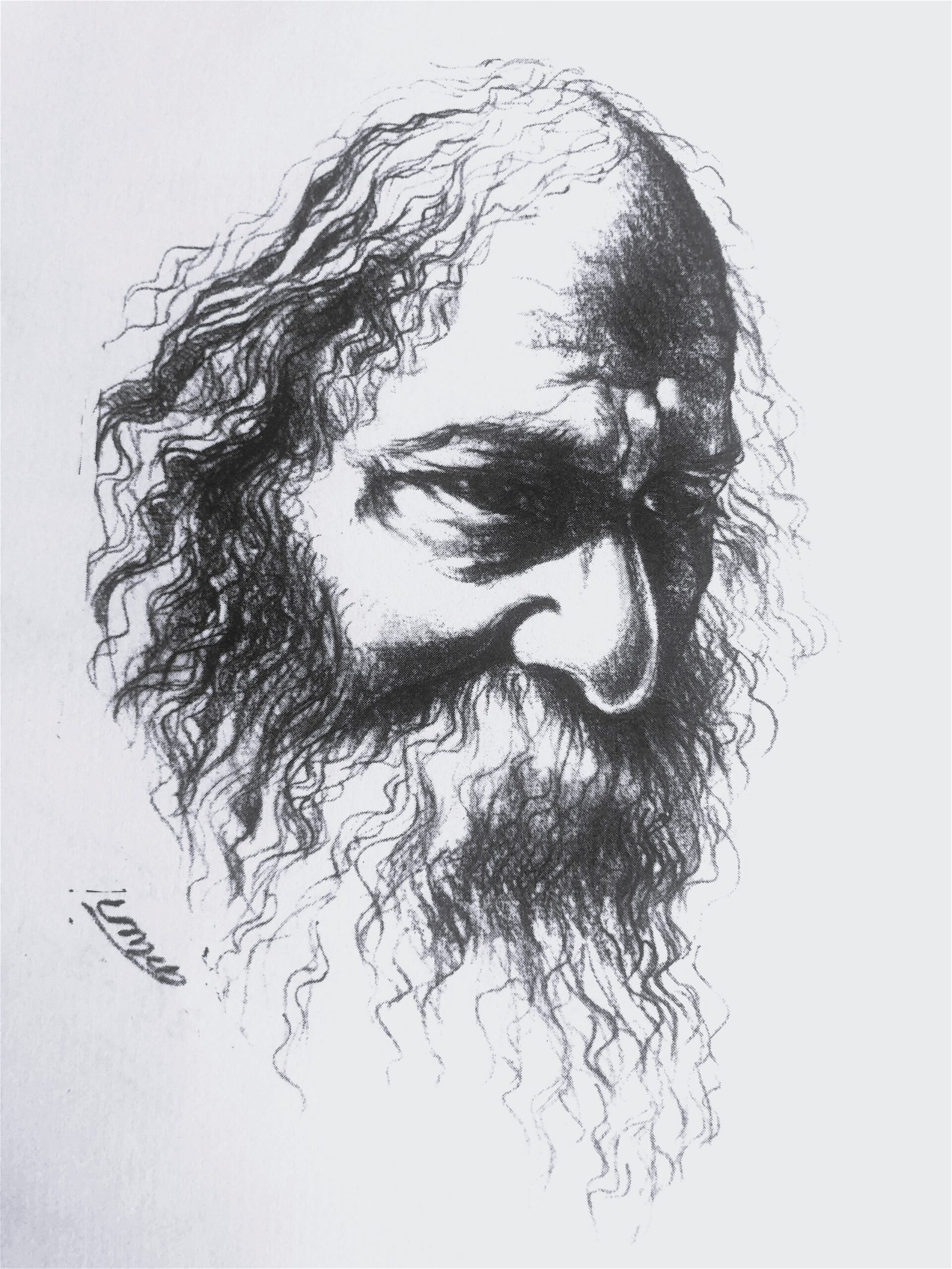
Very recently, when I decided to organize my artwork, I noticed that in the eight years from the early 1980s to late 1987, I made over 40 drawings, seven of which are portraits, while the rest are simply “wartime-drawings.” 

Rabindranath Tagore in remembrance of VV, 1985. Charcoal, 15×22 cm
Just as life was wartime-life, art in turn could only be wartime-art. It traced a trajectory that took its beginning in the immediate realities of the war, and by the force of its convergence in the present moment, gave the work its truth-content and aesthetic legitimacy. Under the circumstances, I could not understand salon, studio and decorative artworks, nor the assumed “freedom” of art. I often wrote in the papers but was not lauded for my critique. The human condition in wartime and massive suffering were central to my thinking, and inevitably, the human figure became dominant in my work. For right or wrong reasons, wars were fought by people and affected all people in every possible respect. While somehow life went on, many suffered, many died, many survived, yet everywhere all waited for deliverance, and the vigil continued.  

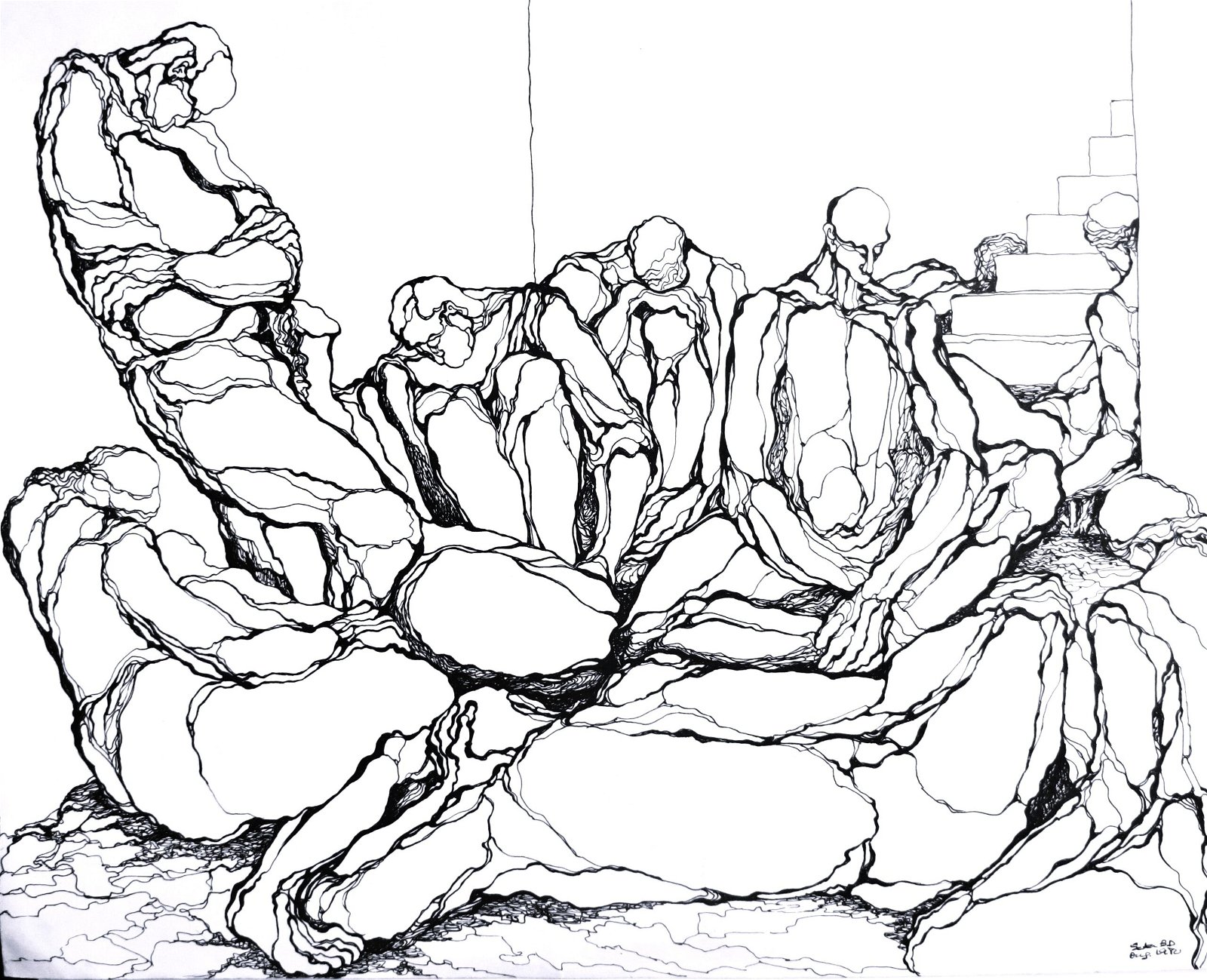
The shelter, Beirut, 1980. Ink, 46.5×34.5 cm
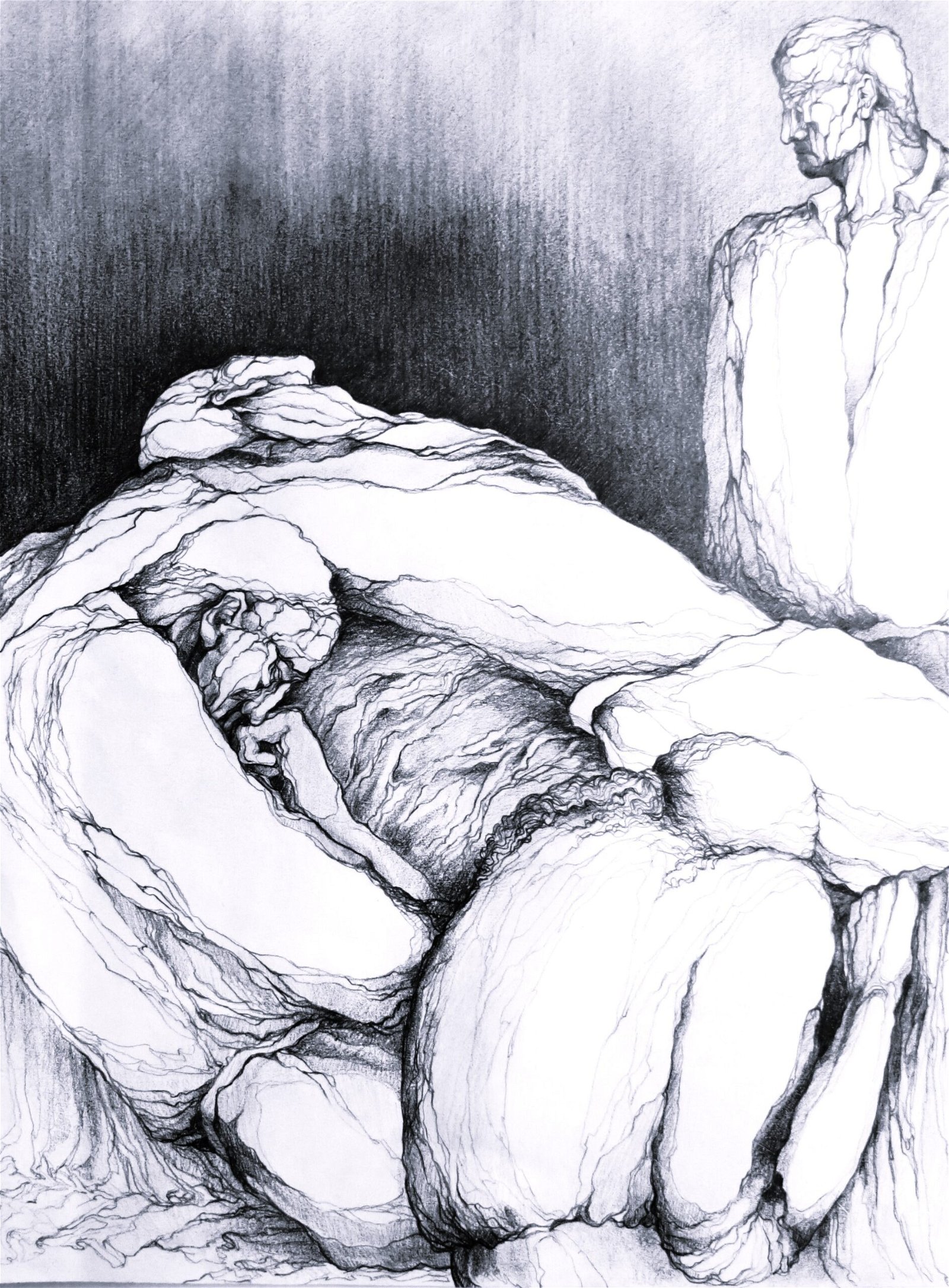
Next to one’s home, the “shelter”, al-malja (refuge, a more expressive word in Arabic) was symbolic of an absurd yet heroic wait [“The wait”]. The shelters, mostly makeshift places, were dark microcosms where people came together in terror, often with genuine sympathy and hope. Some died even in shelters. The existential weight of the term would only allow sharp black lines in ink [“The shelter”]. Death was a central fact of wartime life. Of all those who fought and died, some were true idealists and heroes with dreams of a just society. They were the comrades of the sufferers [“The comrade”]. 

The comrade, Beirut,1980. Pencil, 47×40.5 cm
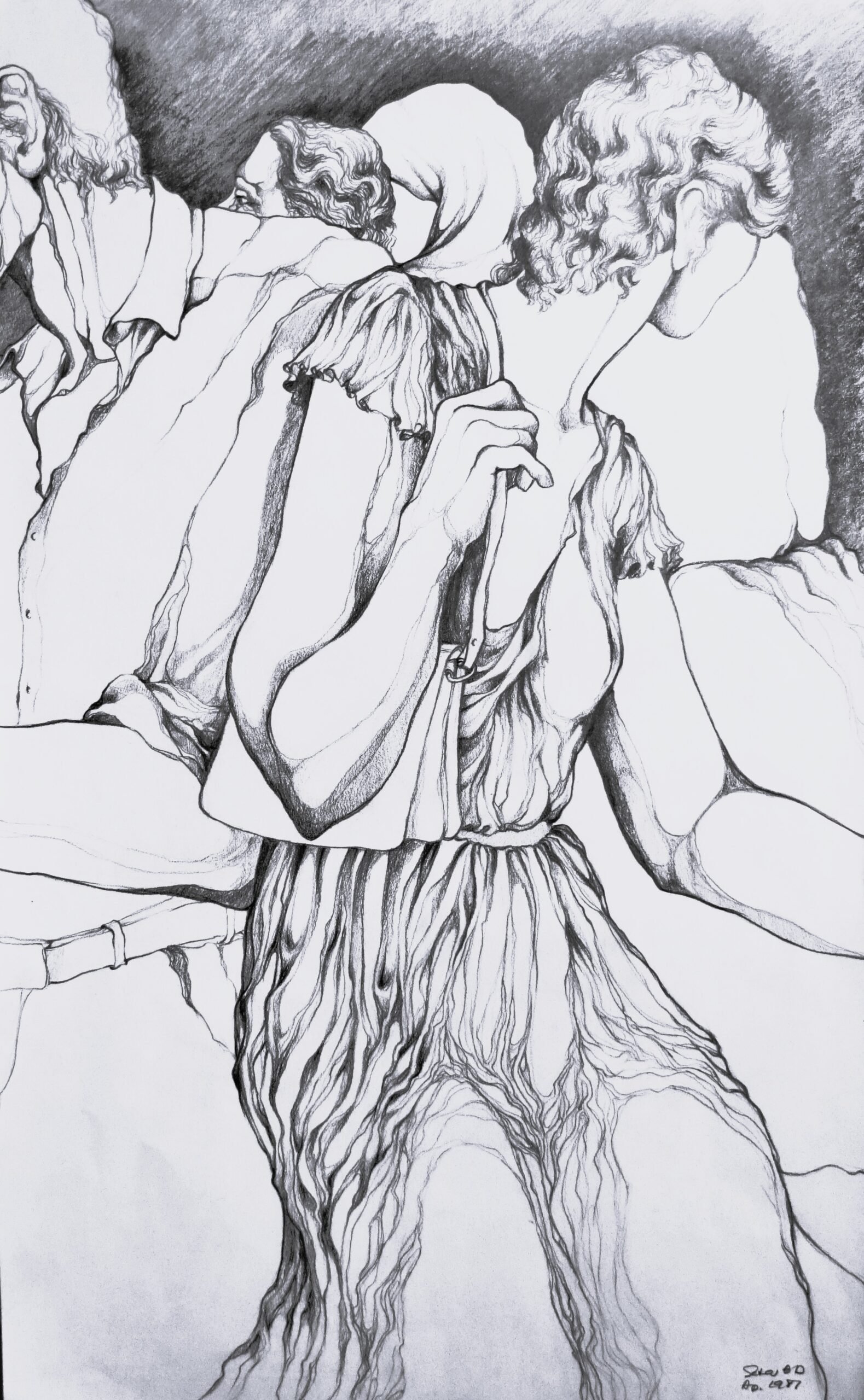
At times of “relative calm”, or hudū’ nisbī, as they were sarcastically referred to, life would return with force. We even took the children to places like Italy and Greece. As I look back, I am surprised at the number and frequency of social activities. The windows of the living room were covered with metal shields for security. We had frequent visitors who climbed a hundred stairs to the fifth floor with a dripping candle or a flickering flashlight. We sat for hours discussing everything, joking about the most serious issues, eating and drinking. When the shelling intensified or a gun battle raged on the street, our friends would simply stay longer. Six sketches sum up these times: “Worlds of silence,” “The cleaning lady,” “Portrait of S.,” “Gothic,” “The friend” and “The visit”. Frequent and often sudden shelling (qaṣf) was another wartime reality. It could happen anytime and cause massive panic. Amid loud car horns and ambulance sirens, people ran in all directions looking for shelter. I made a sketch about these terrifying episodes of “blind shelling” or qașf ‘ashwā’ī, as they were called. 

Qasf (bombardment), Beirut, 1981. Pencil, 48.5×30 cm
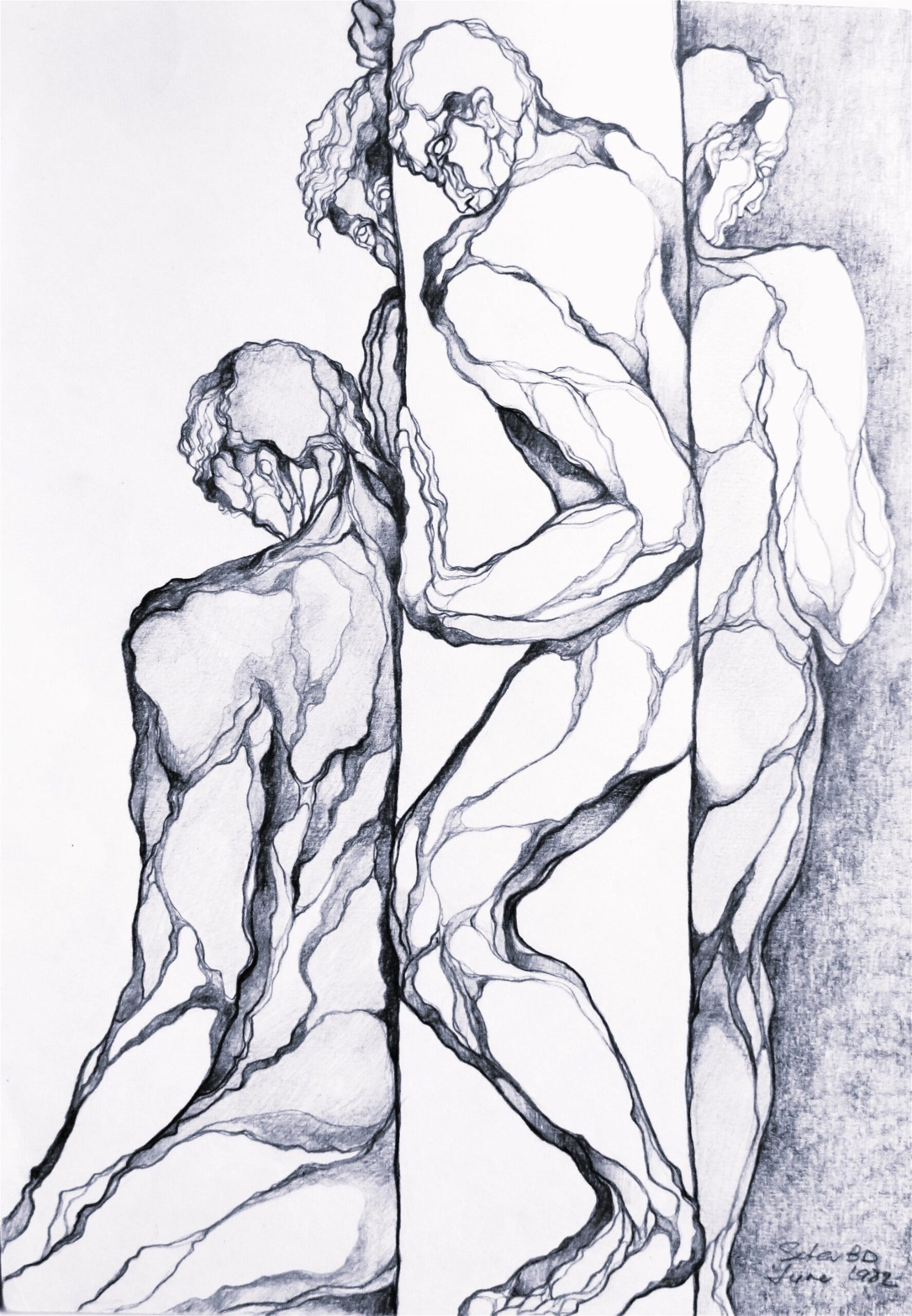
Following the first and partial Israeli invasion in 1981, thousands of Palestinians moved from the camps in south Lebanon and the southern suburbs into the central-western parts of Beirut. They occupied schools, vacant or partly completed houses, apartments and entire buildings. At the time, the construction of our building on al-Farābī street, al-Zarif, was barely completed, and most of the apartments were vacant. About 300 Palestinians moved in, with their weapons and ammunition, even small-size artillery. For the next few years, we lived in surreal conditions with no electricity and running water in an extremely crowded and noisy building with 10 flights and no working elevator. During bombardments, dozens of terrified people would run into the lower floors, or to a partially completed building on the opposite side of the street, or simply crowd the stairs. They would stay for long periods, occasionally coming out for fresh air. Two of the sketches from these times are featured in the book.   

By 1983, events took unexpected turns. After a wave of assassinations of prominent activists and the disappearance of the intellectual elite, it was clear that ideology was at an impasse and that regional regimes were involved in a power game, which continues, getting even more complicated and corrupt. There were few bright spots in the arts and literature, but there was no margin for ideology. Three sketches reflect these times: “Departure,” “Dialectics” and “Ideology in crisis.”  

Dialectics, Beirut, 1981. Pencil, 29.5×21 cm
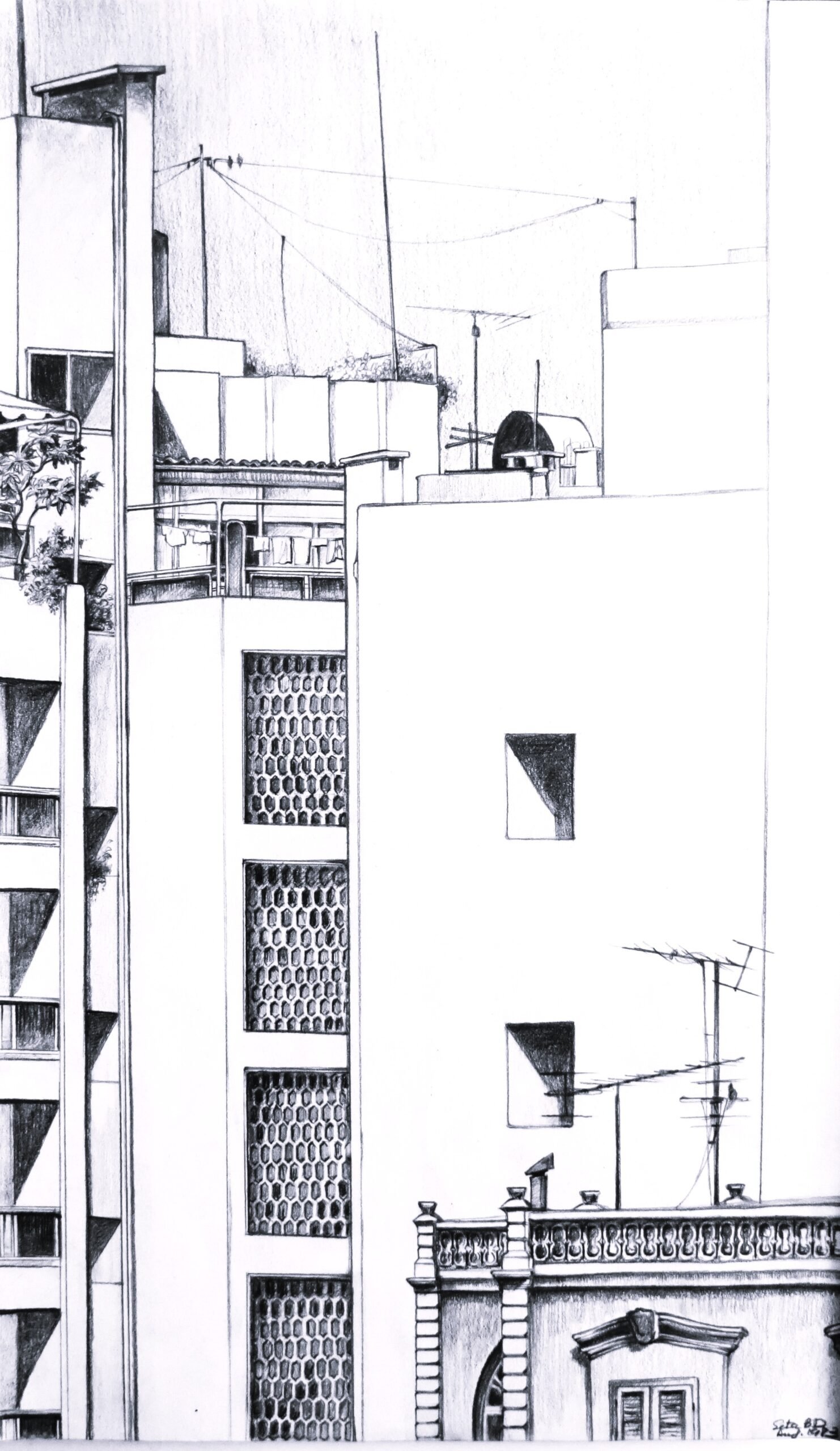
In wartime Beirut, the room, the house and the place where one felt safe took on a special significance and a role of sorts. During prolonged periods of shelling and life in a confined space, I did not even think of doing any figure drawing. While sitting with the family, doing housework, reading or writing at my desk with a manual typewriter, the “view” was the row of yellow buildings typical of old Beirut on the other side of the block. Except for one apartment, they were deserted and looked haunted with some laundry still hanging on the balconies. I drew the building, where an elderly lady, who seemed to be forgotten in the apartment, constantly moved between the balcony and the rooms [“Window 1”]. I made three more “views” of the other old buildings, all demolished. One building, now gone too, on the right corner in “Window 2,” was over two centuries old. It had been one of the most luxurious residences of Beirut in the early 19th century under the Ottomans. When the view from the window was exhausted, I turned to the houseplants, but not to the human figure, yet. There had been too many losses, catastrophes and deaths within a short period. During the three years, from 1983 to 1985, I made only seven sketches, four “windows” and three “rooms.”  These were my “landscapes.”

Window 2, Beirut, 1982. 41.5×25 cm

PART TWO. Chapter III. Thoughts and exits in chaos 

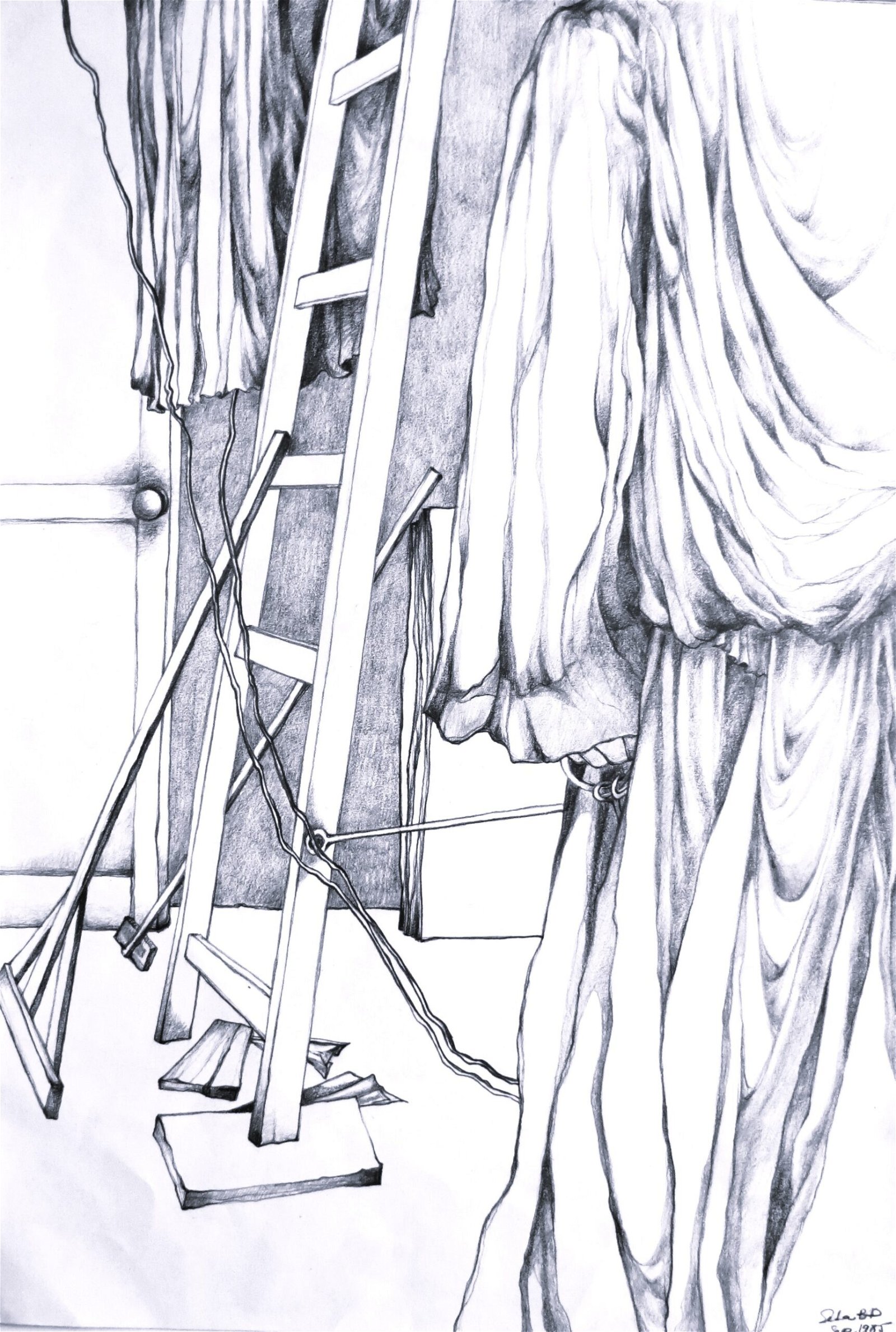
In 1985, even though there was no improvement in the circumstances and the prospects for any solution were bleak, I seemed to have come to terms with my situatedness and made an enigmatic sketch [“Situatedness”]. The central figure on the foreground looks like a medieval monk. He stands too close to the viewer, and his head and feet are outside the frame. In his right hand he holds large old keys on a metal ring. The room is a messy art studio, a backstage room with drapes hanging from a higher level. There are empty boards and canvases against the wall, some ropes and a ladder with uneven sides leaning against the higher level from where the drapes hang. The door with a stain-ring around an old-fashioned nob is part open. With his back to the door, the monk-figure may have just walked in or expects others in the room. Soon, I made another enigmatic yet simpler sketch, “The stride.”

Situatedness, Beirut, 1985. Pencil, 36.5×25.5 cm
Meditation was a healing exercise in wartime, and I made a self-portrait of sorts [“The pause”]. In 2015, 30 years later, I made a variation on this drawing in color, for the cover of my book, The Armenian Condition in Hindsight and Foresight. During the war, the street where one lived was a microcosm where things happened and concerned the people who lived there. I made three sketches of al-Farābī, where we moved in 1981. It was previously known as the “Armenian quarter,” ḥayy al-arman, but almost everyone had migrated. After all night shelling, the streets were eerie scenes of debris and broken glass. We walked or drove through the rubble to school with the children, went to work, did the shopping, met with neighbors on the street and hoped the night would be calmer than the previous one. Four sketches are about this strange routine.  

The human condition in wartime and massive suffering were central to my thinking, and inevitably, the human figure became dominant in my work. For right or wrong reasons, wars were fought by people and affected all people in every possible respect. While somehow life went on, many suffered, many died, many survived, yet everywhere all waited for deliverance, and the vigil continued.  

Between 1981 and 1986, I was doing research at the Armenian library of Haigazian College/University while teaching part-time philosophy of religion and some Armenian studies courses. Despite, and perhaps because of, extremely difficult conditions on every level of daily life, and like many, I found my salvation in hard work. In 1986 I was invited to teach at the Civilization Sequence Program of the American University of Beirut (AUB). Wartime AUB was a peculiar place. There were normally unacceptable but now “legitimate” practices and norms in the way the students, faculty, administration, staff and people from warring parties carried out their duties and interacted. The walls, the classroom boards, the halls, the corridors and the entire beautiful campus on the Mediterranean became billboards for political slogans, comments, threats and caricatures. Professors and staff could be supported or threatened at gunpoint by students, colleagues or other staff, depending on who heard them or was watching. But again, somehow, life on campus too went on, and exams and quizzes were generally held on time, despite threats from students for high marks. Top administrators were assassinated on premises, the historic Assembly Hall was shelled, and the famous clock tower of AUB was bombed and collapsed in 1991. As far as I was concerned, teaching was a salvation, and I absolutely loved teaching cultural studies and art and had very high student evaluations. But I also suffered inner intrigues and a culture of rivalry and slander. 

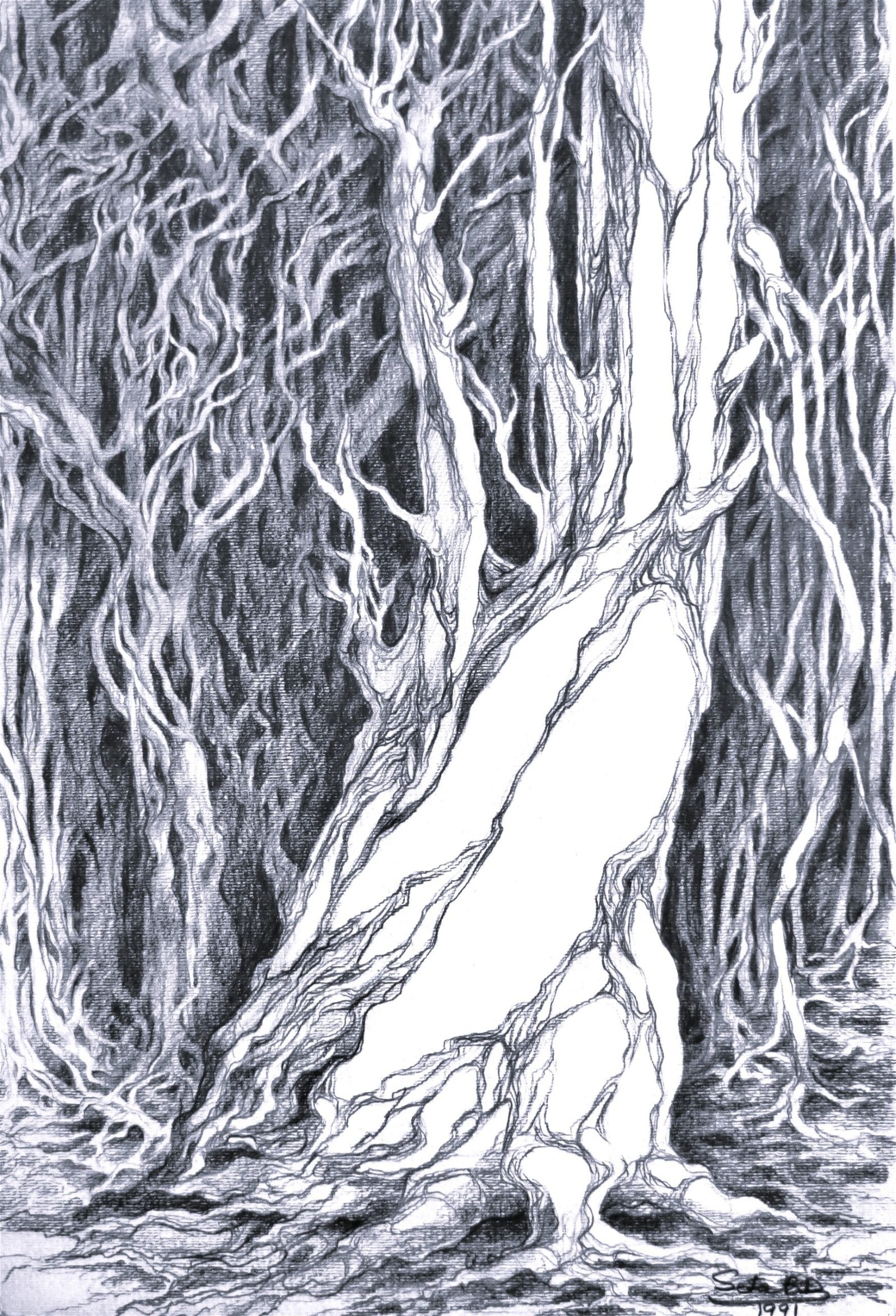
My two decades of teaching at AUB yielded two drawings, a group portrait of six of my colleagues “Colleagues” and “The banyan tree of AUB – A portrait.” The whole experience, from 1986 to 2005, teaching at the Civilization Sequence Program and the Faculty of Engineering and Architecture (philosophy of technology and art history) was unique and rewarding, despite the mentality of some faculty and AUB wartime diplomacy. 

From 1987 to 1991, I worked for the complicated and exclusive degree of Doctor of Sciences in Philosophy, a degree higher than the Ph.D., granted in the German and Russian systems. I traveled to Yerevan for sources; these were otherwise “exits.” For four years, the courses, yearly exams, papers, sources and manuscripts from the Matenadaran and the final work kept me occupied. At the time, Beirut International Airport was closed, and all air travel was via the sea or other capitals. I flew to Yerevan from Damascus and Aleppo airports, sometimes traveling under bullets and shelling on the roads. I made four sketches at the start of my four-year work toward my degree: “Armenia rock island,” “The exit,” “The flight” and “The moment.” The defense of my dissertation was on September 20, 1991, a day before the declaration of the independence of the Third Republic. This was also the year the war ended in Lebanon. The degree, the promotion and total dedication to teaching and scholarship put my life on a different path for the next decades. Except for the 10 portraits made between 1985 and 2005, for the next 35 years from the fall of 1987, all art was put aside.

The banyan tree of AUB, Beirut, 1991. Pencil, 31.5×21.5 cm

The extraordinary case of Armenian Cilicia was always a challenge for me. My father’s family, and over half the refugees in the Arab world, are originally Cilicians. From its rise in 1080 to the demise of the Kingdom in 1375, through the next five centuries to its complete devastation and evacuation by Turkey by the early 1920s, Armenian Cilicia between the Christian and Muslim worlds has been a poorly understood phenomenon. A deeper knowledge of the Armenian experience in the Islamic world is a prerequisite. Other cases too, such as the Fāțimid Armenians in 11th and 12th centuries, the Armenians in Bilād al-Shām (Greater Syria) and many others await thorough research. On the 1700th anniversary of the adoption of Christianity by the Armenian state, I was asked by Catholicos Aram I to prepare two studies about the history and the intellectual culture of Cilicia. This was an opportunity and opened new horizons. I dedicated several studies to various aspects of the history and intellectual culture of Cilicia, its artistic legacy and the institution of the Catholicosate. Later, I also edited and co-authored two volumes and several studies on Cilicia and related subjects. 

My dissertation on the Islamic sources of Erznkats‘i, published in 1991, for the Doctor of Sciences in Philosophy opened a novel discipline of Islamic-Armenian interactive history in regional context. Identifying the patterns of interaction and defining the historicity of 14 centuries of the Armenian historical experience in worlds of Islam became career defining interests. I found myself on the path of hard-core scholarship. Hopefully, my six books in this discipline are a beginning. A truly contemporary and critical discipline of Islamic-Armenian studies is yet to break its way through the Herculean pillars between the Mediterranean and the Atlantic, of mainstream Armenian studies, into the open ocean of Near Eastern and interfaith studies. My work so far is a statement by the force of the material it makes available and the theses it expounds.

Author information

Dr. Seta B. Dadoyan

Dr. Seta B. Dadoyan

Dr. Seta B. Dadoyan (née Satenik Barsoumian) is a prominent Armenian scholar and painter and a Doctor of Philosophical Sciences in Philosophy. In addition to her research and publications on Western Armenian culture, her novel and extensive research focuses on the medieval and modern Armenian political, cultural and intellectual experiences in their interactive aspects within the Near Eastern world. She is considered a trailblazer and leading specialist in a novel discipline of Islamic-Armenian interactive history, initiated by her and to which she has dedicated six of her 12 volumes and many groundbreaking studies. She was professor of cultural studies, philosophy and art history at the American University of Beirut. After moving to the United States in 2005, she was visiting professor of Armenian and Near Eastern Studies at Columbia University, St. Nersess Seminary, the University of Chicago and the State University of Yerevan. For her exceptional scholarly contributions to Armenian studies and intellectual culture, in September 2021 the Society of Armenian Studies honored her with the “Lifetime Achievement Award.” In September 2015, she was granted the “St. Mesrop Mashtots‘” Medal, and in January 1999, the highest “Medal and Diploma of David Invictus/Anhaght” of the Philosophical Academy of the National Academy of Sciences of Armenia. She has authored 11 and co-authored and edited two volumes, as well as published over 60 scholarly papers in academic journals.

|

The post Making art in wartime Lebanon appeared first on The Armenian Weekly.


Categories
Audio Review - South Caucasus News

@SvobodaRadio: RT by @mikenov: Болгария объявила в европейский розыск шестерых граждан России в связи с их возможной причастностью ко взрывам и разрушен…


Болгария объявила в европейский розыск шестерых граждан России в связи с их возможной причастностью ко взрывам и разрушениям на оружейных заводах и складах с 2011 по 2020 год.https://t.co/gKjnaKys6X

— Радио Свобода (@SvobodaRadio) January 30, 2024


Categories
Audio Review - South Caucasus News

@ukraine_map: RT by @mikenov: US 🇺🇸 will deliver the 150km HIMARS-launched GLSDB to Ukraine 🇺🇦 tomorrow, according to Politico With GLSDB, Ukraine will…


US 🇺🇸 will deliver the 150km HIMARS-launched GLSDB to Ukraine 🇺🇦 tomorrow, according to Politico

With GLSDB, Ukraine will be able to strike Russian targets in 1/3 of Crimea and the rest of the country pic.twitter.com/gBieePoHiV

— Ukraine Battle Map (@ukraine_map) January 30, 2024


Categories
South Caucasus News

@SvobodaRadio: RT by @mikenov: Болгария объявила в европейский розыск шестерых граждан России в связи с их возможной причастностью ко взрывам и разрушен…


Болгария объявила в европейский розыск шестерых граждан России в связи с их возможной причастностью ко взрывам и разрушениям на оружейных заводах и складах с 2011 по 2020 год.https://t.co/gKjnaKys6X

— Радио Свобода (@SvobodaRadio) January 30, 2024


Categories
South Caucasus News

@ukraine_map: RT by @mikenov: US 🇺🇸 will deliver the 150km HIMARS-launched GLSDB to Ukraine 🇺🇦 tomorrow, according to Politico With GLSDB, Ukraine will…


US 🇺🇸 will deliver the 150km HIMARS-launched GLSDB to Ukraine 🇺🇦 tomorrow, according to Politico

With GLSDB, Ukraine will be able to strike Russian targets in 1/3 of Crimea and the rest of the country pic.twitter.com/gBieePoHiV

— Ukraine Battle Map (@ukraine_map) January 30, 2024


Categories
South Caucasus News

IALA Announces New Armenian Literary Publications – Asbarez.com – Asbarez Armenian News


IALA Announces New Armenian Literary Publications – Asbarez.com  Asbarez Armenian News

Categories
South Caucasus News

Armenia’s Central Bank chief foresees no increase in food product prices in near future – ARMENPRESS


Armenia’s Central Bank chief foresees no increase in food product prices in near future  ARMENPRESS

Categories
South Caucasus News

NPR News: 01-30-2024 4PM EST


NPR News: 01-30-2024 4PM EST

Categories
South Caucasus News

Iran shows it can unleash its own deadly drone war against US troops – Business Insider


Iran shows it can unleash its own deadly drone war against US troops  Business Insider