NPR News: 01-23-2024 12AM EST
Categories
 The South Caucasus News - SouthCaucasusNews.com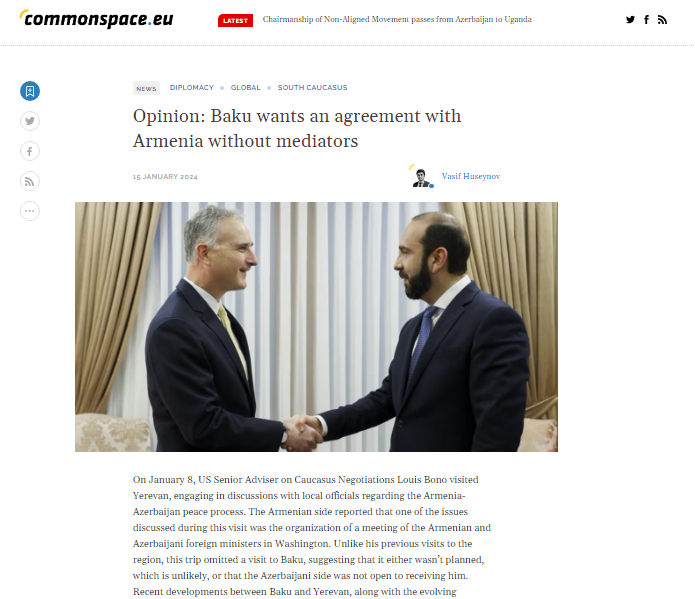
On January 8, US Senior Adviser on Caucasus Negotiations Louis Bono visited Yerevan, engaging in discussions with local officials regarding the Armenia-Azerbaijan peace process. The Armenian side reported that one of the issues discussed during this visit was the organization of a meeting of the Armenian and Azerbaijani foreign ministers in Washington. Unlike his previous visits to the region, this trip omitted a visit to Baku, suggesting that it either wasn’t planned, which is unlikely, or that the Azerbaijani side was not open to receiving him. Recent developments between Baku and Yerevan, along with the evolving dynamics of mediator involvement, indicate that Azerbaijan has grown more cautious and skeptical about the role of third parties in the Armenia-Azerbaijan process. As a result, Azerbaijan has advocated for bilateral meetings between the two countries. Baku’s position is primarily related with the potential geopolitical fallout of the upcoming peace deal with Yerevan.
Azerbaijan is concerned that the peace talks with Armenia are perceived by competing major powers as a tool serving their own strategic interests. Baku, therefore, aims to navigate this process meticulously, avoiding being positioned as a pawn on the geopolitical chessboard. This necessitates prioritizing the interests of the local states and refraining from antagonizing any major power by allying with one side. The confrontational context of the Russia-West relations is a big source of concern for Baku as any deterioration of the relations with either side is at odds with the economic and political interests of Azerbaijan. Hence, Baku seeks a peace treaty that would address only the disputes between Armenia and Azerbaijan; not a treaty that would be of a more geopolitical project attempting to change the power balance between the major powers in the South Caucasus.
Towards this end, Baku pursues two major objectives. First, the peace treaty negotiations are preferred to be conducted at the bilateral level between Armenia and Azerbaijan. On 28 December, the Foreign Minister of Azerbaijan announced that Baku proposes to hold a meeting of foreign ministers of the two countries at the border. In the wake of an earlier meeting of the border delimitation commissions of the two countries at the border on 30 November, it would be another step towards normalization if their foreign ministers also meet at the border, followed by a meeting by the political leaders. It is not clear why Armenia has so far refused to hold bilateral talks on peace treaty, while agreed to such talks on the delimitation issue. The next meeting of the border commissions scheduled to take place at the border this month shows that this format works in practice and can be extended to other levels of bilateral talks. The utility of bilateral contacts is also confirmed by the fact that the landmark deal between the two countries concerning the swap of prisoners last month was possible with no involvement of third parties.
As part of this approach, Baku also rejects the calls for the establishment of an institute of guarantors comprising of third countries in the peace treaty. Instead of this, Baku proposes to form a bilateral commission of the two countries to deal with any dispute that may appear in the future. This formula of “guarantees but not guarantors” is meant to ensure that the Armenia-Azerbaijan relations will not be a subject of great power dynamics in the future.
Secondly, Baku remains committed to the trilateral statements signed by the leaders of Armenia, Azerbaijan, and Russia in 2020-21. One major issue that is now addressed by these statements is the re-opening of regional transportation links. Armenia has recently rejected the trilateral statement of 9 November 2020 that envisages the provision of “unimpeded” access between the western part of mainland Azerbaijan and Nakhchivan exclave as well as the deployment of Russian border guards to this land passage, that is called “Zangezur corridor”. Armenia rejects both proposals; this poses challenges to the peace talks with Baku and provokes further instability in relations with Russia. Hence, Azerbaijan expects Armenia to fulfil its commitments under the trilateral statement without creating a geopolitical crisis over this corridor.
Against this background, the reluctance on the side of Azerbaijan to re-internationalize the peace talks and Baku’s lack of enthusiasm concerning the new round of talks in Washington is understandable. But this situation is also affected by the policies of the United States vis-à-vis Azerbaijan. The re-introduction of the 907 amendment of the Freedom Support Act which prohibits military aid to Azerbaijan, the inclusion of Azerbaijan to the religious freedom watchlist, and the threatening statements against Baku’s decision to open an alternative via Iran to the Zangezur corridor, among others, have damaged the image of the United States as a neutral mediator between the two South Caucasian republics. Nonetheless, Baku’s insistence on bilateral talks between Armenia and Azerbaijan, excluding mediators, reflects a more fundamental intention – to protect the region from the geopolitical rivalries and safeguard regional peace and security.
https://www.commonspace.eu/news/opinion-baku-wants-agreement-armenia-without-mediators

On 21 December 2023, a historic football (soccer) match was played between two Azerbaijani football teams—FC Qarabag (Aghdam) and MOIK (Baku)—in Khankendi. FC Qarabag won one-nil.
This was the first sports event held in this city following the independence of Azerbaijan, and with the participation of Azerbaijani players and spectators. I had never been to Khankendi before, so it was also a great opportunity to visit this city and watch this important match as a spectator. At the same time, I decided to look retrospectively into this city’s history and analyze the relationship between Armenians and Azerbaijanis from this angle.
According to most Azerbaijani sources, Khankendi (which means “village of the Khan,” derived from Xanın k?ndi in the Azerbaijani language) was once a small settlement built in the late XVIII century as a place where the ruler of the Karabakh Khanate, his immediate family and other relatives could live. The first ruler of the Khanate, Panah Ali Khan, initially built the fortress city, situated at an altitude of 1,300-1,600 meters above sea level, in 1752. It was named Panahabad Fortress after him. Later, the people started to call it Shusha Fortress, and, incidentally, Azerbaijan celebrated the two-hundred-and-seventieth anniversary of the establishment of Shusha in 2022. Many famous Azerbaijani writers, poets, thinkers, composers, and musicians from the city of Shusha have made invaluable contributions to the cultural legacy of Azerbaijan. Therefore, on 7 May 2021, to restore its historical appearance and former glory, Azerbaijani President Ilham Aliyev declared Shusha to be the cultural capital of Azerbaijan. Thus, both Shusha and Khankendi were from their foundation, closely associated with the rulers of the Karabakh Khanate.
It must be noted that the entire historic Karabakh region, including its lowland and mountainous parts, has a very long and dramatic history, and it cannot be disputed that a deep vein of history has run through this region over the centuries, as seen in various tangible objects and artifacts, Muslim and Christian historical and religious monuments associated with Caucasian Albanian, Azerbaijani, and Armenian cultural heritage.
Although Karabakh Armenians used to live predominantly in the mountainous part of the historic Karabakh region, Karabakh Azerbaijanis have never differentiated between its lowland and mountainous parts and perceive it “as a single geographical, economic and cultural space, where they have always been politically and demographically dominant.” Moreover, many Azerbaijanis considered the creation in 1923 of the Nagorno-Karabakh Autonomous Oblast (NKAO) within ‘artificial’ (i.e., previously nonexistent) borders an attempt to secure “an Armenian majority region within Azerbaijan as part of the Soviet/Russian policy of divide and rule.”[1]
With the establishment of the NKAO in 1923, Khankendi became the capital of this administrative-territorial unit and was renamed Stepanakert, after Armenian Bolshevik revolutionary Stepan Shahumian. However, the NKAO operated within Soviet Azerbaijan for only 68 years and ceased to exist by the “Law on Abolishment of Nagorno-Karabakh Autonomous Oblast” (resolution ? 279-XII), which was a motion passed by the Supreme Soviet of the Republic of Azerbaijan on 26 November 1991 and signed into law.[2] According to this law, Stepanakert along with two other cities within the former NKAO were renamed with their respective Azerbaijani names. Thus, Stepanakert was once again named Khankendi in law, but this did not happen in practice.
This was because of the illegal activities from 1988 of the irredentist Karabakh movement established in Armenia and the NKAO. This encouraged the mobilization of Armenian ethno-nationalists under the nationalist slogan miatsum or “unification” to demand the transfer of the NKAO from the jurisdiction of Soviet Azerbaijan to Soviet Armenia. In fact, the first demonstration that took place in Stepanakert on 13 February 1988, has traditionally been considered the start of this movement. Despite the rejection of this transfer by Soviet Azerbaijan, neither NKAO’s ethno-nationalists nor their supporters in Soviet Armenia and Armenian Diaspora relinquished their territorial claims. Moreover, with representation of Karabakh movement in the Supreme Soviet of the Armenian Soviet Socialist Republic (SSR) this body adopted a resolution “About reunion of the Armenian SSR and Nagorno-Karabakh” on 1 December 1989[3]. This was a serious violation of the constitutional norms of USSR, and was deemed by a resolution of the Presidium of the Supreme Soviet of Azerbaijan Soviet Socialist Republic (SSR) passed on 7 December 1989[4] as inadmissible interference in the affairs of the Azerbaijan SSR, and territorial encroachment. However, the involvement of Armenian SSR was continued further.
By 1989, the Karabakh movement had transformed into the Pan-Armenian National Movement and won the majority in the parliamentary election in May 1990. In fact, under the pressure of this movement Declaration of Independence of Armenia was adopted by the parliament on 23 August 1990[5]. This document[6] had a special clause related to the above-mentioned resolution on the reunion of Armenia and Nagorno-Karabakh, and, in turn, the Constitution of the Republic of Armenia[7] refers to the Declaration of Independence of Armenia until now.
Thus, the leaders of Armenia SSR as well as afterwards the independent Republic of Armenia encouraged the separatists in the former NKAO and played an instrumental role in further occupation of Azerbaijani territory in pursuit of irredentist claims and ethnic solidarity.
As a result of this policy, all Azerbaijani inhabitants of the historic Karabakh region were expelled and, for more than 30 years, the stadium in Khankendi, built in the mid-1950s during the Soviet era, was used by the Armenian inhabitants alone. Only following the Second Karabakh war as well as localized counter-terrorism measures carried out by Azerbaijani armed forces on September 19-20 2023, the illegal Armenian armed formations were disarmed and Armenia’s armed forces agreed to leave the territory of Azerbaijan. The head of the illegal separatist regime S. Shahramanyan also signed a decree on termination of so called “Nagorno-Karabakh Republic” on 28 September 2023. According to the said decree, all institutions of this illegal entity had to be dissolved before 1 January 2024.
Today Azerbaijanis are able to go to Khankendi. There is also a hope that, one day, some of the Karabakh Armenians, most of whom decided to leave Karabakh, will return to this place.
Everyone now hopes that the Armenian-Azerbaijani confrontation will finally sink into oblivion with a peace treaty to be signed soon and its successful implementation over the coming years.
However, today we are standing head-to-head with the unknown. Can the current Armenian government overcome the revanchist forces in the country and advance the peace agenda with Azerbaijan? Can both Armenians and Azerbaijanis despite current narratives and stereotypes, as well as the geopolitical implications be able to achieve a durable peace for future generations? Only one thing is clear today: that, in the short term, Azerbaijan and Armenia have to establish inter-state relations, which have been nonexistent since both countries regained independence in 1991. For this purpose, perhaps signing an “Agreement on Peace and Establishment of Inter-state Relations” is an important prerequisite.
[1]Tabib Huseynov. A Karabakh Azeri perspective. In: Accord. “The Limits of Leadership. Elites and societies in the Nagorny Karabakh peace process”. Conciliation Resources. Issue 17, 2005, p. 25 – https://rc-services-assets.s3.eu-west-1.amazonaws.com/s3fs-public/The_limits_of_leadership_Elites_and_societies_in_the_Nagorny_Karabakh_peace_process_Accord_Issue_17.pdf
[2] Az?rbaycan Respublikasının Dağlıq Qarabağ Muxtar Vilay?tinin l?ğv etm?k haqqında Az?rbaycan Respublikasının Qanunu – https://web.archive.org/web/20120326151255/http://karabakh-doc.azerall.info/ru/law/law012az.htm
[3]Joint resolution of Armenia SSR and Nagorny Karabakh Oblast on reunification, 1 December 1989 – https://www.legal-tools.org/doc/67c50c/pdf/
[4] Chronology of Armenian-Azerbaijan conflict (1987-1999) – https://karabakh.org/conflict/chronology-of-armenian-azerbaijan-conflict-1987-1999/
[5]Armenia Marks Anniversary of Declaration of Independence. Azatutyun.am, 23 August 2001 – https://www.azatutyun.am/a/1566943.html
[6]Declaration on the independence of Armenia of 23 August 1990 – https://cis-legislation.com/document.fwx?rgn=2902
[7] Constitution of the Republic of Armenia – https://www.constituteproject.org/constitution/Armenia_2015
http://turkishpolicy.com/blog/116/towards-a-durable-peace-an-important-prerequisite
“Germany lost a statesman, Europe a pillar, and France a friend.”
French President Emmanuel Macron spoke in German as he paid tribute to Germany’s former finance minister Wolfgang Schäuble during a ceremony at the Bundestag.pic.twitter.com/oJ0zvuYR1A
— DW News (@dwnews) January 22, 2024
Navy Identifies 2 Navy SEALs Lost in Boarding Action in Arabian Sea – USNI Newshttps://t.co/IR6lyfjrgk pic.twitter.com/UZ2b2WERvI
— U.S. Naval Institute (@NavalInstitute) January 22, 2024