
The original interview, conducted by Vartan Estukyan, was published in Agos in Turkish on January 7, 2024 and translated to English for the Armenian Weekly by Vural Özdemir. Estukyan is a journalist at Agos who reports on culture, art, music, human rights and current politics.
Hangardz Independent Theater Ensemble, founded by a few young Armenian actors from Istanbul, debuted on World Theater Day in 2018 with their play “Mer Çunetsadzı İrarmov Kıdnenk” [Let’s Find in Each Other What We Don’t Have] at the Synergy World Theater Festival in Serbia. Hangardz’s new play, William Saroyan’s “My Heart’s in the Highlands,” debuted for audiences in 2023. The group, which continues to stage the play, is preparing for its first tour of “My Heart’s in the Highlands” in 2024. Vartan Estukyan spoke with Yeğya Akgün, co-founder of the Hangardz Independent Theater Ensemble, about Hangardz and the current state of Armenian theater.
Vartan Estukyan (V.E.): What gap does Hangardz fill in Armenian theater, the theater of the Istanbul Armenian community and the theater life in Istanbul?
Yeğya Akgün (Y.A.): Hangardz is an independent theater ensemble founded by a group of professional Armenian theater artists who gathered around a shared dream five years ago, with the will to perform theater in their native language, Western Armenian, and to reflect universal theater values along with their local motifs and colors. The theater ensemble was founded under the name ‘hangardz’, meaning ‘suddenly’, which conveys how we embarked on this journey.
When we look at the Istanbul Armenian community’s theater life in the last 20 years, I do not think it would be wrong to talk about a theater life led by amateur groups established within associations and schools or using the stages of these schools or associations. However, when we examine the much earlier history, it is possible to situate Armenian theater in a place opposite to this narrow area. To put it more clearly, when we contrast the contemporary moment with the establishment of theater in the Ottoman Empire and the Armenian theater artists who contributed to the development of Republican theater, we see that Armenian theater in Istanbul has since withdrawn to the confines of its own borders, with comedy plays that are generally repetitive. The theater does not have the will to open up to a larger society and is restricted to within the Armenian community.
Hangardz is an ensemble whose precise missions are to open the doors of Armenian theater from local to universal after these long temporal gaps, to remember and to remind a society that is attempted to be rendered without a memory about Armenian theater, and while doing this, Hangardz prioritizes existing in its native language. In fact, we are saying this: “Come and hear our story from us too, after a long pause!”
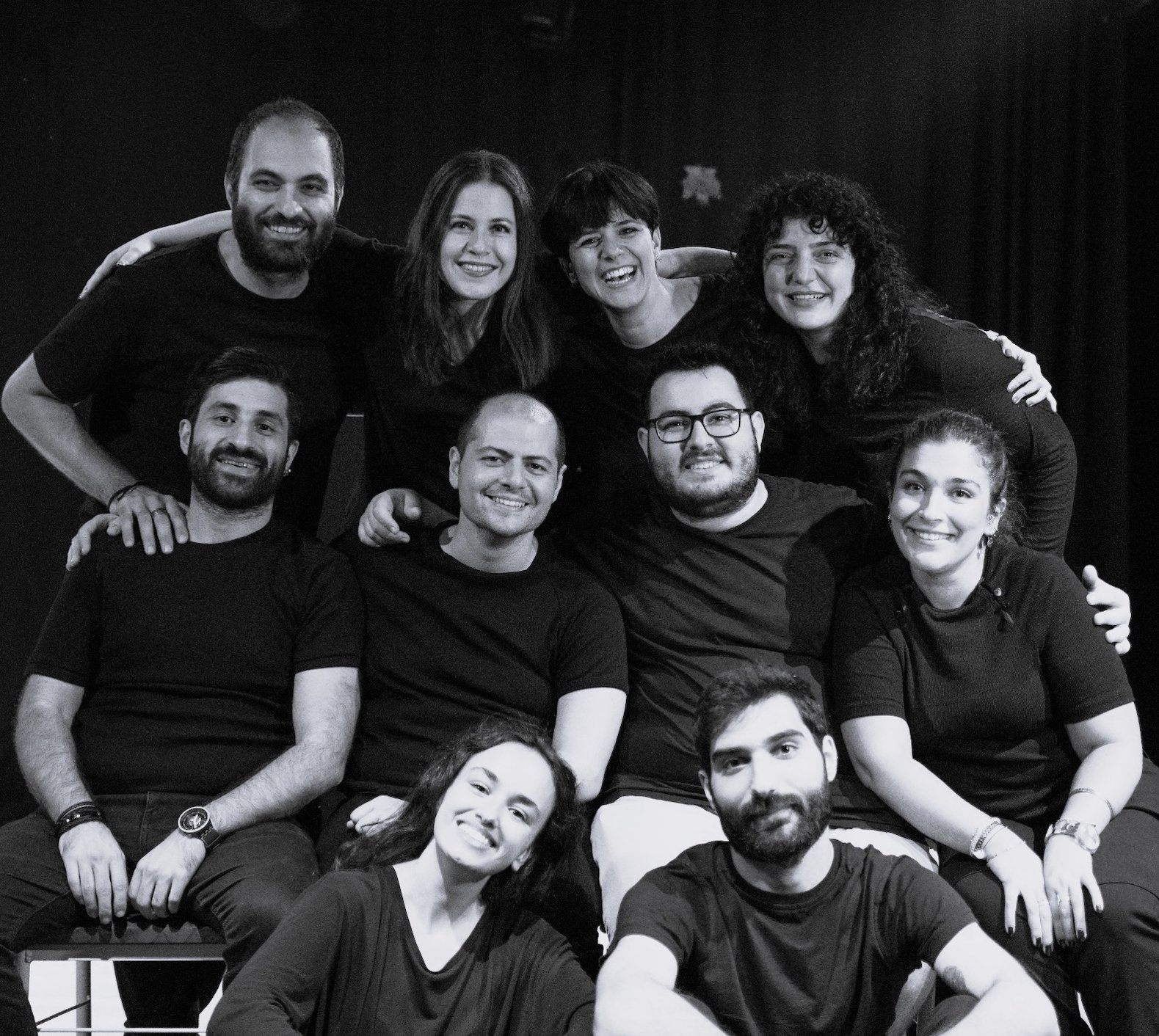 Hangardz Independent Armenian Theater Ensemble
V.E.: How do you choose and evaluate your plays? What kind of a filter do you run them through?
Y.A.: Our priority is to stage plays by Armenian writers. Our aim in doing this, as I just said, is to remember Armenian writers in a society that is attempted to be rendered without a memory, to make the colors they added to the literary history of this country visible again, and to emphasize, without bending the narrative, the points that will open up the audience to some questioning and critical thinking.
Our first play was created with the verses of Heranuş Arşagyan, a young woman writer who passed away at the age of 17. Our second play was the story titled “Kantsı” [Treasure] written by Zaven Biberyan. Then we performed Hagop Baronian’s “Bağdasar Ağpar” as a closet drama, and in 2023 we continued our journey with our playful genius William Saroyan’s “My Heart’s in the Highlands.”
In fact, while remembering these writers, the issues they touch upon and the question marks they leave in people’s minds, we encourage the audience to question many untouched areas and the need to do research. For example, after our first play, many of our audience members requested from us the Turkish translations of Heranuş Arşagyan’s verses and Zaven Biberyan’s story “Kantsı,” which also prompted many people to ask new questions about 1915, the Wealth Tax and the pogroms as a result of the importance that “Kantsı” attaches to life. With “My Heart’s in the Highlands,” we are seeking for an answer to the question, “Where is a person’s home?” with our audience, and we are receiving striking feedback from such different identities that it makes us all happy as a team to be able to send out even a piece of stimulatory and questioning signals to the collective memory.
V.E.: What kind of challenges do you experience as an independent collective?
Y.A.: First of all, I would like to point out that the Armenian community urgently needs an independent stage. This is necessary not only for Hangardz but also for independent Armenian artists to be able to use it whenever they want, to rehearse, introduce their works, give concerts, stage their plays and hold workshops, without restricting themselves and their creative processes and without financial concerns. The reason I insist on underlining this is that people and organizations that carry institutional responsibilities will unfortunately have to bend their words in their work so as to take into account the interests of the institutions and relationships they represent, a kind of self-censorship.
Collective principled collaborations between independent artists in an independent venue will take Armenian theater, music, dance and art to a higher level.
The second is the issue of providing more financial support, but this should not be realized with vertical solidarity. What I mean is this: “I support you, and in return I have such and such conditions!” Such a form of solidarity harms our independent identity and independent principled production, so we need horizontal solidarities that extend beyond time and geography; that is, “I support you, because your existence and principled values are extremely valuable to me, for the peoples and fundamental rights, and for the past, present and future generations!” I think that we, as a society, need to understand and internalize this form of horizontal solidarity a little more.
V.E.: What are your future projects?
Y.A.: As Hangardz members gain experience in new staging styles and techniques through different workshops and training, it will pave the way for the plays currently waiting to be staged. There are many projects that my friends want to realize. Of course, this can be possible through financial and moral support. I have had a dream of staging a play related to Gomidas since my high school years. One of my most important goals is to stage the genius of Gomidas through an interdisciplinary work, and one of the upcoming projects I have been thinking about for a long time is to bring to the stage the life of Vahram Papazyan, who has written his name in history in golden letters with the character “Othello.” Our priority is to stage each of these plays in our native language, Western Armenian.
Another project of ours is the Hangardz Writers Collective. Our first article was written about Hagop Baronian’s life and his valuable works produced in many fields such as theater, journalism and publishing under difficult conditions in the second half of the 19th century. As the Hangardz Writers Collective, we would like to produce, on a regular basis, articles and writing at the intersections of art, culture and topical subjects.
 Yeğya Akgün, Hangardz Co-Founder and Director (Photo: Tara Demircioğlu)
V.E.: In your opinion, what is the biggest problem faced by Armenian theater and association theaters in Istanbul? What is the state of association theaters? What should be done to restore Armenian theater to its former condition?
Y.A.: Actually, it would not be right for us to answer this question exactly, because the plays staged by very valuable theater people such as Hagop Ayvaz, Misak Toros and Arto Berberyan and their struggle for the art of theater 30-40 years ago are still remembered with great respect. I wasn’t even alive in those days, but considering the more recent period of the last 20 years that I can remember, I think it is necessary to move away a bit from repetitive plays that are not quite compatible with theater motives. I am in favor of considering the processes as a whole. Of course, it is an option after long hours of work in the office to go to the association or the school stage, rehearse for a few hours and make plays that do not require much thought. The audience may wholeheartedly laugh at these comedies, but how much they contribute to professional Armenian theater and its deserved place is a serious mystery.
We can gradually raise the quality and the bar of our association and school theaters with, first of all, the support of institutions and society, but also with works that are independent from institutions, performed by experienced independent artists beginning from the alphabet of the theater, so to speak, and at the end of an arduous process through which contributors prepare together as a whole.
V.E.: You also do radio theater. What have you performed so far, and where can we listen to them?
Y.A.: The radio theater recordings that I started in the first days of the pandemic and performed in Western Armenian have truly turned into a corpus today. There is a recording archive of approximately 30 episodes on Spotify and YouTube, and especially students taking Western Armenian courses received these recordings with great interest. Through social media channels, I reached a wonderful audience, especially outside Turkey in the United States and in France, and moreover, an Armenian institute in France offered to add subtitles in three languages (English, French, German) to these recordings and save them in their archives, which I gladly accepted. So far, I have performed the works of Hagop Baronian, Yervant Odyan and Rober Haddeciyan. During this process, I learned how to edit and strengthen the theme with effects and music. I must admit, it was a fairly difficult process. I have recently discovered some Armenian texts written for radio theater, and soon new episodes will be available to listeners on platforms such as Spotify and YouTube (you can search for “Yegya Akgun” or “Western Armenian Radio Theater” and subscribe).
Author information

Vartan Estukyan
Vartan Estukyan is a journalist at Agos who reports on culture, art, music, human rights and current politics.
The post Independent Armenian Theater in Istanbul by Hangardz: An interview with Yeğya Akgün appeared first on The Armenian Weekly.