
Day: January 23, 2024
Categories
A Canvas in Process
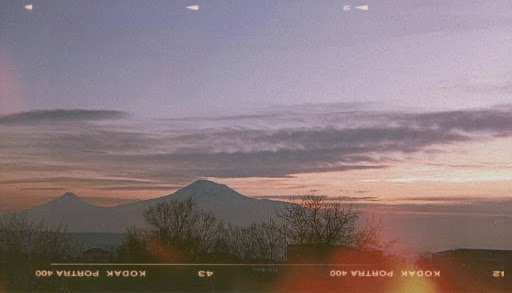 Photo by Milena Baghdasaryan
Dear homeland,
As you bleed from your open wounds
And scream the melody of pain,
I can’t help but notice
The red flowers of Saryan in the rivers of your blood
And the voice of Komitas in the sharpness of your scream.
In the blood cells of your skin
I see the paintbrush of Saryan
Painting your valleys and hills,
Painting your losses and dreams
With a hue of fiery red,
With a teardrop on his hand,
Trying to put the flowers back
In the broken vase of his,
Yet losing them all again
To the rivers and the hills.
But the flowers don’t drown;
They stay afloat in murky flows,
They stay alive in highs and lows,
Flowing, fighting, dancing
To the melody of pain,
Flowing, fighting, blooming
To the memory of land.
The pain of the land,
The land of pain
Keeps the flowers afloat,
Keeps the flowers alive,
And moving incessantly
Into the direction where
Saryan’s red is again the source of life
And not the outcome of death,
And where the Armenian highlands
Are the only vase in which
Those flowers fit correctly —
The vase shattered yet repaired,
The vase once lost yet regained.
In the blood rivers of death
I see bloomings of new life,
And a melody alive
Of freedom and liberty,
Of cleanness and harmony,
In the voice of Komitas
In the echoes of the past,
Of a once-great, long-cherished homeland
Of a once-great, long-cherished highland
Which is to be again,
Which is to rise anew,
And where the flowers will bloom
In the colors of their home.
Author information
Milena Baghdasaryan
Milena Baghdasaryan is a graduate from UWC Changshu China. Since the age of 11, she has been writing articles for a local newspaper named Kanch (‘Call’). At the age of 18, she published her first novel on Granish.org and created her own blog, Taghandi Hetqerov (‘In the Pursuit of Talent’)—a portal devoted to interviewing young and talented Armenians all around the world. Baghdasaryan considers storytelling, traveling and learning new languages to be critical in helping one explore the world, connect with others, and discover oneself. Milena currently studies Film and New Media at New York University in Abu Dhabi.
|
The post A Canvas in Process appeared first on The Armenian Weekly.
SYDNEY— Long before prospectors stumbled upon black gold under the searing sands of the Saudi Arabian desert and overnight transformed the sprawl of Bedouin tent encampments into the bastion of billionaires, the region was once home to a civilization that had close links with the Egypt of the Pharaohs.
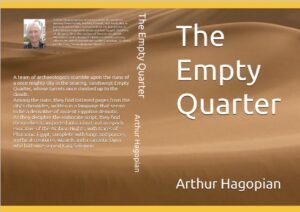
Taking a leaf from the Arabian Nights and their conglomeration of Djinn, wizards, ghouls and their mythological ilk, Australian author Arthur Hagopian has woven a new fantasy, The Empty Quarter, that takes readers to a distant realm of magical possibilities and a trip down altered states of consciousness.
The story opens with the fortuitous discovery by a team of archaeologists of tattered papyrus scrolls among the ruins of Khaliyandra, a once-golden city encircled by a mighty wall.
As they unravel one of the scrolls and begin studying the script, they find, to their profound astonishment and unbridled joy, that the language and writing are a derivative of ancient Egyptian demotic.
They are elated, because there has never been any mention of an Egyptian foray into this part of the world, and the discovery will write a new chapter in the history of ancient Egypt.
They begin reading and are transported into a land and epoch evocative of Solomon, Merlin and Scheherazade, with whom the Djinn has fallen in love.
Alas, “She could not love me, she mocked me, tweaking my nose,” he moans.
Nothing is left now of the royal palace or any of the grand edifices of the city. Even the river, the gift of Khaliyandra, has been swallowed up by the earthquake that struck the region.
The region is called the Empty Quarter, because nothing grows there.
No life breathes through the sea of scorched sands. Except for a couple of bedraggled palms, nothing breaks the dull monotony of the silent, searing desert.
It is as if both man and beast have no use for this forsaken desert.
The 390-page book is published by Amazon, which has published seven previous books by Hagopian so far, among them two about Jerusalem, where he was born, and a fictional reconstruction of the life and times of Jesus.
Author information

Guest Contributor
Guest contributions to the Armenian Weekly are informative articles or press releases written and submitted by members of the community.
|
The post Arthur Hagopian publishes latest book “The Empty Quarter” appeared first on The Armenian Weekly.