
Michael Novakhov: Operation TRUMP: The Hypothesis of Israeli Interference in the US Elections 2016 – GS: Russia was just a cover! https://t.co/SuU2fF95Wl pic.twitter.com/5T1fDT32bI
— Michael Novakhov (@mikenov) January 17, 2024
Day: January 17, 2024

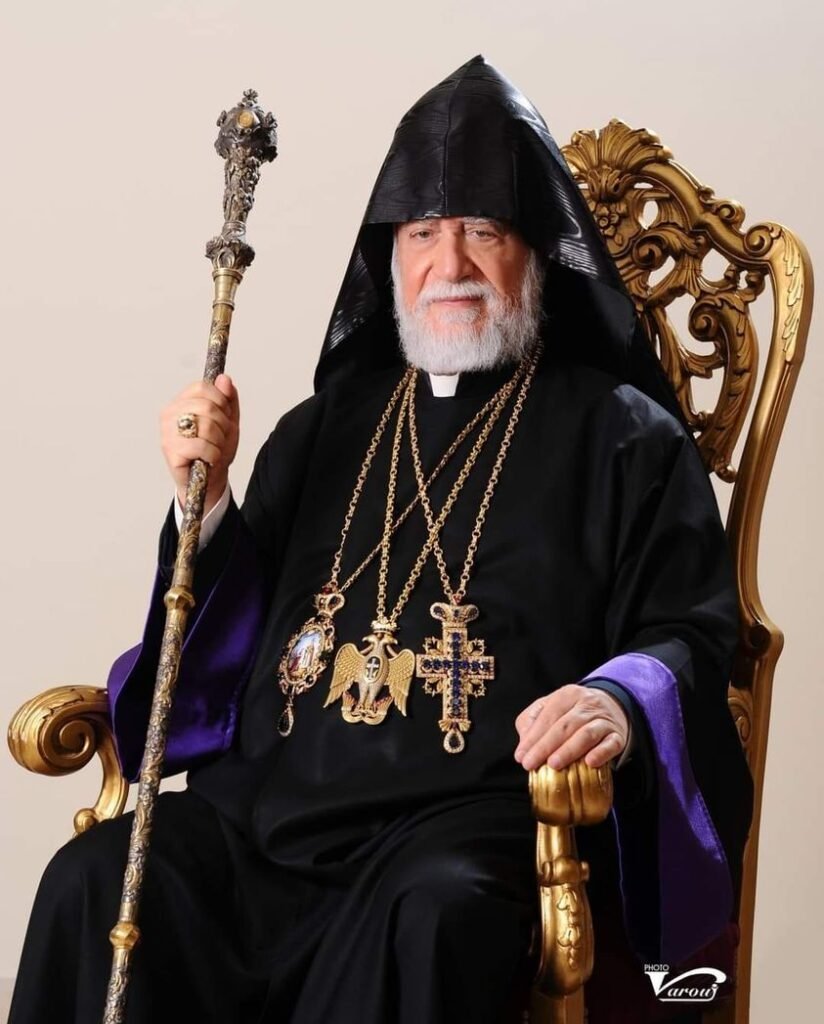 His Holiness Catholicos Aram I of the Great House of Cilicia
MESSAGE OF HIS HOLINESS CATHOLICOS ARAM I
OF THE GREAT HOUSE OF CILICIA
ANTELIAS
To the Prelates, the clergy, the community authorities of the Catholicosate of the Great House of Cilicia, and to the daughters and sons of our people,
On the eve of 2024, with fatherly love, patriarchal blessings and intense patriotic feelings, we greet the beloved daughters and sons of our people from the Monastery of the Catholicosate of the Great House of Cilicia. We greet especially our Prelates, community authorities, the organizations and associations that are active in the Armenian community, as well as community, educational, charitable, cultural, social and sports institutions, and we wish them all a year of new achievements. We pray to Most High God that the New Year that begins with His Son’s becoming man and His revelation will be full of heavenly riches and grace for our people.
***
As it is well-known to the daughters and sons of our people, since 2003 we have dedicated each year to an event, development, value or concern in our collective life. We have made the necessary analysis and highlights within each topic, and then we have conveyed our fatherly suggestions to our people. We have often stressed that the church with its essence and calling is a mission directed to the people. Indeed, the teachings of Christ were not theoretical or casual; they had direct relevance for the life of the people. Today, too, the church is called to invite its spiritual flock to address concerns and challenges that have direct import to their lives. At the same time, it is the church’s mission to give the necessary instructions for further implementation of spiritual, moral and national values. This is the goal of our patriarchal proclamations. We are satisfied to declare that the proclamations published so far have been the object of ample discussion in our collective life and, in light of the concerns and the suggestions expressed in them, the daughters and sons of our people have been driven to review and reassess their individual and community life.
As you know, the years 2022 and 2023 were dedicated to the Diaspora, declaring 2022 the Year of the Diaspora and 2023 the Year of the Diaspora: From Self-Examination to Reorganization. Our decision to focus on the Diaspora for two consecutive years was not at random. The formation and development of the Diaspora has its own process, and it has always been subject to the influence of external factors and environmental conditions. Today, the Diaspora faces serious challenges. In view of the penetration of the global culture into Armenian life, the retreat of national values, the degradation of the Armenian language and other critical problems, the revalorization and reorganization of the Diaspora have become an urgent imperative.
In the two declarations, in 2022 we made the following statement about the current situation of the Diaspora: “The Armenian identity is exposed to rapid attrition in the Diaspora. Our structures have begun to lose their relevance. Hence, the revitalization of the Diaspora is a mandatory task in the light of the circumstances and conditions of our present life.” And in 2023, we made the following comment regarding the structures of the Diaspora: “The Diaspora has an enormous potential in terms of culture, religion, economy, expertise, relations and experience. However, resignation and assimilation here and indifference and omission there have begun to drain the potential of Armenian life. In fact, the Diaspora has not been able to harness its potential and utilize it in an accurate way to its fullest. The organization and utilization of the potential of the Diaspora is a need. Such a huge plan requires collective and consistent work.”
In the two above-mentioned proclamations, after identifying the challenges faced by the communities and structures of the Diaspora, we emphasized that the lack of human resources in every area of Armenian life has begun to make itself felt. In other words, in every community, the number of expert people who are also experienced and accountable has begun to decrease gradually. This is a deeply worrisome development, both because of its global impact in the Diaspora and its unpredictable consequences. Indeed, human resources give vitality to our structures, reinforce the Armenian-centric existence of the Diaspora, preserve its national identity, and give it quality and direction; human resources that are intellectually and psychologically prepared, have acquired expertise and are fully dedicated. With this deep conviction, we declare 2024:
THE YEAR OF HUMAN RESOURCES PREPARATION
The Bible reminds us that on the sixth day of the creation of the universe, He created man (Genesis 1:26-27, 2:7). The creation of man was different from that of the other creatures of the universe, not only because of its timing and nature, but also its purpose. The Bible testifies that the man created in the “image of God” was called to be the caretaker of Creation, its defender, and the one who would enrich it (Genesis 1:28-30); in other words, God’s “collaborator” (1 Corinthians 3:9-17). What a sacred calling! But man betrayed his God-given calling, abused his privilege by using it for his pleasure and glory and was expelled from Paradise because of his disloyalty (Genesis 3).
However, God always kept watch over the sinful man. God took his Only Begotten Son into the world to draw near to his Heavenly Father the man who had distanced himself. The Son of God became man, and he even shed his blood to reestablish man in his divine image and God-given devotion. This is the purpose and message of the Bible, the revelation of God. The Bible stresses with particular importance man’s special place and unique role in the divine revelation and plan. Indeed, by way of different parables, events and teachings, in the Bible we see the fatherly love and care shown by God to man, even sinful man. Thus, for example, when the shepherd abandons his 99 sheep to seek the stray one (Matthew 18:11-14) and when the father welcomes his prodigal son with open arms (Luke 15:11–32). The Bible emphasizes that man and woman are a value for God. However, the value of man is not merely in his physical existence, but in his faithfulness and obedience to God.
All religions and civilizations have devoted special attention to man as a thinking, acting, ruling and enriching reality in the life of society with his creative spirit. For ancient philosophers, psychologists and sociologists, man has been the object of serious analysis and continues to be so in the present world ruled by technology. The history of nations shows the role of man behind every achievement, discovery and innovation. How central is that role in the life of the universe and the society! Countries, communities, societies and organizations develop, progress and grow not only with their wealth, political or military advantages and potential, but with the human resources that create, develop, govern and defend them.
* * *
We have pointed out, and we will again stress it, that there is a lack of human resources in Armenian life. Unfortunately, we often lack the courage and the wisdom to see and accept our shortcomings, our omissions and our weaknesses. We are inclined to see everything through rose-colored glasses, to cover up errors or to look elsewhere for the causes of mistakes. Religious ethics, as well as popular wisdom, remind us that accepting errors covers half the road to success. A general overview of our communities, organizations and structures clearly shows that the lack of human resources increasingly deepens and grows, and its various and negative consequences become obvious. It is unacceptable to be indifferent to this worrisome situation. We all have something to do and give to address this major need in Diaspora life. We must be well aware that without human resources, our lives will lose their quality, will stagnate and fade, and the roots of our existence will be weakened. The preparation of human resources is an urgent priority.
Why is there a lack of human resources in the life of the Diaspora? What are the reasons? It is necessary to ask such questions and try to find answers with an objective approach. In the sense of human resources, Armenian life shows the following picture today: first, our current human resources do not generally address the needs and demands of the present times; second, an important part of our human resources either remains on the margins of Armenian life or out of Armenian life.
Present Involvement of Human Resources in Armenian Life
The first important step in the reorganization and empowerment of the people should be to involve our human resources who are far from the mainstream of Armenian life.
Let us look around for a moment. It is true that we have specialists in many fields, but many of them are far from our lives. We have educated young people, but many do not participate in the activities of our structures. We have devoted teachers, but many work in non-Armenian educational institutions. The enumeration of human resources who are outside Armenian life for one reason or the other can go on and on…In the face of this sad reality, one must ask why an important part of our human resources have moved away from our community life. The questions should lead us to a diagnosis, and the diagnosis, to correctives. In every case, our approach should be realistic, not sentimental; practical, not theoretical; local, not general. We must consider the geopolitical conditions of every area of the Diaspora and the internal movements often derived from them, the decline of some communities for economic reasons and the growth of others, the transformation of their character, the differences in their environmental conditions, etc. These continuing developments should be evaluated in light of the global culture that has permeated Armenian life. Naturally, the abovementioned events have had a negative impact on the displacement of human resources from Armenian life and the migration from one community to another.
Along with the abovementioned external factors, internal and personal reasons have also driven some people away from our community life. Thus, we may mention the indifference sometimes shown by the local leadership or sometimes one-sided positions on issues affecting the community, competition inside institutions, incompatible approaches by the old and new generations, the lack of proper and worthy appreciation of human resources, as well as the desire of opening wider perspectives and securing a higher income, etc.
In the face of this worrying phenomenon, we do not want to blame either those who stay away or the institutions or people responsible for that. We want to stress firmly that, more than ever, it is imperative that the human resources who are far from Armenian life for different reasons should come closer, become participants in our collective experiences, struggles, plans and activities. We expect this firm determination and conscious commitment from those who stay away. At the same time, we expect from responsible bodies to create wide opportunities for our human resources and especially young people, involving them in our institutions and Armenian life in general. We love and respect our human resources. Therefore, it is not acceptable for our human resources to knock on other people’s doors, to serve others, to put their expertise and experience at the service of others’ success. For us, our nation, our Armenian homeland, our communities are what the priority is, what is essential, what is permanent.
Preparation of New Human Resources
The second important step in the organization and empowerment of human resources should be the preparation of new human resources. This is not an easy and smooth plan to be immediately realized. We must be realistic. The preparation of human resources presupposes a long-lasting process, complete dedication, serious organization, consistent work, as well as a large material investment. Look around you! States, religions, organizations and institutions carry out a huge amount of work and make a great investment, materially or otherwise, into human resources training. Indeed, without a conscious, specialized and dedicated person, what we have, from the material to the spiritual spheres, and from the educational to the political ones, has no value. Man is the one who gives it value, meaning, quality, direction and purpose.
The time has come now for us, starting from this awareness and determination, to focus our attention in the Diaspora on the preparation of human resources, fully utilizing our potential and resources. The preparation of human resources means to inculcate spiritual, moral and national values into Armenians, to acquaint them with the special events, figures and challenges of the past and present of our nation, to give them the possibilities to delve into the specialties of the present world, and above all this and giving meaning to all of this, to instill the spirit of serving our people with complete dedication, to bring their active participation into Armenian life.
How can the Diaspora be driven to training human resources with an organized approach and renewed momentum? We must keep in mind that the preparation of human resources is not only the work of a given institution, but it is a collective endeavor and a continuous process, involving various stages and initiatives. We want to briefly point out those institutions and resources that can bring an important contribution to the mission of human resources preparation.
1) The main and lasting anchor of a person’s preparation is the FAMILY. The solid foundation of the formation of an Armenian person is laid within the family. We learn a lot from our parents by listening and seeing. It is not only knowledge about our nation that we learn from our parents, but also and especially the spirit of being a conscious and proud Armenian and the dedication to serve our nation, homeland and church unconditionally. Hence, it is necessary for the Armenian family to emphasize its unique role in the preparation of human resources. To carry out this very important mission with dedication, the Armenian family must stay away from circumstances that can degrade its moral atmosphere and Armenian character and debase its high calling.
2) The second place of human preparation is the CHURCH. The church is the storage furnace of our spiritual, moral and national values and the source of revitalization. Many of the great figures of our nation have immersed themselves in the life and testimony of the church and received the zeal and commitment to serve the nation and the motherland from the church. Through various undertakings (Sunday school, Bible studies, popular lectures, Christian teaching, etc.), it is necessary for our church, along with its spiritual mission and national service, to give a boost to its teaching and educational work.
3) The goal of the THEOLOGICAL SEMINARY of our Holy See continues to be the formation of clergy, teachers and intellectuals imbued with spiritual values and called to serve the nation and the church. In this sense, the Seminary has done a great job in the last decades. Indeed, the presence of many people who have passed through the Seminary and have made important contributions to the religious, educational and cultural areas of our national life in Armenia and the Diaspora is an eloquent testament to the Seminary’s unique mission.
4) THE ARMENIAN SCHOOL is naturally one of the most important institutions in the preparation of human resources. Unfortunately, certain indifference towards the Armenian school has begun to emerge today among our parents. The Armenian school contributes greatly to the preparation of human resources with its successful record in official examinations, with the Armenian education and atmosphere it offers. Therefore, it is necessary to emphasize the formative mission of the Armenian school, supporting its programs that contribute to it.
5) ALL INSTITUTIONS within Armenian life—political, charitable, cultural, sports, social and others—are, in their own way, special schools for the preparation of human resources. Indeed, their internal atmosphere full of national and cultural values, as well as their voluntary work to serve the needs of our communities, contributes to the preparation of human resources. There are Armenians who, for different reasons, have not attended Armenian schools, but by being part of community organizations, they have acquired an ample knowledge of Armenian life and the spirit of serving the nation has taken root in them.
6) The ARMENIAN STUDIES COURSES have a significant role in the development of human resources. Today, in fact, the only organized Armenian Studies Center in the Diaspora operates within the Catholicosate. We also must remember the Armenian Studies courses at the Karen Jeppe School in Aleppo and the Haigazian University. After 15 years of organizational development, the Armenian Studies Center of the Catholicosate operates in a more organized and self-confident manner, offering a wide range of subjects and the presence of experienced teachers invited from Armenia and the Diaspora.
7) The PEDAGOGICAL CENTER that operates within the Catholicosate, which trains teachers with new pedagogical methods, is of particular importance within this field. Its more than 35 years of activity and its cumulative success in state examinations show that its extensive work in the field of pedagogical training remains key.
8) Apart from the above-mentioned community structures for the preparation of human resources, we consider UNIVERSITY EDUCATION an essential, as well complementary part of preparation of human resources. Today’s world is a world of specialization. In fact, there is no longer a place for an amateurish approach to issues, developments, crises and plans in all aspects of society’s life. As much as dedication and preparation are necessary, specialization is just as necessary. Currently, higher education institutions and possibilities have multiplied. In light of the many resources offered by technology, university education has become more accessible, if not materially, in terms of time and work. Our young men and women who are eager to learn must profit as much as possible from the benefits offered by higher and professional university education.
Naturally, living in different conditions, we cannot expect the new generation to pass through the mentioned phases of human resources formation. Self-teaching also gives an opportunity and can have its important contribution in the formation of a person. In all cases, it is imperative that the young Armenian men and women, imbued with spiritual, moral and national values and armed with professional education, make themselves valuable in Armenian life, putting their education in the service of the development and empowerment of our nation. The Diaspora urgently needs human resources. Therefore, the preparation of human resources for the Diaspora should become a priority.
Practical Recommendations
We would like to make the following practical recommendations following the concerns, possibilities and points we have stressed regarding human resources preparation:
1) Despite the difficult conditions and limited resources of the Diaspora, huge work has been done in the field of human resources preparation. We express our high appreciation to all those dedicated to the sacred mission of educational and Armenian formation. The time has come for a more inclusive, coordinated and updated work by the institutions devoted to human resources training in our community life. In this sense, it is essential to do special planning work with the participation of the leaders of these structures, to avoid duplication and omissions.
2) We see an urgent need for gathering human resources within the communities. The gathering can be done in two stages. The first one involves the human resources participating in the community, and in the second stage, the human resources that have remained outside the community get involved.
3) In any case, it is necessary to organize all gatherings with a clear agenda. It is necessary to listen to the points of view, concerns and suggestions of those present, and then together determine a common direction for the empowerment of the community, specifying the priorities and dividing the work.
4) Special attention must be paid to the participation of young men and women, especially university students and graduates.
5) On certain occasions and even gradually, it is necessary to organize gatherings that bring together the community’s human resources, to discuss general plans that pertain to the community as well as concerns and challenges that concern the Diaspora and the Armenian nation.
6) A comprehensive list of a community’s human resources is essential. It should include basic information to exchange with other communities and have a comprehensive picture of human resources in the Diaspora.
7) It is advisable that the executive bodies of prelacies, political parties, educational, youth, cultural, charitable and other organizations participate actively in the abovementioned important works.
8) As we mentioned, the preparation of human resources also requires material commitment. In this collective effort, our wealthy fellow Armenians should feel obliged to make an important contribution in this direction, by establishing funds or by allocating annual benefits, in general, to programs devoted to human resources preparation and in particular to those structures that serve the same purpose.
9) Our prelacies and structures should allocate an important place on the agenda of their activities to initiatives and activities related to human resources training.
It will be the task of our human resources to conceive, plan and execute the work of reorganizing and revitalizing the Diaspora. This is how important human resources are for us and, therefore, how imperative and urgent is the preparation of human resources.
With these thoughts and expectations, we greet you with warm fatherly love, and we assure you that the Catholicosate of the Great House of Cilicia is always ready to support and participate in the sacred mission of human resources preparation.
With patriarchal blessings,
Prayerfully,
ARAM I, CATHOLICOS
GREAT HOUSE OF CILICIA
January 1, 2024
Antelias, Lebanon
Author information

His Holiness Catholicos Aram I
Born in 1947, in Beirut, Lebanon, His Holiness Catholicos Aram I of the Great House of Cilicia, studied at the Armenian Theological Seminary, Antelias, Lebanon and the Ecumenical Institute of Bossey, Geneva, Switzerland. He received his M.Div. from the Near East School of Theology, his S.T.M. jointly from the American University of Beirut and Near East School of Theology, and his PhD from Fordham University in New York. He also holds several honorary degrees. His major areas of specialization are philosophy, systematic theology, and Near Eastern church history. Catholicos Aram I was ordained as a celibate priest in 1968 and obtained the title of Vartabed (Doctor of the Armenian Church) in 1970. In 1979, after serving for one year as Locum Tenens, he was elected Primate of the Armenian Orthodox Community in Lebanon; the next year he received episcopal ordination. In June 1995, His Holiness was elected Catholicos (the Head of the Church) by the Electoral Assembly of the Armenian Catholicosate of Cilicia.
|
The post 2024 | The Year of Human Resources Preparation appeared first on The Armenian Weekly.
 Tebi Yergir/Towards the Homeland
By Khatchik DerGhougassian, Ph.D., translated to English from the Armenian original by Ara Nazarian, Ph.D.
“The Diaspora has in her Nietzsche’s superman, the super Armenian, that life-giving essence that must finally be revealed.” —Vehanoush Tekian
Thirty-five years ago, in February 1988, mass peaceful demonstrations in Stepanakert and Yerevan gave birth to the Karabakh Movement. Just a few months later, the 24th General Meeting of the Armenian Revolutionary Federation (ARF) would make the pivotal decision formulated with the slogan “Towards the Homeland” to return to the homeland and participate in the processes that determine the fate of the Armenian people. The ARF General Meeting of 1988 was the last in a series of General Meetings that marked various historical milestones of the party. Among such General Meetings were those held in 1892, 1907, 1919 and 1972, where “before and after” determinations were made. Some World Assemblies became a turning point for the ARF. The first one was in 1890, when the Federation of Armenian Revolutionaries, as literally what was in the mind of those who gave birth to the organization, became a political party with its program and organizational chart. The second critical World Assembly was that of 1907 when the party officially joined Socialist International and put forward the Caucasian Project (Govgasian Nakhakitz) to expand the political activity to Eastern Armenia and the Armenians in the Russian Tsarist Empire. The third turning point was the 1919 World Assembly in the independent Republic of Armenia, formulating the final aim of the party in terms of a free, independent and united Armenia. The next critical World Assembly was in 1972, when the party decided to return to its revolutionary roots and gave a new impetus to the global struggle for the Armenian Cause.
As one of the primary elements in the Armenian world, the historical development of the ARF also impacted the historical development of the Armenian people, whether the interpretation of that impact is positive or negative. Let us clarify that such an “impact” would not mean the possibility of being the absolute determinant of historical development. Simply, the ability to create positions or influence a given position will give any political organization its leadership position and the ability to mobilize forces with a sizable number of committed members or followers and supporters. In this sense, the ARF 20th (1972) and 24th (1988) World Assemblies are closely related to the Diaspora that was formed after the Genocide and the Sovietization of Armenia. The first was in the sense of politicization of the Diaspora, and the second was to direct the activities of the Diaspora, if not exclusively to the homeland, but at least in a centralized and organized way.
Thirty-five years ago, those who grew up in the Diaspora became politicized after the 50th anniversary of the Genocide. To those who witnessed the movement’s ability to commit itself to the struggle for Armenian nationality on a Diasporan scale and had confidence in its successes, “Towards the Homeland” did not seem like a strange slogan. The achievements of the Armenian National Committee refer to the first actual records of international recognition of the “forgotten” Genocide at the U.N., the European Parliament and the state representative levels of various countries. Marush Yeramian very vividly presents that politicized generation when she writes: “The images of pogroms and emigration pass before my eyes, then the orphans living in poverty with dignity, from whom the generations who came from them learned not only the delicate ways of dealing with foreigners, but they also learned to behave diplomatically with foreign states, to advance their own decisions in depth, with conviction and unbreakable will. They were able to defend their/our theses and make important decisions. All of these provided the Diaspora Armenian with great experience in foreign policy and dealing with foreign states; they were taught how to deal with so-called diplomacy, which is often a deception.” (“Lonely Stars,” Gandzasar, September 28, 2023). “Towards the Homeland” may have reminded some of that generation that during the struggling years of the Armenian Cause (Հայ Դատ/Hai Tahd), during the political debates, leaders and intellectuals of the day warned that this could not be an end in itself, that the national liberation struggle had to conquer its natural soil. These thoughts are related to reflecting on the mirror of developments in Artsakh…
It is impossible to diminish Artsakh’s deep influence on what is defined as Armenian nationalism in the sense of a collective approach. Argentinean Ricardo Torres, whose doctoral dissertation at the Department of International Relations of the National (State) University of Rosario is devoted to the Artsakh issue and its impact on Armenian nationalism, observes that Artsakh “gave a new meaning to Armenian identity” that “in the collective imagination of the Diaspora designated a next logical milestone for the recognition of the Genocide.” With that, and with the independence of Armenia, the homeland idealized in the Armenian Cause became a reality during the national liberation struggle that took place on Armenian land. 1988 Artsakh became a living epic with a great movement during the first war and the years following its victory.
At that time, Artsakh was the “fundamental event” of the process of Armenia’s independence and the starting point for the Diaspora with the vision of “Towards the Homeland.” It is true that this resolution was born at the General Meeting of the ARF and, as such, had its most direct and decisive influence on the planning and direction of the party’s activities and, to some extent, its ideological organizations for the next decades. Nevertheless, no political, cultural, public, philanthropic or even religious organization in the Diaspora can mobilize forces that did not have its version of “Towards the Homeland” in its activities. The Social Democratic Hunchakian Party, the Ramgavar Liberal Party, the Armenian General Benevolent Union…in a word, all the so-called “traditional” organizations of the Diaspora, each of them in their region and according to their capabilities, were endowed with a Diaspora-wide network and the ability to mobilize. Given that they operated mainly in the Diaspora and regardless of their ideological or practical ties with Soviet Armenia and already with the Diaspora Liaison Committee after the mid-1960s, each of these organizations created their organizational structure in Armenia based on their judgment. In this sense, “Towards the Homeland” was also a Diasporan movement in an ideological and practical sense.
Thirty-five years after the birth of the Artsakh movement, three years after the defeat in the 44-Day War, on September 19, 2023, President of the Republic of Artsakh Samvel Shahramanyan signed the document of the dissolution of the second Armenian state. In this way, the Armenian historical territory joined the 86,600 square kilometers of Azerbaijan. This was already accepted by Nikol Pashinyan, the Prime Minister of Armenia, in Prague almost a year before. Since that day, he did not miss an opportunity to confirm and reaffirm the attitude of the Armenian government, the very government that was sometimes the guarantor of Artsakh’s security. A few days before September 19, contrary to the presence of Russian peacekeepers and with the confidence given by the political decision of Moscow not to intervene and to remain as an observer, Azerbaijan, after holding Artsakh in complete blockade for nine months, embarked on an unprecedentedly brutal attack.
According to Shahramanyan’s later explanations in Yerevan, the document signing on the dissolution of Artsakh was for “saving the lives of the people of Artsakh.” In protest of the establishment of complete Azeri control over Artsakh, the entire population of Artsakh left its land and took refuge in Armenia. At the beginning of August, the first prosecutor of the International Criminal Court, Luis Moreno Ocampo, published a bulletin warning that the blockade of Artsakh had created conditions for genocide. After the 44-Day War, no initiative was able to bring the situation of Artsakh to the attention of the international public visibly or urgently. Contrary to the alarms and the absence of an international mechanism for the prevention of genocide, Artsakh was depopulated when the population seeking refuge against the threat of annihilation sought refuge in Armenia en masse. This, as many observers have assessed, is considered forced displacement, ethnic cleansing, and even genocide.
Nevertheless, it is not a coincidence that neither the political assessment and the initiatives it implies on the international stage nor the issue of the status of Artsakh and the forcibly displaced population of Artsakh, were on the agenda of the Armenian authorities. Immediately after the depopulation of Artsakh and the forcibly displaced Artsakh residents taking refuge in Armenia, the issue of their humanitarian assistance naturally became dominant, and perhaps the zeal to initiate their emigration. However, the organization of humanitarian assistance and the resettlement of the maximum number of forcibly displaced Artsakh citizens in Armenia can be considered as a solution to the disintegration and depopulation of Artsakh. Immediately after the disintegration and depopulation of Artsakh, the Pashinyan regime, which is determined to sign a peace agreement with Azerbaijan and is coming to the initiative of the “crossroads of peace,” the continuation of Artsakh state institutions in Armenia seems excluded because it could be a threat to national security, as stated by the special commissioner/deputy of the Prime Minister, Edmon Marukyan. More than a month after the disaster, the political leadership of Artsakh still had not decided on its next steps. A “government in exile” and the “right of return,” which were put into the public discourse, did not receive a response at the leadership level of Artsakh. More than a month after dissolution and depopulation, Artsakh seems to be among the “forgotten” countries. This is not dissimilar to the first decades following the Armenian Genocide in the Diaspora…
And this latest loss of land from the historical homeland of Armenia with the disintegration and depopulation of Artsakh, witnessed helplessly by all Armenians, was so shocking that its collective emotional pain was felt only after some time. In other words, Artsakh became the new Armenian Cause for the Diaspora, as depopulated Western Armenia once was…not its international recognition based on the right of self-determination, which was entrusted to the Armenian lobby in the Diaspora by the successive authorities of Armenia (those who assumed responsibility for the negotiation process after the resignation of Levon Ter-Petrosyan in February 1998). Until the next milestone of April 2018, before the 44-Day War, Pashinyan decided to start everything from scratch. He managed to lower the bar much lower than the zero point, thanks to his ability to never get bogged down by apparent contradictions, the most prominent of which is stating, “Artsakh is Armenia, and that is that” in Stepanakert in 2019 and three years later, in Prague, announcing Artsakh as part of the 86,600 square meters territory of Azerbaijan.
Over the past 35 years, the struggle for international recognition of Artsakh’s independence has been facilitated by Diasporan “lobbyist” organizations from nation-states to lower-level governmental structures, such as city councils or provincial authorities – not at the level of countries, although some signs of success in at least one instance were observed without concrete success. However, what Diaspora organizations did not question in their political relations when approaching third parties with the offer of recognition of Artsakh’s independence was the contradiction that appeared when that third party naturally asked whether Armenia had recognized Artsakh’s independence, and the answer there was dictated by Yerevan: first, a third country must recognize and then Armenia, because the recognition of Artsakh’s independence by Armenia could put the negotiations at risk. The question of why a third country would unilaterally take the risk of recognizing the independence of Artsakh never received a convincing answer. But that did not prevent Diaspora organizations from working in that direction – even if sometimes they asked themselves: what did the entity they had sought to recognize the independence of Artsakh, and to whom they explained why the Armenian authorities had not taken that step, think of them…
Artsakh, as the newest chapter of the Armenian Cause, was on the agenda of the Diaspora’s political mobilization as naturally as all the investments made there without doubting that the historical progress recorded could not be reversed because independent Armenian statehood was its guarantor. The confidence of the Diaspora towards independent statehood was so certain, regardless of who or which political force was in power.
Thirty-five years after “Towards the Homeland,” against the rebuke to the temporary or longer-lasting historical retreat that occurred with the disintegration and depopulation of Artsakh, and especially after the 44-Day War, considering the inability of the political elite of independent Armenia, government or opposition to agree on a narrow consensus of national unity, it is time for the Diaspora to reflect on the completion of a milestone, and to rethink the determinants of its existence, its identity and the concept of its relationship with the motherland.
This process has already started. Analytical-critical approaches will not be lacking for those assumptions that seemed so powerful when the “Towards the Homeland” slogan was perceived in the Diaspora political thinking as a fate expected by many. Thirty-five years ago, it was perhaps very difficult, if not impossible, not to perceive the message of “Unification” communicated by mass signs in the streets of Stepanakert and Yerevan as a call for repatriation. However, it was also necessary to be sensitive to the dictates of the events following that primary enthusiasm, which reminded the Diaspora of the need to review the assumptions of its political thinking on different occasions. This refers to Ter-Petrosyan’s “orange eaters” derogatory speech as a first insult followed by many others, such as Diaspora Armenians denied entry to Armenia for political reasons and the discriminatory attitude primarily targeting the ARF and its affiliates. It is necessary to go beyond the singularity of the homeland-Diaspora dividing line and see the homeland-Diaspora distinction line, to eliminate the burden of denying the distinction and, on the contrary, reflect on how much it is necessary to be aware of that difference, in the linguistic, cultural, political and diplomatic spheres, even in manners and food.
Thirty-five years after “Unification,” “differentiation” is necessary to halt the crushing of the Diaspora’s soul and its potential, the dissolution of communities and the continuation of behavior that perceives Diaspora Armenians as a sum of individuals, if not just a sum…That disrespectful behavior can be shown by Ter-Petrosyan’s already-mentioned expression or Alen Simonyan’s despicable act of spitting in the face of a repatriated Diaspora Armenian. However, these are not the real issues; for the political elite in Armenia, the Diaspora was never perceived as a partner. With different justifications or reasons, the Diaspora was encouraged by the concept of the right to participate in local political processes through community representation or a Diaspora-wide Armenian council. As Vehanoush Tekian rightly observes, “The Diasporan leadership blindly devoted themselves to the motherland, without demanding that they also contribute, that is, to be considered as a legitimate Armenian, not a milk cow.” (“Is the Diaspora important?” Asbarez, October 25, 2023). It is not political participation when the leaders of the Diaspora accept being followers and remain silent regarding the controversial decisions made in Armenia. It is not patriotism to organize a fundraiser for the motherland in the Diaspora but to accept the unconvincing accounting of the money sent, which is properly ordered by the relevant bodies. It is self-deception to look at the political affairs in the Diaspora in the mirror of the internal dynamics of Armenia…
It is not political participation when the leaders of the Diaspora accept being followers and remain silent regarding the controversial decisions made in Armenia. It is not patriotism to organize a fundraiser for the motherland in the Diaspora but to accept the unconvincing accounting of the money sent, which is properly ordered by the relevant bodies. It is self-deception to look at the political affairs in the Diaspora in the mirror of the internal dynamics of Armenia…
The greatest mistake of the Diasporan leadership in the past 35 years has been the inability to implement a Diaspora-style agenda. Before independence, there was a Diaspora where the communities communicated spiritually with each other thanks to the Diaspora-wide organizational network and structures capable of mobilization. There was a global Diaspora before any political, economic or socio-cultural theories of the globalization process; it was the birth of the instinct to survive and preserve the identity of a stateless community, which became politicized during the years of demands for the Armenian Cause. Statelessness was not an obstacle to the Diaspora-wide movement, which the day’s leadership proved in its ability. On the contrary, statelessness even caused the transformation of a global network free from the restrictions of inter-state relations into a politically autonomous factor endowed with flow and communication logic and network. The Diasporan political operator directly contributed to the rapid international recognition of a small state in a geopolitically unfavorable situation, starting with the diplomatic representations of Armenia opened with the direct investment of Diaspora Armenian communities and individual philanthropists to facilitate political relations.
Regardless of whether the statehood was more or less established, the leadership of the Diaspora willingly or unwittingly followed the decisions made in the homeland, regardless of whether it supported those in power or those in the opposition. It was carried away by the “strong state” and similar rhetoric without criticism or questioning the meaning and practicality of such efforts for the Diaspora. It defined the political work in the Diaspora by the fetishization of state politics. As a result, the Diaspora, appearing on the international stage as an independent political actor, remained in the spotlight of an independent state. The political thinking in the Diaspora, which was formed by the Armenian Cause movement, could not be transferred from the 20th century to the 21st century to re-establish and repair itself as its factor.
In the absence of favorable conditions for mass voluntary repatriation, the Diaspora communities continued their daily lives, but giving priority to relations with the homeland, they lost the once horizontal communication link and the consciousness of being a Diaspora. Diaspora understanding was translated into community-homeland relations. Perhaps the unforeseen consequence of the country was patriotism. As a result of the effort to think of the Diaspora as a whole and its birth, any Diaspora-wide practical plan was absent, especially in the field of political mobilization, which could not separate itself from the logic of state politics – an internal political process in opposition to the government and decisions made in foreign relations.
Here, we should clarify that when it was said that the political affairs in the Diaspora should not be viewed in the mirror of the state policy, it would not mean a break with the homeland. It would not mean that in the Diaspora, it was not possible to take a position on the issues of the internal political agenda of Armenia, not to take sides in favor of the government or the opposition, or not to become a participant in political-social mobilizations. It is important to realize that the debate and freedom of opinion in the Diaspora could, at best, have a very limited influence on the transitions of the internal Armenian sphere, as the experience of the past 35 years has shown. It means not to condition the freedom of opinion with the logic of government-opposition polarization, and sometimes even to have a third alternative proposal if the Diaspora factor is ever so influential that they can sometimes assume a positive role of “mediator” to the events in the homeland. It is important to have a Diasporan agenda and keep it away from internal Armenian logic, not to give in to issues vital for the Diaspora identity, such as Western Armenian and classical spelling. It means especially to have a Diaspora position on Armenian-wide issues, preferably in agreement with the state policy, but also independence, when necessary, with the agreement to disagree. One can already show that as a national community, we have given an important promise to the level of political development by getting out of the undergrowth we have been in since the defeat of the 44-Day War.
The Diaspora that existed in the collective imagination as a factor until 1988 has changed, as the successive newsletters of the Diaspora Survey (2019, 2021, 2022) show. The Diaspora as a whole, as a global civil society of ethnic identity, is facing the challenge of rethinking, reorganizing and reworking its responsibility. The debate regarding the Diaspora as a transnational collective in the 21st century, the alternatives for organizing the political movement with a non-state logic, the opportunities opened by the Internet and Artificial Intelligence for new flights of the collective imagination…all these and more already exist as a formative thinking, as a field of working experience, developed perhaps in the past 20 years. It is there that, in addition to the “Towards the Homeland” milestone, a new milestone of Diaspora commitment will be outlined, perhaps even to the point of mitigating the psychological pain of the crisis of disintegration and depopulation of Artsakh and creating an opportunity to look to the future. It is there that Vahe Oshagan’s message, “There is something to be a Diaspora Armenian,” is renewed. The organizational networks of the Diaspora structures can best facilitate the coordination and complementation of all these processes to reinterpret the Diaspora as a factor of the Armenian identity. In the past 35 years, the leadership of those structures failed to ensure the place and role of a legitimate Diaspora in the independent state system. It is time for them to turn their attention to the Diaspora, where there is a battle for the reunification of the Armenians.
Author information

Guest Contributor
Guest contributions to the Armenian Weekly are informative articles or press releases written and submitted by members of the community.
|
The post “Towards the Homeland” 35 years on appeared first on The Armenian Weekly.