
Day: January 16, 2024
From December 8-15, the President of Armenia, Vahagn Khachaturyan, visited Argentina and Uruguay to attend the inauguration of the new Argentinian President Javier Milei. President Khachaturyan also met with leaders of the local Armenian community. I had the opportunity to interview him on December 11 and asked him about some of the government’s decisions regarding the negotiation process with Azerbaijan, as well as its diplomatic strategies with South and North America.
The trip did not receive much coverage in Armenian media or Diaspora newspapers, but it left many concepts and issues to be analyzed, especially in a community as politicized as the Argentine-Armenian community.
The inauguration of the President of Argentina
President Khachaturyan began his visit with a meeting with the newly-elected President of Argentina Javier Milei on December 9, whom he invited to visit Armenia. It was Milei’s first protocol activity with a foreign delegation that arrived in the country to witness his inauguration.
The next day, Khachaturyan attended the Argentine Congress and Casa Rosada to participate in the inauguration ceremony, along with the President of Uruguay Luis Lacalle Pou, whom he met later in Montevideo, the King of Spain Felipe VI, the President of Ukraine Volodymyr Zelensky, the Prime Minister of Hungary Viktor Orban, the President of Paraguay Santiago Peña, the President of Bolivia Luis Arce Catacora and the President of Chile Gabriel Boric.
When I asked him about these meetings, the Armenian president confirmed that he met with Zelensky: “We have many issues to discuss, especially related to the Armenian community of Ukraine, where 500,000 Armenians live. It is important for Ukraine to know and understand our position: we are not allies of anyone in this war. We are always ready to demonstrate humanitarian assistance, and we have done it by sending humanitarian assistance to Ukraine two months ago,” he said.
This meeting and the visit to Argentina were especially relevant in light of the current geopolitical context of Armenia. Milei, a far-right populist politically aligned with the former presidents of the United States and Brazil, Donald Trump and Jair Bolsonaro, announced on several occasions during his political campaign that he would not have diplomatic relations with what he called “communist countries” such as Russia, China and Brazil. Russia did not send any representative to Milei’s inauguration and, weeks after taking office, Milei announced that Argentina would not join the BRICS bloc with Brazil, Russia, India and China. Armenia’s gesture of sending its president to the inauguration must have resonated in Russia, especially since he was one among few presidents to travel to Argentina for the occasion.
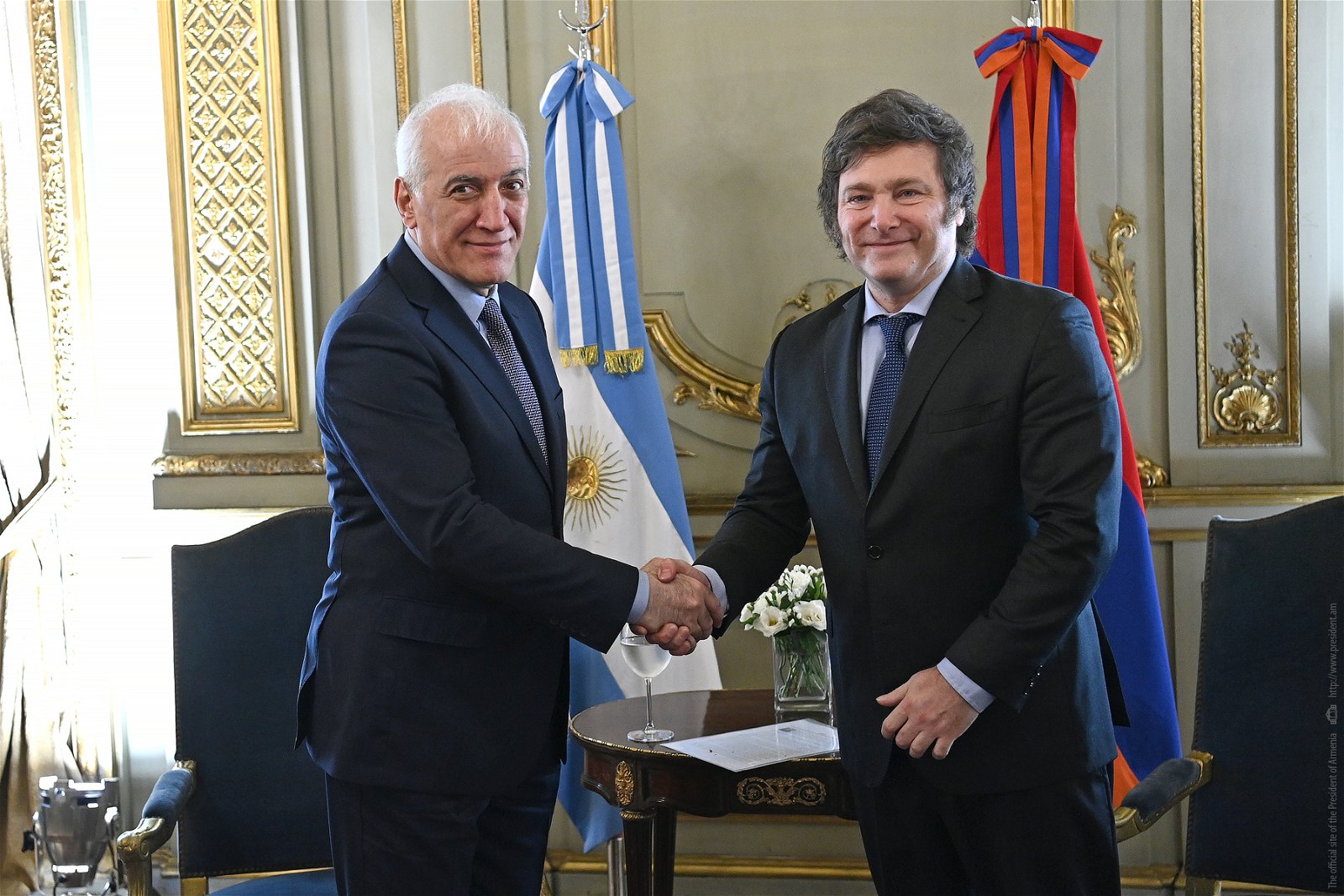 Armenian President Vahagn Khachaturyan with Argentinian President Javier Milei (Press Office of the President of Armenia)
Gratitude towards Argentina
Asked about diplomacy with South American countries, the Armenian President emphasized, “We have to make our work more active in South America,” because “in many cases it seems to us that the presence of the community is enough to have close relations, but we realize that we must also have relations with the state authorities of each country, establish relations and develop them.”
“The recent events of 2020 showed us that there are no primary and secondary countries. We have to establish relations with all countries, and if those relations are warm, even better,” Khachaturyan said. He referred in particular to the former Argentinian President Alberto Fernandez and the first Prosecutor of the International Criminal Court Luis Moreno Ocampo, two Argentine figures who have been very important in telling the world about events in Armenia and Artsakh.
During his visit, Khachaturyan also met with the outgoing President Alberto Fernandez, who was awarded the Medal of Honor after having condemned the genocidal blockade of Azerbaijan against the Republic of Artsakh (Nagorno-Karabakh). On September 9, 2023, Fernandez criticized the Artsakh blockade during his speech at the First Plenary Session of the 18th Summit of Heads of State and Government of the G20. On September 13, Fernandez again denounced the blockade against the population of Artsakh during the Latin American and Caribbean Conference on Peace Operations of the United Nations Organization in Buenos Aires. Finally, on September 19, Fernandez referred to the attacks unleashed by Azerbaijan against the population of Artsakh during his speech at the 78th U.N. General Assembly.
Under Fernandez’s administration, a plane carrying 15 tons of humanitarian aid collected by the institutions of the Armenian community of Argentina and a team of volunteers from the Argentine Foreign Ministry were sent to Armenia to help the forcibly displaced population of Artsakh at the beginning of November.
On January 5, Armenian Ambassador to Argentina Hovhannes Virabyan awarded the Medal of Gratitude to Luis Moreno Ocampo on behalf of the Armenian President, thanking him for his reports on the genocide against the Armenian population of Artsakh by Azerbaijan. “Every step in favor of the recognition and condemnation of the crimes committed against the people of Nagorno-Karabakh is a signal, a particular warning to all those who are still trying to normalize relations and achieve their objectives through the use of force and violations of human rights,” said Khachaturyan in a recorded message that day.
 Armenian President Vahagn Khachaturyan with former Argentinian President Alberto Fernández (Press Office of the President of Armenia)
Closed-door meetings with the Armenian community
In both Argentina and Uruguay, the President held meetings with representatives of the Armenian institutions in which, in summary, he defended the decision of the government of Armenia to sign a peace treaty with Azerbaijan and presented the “Crossroads for Peace” project.
The community leadership engaged in an internal debate about whether or not to participate in the meetings. Hagop Tabakian, president of the Armenian National Committee of South America (ANC-SA) and member of the Armenian Revolutionary Federation (ARF) of South America, explained to the Weekly that even though they “have many differences with the administration,” “our organization has as a fundamental idea the strengthening of the state of Armenia.” “We believed that not participating in that, beyond the people in power, would affect the presence of the state of Armenia in South America. The last thing Argentina did was to support the people of Artsakh and denounce what Azerbaijan was doing with the blockade and the attacks, so that was what turned into our internal debate of going or not going in the case of the President’s presence,” he added.
“There are sensitive differences that separate us with the current government of Armenia on such transcendental issues such as its position on Artsakh and its future, the relations with Turkey and Azerbaijan and the cession of the rights and future claims of the Armenian people. We remain committed to the strengthening of the Republic of Armenia, the defense of the violated rights of the Armenian people in 1915 and today, the protection of the security of the borders and the sovereignty, and basically the existence of the Armenian people,” Tabakian continued.
Rubén Kechichian, Honorary President of the Armenian General Benevolent Union (AGBU) in Argentina, also gave his opinion on the visit to the Weekly: “We must divide the evaluation of the visit into two parts. The protocol and diplomatic part seemed impeccable to me, since not many delegations had meetings with President Milei and different representatives of the government and the political circle. At the community level, it was reduced only to the meeting at the Hilton Hotel with a limited presence of leaders and personalities, which left a wide spectrum of the active and educational community without the possibility of listening to it. Personally, I am convinced that visits of this magnitude have positive consequences that mobilize national and patriotic feelings in broad sectors of the active community,” Kechichian said.
Maral Masrian, President of Armenian Relief Society (ARS) of South America, said that Khachaturyan underestimated community representatives during internal meetings by “saying that we only got the news here and not the realities.” “He wanted to convince us. He kept saying what he wanted, repeating his speech and not answering our questions,” she said.
Many community members from Montevideo criticized the organization of the meeting: “The invitation was very informal and disorganized, not at all in line with the planning required by a president’s visit,” said members of the ARS of Uruguay. “According to the information we continually receive from our ARS colleagues from Armenia through the Central Commission, who work tirelessly to assist the forcibly displaced population of Artsakh, it seems to us that what the President of Armenia reported does not coincide with the reality that we know they live. Faced with this distance between words and reality, it is not possible to rate the view positively.”
Luciné Varjabedian, representative of the Armenian National Committee (ANC) of Uruguay, called the meeting a “meaningless formality, to which we participants were called by WhatsApp messages, which reveals an alarming level of improvisation.” “The message that the President of Armenia has left towards the community was the continuation of a self-deprecating speech, where apparently all the tragedy that occurred in the last months of 2023 with the loss of the territory of Artsakh and the forced displacement of our 120,000 compatriots have been overcome thanks to the government of Armenia, conveying that the issue of Artsakh was a settled issue, despite the latent danger to the security and territorial integrity of the Republic of Armenia,” Varjabedian said.
 Armenian President Vahagn Khachaturyan meeting with the Armenian community of Argentina
International sanctions, military aid and a peace treaty with Azerbaijan
During our interview, I asked Khachaturyan if Armenia would support sanctions against the Azerbaijani authorities and the project to encourage the United States to stop providing military aid to Azerbaijan. “We have to be able to understand what our interest is. In many cases, not understanding our interest, we end up serving the interests of others. This is nothing new. Even the most friendly country has its own interests. We have to understand what are its objectives when the United States limits the sale of arms to Azerbaijan. If the aim of this decision is to defend democracy in Armenia, it is of course acceptable for us. It is important. We have to be able to work in that direction. Their proposal does not have to be without a specific purpose,” he said.
“Of course, we can also ask various countries to impose sanctions, but would that not disturb our main purpose, which is peace?” he continued. “Any initiative that is made by the members of the Armenian communities in the Diaspora has to be done in the sense of not disturbing the process that has already started, which is the peace process. In many cases we realized that a careless gesture, a careless word, could have a negative influence on the whole process.”
One of the questions that is not generally asked of the Armenian government is why it seeks to sign a peace treaty with Azerbaijan, a country that it accuses of failing to comply with signed agreements, especially the trilateral ceasefire declaration of November 9, 2020. “In politics you have to be pragmatic, and pragmatism often does not accept emotions. I believe that we do not have to go too far. There are historical facts that prove what I am saying. Our countries and our region need peace. To reach peace we have to engage in direct talks with Azerbaijan, or indirectly with mediators but dealing with certain issues,” he said.
Khachaturyan also called the blockade of Artsakh a “very painful” situation. “We could not use the possibilities of our partner countries or explain to them that in case the Lachin Corridor would remain closed, it would mean that Artsakh would be practically emptied of Armenians,” he said. He stressed that the forced displacement was “foreseeable” for the Armenian government: “We knew it from our own experience. We knew that Azerbaijan was going to act like this. But many were surprised by what happened on September 19.”
In conclusion
The Armenian President’s visit to South America was well received by the states of Argentina and Uruguay. It was a necessary visit, given all the selfless support from Argentina and Uruguay to Armenia. The leadership of the Armenian communities understood this, leading to their decision to participate in meetings with the president, despite the general criticism of the current administration.
Author information
Matías Raubian
Matías Raubian is the editor of Diario Armenia, the largest Armenian newspaper in Spanish founded in 1931. Diario Armenia covers news from Armenia, Artsakh and the Diaspora, with special focus on Argentina, Uruguay, Brazil, Chile, Mexico and Spain.
|
The post Armenian President Vahagn Khachaturyan visits South America appeared first on The Armenian Weekly.
There are films that can’t be watched with a box of popcorn. There are films that can’t, and shouldn’t, be watched just once. There are films that leave a lasting mark. Amerikatsi is one of those films.
The news that an Armenian film was shortlisted for the Academy Awards immediately sparked the interest of my family and me, and we decided to watch it. From the very beginning of Amerikatsi, the mise-en-scène of the first shot and the first notes of the melody, I knew something great awaited us. Throughout the film, we saw and experienced everything, from hatred to love, from frustration to hopefulness, from overwhelming sorrow and despair to immense joy and excitement. Actor, writer and director Michael Goorjian made us cry and smile at the same time, creating a beautiful mix of emotions and sentiments that made us feel like we were there with the protagonist, looking at life from behind the prison bars of Soviet Armenia. There was so much life in Goorjian’s eyes, so much charisma in his acting and such power in his storytelling that only a few minutes after the film ended, something in me whispered: “You need to interview this person, ASAP!”
Upon interviewing Goorjian, I recognized a person who is not only talented and professional, but also humble, sincere and courageous, as well as dedicated and genuine in his love for Armenia. Even though he did not use loud, pompous words to describe Armenia and Armenian culture, his way of showing and embodying the Armenian character was enough to convey his love for our homeland, for our peculiarities and cultural traditions. His film and our conversation are devoid of artificiality and full of hopeful realism, showing both the tragic and the beautiful aspects of the Armenian past, the good and bad traits of the Armenian character, and the fragility and resilience of humanity as a whole.
Milena Baghdasaryan (M.B.): Childhood plays an important role in a person’s life. What is your most impactful childhood memory? Do you have a favorite childhood film? What was your first encounter with your Armenianness?
Michael Goorjian (M.G.): I would say theater. I remember going to plays when I was a young boy and being so affected by what I saw. For me, storytelling and acting were really sort of magical. It was almost religious. Speaking about films, I saw a lot of American films as a young boy, but then I do remember in high school being taken to see a French film called the Big Blue, which was a film about deep sea diving, and it was so visual. There was a lot of the film without dialogue, which was just in the water, and it was incredible. It really was for me very, very effective to see that film. After that, I started to watch many films from other cultures, European films, films from the Middle East, and I realized how different people saw the world. I learned a lot that way.
In terms of my Armenianness, I didn’t really grow up that connected to being Armenian. I grew up more as an American. I’m half-Armenian. My grandparents were Genocide survivors who came to America, and they raised my father to be American. He was a scientist—he worked for NASA—and I think partly because of that we didn’t go to church that often, and in America a lot of the Armenian community tends to revolve around the church. It’s kind of a center point for Armenians to meet and get to know each other. So because I didn’t have that growing up, it wasn’t until I came to Los Angeles and went to UCLA to study theater that I started to meet more Armenians and get involved with Armenian communities; and then it was in 2006 that I first came and visited Armenia, and that was quite a wonderful experience for me.
M.B.: How has your Armenianness impacted your ‘signature’ as a filmmaker? Are there any Armenian filmmakers, landscapes, melodies or artworks from which you have drawn inspiration for your artistic signature in general and for Amerikatsi in particular?
M.G.: I’ve seen a lot of Parajanov films, and I’ve seen some early Soviet Armenian films. Not too much more than that. More recently I’ve seen more Armenian films, but growing up I didn’t know much about Armenian cinema beyond Parajanov. But in terms of influence, I would say I was more affected by the people that I met, especially from that first trip to Armenia in 2006. You know, Armenian culture is very diverse. There’s all sorts of versions of it, depending on where you live, what dialect you speak, which church you go to, and if you go to church or not. So I think my experiences in the country were the most influential for making Amerikatsi. Just because the film is set there and because it takes place during the Soviet era, as an American and as an Armenian from the diaspora, my understanding of what it was like to live in that time was very limited. So I relied heavily on the artists, actors, crew and technicians in Armenia to help inform a lot of that side of the story.
M.B.: In one of your interviews you mentioned that you “wanted to make an Armenian film that was hopeful.” In your film, Charlie demonstrates a supernatural level of resilience and hopefulness. How do you keep your hope alive in challenging times? What would be your formula for keeping our hope alive as a nation today?
M.G.: It’s difficult, because you have to face reality, and you can’t ignore the truth of tragedies and conflicts and the terrible things that Armenians in particular have gone through. At the same time, I think you need to come back to the simple things in life. In the film in particular, I wanted to help share Armenian culture. And I always come back to the idea of the table, the dinner table and how, for me, especially when I came to Armenia in 2006, I saw the contrast between American and Armenian cultures of eating. In America, sometimes eating just means getting fast food; you eat and you run. On the contrary, in Armenia you sit down for a meal, and sometimes it is five hours long. And we’re toasting, and we’re talking and living. To me, it is these things that I think we need to remember to appreciate. And the fact that, despite everything, all of the tragic things and conflicts and divisions within Armenians, at the same time we’re very good at enjoying life, and that’s the part that we have to remember.
M.B.: How would you evaluate the current state of Armenian cinema? As both an insider and an outsider, have you observed and identified any gaps and potential solutions to fill them?
M.G.: I think the best way to evolve and grow is through just more voices, more diversity, and different types of films and different types of filmmakers. We, at least from my standpoint, from an outside perspective, think that we need to make a big genocide movie that will teach the world. But no, we don’t. We just need more movies and more about the different angles of Armenian culture that is so rich and which has so many aspects to it. I think we just need more people making different things and not being too judgmental about what is Armenian and what is not, or what is real Armenian. It doesn’t matter. Even if there’s just a character who’s Armenian, great! Or if there is some bit of our culture. Or if it just takes place in Armenia. It doesn’t matter. I just think we need more, and more different kinds of things. Infrastructure-wise, it feels for me that in Armenia there is just more commercial stuff and then a kind of high-art filmmaking, and I think the more they come together, and the more there’s a middle ground, the less of just low and just high and more of middle, the better. That would be my suggestion.
M.B.: A significant part of the film Amerikatsi takes place behind prison bars. Even those who are not in prison still live and act behind non-physical, intangible barriers created by the communist regime. Yet, in the film, the bars eventually serve not as a constraint but rather as a fuel for creativity. Do you encounter such ‘bars’ (whether financial, political or any other) in your career as a filmmaker today, and are they a limitation or rather a locomotive?
M.G.: You kind of answer the question right there. I would say, of course there are many constraints. Making films is not easy. It takes money, it takes people, it’s a big process, and there’s no way you don’t come up against barriers and things that will make it difficult. Otherwise, everybody would do it all the time. I think if you can approach those barriers and try to find the opportunities within them, you will succeed, because constraints can stop what you’re doing, but they can also make it stronger. When we shot Amerikatsi, it was right at the beginning of the pandemic. We were even planning to go into lockdown for months at a time, but a lot of those constraints and problems that we faced ultimately ended up making it a better film. So I would say, every time you face a challenge, ask yourself if there is something there that can help what you are doing and make it better.
M.B.: What was your secret ‘recipe’ for combining and balancing the roles of director, writer and actor so harmoniously and successfully? Did this multitasking approach cause any difficulties on set, and how did you overcome such challenges?
M.G.: I would say it all comes down to your relationships with the people you’re working with and being able to trust them. I allow my cinematographer to do what we’ve hired him to do. I don’t try to do his job. I try to convey to him everything I see or feel, and then let him do what he’s meant to do. So I think the key for me in playing those different roles is that, the more I can rely on the people I’m working with, the more it all becomes possible. I wouldn’t say it was easy. But it’s possible by being able to have people who you rely on. When I’m acting, I tend to not even look at what we’ve shot. I trust that we’ve got what we need to get. That requires having a relationship with the cinematographer, the first A. D., your crew and your actors. You really have to have a good, strong relationship. At the end of the day, you’re all working for the same goal.
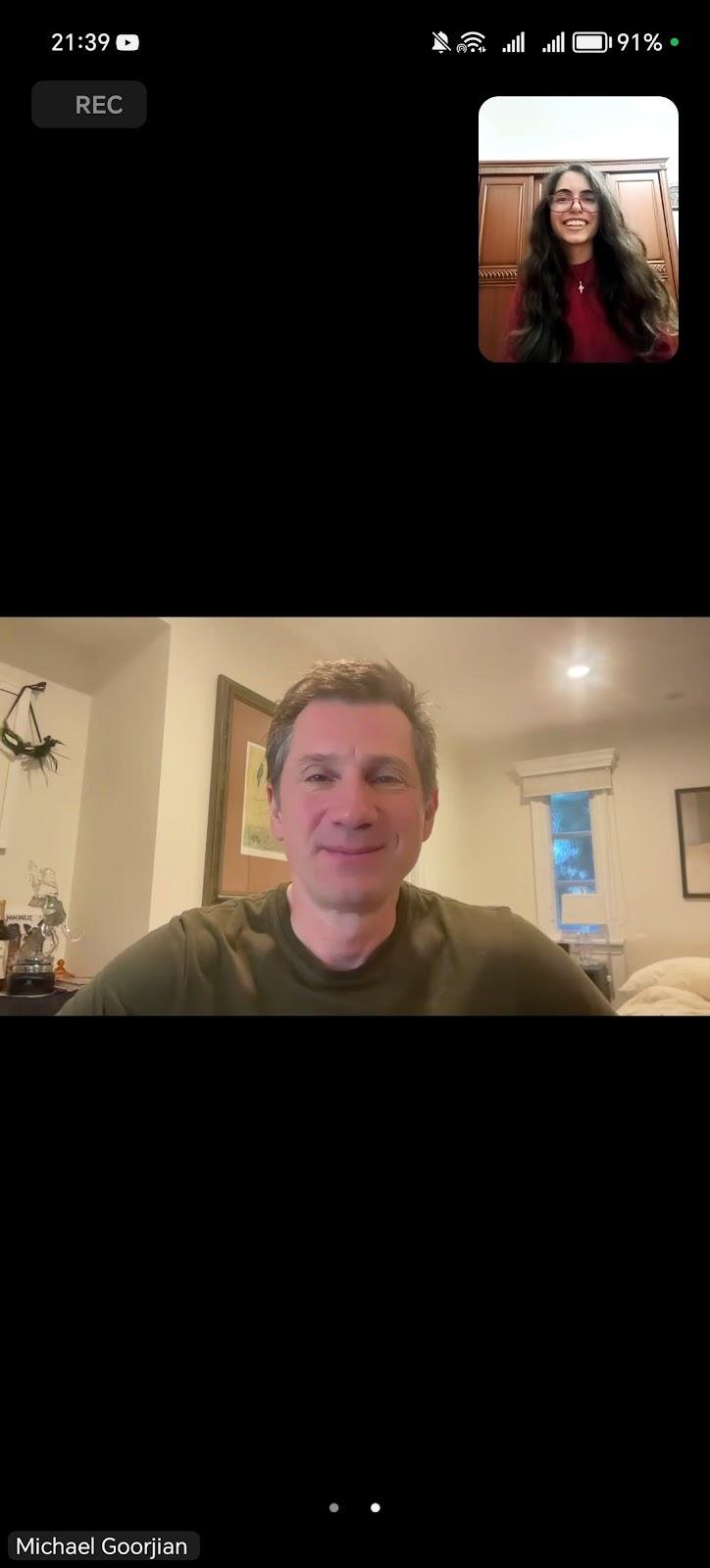 Milena Baghdasaryan interviewing Michael Goorjian
M.B.: In Amerikatsi, the actors fuse so perfectly with the characters they embody that sometimes it seems that the roles have been created for and with the actors in mind. What were your criteria when choosing the cast members? Did you see yourself in Charlie’s role since the very beginning, or was it a decision you came to gradually?
M.G.: I wrote Charlie’s role imagining playing it, but we did try for a while to get other actors to do it, because it felt like a lot for me to direct and to act, but eventually it seemed like the best thing. In terms of the other actors, we were blessed with so many great performances and actors, and part of that is because I trusted them to take their roles and did not try to control them, and instead to have them bring anything of their own to these roles. So I think it’s thanks to that freedom that it feels very much like you said. As an actor, I know what it’s like to work on something and be constrained and not allowed to invest myself into it. So I always try to work with actors and help them to find the role so that they feel like they’re free to play and do stuff that makes the character richer, and then it also benefits me as a filmmaker, because it makes the film better.
M.B.: How has the Oscars nomination changed your life? Has it changed the lens through which you look at your own film? In general, how has your relationship with Amerikatsi evolved from the time of its ideation through production, release and distribution? Is the final product what you had envisioned initially?
M.G.: Right now we’re shortlisted, so we’re working on being nominated, but even just being shortlisted means a lot to us, as it is the first time for Armenia to get this far. I would say it has brought me confidence that what we’ve created is something that is good, and you don’t have to be Armenian to appreciate it. It’s wonderful to see the acknowledgement, the reaction and the interest from non-Armenians and from film critics. I have had many screenings where people come up to me after the film and tell me how they knew nothing about this part of history. Their interest in Armenia and in the Armenian culture is for me the success of the film. It’s helping to create a bridge between the Armenian community and the non-Armenians.
M.B.: Why are the Academy Awards, and awards in general, important for an artist? Are they important?
M.G.: I’ve always thought, “An award? Ah, that’s silly!” But especially for something like this, I realized the importance of it, both for me as a filmmaker by getting recognition (awards help bring attention to a project), but also because this is for Armenia. To help Armenia have a place in world cinema is important, for people to look towards Armenia for art and culture and not just because there’s conflict. Before being shortlisted for the Oscars, most of our audience was Armenian, and most of the people who knew about the film were Armenian, but the Oscars shortlisting now opened it up. So a lot more people, non-Armenians, are going to see what it is that’s being talked about. They get interested. Awards are silly in a way, but also I think they are valuable, especially in certain cases like this. I mean, it’s not going to make a huge difference for France if they get a nomination; they’ve had millions of nominations. It’s a big country. But for Armenia it does make a difference. And so I think that’s important.
M.B.: What are you looking forward to in 2024? Are there any projects that you are currently working on and about which you would like to share with our readers?
M.G.: What am I looking forward to? I’m looking forward to developing more projects that I can come shoot in Armenia!
M.B.: What has been the best advice you have received as a filmmaker, and what would be your own best advice to young Armenian filmmakers?
M.G.: Best advice to myself is understanding that a large project that involves a lot of moving pieces (e.g. film or anything else) is always going to be difficult, and there are always difficult times, but being resilient and sticking with it eventually pays off. If your heart is in the right place, if you’re doing it for the right reasons, if you can try to stick with what you believe in, it pays off. In terms of advice for other filmmakers – be daring. The more voices we the Armenians have the better. We’re not competing against each other. We all help each other. So I think the more we can make films and make art and move forward, the better it will be. We have a rich history that should inform us, but inform us to move forward. We don’t need to just retell the past. We need to continue. I would love, 100 years from now, people to look back at this era and say, “Wow, Armenia…So many great movies and music! And it all came out of Armenia during this time.” We can do that.
Author information
Milena Baghdasaryan
Milena Baghdasaryan is a graduate from UWC Changshu China. Since the age of 11, she has been writing articles for a local newspaper named Kanch (‘Call’). At the age of 18, she published her first novel on Granish.org and created her own blog, Taghandi Hetqerov (‘In the Pursuit of Talent’)—a portal devoted to interviewing young and talented Armenians all around the world. Baghdasaryan considers storytelling, traveling and learning new languages to be critical in helping one explore the world, connect with others, and discover oneself. Milena currently studies Film and New Media at New York University in Abu Dhabi.
|
The post An interview with “Amerikatsi” writer-director-actor Michael Goorjian appeared first on The Armenian Weekly.
Categories