NPR News: 01-10-2024 10AM EST
Categories
 The South Caucasus News - SouthCaucasusNews.com
After Azerbaijan and Turkey resumed discussions of the ‘Zangezur corridor’, Armenian officials have expressed their opposition to the proposal.
The corridor is proposed to connect Azerbaijan to its exclave of Nakhchivan through Armenian territory, with Azerbaijan demanding that such transport be exempted from any customs checks. It has been a consistent point of disagreement in Armenia–Azerbaijan peace negotiations.
While it appeared in late 2023 that discussions of the corridor had been put on hold after the agreement to construct an alternative route to Nakhchivan through Iran, since early January, Azerbaijani officials have resumed its discussion.
[Read more: Azerbaijan begins construction of corridor to Nakhchivan through Iran]
On 2 January, Elchin Amirbayov, an Azerbaijani presidential envoy for special assignments, told Estonian Public Broadcasting that restoring transport links was ‘an integral part of the peace process’.
‘We started talking with the Armenian side about restoring the so-called “Zangezur corridor” so that Azerbaijani citizens living in Nakhchivan, or the main part of Azerbaijan, had an unhindered passage of this territory’, said the official.
Amirbayov added that the 42-kilometre railway would be ensured by Russian Federal Security Service (FSB) forces, as per the trilateral agreement signed on 9 November 2020 that ended the Second Nagorno-Karabakh War.
Two days later, Hikmat Hajiyev, the advisor to Azerbaijan’s President Ilham Aliyev, told Berliner Zeitung that Azerbaijan expected cargo to be exempted from customs and border control when transported through Armenia between Nakhchivan and Azerbaijan’s main territory. He added that were goods being transported to a third country, customs and border control would be provided by Armenia.
On 7 January, Abdulkadir Uraloğlu, Turkey’s transport minister, said that they expected the Zangezur Corridor would be ‘implemented’ by 2029. He added that Turkey considered the corridor ‘irreplaceable’ despite previously endorsing propositions to route the corridor through Iran.
Armenian officials have consistently opposed the proposition, with Foreign Minister Ararat Mirzoyan stating on 23 September 2023 that Azerbaijan was attempting to ‘forcefully impose’ an extraterritorial corridor on Armenia that would pass through Armenia’s territory but be out of Armenian control, with the aim of creating a new target.
‘This is unacceptable for us and should be unacceptable for the international community’, said Mirzoyan, speaking at the UN General Assembly.
Sargis Khandanyan, the chair of Armenia’s Foreign Relations Committee, told RFE/RL on 8 January that while Yerevan was willing to discuss simplified customs and border regimes and unblocking regional transport, ‘unhindered crossing’ would not be accepted by Armenia.
‘It again assumes extraterritoriality […] which is a violation of our sovereignty’, said Khandanyan.
The previous week, Armen Grigoryan, Secretary of Armenia’s Security Council, told News.am that discussions regarding unblocking transport between the countries could take place after Azerbaijan had publicly confirmed that the principles of sovereignty, preservation of jurisdiction, reciprocity, and equality would form the basis of the discussions.
‘We have heard agreement from Azerbaijan on these principles; we expect that they will announce [it] publicly as well, and we will continue to work on clarifying the next steps,’ said Grigoryan.
Azerbaijan has, since the end of the Second Nagorno-Karabakh War, increasingly sought to establish a corridor to connect the exclave of Nakhchivan to the rest of the country.
However, in October 2023, Azerbaijan’s Presidential Advisor Hikmat Hajiyev told Reuters that the construction of a route through Armenia had ‘lost its attractiveness’ for Azerbaijan after the two countries failed to agree on its opening.
The construction of an alternative route through Iran began the same month. On Monday, Iran’s Foreign Ministry Spokesman Nasser Kanaani stated that developing regional transport cooperation could not be ‘a basis for geopolitical changes and violation of the territorial integrity and national sovereignty of countries’.
The idea of a corridor through Armenia’s territory has resurfaced in statements by Azerbaijani officials since the beginning of 2024.
Azerbaijani political commentator Zardusht Alizade told RFE/RL that while Azerbaijan wanted goods to travel to Nakhchivan without passing border or customs checks, the country did not seek to control the corridor.
‘There is such an example in international practice: the corridor that connects the Kaliningrad region with Russia. Trains from Russia on that corridor pass through the territory of Lithuania to Kaliningrad without obstacles and are not checked by customs officers or border guards. This regime can also be applied to the 42 kilometres passing through Armenia’, said Alizade.
While there were hopes that a peace treaty between Armenia and Azerbaijan could be signed by the end of 2023, this failed to take place.
On 8 January, Armen Grigoryan stated that Armenia had responded to Azerbaijan’s most recent proposals regarding a peace treaty the previous week, adding that the two countries’ demarcation commissions would meet at the end of January.
‘There are issues on which we reached an agreement during the verbal negotiations, but we have seen certain setbacks in the text of the peace agreement’, said Grigoryan. He also affirmed that there could be no question of a corridor in the peace agreement.
Mediation of the negotiations also remains a point of contention. Azerbaijan has been pushing for bilateral negotiations amidst a reported refusal to engage in US-mediated talks.
Russia’s foreign ministry spokesperson Maria Zakharova stated in December that it was ‘extremely dangerous’ for Armenia and Azerbaijan to pursue peace negotiations without taking into account tripartite Russia-mediated agreements made in 2020, 2021, and 2022.
‘Unlike Russia, the United States and the European Union are not trying to bring peace and stability to Armenia and other states of the South Caucasus’, said Zakharova, while calling for the countries to return to Russia-mediated negotiations.
Speaking to Berliner Zeitung, Hikmat Hajiyev stated that while ‘all formats’ of negotiations had advantages and Azerbaijan was grateful to ‘all mediators’, the country’s goal was ‘result-oriented negotiations’.
He added that while Azerbaijan was ‘not against honest mediation’, it preferred direct discussions.
‘Accordingly, the text of the peace agreement between Baku and Yerevan will be prepared directly and bilaterally’, said Hajiyev.
Azerbaijan has also repeatedly proposed separating the border delimitation and demarcation process from the agreement of a peace treaty, which Armenian officials have suggested might be acceptable.
On Wednesday, Armenian Foreign Minister Ararat Mirzoyan stated that the peace treaty should include ‘clear foundations’ for the demarcation process, even if demarcation itself took significantly longer.
‘I want to emphasise that these two issues — territorial integrity and inviolability of borders and also the further delimitation of borders — are issues where the Republic of Armenia cannot see and cannot allow any uncertainty’, said Mirzoyan. ‘Any uncertainty is a great basis and fertile ground for further aggressions and further escalations.’
The post Armenia tense as Turkey and Azerbaijan renew ‘Zangezur corridor’ discussions appeared first on OC Media.
A group of far-right activists on Wednesday surrounded the house of an activist accused of painting over a controversial icon, after Georgia’s interior ministry launched an investigation into the act on charges of hooliganism.
On Tuesday, activist Nata Peradze published a video on Facebook showing blue paint on an icon of St. Matrona that depicts the 20th century saint in the company of a man resembling the Soviet dictator Joseph Stalin. The icon is in the Holy Trinity Cathedral in Tbilisi.
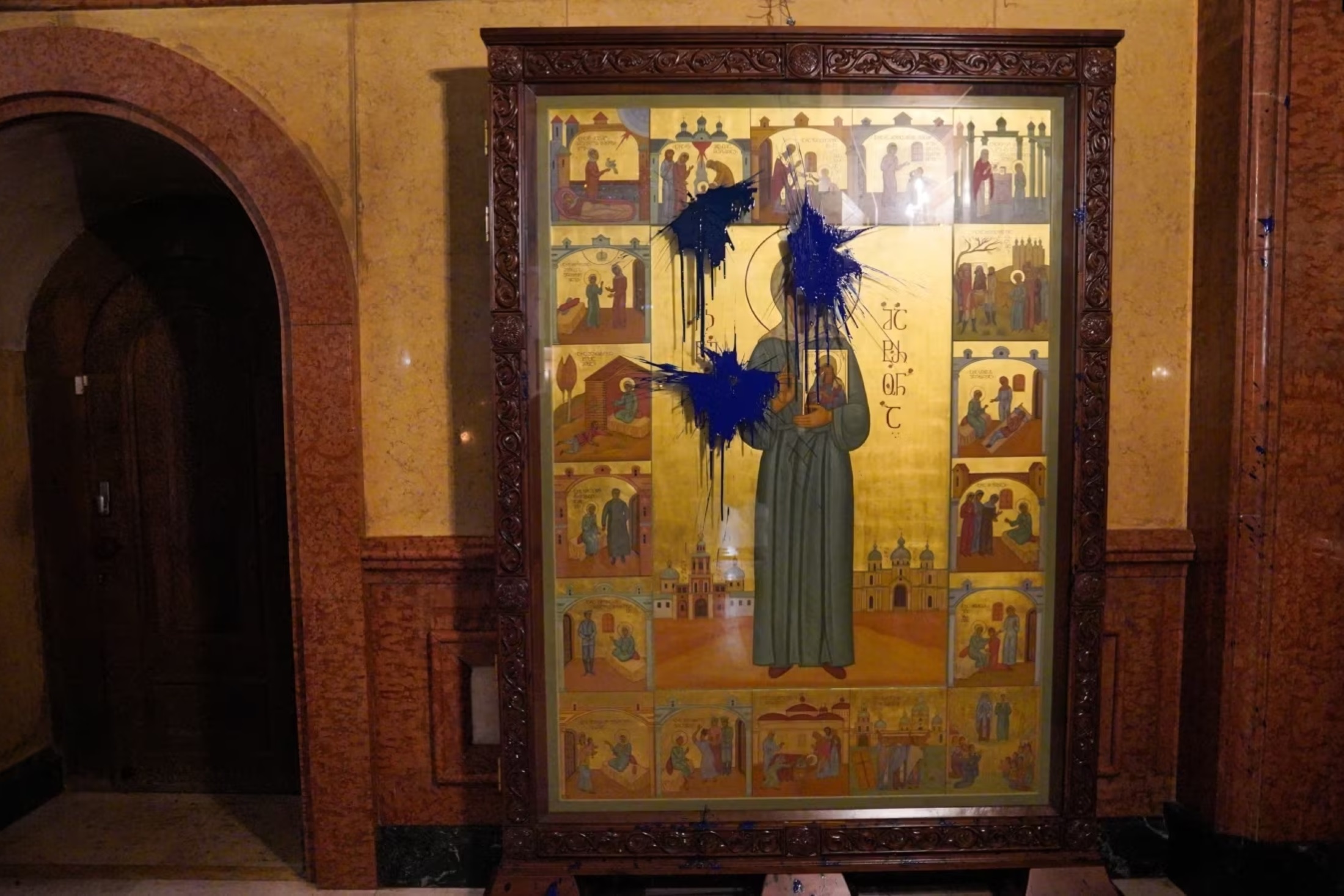 Paint on the icon of St. Matrona in Tbilisi’s Sameba Holy Trinity Cathedral. Photo via RFE/RL.
The icon has gained notoriety and provoked controversy in Georgia since its image was shared on Georgian social media by archpriest Ilia Chigladze on 6 January.
[Read on OC Media: Controversy after Stalin icon found in Tbilisi’s Sameba cathedral]
On Sunday, Davit Tarkhan-Mouravi, the leader of the conservative Alliance of Patriots party, announced that he had donated the icon to the cathedral, claiming that Stalin had met Matrona for counsel during World War II.
Georgia’s Interior Ministry told OC Media on Wednesday that an investigation was launched a day earlier into the icon’s painting on charges of petty hooliganism.
Although it has not been publicly confirmed that Nata Peradze was responsible for the paint visible on the icon in her video, both she and social media commentators have strongly implied that that is the case.
On Wednesday afternoon, several hundred members of the radical far-right Alt Info group gathered outside Nata Peradze’s house in Tbilisi.
Members of the group called for others to ‘mobilise’ on social networks shortly after Peradze posted her video.
OC Media observed members of the crowd, which included a number of priests, shouting insulting phrases and attempting to disrupt the police cordon outside her house.
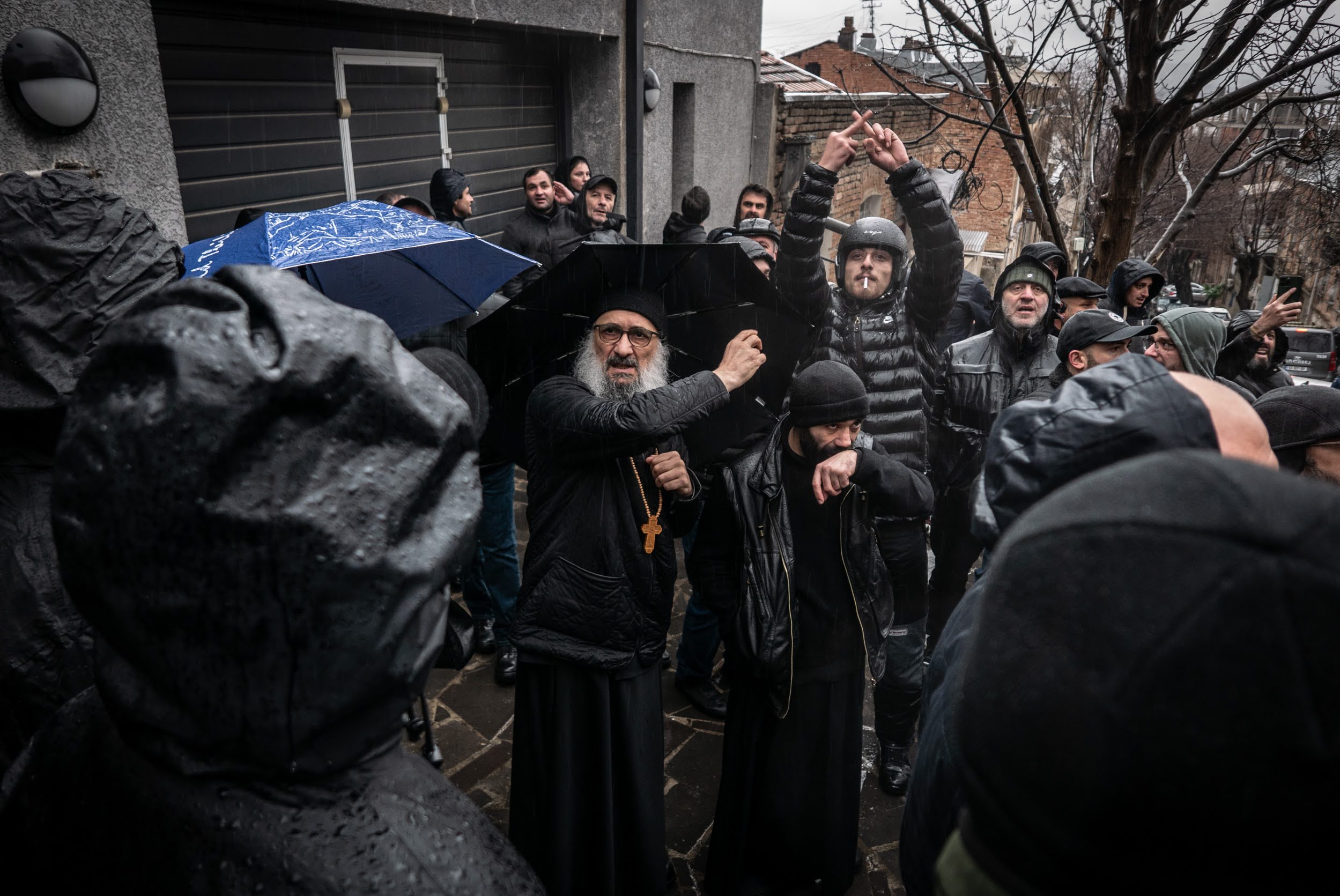 Far-right protesters gathered outside the house of activist Nata Peradze. Photo: Mariam Nikuradze/OC Media.
Zurab Makharadze, one of the leaders of the Conservative Movement and far-right Alt Info, used insulting phrases towards Peradze while addressing the gathering. He appealed to the authorities, demanding that Peradze be punished on charges of ‘unlawful interference with the performance of religious rites’.
Peradze published personal messages she received on Facebook, in which she was insulted and threatened. The activist wrote on Tuesday that she had shared the threatening messages with the police. Georgia’s Interior Ministry did not respond to enquiries from OC Media regarding whether an investigation had been launched into the threats.
According to RFE/RL the icon of St. Matrona has since been cleaned of paint, and its location changed to a ‘more visible place’.
The post Formal investigation and far-right demonstration prompted by paint on controversial Stalin icon appeared first on OC Media.
Met with Palestinian Authority President Mahmoud Abbas to discuss ongoing efforts to minimize civilian harm in Gaza, accelerate the delivery of humanitarian aid, end extremist violence, and work towards an independent Palestinian state. pic.twitter.com/c60d5ISLnT
— Secretary Antony Blinken (@SecBlinken) January 10, 2024
forensic examination of the seized Weiner – Abedin laptop – Google Search https://t.co/rAwv0AXQBj
— Michael Novakhov (@mikenov) January 10, 2024
Peter Strzok ordered the forensic examination of the seized Weiner – Abedin laptop but it was never performed – GS https://t.co/YFP9FohzjH pic.twitter.com/kZnn92DLuJ
— Michael Novakhov (@mikenov) January 10, 2024
Met with Palestinian Authority President Mahmoud Abbas to discuss ongoing efforts to minimize civilian harm in Gaza, accelerate the delivery of humanitarian aid, end extremist violence, and work towards an independent Palestinian state. pic.twitter.com/c60d5ISLnT
— Secretary Antony Blinken (@SecBlinken) January 10, 2024
forensic examination of the seized Weiner – Abedin laptop – Google Search https://t.co/rAwv0AXQBj
— Michael Novakhov (@mikenov) January 10, 2024
Peter Strzok ordered the forensic examination of the seized Weiner – Abedin laptop but it was never performed – GS https://t.co/YFP9FohzjH pic.twitter.com/kZnn92DLuJ
— Michael Novakhov (@mikenov) January 10, 2024