Categories
South Caucasus News

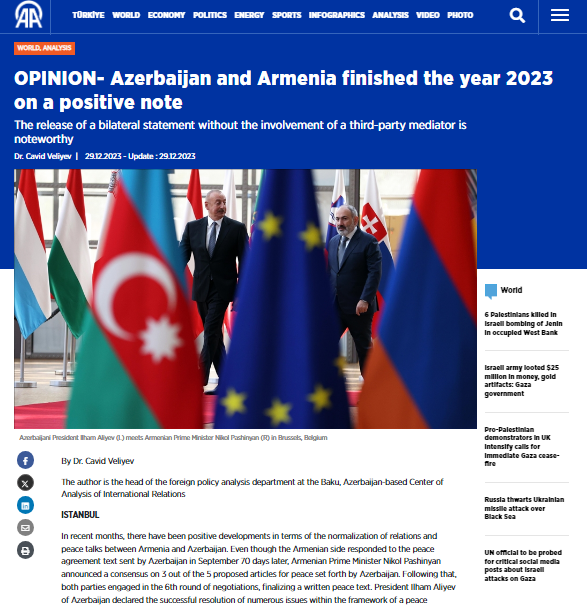
OPINION- Azerbaijan and Armenia finished the year 2023 on a positive note


ISTANBUL

In recent months, there have been positive developments in terms of the normalization of relations and peace talks between Armenia and Azerbaijan. Even though the Armenian side responded to the peace agreement text sent by Azerbaijan in September 70 days later, Armenian Prime Minister Nikol Pashinyan announced a consensus on 3 out of the 5 proposed articles for peace set forth by Azerbaijan. Following that, both parties engaged in the 6th round of negotiations, finalizing a written peace text. President Ilham Aliyev of Azerbaijan declared the successful resolution of numerous issues within the framework of a peace agreement. Simultaneously, Azerbaijan’s Foreign Minister Ceyhun Bayramov revealed hopeful developments stated in Armenia’s latest proposal.

The Delimitation and Demarcation Commission, which has been involved in bilateral discussions, has made significant progress. Subsequently, the governments of both countries gave their consent, approving the date, time, and the location for the convening of the Delimitation of State Border and Border Security commissions between the Republic of Armenia and the Republic of Azerbaijan. 

Joint statement

Remarkably, on December 7, a joint statement was unexpectedly released by the Presidential Administration of the Republic of Azerbaijan and the Office of the Prime Minister of the Republic of Armenia. The nature of this statement, resembling a collaborative declaration between long-term partners rather than adversaries entrenched in a 30-year conflict, surprised many experts. Notably, the joint statement was issued ahead of a formal peace agreement, signaling a significant step towards resolution.

According to this statement, the two countries express a shared commitment to normalize relations and reach a peace agreement. Based on the principles of sovereignty and territorial integrity Azerbaijan releases 32 Armenian soldiers, and Armenia releases 2 Azerbaijani soldiers; Armenia withdraws its candidacy for hosting the 29th Conference of the Parties (COP29) to the UN Framework Convention on Climate Change; Armenia and Azerbaijan express optimism that other countries within the Eastern European Group will join in supporting Azerbaijan’s offer to host COP29; The Republic of Azerbaijan supports Armenia’s candidacy for membership of the COP Bureau of the Eastern European Group.

This joint statement holds significant importance in shaping a positive agenda towards a peace agreement between the two countries. There are several reasons for this. Firstly, the release of a bilateral statement without the involvement of a third-party mediator is noteworthy. Notably, Armenia, which had previously advocated for a mediator’s presence, and Azerbaijan’s preference for direct bilateral resolution shows an impressive determination to addressing issues independently. Secondly, the decision by Armenia to withdraw from hosting an international meeting in favor of Azerbaijan, coupled with Azerbaijan’s support for Armenia’s candidacy, represents a pivotal confidence-building measure. Third, the significance of this joint statement comes from a sense of mutual goodwill and political commitment rather than external pressure. In summary, these three pivotal aspects—direct bilateral engagement, reciprocal support on the international stage, and the absence of external pressure—significantly contribute to creating a positive environment for further peace process between Armenia and Azerbaijan.  

Factors contributing to the change of dynamics

The joint statement, the first since the two republics gained independence, was also welcomed by Türkiye, the US, the EU, Russia and many international players. During his visit to Azerbaijan, Turkish Foreign Minister Hakan Fidan stated that Ankara supports the process of normalization of relations between Armenia and Azerbaijan.

Certainly, the joint statement signifies a notable shift in the diplomatic dynamics, and one of the significant factors contributing to this change is the altered military landscape in the aftermath of anti-terrorism measures taken by the Azerbaijani army on September 19 against the Armenian armed forces in Karabakh. The military developments compelled the surrender of armed groups, diminishing Armenia’s leverage in diplomatic negotiations. The actions taken by the Azerbaijani army not only resulted in the surrender of armed entities but also necessitated the dissolution of illegal structures in the region. This strategic development effectively limited Armenia’s ability to wield illegal armed forces in the region as a diplomatic tool against Azerbaijan.

Furthermore, Armenia submitted a comprehensive 10-article request against Azerbaijan to the International Court of Justice (ICJ). The ICJ’s deliberation resulted in the rejection of 7 of these demands, while affirming Azerbaijan’s sovereignty in the remaining 3 articles. Notably, over the course of the past year, the ICJ issued 3 decisions in response to Armenia’s complaints, and in all instances, the decisions favored Azerbaijan. As a result, Armenia has suffered an enormous setback, losing important diplomatic influence because the ICJ decisions did not support its requests.

The third factor leading to the signing of the joint statement stems from the outcomes of Armenia’s previous aim to exploit the EU and US assistance to exert pressure on Azerbaijan. For a while, Armenia was successful in this. Without Azerbaijan’s participation, the EU accepted the Granada Statement, and the US deputy secretary of state threatened Azerbaijan before members of the US Congress. However, this could end up resulting in the West losing Azerbaijan, the peace talks being halted, and the West losing its role as a neutral mediator in this process. Losing Azerbaijan is an undesirable conclusion for the West, which aims to strengthen its ties with Central Asia by avoiding Russia and Iran in the region. Azerbaijan was also an alternate energy source for Europe. As a result, Armenia was forced to take action against Azerbaijan, giving up its third advantage in diplomatic negotiations.

The joint statement made on December 7 does generate a positive state between the two sides for the first time. This might accelerate the process of establishing trust between the parties, normalization, and, finally, the signing of a peace agreement. There is already a document on which the two parties have mutually negotiated and reached an agreement in principle.

The positive atmosphere developed between countries can provide new hope to the Zengezur corridor’s realization. In one of his latest speeches President Aliyev stated that, Azerbaijan does not have any reservations with respect to Armenian sovereignty; however, the notion of seamless passage from Azerbaijan to Nakhchivan entails a commitment not to impose customs taxes, inspections, or border security. President Aliyev has shown that Azerbaijan has hope for the Zengezur corridor. On the other hand, with the completion of the road via Iran, the Armenian side became concerned that they would be cut off from future regional projects. The possibility of Armenia becoming isolated from the region, as well as Azerbaijan’s expectations, suggest that Zengezur is still on the agenda.

Of course, disagreements between Armenia and Azerbaijan still remain. Despite Armenia’s acceptance of 3 out of the 5 articles proposed by Azerbaijan, a formal statement regarding the remaining 2 is yet to be made. This delay can be linked to internal factions within Armenia resistant to the idea of normalization with Azerbaijan.

The December 7 statement showed that the parties could resolve issues at a bilateral level and cooperate without a peace agreement. For this reason, such collaborations can be made to establish a positive atmosphere that will also serve the signing of the peace agreement in 2024. 
https://www.aa.com.tr/en/analysis/opinion-azerbaijan-and-armenia-finished-the-year-2023-on-a-positive-note/3095682


Categories
South Caucasus News

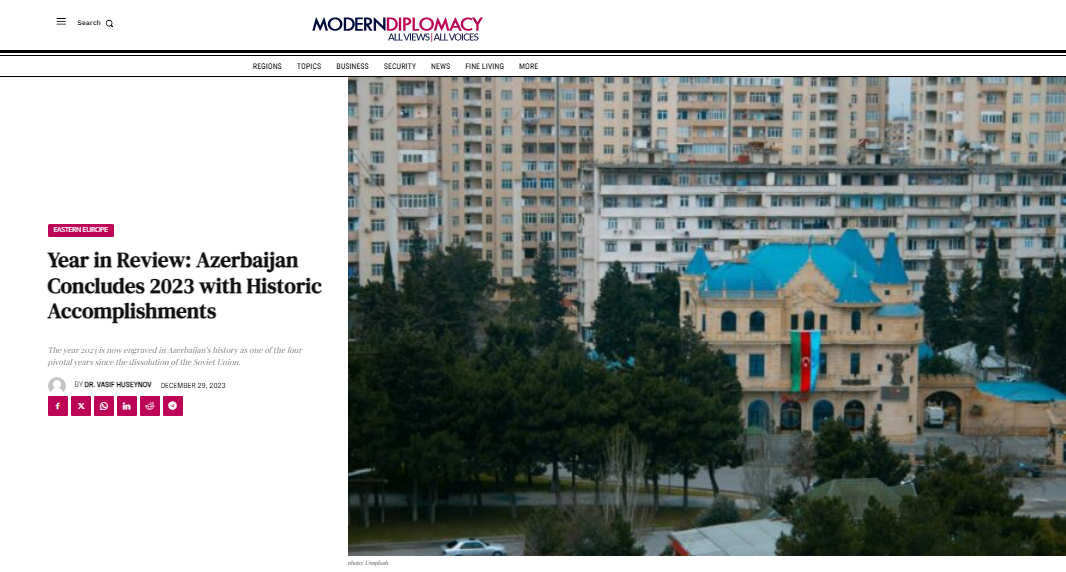
Year in Review: Azerbaijan Concludes 2023 with Historic Accomplishments


The year 2023 is now engraved in Azerbaijan’s history as one of the four pivotal years since the dissolution of the Soviet Union, alongside 1991 (the restoration of independence), 1993 (Heydar Aliyev’s return to the country’s leadership) and 2020 (the 44-day War). In the past year, Azerbaijan accomplished a historic feat by successfully restoring the country’s territorial integrity and securing full sovereignty within its internationally recognized borders. This completed the liberation process of the Azerbaijani territories occupied by Armenia in the early 1990s and solidified President Ilham Aliyev’s role as the chief strategist of this mission. During this period, Azerbaijan attained several other notable accomplishments across various spheres, including the reconstruction of liberated territories, energy exports, and economic diversification. Overall, 2023 stands out as a remarkably successful year for Azerbaijan.

Restoration of Territorial Integrity

20 percent of the internationally recognized territories of Azerbaijan (the Karabakh region and seven adjacent districts) had been occupied by the neighboring Armenia in the early 1990s. The occupation had displaced more than 700,000 Azerbaijanis who were expelled from their homelands through violent ethnic cleansing and massacres. For up to three decades, Baku sought to return the occupied territories through internationally mediated negotiations. These efforts delivered no practical results due to Yerevan’s refusal to de-occupy the territories and its disregard to the international resolutions including the four resolutions of the United Nations Security Council (1993).

In 2020, Azerbaijan had to use military force to put an end to this illegal occupation and liberated significant part of the region in the course and aftermath of the war which went down in history as the Second Karabakh War or the 44-day War (September 27 – November 10). The war, however, left a part of the Karabakh region under the joint control of the local separatist regime and the peacekeeping mission of the Russian Federation that had been deployed to the area following the 44-day War.

Since then, Baku sought to reintegrate the remaining part of the Karabakh region and the local Armenian community through negotiations that were mediated by Russia, the European Union, and the United States. These negotiations delivered notable outcomes to normalize the Armenia-Azerbaijan relations, and Armenia recognized Karabakh as part of Azerbaijan. However, these efforts had no impact on the reintegration of the Karabakh region, as the local separatist regime refused all calls from Baku for talks. This ended up with another military operation by Azerbaijan which lasted less than 24 hours on September 19-20, 2023 and resulted in the dissolution of the separatist regime on September 28.

The collapse of the separatist entity undeniably stands as one of the most historic achievements in Azerbaijani history, as the nation shattered the shackles of frozen conflicts in the former Soviet space, setting a model for other countries (e.g. Georgia and Ukraine) who are facing similar challenges. This firmly cements the position of the country’s leader, President Ilham Aliyev, in Azerbaijani history, making an accomplishment that few would have deemed possible even a couple of months prior to the 2020 war. Despite the highly confrontational geopolitical landscape in the South Caucasus and the external powers’ manipulation of the conflict, Aliyev’s strategic approach proved remarkably successful and boosted his popularity amongst the citizens.

Reconstruction of liberated territories

The liberation of the Karabakh region and surrounding territories disclosed all the destruction and plundering committed by Armenia in those areas during the years of occupation. “Everything is devastated – the infrastructure is destroyed, residential and administrative buildings are demolished”, President Aliyev declared in his address to the nation on December 1, 2020. Immediately following the war, Baku launched extensive reconstruction process to bring life back to once vibrant cities and villages of the Karabakh region.

The reconstruction of the liberated territories is a costly and lengthy process which is being carried out in the face of a number of challenges. On the one hand, the contamination of the region with landmines and other explosive materials and Armenia’s refusal to provide all accurate maps of the mined areas dramatically delay the reconstruction and increase its costs. On the other hand, the reconstruction of the cities and villages from scratch requires huge financial resources which will take several years for Azerbaijan to deliver.

The nation is undertaking the reconstruction of the liberated territories using its own resources, with no international assistance and without resorting to loans. To date, 7 billion USD from the state budget have been invested in reconstruction and restoration efforts. A further allocation of 2.4 billion USD is planned for 2024. As outlined in the state program aimed at facilitating the return of internally displaced people (IDP), an estimated total of approximately 30.5 billion Azerbaijani manats (equivalent to around 18 billion USD) is anticipated to be expended between 2022 and 2026. In accordance with this program, 34,500 families or 140 thousand of Azerbaijani citizens are planned to be resettled in this region by 2026. More than a thousand families have already returned to different parts of the liberated territories.

Energy exports and economic diversification

Over the past year, the Azerbaijani economy successfully rebounded from the challenges posed by the Covid-19 pandemic. The country managed to uphold macroeconomic stability and stimulate economic growth, particularly within the non-oil and gas sector. This achievement is also reflected in the reduced inflation rate and the surplus in the balance of payments. Currently, Azerbaijan boasts strategic foreign exchange reserves totaling 68.3 billion US dollars, equivalent to 97 percent of the GDP.  These reserves surpass the country’s direct foreign debt, which is 10 percent of the GDP, by a factor of 10.

Official estimates project a positive macroeconomic outlook for 2024, anticipating real growth in the country’s economy, a manageable inflation level, and a surplus in the balance of payments. The budget for the upcoming year sets the price of oil at 60 US dollars. The government expects that the non-oil revenues of the state budget will exceed 75% of current expenses in 2024. Thus, the predicted average annual rate of economic growth is 2.9%, as well as 4.8% for the non-oil sector.

Nevertheless, the energy sector maintains its pivotal role in the Azerbaijani economy. In 2023, Azerbaijan has built upon the achievements it has already realized in this field since the early years of the country’s independence. This year, Serbia joined the countries purchasing natural gas from Azerbaijan after the Serbia-Bulgaria Gas Interconnector was launched in the Serbian city of Niš on December 10. The launch of this interconnector played a critical role in the expansion of the geography of Azerbaijan’s gas exports in Europe.

“We currently export our natural gas to eight countries, and Serbia is the ninth country. Seven of these nine countries are European, and, of course, today’s ceremony, the launch of the interconnector will make an important contribution to European energy security,” President Aliyev said in his speech at the inauguration of the Serbia-Bulgaria Gas Interconnector.

The Azerbaijani government is confident that the amount of natural gas exports will steadily grow in the upcoming years and reach the target of 20 billion cubic meters (bcm) per year by 2027, as envisioned in the energy deal between Azerbaijan and European Union (EU) in 2022. “The numbers already show that we are confidently moving towards this goal,” President Aliyev said in his afore-mentioned speech, explaining that Azerbaijan exported just over 8 billion cubic meters of gas to Europe in 2021 which will rise to about 12 billion cubic meters for this year.

In 2023, Azerbaijan advanced in the development of the renewable energy sector, recognized as a key avenue for economic diversification in the country. Presently, Azerbaijan’s renewable energy potential surpasses its installed capacity by a factor of four. By the close of 2023, the country has achieved an installed electricity production capacity of 7.5 GW, yet its economically viable renewable energy potential is notably higher, reaching approximately 27 GW.

The significant strides achieved by Azerbaijan in the field of renewable energy played an important role in the country’s successful bid to host the 29th Conference of Parties (COP29) to the UN Framework Convention on Climate Change, a highly prominent international event. The symbolic and politically significant support extended by Armenia in favor of Azerbaijan’s candidacy added another layer of significance. This support materialized as part of a bilateral agreement between Baku and Yerevan on December 13, wherein both nations committed to the mutual release of prisoners detained at various times since the end of the Second Karabakh War.

As the Azerbaijani government prepares to take center stage at COP29 next year, the conference will not only serve as a platform for global collaboration against climate change but will also stand as a symbol of peace and cooperation in the South Caucasus. The resolution of the Armenia-Azerbaijan conflict and full restoration of Azerbaijan’s territorial integrity in 2023 opens a new chapter in the interstate relations of the South Caucasus.

https://moderndiplomacy.eu/2023/12/29/year-in-review-azerbaijan-concludes-2023-with-historic-accomplishments/


Categories
South Caucasus News

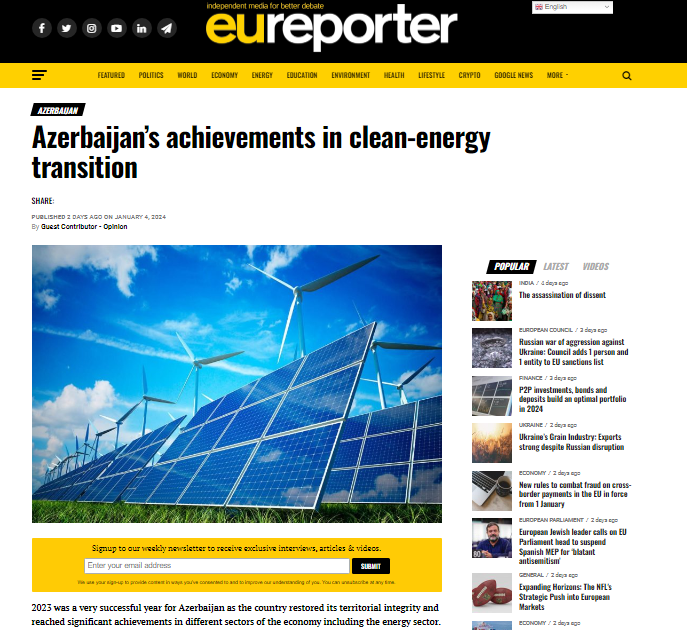
Azerbaijan’s achievements in clean-energy transition


 It is worth noting that the energy sector plays a key role in Azerbaijan’s economy and, driven by its natural resources, the country’s energy production is strongly tied to fossil fuels. The finalization of the Southern Gas Corridor (SGC) enables the country to export its natural gas to the European energy markets. In 2016, the country signed the Paris Agreement on climate change, which set up a goal to reduce greenhouse gas emissions (GHG) by up to 35 per cent by 2030. Overall, Azerbaijan aims to export not only fossil fuels but also green energy to Europe. To this end, the country has already started to develop its renewable energy capacity, and one of the country’s primary goals is to support a sustainable energy future.

According to calculations, the technical potential of renewable energy in the country is around 135 GW onshore and 157 GW offshore, which is an important source for the generation of electricity to support energy transition and sustainable development. Renewable energy sources are expected to make up 30 per cent of Azerbaijan’s electricity generation by 2030. Such potential of the country would help the country save natural gas for exports as well as reduce the country’s GHG emissions to meet its 2030 Paris Agreement commitment and improve electricity security by diversifying generation. 

Touching upon Azerbaijan’s clean energy strategy, it should be noted that the country supports the creation of “Green energy” zones and the attraction of international investments in the green energy sector. Towards this end, Azerbaijan has already started cooperation with Saudi-listed ACWA Power, the UAE’s clean energy powerhouse, and one of the world’s fastest-growing renewable companies, Masdar and BP to implement various green energy projects in the country. In 2023 the country accelerated the process of development of green energy,   therefore Masdar has signed agreements for solar and onshore wind projects with a total capacity of 1GW in Azerbaijan, following the inauguration of the 230 MW Garadagh Solar Park, the region’s largest operational solar plant. The strategic agreements cover the progression of the first phase of a 10 GW pipeline of renewable energy projects in Azerbaijan signed in June 2022. This follows the successful development of Garadagh, Azerbaijan’s first foreign investment-based independent solar power project.

Also, in 2023 ACWA Power agreed to develop 500 MW renewable energy projects in Azerbaijan’s Nakhchivan Autonomous Republic with Masdar and the State Oil Company of Azerbaijan Republic (SOCAR). ACWA Power signed implementation agreements with the Azerbaijani Ministry of Energy for a 1GW onshore wind farm and a 1.5 GW offshore wind farm with storage.  It has an agreement with SOCAR for collaboration and exploration of renewable energy and green hydrogen. In addition, Masdar has signed agreements to develop integrated offshore wind and green hydrogen projects and onshore wind and solar projects with a total combined capacity of 4 GW.

It is noteworthy to mention that President Ilham Aliyev supports a sustainable energy future in the country, thus transforming Azerbaijan into a “green energy hub” is a key component of the country’s energy policy. Speaking at the inauguration of Garadagh Solar Park, President Ilham Aliyev emphasized that “Karabakh, East Zangezur, and Nakhchivan have already been declared a green energy zone. There is a significant potential to use our natural resources, one of which is apparently the wind. Of course, among our plans is to work actively with our partners to create an energy corridor – Caspian-EU Energy Corridor”.

Overall, the abundant renewable energy resources in the region can support the green energy ambitions of Europe. These resources can also contribute to achieving the target rate- 42.5% (by 2030) of renewable energy in the continent. To this end, Georgia Azerbaijan, Romania, and Hungary signed an agreement on the development of the high-voltage submarine electricity cable under the Black Sea, which will support the “Green Energy Corridor” across the region. This energy project will be the longest power cable underwater in the world, aiming to connect the South Caucasus region with South-Eastern Europe, involving the electricity systems of these countries and continental Europe.

The culmination of Azerbaijan’s success in the green energy sector and sustainable development for the 2023 year was the country’s success in hosting the 29th Conference of Parties (COP29) to the UN Framework Convention on Climate Change in 2024. The significant achievements in the energy sector and future vision for sustainable development made Azerbaijan an ideal candidate country to win the backing from other Eastern European countries to host such an important international event.  As noted on President Ilham Aliyev’s Facebook page, “Azerbaijan consistently supports global climate action and implements various energy efficiency measures. Clean environment and green growth are among our national priorities. Renewable energy is gaining momentum in Azerbaijan.” 

To sum up, Azerbaijan’s path to a sustainable energy future supports global efforts to cope with climate changes and inter-regional energy cooperation. Meanwhile, the end of the Garabagh conflict in the South Caucasus opens up new opportunities for regional economic integration, and Armenia’s support of Azerbaijan’s bid to host COP-29 could be characterized as a significant mechanism for future durable peace in the region. 

https://www.eureporter.co/world/azerbaijan-world/2024/01/04/azerbaijans-achievements-in-clean-energy-transition/


Categories
South Caucasus News

Boeing 737 MAX 9 suspended in Europe for inspections


The European Aviation Safety Agency (EASA) has ordered the grounding of Boeing 737 MAX 9 aircraft following a recent incident involving a passenger airliner of this type

Categories
South Caucasus News

Japan’s top diplomat makes surprise Ukraine visit amid support concerns


Japanese Foreign Minister Yoko Kamikawa made a previously unannounced visit to Ukraine on Sunday — her first trip to the war-torn nation as Japan’s top diplomat — amid concerns of dwindling support in some countries for Kyiv’s nearly 2-year attempt to fen

Categories
South Caucasus News

32 arrested for terrorist attack in Iran


32 people were arrested in connection with the terrorist attack in the city of Kerman, Iran.

Categories
South Caucasus News

Azerbaijan among top five countries opening company in Antalya last year


Azerbaijan was among the top five countries that opened a company in Antalya last year, Report informs citing the local press.

Categories
South Caucasus News

US military says it shot down another Houthi-launched drone over Red Sea


US military forces shot down a drone early Saturday over the Red Sea in international waters near several commercial vessels

Categories
South Caucasus News

Uzbekistan becomes world’s largest gold seller for the second month in a row


Uzbekistan became the world’s largest seller of gold for the second month in a row, Azernews reports, citing Kun.uz News Agency.

Categories
South Caucasus News

Azerbaijan’s CEC registers 72 int’l observers for upcoming presidential election – News.Az


Azerbaijan’s CEC registers 72 int’l observers for upcoming presidential election  News.Az