
Day: January 3, 2024
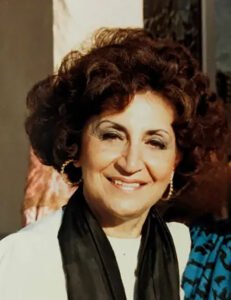 Anne Atanossian
Along the road of the journey of life on earth, we are blessed to meet people who change our vector and inspire us to new heights. Whether they are chance encounters or long-term friendships, they are all worthy of remembrance, because they influenced who we have become. I have been fortunate to meet many such people along my path who have had a significant influence on my identity. We lost Anne Atanossian a few weeks ago, and her impact will not end with the conclusion of her earthly life. Anne was a long-time part of the Washington, D.C. Armenian community who galvanized many through her grace, intellect and example. Great role models do not look for followers or those to mentor. It is a much more organic process that occurs as a result of their talent and humility. Such was the case with Anne.
My encounter with her brilliance began in 1971. I was in my late teens and in the early stages of my bond with our Armenian cause. Armenian political activism was also in its infancy, as this was a time before the Armenian National Committee of America (ANCA) and Armenian Assembly. It was 20 years before the independence of Armenia. Advocacy for genocide recognition was a diaspora project managed by emerging committees and campaigns. Anne and her beloved husband Harry had an idea to bring together activists of all generations in Washington to protest against Turkish denial. They formed an ad hoc committee called the Action Committee for Armenian Rights (ACAR). The small but organized group sponsored several activities, but the highlight was a demonstration in Washington in April 1971. They partnered with respected patriot Dr. Haigaz Grigorian to begin a new chapter in our struggle for justice in the nation’s capital.
My involvement up to that point was limited to a few rallies in Boston and one memorable trip to the United Nations. The ACAR publicized the demonstration to the communities on the east coast. Our family became aware of the rally through the Armenian church network. My father Carnig, an ardent Armenian patriot and WWII veteran, suggested we attend. He drove my sister Priscilla, my friend Varoujan and me from Indian Orchard to D.C. The rally was well attended and held in the shadow of the Turkish embassy. It was there that I first met Anne and witnessed her magnetic leadership. Her organizational skills and passion for Armenian rights were inspiring to the hundreds of young Armenians in attendance. Political activism was a recent phenomenon for our generation—a generation eager to apply our knowledge of the injustices against our people. Similar to many of my peers, we were the beneficiaries of a heritage-based education that provided a foundation for contributing to our cause. Over that weekend, Anne became a beacon for us, as we marveled at her ability to connect people to a common purpose. During a small group gathering, it became obvious that she deeply cared about the youth and was an incredibly effective motivator. That weekend was a watershed event in my entry into Hai Tahd. Anne and Harry continued their efforts with the ACAR until the spark they lit ignited new national efforts.
We must always remember and respect those who had the foresight and courage to trailblaze. Anne left a huge footprint in the growth of political activism in this country. I remember that weekend and subsequent activities as if they occurred yesterday. This vivid recollection is attributed to the impact they had on my own journey. There have been countless demonstrations, advocacy campaigns and educational processes, but I have often thought about Anne and Harry. For myself, and I would assume many others, it began on those streets in Washington.
Years went by, and my path crossed with the Atanossians a few times, but in 2011 an unexpected encounter brought the past to the present. Our family made our first trip to Armenia that year and joined a small tour group. We grew close with an Armenian woman named Noni (Nazeli DeBlasio) from New York who also was visiting for the first time. Typical of Armenians and the interconnecting branches of many dialogues, we quickly discovered that she had been in the Long Island AYF and attended the St. Sarkis Church. Under the shadow of eternal Ararat, our conversation shifted into our history and the Genocide. Noni asked me how I got involved. I told her about my teenage years in New England, the special experience in Washington and the couple who led this life-changing event.
When I mentioned Anne and Harry, Noni looked stunned and declared that they were her dear aunt and uncle (Harry was her mom’s brother from Providence). Older memories instantly became current, as I learned more about this incredible couple. During that conversation and subsequent discussions, I shared with Noni my deep respect for Anne and the impact she had on many of us. Noni was kind enough to keep us informed of her status over the years, and it was she who called me with the sad news of Anne’s passing. I believe that with faith there are no coincidences. Our paths crossing with Noni created a beautiful friendship and gave us wonderful insight into Anne and her extended family. It also enabled me to recall some very important years and articulate to others their meaningful impact. I am fortunate to have learned about this incredible individual who led one of the most important inflection points in my life as an Armenian. A pilot light was lit that has never extinguished. Anne belongs on the list of those to whom I am eternally grateful.
Leadership requires the courage to focus on the mission and ignore the noise. Her love of our culture and community fueled a unique and inspiring brand of leadership.
When I decided to tell this story, I wanted to seek the wisdom of one of Anne’s peers from those incredible early days. After asking several friends who were a part of the Washington scene during that time, most suggested that I speak with Eleanor Caroglanian. Eleanor and her husband Oscar were close friends of Anne and Harry for decades. They were equally active in the community, and Oscar led the remarkably successful 70th anniversary commemoration of the Armenian Genocide at Arlington National Cemetery. From my observations of Anne during those early activist days, it was apparent that she was a very talented woman who willingly shared her gifts with her people. After speaking with Noni and Eleanor, I learned that she was truly a Renaissance woman. More than 50 years ago, Anne was one of the few female leaders in our community, and I am certain that she inspired many young Armenian women and men to greater heights. Leadership requires the courage to focus on the mission and ignore the noise. Her love of our culture and community fueled a unique and inspiring brand of leadership. Professionally, Anne was equally remarkable. For many years she was the head of the English department at Wheaton (Md.) High School. She was a prolific writer and always responded with grace when her talents were needed. Anne was quite fluent in Shakespearean literature, and she practiced her knowledge as an actor in the prestigious Arena Theatre in Washington. Anne was able to willingly contribute to her communities in a variety of ways with her speaking, writing and acting capabilities. Consider for a moment how many high school students she must have motivated and mentored simply through her natural ability.
Anne was originally from New York, and her family moved to the Washington area after the war. She met her husband Harry through the AYF, and they made their life together in the metro D.C. area. In addition to being an early role model of female leadership in the Armenian community, she was a beloved wife, mother, aunt, cousin and friend to many during her extraordinary life. The breadth of her impact is so extensive that it reminds me of the adage, “If you want to accomplish something, ask a busy person.” Several individuals who knew her well speak often of her intelligence and talent. I was impressed that they also spoke of these attributes with immense respect, which is a clear indication of her compassion and humility.
Our life on earth is sometimes referred to as a journey, during which we are privileged to meet some very special people. Perhaps they mentored us at a critical juncture of our lives or provided us the support that we all need at some point. As Armenians in America, we have the unique and rewarding opportunity to meet people who become friends for a lifetime in various geographies. Sometimes we meet people briefly who we will never forget. Anne Atanossian was one of those special people. I always have high regard for those with vision. When Anne and Harry decided to do something special for Genocide recognition, we had very little infrastructure. It took vision, energy and courage to overcome the obstacles, as our “reawakening” was in its early moments. It took someone like Anne to fulfill that opportunity, and we should all be thankful for the footprint she left for our cause. After those early days, our advocacy and activism went through a period of remarkable growth, due in part to the work of those early trailblazers.
It has often been said that the greatest legacy is to be remembered. A society that fails to remember those who created what we have inherited is indeed shallow. We will always remember Anne, because her legacy is one of unique leadership and inspiration. Her gifts live on through the many who have been impacted by her teaching, writing and opening of doors that were previously closed. We offer our sympathy to her family and are comforted by the knowledge that she has been reunited with her husband and son. Those of us continuing our earthly life will remember her for the important pillars that she established for the foundation we enjoy today. Asdvadz Hokin Louysavoreh. May God illuminate her soul.
Author information
Stepan Piligian
Columnist
Stepan was raised in the Armenian community of Indian Orchard, MA at the St. Gregory Parish. A former member of the AYF Central Executive and the Eastern Prelacy Executive Council, he also served many years as a delegate to the Eastern Diocesan Assembly. Currently , he serves as a member of the board and executive committee of the National Association for Armenian Studies and Research (NAASR). He also serves on the board of the Armenian Heritage Foundation. Stepan is a retired executive in the computer storage industry and resides in the Boston area with his wife Susan. He has spent many years as a volunteer teacher of Armenian history and contemporary issues to the young generation and adults at schools, camps and churches. His interests include the Armenian diaspora, Armenia, sports and reading.
|
The post A Tribute to a Renaissance Woman and Trailblazer…Anne Atanossian appeared first on The Armenian Weekly.
An ongoing land dispute between the Armenians of Jerusalem and a real estate company with alleged ties to settler organizations escalated on December 28 when the Armenian community was attacked by a group of masked men.
A group of 30 people wearing ski masks entered the Cows’ Garden in the historic Armenian Quarter of the Old City of Jerusalem and deployed pepper spray, batons, attack dogs and stones. A dozen community members were injured, including several priests and students of the Armenian theological academy.
The Armenian community has organized over the past two months to defend the Cows’ Garden, or Goverou Bardez, from attempts by developers to seize and demolish it. The Armenian Patriarchate of Jerusalem canceled a controversial deal in October that would lease the Cows’ Garden to a real estate company to build a luxury hotel. Since then, the company, which allegedly has ties to Israeli settler groups, has sent bulldozers and armed groups to take the land and commence construction by force. For the past two months, Armenian community members have launched a 24-hour sit-in to protect the Cows’ Garden, setting up tents and mattresses and refusing to move.
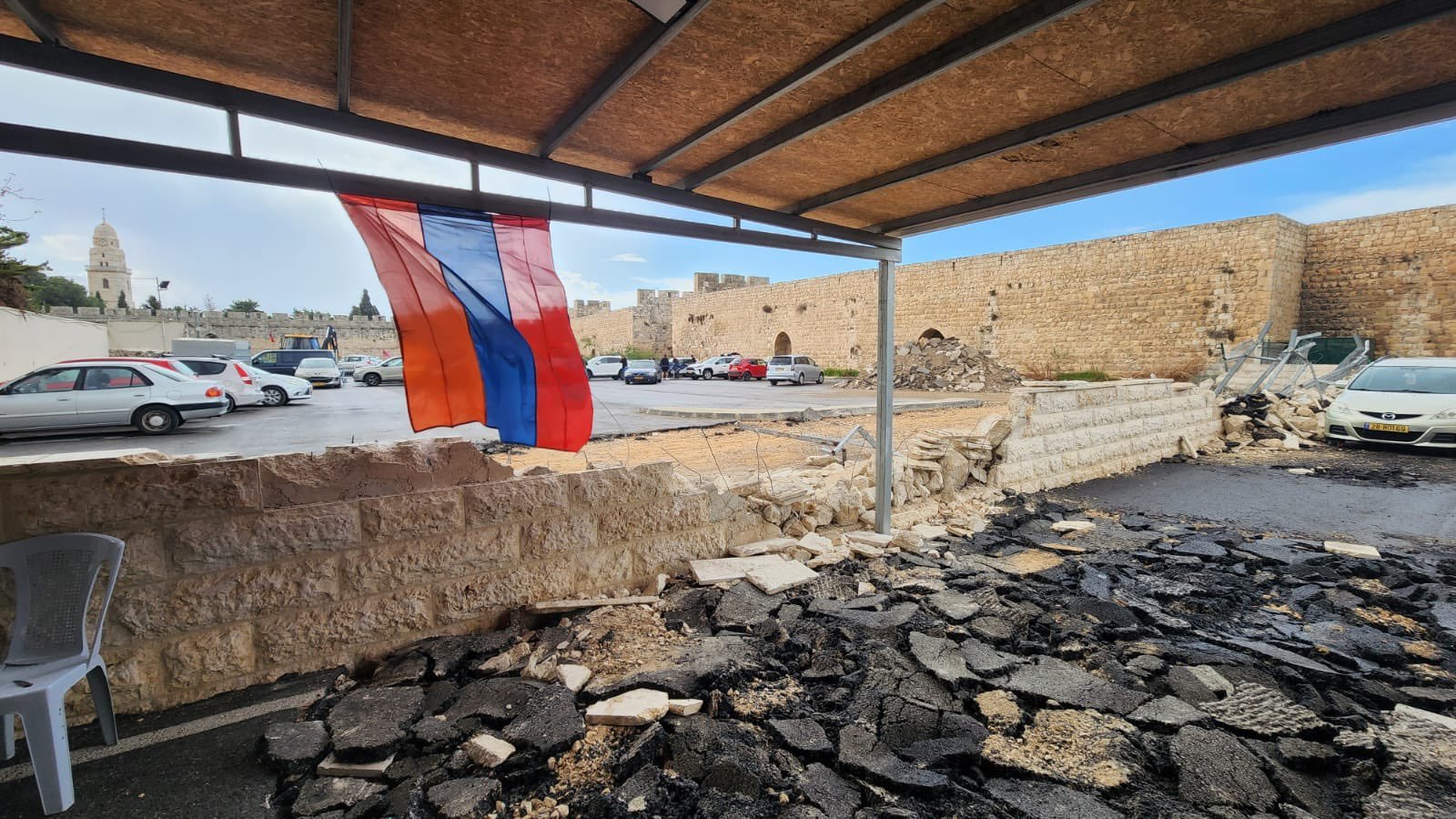 Photo Credit: Vince Kahkejian
The Armenian Quarter is home to the oldest Armenian diaspora in the world. “The Armenian Quarter, representing 1/6 of the Old City, has been inhabited by Armenians since the fourth century during the inception of Christian pilgrimages to Jerusalem, adding to its historical and cultural richness,” reads a joint statement from Bedross Der Matossian, professor of Modern Middle East History at the University of Nebraska-Lincoln, and author Mary Hoogasian.
“Since the 1300s, this plot of land has been acquired through blood, sweat and a lot of financial help from the entire Armenian community,” Kegham Balian, Weekly columnist, Jerusalemite Armenian writer and media coordinator for Save the ArQ, told the Weekly regarding the Cows’ Garden. “Refugees used to come here. Pilgrims used to come here, set up tents and get nourished from the farm. To have it whisked away with a simple signature, with just the stroke of a pen, is catastrophic.”
A court confirmed that the 30 men who participated in the December 28 attack were hired by Xana Capital, the real estate company involved in the deal, according to Balian. He said Xana Capital has recruited groups of either Israelis or Arabs to participate in repeated, attempted attacks on the Cows’ Garden, providing them with false information about the purpose and targets. “It’s the classic modus operandi of settler-backed organizations. They try to make it seem like a religious altercation to pit different communities against each other,” Balian said.
“It’s not a Jewish-Armenian issue. It’s not a Muslim-Armenian issue. It’s an issue with Xana Capital,” he continued.
No matter how many times they try.
No matter how many settlers they bring.
No matter how many terrorists they bring.
No matter how many guns they point at us.
We will not be intimidated, we will not back down, and we will protect our Armenian community and 2,000-year-old… pic.twitter.com/KBFboFHlQh
— SaveTheArQ (@SavetheArQ) December 28, 2023
Arriving at the Cows’ Garden following the attack, Israeli police arrested two Armenian community members, Paul Djernazian and Bedig Giragossian. About a dozen Armenians have been detained so far while participating in the ongoing sit-in, including Kegham’s brother Setrag Balian, the co-founder of Save the ArQ, and one minor, a 17-year-old. Those detained are typically held for a few hours then released. According to Balian, none of the Armenians who have been detained were engaging in violence or in a physical altercation.
Yet Djernazian and Giragossian are the first to have been arrested. They were taken to a high security prison outside of Jerusalem and placed in cells along with members of the armed group who had attacked the Cows’ Garden. Djernazian slept on a cement floor with a thin blanket and his slippers under his head, afraid they could be stolen. Djernazian and Giragossian were released by the court two days later. While the police appealed the court’s order, the Jerusalem District Court rejected their appeal.
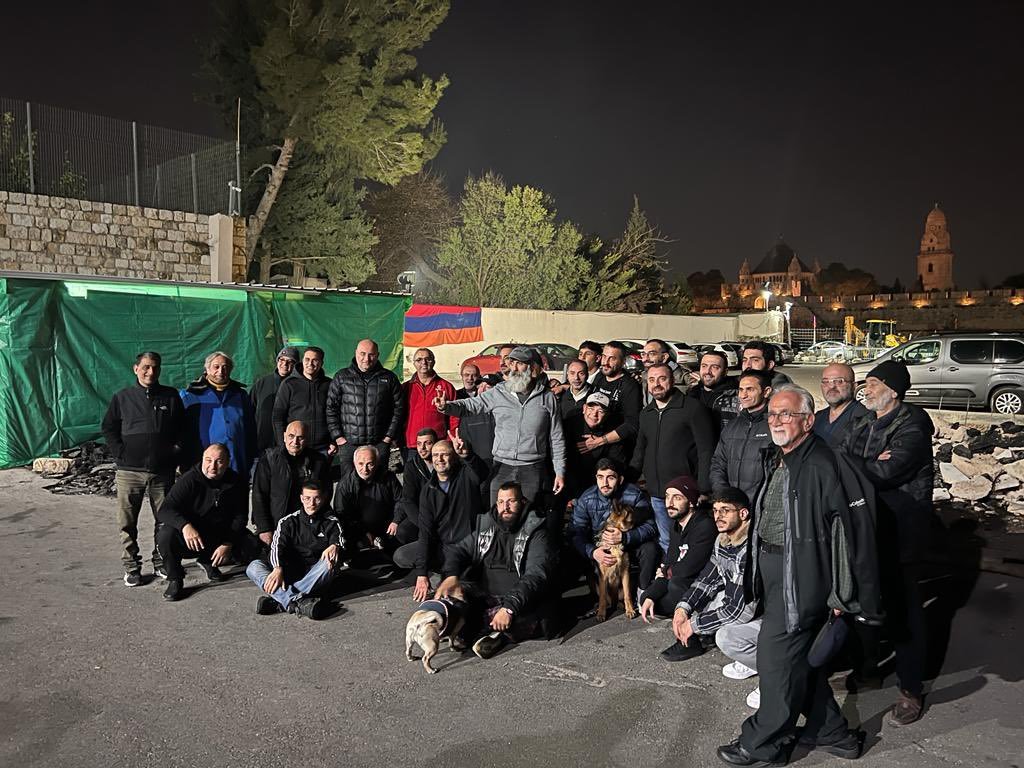 The Armenian community celebrating the release of Paul Djernazian and Bedig “Kach” Giragossian
The land dispute revolves around a controversial deal signed between the Armenian Patriarchate and Xana Capital in 2021. The 99-year lease agreement granted the real estate company, led by Australian-Israeli investor Danny Rothman (also known in documents as Danny Kaufman or Rubenstein), about 25-percent of the Armenian Quarter. The agreement included a parking lot used by the entire community, five residential Armenian homes and the patriarchate’s seminary hall, all located in the Cows’ Garden.
“The more they attack, the more resilient and resolute we become in our goal of preserving and protecting our heritage. By intimidating us, they think we will be deflated and demoralized, but clearly they have never dealt with Armenians. Our community isn’t violent. We’re peaceful, but we’re not stupid,” Balian said.
The secretive agreement was reached without the knowledge or consultation of the Armenian community of Jerusalem and came under intense scrutiny by the community, clergy and Armenian lawyers from the United States. Pressure on the Patriarchate to cancel the deal heightened when the Palestinian Authority and Jordan withdrew their recognition of Armenian Patriarch Nourhan Manougian in May 2023, believing that the deal threatened the status quo in the Old City.
After the Patriarchate nullified the agreement on October 26, citing “false representation, undue influence and unlawful benefits,” Xana Capital resorted to sending bulldozers and armed groups to the Cows’ Garden to start construction by force. So far they have partially torn down the wall that separates the main parking lot from that of the Patriarchate. For two months, the Armenian community has staged a peaceful sit-in to protect the Cows’ Garden from further destruction.
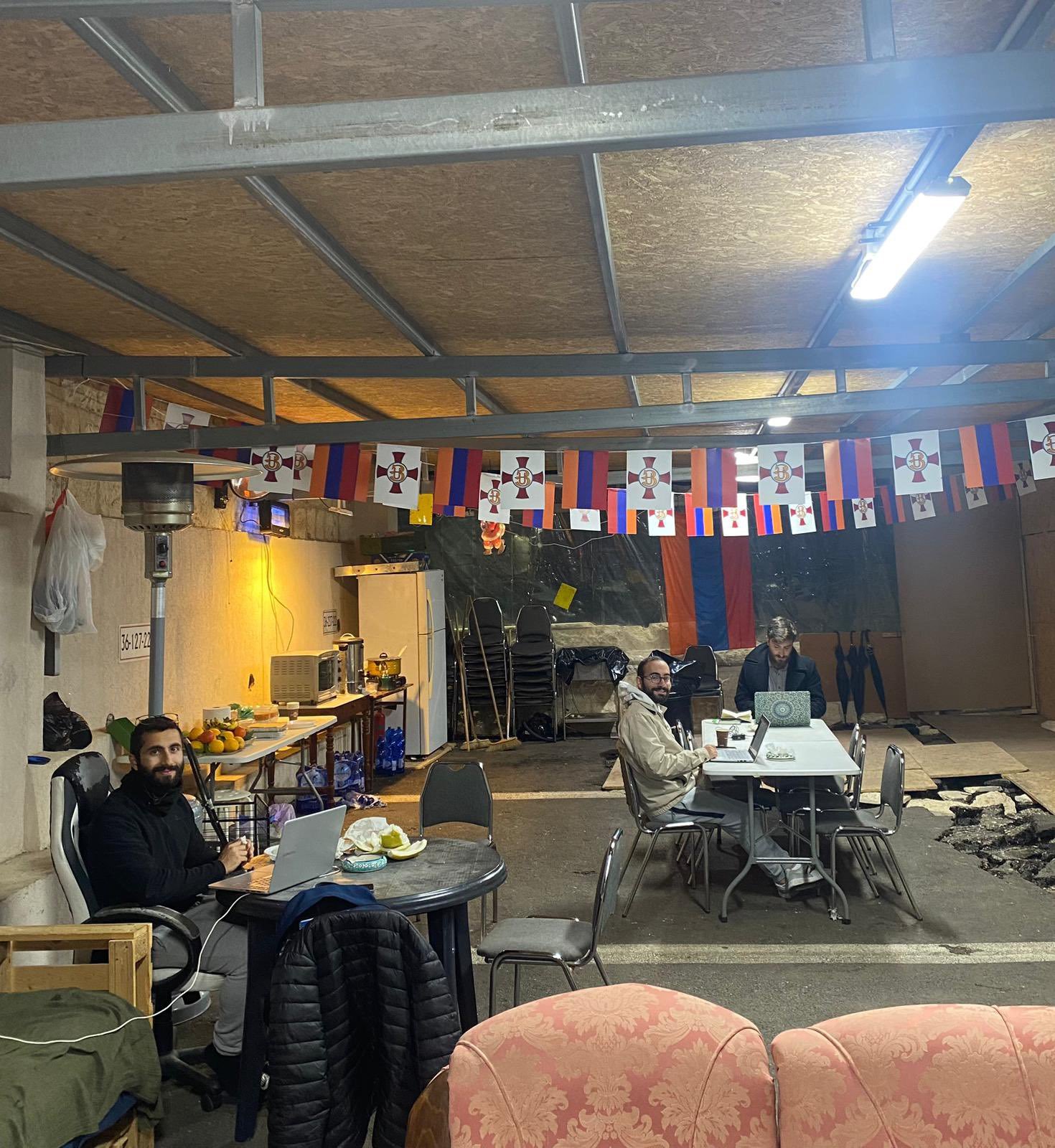 Members of Save the ArQ burning the midnight oil
On November 5, Rothman entered the site with a group of 15 armed Israeli settlers and attack dogs. They reportedly demanded the expulsion of Armenians from the Cows’ Garden and called it their land. Alerted to their arrival, local Armenians joined the protest. After several hours of an intense stand-off, the settlers and Armenian community members were forced to disperse.
On November 12, a bulldozer arrived at the Cows’ Garden to continue demolition work. A group of Armenian protesters gathered to block access to the site with cars and fences.
A motorcade of Israeli settlers returned to the Cows’ Garden on November 15 on vehicles and motorbikes. Israeli police arrived on the scene and detained three Armenian community members participating in the peaceful protest.
In response, the Armenian Patriarchate released a statement on November 16 accusing the developers attempting to build on the Cows’ Garden of disregarding its cancellation of the lease agreement. “[They] have instead elected for provocation, aggression and other harassing, incendiary tactics including destruction of property, the hiring of heavily armed provocateurs and other instigation,” the statement reads.
“In recent days, the vast destruction and removal of asphalt on the grounds of the Armenian Quarter has been done without the presentation of permits from the municipality by neither the developer nor the police,” the statement continues.
For Balian, the crisis facing the Armenian Quarter represents another threat to historic Armenian land, following the fall of Artsakh in September 2023 and the ethnic cleansing of its Armenian population by Azerbaijan. “We saw our brothers and sisters get bombarded and butchered during the Artsakh War. It was a moral obligation on our part to defend this land, to prevent another loss of land,” Balian reflected. “We felt like we needed to do this to protect and preserve our heritage. Enough is enough.”
Author information
Lillian Avedian
Lillian Avedian is the assistant editor of the Armenian Weekly. She reports on international women’s rights, South Caucasus politics, and diasporic identity. Her writing has also been published in the Los Angeles Review of Books, Democracy in Exile, and Girls on Key Press. She holds master’s degrees in journalism and Near Eastern studies from New York University.
| Twitter |
The post “The more they attack, the more resolute we become” appeared first on The Armenian Weekly.