
https://t.co/heuddp9MMH #News #Times #NewsAndTimes #NT #TNT #Israel #World #USA #POTUS #DOJ #FBI #CIA #DIA #ODNI #Mossad #Putin #Russia #GRU #Ukraine #SouthCaucasus #NewAbwehr #Bloggers
— Michael Novakhov (@mikenov) January 3, 2024
Day: January 2, 2024
I was recently at St. Gregory the Illuminator Church in Chicago for a concert. I noticed a photo, black and white, taken at a banquet at the Sheraton Towers on June 25, 1960, in honor of the visit of Catholicos Vazken I, of blessed memory. The photo was taken from a balcony and showed the head table and at least 30 tables of 10 people that could fit in the shot. Everyone was dressed up—to the nines as they used to say. My guess is there were 350-500 people in attendance.
The photo was impressive, not only because it captured a celebration of a Pontifical visit, or coincidently, that it was taken on the evening of my seventh birthday. It was something more—something nostalgic. There have been photos like this in every Armenian church, agoump or getron, in commemorative and souvenir booklets. These photos, always in black and white and from an aerial vantage point, keep us rooted to the past. They are always taken from an aerial vantage point, in the grand ballroom of a swanky downtown hotel. They capture the gatherings of Armenians in the U.S. honoring or commemorating something—a convention, the founding of a church, the burning of a mortgage, or perhaps the 25th anniversary of this or the 30th anniversary of that.
I am sure these photos are not unique to the Armenian community. Every ethnic group, church, civic or professional organization likely has similar photos.
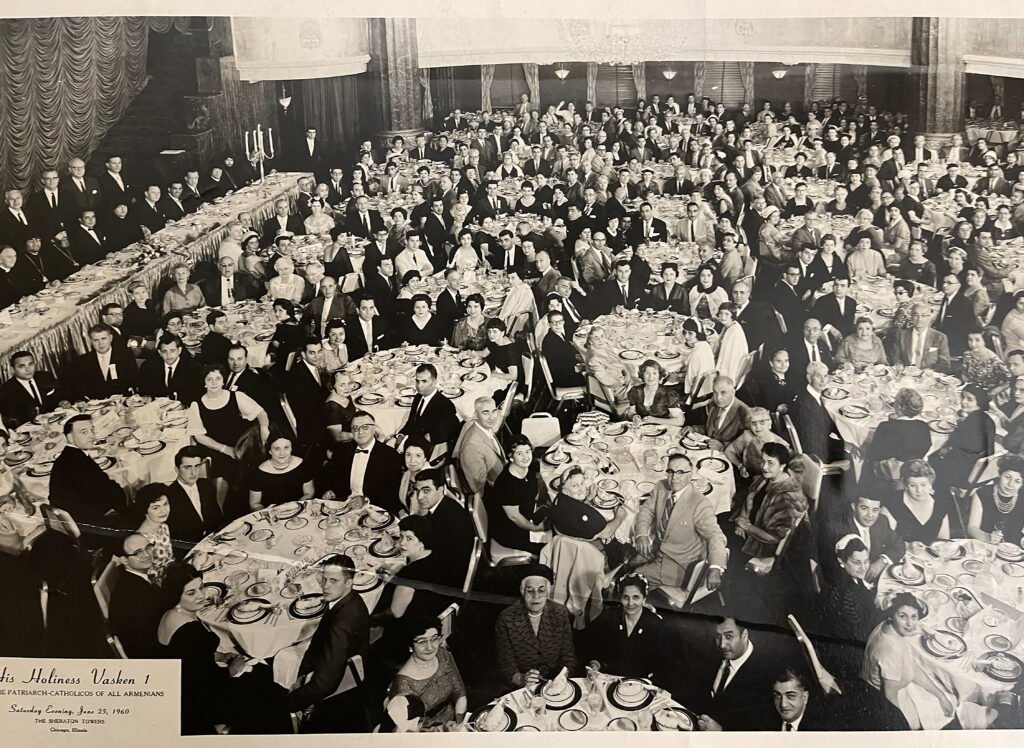 Banquet at the Sheraton Towers in Chicago on June 25, 1960, in honor of the visit of Catholicos Vazken I, of blessed memory
From my perspective, I have seen more Armenian banquet photos than any others. These panoramic photos have impressed me for years, especially those from the 1930s and 1940s. These photos of hundreds of Armenians, dressed in their finest gathered in luxurious ballrooms, were taken just 15-30 years after the Genocide. It is hard to distinguish faces pictured beyond the front two rows of tables, and if the photo is not from Detroit, where I grew up, there is almost zero chance I will recognize anyone. Yet, I am mesmerized by these photos. I look at and study them much longer than I would a masterpiece in an art museum. It is a window to the first generation, the survivors of the Genocide. Who is the baker, the butcher, the storekeeper, the rug merchant? Who are the factory workers and common laborers? To me, they all seem to say, “Look at us. We not only survived but are thriving. We miss our homeland, but look at us.”
Why don’t we see more banquet photos these days? We certainly have photos of participants and delegates of various conventions, Armenian and Sunday School students, and gatherings on the steps of churches or other venues. We took photos like these then and certainly today. Yet, we almost never see these kinds of banquet photos anymore.
The answer is probably quite simple. These days we rarely use the grand city center hotels. Most of our banquets and dinners are held in suburban hotels and banquet halls. These venues were probably built after 1960. They all have something in common—none of them have balconies. It is almost impossible to get these kinds of photos without a very tall ladder or perhaps a drone. It seems these kinds of photos just faded away with the change in architecture and interior design of the newer, more “modern” venues.
There are a few modern versions of this genre of nostalgic photos. Maybe, given how many images are created these days, we should leave these panoramic banquet photos to the black and white era of that first generation.
Author information

Mark Gavoor is Associate Professor of Operations Management in the School of Business and Nonprofit Management at North Park University in Chicago. He is an avid blogger and oud player.
|
The post Chidem Inch: Old Banquet Photos appeared first on The Armenian Weekly.
This week’s commentary is a lesson for all those who naively believe what they hear or read and then pass on unsubstantiated stories to others. By doing so, they are actually helping to spread fake news. When someone gives you a piece of ‘news,’ you should always ask, ‘What is your source?’ When the answer is, ‘I heard it from someone else,’ immediately dismiss what was said to you. It is critical to verify what you are told in order not to disseminate baseless rumors to others.
Those of us who are in the news business have a bigger responsibility to be vigilant, because if we do not double-check what is being reported to us, then we become guilty of spreading fake news to thousands of readers or viewers.
Here is an example of a news item we just heard about. A 57-year-old entertainment producer, Armen Grigoryan, who died in Armenia, was found guilty by a judge in Armenia last week, a year and five months after his death. Not having heard that a dead man can be tried and convicted, I wondered if such a thing really happened.
Since I have had long years of experience hearing all sorts of baseless reports, I immediately contacted the late defendant’s lawyer in Armenia, Ruben Melikyan. Melikyan, the former Human Rights Defender of Artsakh, was kind enough to explain the circumstances of this strange story.
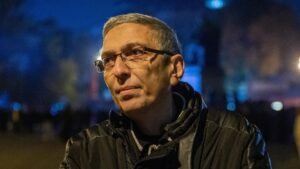 Armen Grigoryan (Twitter)
Grigoryan, during a street protest against the authorities in Armenia in May 2022, shortly before the parliamentary elections, told a reporter that he stood by his earlier statement in April 2021 that half of Prime Minister Nikol Pashinyan’s supporters in certain parts of the country have Turkish blood. Naturally, this was a disparaging remark, but if a country is truly democratic, citizens have the right to use unpleasant, even offensive words. Nevertheless, Grigoryan had not said anything threatening, which would have been against the law.
In May 2022, Grigoryan, a vocal critic of the regime, was arrested and jailed for the statement he had made a year before his arrest. He was charged with ‘inciting ethnic hostility.’ Those accused of such a charge in the past had made offensive or degrading comments about other ethnic groups living in Armenia. However, no Armenian had been charged before with incitement after making such remarks about fellow Armenians. For example, Pashinyan supporters, who have made insulting comments against Artsakh Armenian refugees, have not been charged with incitement.
On July 15, 2022, two months after his arrest, Grigoryan was brought to court from jail to stand trial. Regrettably, in the midst of the trial, he collapsed and died in the courtroom from a brain aneurysm or stroke.
In Armenia, when a defendant dies, his trial is discontinued. However, in this case, according to Armenian law, the defendant’s family has the right to ask that the trial be continued until a verdict is reached. Grigoryan’s lawyer explained that his family wanted to see him exonerated, even though, due to the presumption of innocence (innocent until proven guilty), he was merely charged but not convicted prior to his death. The family insisted that Grigoryan’s name be cleared since they believe that he should have never been arrested, charged and jailed.
Melikyan told me that during the trial, after Grigoryan’s death, a government witness testified in court that he had not written the testimony that was submitted in his name to the court. He said that a government investigator had written the testimony and told him to sign it.
Also, a government expert, who testified in court, admitted that Grigoryan’s words could not be considered an incitement to inter-ethnic hostility, which means targeting members of another ethnic group. Grigoryan had only used offensive words about his fellow Armenians, members of his own ethnic group.
Nevertheless, last week, a year and five months after Grigoryan’s death, the judge declared him guilty of the charge filed against him. His lawyer told me that after the verdict is received in writing, the family has one month to file an appeal, which they intend to do. If they lose in the court of appeal, they will then appeal to the Court of Cassation, which is a Court that hears appeals against decisions of courts of appeal. If they fail there too, they will then go to the European Court of Human Rights.
Having investigated the circumstances of a court in Armenia holding a trial and finding a dead man guilty, I wanted to know if such trials had also taken place in other countries. Surprisingly, I found several cases in ancient and recent history when other countries held posthumous trials of defendants and found them guilty after their death.
Author information

Harut Sassounian
California Courier Editor
Harut Sassounian is the publisher of The California Courier, a weekly newspaper based in Glendale, Calif. He is the president of the Armenia Artsakh Fund, a non-profit organization that has donated to Armenia and Artsakh one billion dollars of humanitarian aid, mostly medicines, since 1989 (including its predecessor, the United Armenian Fund). He has been decorated by the presidents of Armenia and Artsakh and the heads of the Armenian Apostolic and Catholic churches. He is also the recipient of the Ellis Island Medal of Honor.
|
The post Court convicts Pashinyan critic after his death appeared first on The Armenian Weekly.
 Norik Y. Astvatsaturov
Norik Yegishevich Astvatsaturov passed away peacefully at the age of 76 in Wahpeton, North Dakota on December 30, 2023, at 5:45 am from a long battle with cancer. He was surrounded by his loving family. His last words on this earth were, “I’m not afraid.”
A celebration of Norik’s life will be held at Evergreen United Methodist Church on Tuesday, January 23, 2024, at 10:30 a.m., at 1120 Evergreen Court Wahpeton, North Dakota with visitation starting at 9:30 a.m. A funeral service for Norik will be held in Yerevan, Armenia later in the spring.
Everyone who met Norik knew him as he was—soul of the party, jokester, teaser, family toastmaster, Armenian barbecue aficionado, U.S. and Armenia’s national treasure, jaw-droppingly talented award-winning artist, grandchildren’s giggle-instigator and the best advice and hug-giver in the world. He loved sitting outside at the lake, carving wood and creating beauty all around him. Norik was never without candy in his pocket and a newsboy hat on his head. He loved keeping in touch with family spread around the world and maintained a network for decades, ensuring that his children had a connection to family in Armenia. Norik loved a good, loud laugh, good quality tools and a big dinner party. Above all else, he spent his life dedicated to his children and his grandchildren, who he was so proud of. He was a strong, simple, yet such a complicated man, and the world is so much dimmer without him.
Norik was born in Baku, Azerbaijan, former USSR, on December 22, 1947, to his parents Yegishe and Tamara, the oldest of three. From an early age, Norik loved visual art and expressed himself through wood carving and drawing. After returning from compulsory Soviet military service in 1968, he became an apprentice to a metal repoussé artist in Baku, soon becoming a master himself. The metal art he produced, although rooted in traditional and often religious Armenian art history, was mostly based in commercial and Soviet themes. Even under the fear of prosecution, Norik produced customary and traditional decorative metal items such as crosses, family Bible covers and wedding jewelry boxes with precious and semi-precious metals and stones.
During his time as a master in Baku, Norik met Irina Adamyan, and they married in 1977. Norik and Irina had two children: Anna born in 1978 and Mikhail born in 1984. In the late 1980s and early 1990s, the Soviet Union collapsed, and simmering ethnic hatred toward minority Armenians in Azerbaijan resurfaced. Ethnic violence ensued against Christian Armenians by the predominantly Muslim Azerbaijanis that echoed the Armenian Genocide of 1915 and massacres of Armenians of 1918, which his family survived over and over again. Norik and his family fled Baku in 1989, settling in blockaded, cold and hungry Armenia for three years, trying to survive.
Norik worked as a machinist in a crystal factory, under extreme conditions and stress. There was no food or electricity during the war between Armenia and Azerbaijan and not many prospects for the future. The family took a chance at a better life and applied for refugee status, and after 2.5 years settled in Wahpeton, North Dakota in 1992. While they were forced to leave most of their possessions behind, Norik brought his art tools: his hammer and nail punches. He said, “A good artist is one who can carry all the tools he needs in his pocket.”
To support his family, Norik worked as a machinist in Wahpeton at the Primewood factory for two decades, while also continuing his art, making items cherished by the Armenian Diaspora in the United States. His work is known not only for extraordinary technique with simple tools but for the meaning and feeling he infuses into his art. He once said, “Technique without meaning is lifeless.”
During his life, Norik demonstrated love and deep respect for his adoptive United States and instilled the same in his children toward their ancestral homeland of Armenia. He worked tirelessly to teach and share his Armenian art and its message with Americans and the Armenian diaspora nationally and internationally. He taught, gave workshops, presented at festivals and universities, exhibited and was a recipient of fellowships from the North Dakota Council on the Arts, the Fund for Folk Culture, the Bush Foundation and the prestigious U.S. National Endowment for the Arts “National Heritage Fellowship.” In 2017, Norik was awarded an “Arshile Gorky” medal from the President of Armenia that recognizes achievement in the arts within the Armenian Diaspora.
Norik is preceded in death by his parents, Yegishe and Tamara Astvatsaturov. He is survived by his wife, Irina Astvatsaturova; his daughter, Anna Astvatsaturian Turcotte, her husband John Turcotte and their children Armen and Evangeline of Westbrook, Maine; his son, Mikhail Astvatsaturov, his wife, Cassandra Astvatsaturova and their children Nicholai, Alexander, Artem and Ruben of Williston, North Dakota; and his sister Nora and brother Novik and his family, both of Boston, Massachusetts.
In lieu of flowers, please donate to Norik’s favorite charitable organization Anna Astvatsaturian Foundation at www.astvatsaturian.org to support Armenian children and indicate “for Norik” in your donations.
Author information

Guest Contributor
Guest contributions to the Armenian Weekly are informative articles or press releases written and submitted by members of the community.
|
The post In Memory of Norik Y. Astvatsaturov appeared first on The Armenian Weekly.
– Очень били по ногам. У меня на ногах варикоз. Ноги были не то что синие, они были просто черные, все было как месиво.
– Хорошо одно, что не насиловали. Парней – насиловали.Украинские женщины-военные рассказывают, с чем им пришлось столкнуться в российском плену pic.twitter.com/Ubf3OPd6Kb
— Настоящее Время (@CurrentTimeTv) January 2, 2024
The far-right populist Alternative for Germany is flying high in the polls. In 2024, it expects success in regional elections in eastern Germany and the vote for the European Parliament.
But is the AfD a threat to democracy? https://t.co/s4G47liIyU
— DW News (@dwnews) January 2, 2024
IT’S TIME FOR STRANGE SPY FACTS! NAZIS IN AMERICA EDITION!
The address of Nazi meeting place, Little Casino bar and restaurant on East 85 St in NYC, is now occupied by a French bistro. Get it? “Occupied.” pic.twitter.com/dci2PcgohY— SPIES&VESPERS (@SpiesVespers) January 2, 2024
Only 15% of #Israelis want Prime Minister Benjamin @Netanyahu to stay in office after the war on #Hamas in #Gaza ends.https://t.co/89KCi3AVOU
— The Jerusalem Post (@Jerusalem_Post) January 2, 2024
– Очень били по ногам. У меня на ногах варикоз. Ноги были не то что синие, они были просто черные, все было как месиво.
– Хорошо одно, что не насиловали. Парней – насиловали.Украинские женщины-военные рассказывают, с чем им пришлось столкнуться в российском плену pic.twitter.com/Ubf3OPd6Kb
— Настоящее Время (@CurrentTimeTv) January 2, 2024