Categories
South Caucasus News

Armenia, Iran sign memorandum of understanding on strengthening cooperation, workforce exchange


default.jpg


Categories
(@mikenov) / Twitter

@mikenov: #POTUS POTUS #DOJ DOJ #FBI FBI #CIA CIA #DIA DIA #ODNI ODNI https://t.co/PH3LtsdUTH https://t.co/aNqa3wvK2v #News #Times #NewsAndTimes #NT #TNT Putin Russia #Putin #Russia #GRU GRU #Israel Israel #World World #USA USA https://t.co/1VVWOdiB7K


Categories
South Caucasus News

Tbilisi took active role for Azerbaijan Armenian Peace Negotiations


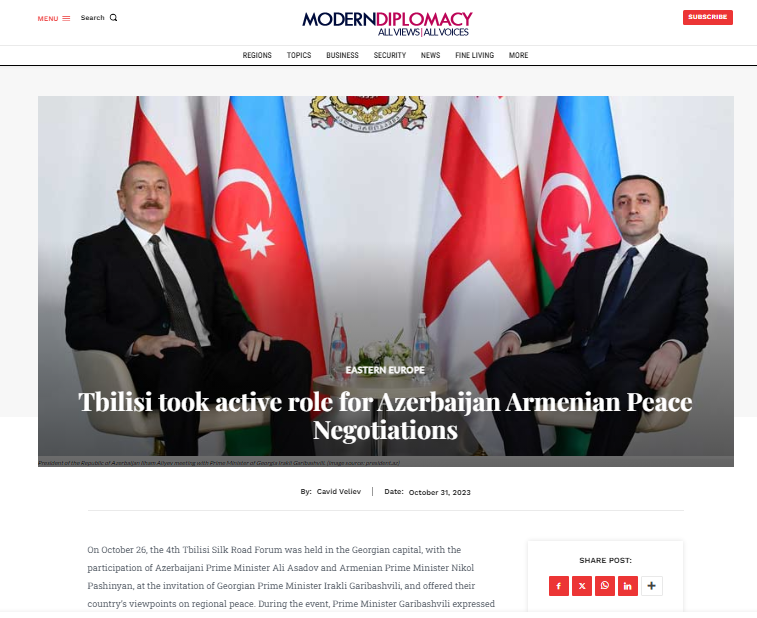
On October 26, the 4th Tbilisi Silk Road Forum was held in the Georgian capital, with the participation of Azerbaijani Prime Minister Ali Asadov and Armenian Prime Minister Nikol Pashinyan, at the invitation of Georgian Prime Minister Irakli Garibashvili, and offered their country’s viewpoints on regional peace. During the event, Prime Minister Garibashvili expressed Georgia’s commitment to cooperate with Armenia and Azerbaijan to establish lasting peace in the South Caucasus region and within the framework of the forum, the prime ministers of Azerbaijan and Armenia hold trilateral meeting with mediation of Garibashvili. Notably, a trilateral meeting between the prime ministers took place behind closed doors. This meeting highlights Georgia’s proactive involvement in the Azerbaijan-Armenia peace negotiations, following the recent statements made by President Aliyev during his visit to Georgia.

On October 8, 2020, Azerbaijani President Ilham Aliyev went on a one-day visit to Georgia, holding discussions with Georgian Prime Minister Irakli Garibashvili. This marked President Aliyev’s first international trip following Azerbaijan’s launch of an anti-terrorism operation in Karabakh against illegal military forces in the region. After the talks, President Ilham Aliyev expressed his willingness to continue peace negotiations between the two countries in Tbilisi. He extended an invitation to the Armenian side to convene in Tbilisi for discussions. Additionally, President Aliyev expressed readiness to send Azerbaijani officials to Georgia if Armenia shows its willingness for engagement. This approach could potentially facilitate the signing of a peace agreement between the two conflicting states in a neutral third country of the region.

Following the Second Karabakh war, Azerbaijan consistently emphasized Tbilisi’s role as a mediator. Tbilisi has also actively facilitated cooperation between Azerbaijan and Armenia on various matters. Notably, the recent meeting between the prime ministers of Azerbaijan and Armenia suggests that Tbilisi will assume a renewed role in the ongoing Azerbaijan-Armenia normalization process.

Despite Azerbaijan’s support for the continuation of peace talks with Armenia with the mediation of Brussels, Baku was dissatisfied with the latest Granada Declaration related to the Armenian-Azerbaijan peace process. The quadrilateral declaration, signed during the European Political Community (EPC) meeting in Granada on October 5, 2023, was signed without the inclusion of Azerbaijan. This idea was backed by France, Germany, and the President of the European Council, Charles Michel. Surprisingly, these four parties anticipated Azerbaijan’s support for this declaration. However, during a phone discussion with Charles Michel, President Aliyev expressed his belief that accepting the quadrilateral declaration in Granada without Azerbaijan’s involvement was inappropriate. As a result, without Azerbaijan’s participation, the declaration was unlikely to lead to any positive results.

Preceding the Granada meeting, Azerbaijan had actively advocated for the inclusion of Turkey, recognizing its pivotal role as an ally of Azerbaijan and a key regional player. Given the direct implications of the Azerbaijan-Armenia normalization process on the Turkey-Armenia normalization process, Turkey’s participation could have significantly broadened the scope of regional reconciliation efforts. However, due to Armenian and French opposition to Turkey’s participation, Azerbaijani President Ilham Aliyev chose not to attend the Granada summit. As a result, the adoption of the Granada Declaration without Azerbaijan’s approval damaged Europe’s position in the Armenia-Azerbaijan peace talks. According to Azerbaijani perspective, the losses in the Brussels process are due to France’s intervention in favor of Armenia, which has harmed the mediation process.

Following Azerbaijan’s absence from the Granada meeting, Charles Michel extended an invitation to the leaders of both countries to convene in Brussels at the end of October. However, no meeting took place. Press reports suggested that Brussels sought to frame this meeting based on the principles outlined in the Granada declaration, which Azerbaijan did not endorse. Consequently, the role of Georgian mediation has become even more crucial in the ongoing peace process.

The diminished efficacy of the Brussels process has elevated Georgia’s position as a promising new negotiation platform. Conducting peace talks in Georgia carries significant implications for regional cooperation and normalization. Georgia has close relationships with both Armenia and Azerbaijan. As a regional state, facilitating the signing of a peace agreement between its neighboring countries is critical not only for regional stability but also for ensuring the harmonious coexistence of Azerbaijani and Armenian communities within Georgia. Notably, Georgia serves as an example of peaceful coexistance between these two ethnic groups. Therefore, the continuation of the peace talks between Armenia and Azerbaijan in Georgia may result in the signing of a real peace agreement.

The prospect of both tripartite and bilateral meetings in Tbilisi holds the potential to catalyze Azerbaijan-Georgia-Armenia trilateral cooperation, serving as a robust foundation for fostering enduring peace in the South Caucasus. Azerbaijan has effectively forged various trilateral cooperation formats in its foreign policy, exemplified by the Azerbaijan-Georgia-Turkey partnership, which have made significant achievements in terms of regional cooperation. Azerbaijani President Ilham Aliyev emphasized this point, saying, “If we are successful in signing a peace agreement with Armenia, a new political situation will emerge in the region.” South Caucasus states may begin trilateral cooperation. It is possible to have energy security, transportation, trade, and mutual capital investment.” Notably, this message to Armenia highlights the prospect of participation in regional energy and transport initiatives, which will serve as a useful stimulus in the event of a successful peace agreement, which represents a significant opportunity for Armenia.

Armenia might learn from the peace and cooperation established between Azerbaijan and Georgia. Azerbaijan for the past 30 years has emerged as a reliable energy partner and investor for Georgia while Georgia has evolved into an important transit country, effectively managing the movement of Azerbaijani energy resources to global markets, thereby creating a strong relationship based on mutual reliance. President Aliyev’s latest speech might be interpreted as Azerbaijan’s serious offering of peace to Armenia. Given the events that have transpired in the Caucasus, it is importand to explore new opportunities for cooperation and normalization in the region. Prioritizing peace and cooperation over war and hatred is essential to ensure a better future for generations to come.

https://moderndiplomacy.eu/2023/10/31/tbilisi-took-active-role-for-azerbaijan-armenian-peace-negotiations/


Categories
(@mikenov) / Twitter

@mikenov: 2:44 AM 11/1/2023 – Israel-Hamas War: Open Hatred of Jews Surges Globally, Be it US, China, Russia or Europe https://t.co/fsvdbj96cX In Los Angeles, a man screaming “kill Jews” attempts to break into a family’s home. In London, girls in a playground are told they are “stinking… https://t.co/etLNf8paMk


Categories
South Caucasus News

Blinken mentions Armenia during US Senate hearing


default.jpg


Categories
South Caucasus News

Regulations on liquidity of Azerbaijani banks updated


103100068800.webp On October 18 the Central Bank of Azerbaijan approved “Rules on Liquidity Risk Management in Banks”.This is reported on the structure’s website.The new rule will come into force from 1 December, and from this date the “Rules on Liquidity Management in Banks”, which had been in force since 2009, will be cancelled, the report says.Note that the new rule introduced the concept of “liquidity coverage ratio” (LCR) in the …

Categories
(@mikenov) / Twitter

@IDF: RT by @mikenov: We will fight to eliminate Hamas. We will fight for the thousands of lives lost. We will fight to defend our country. 🇮🇱 https:/…


Categories
(@mikenov) / Twitter

@sentdefender: RT by @mikenov: The Al-Tanaf Military Base used by the U.S. Forces in Southern Syria near the Border with Iraq and Jordan has reportedly…


Categories
(@mikenov) / Twitter

@mikenov: 2:44 AM 11/1/2023 – Israel-Hamas War: Open Hatred of Jews Surges Globally, Be it US, China, Russia or Europe https://t.co/fsvdbj96cX In Los Angeles, a man screaming “kill Jews” attempts to break into a family’s home. In London, girls in a playground are told they are “stinking… https://t.co/xV1Z1kjSzT


Categories
South Caucasus News

2:44 AM 11/1/2023 – Israel-Hamas War: Open Hatred of Jews Surges Globally, Be it US, China, Russia or Europe


 Michael Novakhov’s favorite articles 

untitled-design-2023-10-5ee21230a5291b7e

In Los Angeles, a man screaming “kill Jews” attempts to break into a family’s home. In London, girls in a playground are told they are “stinking Jews” and should stay off the slide. In China, posts likening Jews to parasites, vampires or snakes proliferate on social media, attracting thousands of “likes”.

These are examples of incidents of antisemitism, which have surged globally since the attack by Hamas gunmen on southern Israel on Oct. 7 and subsequent war on the Islamist group launched by Israel in the Gaza Strip. “This is the scariest time to be Jewish since World War Two. We have had problems before, but things have never been this bad in my lifetime,” said Anthony Adler, 62, speaking outside a synagogue where he had gone to pray in Golders Green, a London neighbourhood with a large Jewish community.

Adler, who runs three Jewish schools, temporarily closed two of them after Oct. 7 because of fears of attacks on pupils, and has beefed up security at all three. “The biggest fear is that there will be a random attack on our community, on our families and our children,” he said. In countries where figures are available from police or civil society groups, including the United States, Britain, France, Germany and South Africa, the pattern is clear: the number of antisemitic incidents has gone up since Oct. 7 by several hundred percent compared with the same period last year. In some countries, such as the United States and Britain, Islamophobic incidents have also increased since Oct. 7.

In the case of the antisemitic incidents, most consist of verbal abuse, online slurs or threats, graffiti, and defacing of Jewish properties, businesses or sites of religious significance. Physical assaults represent a significant proportion. One common thread is that anger over the deaths of thousands of Palestinians as a result of Israel’s bombardment of Gaza is invoked as justification for verbal or physical aggression towards Jews in general, often accompanied by the use of slurs and tropes rooted in the long history of antisemitism.

“Whatever their opinion on the conflict, even if they are extremely critical of the Israeli government’s policy, Jew is for them equal to Israel, equal to killing Palestinian children,” said political scientist Nonna Mayer, a member of France’s CNCDH, an independent human rights commission. She was describing what was in the minds of those behind antisemitic incidents.

‘ANY EXCUSE’

The climate of fear is worse for many Jews than in previous rises in antisemitism linked to flare-ups of violence in the Middle East, partly because of the intensity of the Gaza conflict and partly because of the trauma of Oct. 7. “The idea that Israel was the ultimate shelter, that idea is totally shattered by what happened on Oct. 7,” said Mayer.

The most chilling antisemitic incident globally was the storming of an airport in Russia’s Dagestan region on Sunday by an enraged crowd looking for Jews to harm after a flight arrived from Tel Aviv. Rabbi Alexander Boroda, president of Russia’s Federation of Jewish Communities, said in response that anti-Israeli sentiment had morphed into open aggression towards Russian Jews.

Shneor Segal, the chief Ashkenazi rabbi of Azerbaijan, said the incident showed that “antisemites will use any excuse – the current Middle East crisis being just the latest – to terrorise the dwindling numbers of us that still remain” in the Caucasus. “And where do they think they are chasing these Jews away to? The very country whose existence is such an abomination to them!” he said, referring to Israel. But without reaching such extremes, a string of incidents all over the world show the fears and tensions affecting Jewish communities.

In Buenos Aires, pupils at a well-known Jewish school were asked not to wear their usual uniforms to be less easily identifiable, parents said. Other schools cancelled planned camping trips and activities outside their premises.

At Cornell University in upstate New York, security was increased around the Center for Jewish Living after online threats, including a call for it to be bombed. In Johannesburg, pro-Palestinian protesters marched to an area with a large Jewish community on Saturday, tearing off pictures of Israeli hostages in Gaza from the perimeter walls of a community centre while a Shabbat service was being held at a nearby synagogue.

“I feel rage towards the people who are trying to curtail my freedom of religion and my freedom of movement, for the most part based on their antisemitism,” said Akiva Carr, who was in the synagogue when the incident took place. Official responses to the surge in antisemitism has varied from country to country. In the United States and Western Europe, authorities have mostly been quick to express strong support for Jewish communities, denounce antisemitism and in some cases reinforce security at relevant locations.

In Israel, the government said after the Dagestan incident that Israeli citizens should “review the necessity to travel abroad at this time” and urged Israelis residing abroad to be vigilant and stay away from demonstrations. In China, where the government routinely censors words or phrases it considers sensitive on social media, there was no indication that it had taken any steps to curtail a torrent of antisemitic vitriol on social media. A Chinese foreign ministry spokesperson said Chinese law prohibits the use of the internet to propagate extremism, ethnic hatred or discrimination.

(This story has not been edited by News18 staff and is published from a syndicated news agency feed – Reuters)

Для российской армии

NT-News-and-Times.png
Selected Articles – The News And Times

In Los Angeles, a man screaming “kill Jews” attempts to break into a family’s home. In London, girls in a playground are told they are “stinking Jews” and should stay off the slide. In China, posts likening Jews to parasites, vampires or snakes proliferate on social media, attracting thousands of “likes”.These are examples of incidents of antisemitism,…
posted 1m ago via news18.com
 
Israel-Hamas War: Open Hatred of Jews Surges Globally, Be it US, China, Russia or Europe  News18The post Israel-Hamas War: Open Hatred of Jews Surges Globally, Be it US, China, Russia or Europe – News18 first appeared on The South Caucasus News.
posted 11m ago by Mike Nova via The South Caucasus News
 
Scholz says Putin’s statements on Middle Eastern conflict “cynical”  Ukrinform
posted 9m ago via “scholz” – Google News
 
US Congress split over aid package for Israel and Ukraine  ABC News
 
Idaho judge gives Bryan Kohberger win over genetic genealogy battle  FOX 29 Philadelphia
Ukraine War, Day 616: 18 of 20 Russia’s Iranian Drones Downed …  EA WorldView
Thanks to Ukrainian bravery, we are de facto pushing the Russian navy out to the eastern part of the Black Sea. Russia can no longer use our sea to expand its aggression to other parts of the world, as it did in the past with Syria. Russia contributed to the humanitarian… pic.twitter.com/fMXe9bDtJT— Volodymyr Zelenskyy / Володимир Зеленський (@ZelenskyyUa)…
posted 7m ago by @ZelenskyyUa via (@mikenov) / Twitter
 
Houthis Claim Responsibility for Attack on Israel  Asharq Al-awsat – English
Refugee camp bombing underscores deadly day in Gaza  FOX 2 St. LouisAirstrike hits Gaza’s largest refugee camp; IDF says target was Hamas commander: Full coverage  Yahoo News”Huge destruction” at bombed refugee camp, aid official says  CNNListen: Israel Hits Aid Camp, Fed Decision, More  BloombergView Full Coverage on Google News
posted 8m ago via Top Stories – Google News
 
Biden and Jordan’s King Abdullah discuss ‘shared commitment’ to …  The Independent
Biden, Jordan’s King Abdullah discuss commitment to aid civilians in Gaza  Al Arabiya English
Rampage by antisemitic mob puts pressure on Moscow to confront rising ethnic tensions in Russia  NBC New York
 
Mob storms Russian airport looking for Israelis as US condemns ‘anti-Semitic protests’  FRANCE 24 English
 
Ukraine war: Whole family shot dead in Russian-occupied Ukrainian town  BBC

“I wanted to tell a story about Jews and Muslims coexisting peacefully and happily, and helping one another, which is the narrative that we don’t really hear,” Sabina Vajrača said.
posted 11m ago via JPost.com – Homepage
 
AFP: Saudi Arabia pauses normalization talks with Israel  news.amThe post AFP: Saudi Arabia pauses normalization talks with Israel – news.am first appeared on The South Caucasus News.
posted 11m ago by Mike Nova via The South Caucasus News
 
Deportation looms for Afghan refugees in Pakistan  Saudi Gazette

A court hearing on the criminal case of Vagif Khachatryan, accused of committing genocide in the village of Meshali, Azerbaijan’s Khojaly district, committed by members of Armenian separatist troops, will be held today, Azernews reports.

Apple dismisses political controversy over its security alert Apple Inc has released a statement acknowledging attempts by state-sponsored actors to breach the devices of its users in various countries, including India. However, the company distanced itself from the ongoing espionage controversy within Indian politics, where the Opposition Congress…
posted 13m ago by Naveen Goud via Cybersecurity Insiders
 
The News And Times Information Network – Blogs By Michael Novakhov – thenewsandtimes.blogspot.com