
Day: November 29, 2023
Israeli Prime Minister Netanyahu requested a meeting with the family of an Israeli captive who was released from Gaza, but his request was rejected.
Israeli PM has been facing criticism for his handling of hostages and the genocide in Gaza in which more than 15000 civilians have been killed.
People demand resignation from Netanyahu while he is facing international pressure to be charged with the International Criminal Court (ICC).
Categories
NPR News: 11-29-2023 10PM EST
The United States, Japan, and South Korea will fully operationalize a missile warning system “by the end of December.” While justified as a means to counter North Korea’s missile launches, more worrisome, it escalates tensions in the region with China through the “NATOification” of all three countries, agreed upon in the “Spirit of Camp David” agreement.
The agreement was hailed as a “new era of trilateral partnership” during the August 18 press conference following a meeting between the heads of state of all three countries. Western media echoed the sentiment, calling it “historic” and “unprecedented.” China, listed in the agreement as a regional concern, accused the United States of creating a “mini NATO in Asia.” In response, United States National Security Advisor Jake Sullivan emphatically stated that the trilateral alliance is “nothing new” and certainly “not a new NATO for the Pacific.” Yet despite such dismissals, this meeting between the U.S. and its strongest allies in the region lays the foundations for NATO-level military cooperation—a common threat, interoperability, and security coordination—that threatens China and escalates tensions in the region.
‘Collective Interests and Security’
While the United States has had bilateral agreements under the San Francisco System with South Korea and Japan for decades, the August 18 Camp David meeting institutionalized trilateral cooperation among the three nations, changing the scope and nature of their relations from the hub-and-spoke bilateral alliances to trilateral annual summits (covering finance, commerce, industry, foreign policy, and defense) and joint military exercises. As Victor Cha of the Center for Strategic and International Studies (CSIS) states: “This [unprecedented] institutionalization of the trilateral relationship… transforms these alliances into something quite new.” This was a historical breakthrough for the United States, which first pursued a NATO-level alliance built around Japan in the 1950s. Yet, unresolved grievances around Japan’s colonialism (enabled by the U.S. decision to prioritize its security interests over rectifying Japan’s war crimes and colonialism), and the different security interests between South Korea and Japan forced it to settle for bilateral agreements with governments it installed and propped up. Nonetheless, as noted in Foreign Policy magazine, this U.S. “military preeminence in the Pacific gave Washington the luxury of not needing a collective security agreement.” Today, as the U.S. “has lost its preponderance of military power in the maritime domain… [the U.S. and its allies face a] threat comparable to what NATO confronted in Europe during the Cold War.”
The conservative, pro-U.S. Yoon Suk Yeol administration’s 2023 decision to normalize relations with Japan (casting aside a South Korean Supreme Court ruling against Japanese companies for the wartime conscription of Koreans) paved the way towards establishing the trilateral alliance that the U.S. had sought for the past 70 years. While the Spirit of Camp David Agreement is not yet a full-fledged mini Asian-NATO, combining two of the United States’ closest allies in the region into military cooperation with each other is a step towards it. The agreement contains the seeds of a NATO-level trilateral alliance based on mutual self-defense. More specifically, it calls for consultation and coordinated responses “to regional challenges, provocations, and threats that affect our collective interests and security.” As Kurt M. Campbell, Biden’s Asia strategy architect, has stated: a “fundamental, foundational understanding” of the Spirit of Camp David statement is that “a challenge to the security of any one of the countries affects the security of all of them.”
‘Integrated Deterrence’
One of NATO’s strengths, which enhances and expands U.S. power projection in the region, is the synergy achieved by greater interoperability (i.e., the ability to effectively “achieve tactical, operational and strategic objectives”) between member countries. All of these are being built up and pursued through the trilateral security cooperation agreement.
This agreement lays the groundwork for trilateral interoperability to achieve “integrated deterrence” against China. This integrated deterrence is key in the U.S. containment of China. It allows the United States to carry out provocations (e.g., former U.S. House Speaker’s Nancy Pelosi August 2022 visit with Taiwan’s president) while limiting China’s response options.
A key component of integrated deterrence is joint military cooperation and coordination through a common operational picture. In other words, all parties need to be looking at the same operational picture informing their operational decisions. The recent normalization of the General Security of Military Information Agreement (GSOMIA) by the Yoon Administration lays the foundation for this. Previously, under the 2014 trilateral information sharing agreement, South Korean and Japanese intelligence would be shared between each other through the United States and would be limited to threats from North Korea. GSOMIA, first signed in 2016, and reinstated by Yoon (after former President Moon allowed it to expire in 2019), allows comprehensive intelligence sharing between South Korea and Japan directly, including “threats from China and Russia.” On August 29, the United States, South Korea, and Japan held joint ballistic missile defense drills to “detect and track a computer-simulated ballistic missile target, and share related information.” The system is expected to be fully operationalized by the end of December 2023. While ostensibly against North Korean intercontinental ballistic missiles, given the scope of GSOMIA, this missile defense system can just as well be applied to China.
At a time when regional power is maintained through an “extended deterrence” to determine the outcome without a bullet even fired against an adversary, the United States’ missile defense system allows it to project its power in the region by neutralizing China’s anti-access and area-denial capabilities. Furthermore, it threatens to neutralize China’s ability to respond to a first strike by the United States. The United States’ “extended deterrence” containing China and China’s “extended deterrence” safeguarding its economic rise leaves both jostling for military advantage. In effect, U.S. actions are triggering a set of actions and counteractions that are escalating tensions in the region.
Members of the Biden Administration extol the Camp David Agreement as historic and unprecedented and as a qualitative leap forward in the United States, Japan, and South Korea military cooperation and coordination. At the same time, they oppose its characterization as a mini-Asian NATO. And while the agreement has not yet reached NATO status, it is clearly laying the groundwork toward that objective. It has also driven China, North Korea, and Russia to strengthen their own coordination, effectively consolidating an opposing bloc. Ultimately, the fight to establish competing “extended deterrence” is the beginning of war. To stop war, we must shift from military posturing and escalation to diplomatic solutions and respect for the security concerns of all countries.
About the authors:
- Jeffrey Wagner is an educator in South Korea and a member of the International Strategy Center.
- Dae-Han Song is in charge of the networking team at the International Strategy Center and is a part of the No Cold War collective.
Source: This article was produced by Globetrotter.
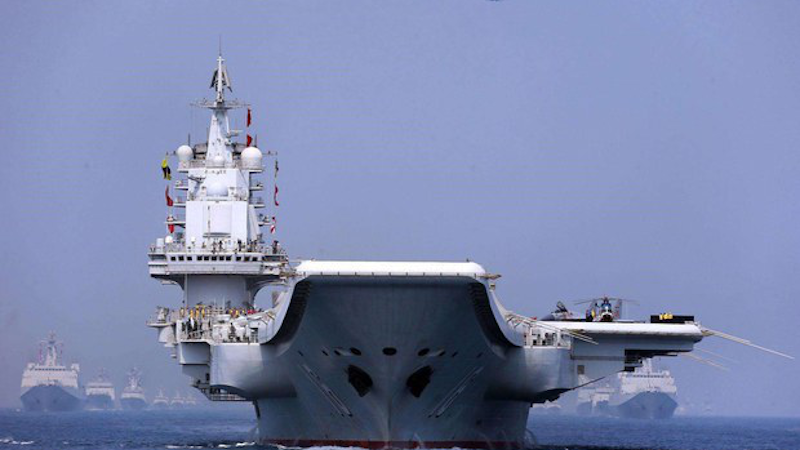
Chinese developers are believed to have started testing electromagnetic catapults on China’s third aircraft carrier, which analysts say is an important milestone in the country’s naval ship construction.
The catapults will be used to launch airplanes from the carrier, which is named Fujian after the Chinese province closest to Taiwan. The Fujian features a so-called Catapult Assisted Take-Off Barrier Arrested Recovery, or CATOBAR, system that is much more advanced than systems on the first two carriers.
The first aircraft carriers – Liaoning and Shandong – use a less advanced ski jump-style launch system but the Fujian’s CATOBAR will help launch a bigger variety of aircraft faster and with more ammunition.
A video clip, said to be filmed from an overflying airplane and shared first on China’s Weibo microblogging website, shows what appeared to be a test vehicle being dropped from a catapult position on the Fujian aircraft carrier into the water.
The apparently successful test took place on Sunday.
A satellite image from Nov. 26 provided by the U.S. satellite imaging company Planet Labs shows the Chinese aircraft carrier sitting at its berth at the Jiangnan Shipyard in Shanghai. A crane that may be used during the test launch was visible at the front of the ship.
“This is one of the most eagerly awaited milestones besides the first sea trial,” said Andreas Rupprecht, a well-known Chinese military blogger.
“Suffice to say, an important step towards getting the ship operational,” wrote another analyst, Alex Luck, on the social media platform X, formerly known as Twitter.
The 80,000-ton Fujian – also called Type 003 – is China’s third aircraft carrier, built with a fully indigenous design.
It is also the first People’s Liberation Army (PLA) carrier equipped with electromagnetic catapults and arresting devices similar to the those on U.S. aircraft carriers.
China’s maritime ambitions
Currently, only France and the United States are members of the CATOBAR club.
China, having never operated a CATOBAR carrier before, is starting from the ground up in developing one, according to Robert Farley, a senior lecturer at the Patterson School of Diplomacy and International Commerce, University of Kentucky.
“Fujian carries electromagnetic catapults (EMALS), which are a complicated new technology,” said Farley. “I don’t know if we can generate a clear estimate on the length of catapult testing because it’s uncharted territory.”
Aircraft carriers represent China’s maritime ambitions and the carrier fleet may be expanded to five ships in the next 10 years, according to a report by the Center for Strategic and Budgetary Assessments (CSBA), an independent U.S. think tank specializing in defense policy, planning and budgets.
The PLA developed Liaoning, its first aircraft carrier, from a Soviet-built ship and commissioned it in 2012. The second carrier that was the first one to be built domestically – Shandong – was commissioned seven years later.
The construction of the Fujian aircraft carrier began during the 2010s and the ship was launched in June 2022. It is currently undergoing mooring trials at the shipyard before being put on sea trials.
Compared to the Liaoning and Shandong, the Fujian, with an 80,000-ton displacement, is not only much bigger but also far more technologically advanced.
Still a long way
Although Fujian looks to be an impressive ship, larger than any carrier in the world other than the U.S. supercarriers, Farley believes the Chinese are still significantly behind in several areas.
The U.S. Navy has 11 aircraft carriers, most of them of the large “supercarrier” category, which are much more advanced and powerful.
“As a ship, Fujian is only about 80% as large as existing U.S. carriers, and is conventionally propelled rather than nuclear, which makes a big difference for range, endurance, and carrying capacity,” he said.
It will take a while for the ship to become fully operational as the Fujian has yet to begin sea trials.
“For the first ship of a new class, the entire process of trials can often take a year or more. [Fujian’s] predecessor, Shandong, took 19 months from completion to commissioning and [that] was of a far less advanced design,” the analyst told Radio Free Asia, a news service affiliated with BenarNews.
“After sea trials are done, the PLA Navy will need to begin work on carrier group training, which will require very detailed procedures of launch and landing to be worked out,” he added.
“The PLA has historically been careful and deliberate with training for its carrier operations and I would expect them to continue to do so.”
Military experts say the Fujian may be commissioned by 2025 but its capacity will be gradually built up in the following years.
According to Farley, “training up to U.S. standards will take years, if not decades.”
The PLA has the largest navy in the world by number, with an overall battle force of over 370 ships and submarines, compared with the U.S.’s 293, according to the Pentagon.

The Middle East and Central Asia face a sobering climate reality. Temperatures have risen twice as fast as the global average, and rainfall has become scarcer and less predictable. Fragile states are disproportionally affected and conflicts may worsen. The toll this is taking on people and economies is poised to worsen.
This week’s United Nations Climate Change Conference, or COP28, provides a forum to discuss the policies needed to stave off more disruptive climate change. It comes at a vital time: our new analysis shows current global commitments would reduce emissions by just 11 percent by the end of this decade, well short of the 25 percent to 50 percent that’s needed to meet the goals of the Paris Agreement. All countries must step up.
Devasting impact, economic disruption
From devasting floods in Libya and Pakistan to drought in Somalia, the far-reaching impact of climate change is obvious. Record temperatures amid scorching heatwaves are becoming a new normal. Droughts leave farmland parched and rivers depleted. Violent storms batter coastal areas.
In addition to the human toll, climate change has huge economic and social costs. Over the past three decades, changing temperature and rainfall patterns have eroded per capita incomes and significantly altered the sectoral composition of output and employment. We see this pattern emerging in all corners of the world, but it is especially true for countries in the Middle East and Central Asia.
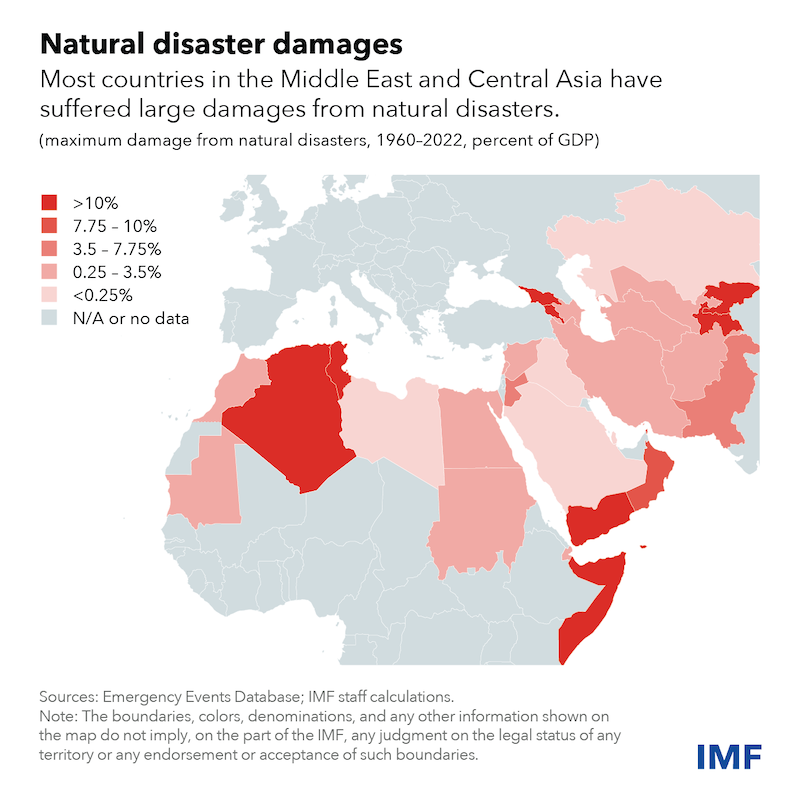
A recent IMF study shows the fundamental economic disruptions brought about by climate change not only endanger food security but also undermine public health, with a ripple effect on poverty and inequality, displacement, political stability and even conflict. Past climate disasters have resulted in permanent gross domestic product losses of 5.5 percent in Central Asia and 1.1 percent in the Middle East and North Africa. And these disasters will only become more frequent.
Climate effects are particularly pronounced in fragile and conflict-affected states. They suffer four times higher output losses after climate-related weather shocks, compounding their existing fragility.
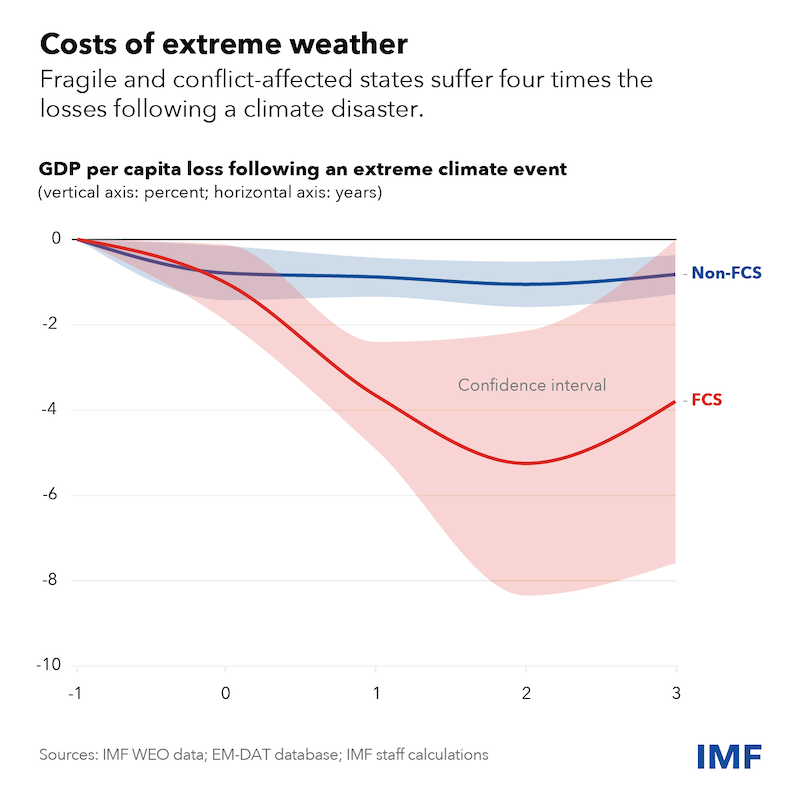
Climate displacement crises, such as in Somalia, demonstrate the destructive consequences and human toll of climate change, especially for vulnerable countries and regions. Climate change can even make conflicts deadlier.
Policy priorities
Frontloading action on climate change is a must. So, governments in the Middle East and Central Asia must step up their goals both to adapt to climate change and to reduce their own contribution to global warming. Investment of up to 4 percent of GDP annually is needed to sufficiently boost climate resilience and meet 2030 emissions reduction targets, according to recent IMF studies on adaptation and mitigation.
Amid higher borrowing costs and already constrained government spending powers, attracting more private finance is crucial to bridge the financing gaps. Measures such as accelerated fuel-subsidy reform and carbon taxes, and other climate regulations could also help ease the funding burdens and give investors clearer signals.
The good news is that many countries in the Middle East and Central Asia are already taking steps to alleviate the devastating impacts of climate change. For instance, Morocco, Jordan, and Tunisia have improved water management practices, helping to enhance their resilience amid prolonged droughts.
Countries also are gearing up to contain their carbon footprint, from fossil-fuel subsidy reforms in Jordan to solar power projects in the United Arab Emirates and Qatar.
IMF research sheds light on fiscal policies that can help countries in the region achieve their climate pledges by cutting per capita greenhouse gas emissions by up to 7 percent by 2030 and accelerate policies further to achieve net-zero emissions by 2050.
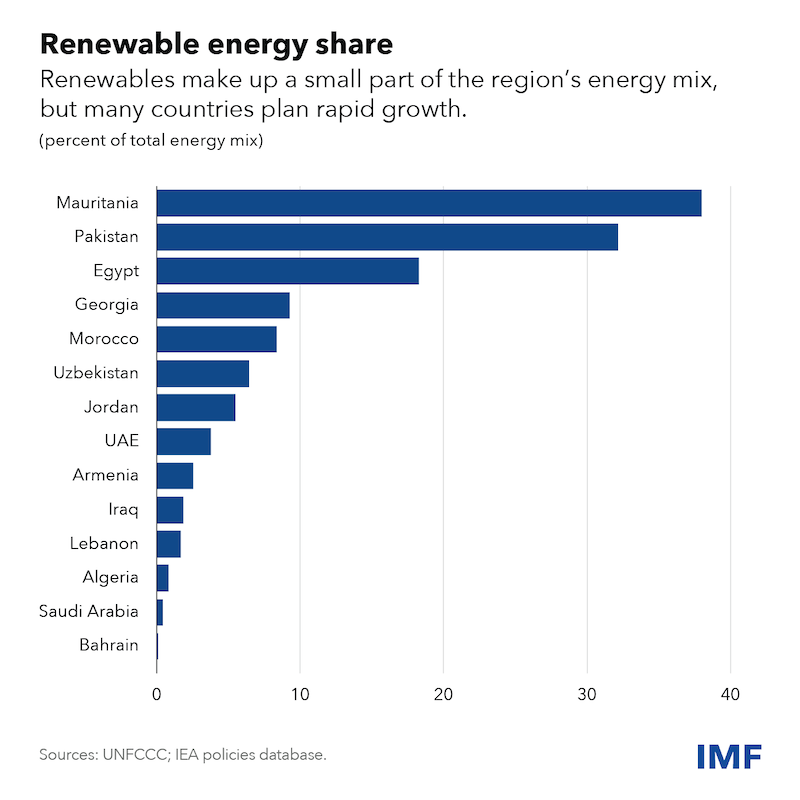
However, much more ambitious climate action is needed in the Middle East and Central Asia. Both the adaptation and mitigation policies currently in place must be expanded and reinforced. Nations must prioritize comprehensive strategies that not only address the immediate crises but also prepare for the longer-term consequences of climate change. Policymakers should prioritize investment in “no regret” measures such as climate-resilient infrastructure and agriculture, disaster risk management, and social protection.
Managing trade-offs
The policy options, however, often require economic tradeoffs. Reducing fuel subsidies or putting a price on carbon emission, for example, promise long-term gains but may raise transition costs in the near term due to large shifts in economic behavior.
Boosting investment in renewable energy through additional government spending and subsidies—such as the development of the world’s largest solar power plant in Saudi Arabia, led by its sovereign wealth fund—might seem easier in the near term. Yet, it would make the energy transition more costly overall, as it won’t deliver the economic efficiency resulting from carbon pricing. For these reasons, policymakers should find a mix of policies to balance these trade-offs.
Ultimately, more action also requires more multilateral support. It can help spark action where it is needed most, transfer valuable technical knowledge and policy experiences, and catalyze other funding sources to meet the region’s large adaptation and mitigation climate financing needs—all particularly important for low- and lower-middle income countries.
The IMF’s Resilience and Sustainability Facility will help address climate vulnerabilities. An example in the region is the recent $1.3 billion RSF climate program with Morocco.
Yet the scale of the challenge means that global and regional initiatives such as COP28 remain instrumental to foster cross-border collaboration and promote private sector climate finance. This should include securing additional climate funding for the most vulnerable countries.
About the authors:
- Jihad Azour is the Director of the Middle East and Central Asia Department at the International Monetary Fund where he oversees the Fund’s work in the Middle East, North Africa, Central Asia and Caucasus.
- Hasan Dudu is an economist in the IMF’s Middle East and Central Asia Department. His work focuses on the macrocriticality of impact of climate change on real, financial, external, and public sectors in region’s economies.
- Ling Zhu is a senior economist in the Middle East and Central Asia Department at the International Monetary Fund. Previously, he worked in the IMF’s Monetary and Capital Markets Department. His research interests cover macroeconomics of climate change, international finance and monetary policy.
Source: This article was published by IMF Blog