

Day: November 22, 2023
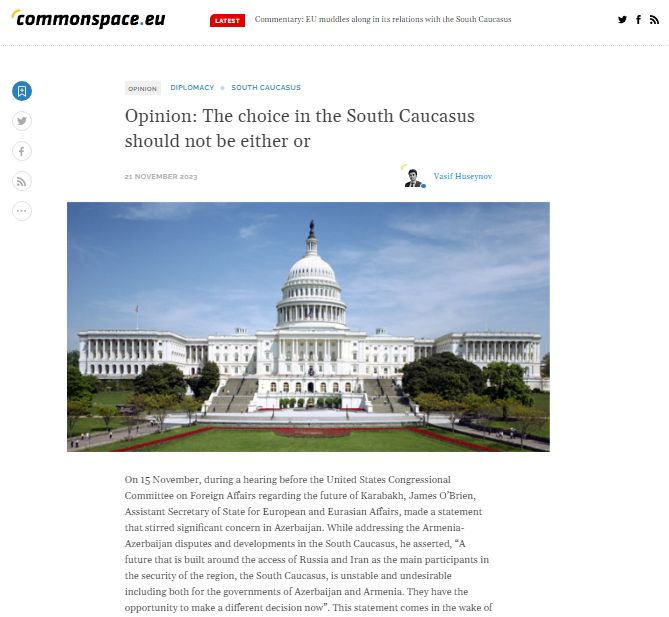
On 15 November, during a hearing before the United States Congressional Committee on Foreign Affairs regarding the future of Karabakh, James O’Brien, Assistant Secretary of State for European and Eurasian Affairs, made a statement that stirred significant concern in Azerbaijan. While addressing the Armenia-Azerbaijan disputes and developments in the South Caucasus, he asserted, “A future that is built around the access of Russia and Iran as the main participants in the security of the region, the South Caucasus, is unstable and undesirable including both for the governments of Azerbaijan and Armenia. They have the opportunity to make a different decision now”. This statement comes in the wake of a series of developments indicating a shift towards a new security order in the South Caucasus.
Following Russia’s military setbacks in Ukraine and its domestic economic challenges, its influence over the South Caucasus has plummeted to historically low levels. Notably, not any major development between Armenia and Azerbaijan since the mid-2020s would have been desired by the Kremlin. Moscow has witnessed the gradual erosion of its regional strongholds, with its long-standing project, the “Karabakh card,” disappearing as the region returns under the control of Baku. Russia has been compelled to initiate a phased withdrawal of its peacekeeping mission from the area, marking the end of a two-hundred-year-old project.
This has been coinciding with the rise of the influence of other external actors in the region, particularly Turkiye and the Western powers. Many observers have been prognosing a military escalation in the region due to these power shifts. These expectations were not ungrounded as the region is treated as one of extreme security importance by Russia and Iran who categorically oppose the “encroachment” of other powers into this area and often threaten potentially severe consequences, if that happens.
Yet the revitalization of the 3+3 regional cooperation platform which includes Armenia, Azerbaijan, and Georgia plus three surrounding powers (Turkiye, Iran, and Russia) has appeared as an attempt to handle this regional power shift peacefully. The convening of the ministerial meeting of the 3+3 framework on October 23, after a two-year delay, though again without the participation of Georgia – a and thus so far in the 2+3 formula – can be seen as the first major manifestation of this attempt.
Coinciding with the introduction of “regional solutions to regional problems” approach by Azerbaijan and Turkiye, the 3+3 framework may characterize the new security order emerging in the region. This would be an order that is not dominated by any other extra-regional actor and gives stronger agency to the local states. The three countries of the region, namely Armenia, Azerbaijan, and Georgia, gain an opportunity to diversify their foreign policy and prevents the dominance of any external power over them.
This security structure gives Russia, Iran, and Turkiye an opportunity to ensure that their interests and concerns would be respected by these three local countries. Thus, the region obtains a unique chance to put the Russian hegemony in the past and becomes a bridge between the East and the West. The Middle Corridor and the Zangezur corridor projects signify this transformation of the region into a bridge between various power centers.
The afore-mentioned statement of Ambassador O’Brien suggests that the United States perceives these developments in the South Caucasus in a different way; and in a way that may lead to dangerous outcomes for the three countries of the South Caucasus. It’s important to note that denying any access to Russia and Iran to the regional security space of the South Caucasus, as O’Brien anticipates, could significantly antagonize them, potentially provoking retaliatory actions at the earliest opportunity.
Hence, Baku and, to an increasing extent, Tbilisi, are working to maintain a delicate balance between competing major powers. They aim to avoid alienating any side by avoiding excessive alignment with a single power. In this context, the foreign policy of the Armenian Prime Minister, Nikol Pashinyan, diverges from that of Armenia’s two neighbors. As an Armenian expert asserted, Pashinyan is taking a risky and adventurous approach by antagonizing Russia without securing any realistic security guarantees from the West. His bold actions pose the potential for a deterioration in Armenia-Russia relations, possibly escalating into a military conflict with severe consequences for the entire South Caucasus region. Previously, only the Armenian people bore the brunt of Pashinyan’s adventurous policies; however, Azerbaijanis and Georgians may also be adversely affected if he continues recklessly in his foreign policy pursuits.
The tragic events in Ukraine since March 2014 and the war in Georgia earlier in 2008 have underscored that the power balance in this region does not favor making idealistic foreign policy moves without considering the existing geopolitical realities. Given the escalating great power rivalries, it is now more crucial than ever for the South Caucasus countries to recognize and factor in this reality. That said, external actors must refrain from pushing these nations into an either-or choice, as such pressure could significantly undermine regional security and stability.
https://www.commonspace.eu/index.php/opinion/opinion-choice-south-caucasus-should-not-be-either-or
The United States Tuesday night welcomed the deal to release 50 hostages, including American citizens, held by Hamas since its October 7 attack on Israel, TURAN’s Wasbington correspondent reports.
Israel and Hamas agreed to implement a temporary cease-fire for four days to allow for the safe transfer of…
The United States on Tuesday, once again, urged the Azerbaijani government to respect rights and freedoms in the country, as the authorities in Baku reportedly detained additional journalists associated with the independent news outlet AbzasMedia, TURAN’s Washington correspondent reports.
“We are deeply troubled by the reported arrest…