
Day: November 20, 2023
Former US First Lady Rosalynn Carter, the wife of ex-President Jimmy Carter, has died at the age of 96, the BBC reports.
The Carter Center confirmed in a statement that she died peacefully with her family by her side.
On Friday, it was reported that she had entered a hospice care home in the state of Georgia, and was spending time with her 99-year-old husband, who has been in hospice care since February.
Mrs Carter was diagnosed with dementia in May.
The longest-married first couple marked their 77th wedding anniversary in July.
/cloudfront-us-east-2.images.arcpublishing.com/reuters/GOKBNM77U5J5XEMTAEFMSNWMYU.jpg)
BEIJING, Nov 20 (Reuters) – Arab and Muslim ministers called on Monday for an immediate ceasefire in Gaza, as their delegation visited Beijing on the first leg of a tour to push for an end to hostilities and to allow humanitarian aid into the devastated Palestinian enclave.
The delegation, which is set to meet officials representing each of the five permanent members of the U.N. Security Council, is also piling pressure on the West to reject Israel’s justification of its actions against Palestinians as self-defence.
The officials holding meetings with China’s top diplomat Wang Yi on Monday are from Saudi Arabia, Jordan, Egypt, Indonesia, Palestine and the Organisation of Islamic Cooperation, among others.
“We are here to send a clear signal: that is we must immediately stop the fighting and the killings, we must immediately deliver humanitarian supplies to Gaza,” said Saudi Foreign Minister Prince Faisal bin Farhan Al Saud.
The extraordinary joint Islamic-Arab summit in Riyadh this month also urged the International Criminal Court to investigate “war crimes and crimes against humanity that Israel is committing” in the Palestinian territories.
Saudi Arabia has sought to press the United States and Israel for an end to hostilities in Gaza, and Crown Prince Mohammed bin Salman, the kingdom’s de facto ruler, gathered Arab and Muslim leaders to reinforce that message.
About 240 hostages were taken during Hamas’s deadly cross-border rampage into Israel on Oct. 7, which prompted Israel to invade the Gaza Strip with the intention of eradicating the Islamist militant group.
Gaza’s Hamas-run government said at least 13,000 Palestinians have been killed in Israeli bombardments since then, including at least 5,500 children.
Israeli ambassador to Beijing Irit Ben-Abba told foreign reporters at a briefing on Monday that she hoped there would not be “any statements from this visit about a ceasefire, now is not the time.”
She said that Israel hoped that the delegation would talk about hostages captured by Hamas “and call for their immediate release without preconditions,” adding that the parties involved should talk together about Egypt’s “role in facilitating humanitarian assistance.”
‘BROTHER AND FRIEND’
China’s Wang said Beijing was a “good friend and brother of Arab and Muslim countries,” adding it has “always firmly supported the just cause of the Palestinian people to restore their legitimate national rights and interests.”
Since the start of hostilities, China’s foreign ministry has repeatedly stopped short of condemning Hamas, instead calling for de-escalation and for Israel and Palestine to pursue a “two-state solution” for an independent Palestine.
Since the end of China’s nearly three years of COVID lockdowns, Xi has launched a diplomatic push aimed at countering the United States and its allies, who he says seek to contain and suppress his country.
Beijing has deepened alliances with non-Western led multilateral groups such as the BRICS bloc of nations while strengthening ties with countries in the Middle East and the Global South.
On Monday, Wang added China will work to “quell the fighting in Gaza as soon as possible, alleviate the humanitarian crisis and promote an early, comprehensive, just and lasting settlement of the Palestinian issue.”
China’s special envoy on the Middle East, Zhai Jun, has engaged officials from Israel and the Palestinian Authority – which governs in the occupied West Bank – as well as the Arab League and EU in the last year to discuss a two-state solution and recognition for Palestine at the United Nations.
Reporting by Yew Lun Tian, Laurie Chen and Beijing newsroom; Editing by Edmund Klamann & Simon Cameron-Moore
Our Standards: The Thomson Reuters Trust Principles.
Laurie Chen is a China Correspondent at Reuters’ Beijing bureau, covering politics and general news. Before joining Reuters, she reported on China for six years at Agence France-Presse and the South China Morning Post in Hong Kong. She speaks fluent Mandarin.

Save
Israel’s military on Sunday released footage of what it said was Hamas members “forcibly transporting hostages” through al-Shifa Hospital on Oct. 7, citing the video as proof that Hamas used the hospital “on the day of the massacre as terrorist infrastructure.” Hamas, in response, did not dispute that its hostages receive medical treatment and said some had been wounded by Israeli airstrikes. “Caring for prisoners … and offering necessary medical care are points in our favor,” a member of the Hamas political bureau said. The Washington Post could not independently verify when the videos were taken or who the people in them were. The medical director of the Indonesian Hospital in northern Gaza told The Post that there was a strike on the facility early Monday local time, followed by shooting in the direction of the hospital. Ten people were killed and five injured, he said. The media office of the Gaza Health Ministry later said that 12 people were dead. The Post could not independently verify the accounts, and the Israel Defense Forces did not immediately respond to a request for comment.
End of carousel
Skip to end of carousel
Here’s what to know
End of carousel
Get important stories as they unfoldSign up for breaking news alerts

Alexis de Tocqueville once described history as “a gallery of pictures in which there are few originals and many copies.” Right now, in contested regions across the world, enemies of freedom and decency are adding new works of horror to this already gruesome gallery.
Some American leaders have risen to the challenge of the moment. One of them, North Carolina’s own US Sen. Thom Tillis, has been a voice of moral clarity and resolve.
In September, for example, Tillis and his Democratic colleague Jeanne Shaheen issued a statement calling the Ukrainian resistance to Vladimir Putin “a fight for democracy and freedom in every corner of the world,” arguing that “if we let authoritarians like Putin dictate the futures of sovereign countries, respect for human rights and democratic values will deteriorate, the global economy will suffer and any autocrats, including Xi Jinping, will be emboldened to follow suit.”
And just last week, Tillis defended Israel’s military operations in Gaza.
“The only two nations in recent history that have consistently welcomed Jews and provided them with a safe home are Israel and the United States,” Tillis wrote in an op-ed. “The only way that can be preserved is by destroying Hamas and rooting out antisemitism here at home.”
Alas, in too many ears, the phrase “never again” lacks the powerful resonance it should invoke. Consider three notorious genocides of the 20th century — and their ominous parallels today.
Shortly after the start of World War I in 1914, the supposedly “modernist” Young Turks, who ran the Ottoman Empire in its last days, embarked on a systemic expulsion of Armenians, Greeks, Assyrians, and other ethnic minorities who’d lived in Asia Minor for countless generations.
The Armenians, in particular, were subjected to forced migration and murder on a massive scale. Of the approximately 1.5 million Armenians then under Ottoman rule, as many as 1.2 million died — either killed outright by Turkish soldiers or marched into the deserts of Syria and Iraq to die of exposure, disease, or starvation.
Two decades later, another ruthless gang massacred another ethnic minority. The culprits were Joseph Stalin and his Communist thugs. The victims were Ukrainians. Some had actively resisted Stalin’s tyranny. Others wanted only to live unmolested in their rural villages.
Although the Communists executed many Ukrainians outright, their primary tool of genocide was starvation. After forcibly collectivizing all agriculture, Russians repeatedly confiscated Ukrainian harvests and used violence to keep peasants from leaving home to find food elsewhere.
Ukrainians call it the Holodomor, the Great Starvation of 1932-1934. Estimates of the death toll vary, but four to five million is a reasonable guess, amounting to about 15% of Ukraine’s population.
At about the same time, Adolph Hitler and his National Socialist Party initiated their own campaign of persecution against the Jews of Germany. Over the next decade, as the scope of Nazi power grew across Europe, so did the breadth and depth of their savagery. Six million Jews — about two-thirds of all the Jews in Europe — died during the Holocaust, as did some 3.3 million Soviet prisoners-of-war, 1.8 million Poles, half a million Romani, and hundreds of thousands of other ethnic and religious minorities, political dissenters, and homosexuals.
Here we are, nearly a century later, and what horrors do we confront? In September, the military forces of Azerbaijan, aided by Turkey, invaded the disputed region of Nagorno-Karabakh, forcing some 100,000 Armenians to flee a place their ancestors called home for centuries. In Ukraine, Putin continues his bloody war of conquest, which has already cost hundreds of thousands of lives. And in the Middle East, Jews again face genocidal foes — not just Hamas but their allies in Lebanon, Iran, Yemen, and elsewhere.
This time, however, Jews possess the military might to fight back. And they do not face their foes alone. Most Americans stand, rightly, with them.
“Throughout history,” Sen. Tillis wrote, “we have seen the tragic consequences of what happens when antisemitism is allowed to metastasize. It can never happen again.”
John Hood is a John Locke Foundation board member. His latest books, Mountain Folk and Forest Folk, combine epic fantasy with early American history.
:quality(70):focal(3135x1963:3145x1973)/cloudfront-eu-central-1.images.arcpublishing.com/irishtimes/Z3BNQQT7ISEXDYCK5DZIRZKNPQ.jpg)
Calls by states to categorise Israeli action in Gaza as genocide are increasing amid appeals for an immediate action to end the carnage. Critics of the Israeli response to the brutal attack by Hamas, which range from the United Nations to Brazil, South Africa and Colombia, have invoked a range of international crimes – genocide, war crimes and crimes against humanity, including ethnic cleansing.
This highlights the urgent need for clarity around what these terms – referred to collectively as atrocity crimes – mean. They are regarded as international crimes primarily because in the past they often went unpunished and were often perpetrated by governments, or with government complicity. Today they are firmly part of international law, and humanity as a whole is seen as the victim.
The term “genocide” was first used in 1944 by an academic of Polish-Jewish origin, Raphael Lemkin, in his book on Nazi crimes in occupied Europe. Later, the UN General Assembly adopted the Convention on the Prevention and Punishment of the Crime of Genocide in 1948, primarily inspired by the extermination of European Jews by the Nazi regime. Article 1 of the convention establishes a general obligation on states that have ratified the convention to prevent and punish genocide. Little heed has been paid to this obligation.
[ Ireland ‘can and should’ refer Israeli actions in Gaza to ICC, Sinn Féin says ]
[ Thousands march through Dublin in support of Palestine amid conflict in Gaza ]
The convention defines genocide as specific acts intended to destroy “a national, ethnical, racial or religious group, as such”. These acts include killing members of the group, causing serious bodily or mental harm, and imposing conditions on the group calculated to destroy it. The distinguishing feature of genocide is the intent to destroy the group – and this requirement to demonstrate intent is the most significant legal obstacle to prosecuting this offence.
Deportation or forcible transfer of a population are examples of crimes against humanity and are often referred to as ethnic cleansing
A recent example of ethnic cleansing was the effective expulsion of Armenians from Nagorno-Karabakh following a short but intense military campaign by Azerbaijan last September. This received little media attention but is generally not considered to have amounted to genocide, owing to lack of evidence of an intent to destroy the Armenian population. Nonetheless, the consequences for an estimated 100,000 Armenians driven from their homes have been profound.
The legal definition of genocide has been rightly criticised as too narrow in terms of the groups protected, and of giving rise to a significant evidential burden for proving genocidal intent. Nevertheless, it has been incorporated into a range of international treaties since 1948, most recently the Statute of the International Criminal Court. A number of individuals have been prosecuted for genocide before the international tribunals for the former Yugoslavia, Rwanda and Cambodia. Recent cases before the International Court of Justice concerning allegations of genocide include proceedings in relation to the treatment of the Rohingya in Myanmar and those taken by Ukraine against Russia. A UN commission of inquiry on Syria considered the crimes perpetrated by Islamic State against the Yazidis as genocide, while in Sudan today civilians are at risk from resurgent conflict resembling the earlier Darfur genocide.
The UN Special Adviser on the Prevention of Genocide has warned about the heightened risk of genocide and related atrocity crimes in Ethiopia.
Following Russia’s invasion of Ukraine, western officials were quick to depict the Kremlin’s actions as “genocidal”. US president Joe Biden invoked the term in April 2022 in the context of Russia’s mass killing of civilians in the town of Bucha and the extensive bombardment of Mariupol, a city where thousands are believed to have been killed. Russian officials, at the time, blamed Ukraine’s military for using its civilians as “human shields”. The US policy in particular is in stark contrast to that taken in respect of Gaza.
[ Israel-Hamas war: Al-Shifa Hospital patients and staff leave the compound, Gaza health officials say ]
[ Israel-Hamas war: Only minor obstacles to hostage deal remain, Qatari PM says ]
How does all of this apply to what is currently happening in Gaza? There is a growing clamour of voices accusing Israel of war crimes, crimes against humanity, ethnic cleansing and genocide. Crimes against humanity – which include ethnic cleansing – are closely related to genocide. While some of the underlying acts for genocide can also be considered as crimes against humanity or war crimes, the challenge with genocide is proving the intent to destroy the Palestinian population of Gaza.
Article 7 of the Statute of the International Criminal Court defines crimes against humanity as certain acts committed as part of a widespread or systematic attack directed against any civilian population. The attack need not be a military operation, but must involve a course of conduct involving the multiple commission of crimes targeting any civilian population. It must also be carried out pursuant to, or in furtherance of, a state or organisational policy.
A group of UN experts has recently warned that there is an ongoing campaign by Israel resulting in crimes against humanity in Gaza
Deportation or forcible transfer of a population are examples of crimes against humanity and are often referred to as ethnic cleansing. This may be defined as rendering an area ethnically homogeneous by using force or intimidation to remove from a given area persons of another ethnic or religious group. Settlement expansion and violence have led to increased claims of ethnic cleansing in the Occupied Palestinian Territory.
A group of UN experts has recently warned that there is an ongoing campaign by Israel resulting in crimes against humanity in Gaza. Considering statements made by Israeli political leaders such as the defence minister Yoav Gallant – “We are imposing a complete siege on [Gaza]… We are fighting human animals, and we act accordingly” – accompanied by military action in Gaza and escalation of arrests and killing in the West Bank, there is also a risk of genocide against the Palestinian people.
The crime of direct and public incitement of genocide also falls within the jurisdiction of the International Criminal Court, which has an active investigation at present. The dehumanising language used by Israeli government officials – combined with the sheer number of Palestinian casualties, mass destruction and displacement – points to possible genocide. Significantly, following the attack by Bosnian Serb forces on the Muslim population at Srebrenica in 1995, it was established that genocide may be committed in a small geographic area such as Gaza against only part of a group. Hamas has also been accused of genocide.
Whatever the categorisation of the crime, international law is only useful if states abide by it. These laws encourage everyone to view one another and each other’s communities as fundamentally human and worthy of dignity and protection. International humanitarian law in particular requires that all parties during armed conflict ensure respect for and protection of the civilian population and civilian objects.
This is clearly not happening in Gaza. Ensuring accountability remains a major challenge for proponents of international law. When international law is violated, there must be sanction and accountability. If other states and individuals stand by and do not call out atrocities for what they are, we are all complicit.
Dr Ray Murphy is a professor at the Irish Centre for Human Rights in the school of law, University of Galway
With tensions in the Middle East at boiling point after Hamas triggered a war with Israel, there are growing risks of uncontrolled escalation – plunging the whole region into conflict.
The US – sensing the danger, in particular from Iran – is ramping up its military presence around Israel, announcing the deployment of additional air defence systems over the weekend on top of two carrier strike groups.
Israel carries out ‘significant’ strike – live updates
But it’s not clear whether even the might of the world’s most powerful military will be enough to prevent a melting pot of competing ambitions among rival factions from erupting into a full-blown Middle East war – one with global consequences.
In fact, no one seems to be in control of what might happen next as Israel moves inexorably to expand its offensive against Palestinian militants inside Gaza.
Israeli leaders understand the dangers but say they have no choice other than to fight after the 7 October Hamas atrocities changed the reality on the ground.
Please use Chrome browser for a more accessible video player
 2:59
2:59
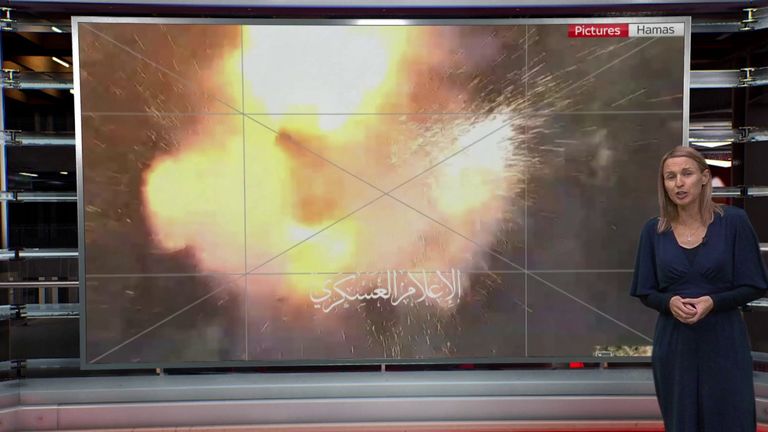
How did Hamas pull off attack?
More than 1,400 citizens, mainly civilians, were killed in the carnage in southern Israel and more than 200 people taken hostage, including babies – a move designed to complicate the Israeli response inside Hamas-controlled Gaza.
The fate of more than two million Palestinian civilians who live in the enclave is also a major factor.
Israel accuses Hamas of using them as human shields but every civilian death prompts criticism of Israeli tactics and plays into the militants’ hands.
Read more:
What Hamas’s release of US hostages may mean for Israeli offensive
Sean Bell: Politicians are making Israel-Hamas war worse – not better
Even before an anticipated ground assault into the Palestinian enclave, the war threatens to open new fronts.
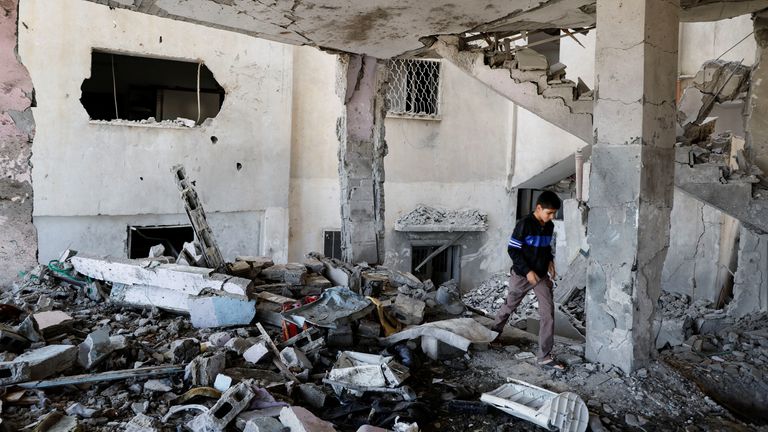
Deadly clashes are already erupting in the West Bank, with the Israeli military launching a rare airstrike on the territory in the early hours of Sunday morning, targeting what it described as an “underground terror compound” in a mosque in the town of Jenin.
The area has been the site of heavy gun battles between Palestinian militants and Israeli forces over the past year – when the threat from the West Bank was regarded as greater than the one from Gaza.
That all changed on 7 October, but the West Bank remains a flashpoint.
Please use Chrome browser for a more accessible video player
 0:41
0:41
Israeli airstrike hits mosque in West Bank
Could another militant group enter war?
Israeli troops are also locked in clashes on their northern border with Lebanon, where Iranian-backed Hezbollah militants have been increasing their attacks against Israel in a sign they are seeking to exploit the crisis.
Prime Minister Benjamin Netanyahu, visiting troops massed at the border, said he could not tell whether Hezbollah would decide to enter the war.
But if the group did, he warned: “He will make the mistake of his life.
“We will cripple him with a force he cannot even imagine and the meaning for him and the state of Lebanon is devastating.”
Please use Chrome browser for a more accessible video player
 2:30
2:30
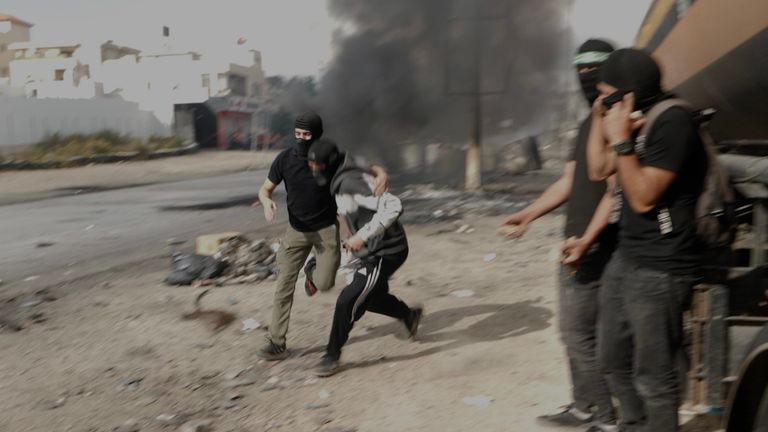
What protests on the West Bank look like
And what of Iran?
Yet Israel is increasingly stretched and Hezbollah has powerful allies, most notably Iran, which is also closely aligned with Russia.
Tehran will be watching the turmoil engulfing its enemy closely and planning its next move.
As well as backing Hezbollah, Iran’s Islamic Revolutionary Guard Corps (IRGC) is known to provide financial and military support to Hamas as well as other militias in the region.
There has not yet been clear proof the Iranians played a direct role in the planning and execution of the 7 October attack but – either way – they would doubtless be seeking to exploit Israel’s vulnerability.
A uniquely perilous conflict
In another potential frontline, Syrian media have reported a series of Israeli missile strikes against airports inside Syria, also closely allied with Iran and Hezbollah.
Israel has not commented publicly on the claims but has in the past struck Hezbollah targets inside Syria.
Each single point of friction is dangerous, but the combination of such a combustible mixture of elements is uniquely perilous and unpredictable.
One thing is clear – Israel is in no mood to ceasefire as long as the threat from Hamas remains.
- UK has sent military assets to the eastern Mediterranean to prevent escalation and provide humanitarian support
- Visit comes less than a week after UK and US defence secretaries met at NATO HQ in Brussels
- As the Prime Minister visits Israel, UK is clear that the situation in the Middle East will not distract the world from Ukraine
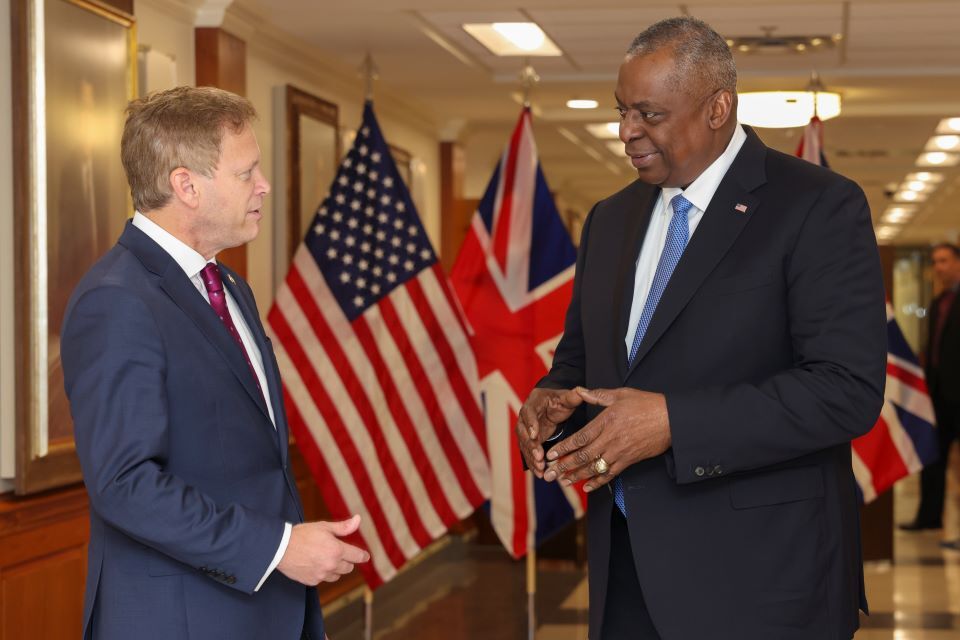
Following Hamas’ barbaric attack on Israel and Ukraine’s continued defence against Putin’s illegal invasion, Defence Secretary Grant Shapps visited Washington D.C. for the first time in his role to hold urgent talks with his counterpart and members of Congress, in support of global stability.
The UK and US stand firm in our shared commitment to uphold international law and protect civilian lives wherever freedom is challenged. That commitment has been clear in the last week as our two countries have led the response to prevent escalation in the Middle East, and support Israel’s right to defend itself – taking all steps possible to minimise civilian casualties.
Prior to the trip, Grant Shapps held calls with his Israeli counterpart, Minister Gallant, to set out the UK’s support to Israel and to urge the importance of a proportional response to the situation.
The Secretary of State has also been speaking with his opposite numbers in Qatar, the Kingdom of Saudi Arabia and Egypt to coordinate the response and prevent escalations.
The Defence Secretary’s visit came as the Prime Minister and Foreign Secretary travelled across the Middle East to discuss the importance of avoiding escalation and a growing humanitarian crisis.
The Prime Minister ordered the deployment of surveillance aircraft and RFA ships to the Eastern Mediterranean to support regional stability and announced the UK will provide a further £10 million in humanitarian aid funding for civilians in the Occupied Palestinian Territories (OPTs).
Defence Secretary Grant Shapps said:
The UK and US are determinedly standing up to aggressors and terrorists and supporting our friends and partners in the fight for freedom and security.
Our nations were the first to provide Ukraine with the sustained support they need to beat Russia, and now we’re working alongside regional partners to prevent escalation and protect civilians in the Middle East.
At such a crucial time for global stability, the urgent talks I have held with Secretary of Defense Lloyd Austin, US Members of Congress and my counterparts in the Middle East underline the UK’s enduring commitment to peace and prosperity.
On Wednesday, Defence Secretary Shapps met US Secretary for Defense Lloyd Austin to discuss the UK and US’s continued support for global security and prosperity, including the Middle East, Ukraine and AUKUS. These topics were also discussed with Congress representatives Adam Smith and Mike Rogers, as well as senators Roger Wicker and Jack Reed, during Shapps’ meetings on Capitol Hill which sought to strengthen the deep defence political and political ties with Congress.
The Defence Secretary also visited the National Geospatial-Intelligence Agency (NGA) headquarters in Virginia. The NGA delivers geospatial intelligence for the military service and intelligence professionals, as well as emergency services and has cooperated closely and provided support to the UK for more than half a decade.
Speaking during engagements in the US, the Defence Secretary made clear the crisis in the Middle East will not distract the UK or our allies and partners from our unwavering resolve to provide Ukraine with the support it needs to repel Russia’s barbaric invasion. The joint efforts of the international community, led by the UK and US, have ensured Putin continues to fail in his goal of conquering Ukraine.
The Defence Secretary also paid his respects to all those sacrificing their lives for Ukraine’s freedom at Holodomor memorial where he laid a wreath in their honour, and the memory of the millions killed by the famine 90 years ago.