
Day: November 20, 2023
Explained: What could hostage deal involve?
There’s growing hope dozens of hostages seized from southern Israel by Hamas might soon be released.
Last night, US and Israeli officials said a deal was edging closer, while Qatari mediators continue to seek an agreement where up to 50 captives would be handed over, in exchange for a pause in fighting, potentially three or five days.
Our international affairs editor Dominic Waghorn has been discussing what a deal could involve…
“Hope is building. We heard from Prime Minister al Thani in Qatar, who is the chief negotiator, saying the broad outlines of a deal are there – but the devil is in the detail.
“There still seems to be differences about the number of hostages, but also the logistics of how they are found in the various bits of Gaza and how they are brought in.
“The deal is still thought to be focused on the women and children. Israel wants all women and children out of Gaza and in return, it is prepared to hand over a greater number of Palestinian women and children they are holding in their jails.
“There is still hesitation among some in the Israeli government as to if this is the right moment to have a pause in the fighting.
“They believe they are still pressing home an advantage against Hamas and will worry about the chances of their enemy regrouping.
“That’s being stacked against the impatience about getting women and children out of Gaza and obviously a huge amount of pressure from allies as well.”
Three Hamas commanders killed, claims Israel
Three Hamas commanders have been killed as ground operations continue in Gaza, the Israel Defence Forces has claimed.
Fighter jets directed by the IDF and the Israel Securities Authority targeted the militants as well as “terrorist infrastructure” in the region, it said in its latest update.
Troops also found a “weapons depot”, which was “struck” by an IDF aircraft, it added.
“Ground operations in the Gaza Strip continue; the IDF and ISA killed three additional company commanders of the Hamas terrorist organisation,” it said.
“IDF troops continue to operate in the Gaza Strip, directing aircraft to strike terrorists, terrorist infrastructure, and locating weapons and military equipment.”
It did not detail what part of the besieged Palestinian enclave was targeted in the strikes.
It shared these photos, claiming to show the military operation, but Sky News has not independently verified them.
Japan ‘directly reaching out’ to Houthis after ship hijacked and crew taken hostage
Japan has said it is “directly reaching out” to Yemen’s Houthi rebels after they hijacked a ship in the Red Sea.
Houthis rappelled from a helicopter onto the Japanese-operated cargo ship before taking the 25-member crew hostage, according to US and Israeli officials.
The vessel is linked to one of Israel’s richest men, and the attack came after the militant group vowed to target ships affiliated with the country.
Japanese chief cabinet secretary Hirokazu Matsuno said the government was doing its utmost for an “early release” of the ship and its crew.
“While communicating with Israel, in addition to directly reaching out to the Houthis, we are also urging related countries such as Saudi Arabia, Oman and Iran to strongly urge the Houthis to release the ships and sailors as soon as possible,” he said.
The Houthis are part of an Iran-aligned regional alliance, which also includes Hamas and Lebanon’s Hezbollah.
It has blamed Israel for instability in the Middle East, saying the “circle of conflict” in the region was driven by its “continued crimes”.
Premature babies to be taken to Egypt today
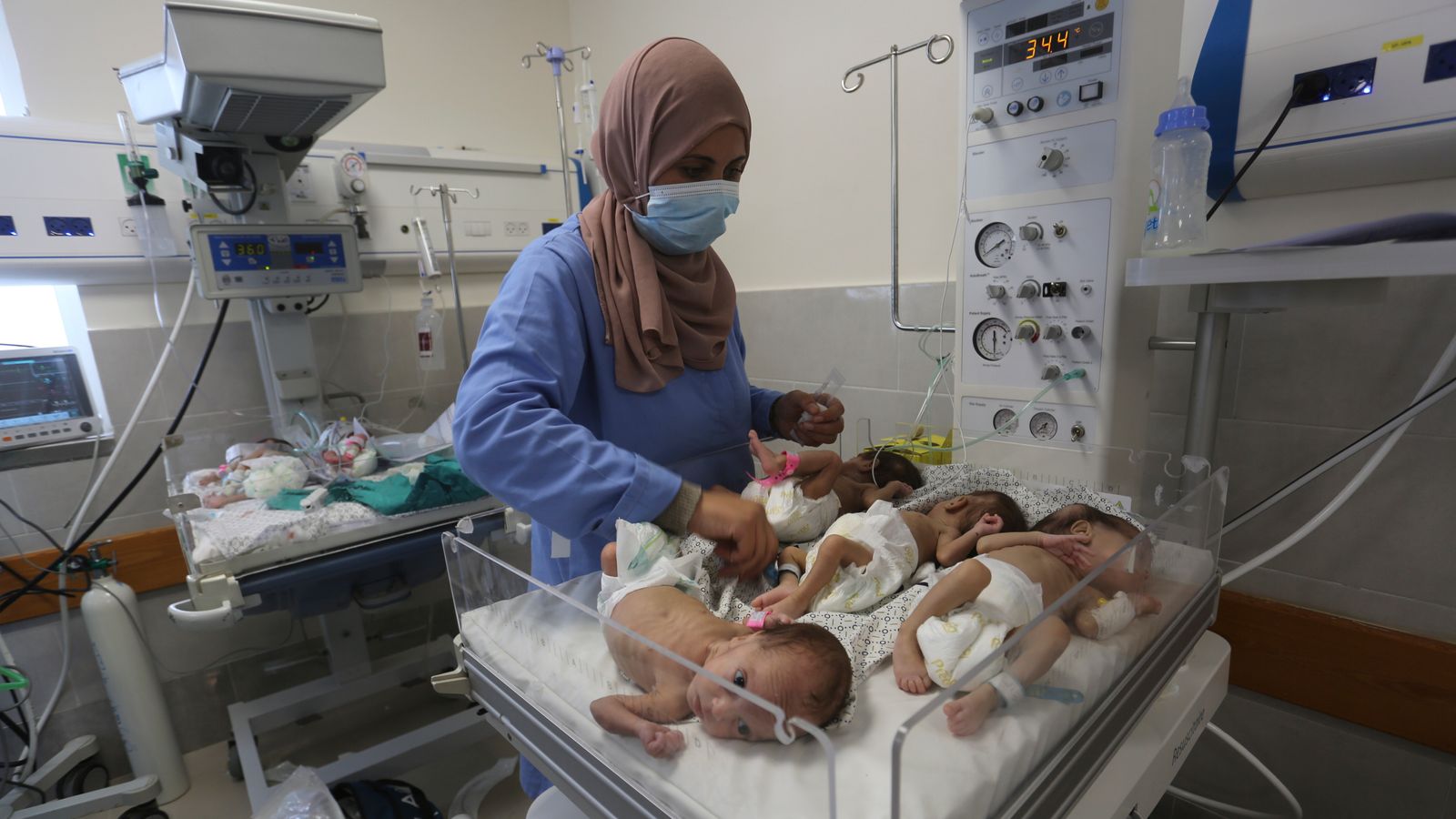
A total of 31 premature babies were safely moved from Gaza’s main hospital to another in the south over the weekend, and today they will be moved to Egypt, health officials have said.
It comes as scores of other critically wounded patients remain stranded at al Shifa hospital, days after Israeli forces entered the compound.
The fate of the newborns captured global attention after photos showed doctors trying to keep them warm and placing several of them in one bed.
A power cut had shut down incubators and other equipment, while food, water and medical supplies ran out as Israeli forces battled Hamas militants outside the hospital.
World Health Organisation chief Tedros Adhanom Ghebreyesus said the “very sick” babies were evacuated, along with six health workers and 10 staff family members.
He said they were taken to a hospital in the southern Gaza city of Rafah where they are receiving urgent care.
A UN official said the babies were threatened by serious infections, with 11 in critical condition.
A WHO team that visited the hospital on Saturday said 291 patients were still there, including the babies, trauma patients with severely infected wounds and others with spinal injuries who are unable to move.
Israel has long alleged that Hamas uses the facility for military purposes – a claim the militant group has denied.
Israeli troops, who have been based at the hospital and searching its grounds for days, say they have found guns, a tunnel shaft and weapons.
Good morning
Welcome back to our live coverage of the conflict.
Before we resume reporting, let’s get you up to speed on the key developments that took place yesterday.
Hospital tunnel: The IDF claimed to have found a Hamas tunnel underneath the al Shifa hospital complex. A Hamas official said a tunnel did not indicate any military presence, alluding to previous accusations made by the IDF that a Hamas headquarters was positioned under the hospital.
Babies evacuated: 31 babies were evacuated from the hospital following a WHO mission to the facility, but a UN official warned all of them were threatened by serious infections, with 11 in critical condition.
“Death zone”: The WHO described al Shifa as a “death zone” which had ceased to function as a hospital, finding a mass grave at its entrance where more than 80 people were buried.
Hostage deal hopes: A US official said a hostage deal was closer than ever, but warned it could all fall apart at the last hurdle. Israel said it was hopeful a significant number of hostages could be freed in the coming days, while Qatar, which has been meditating negotiations, said only minor “logistical” challenges remained.
Ship hijacked: Houthis launched from a helicopter onto a ship linked to one of Israel’s richest men before taking its crew hostage, according to US and Israeli officials, and a statement by the Houthis. The Yemen-based group vowed to target ships affiliated with Israel.
Death toll climbs: The number of Palestinians killed in Gaza reached 13,000, according to its Hamas run government media office.
Arab and Muslim ministers in Beijing urge end to war
Arab and Muslim ministers have called for an immediate ceasefire in Gaza, as their delegation visited Beijing on the first leg of a tour to push for an end to hostilities and to allow humanitarian aid into the territory.
The delegation, which is set to meet officials representing the permanent members of the UN Security Council, is also piling pressure on the West to reject Israel’s justification of its actions against Palestinians as self-defence.
The officials holding meetings with China’s top diplomat Wang Yi on Monday are from Saudi Arabia, Jordan, Egypt, Indonesia, Palestine and the Organisation of Islamic Cooperation, among others.
Pro-Palestinian convoy in London caused ‘danger to other road users’, Met says
Police are trying to identify 15 people who took part in a pro-Palestinian convoy that caused “danger to other road users”.
A total of 80 cars “stopped twice on major roads” – the A13 and the Limehouse Link Tunnel – Scotland Yard said.
It caused “not only disruption but danger to other road users”.
Read full story below…
Watch: Gaza on verge of major disease outbreak
The World Health Organisation’s regional emergency director, Richard Brennan, has told Sky News that Gaza could be “on the precipice of a major disease outbreak”.
With 800,000 people crammed into overcrowded schools and other “collective centres”, skin infections including scabies are being found, along with jaundice and diarrhoea, Mr Brennan said.
Lammy on visit to Israel and Occupied Palestinian Territories
Shadow foreign secretary David Lammy is making Labour’s first visit to Israel and the Occupied Palestinian Territories since the Israel-Hamas war started.
In Israel, he will meet President Isaac Herzog and other politicians after calling for a “longer pause” to the conflict to alleviate the “shocking humanitarian emergency” in Gaza.
Mr Lammy will also meet the Palestinian Authority’s deputy foreign minister Amal Jadu in the West Bank.
From Israel, Mr Lammy criticised the international allies for failing to realise the threat posed by Hamas ahead of the 7 October attacks.
The shadow foreign secretary urged them to “learn the lessons of decades of failure to resolve this conflict”.
He said political leaders have been complacently “content with the delusions of wishful thinking” while failing to work for a two-state solution for Israel and Palestine.
Mr Lammy also stressed that “diplomacy is how we can secure the release of hostages” while protecting Palestinians, as Israel carries out a ground assault.
“Hard diplomacy is required with all governments in the region to deliver a longer pause immediately to respond to the shocking humanitarian emergency in Gaza, secure the release of hostages so cruelly taken by Hamas and as a necessary step to an enduring cessation of violence,” he said.

Published On 23 Oct 202323 Oct 2023
Russia has criticised the United States president’s assertion that Washington must be the driving force in a new “world order”, saying such an “American-centric” vision is outdated.
Kremlin spokesperson Dmitry Peskov told reporters on Monday that while he agrees on the need for a “new world order”, he does not believe the US should be at the helm. Any new system should be “free from the concentration of all mechanisms of world governance in the hands of one state”, he said.
list of 4 itemslist 1 of 4list 2 of 4list 3 of 4list 4 of 4end of list
Peskov was responding to a speech US President Joe Biden delivered on Friday in which he addressed the US engagement in foreign crises from Ukraine and Taiwan to Israel.
During his remarks, Biden said the “world order” of the past half-century was “running out of steam” and America needed to “unite the world” in a new order to forge peace.
“I think we have a real opportunity to unite the world in a way it hasn’t been in a long time and enhance the prospect of peace, not diminish the prospect of peace,” Biden said.
Peskov responded: “In this part we disagree because the United States, … no matter what world order they talk about, they mean an American-centric world order, that is, a world that revolves around the United States. It won’t be that way anymore.”
Deepening chasm
The clash of words reflects a deepening chasm between the two global superpowers, which are bitterly opposed over Russia’s war in Ukraine and Moscow’s blooming alliances with American archrivals such as Iran and North Korea.
Since Russia invaded Ukraine in February 2022, the US has imposed wide-reaching sanctions on Kremlin-linked individuals and entities, and supplied Ukraine with tens of billions of dollars in humanitarian, financial and military aid.
Biden in recent remarks has also frequently drawn comparisons between Russian President Vladimir Putin and Hamas, the Palestinian group governing the Gaza Strip that the US has designated a “terrorist” organisation, saying they both pose threats to neighbouring democracies.
“Hamas and Putin represent different threats, but they share this in common: They both want to annihilate a neighbouring democracy,” Biden said in an Oval Office address on Thursday.
Source: Al Jazeera and news agencies
Israel’s military response to Hamas’ October 7 attack is causing widespread international outrage, which was crystallized this week in a U.N. Security Council resolution calling for “urgent and extended humanitarian pauses and corridors” in Gaza for “a sufficient number” of days to allow full, rapid, safe and unimpeded access for U.N. agencies and their partners. The resolution is binding; however, nothing guarantees that this will happen. Now, as at other times in the past — when, for example, Israel was urged to stop its colonization of Palestinian territories — the international community is not effectively imposing its will on the Israeli state. Why?
The High Representative of the European Union for Foreign Affairs and Security Policy, Josep Borrell, said on Friday in Ramallah (West Bank) that what is currently happening in Gaza “is the consequence of a political and moral failure of the international community,” which for decades has theoretically supported a two-state solution without doing “what it should have” to make it “a reality.” Borrell insisted that because of this failure, “the Israeli and Palestinian people are paying a high price.”
This general statement has specific derivations once applied to the Israeli side, the dominant force in the conflict and occupying power. From this point of view, the United States has a relevant share of responsibility in the collective failure mentioned by Borrell. The support and protection of Washington — the only actor with real influence over Israel, in view of the fundamental military support it provides, and with veto power in the Security Council — is an essential key to understanding Israel’s margin for action. European countries also bear responsibility, but less so because of their lesser capacity to influence Israel.
The position of a hegemonic force like the U.S. and the institutional design of the U.N. — which prevents it from being effective in security matters unless there is consensus among its members — explain why, although large majorities in the General Assembly or even in the U.N. Security Council have condemned Israel’s actions, this political will has not had any real consequences on the round. Washington has at times let resolutions pass that have been uncomfortable for its ally, but it has never exerted or permitted substantial pressure to fully achieve certain objectives, be they humanitarian pauses, a halt to colonization or the establishment of a Palestinian state.
In the current crisis, Israel suffered a barbaric attack by Hamas that gave it the right to self-defense. The manner in which this is being carried out is causing immense human suffering, through tactics of collective punishment that many experts consider to be war crimes. Despite international pressure, Israel continues with its massive bombardments and siege on the Gaza Strip, which allows only a tiny amount of basic products such as food, water, or fuel to pass through. The episode is just the latest in Israel’s long pattern of excesses and abuses in its legitimate attempt to guarantee its security.
Here are some clues and data to delve deeper into the question of the leverage that various international actors have over Israel’s actions and why they have not used it to its fullest extent.
The protection of the U.S.
The history of the State of Israel cannot be understood without the active support of the United States, which has been supporting and protecting the Jewish State for decades.
Whether for genuine political and moral convictions (wanting to defend a safe home for the people who suffered the most tremendous persecution in the history of mankind), for domestic political reasons (considering the considerable influence of the Jewish community on American politics) or for strategic interests in the region (given that several Arab countries have opted to ally themselves with the former USSR and the confrontation with Iran since the establishment of the Islamic Republic), Washington’s support of Israel has been unwavering. A support that comes in the form of powerful military aid and political cover in the U.N.
This does not mean that their relationship has not had its ups and downs. While the U.S. has on countless occasions blocked U.N. initiatives aimed at Israel by wielding its veto power, it also has in a number of significant circumstances — out of exasperation — let its ally down. A famous example would be Resolution 2334 of 2016, which the Barack Obama administration let through and which dealt a tremendous blow to Israeli colonization. This week’s resolution, which the U.S. let pass and which does not even include a condemnation of the Hamas attack, is another strong critical signal. In many other situations the U.S. has bilaterally or even publicly expressed its displeasure with certain Israeli policies, and there is no doubt that unobvious U.S. pressure has achieved significant results in the region in recent history.
But Washington has never given — or allowed to be given — a decisive push to end the occupation, to end colonization, to establish a Palestinian state, to stop military campaigns that might have been even more brutal without its actions, but which in any case have caused atrocious suffering to civilians and, according to many experts, abundant war crimes.
The U.S. is Israel’s great military ally and thus has the most influence over it. If the U.S. were to make this aid conditional on the respect of certain limits, it would probably be very effective, given its fundamental influence over Israel.
Over the decades, Washington’s support has been of enormous quantity and quality, making Israel the powerful military power in the region that it is. In the decade covered by the current Memorandum of Understanding (MOU), which was signed in 2016, Washington plans to provide military aid to Israel to the tune of $38 billion. This represents approximately twice the total annual defense budget of a country like Spain, which is much larger in terms of economy and population than Israel. There are estimates that the total amount of U.S. taxpayer military aid to Israel exceeds $300 billion when adjusted for inflation.
Not only is the quantity enormous: the quality is decisive. The U.S. is pursuing an active policy that seeks to guarantee that Israel will always have a qualitative edge over its adversaries. Thus, for example, Israel was the first country to receive American-made F-35 fighter planes, the most advanced in the world, and the U.S. helped fund and produce the Iron Dome, Israel’s anti-missile defense system.
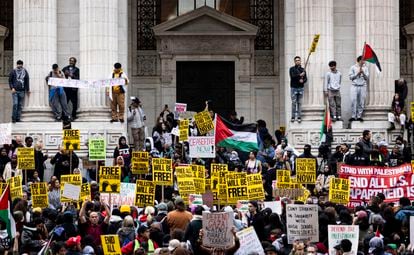 People gather for a protest against Israel’s ongoing military operation in the Gaza Strip, in New York on November 9, 2023.JUSTIN LANE (EFE)
To imagine the U.S. supporting a sanctions initiative at the U.N. for illegal colonization is practically impossible. But what would have happened if the delivery of F-35s and critical parts for Iron Dome had been conditioned on a freeze on colonization, or on the acceptance of a humanitarian pause in the current Gaza conflict?
Europe’s acquiescence
While the responsibility of the U.S. deserves priority consideration in the collective failure of which Borrell speaks, Europe also has a significant share. There are two levels, that of the EU as a bloc, and the national positions of individual states, which obviously influence the former, but also have their own course.
The EU is not a geopolitical or military power, and in that sense it lacks important levers of influence. However, the EU is Israel’s number one trading partner. Last year, 28% of Israel’s trade in goods was with countries in the EU. This is not the same as being an essential supplier of arsenals, but it is not insignificant either. South Africa’s apartheid did not fall by means of hard power, but through enormous diplomatic, commercial, cultural and media pressure.
However, the EU is finding it difficult to articulate common positions on this issue. A late October resolution at the U.N. General Assembly also calling for a humanitarian truce — which passed by 120 votes in favor, 45 abstentions and 14 against, including Israel and the U.S. — is a good illustration of this disjointedness: some EU countries were in favor, a number were against and others abstained.
Specifically, Germany’s Nazi past paralyzes the leading European power on this issue. Having collaborated with Nazi Germany continues to weigh Italy down. And France, the EU’s second-largest power, is home to Europe’s largest Jewish community.
The enormous caution of important countries and internal disagreements explain, at least in part, why the EU has never taken any major action to try to exert influence on Israel. Even measures on the mere labeling of products from occupied and colonized territories have been met with difficulties.
Russia, a Eurasian power, has cultivated increasingly close relations with Israel during Vladimir Putin’s two decades in power. While Russia has never had the type of influence that Western powers have, this policy of rapprochement with Israel has in any case inhibited tangible moves. This is changing, with the ever closer relationship between Moscow and Tehran. Time will tell what the consequences will be.
 Benjamin Netanyahu and Vladimir Putin, in 2020 in Moscow.MAXIM SHEMETOV (Reuters)
The impotence of the U.N.
This underlying political reality has a major impact on the ability of the United Nations to translate policy statements with overwhelming support into reality on the ground.
The U.N. has instruments to give an executive dimension to its decisions, to influence the actual course of events, such as the deployment of peacekeeping missions — there are currently 12, with 90,000 troops — or the imposition of sanctions which, although with limited effectiveness, do represent a powerful instrument of pressure.
The U.N., moreover, embodied in the 2005 World Summit conclusions the concept of “responsibility to protect,” according to which (art. 138) each state has the responsibility to protect its population from genocide, war crimes, ethnic cleansing and crimes against humanity; and (art. 139) the international community also has the responsibility to protect peoples from such crimes through peaceful means. “In this context, we are prepared to take collective action, in a timely and decisive manner, […] should peaceful means be inadequate and national authorities manifestly fail to protect their populations from genocide, war crimes, ethnic cleansing and crimes against humanity,” reads the article.
The principle has been invoked on some occasions in past international crises (i.e., Libya). In the Gaza conflict, some experts believe that it is not applicable, because it refers to the duty of states to protect their population, and Gazans would not fall into that category vis-à-vis Israel. But others opine that, since the U.N. considers the Strip as being occupied by Israel, the country is responsible for the population residing there.
In any case, by one means or another, any executive action requires a political will that has never been forthcoming, especially given the ironclad protection that the U.S. has provided to its ally in the Security Council.
Conclusions
The Israeli-Palestinian conflict is one of immense complexity that gives rise to disparate political judgments. There are serious responsibilities on both sides. Israel, as an occupying power, has specific responsibilities. As a democracy, it should have moral standards that cannot be expected from an organization such as Hamas, considered terrorist by the EU. Several of its policies have been labeled unlawful by the international community, and many experts consider it to be racking up war crimes. There are no judgments on these cases because Israel is not a party to the Rome Statute and therefore not subject to the International Criminal Court, but after Palestine was admitted as a member a few years ago, investigations have begun and judgments could be forthcoming in the coming years.
In the meantime, the reality is that Israel’s actions, whether considered justified or not, have only been possible because of the active backing of a hegemonic power — the United States — and an executive incapacity of the U.N. largely derived from that backing.
Sign up for our weekly newsletter to get more English-language news coverage from EL PAÍS USA Edition
Categories
Why no one is stopping Israel
Israel’s military response to Hamas’ October 7 attack is causing widespread international outrage, which was crystallized this week in a U.N. Security Council resolution calling for “urgent and extended humanitarian pauses and corridors” in Gaza for “a sufficient number” of days to allow full, rapid, safe and unimpeded access for U.N. agencies and their partners. The resolution is binding; however, nothing guarantees that this will happen. Now, as at other times in the past — when, for example, Israel was urged to stop its colonization of Palestinian territories — the international community is not effectively imposing its will on the Israeli state. Why?
The High Representative of the European Union for Foreign Affairs and Security Policy, Josep Borrell, said on Friday in Ramallah (West Bank) that what is currently happening in Gaza “is the consequence of a political and moral failure of the international community,” which for decades has theoretically supported a two-state solution without doing “what it should have” to make it “a reality.” Borrell insisted that because of this failure, “the Israeli and Palestinian people are paying a high price.”
This general statement has specific derivations once applied to the Israeli side, the dominant force in the conflict and occupying power. From this point of view, the United States has a relevant share of responsibility in the collective failure mentioned by Borrell. The support and protection of Washington — the only actor with real influence over Israel, in view of the fundamental military support it provides, and with veto power in the Security Council — is an essential key to understanding Israel’s margin for action. European countries also bear responsibility, but less so because of their lesser capacity to influence Israel.
The position of a hegemonic force like the U.S. and the institutional design of the U.N. — which prevents it from being effective in security matters unless there is consensus among its members — explain why, although large majorities in the General Assembly or even in the U.N. Security Council have condemned Israel’s actions, this political will has not had any real consequences on the round. Washington has at times let resolutions pass that have been uncomfortable for its ally, but it has never exerted or permitted substantial pressure to fully achieve certain objectives, be they humanitarian pauses, a halt to colonization or the establishment of a Palestinian state.
In the current crisis, Israel suffered a barbaric attack by Hamas that gave it the right to self-defense. The manner in which this is being carried out is causing immense human suffering, through tactics of collective punishment that many experts consider to be war crimes. Despite international pressure, Israel continues with its massive bombardments and siege on the Gaza Strip, which allows only a tiny amount of basic products such as food, water, or fuel to pass through. The episode is just the latest in Israel’s long pattern of excesses and abuses in its legitimate attempt to guarantee its security.
Here are some clues and data to delve deeper into the question of the leverage that various international actors have over Israel’s actions and why they have not used it to its fullest extent.
The protection of the U.S.
The history of the State of Israel cannot be understood without the active support of the United States, which has been supporting and protecting the Jewish State for decades.
Whether for genuine political and moral convictions (wanting to defend a safe home for the people who suffered the most tremendous persecution in the history of mankind), for domestic political reasons (considering the considerable influence of the Jewish community on American politics) or for strategic interests in the region (given that several Arab countries have opted to ally themselves with the former USSR and the confrontation with Iran since the establishment of the Islamic Republic), Washington’s support of Israel has been unwavering. A support that comes in the form of powerful military aid and political cover in the U.N.
This does not mean that their relationship has not had its ups and downs. While the U.S. has on countless occasions blocked U.N. initiatives aimed at Israel by wielding its veto power, it also has in a number of significant circumstances — out of exasperation — let its ally down. A famous example would be Resolution 2334 of 2016, which the Barack Obama administration let through and which dealt a tremendous blow to Israeli colonization. This week’s resolution, which the U.S. let pass and which does not even include a condemnation of the Hamas attack, is another strong critical signal. In many other situations the U.S. has bilaterally or even publicly expressed its displeasure with certain Israeli policies, and there is no doubt that unobvious U.S. pressure has achieved significant results in the region in recent history.
But Washington has never given — or allowed to be given — a decisive push to end the occupation, to end colonization, to establish a Palestinian state, to stop military campaigns that might have been even more brutal without its actions, but which in any case have caused atrocious suffering to civilians and, according to many experts, abundant war crimes.
The U.S. is Israel’s great military ally and thus has the most influence over it. If the U.S. were to make this aid conditional on the respect of certain limits, it would probably be very effective, given its fundamental influence over Israel.
Over the decades, Washington’s support has been of enormous quantity and quality, making Israel the powerful military power in the region that it is. In the decade covered by the current Memorandum of Understanding (MOU), which was signed in 2016, Washington plans to provide military aid to Israel to the tune of $38 billion. This represents approximately twice the total annual defense budget of a country like Spain, which is much larger in terms of economy and population than Israel. There are estimates that the total amount of U.S. taxpayer military aid to Israel exceeds $300 billion when adjusted for inflation.
Not only is the quantity enormous: the quality is decisive. The U.S. is pursuing an active policy that seeks to guarantee that Israel will always have a qualitative edge over its adversaries. Thus, for example, Israel was the first country to receive American-made F-35 fighter planes, the most advanced in the world, and the U.S. helped fund and produce the Iron Dome, Israel’s anti-missile defense system.
People gather for a protest against Israel’s ongoing military operation in the Gaza Strip, in New York on November 9, 2023.JUSTIN LANE (EFE)
To imagine the U.S. supporting a sanctions initiative at the U.N. for illegal colonization is practically impossible. But what would have happened if the delivery of F-35s and critical parts for Iron Dome had been conditioned on a freeze on colonization, or on the acceptance of a humanitarian pause in the current Gaza conflict?
Europe’s acquiescence
While the responsibility of the U.S. deserves priority consideration in the collective failure of which Borrell speaks, Europe also has a significant share. There are two levels, that of the EU as a bloc, and the national positions of individual states, which obviously influence the former, but also have their own course.
The EU is not a geopolitical or military power, and in that sense it lacks important levers of influence. However, the EU is Israel’s number one trading partner. Last year, 28% of Israel’s trade in goods was with countries in the EU. This is not the same as being an essential supplier of arsenals, but it is not insignificant either. South Africa’s apartheid did not fall by means of hard power, but through enormous diplomatic, commercial, cultural and media pressure.
However, the EU is finding it difficult to articulate common positions on this issue. A late October resolution at the U.N. General Assembly also calling for a humanitarian truce — which passed by 120 votes in favor, 45 abstentions and 14 against, including Israel and the U.S. — is a good illustration of this disjointedness: some EU countries were in favor, a number were against and others abstained.
Specifically, Germany’s Nazi past paralyzes the leading European power on this issue. Having collaborated with Nazi Germany continues to weigh Italy down. And France, the EU’s second-largest power, is home to Europe’s largest Jewish community.
The enormous caution of important countries and internal disagreements explain, at least in part, why the EU has never taken any major action to try to exert influence on Israel. Even measures on the mere labeling of products from occupied and colonized territories have been met with difficulties.
Russia, a Eurasian power, has cultivated increasingly close relations with Israel during Vladimir Putin’s two decades in power. While Russia has never had the type of influence that Western powers have, this policy of rapprochement with Israel has in any case inhibited tangible moves. This is changing, with the ever closer relationship between Moscow and Tehran. Time will tell what the consequences will be.
Benjamin Netanyahu and Vladimir Putin, in 2020 in Moscow.MAXIM SHEMETOV (Reuters)
The impotence of the U.N.
This underlying political reality has a major impact on the ability of the United Nations to translate policy statements with overwhelming support into reality on the ground.
The U.N. has instruments to give an executive dimension to its decisions, to influence the actual course of events, such as the deployment of peacekeeping missions — there are currently 12, with 90,000 troops — or the imposition of sanctions which, although with limited effectiveness, do represent a powerful instrument of pressure.
The U.N., moreover, embodied in the 2005 World Summit conclusions the concept of “responsibility to protect,” according to which (art. 138) each state has the responsibility to protect its population from genocide, war crimes, ethnic cleansing and crimes against humanity; and (art. 139) the international community also has the responsibility to protect peoples from such crimes through peaceful means. “In this context, we are prepared to take collective action, in a timely and decisive manner, […] should peaceful means be inadequate and national authorities manifestly fail to protect their populations from genocide, war crimes, ethnic cleansing and crimes against humanity,” reads the article.
The principle has been invoked on some occasions in past international crises (i.e., Libya). In the Gaza conflict, some experts believe that it is not applicable, because it refers to the duty of states to protect their population, and Gazans would not fall into that category vis-à-vis Israel. But others opine that, since the U.N. considers the Strip as being occupied by Israel, the country is responsible for the population residing there.
In any case, by one means or another, any executive action requires a political will that has never been forthcoming, especially given the ironclad protection that the U.S. has provided to its ally in the Security Council.
Conclusions
The Israeli-Palestinian conflict is one of immense complexity that gives rise to disparate political judgments. There are serious responsibilities on both sides. Israel, as an occupying power, has specific responsibilities. As a democracy, it should have moral standards that cannot be expected from an organization such as Hamas, considered terrorist by the EU. Several of its policies have been labeled unlawful by the international community, and many experts consider it to be racking up war crimes. There are no judgments on these cases because Israel is not a party to the Rome Statute and therefore not subject to the International Criminal Court, but after Palestine was admitted as a member a few years ago, investigations have begun and judgments could be forthcoming in the coming years.
In the meantime, the reality is that Israel’s actions, whether considered justified or not, have only been possible because of the active backing of a hegemonic power — the United States — and an executive incapacity of the U.N. largely derived from that backing.
Sign up for our weekly newsletter to get more English-language news coverage from EL PAÍS USA Edition
