
The Pentagon failed an independent audit of its accounting systems for the sixth consecutive year
Day: November 16, 2023
By Connor O’Keeffe
Last week, Senator Joe Manchin (D-WV) announced he would not seek reelection in 2024. In a Wall Street Journal op-ed, Manchin explained his reasons for leaving. He starts with a relatively noncontroversial assessment of the problems facing America—rising costs, dangerous drugs crossing the border, a large national debt, unsafe communities, and foreign wars that threaten to pull the United States in.
After some platitudes about these not being “Republican or Democratic challenges” but “American challenges,” Manchin concludes: “There are enough votes in Congress to solve or at least make headway against every one of these problems. A genuine commitment to legislating would put America on firmer footing for the next 20 years. But the Democratic and Republican machines have no interest in solutions. Instead, they stoke outrage because doing so brings them fame and funding.”
For that reason, Manchin’s done with Congress. He now plans to travel the country to scope out interest in a movement to “mobilize the middle.”
That has many speculating and worrying that the West Virginia senator intends to run as the Democrat on the so-called unity ticket being organized by the centrist group No Labels.
The group has said Manchin’s announcement took them by surprise, but Manchin has a close relationship with No Labels, and his op-ed struck all the same chords as the group’s so-called common sense agenda.
Centrists like Manchin and No Labels can sound reasonable because they often cite the most pressing problems facing Americans and point out that Congress is entirely unable or unwilling to solve them. That’s all true. But things start falling apart when they try to explain how we got here and the way out.
As Manchin sees it, the American people are unified in their values and beliefs but unfortunately Congress has been taken over by two “extremes” that shun the wants and needs of the American people.
In fact, the reverse is true. The more than three hundred million people in the US have many different beliefs, values, priorities, and interests. Politically, there are American socialists, nationalists, libertarians, progressives, conservatives, liberals, monarchists, anarchists, neoconservatives, etc. And then there are the politically disinterested—the largest group by far.
In contrast, Congress is much more unified than the massive population it claims to represent. Ludwig von Mises, who spent many years studying and analyzing comparative systems of political economy, defined interventionism as the prevailing ideology among the world’s governments.
According to Mises, interventionism creates a mixed economy between socialism and capitalism where the bulk of the government’s actions are isolated interventions. Interventionism is built on the idea that the income and wealth of the population “is a fund that can be freely used” for the improvement of society through targeted interventions.
In other words, interventionism is an ideology whose adherents believe, or pretend to believe, that we are perpetually only a handful of government interventions away from fixing most of our problems.
While Mises was focused on economic policy, his analysis applies well to all kinds of government intervention. And so does his insight that, over time, middle-of-the-road interventionism leads to socialism—where the government effectively controls all production.
Mises details how, time and again, government interventions are implemented despite warnings from economists that terrible consequences will result. Then, when those terrible consequences inevitably arise, the government uses them to justify more interventions that themselves have terrible consequences, which are used to justify even more interventions, and so on.
The result is a long march toward tyranny. In his book Crisis and Leviathan, Robert Higgs argues this long march can often be sped up by what he calls the ratchet effect. Some interventions lead to a gradual, continuous decrease in living standards—such as the minimum wage or land-conservation laws. But other interventions, like sending newly created money into credit markets or bombing people in foreign countries, can lead to sudden crises like economic depressions or terrorist attacks.
The fear, uncertainty, and destruction caused by these crises make it much easier for governments to justify previously unthinkable levels of intervention, all in the name of addressing an emergency. But, as Higgs demonstrates, the emergency powers seized by the government are rarely rolled back once the crisis dissipates.
This pattern should be familiar to anyone who’s studied American history. Because the political class is made up almost entirely of interventionists. The political establishment is committed to a specific pace by which the government intervenes more and more in the economy. Meanwhile, the two “extremes” in Congress rarely push for anything more than a slight increase or decrease in the rate at which we travel down this same trajectory.
Understanding this dynamic makes the centrist solutions look a bit absurd. The “big spending” Obama Democrats implemented a top marginal tax rate of 39.6 percent, while the “extreme” Trump Republicans imposed a top marginal rate of 37.0 percent. Are our economic problems solved or at least greatly diminished if a centrist Unity ticket can split the difference and usher in a 38.3 percent rate?
Similarly, the apparently far-right House proposed a $14.3 billion aid package to Israel. The Democrats instead wanted $10.0 billion. Is the key to peace in the Middle East really as simple as “mobilizing the middle” to send $12.1 billion instead?
Centrists like Joe Manchin and his friends at No Labels are right about many of the most pressing problems facing Americans. But they’re wrong to blame extremism and dissent within Congress. The infighting in Washington, while nasty, is largely a sham. The two parties remain unified behind the same destructive ideology—interventionism. If we keep trying the same thing, how can we expect different results?
About the author: Connor O’Keeffe (@ConnorMOKeeffe) produces media and content at the Mises Institute. He has a master’s in economics and a bachelor’s in geology.
Source: This article was published by the Mises Institute
Panama’s drought shows how trade disruptions from climate extremes can reverberate around the world
Around 1,000 ships pass through the Panama Canal each month carrying a total of over 40 million tons of goods—about 5 percent of global maritime trade volumes. But water levels in this vital link between the Atlantic and Pacific oceans have fallen to critical lows because of the worst drought in the canal’s 143-year history.
Drought restrictions imposed amid insufficient rainfall at the Gatún Lake, which feeds the canal, have reduced throughput by some 15 million tons so far this year. Ships have faced an additional six days in transit. The authorities are exploring strategic options to boost the water supply in the canal.
As the Chart of the Week shows, ports in Panama, Nicaragua, Ecuador, Peru, El Salvador and Jamaica are suffering most from these delays, with 10 percent to 25 percent of their total maritime trade flows affected. But the drought’s effects are felt as far away as Asia, Europe and North America. The drought will hamper trade for months to come, withcanal passages set to halve to 18 ships per day by February, down from 36 in ordinary times. Economies reliant on the canal for trade should prepare for more disruption and delay.
Amid climate change, droughts, floods, tropical storms and other disasters are becoming more common and pose a serious threat to maritime infrastructure. With PortWatch, an open platform launched today by researchers from the IMF and the University of Oxford, policymakers can prepare for trade disruptions caused by shocks like climate extremes and decide how to respond to them.
The platform uses real-time satellite data to track nearly 120,000 cargo ships and tankers worldwide—over 99 percent of global maritime trade. It provides daily estimates of trade volumes at 1,400 ports and more than a dozen pinch points, such as the Panama Canal.
PortWatch simulates international spillovers from a port closure and plots disruptions to onward supply chains on an interactive map. It enables climate scenario analysis, providing modeled risk estimates for a range of climate extremes. PortWatch also sends alerts on potential and actual trade disruptions after major disasters.

—This article was co-authored by the PortWatch team, which includes Parisa Kamali. See the press release: IMF and University of Oxford Launch “PortWatch” Platform to Monitor and Simulate Trade Disruptions.
About the authors:
- Serkan Arslanalp is Advisor in the IMF’s Office of the Managing Director. He has worked in several departments of the Fund (STA, APD, MCM, FAD, AFR) on a range of countries (advanced economies, emerging markets, low-income/fragile states) and policy areas (strategy; bilateral, regional, and global surveillance; Fund lending operations; standards; capacity development). He has led missions to several countries in the Asia-Pacific and Middle East regions.
- Robin Koepke is an economist in the IMF’s Strategy, Policy and Review Department. His work focuses on external sector policy issues such as external balance assessments, capital flow management, and exchange rate policies. He is also the deputy project leader for PortWatch , an innovative online platform for monitoring and simulating trade disruptions.
- Alessandra Sozzi is a Data Scientist in the IMF’s Statistics Department. Her research focuses on the use of big data and non-traditional data sources in the context of official statistics and macroeconomic analysis.
- Jasper Verschuur contributes to the IMF Blog
Source: This article was published by the IMF Blog
By Jonathan Power
It should take a long time before America can again strut the world stage and lecture us all about the values of democracy and human rights, poking its finger in the eye of every authoritarian or dictatorial government it has the desire to show up.
A former president, no less, has used every occasion to tell the world that the election of 2020 was illegally hijacked. I’m sure Israel’s Prime Minister Benjamin Netanyahu has such doubting thoughts, even if he keeps them to himself.
The last general election held three years ago showed deficiencies in America’s “democracy”. We again learned that more than winning a handsome majority of votes was needed and that for Joe Biden to win, he had to garner 270 votes in the electoral college, which is biased towards the under-populated, rural states such as Wyoming, with only 600,000 people.
In the present Senate, the Democrats have an advantage of only one vote. On rare occasions, the Democrats have dominated it, but after most elections, we find that the smaller and rural states, all Republican most of the time, have tipped the scales. Wyoming gets two senators, just as does the state of New York. As for the lower house, 90% of Congressmen are re-elected. Over the years, congressional boundaries have been jiggled, making it difficult for incumbents to lose.
Then there is the role of the Supreme Court that can occasionally cement the bias- as it did when it overrode presidential candidate Al Gore in favour of George W. Bush. It is a court where justices have been appointed not always for their legal skills but for their political convictions.
Is this American system better or worse than other Western and that of many Third World nations? The UK, France, France, Germany, Brazil, India, Nigeria, South Africa and Canada, to mention some, are better and fairer by a long shot.
But surely, you say, this is countered to some extent by a free press. Indeed, there are good news outlets like the New York Times and the Public Broadcasting System. But even then on key occasions, such as during the Vietnam War and at the onset of the first war against Iraq, there are lapses. With Iraq, the Times did not give much space to reporters or editorial contributors to question the paper’s pro-war line. (We now know the war happened because of lies told by President George W. Bush and UK Prime Minister Tony Blair.)
The respected journalistic organization, Reporters Without Borders publishes an annual press freedom index. The US ranks 45th.
Freedom House, a conservative-leaning organisation I’ve long respected for its honesty, once ranked the US, out of a hundred 94, almost the most democratic in rankings. But by 2009 it had fallen to 22nd place. By 2016, it had dropped to 28th place, with a score of 82. Over the years of President Trump, it fell to 33rdplace. Also notable is Freedom House’s separate index on the question of inequitable treatment for different groups. The US gains only two points out of maximum of four. This is almost unheard of among democracies.
Other measuring organisations such as The Economist Intelligence Unit and Civicus Monitor, come up with similar figures.
President Bill Clinton’s secretary of state, Madeleine Albright, once said, “The United States is the indispensable nation”. But, as James Traub has written in Foreign Policy, “The US remains indispensable because it is the world’s greatest military power- but not because other nations look to it for guidance”.
All this should prompt us to think how important democracy is. For all its failings, the world has no better idea, as Winston Churchill famously declared. The 20th century saw all sorts of experiments, including fascism, socialism (not to be confused with social democracy), anarchism, monarchism, Marxism and theocracy. All came undone. Out of the ferocious competition of rival ideas democracy came out on top.
Professor John Dunn of Cambridge University in his magisterial study of democracy writes, “The term democracy has become (as the Freudians put it) too highly cathected: saturated with emotion, irradiated by passion, tugged to and fro and ever more overwhelmed by accumulated confusion. To rescue it as an aid in understanding politics, we need to think our way past a mass of history and block our ears to many pressing importunities”.
We need to know far more about democracy than we do. President George W. Bush declared that “the reason I’m so strong on democracy is that democracies don’t go to war with each other”. Indeed, much academic research has proved his point, and it is an important and good one. But democracies have a terrible record of going to war against non-democracies, often on the flimsiest excuse.
Look at America’s war against Spain in the nineteenth century or against Cuba and Nicaragua in the last century. Britain has gone to war more times in the last 120 years than any other country in the world.
Perhaps we should not be surprised that Plato was against the democracy of his home city, Athens. Plato believed that in the best form of government philosophers should rule.
Historians have wondered why he was so against democracy. Was it because he was from a wealthy family and Athenian democracy seemed to favour more equal income distribution? Or was it because a democratic state had sentenced to death his teacher, Socrates, falsely accusing him of impiety and trading on Greeks’ religious sensibility?
The US holds 2 million people in jail, mostly young black men
Regardless of the reason, Plato saw democracy as the rule of the foolish, vicious, and always potentially brutal. Look how, as a senator, Biden and his congressional contemporaries voted into being a law that judges must incarcerate the convicted for long terms, even for minor offences, if this was their third conviction. The result is the US has 2 million people in jail, mostly young black men. No other country in the world, even authoritarian or dictatorial, has such numbers, or anywhere near it.
The US holds 25% of the world’s prisoners.
Athenian democracy flourished but then the idea faded away for the best part of 2000 years. The Romans had little time for it. It returned in the struggle for American independence.
A few years later it became the central rallying cry of the French Revolution. Only after 1789 did people start to speak of democratizing societies and it was the French spirit, not the America one, that was its most potent exporter. We must never forget that democracy would never have achieved the promise it did without the vision of Robespierre, this figure of “reptilian fascination” who organized the mass executions of those thought to oppose the path of the Revolution.
Over the next 150 years the cause of democracy edged forward gradually, but it only triumphed after 1945. It achieved its peak, in terms of the number of democracies, after the Cold War. But in the last few years the numbers have slipped back. If the head boy sets a bad example, we shouldn’t be surprised.
Today some of us like to think, as Pericles did in his great oration on the subject, that democracy gives society its sobriety of judgment, respect for wisdom, the pride necessary for its economic energy, its generosity and even its respect for taste and responsiveness to beauty. At the same time, we are engaged in a perpetual fight against its worst elements.
America has moved from being its modern-day founder to being its saboteur. Why should the authoritarians and dictators seek to emulate it when it is making such a mess of the concept?

The High Court of Australia is not known for its zealotry in protecting human rights, and certainly not when considering the persuasive pull of international law and conventions. The Australian Parliament is usually given a generous hand in making policies that tend to outrage such conventions, a freedom made that much easier by an absence of any bill of rights.
A grim example of this was the 2004 High Court decision of Al-Kateb v Godwin, which gave the Commonwealth full assurance that policies on indefinitely detaining unwanted, designated “unlawful” arrivals were entirely within its power. The case concerned the application of various provisions of the Migration Act 1958 (Cth) requiring an officer of the Commonwealth to detain those reasonably suspected to be unlawful citizens in the migration zone and held in immigration detention till their deportation or grant of a visa.
In such provisions, a pincer movement against such “unlawful citizens” had been enshrined with stunning cynicism. Once detained and having their status determined, such individuals might be found to be refugees. Accordingly, they might receive a visa, though not if they were those undesirables marooned in the offshore concentration camps of Nauru and Manus Island. Since 2013, Australian governments have proclaimed that those undocumented souls seeking refuge in Australia by boat would never be given the chance to settle in the country. Even in the event of being deemed refugees, they might still be refused a visa on character grounds or face the prospect of deportation to a third country, the latter being something of a favourite of Australian policy makers for two decades. (A gaggle of European states have also been impressed by this formula.)
What, then, of stateless citizens found to be refugees and without fault? Or those who would not be accepted by a third country? Or those who, having been convicted of an offence and served time for it, could be placed in a vicious limbo of de facto carceral administration for the rest of their natural lives, undesired by any country, and not allowed out in the Australian community for failing to meet visa requirements and deemed a threat to society?
To answer these questions, the facts of Al-Kateb are worth recounting. Ahmed Ali Al-Kateb was a stateless Palestinian born in Kuwait in 1976, having sought sanctuary in Australia in December 2000 without a passport or visa. He was duly detained under the Migration Act. Efforts to gain a protection visa proved futile. The Refugee Review Tribunal and the Federal Court agreed with the decision makers. With Australia having ceased to be an option, Al-Kateb informed the Department of Immigration and Multicultural Affairs that he wished to be transferred to Kuwait or Gaza. Those efforts also came to naught.
Al-Kateb’s cupboard of legal options started looking increasingly threadbare. With little else possible, he resorted to that immemorial principle of Britannic common law that he be released on habeas corpus grounds. After all, the Australian authorities surely had no reason to continue detaining him. He had committed no crime, and there was “no real likelihood or prospect” of Al-Kateb’s removal outside the country in the reasonably foreseeable future, a point acknowledged by the Federal Court.
In a granite hard decision, the High Court rejected the claim. For one thing, the discretion was mandatory under the legislation, not discretionary. Nor was the exercise of such a detention power punitive, thereby violating the separation of powers. In Chief Justice Gleeson’s words: “A person in the position of the appellant might be young or old, dangerous or harmless, likely or unlikely to abscond, recently in detention or someone who had been there for years, healthy or unhealthy, badly affected by incarceration or relatively unaffected. The considerations that might bear upon the reasonableness of a discretionary decision to detain such a person do not operate.”
Justice McHugh also reiterated the view that the Migration Act required “the indefinite detention of Mr Al-Kateb, notwithstanding that it is unlikely that any country in the foreseeable future will give him entry to that country. The words of the three sections [189, 196, 198] are too clear to read them as being subject to a purposive limitation or an intention not to affect fundamental rights.” With Australia lacking any express constitutional protection of habeas corpus, Al-Kateb was doomed.
Efforts to challenge this ghastly precedent over the years faltered. In the meantime, periods of lengthy immigration detention ballooned. Currently, the average period of time individuals held in immigration detention by Australian authorities is 708 days. In May 2022, the detention period reached a dubious peak of 736 days, with 138 having spent time in detention for over five years.
All this has changed. On November 8, the High Court handed down a stunning decision in NZYQ v Minister for Immigration, Citizenship and Multicultural Affairs & Anor, thereby archiving Al-Kateb as a dark, judicial episode.
NZYQ was a stateless Rohingya applicant who had fled Myanmar and journeyed to Australia by boat in September 2012. He received a bridging visa in September 2014. In January 2015, he was arrested and charged with a child sexual offence, his visa cancelled, and prison term imposed. Despite receiving parole in May 2018, he was immediately thrown into immigration detention. As a person regarded as stateless by Myanmar and facing a genuine risk of persecution on his return, NZYQ also faced the prospect of perennial detention for not having a visa. On character grounds, Australian authorities could continue to refuse granting it. It also seems that no third country option arose as a serious possibility, though this will only be known with certainty once the judgment is published.
Much to the surprise of those present, NZYQ’s legal team received the news after two days of oral argument that it was unconstitutional to detain a person where there was no real prospect of being removed from Australia. As a consequence, the court held that provisions under the Migration Act obliging the authorities to detain “unlawful non-citizens” for such inordinate periods should be read as beyond the immigration power of the Commonwealth. NZYQ’s administrative detention, being deemed unlawful, necessitated his release.
The decision immediately affects 92 people in immigration detention. But as the Australian Human Rights Commission reminds us, the perverse cruelties of Australia’s detention system has, over the last two decades, affected “the lives of tens of thousands of people, most of whom came to this country seeking protection as refugees.”
Panicked, the Albanese government has tried dousing the fires of concern, though some of these have been lit by a few parliamentarians prone to pyromania. Public safety, it has been suggested, might be compromised by these reprobates newly found with their freedom in the Australian community. Instead of acknowledging the human rights dimension of the case, the Home Secretary Claire O’Neil came close to slighting the High Court. “If I had any legal power to do it, I would keep every one of those people in detention.” This was irrespective of the fact that they had served time for any offences they had committed.
A government spokesperson was also quick to point out in the immediate aftermath of the High Court decision that, “Individuals released into the community from immigration detention may be subject to certain visa conditions.” But instead of waiting for the decision’s full publication, the government has cobbled a mash of legislative measures in a paroxysm of populism.
On November 16, Immigration Minister Andrew Giles introduced laws applicable to 83 released detainees, among them three murderers and a number of unspecified sex offenders. “The Australian community reasonably expects that all non-citizens in Australia will obey Australian laws.” Some would, for instance, be electronically tagged. Curfews could also be imposed. Attached visa conditions could also include notification requirements for changes of address, any illegal activities or change of address. “These measures,” Giles stated, “are consistent with the legitimate objective of community safety and the rights and interests of the public.” How these objectives square with such savage punishments as five-year prison terms in violation is hard to see.
The opposition leader, Peter Dutton, was left unsatisfied by the proposals. As a proud, demagogic hater of civil liberties, he feels that prolonged punishment is the preferred formula. How this will be done constitutionally is not something that bothers his minute, vengeful imagination. But he proved enough of a fantasist to link the release of the detainees to the threat of rising antisemitism in Australia, a cavalier effort verging on the imbecilic.
In responding to Dutton’s conflating resolution, Prime Minister Albanese thundered that linking “antisemitism with the decision of the high court, is beyond contempt.” But the entire chapter had been beyond contempt. Instead of respecting the central tenets of a fair judicial system, the major parties have heaped scorn upon it. It affirms the penological fixation Australian politicians continue to suffer from when considering the plight of refugees and asylum seekers who dare arrive via unconventional channels. They are the pseudo-criminals who pay people traffickers, the indecent queue jumpers, the unprincipled, cashed up opportunists.
Given that Australia already has a suppressive regime of post-release control measures that effectively mock and caricature sentences served by prolonging state surveillance and control of society’s “most dangerous”, another set of legal measures seeking to achieve precisely the same purpose serves to deaden liberty that bit more.
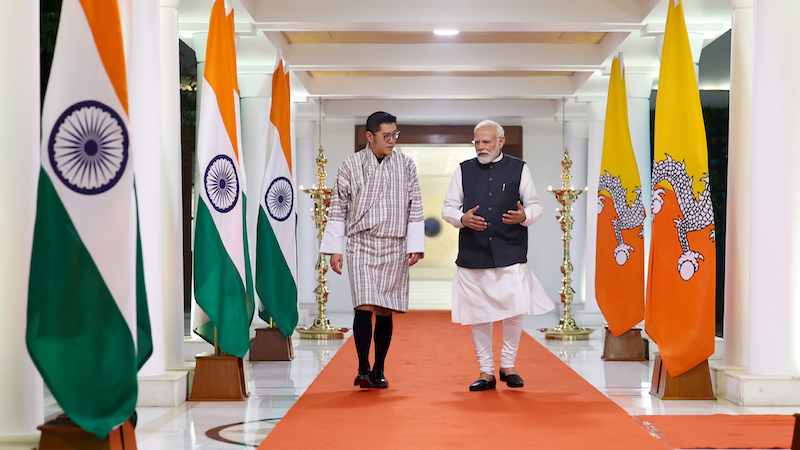
King Jigme Khesar Namgyel Wangchuk of Bhutan’s eight-day visit to India from November 3-10 is most likely aimed at mollifying India on the eve of a possible border deal with China. Recall that the King had visited New Delhi earlier this year in April as well. During the visit to New Delhi, the King met with Prime Minister Modi and senior officials of the government.
The government terms relations with Bhutan an “exemplary bilateral partnership” and the Joint Statement following the visit listed a range of areas in which the two cooperate. But the timing of the visit suggests that it is related to the fast-moving border talks between China and Bhutan. At the official level, though, there have been no indications that his subject has come up for discussions.
Going by the Joint Statements issued after the King’s visits, there was nothing remarkable. The visits were about furthering the already close India-Bhutan relations and their focus was on the multiple areas of cooperation between the two sides, primarily on hydropower and connectivity. However, two visits by the heads of state in one year is somewhat unusual even if the country is Bhutan, and is most likely linked to the Bhutan-China border talks.
The key point of departure has been the “3-Step Roadmap”, a Memorandum of Understanding (MoU), signed by China and Bhutan in October 2021 during the 10th round of their Expert Group Meeting (EGM) in Kunming, China, which envisaged a three-stage process. This involves, first, the delimitation of the border on maps through talks between the two sides, followed by joint surveys which would finally lead to an actual demarcation of the 477 km border between them. India’s response at the time had been that it had noted the signing of the MoU and that like Bhutan, “India has similarly been holding boundary negotiations with China.”
Last month, China and Bhutan held their 25th round of border talks in Beijing. The previous 24th round had been held eight years earlier in 2016. The Bhutanese delegation was led by Lyonpo Tandi Dorji, the Foreign Minister of Bhutan and the Chinese one by Sun Weidong, Vice Foreign Minister of China. Sun is a former Chinese ambassador to India. Maj Gen (retd) V Namgyel, the Bhutanese ambassador to India and the Bhutan foreign secretary Pema Choden were part of the Bhutanese delegation.
Beginning in January this year, there has been a quick sequence of Expert Group Meetings, that culminated in the 25th round of their border talks. The 11th round of Expert Group Meeting was held in Kunming in January 2023. In May, the two sides held their 12th round of their Expert Group Meeting in Thimphu, Bhutan, and said that they had made progress in discussing the “3-Step Roadmap” towards settling their border issue. In August, they held the 13th Expert Group Meeting in Beijing, followed by the 25th round of talks last month in Beijing.
During the 25th round of talks, the two sides signed a Cooperation Agreement detailing the functioning of the Joint Technical Team on the delimitation and demarcation of the Bhutan-China boundary that had been agreed to after the 13th Expert Group Meeting.
Dorji also met his Chinese counterpart Wang Yi and both sides indicated that they wanted a quick border settlement. According to a statement by the Chinese foreign ministry, Wang said that “the conclusion of boundary negotiations and the establishment of diplomatic relations between China and Bhutan” would serve the fundamental interests of both countries. As of now, Bhutan does not have ties with any of the permanent members of the UN Security Council.
In an interview with The Hindu last month, the current Prime Minister of Bhutan, Lotay Tshering, whose term ends this month, had said that he expected progress to be made and confirmed that China and Bhutan were “inching” towards completing their 3-Step Roadmap and that the two sides had “managed two to three meetings and we feel we are nearing the completion of the three-step roadmap” and that the talks also included a possible tradeoff between Chinese claims in Doklam and the ones in northern Bhutan.
The main areas in dispute between China and Bhutan are 269 sq kms on the western border along the Chumbi Valley and two northern areas of Jakarlung and Pasamlung valleys measuring 495 sq kms. Since 2020, the Chinese have also raised an additional claim in eastern Bhutan. There are two important tri-junction points involving India, China, and Bhutan. The one in the west involves Doklam, and the one in the east is the eastern terminus of the McMahon Line which delineates the Sino-Indian border in the region. Doklam was also the site of an India-China standoff in 2017. This is the area where the India-China-Bhutan borders meet but India considers Doklam to be Bhutanese territory and is concerned that it could be ceded to China in the border settlement and enable them to overlook the sensitive Siliguri Corridor that links mainland India to the Northeastern region.
In April, the Foreign Secretary V M Kwatra had briefed the media on the visit. In response to direct questions as to whether there had been any discussions on the China-Bhutan border negotiations, especially Doklam, Kwatra noted that India and Bhutan remain in close touch and maintain “close coordination” relating to our national and security interests. As to the Doklam issue, he referred to the Ministry’s earlier statements which “explicitly bring out our position on the determination of the trijunction boundary points.”
He was referring to the Ministry of External Affairs (MEA) statement at the onset of the 2017 Doklam crisis which had laid out the Indian view of how the crisis had unfolded. Further, it had revealed that in 2012, India and China “had reached an agreement that the tri-junction boundary points between India, China and third countries will be finalised in consultation with the concerned countries.” Adding that any attempt “to unilaterally determine trijunction violates this understanding.”
In an interview with a Belgian newspaper in March, Tshering had more or less upheld the Indian position when he noted that “Doklam is a junction point between India, China and Bhutan. It is not up to Bhutan alone to fix the problem. There are three of us… We can discuss this as soon as the other two parties are ready.”
The border settlement, if and when it comes, will mark a major change in Bhutan’s geopolitical perspective. But as for the present, the Bhutanese seem determined to press ahead. Their problem is the lack of capacity to police its borders and the deliberate Chinese pressure to press their claims.
About the author: Manoj Joshi is a Distinguished Fellow at the Observer Research Foundation
Source: This article was published by Observer Research Foundation