
Russia’s approach to Israel reveals problems in the Kremlin – By ALEXANDER BAUNOV – FThttps://t.co/aBcx7I34zf pic.twitter.com/Qf75S99TcW
— Michael Novakhov (@mikenov) November 14, 2023
Day: November 14, 2023


Stay informed with free updates
Simply sign up to the Russian politics myFT Digest — delivered directly to your inbox.
The writer is senior fellow at the Carnegie Russia Eurasia Center, Berlin and visiting fellow at the European University Institute, Florence
On October 29, several thousand angry men stormed the airport at Makhachkala, capital of Dagestan in Russia’s mainly Muslim north Caucasus. They were looking for Jews believed to have arrived from Israel. The police seemed inactive, much like during Yevgeny Prigozhin’s abortive mutiny in June. In a second Dagestani city, Khasavyurt, a mob searched for Jewish refugees allegedly placed in local hotels. In Karachay-Cherkessia, protesters demanded the eviction of all Jews from the republic. In Nalchik, also in the north Caucasus, a Jewish cultural centre under construction was set on fire and antisemitic graffiti scrawled on its walls.
As happened after the Prigozhin mutiny, Vladimir Putin appeared to have temporarily lost control. This time, it occurred in the Caucasus, where Putin’s rise to power began with ruthless military campaigns. In both cases the explanation is the same: enthusiasts attempt to help the government carry out its policy more decisively, as they interpret it. With the Wagner group, this meant fighting Ukraine with full force. With the Dagestani mob, it meant openly supporting Palestinians in defiance of the west and Israel. The current war in the Middle East is not the first during Putin’s long rule, but the consequences are different. The reason lies in Russia’s fundamentally changed foreign and domestic policy.
After 9/11, Putin was the first foreign leader to phone his US counterpart, George W Bush, to express his condolences. Twenty-two years later, after Hamas’s attack on Israel, Putin was careful, even ambiguous, in his words, even though Israel has not joined western sanctions against Russia and has limited its aid to Ukraine. One reason is that the war against Ukraine has changed Russia so much that it has a different approach to the Arab-Israeli conflict and domestic antisemitism.
By disputing Ukraine’s right to exist, Russia is acting as the arbiter of and successor to the Soviet and tsarist empires. Their legacy includes friendships with Arab states, directed against Israel and the west, and unofficial antisemitism in Soviet institutions that marked out domestic opponents in ethnic and cultural terms. This is not to mention the pogroms of the late tsarist era.
In foreign policy, this legacy manifests itself in the Kremlin’s attempts to rally countries against the world order under the banner of anti-westernism and anti-imperialism. Inside Russia, it labels critics of the war, many of whom went abroad, including to Israel, as insufficiently patriotic. The Kremlin sees ordinary people in and outside Russia as having a natural hostility towards liberals, gay people, intellectuals and political, cultural and financial elites, as well as imbued with a certain antisemitism.
After the failure of Russia’s blitzkrieg attack on Ukraine in early 2022, the Kremlin became consumed with the idea of opening a second front. It tried a gas front against Europe last winter, and a grain front stoking fears of world food shortages and migration crises. It hoped for a flare-up over Taiwan, or domestic political problems in the US. Now that a second front has opened in the Israel-Hamas war, Moscow may hope to propose a bargain to the west: “We’ll help you get out of the mess in Palestine, you help us do the same in Ukraine.” This accounts for a Hamas delegation’s visit to Moscow on October 26.
However, Russia’s decision-making is too degraded for its leaders to use such opportunities. They are in the grip of destructive emotions, obsessed with grievances and fixated on revenge. This reduces their ability to play a constructive role in the Middle East. While conducting its aggressive geopolitical game, the Kremlin has overlooked the consequences at home. Its intense anti-western sentiment has generated violence in the north Caucasus which contradicts the image of domestic harmony that Putin aims to project.
Stay informed with the latest news, analysis and opinion featured on the Israel-Hamas war section
U.S. Senate Democrats Block Republican Bid To Aid Israel, Not Ukraine Radio Free Europe / Radio Liberty
Categories
Russia’s Second Front in Europe
In late September, Serbia deployed advanced weapons to its border with Kosovo, in what amounted to one of the largest Serbian military buildups since the end of the Kosovo war nearly a quarter century ago. In the United States, a spokesman for the National Security Council called it “an unprecedented staging of advanced Serbian artillery, tanks, and mechanized infantry units.” U.S. Secretary of State Antony Blinken called Serbian President Aleksandar Vucic to demand an “immediate de-escalation.”
Although the buildup was largely overlooked by Western media at the time—and has since been forgotten amid the outbreak of war between Israel and Hamas—it is part of an alarming development in the Balkans. The immediate pretext for the Serbian mobilization was months of unrest between Kosovo and Serbia, which have maintained a fragile peace ever since a NATO bombing campaign helped Kosovo win de facto independence from Belgrade in the 1998–99 war. In May, Serbia placed its troops on combat alert after ethnic Serbs living in Kosovo clashed with Kosovo police. And then in September, just before the recent mobilization at the border, 30 heavily armed ethnic Serbs attacked a police patrol in Kosovo, leaving four people dead.
But there are many indications that these incidents go beyond the familiar tensions that persisted in past years. These incidents also show the growing threat that Russia, Serbia’s partner, is posing to the region. In 2022, for example, Serbian Prime Minister Ana Brnabic said that Kosovo and Serbia were “on the brink of armed conflict.” And Moscow—which does not recognize Kosovo’s independence—fanned the flames, using information operations to fuel Kosovar-Serbian distrust and to spread hawkish messages that polarize the region along ethnic and religious lines. Russia has also armed Serbia while increasing Serbia’s energy dependence on its companies by providing gas and oil at a sharp discount. Moscow has promised Belgrade that it will block Kosovo from becoming a UN member state. “A big explosion is brewing in the center of Europe,” Russian Foreign Minister Sergei Lavrov said in May. It might have been a boast.
Part of why Russia is happy to stoke the historical conflict between Kosovo and Serbia is because doing so stresses NATO resources and undermines U.S. power in Europe. NATO forced Serbia to pull out of Kosovo in 1999, and the alliance has maintained a small peacekeeping force of NATO troops in the latter country ever since. As a result, rising tensions between Kosovo and Serbia test NATO’s staying power in the region. Backing Serbia also gives Russia a foothold in the Balkans. Serbian officials have thanked Russia for its “support for Serbia’s territorial integrity and sovereignty” and have stressed that Moscow’s support is the reason Serbia refuses to impose sanctions on Russia.
By putting pressure on Belgrade, the United States was able to calm the most recent bout of unrest, with Vucic declaring a few days later that he would draw down forces on the border and that Serbia had no intention of invading Kosovo. But tensions remain high. Kosovo has labeled the September attacks terrorism, while Vucic has charged Kosovo with perpetrating a “brutal ethnic cleansing” against ethnic Serbs in Kosovo with the help of “the international community.” And Vucic does not need to pursue a full-blown military campaign in Kosovo to further his project of destabilizing the country and humiliating NATO. Like Russian President Vladimir Putin, Vucic uses paramilitary groups to advance his aims. According to Kosovo’s government, Belgrade helped orchestrate the September attack. Vucic could use “little green men” to seize control of northern Kosovo while maintaining plausible deniability, just as Putin did in Crimea.
It is time, then, for NATO to decisively put an end to Vucic’s Kremlin-enabled sideshow. The United States and Europe must make it clear to Belgrade and Moscow that they will react strongly, and harshly, to future Balkan provocations. They must strengthen NATO’s presence in the region and establish credible redlines that Serbia cannot cross without provoking a military confrontation with NATO forces. And they must sanction Belgrade if Serbia’s leaders do not move away from Moscow and de-escalate tensions.
AXIS OF CONVENIENCE
Vucic’s emergence as a key instigator of tensions with Kosovo should not come as a surprise. As a young politician, Vucic was a hardcore Serbian nationalist. During the Balkan wars that followed the collapse of Yugoslavia—in which Albanians, Bosnian Muslims, Croatians, and Serbs killed each other as they tried to control the region—Vucic encouraged the new Serbian state to crush its ethnic opponents. He felt particular vitriol for Kosovar Albanians, who are mostly Muslims and make up more than 90 percent of Kosovo’s population. “For every Serb killed, we will kill 100 Muslims,” Vucic declared in a 1995 address. In 1998, he became Serbian President Slobodan Milosevic’s minister of information. Milosevic’s regime, infamous for its particularly brutal killing of Albanians, fell apart after NATO’s intervention. Milosevic was arrested for war crimes by the International Criminal Tribunal for the Former Yugoslavia. He died in prison before he could be convicted.
Today, Vucic is more of an opportunist than a nationalist, driven largely by his desire to remain in office and expand his power. But this new motivation has not made Serbia’s president particularly benevolent. Vucic benefits politically from chaos in the Balkans, which helps him justify his political relevance and maintain control. A crisis in Kosovo, for example, helps Vucic divert attention from his own domestic political issues and tamp down antigovernment protests. It has also improved his international hand. By escalating and de-escalating crises in Kosovo, Vucic has positioned himself as the determiner of the region’s stability, allowing him to negotiate and bargain with countries in the West, promising to ease tensions if they meet his demands for economic support.
Such bargaining is just one of the ways that Vucic has played the United States and Europe. He has also strung the EU along as part of Serbia’s membership bid. European leaders, including Ursula von der Leyen, the president of the EU commission, say they want Serbia in the organization, and Vucic has, theoretically, agreed to accession. But he does so simply because it brings in EU aid, and what he really wants is to keep Serbia on a long and unending admission path. He does not want to join an organization that would force him to fortify the rule of law.
Many Serbs believe Russian talking points about the war in Ukraine.
In fact, as soon as Vucic came to power, he undermined all pro-Western political opposition while strengthening far-right Serbian groups to improve his own political standing. To extend his power in the region, he is also trying to keep ethnic Serbs in Kosovo in Belgrade’s orbit. And Vucic still appears interested in forcibly taking parts of Kosovo. “All Serbs know they lost Kosovo,” he stated in 2018. “But I will try everything in my might to retrieve what I can, so in the end it is not a total defeat or total loss.” With the West busy supplying Ukraine, supporting Israel, and constraining China, Vucic believes his opportunity to conduct operations in Kosovo may come soon.
To succeed, however, Vucic needs Putin’s help. He wants, first and foremost, Russian energy: Moscow’s key tool of influence. But Russia and Serbia have also bolstered their military-technical cooperation (which Belgrade has then used as a bargaining chip with the West). Vucic has even called on Moscow for domestic help. In May, for example, Vucic warned about “attempts at color revolutions”—the series of protest movements that helped topple pro-Russian rulers in post-Soviet states—and in 2021, Serbia and Russia pledged to jointly combat them. The result could be Russian meddling in Serbia’s snap parliamentary elections on December 17, which Vucic called in October.
To win those elections, Vucic will likely lean heavily on the media. It is a domain that Vucic, as Serbia’s former information minister, knows well. Under Vucic’s watch, Belgrade has spread disinformation to prepare Serbs for escalations in Kosovo, including by accusing the United Kingdom of plotting Kosovo’s war for independence, alleging that Kosovo’s prime minister has conducted acts of “terror against the Serbs,” and blaming NATO for the country’s rise in cancer rates, which Belgrade claims came as a result of NATO using depleted uranium ammunition during its 1999 intervention. Serbia’s newspapers, which largely toe the government line, are filled with anti-Kosovo narratives, and Serbian radio stations have been blasting patriotic songs. Serbian streets have been flooded with graffiti that read “Kosovo is Serbia” and “When the army returns to Kosovo.” (The latter slogan, in effect, calls for Serbia to invade Kosovo).
Vucic and Putin in Sochi, Russia, November 2021
Mikhail Klimentye / Sputnik / ReutersRussia has helped. It has put up billboards in its cities that proclaim, “We mourn together with Serbia / One color, one faith, one blood,” endorsing Serbia’s territorial claims. It has also echoed Serbian propaganda in its media outlets, which Vucic allows to freely operate in his state. These stations, such as RT and Sputnik, have used this freedom to spread pro-Russian messaging about Ukraine alongside pro-Serbian messaging—and with great success. Many Serbs believe Russian talking points about the war, and Serbia’s domestic media have adopted Kremlin narratives and spread Moscow’s propaganda. Serbian news sources, for example, frequently portray the Ukrainians as Nazis and declare, falsely, that Ukraine attacked Russia first.
For Putin, this opening has been a boon. Russia views the Balkans as Europe’s soft underbelly, and Moscow believes that Serbia is its most vulnerable spot. His goal is to turn Moscow into the Balkans’ only reliable conflict negotiator—giving the Kremlin leverage over Western powers. After all, if peace in the Balkans depends on Putin, NATO officials might have to make concessions to Moscow if they want to avoid war. By pushing the Balkans to the brink, he also hopes to show that NATO is a paper tiger and will not act if truly tested. Even if NATO does fight back against Serbia, Putin could still win. By opening another front, the West would have less capacity to help Ukraine.
The Kremlin has other reasons to support chaos in the Balkans. Putin uses the so-called Kosovo precedent to defend its illegal invasion of Ukraine, arguing that the annexation of Ukrainian territories is justified by Kosovo’s independence. According to this perverse logic, articulated by Russia’s permanent UN representative in a January speech, the illegal and wildly fraudulent annexation referendums held in occupied Ukrainian territories are akin to Kosovo’s fight for freedom from Serbia more than two decades ago. Kosovo, in other words, had the right to leave Serbia, and so the occupied Ukrainian territories have the right to join Russia. (The fact that Russia does not recognize Kosovo’s independence, or that Kosovo’s independence is, in fact, a precedent for Ukraine’s own fight for freedom, are ironies that Moscow has not addressed.)
The Kremlin’s support for Belgrade goes beyond narrow interests: Russia has a genuine ideological connection to Serbian nationalists. Putin has worked to position Russia as the leading defender of traditional cultural values—such as strict gender roles and conservative Christianity—against the liberal West. Many Serbians are natural partners. The Serbian media has accused the West of trying to destroy the Russian and Serbian Orthodox Churches, and it has railed against liberal policies, such as LGBTQ rights. Many in Serbia support the creation of the “Serbian world”—a Balkan equivalent to Putin’s “Russian world”—designed to unite all Serbs, including those in Kosovo, under a common Serbian cultural framework. Both states even have foundational myths that are rooted in the territories they would like to take. Many Russian nationalists, for their part, trace Russian civilization to a prince who governed from what is now Kyiv. Many Serbs believe their country should retake Kosovo because it is the home of many medieval Serbian Orthodox monasteries and was the site of the 1389 Battle of Kosovo, when the creation myth of Serbian civilization was born.
GET TOUGH
Western leaders understand that Vucic is motivated at least in large measure by a desire to stay in power. As a result, they have been trying to appease Serbia’s president by giving Belgrade incentives, including economic initiatives and investments, designed to stop his escalations. In June, for example, a month after ethnic Serbs injured NATO peacekeepers, the EU gave Serbia a financial grant. The U.S. ambassador to Serbia has labeled Vucic “a constructive partner,” and when Serbian armed forces participated in a multinational military exercise with NATO in June, the U.S. embassy insisted that Belgrade had chosen the West over Russia. Vucic continues to walk a tight rope in his relationship with the West. According to a leaked document, Serbia has agreed to provide ammunition to Ukraine, and Vucic has not repudiated that claim. Last March, Serbia even voted in favor of the UN resolution condemning Russia’s aggression.
But these steps are just part of Vucic’s balancing act. The military exercise has been organized in Serbia since 2014, and it requires little of Belgrade. To Vucic, ammunition shipments to Ukraine are simply a business deal, and they have not dampened Russian-Serbian relations. And the UN resolution was purely symbolic—an opportunity to boost the country in the eyes of Western leaders without jeopardizing its relations with Moscow. In fact, the resolution’s real, coded meaning was that Serbia will not give up its claims to Kosovo. “For us, Crimea is Ukraine, Donbas is Ukraine, and it will remain so,” Vucic said in January 2023. But this is only because Belgrade believes that, as the Serbian graffiti proclaim, “Kosovo is Serbia.”
If the West continues to enable Vucic, it will simply embolden him. He will keep testing NATO and trying to prove that the alliance is toothless. The West has already given him encouraging signals: after more than 30 NATO peacekeepers were injured in the May clashes with Serbian protesters, the alliance did not detain the violent protesters out of fear that doing so would escalate the conflict. But such restraint is an invitation for further escalation by Vucic, as well as by the Kremlin. Russian officials are watching what happens in Kosovo and wondering whether they can get away with attacking NATO forces and installations.
Russia has a genuine ideological connection to Serbian nationalists.
Kosovo, for its part, has at times ignored the West’s goals. For example, NATO countries have been pushing Kosovo to establish an Association of Serbian Municipalities, which Kosovo has not done so far. The West has, relatedly, accused Kosovo of forcibly installing Albanian mayors in majority Serb towns and, in doing so, raising tensions with Serbia. In response, the United States imposed measures against Kosovo and canceled the country’s participation in the Washington-led Defender Europe 2023 military exercise. But none of Kosovo’s behavior justifies Serbia’s de facto campaign to undermine its independence.
To try to contain the conflict, a week after the May attack, NATO increased its presence in the region with a new legion of roughly 500 Turkish soldiers. NATO also deployed hundreds of British troops to the country in October. But these measures are insufficient. NATO must create a coalition of the willing, headed by the United States, that can send successfully pressure Belgrade and Moscow to stop promoting political instability. That means making it clear to Vucic that, if he continues to take escalatory measures, he will face an escalating series of tangible consequences—including, possibly, sanctions.
The West is well positioned to take such steps. In June 2021, U.S. President Joe Biden signed an executive order allowing Washington to impose sanctions against anyone who destabilizes the Western Balkans. Washington should not be shy about using them against individuals who (in the words of the order) “threaten the peace, security, stability, or territorial integrity” in the region. For American sanctions to have maximum effect, the United Kingdom and the EU should join Washington’s efforts. European leaders should, at a minimum, make future assistance to Serbia dependent on specific policy shifts in Belgrade. The EU, for example, could condition further aid on Vucic’s imposing sanctions on Russia, aligning its foreign policy with that of the bloc, tamping down on regional provocations, and fulfilling the EU’s reform agenda—especially when it comes to the rule of law and media freedom.
What happens in Kosovo and Serbia rarely stays in those countries.
On the ground, NATO should deploy teams in Kosovo that counter Russia’s and Serbia’s propaganda machine. These teams should target far-right Serbian groups and remind them that Russian messaging about a “Slavic brotherhood”—to which Serbia ostensibly belongs—is a myth and that if conflict does erupt, Putin will not help them. To do so, all they need to do is speak the truth: Putin has his hands full fighting a losing war against Ukraine, and he will not provide resources to Serbia for an armed conflict with Kosovo. As evidence, these teams could point to the September war between Armenia and Azerbaijan. Russia is a longtime ally of Armenia, and yet despite Armenia’s requests, Russia provided it with no military support in the recent conflict, which Armenia lost. The teams could also remind Serbian nationalists that Moscow did not help them during the wars in the 1990s.
NATO states may not want to take these measures. In fact, they probably want to ignore Vucic altogether. The alliance has been worn thin helping Ukraine, so expending time and resources on Kosovo and Serbia may feel like too much, especially when they can just buy off the latter country’s president.
But the West must realize that, if left to fester, tensions in these states could become far more difficult—and expensive—to address. What happens in Kosovo and Serbia rarely stays in those countries, and this crisis could easily spill over to other Balkan states. Nearby North Macedonia, which belongs to NATO, might get dragged in. Further escalations in Kosovo will also invite chaos in Bosnia and Herzegovina, where Bosnian Serb leader Milorad Dodik—who has close ties to Putin—has threatened to have Bosnia’s Serbian territories secede. In October, Dodik even emphasized that Serbs should “form a single state,” consisting of Serbia, Republika Srpska, and Montenegro.
A widening conflict would be an even bigger gift for Putin, who wants the West to train its attention away from Kyiv as he fights to seize more of that country. To protect Europe and stop the Kremlin, it is therefore essential that NATO fortify its Balkans flank right now, while the costs of doing so are still cheap.
Loading…
Earlier this year, analysts at the Stockholm International Peace Research Institute warned that the world was “drifting into one of the most dangerous periods in human history”.
Since then, a conflict in the Middle East that threatens to spill over into a regional war has only added to geopolitical tensions – and the risk of all-out war between emerging superpower blocs.
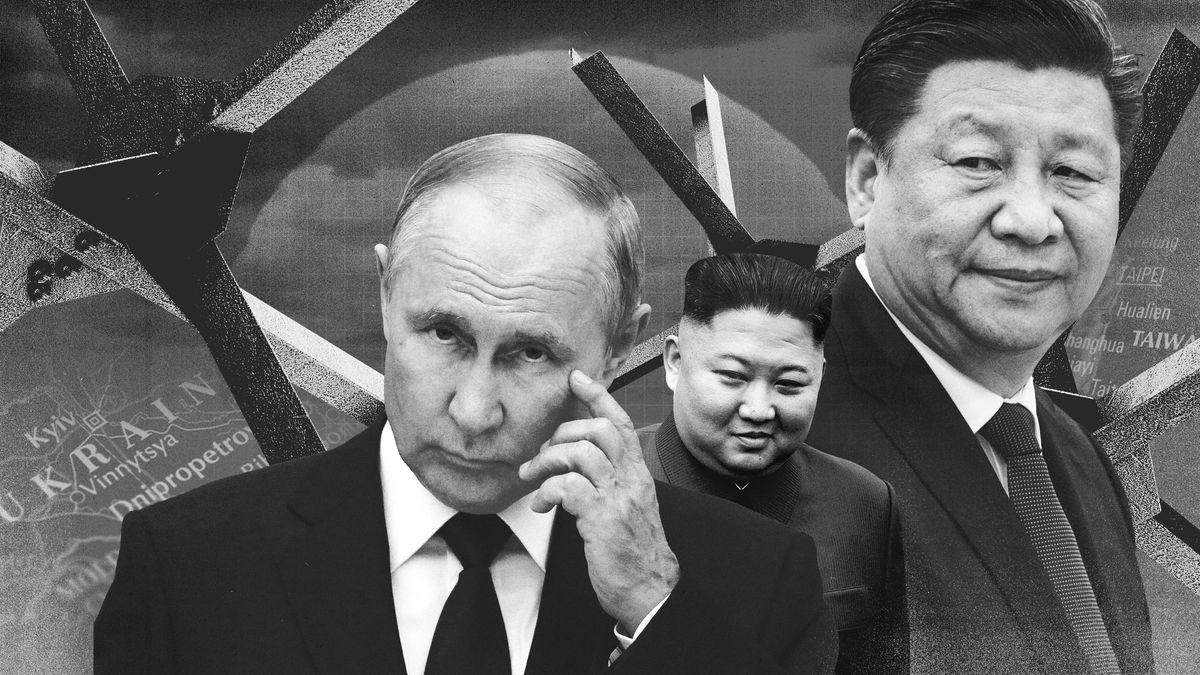
In reality, the US and its allies have been in a new cold war with China for the last five years, argued Niall Ferguson in The Times, with the invasion of Ukraine “roughly equivalent to the Korean War during the first Cold War, revealing an ideological as well as geopolitical division between the countries of the ‘Rimland’ (the Anglosphere, western Europe and Japan) and those of the Eurasian ‘Heartland’ (China, Russia and Iran plus North Korea)”.
From our morning news briefing to a weekly Good News Newsletter, get the best of The Week delivered directly to your inbox.
From our morning news briefing to a weekly Good News Newsletter, get the best of The Week delivered directly to your inbox.
Now the Israel-Hamas war threatens to become the “next crisis in a cascade of conflict that has the potential to escalate to a Third World War, especially if China seizes the moment – perhaps as early as 2024 – to impose a blockade on Taiwan”, he warned.
So where does the biggest threat to world peace lie?
Middle East
Israeli prime minister Benjamin Netanyahu has “spent the past three decades sounding the alarm about Iran’s nuclear programme” and he has threatened to attack the country numerous times, but after Hamas’s assault on 7 October he “may finally be able to act on his threats”, said Al Jazeera.
Whether he does or not will ultimately depend on whether the current, limited, conflict in Gaza broadens out to a wider war in the Middle East involving regional superpower Iran through its proxy Hezbollah in Lebanon.
Many experts believe there is “little desire in Washington and Tehran for a regional conflict”, reported NBC News, but given the intensity of Israel’s bombardment and ground operation “the scope for miscalculation is huge”.
For decades, Israel and Iran have been engaged in a “shadow war” fought on land, at sea, and in the air, said Foreign Affairs. Now, the war in Gaza is “disrupting their already delicate calculus, and the longer the conflict continues, the more it will reduce the incentives for moderation and raise the risk of Israeli-Iranian conflict”.
Seeking to act as a deterrent against a further escalation, the US has continued its troop build-up in the region, with CBS News reporting the deployment of a nuclear-power submarine to join the two American aircraft carriers already in position in the eastern Mediterranean. However, Netanyahu and his ministers “may have something very different in mind for the US deployment, that goes beyond military deterrence and political posturing”, said Al Jazeera. “He may try to widen the scope of the war to include Iran.”
“Iran is how the conflict spirals”, agreed Sky News‘s Mark Stone, but in truth the path to escalation via a Hezbollah-led second front from Lebanon is “unlikely” said Lina Khatib, director of the Soas Middle East Institute, in The Guardian. It would most likely spark US intervention which has “the potential for the war to spread to Iran itself, which is the last thing Iran wants”.
Russia
Russia’s invasion of Ukraine, which began in February 2022, has been described as “more dangerous than anything Europe has seen since the end of World War II” by Politico.
In the 20 months since, the Kremlin’s hopes for a quick victory have turned into a drawn-out war of attrition, with even Ukraine’s commander-in-chief recently admitting the conflict was at risk of becoming a “stalemate”.
With European leaders thought to be tiring of the conflict and resistance growing in Washington to open-ended support, Putin’s “strategic priority is to divert Western support and attention away from Ukraine”, said Politico, and he may see the war in Gaza as the perfect opportunity to push his advantage.
Last week, the Russian president signed a law withdrawing Russia’s ratification of the global treaty banning nuclear weapons tests. Russia has the world’s largest nuclear arsenal and some Western arms control experts are concerned that Putin may be “inching towards a nuclear test to intimidate and evoke fear amid the Ukraine war”, reported Reuters.
He followed this up on Tuesday by formally withdrawing Russia from a post-Cold War era security pact restricting the use of conventional weapons. Nato has previously condemned the move, which has worsened relations between the US and Russia, which Kremlin spokesperson Dmitry Peskov said were already “below zero”.
Last week, Dmitry Medvedev, the former Russian president and now deputy chairman of its Security Council, sought to ratchet up pressure on Poland – a key Nato member – by warning that continued aid to Ukraine may cause a direct confrontation with Russia and Belarus, which could result in the start of World War Three.
With Russia increasingly emboldened, Western war weariness could lead to the fall of Ukraine and, in due course, a Third World War, Ukrainian President Volodymyr Zelenskyy warned CBS‘s flagship 60 Minutes.
“I think that [Putin]’s going to continue threatening,” Zelenskyy said. “He is waiting for the United States to become less stable. He thinks that’s going to happen during the US election. He will be looking for instability in Europe and the United States of America. He will use the risk of using nuclear weapons to fuel that. He will keep on threatening.”
China
The greatest threat to geopolitical stability has long been assumed to be the growing tensions between China and the US, with relations at their lowest point in decades.
Believing continued economic growth would make it a rival centre of geopolitical power to the US, “the conventional wisdom was that China had time to wait”, said The Telegraph. “Time, and investment, would deliver armed forces capable of deterring American intervention within its sphere of influence,” said the paper. “But if China’s power has peaked, and still lags behind, none of this holds true. Instead, the incentive is to be aggressive and take what it can, now.”
The flashpoint, if it comes, is likely to be Taiwan.
Much like Russia’s claim over Ukraine, Beijing sees the island as an integral part of a unified Chinese territory. It has, in recent years, adopted an increasingly aggressive stance towards Taiwan. At the same time, the US under Joe Biden has ramped up its support – financially, militarily and rhetorically – for Taiwan’s continued independence.
In recent months there has been an attempt, led by Washington, to cool the hostile rhetoric and find common ground. However, analysts believe relations are so fraught that “re-establishing a semblance of stability and balance will take much more effort and political will”, said NPR, and will be “tested” by presidential elections in the US and Taiwan in 2024. “Mutual trust is running thin.”
Failure to de-escalate risks a doomsday scenario, in which China takes advantage of the current crisis in Gaza to impose a blockade on Taiwan that draws in the US.
The devastating human cost aside, even if fought by conventional methods, a military conflict between the world’s two biggest economies would lead to “a severing of global supply chains, a blow to confidence and crashing asset prices”, said The Observer‘s economics editor Larry Elliott. “It would have catastrophic economic consequences, up to and including a second Great Depression.”
Artificial intelligence
Recent high-profile advances in artificial intelligence have led to increased fears that AI could accidentally cause a global conflict.
A leading academic at the University of Cambridge told the i news site in March that the technology could, in an extreme case, “mistake a bird as an incoming threat and trigger a nuclear launch if no human override is in place to assess alerts from an AI-assisted early-warning system”.
Although no state is openly attempting to automate its nuclear weapons systems, “integrating AI with command systems seems promising and even unavoidable”, said Peter Rautenbach from the Bulletin of the Atomic Scientists.
Siberian Man Sentenced To 7 1/2 Years In Jail For Criticizing Stalin, Ukraine Invasion Radio Free Europe / Radio Liberty
#POTUS POTUS #DOJ DOJ #FBI FBI #CIA CIA #DIA DIA #ODNI ODNI #News #Times #NewsAndTimes #NT #TNT Putin Russia #Putin #Russia #GRU GRU #Israel Israel #World World #USA USAhttps://t.co/noWTKG2FGK
The News And Times https://t.co/PH3LtsdUTH | https://t.co/N97PQoK4kU |… pic.twitter.com/SQH9wpbFIH— Michael Novakhov (@mikenov) November 14, 2023