
Azerbaijan has undergone great economic transformation since the inception of its independence. Over 30 years, the GDP of the country increased by 174 times which is considered a miracle. Azerbaijan achieved this goal through endless reforms and cooperation with famous investment institutions.
Day: November 14, 2023
The Qur’an contains 99 names (attributes) of the one God while the Torah contains only one personal name of God plus dozens of attributes.
For thousands of years the religions of the Near East, India and China worshipped hundreds of gods, and had hundreds of names for their gods; including several miracle working humans who lived and died among their fellow humans, and were then in retrospect elevated into deities like: Asklepios. Confucius, Siddhartha Gautama and Tin-Hau.
Who was Tin-Hau? She was a young woman who for more than a dozen years had many dream visions of sinking fishing ships that she was able to rescue. Not long after her death at age 28, her story was inscribed on the walls of a sanctuary in Hangchiow, China (in 1228); and she was deified 50 years later by the Mongol emperor Kublai Kahn. So she became a goddess.
But for those religions that trace their prophets back to Prophet Abraham, and his two Prophet sons Ishmael and Isaac, the many names of God simply describe different aspects or attributes of the one God’s multifaceted personality.
God’s names are appellations: titles and descriptions. Thus to say that God is a King or Judge describes one of many ways God acts. To say that God is the Compassionate One is to describe one of many character or personality traits of the one God. Ibn Al-Qayyim writes: The attribute of generosity is an attribute of God who feeds and is not fed. The most beloved creatures to Allah are those who take on his characteristics. Indeed, Allah is noble and loves nobility from his servants, he is knowledgeable and loves the scholars, he is powerful and loves courage, and he is beautiful and loves beauty. (al-Wābil al-Ṣayyib 1/34)
While each of the many ‘names’ for the one God is only one of the many appellations of the one universal creator of space and time; both Islam and Judaism also have one special Divine name that is always in the believer’s heart and soul.
Because the Qur’an is filled with beautiful Arabic poetry, it is not surprising that the Qur’an is also filled with so many names of God.
Because the Jewish tradition reaches back more than thirty five centuries; it is not surprising that Jews have focused on many additional names for the one and only God over those many centuries.
Yet, because all the many names of God call upon the same One God, it is also not surprising that many of the 99 beautiful names of God in Muslim tradition also appear in Jewish tradition, which sometimes refers to the 70 names of God (found in Midrash Shir HaShirim and Midrash Otiot Rabbi Akiba).
Since Islam and Judaism are very close yet uniquely different religions, there are also several Jewish names for God’s attributes that are not found among the 99 names that appear in the Quran. One rabbinic name for God is Shekinah. This Hebrew word is very close in meaning to the Arabic word Sakinah. Both words are feminine gender, but only Jews think of Shekinah as the feminine side of the one and only God. I have written elsewhere about the Sakina-Shekenah connection.
For Jews the most important name of the one God, the name that God himself revealed to Moses at the burning bush, is YHVH: which appears more than 6,800 times in the Hebrew Bible.
In Exodus 3:13-15, Moses said to God, “If I go to the Israelites and tell them, ‘The God of your fathers has sent me to you,’ and they ask me, ‘What is his name?’—what should I say to them?” And God said to Moses, “Ehyeh asher Ehyeh.”
Ehyeh is the verb ‘to be’ in its future tense singular form and means ‘I will/might/may become the one who I may/will/might become,’ indicating that Ehyeh is The God of Potentialities, The God of Possibilities, The Living God of Becoming and Transforming, the One who can liberate Banu/Bnai Israel from bondage in Egypt.
The Torah continues, “And God said, ‘You must say this to the Israelites, “I Am” (the usual mistranslation for God’s self-revealed name) has sent me to you.’” God also said to Moses, “You must say this to the Israelites: Ehyeh, the God of your fathers, the God of Abraham, the God of Isaac, and the God of Jacob—has sent me to you. This is my name forever, and this is my memorial from generation to generation’ (Exodus 3:13-15).
When Jews speak of God in the third person, God’s name is YHVH: “the One who causes being and becoming, the One who brings potentials into existence.”
This name was spoken publicly from the time of Moses and throughout the centuries of the 1st Temple of Solomon, but it was replaced by Adonai (Lord) before the beginning of the 3rd century B.C.E., because God’s actual holy name was eventually considered too holy to utter audibly.
In later centuries even that substitution was considered too holy to utter; and the custom among pious Jews till this day is not to use any name for God at all (except in prayer); but to say HaShem–the name (of God) when speaking about God.
The distinction between the personal intimate name of God that the Jewish believer uses in prayer and when reciting his or her holy scripture versus all other names, is a measure of the believer’s piety and love of the God of his or her own religion.
By Jon Miltimore
I recently took my 6-year-old to see PAW Patrol: The Mighty Movie, Paramount’s sequel to its 2021 hit PAW Patrol: The Movie.
We’d seen that first movie together and both enjoyed it immensely—if for different reasons. As I noted at the time, the first Paw Patrol movie was perhaps the most pro-liberty animated movie since Disney rolled out its beloved classic “Robin Hood” in 1973. (Liberty literally saved the day, thwarting the meddling Mayor Humdinger, who nearly created an environmental catastrophe through his political meddling.)
The second film installment of Paw Patrol isn’t as overtly libertarian as the first movie. But it’s been a smash success, raking in $166 million worldwide already on a $30 million budget. To my delight this film also carried an important moral, showing how well-intentioned people can cause problems in the name of “safety.”
The story begins with an evil scientist named Victoria “Vee” Vance stealing an electromagnet from a junkyard so she can retrieve a magical meteor from the sky. She’s caught and put into prison, where she meets the devious Humdinger, who is still serving time for his own mad plot to control the weather, which nearly destroyed Adventure City.
Before she was nabbed, however, Ms. Vance succeeded in seizing the meteor, which contains crystals that grant our team of hero pups new superpowers. Sky can fly. Chase can run like the Flash. Rubble can crush things, etc.
Things are going fine until the evil scientist and Humdinger break out of prison in an Andy Dufresne-style escape, and manage to steal Sky’s magical crystal, the source of her superpowers. This is where things get interesting.
Sky is crushed that she allowed the villains to get her crystal, but when she tries to assist her team in their effort to retrieve it, Ryder, the team’s leader, forbids her from helping. He says it wouldn’t be safe because she no longer has superpowers.
To make matters worse, Ryder also breaks up a new team of hero pups—the Junior Patrollers—who were being trained by Liberty, who was relegated to mentorship duties because her superpowers hadn’t yet manifested. It just wouldn’t be safe, Ryder tells Liberty.
Ryder’s intentions are pure. He’s just trying to protect his team. But his decision ends up making things worse. Deprived of her superpowers and sidelined by Ryder, Sky decides to take matters into her own hands. While Ryder and the other pups sleep, she steals all the magical crystals and sets out by herself to take back from Victoria Vance the crystal that was stolen from her.
The audience can see where this is going.
“She shouldn’t be doing that,” my 6-year-old whispered to me during the movie. “That isn’t nice!”
To no one’s surprise, Sky ends up losing all the crystals, which fall into the hands of Humdinger and Vance. Things don’t end here, of course. Sans superpowers, the Paw Patrol is able to free Sky and defeat Humdinger and Vance.
Interestingly, however, they are only able to do so with the help of the Junior Patrollers, who Ryder had disbanded in the name of safety.
Many may not see these plot elements as particularly profound, but I believe the theme was included for a reason. Increasingly, modern society is drifting away from a culture of freedom and toward one of “safetyism,” a term coined by authors Greg Lukianoff and Jonathan Haidt.
In their best-selling book The Coddling of the American Mind, Mr. Haidt and Mr. Lukianoff describe safetyism as a belief system that treats safety as “a sacred value.” This includes not just physical safety, but emotional safety, and it has given rise to the censorious culture we see on college campuses today.
“Safetyism,” writes Mr. Haidt, “inflicts collateral damage on the university’s culture of free inquiry because it teaches students to see words as violence and to interpret ideas and speakers as safe versus dangers rather than merely as true versus false.”
It’s precisely this culture that has eroded the tradition of free speech in America, which is now considered “unsafe.” But as the speaker T.K. Coleman recently observed, free speech may not be “safe,” but it is good.
Safetyism goes beyond emotions and free speech, of course. The government routinely violates individual rights in the name of safety.
During the pandemic, we witnessed the widespread propaganda of “stay home, stay safe”—a slogan designed to make people overlook the clear violation of civil liberties from government lockdowns (not to mention the obvious economic tradeoffs of forcing people to stay home). Governments also forced people to take vaccines in the name of public safety.
Using safety as a pretext to suppress civil liberties is hardly new, however. For decades, lawmakers have been doing it to various degrees. We force people to wear “safety belts” while driving. We abridge the rights of gun owners in the name of collective safety. Millions of Americans today are even prevented from pumping gasoline because lawmakers determined it was “unsafe.” (Pumping gas is perfectly safe, of course; safety is merely a false pretext for such laws.)
None of this is to endorse recklessness, of course. Safety is important. I choose to wear my seatbelt because I want to be safe. And when I pump my gas, I try to be careful about it.
But Paw Patrol reminds us that doing what’s safe isn’t always doing what’s right, and that’s a lesson many desperately need—especially those seeking to exploit the natural human desire to be safe to undermine individual rights.
About the author: Jonathan Miltimore is the Editor at Large of FEE.org at the Foundation for Economic Education.
Source: This article. was published by FEE and first appeared in The Epoch Times.
By Justin Burke
(Eurasianet) — Kazakhstan’s president, Kassym-Jomart Tokayev, hosted routine talks with Russian leader Vladimir Putin in Astana on November 9. At the customary, post-meeting press conference, Tokayev said little that was new, yet his delivery marked a notable departure from the past. He opened his remarks in Kazakh, not Russian.
Tokayev’s rhetoric included the usual platitudes concerning the strength of bilateral relations, which he said were underpinned by “unshakable values of mutual respect and trust.” He went on to “confirm Kazakhstan is committed to the strategic direction of further strengthening comprehensive cooperation with Russia.” But in making top Russian officials in attendance, including Foreign Minister Sergei Lavrov and presidential spokesman Dmitry Peskov, reach for their translation devices, Tokayev sent a clear signal to the Kremlin: the dynamics of the relationship are shifting as the Ukraine war plays out. Russia needs to actually respect Kazakhstan’s sovereignty, in deeds not just words, and adjust its imperial mindset.
Putin likely rankled his host by mispronouncing the Kazakh president’s name on several occasions in Astana, at one point calling him “Kemel Jomartovich.” It was not the first such flub for Putin, who previously has called Tokayev – whose patronymic is Kemeluly (or Russified, Kemelovich) – “Kemel Jomartovich,” as well as mangling the Kazakh president’s patronymic in a variety of other ways, Tokayev’s use of Kazakh may have been his way of offsetting Putin’s disses with a diss of his own.
Tokayev has walked a fine diplomatic line during the Ukraine war, striving to keep both the West and Russia satisfied. While repeatedly striving to reassure Russia that Kazakhstan is a good neighbor, he has told Western leaders, including German Chancellor Olaf Scholz, that Kazakhstan is committed to enforcing economic sanctions against Russia.
Justin Burke is Eurasianet’s publisher.
For anyone wishing to bury secrets, especially of the unsavoury sort, there is one forum that stands out. Call it a higher education institution. Call it a university. Even better, capitalise it: the University. This is certainly the case in Australia, where education is less a pursuit of knowledge as the acquiring of a commodity, laid out spam for so much return. On that vast island continent, the university, dominated by a largely semi-literate and utterly unaccountable management, is a place where secrets are buried, concealed with a gleeful dedication verging on mania.
In its submission to what will hopefully become the Australian Universities Accord, the Australian Association of University Professors (AAUP) notes the following: “Unfortunately, university managements are increasingly disconnected from and unaccountable to academic values and academic communities. Students, Government and granting bodies, pay universities to deliver services according to academic values, but academics are impeded from working in accordance with academic values by interfering management. Further, the managers themselves do not work in accordance with academic values.”
Those in the defence industry have taken note. By turning such institutions of instruction into supply lines for research and development in armaments, they can be assured of secrecy conditions the envy of most intelligence agencies. Consulting, viewing, gaining access to relevant agreements, documentation and projects for reasons of public discussion is virtually impossible. These are always seen as “commercial” and “in confidence”.
Only the overly fed and watered members of the University Politburo are granted such access. Entry into the arcana of its deliberations is ceremonially tolerated via Academic Board meetings or Senatorial deliberations. Furthermore, academics throughout the university sport a reliable, moral flabbiness that will prevent them from spilling the beans and airing a troubled conscience, even in cases where leaking the documentation might be possible. Middle class, mortgage-laden status anxiety is the usual formula here, one that neuters revolutionary spirits – not that there was much to begin with.
Across Australia’s universities, the AUKUS military initiative between the US, UK and Australia, primarily focused on developing nuclear powered technology for a new submarine design, has titillated the managerial wonks of the tertiary education sector. In September, the Defence Department announced that 4,000 additional Commonwealth supported places (CSPs) for undergraduate students would be funded as part of its “Nuclear-Powered Submarine Student Pathways” strategy.
Institutes have sprung up running short courses to rake in the cash, such as the UWA Defence and Security Institute, which proudly claims to have created the “essential course for those seeking to gain a greater understanding of AUKUS Pillar 1 (nuclear powered submarines) and the impacts for Western Australia and beyond.” A course running for thirteen hours does not seem particularly hefty, but this is a field of glitz over substance.
Then come the true villains of the peace, the arms manufacturers and companies that make the military-university-industrial complex intimate and obscene. One of interest here is Israel’s Elbit Systems. For years, it has hammered out a reputation for manufacturing such lethal products as the Hermes 900 drone, which was first deployed in 2014 against targets in the Gaza Strip. It supplies the lion’s share of drones used by the Israeli Defence Forces for strikes and surveillance (the figure may be as high as 85%).
The company has managed to beef up many an activist’s resumé. Members of the Palestine Action group claim to have scored a victory in securing the permanent closure of two of Elbit’s sites in 2022, including the London head office. “The cracks in Elbit’s warehouse windows,” the organisation trumpeted in August this year, “do not simply represent cosmetic damage but also symbolise the crumbling foundations of Elbit’s relationship with the British State’s so-called defence interests.”
The corporation has also fallen out of favour with a number of investors. HSBC and the French multinational AXA Investment Managers divested from the company in 2018 and 2019 given its role in producing and commercialising cluster munitions and white phosphoros shells. In May 2022, the Australian sovereign wealth fund, Future Fund, excluded Elbit Systems Limited from its investment portfolio for much the same reasons.
Despite this blotched and blotted record, Elbit could still stealthily establish a bridgehead in the university sector down under through its creation, in 2021, of a Centre of Excellence in Human-Machine Teaming and Artificial Intelligence in Port Melbourne. Elbit Systems of Australia (ELSA) had two special clients: the state government of Victoria, which provided some funding via Invest Victoria, and RMIT University’s Centre for Industrial AI Research and Innovation. The two-year partnership with ELSA’s Centre of Excellence was intended to, according to ELSA’s then managing director and retired Major General Paul McLachlan, “research how to use drones to count the number of people in designated evacuation zones, then to co-ordinate and communicate the most efficient evacuation routes to everyone in the zone, as well as monitoring the area to ensure that everyone has been accounted for.”
Despite such seemingly noble goals, the opening ceremony in February 2021 had a distinctly heavy military accent, with senior representatives from the Royal Australian Airforce, DST (Defence Science and Technology) Group and the Capability Acquisition and Sustainment Group (CASG). No one present could deny that technology used in the context of civilian evacuations in the face of natural disaster could just as well be deployed in a military security context. As Antony Loewenstein has observed, “If you partner, as a state or a university, with a company like Elbit, you have blood on your hands because the record of Elbit in Israel-Palestine, on the US-Mexican border and elsewhere is so damned clear.”
Since the Hamas attacks on Israeli soil that took place on October 7, the ELSA-RMIT-Victorian relationship has seemingly altered. A war of horrendous carnage is being waged in the Gaza Strip. Activists claim to have scored a famous victory in securing the university’s hazy termination of any partnership with ELSA. “This is a significant victory for the Boycott, Divestment and Sanctions movement in Australia,” claims Hilmi Dabbagh of BDS Australia. “Australian universities have been put on notice that they will be targeted if they partner with any Israeli company or institution complicit in human rights abuses and attacks on Palestinians.”
Such confidence is admirably fresh, if a touch green. It is worth looking at the university statement, which is revealing in ways that have been entirely missed in the enthusiastic pronouncements of the BDS movement. The university claims to “not design, develop or manufacture weapons or munitions in the university or as part of any partnership. With regard to Elbit Systems, RMIT does not have a partnership with Elbit Systems or any of their subsidiaries, including Elbit Systems of Australia (ELSA).” Such wording avoids the language of termination, leaving the question open as to whether it ever had an arrangement to begin with, with its requisite project links. This will, as with much else, be deemed commercial, in confidence, and buried in the bowels of secrecy we have come to expect from the antipodean university sector.
By Khinvraj Jangid
The Israel-Palestine conflict is at the centre of international politics after the Hamas terrorist attack on Israelis on 7 October, the eve of Simcha Torah, following the long week of Sukkot and Kippur. Over 1,400 Israelis were killed, more than 3,000 were injured, and another 246 were abducted by Hamas – a loss not experienced by Israel inside its territory in the last seven decades. Declaring a war, Israel’s army has responded with air strikes and ground operations in Gaza that have killed more than 9,000 people. Israel’s retaliation is supported by the governments of the U.S., Europe and other powers, such as India, Japan and Australia. Simultaneously, thousands from West Asia, Europe and the U.S. are protesting the rising death toll from Israel’s actions in Gaza.
World leaders are conferring on how to bring this terrible situation to a close. But a solution seems distant largely because Hamas has conflated its goals with the Palestinian cause. Hamas, an armed group with an Islamist ethos, is a complex actor in the long struggle of the Palestinian movement for statehood. Founded in 1987-88, Hamas has been more of a rabble-rouser than a responsible liberation mission for the Palestinian cause. Two reasons for this: the Islamic Muslim brotherhood, which seeks the emancipation of the whole of Palestine as opposed to the two-state solution,[1] and the use of violence against Israeli civilians through suicide bombings starting in the 1990s. Hamas rose to fight Israel violently, opposing the authority and political leadership of Yasser Arafat, the quintessential Palestinian guerilla fighter and later, Nobel Peace winner.
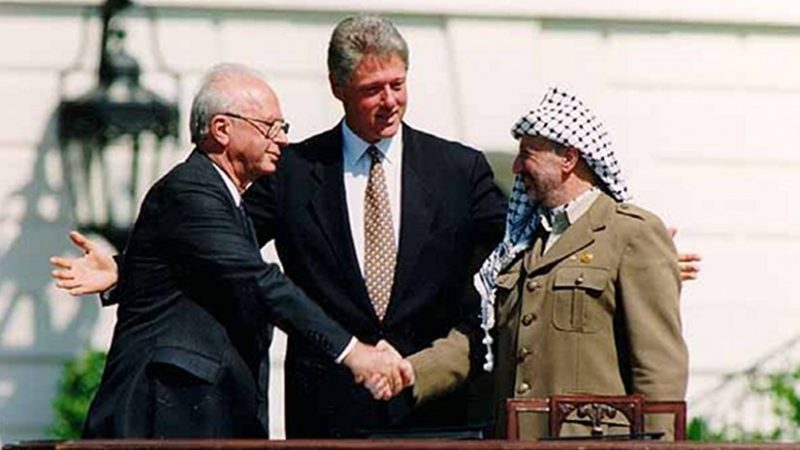
In contrast, Yasser Arafat led an armed struggle against Israel through the famous Palestinian Liberation Organization. He was a guerilla fighter in the Middle East, believing that Palestine was lost by the vested interests of the Arab states in 1948 and that he should then fight for it with a gun. He was neither an Islamist nor a leftist, which would, in either case, have limited his outreach. With the blending of Islam, Marxism-Leninism, Arab Nationalism, and Third World radicalism during the 1960s, Arafat succeeded beyond expectations, in impactfully putting the Palestinian question forward for international attention. The United Nations (UN) invited him to address the General Assembly in 1974, an exceptional honour for one not representing a member state. That historic speech is still recalled for his famous sentence, “I have come bearing an olive branch and freedom fighter’s gun. Do not let the olive branch fall from my hands”.[2] He accepted the two-state solution in 1988 and joined the Oslo Peace Process, shaking the hand of Israel’s Prime Minister Yitzhak Rabin in 1993. It wasn’t a peace treaty, yet peacebuilding was worth the Nobel Prize for Peace in 1994.
The Oslo Peace Process was a complex decision for Arafat. After fighting with guns, he realized that violence would not beget a Palestinian state. But in 1995, Arafat lost his Israeli counterpart: Rabin was tragically assassinated by Yigal Amir, a radical religious Jew who believed the territory of the West Bank was non-negotiable. Arafat was also facing radicals at home. The extremist groups of Hamas and Palestinian Islamic Jihad had risen during the early 1990s and did not want the Oslo Peace Process to succeed. The end of the conflict would a) be the end of their political and religious goals; b) a process that did not involve them and therefore had better not do well; and c) threatening the peace process was a shortcut to challenging the hegemony of secularist Yasser Arafat within the Palestinian national movement.
With the promising Oslo peace process of 1993, Arafat was at the pinnacle of his political career. Yet, he was called a traitor and sell-out to American money for sticking to the Oslo process.[3] He wasn’t a democratic leader and worked more like a feudal lord. He left behind a corrupt and notoriously ineffective organization. He was diplomatic and politically savvy and understood that acts of terror wouldn’t make Israel end the occupation. It had to be through dialogue and mutual trust. In Egypt, he spoke against the suicide bombing tactics of Hamas in a speech in 1996: “We are confronting and will continue to confront terrorism and to uproot it from our land, because our dream of freedom, independence, and self-determination cannot bear fruit and be realized amid a sea of blood and tears, but by perseverance in confronting this terrorism and these extremist and dangerous wings of Hamas and the [Islamic] Jihad”[4].
Mohammad Dajani, a well-known Palestinian peace activist and professor from Jerusalem, recently wrote about the failed Oslo peace process, “For his part, Yasser Arafat had adopted an odd Chinese-style military suit for the four decades prior to Oslo. He did not shelve this suit after Oslo and could not shift, as Nelson Mandela did, from his role as a freedom fighter to becoming a suave diplomat. Under pressure from Palestinian extremists, Arafat came to feel that the Oslo Accords failed to fulfill his political ambitions of becoming the Saladin of this era”.[5]
The Oslo Peace Process did not bear much fruit for the Palestinians or Israelis. The spoiler was Hamas, with its jihadi calls for the cause of Palestine and rejection of peace initiatives. Over the last two decades, its radical religious ethos and suicide bombings against the civilians of Israel in the Second Intifada, known as Al-Aqsa Intifada, hardened positions all around and weakened the will for peace.
About the author: Dr Khinvraj Jangid is an Associate Professor and Director Centre for Israel Studies, Jindal School of International Affairs, OP Jindal Global University, Sonipat. He is visiting faculty at Ben-Gurion University of the Negev, Israel, for 2022-2024.
Source: This article was written for Gateway House: Indian Council on Global Relations.
References
[1] Hamas Charter of 1988 called for the liberation of the whole of Palestine. In 2017, Khaled Mashal as head of Hamas moderated this extremist position when he said Hamas is willing to have full peace with Israel within the 1967 borders (a Palestinian state in West Bank, Gaza and East of Jerusalem). For more see: Hamas: From Resistance to Regime by Paola Caridi (2012).
[2] Yasser Arafat General Assembly Speech, United Nations, 1 January 1974. https://www.unmultimedia.org/classics/asset/C792/C792a/
[3] Judith Miller (2004), Yasir Arafat, Father and Leader of the Palestinian Nationalism, dies at 75, The New York Times, 11 November 2004. https://www.nytimes.com/2004/11/11/world/middleeast/yasir-arafat-father-and-leader-of-palestinian-nationalism.html Emad Moussa (2021), Martyr, villain, traitor? Yasser Arafat’s complicated legacy, 17 years after his death, The New Arab, 10 November 2021. https://www.newarab.com/opinion/martyr-villain-traitor-yasser-arafats-complicated-legacy
[4] Bary Rubin and Judith Colp Rubin (2003), Yasser Arafat: A Political Biography, Oxford University Press, page 173.
[5] Mohammed Dajani (2023), The Oslo Accords Held Promise; Extremists Derailed them, The Washington Institute for the Near East Policy, 1 September 2023. https://www.washingtoninstitute.org/policy-analysis/oslo-accords-held-promise-extremists-derailed-them