
President of the Republic of Azerbaijan Ilham Aliyev has received President of the OSCE Parliamentary Assembly Pia Kauma, Azernews reports.
Day: November 13, 2023
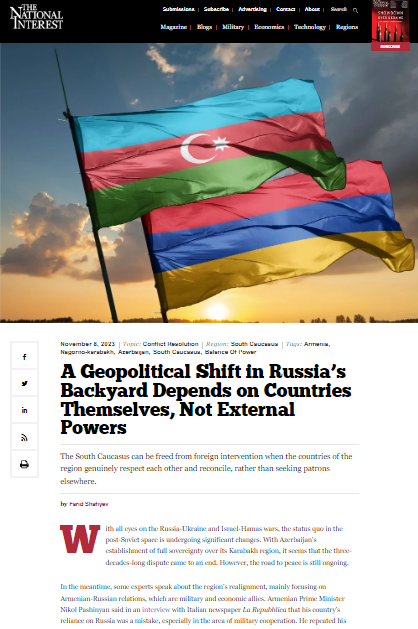
With all eyes on the Russia-Ukraine and Israel-Hamas wars, the status quo in the post-Soviet space is undergoing significant changes. With Azerbaijan’s establishment of full sovereignty over its Karabakh region, it seems that the three-decades-long dispute came to an end. However, the road to peace is still ongoing.
In the meantime, some experts speak about the region’s realignment, mainly focusing on Armenian-Russian relations, which are military and economic allies. Armenian Prime Minister Nikol Pashinyan said in an interview with Italian newspaper La Repubblica that his country’s reliance on Russia was a mistake, especially in the area of military cooperation. He repeated his dissatisfaction with Russia in an interview with The Wall Street Journal, stressing that Armenia sees no advantage in keeping Russian military bases.
This change, which many Western experts rushed to announce as a strategic shift, should be taken cautiously. Armenia continues to provide many Western sanction-listed goods to Russia, and the United States has put several Armenian companies on the blacklist. Armenia is heavily dependent on the Russian economy, with $4.6 billion in trade, mainly consisting of Armenian exports of Western products that Moscow can no longer get directly.
Armenia voted against Ukraine in the UN and has consistently supported Russia, even taking a unique stance in the Council of Europe. Yerevan also sent troops to Syria and maintains close ties with Iran.
The current spat between Yerevan and Moscow has much to do with the Armenian expectation that Russia would continue to support its irredentist adventure into the Karabakh region of Azerbaijan, which, along with several adjacent areas, was under Armenian control for almost three decades. However, as early as 2016, when there were small-scale clashes between the two countries, it was obvious that Russia was unable to stop Azerbaijan’s military advancement.
With the current focus on the situation around Armenia and the so-called Zangezur corridor, which is supposed to connect Azerbaijan proper with its Nakhichevan exclave, several news outlets and experts have warned about the danger of a new escalation.
With a plethora of articles by experts about the possible Azerbaijan “takeover” of Zangezur and the Armenian departure of Karabakh, let’s first recall the basics.
First, the conflict between the two parties began with the Armenian slogan miatsum (unification) some thirty-five years ago, which means that the cause of the conflict was an Armenian territorial claim.
Second, 99 percent of all actions and destructions happened on the territory of Azerbaijan, which is the most adversely affected side of the conflict.
Third, the first complete ethnic cleansing happened in Armenia during 1988–89—no Azerbaijani was left there.
Fourth, international law was on the Azerbaijani side with four resolutions demanding the withdrawal of occupying forces from Azerbaijani territories.
During the conflict, both peoples suffered. However, the “reality” reported in the Western press, which has traditionally favored the Armenian narrative, has always been prone to Orientalist bias with Islamophobic and Turcophobic undertones.
While the West unequivocally supports the territorial integrity of Georgia, Moldova, and Ukraine, the position regarding Azerbaijan has been ambiguous, which can be interpreted through an Orientalist prism. Interestingly, in 2020, after the Second Karabakh War, some Western institutions and experts supported Russian control of Karabakh.
The war against Ukraine has raised the issue of territorial integrity to a new level. As a result, the United States and the European Union have gradually modified their approach to the territorial dispute between Armenia and Azerbaijan.
Not all Western actors envision the region’s future similar to Washington’s. France, which once posed as a conflict mediator, decided to move in favor of Armenia by supplying modern weaponry, including an air defense system. The problem is that Armenia’s air defense is in Russia’s hands. Let us recall how the United States reacted to the Turkish purchase of Russia’s S-400 and its complaint about the security threat to the NATO system. Here, another NATO member—France—is about to deliver weapons to a country where Russia controls air space.
The perpetuating stories about Azerbaijan’s plan to take over Armenian territory—a plan which was dismissed repeatedly by Azerbaijan and even U.S. officials reported as fake, serve no one in the region.
Both countries should make efforts to bring sustainable peace to the region. This rests on a peace treaty based on firm support and mutual recognition of the principle of territorial integrity. To achieve this, the media has a role to report fairly and encourage both countries toward cooperation. Stories infused with one-sided propaganda clichés ignite emotions and prolong the conflict.
Further, the conflict left deep emotional scars on both peoples and governments, and the public should work together to promote reconciliation. Here, international actors can help with relevant experience from the British-Irish dialogue, the Balkans platform, and other peace-building initiatives.
Third, the issue of refugees and internally displaced persons remains a burden for both countries. With the focus on the fate of Armenians who left the Karabakh region of Azerbaijan, some countries call for their return to homes. However, the question of refugees needs a holistic approach, which implies that Azerbaijanis are also entitled to move back to Armenia, which will entail security guarantees and other arrangements. As I argued in December 2020, immediately after the war, “true reconciliation is not possible without efforts to return to more integrated populations such as were prevalent in pre-conflict days.”
Transportation projects and other economic incentives might break the barriers created by war. In this domain, efforts should go beyond the bilateral Armenian-Azerbaijani context. The trilateral format of South Caucasus countries where Georgia might emerge as an important interlocutor looks promising. The bottom line is that the region’s countries should take ownership of the South Caucasus back into their hands.
The South Caucasus can be freed from foreign intervention once the countries of the region genuinely respect each other and reconcile rather than seeking patrons elsewhere, as happened first with Russia and now in the quest for the West.
ISTANBUL
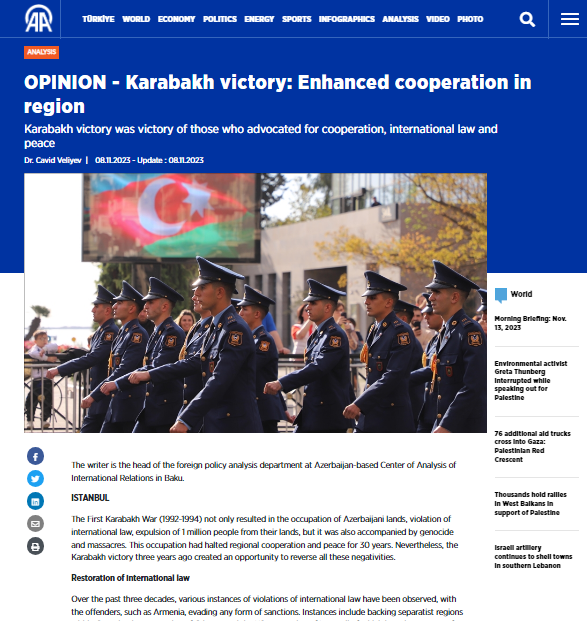
The First Karabakh War (1992-1994) not only resulted in the occupation of Azerbaijani lands, violation of international law, expulsion of 1 million people from their lands, but it was also accompanied by genocide and massacres. This occupation had halted regional cooperation and peace for 30 years. Nevertheless, the Karabakh victory three years ago created an opportunity to reverse all these negativities.
Restoration of international law
Over the past three decades, various instances of violations of international law have been observed, with the offenders, such as Armenia, evading any form of sanctions. Instances include backing separatist regions within Georgia, the annexation of Crimea, and the US occupation of Iraq – all of which have been cases of violations of international law. These actions have undermined the credibility of the international legal system, which constitutes the basis of the post-World War II global order established through the UN Charter. This seriously threatened world peace and security of contemporary international relations.
Following the first Karabakh war, the co-chairs of the Minsk Group of the Organization for Security and Cooperation in Europe (OSCE), which was established to contribute to the peaceful solution of the former Karabakh conflict, wanted a sovereign state to compromise its territorial integrity and sovereignty in their proposals. Some proposals even sought to alter the borders of a sovereign state and legitimize the occupation. Therefore, through Azerbaijan’s liberation of its territories from occupation, Baku not only reclaimed its lands but also reinstated the importance of respecting the territorial integrity and sovereignty of states, thereby reinvigorating the principles of international law.
Over the past three decades, not only has the principle of respecting the territorial integrity and sovereignty of states, a basis of international law, been disregarded, but Article 2 (4) of the UN Charter has also been repeatedly violated. In this sense, Azerbaijan reclaimed its illegally occupied lands, exercising its right to self-defense under international law and in line with Article 51 of the UN Charter.
Restoration of justice
During the first Karabakh war, 30,000 people were killed following the occupation, genocide and massacres carried out in many places, including the town of Khojaly in Azerbaijan. As a result of the occupation, 1 million people were expelled from their lands, and 12 cities, five towns and more than 500 villages of Azerbaijan were occupied. With the mediation of the OSCE Minsk Group, it was proposed that initially only five of the occupied territories would be handed back, however, the Armenian side did not accept that proposal. Therefore, after the Karabakh victory, all cities, towns and villages were liberated from Armenian occupation and justice was restored.
Throughout the occupation, the Armenian forces decimated three of Azerbaijan’s largest districts – Aghdam, Fuzuli, and Jebrayil. Aghdam was described as the Hiroshima of the Caucasus. However, following the liberation of these territories, swift efforts were initiated for their reconstruction. In the last three years, Azerbaijan has invested $7 billion for the reconstruction of these regions. Three airports, Horadiz-Aghband railway, smart villages, cities, industrial centers, and large universities are being built in this region. The repatriation process has started, beginning with the gradual return of people to Aghali village of Zengilan. According to Azerbaijani President Ilham Aliyev, at the first stage 140,000 people are expected to return to their homeland. People who were expelled from their homes during the first Karabakh war will return and justice will be ensured.
Throughout the first Karabakh war, the Armenian military and separatist forces were responsible for the deaths of thousands, while during the second Karabakh war, their missile attacks on cities like Ganja, Berde, and Mingechevir caused the loss of hundreds of innocent lives. Numerous war crimes were committed in the occupied territories but eventually the separatist leaders and masterminds of those criminal acts are now held accountable before the court. Consequently, as a result of the second Karabakh war in 2020 and Sept. 19 anti-terrorist operation this year, Azerbaijani law enforcement agencies apprehended these offenders and brought them to justice.
Establishment of regional cooperation
After the first Karabakh war, due to the occupation, Armenia was excluded from regional energy and transportation projects, and its borders with Azerbaijan and Türkiye were closed. In fact, when Armenia rejected the offer to participate in regional projects in exchange for ending the occupation, regional cooperation opportunities disappeared.
New opportunities emerged for Armenia in the tripartite declaration signed after the Karabakh victory in September 2023. The Zangezur corridor holds the potential to connect Azerbaijan’s mainland to Nakhchivan, Türkiye to Central Asia, Russia to the Middle East, and Iran to the South Caucasus, thus creating significant regional opportunities for Armenia. However, while the Azerbaijani side is about to complete this project on its own territory, the Armenian side has not even launched a tender for the project even after three years.
Following the Karabakh victory, both Türkiye and Armenia appointed special representatives, thereby paving the way for potential normalization of relations between the two nations. The normalization of relations between Armenia, Türkiye and Azerbaijan will ensure broader regional cooperation. Meanwhile, the two meetings of the regional cooperation platform – the so-called 3+3 proposed by the presidents of Azerbaijan and Türkiye after the Karabakh victory – were held. Therefore, the potential for expanded cooperation within the region has emerged.
Restoration of peace
After the second Karabakh war, Aliyev declared their readiness to enter into a peace agreement with Armenia. Following this statement, in February 2022 the Azerbaijani Foreign Ministry presented a five-article peace document to Armenia. Meanwhile, Armenian Prime Minister Nikol Pashinyan acknowledged the territorial integrity of Azerbaijan, including Karabakh, in May 2023. Therefore, a new peace agreement opportunity between the two countries emerged after the Karabakh victory.
Consequently, the winners of the first Karabakh war, which led to the occupation of the territory of a sovereign state, the death of 30,000 people, the destruction of cities and the expulsion of 1 million people from their homeland, were those who supported cooperation, international law and global peace. The Karabakh victory was the victory of those who advocated for cooperation, international law and peace. The best option would be to take advantage of these emerging opportunities and ensure sustainable cooperation and normalization.
https://www.aa.com.tr/en/analysis/opinion-karabakh-victory-enhanced-cooperation-in-region/3047266
EU-Azerbaijan relations are important for both sides, and the Brussels format of the Armenia-Azerbaijani peace talks, are likewise important to reach negotiated solutions over the remaining unresolved questions between Baku and Yerevan, writes Vasif Huseynov in this op-ed for commonspace.eu. “The reactivation of the Brussels format and the revitalization of the constructive role of the EU in the South Caucasus should happen sooner rather than later. A balanced approach by the EU and its leading member states vis-à-vis the countries of the region is of utmost necessity towards this end”, he argues.
On 25 October, Toivo Klaar, the EU Special Representative for the South Caucasus, announced that the scheduled meeting between Armenian Prime Minister Nikol Pashinyan and Azerbaijani President Ilham Aliyev with the mediation of the European Council President Charles Michel in Brussels [known as the Brussels format of the Armenia-Azerbaijan peace talks] had been postponed due to scheduling problems. Previously, another EU-brokered summit between these two leaders from the South Caucasus, originally planned to take place on the sidelines of the European Political Community gathering on 5 October, was cancelled by the Azerbaijani side.
Few, if any, found Toivo Klaar’s explanation regarding busy schedules as the reason for the Brussels summit’s cancellation convincing. In the aftermath of Baku’s refusal to join the Granada summit, which took place nonetheless with the participation of Pashinyan, along with the French President Emmanuel Macron, German Chancellor Olaf Scholz, and the European Council President Charles Michel [without Aliyev’s participation], more setbacks in the European track of the Armenia-Azerbaijan peace process were to be expected.
The reasons behind this trend are inextricably linked with Baku’s frustration with the military supplies by France to Armenia, an act which spoils the image of the French government as a neutral broker, as well as with the anti-Azerbaijani campaigns by the Western media and some political circles. Despite the repeated denial by the Azerbaijani side at the highest level, the propaganda about Azerbaijan’s plan to launch a military invasion of Armenia is being widely distributed by the Western outlets.
According to Farid Shafiyev, Chairman of the Baku-based political think-tank, Center of Analysis of International Relations, this campaign may have a geopolitical objective. It appears that Western powers are leveraging this situation to enhance their influence in Armenia and diminish Russia’s presence in the country. “Here Azerbaijan, and indeed Armenia too are the collateral damage of the greater geopolitical power game”, he posted on X.
Whatever the reason why these developments are occurring, they demonstrate that the biased policies pursued by France and some other countries in the West, as well as the aforementioned campaign against Azerbaijan, have counterproductive consequences for the EU’s overall role in the South Caucasus. Indeed, as was mentioned by Hikmet Hajiyev, foreign policy advisor to President Aliyev, in his tweet on 5 October concerning Azerbaijan’s refusal to join the Granada summit. “France’s biased actions and militarization policy… seriously undermine regional peace and stability in the South Caucasus and put at risk European Union’s overall policy towards the region”.
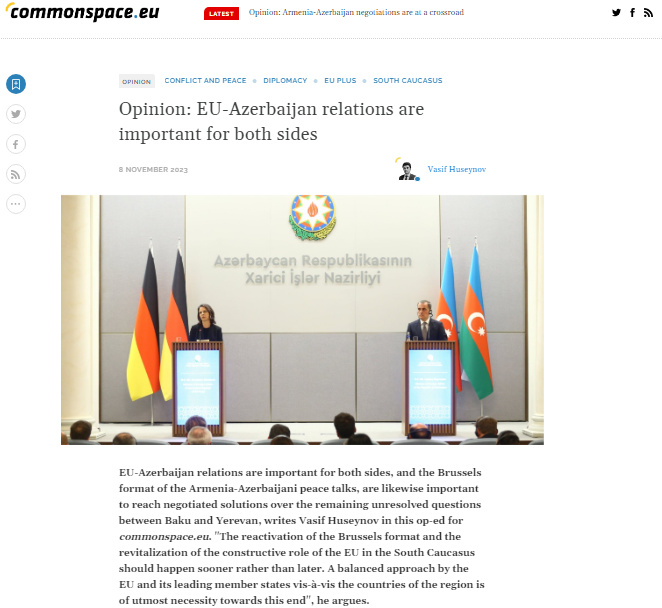
Regretfully, the visit of German Foreign Minister Annalena Baerbock to Baku on November 5 was not helpful to fix this problem. Her use of Armenian names for Azerbaijani cities in Karabakh in the press conference with her Azerbaijani counterpart, along with her false claim of meeting with Azerbaijani IDPs, disclosed the overall negative atmosphere in the negotiations between the two. Reacting to Baerbock’s comments, Azerbaijani Foreign Minister politely invited her to respect the principles of international law while uttering the names of the Azerbaijani cities.
The deterioration of relations between Azerbaijan and the EU, along with the collapse of the Brussels platform for Armenia-Azerbaijan peace talks, poses threats to both sides and does not help the peace negotiations between Baku and Yerevan.
The EU stands as Azerbaijan’s foremost trading partner, contributing to 65 per cent of its total foreign trade. Likewise, Azerbaijan holds the position of being the primary trading partner of the EU in the South Caucasus and plays a crucial role in supplying energy to the EU. Beyond these economic connections, numerous other factors, such as connectivity and geopolitical considerations, underscore the need for both parties to uphold a close relationship and collaborate in addressing shared challenges. The EU has been a critical partner for Azerbaijan to diversify its foreign policy and build independent stance vis-à-vis other external powers. Baku continues to need this partnership in the aftermath of the restoration of the country’s territorial integrity and the elimination of the separatist regime in Karabakh.
EU-Azerbaijan relations, more precisely, the Brussels format of the Armenia-Azerbaijani peace talks, are likewise important to reach negotiated solutions over the remaining unresolved questions between Baku and Yerevan. The EU’s support to, and facilitation of, the peace treaty negotiations between the two countries remains critical for the process. It’s worth recalling that it was thanks to the EU-mediated negotiations that Armenia and Azerbaijan recognized each other’s territorial integrity in October 2022 and opened a path to peace and reconciliation.
The EU’s support is important also to promote regional integration in the South Caucasus and develop a cooperation platform amongst the three countries. Without any doubt, the EU, unlike some other countries neighbouring the South Caucasus, stands to support and benefit from this integration. Closer ties amongst the three countries of the region will unleash their potential as an economic partner and connectivity hub for the EU, amongst many other benefits. That said, the reactivation of the Brussels format and the revitalization of the constructive role of the EU in the South Caucasus should happen sooner rather than later. A balanced approach by the EU and its leading member states vis-à-vis the countries of the region is of utmost necessity towards this end.
https://www.commonspace.eu/opinion/opinion-eu-azerbaijan-relations-are-important-both-sides