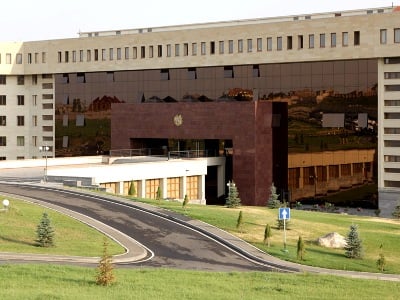
Turkish President Recep Tayyip Erdogan has sent the bill on extending the mandate of the Turkish Armed Forces in Azerbaijan for another year to the Turkish Grand National Assembly (TBMM), Report informs.
Day: November 13, 2023
Elections in Ukraine, Zelenskyy, Zaluzhny, Arestovich
Four issues currently dominate discussion about Ukraine:
- Ukraine’s war with Russia is becoming positional, which is dangerous for Ukraine. Ukraine needs a technological breakthrough in those areas where Russia has an advantage. This is the position expressed by Valeriy Zaluzhny, Commander-in-Chief of the AFU, in a series of articles in The Economist.
- TIME magazine published an article about Volodymyr Zelenskyy saying that the Ukrainian president has no support even among his inner circle.
- Oleksiy Arestovich, a former adviser to the president’s office, called for peace talks with Russia and said he would run for president.
- The U.S. is allegedly pushing Ukraine to end hostilities on the principle of “territory in exchange for peace.”
Ukrainian political analyst Volodymyr Fesenko commented on these topics in a conversation with journalist Farida Kurbangaleyeva from Republic.
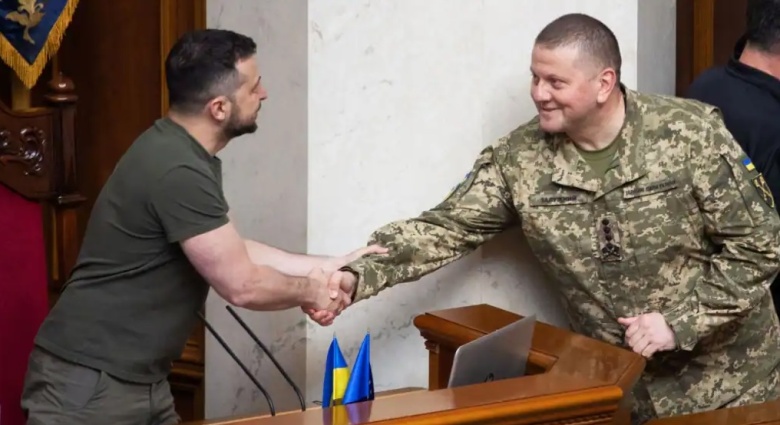 Volodymyr Zelensky and Valery Zaluzhny, summer 2022. Photo: office of the president of Ukraine
“Only Zaluzhny could criticize their military strategy”
It’s no secret that Zelenskyy’s office has long been jealous of Zaluzhny. They do not control him completely. At the same time, both sides realize that direct confrontation is quite risky for them and for the country.
The office realizes that if they do something against Zaluzhny, for example dismiss him from the post of commander-in-chief, they will bring him into politics with their own hands. And that will be a much more dangerous challenge for them than ten Arestoviches.
▇ From the point of view of influencing public opinion in Ukraine, Zaluzhny’s article is useful because it removes illusions.
Zaluzhny formulated five priorities. Four of them relate to interaction with Western partners. New military technologies necessary to change the balance of power in a war can be provided mainly by allies.
Therefore this article is addressed primarily to Western partners.
Zaluzhny says, “Just helping us minimally is not enough.” But there is no defeatism or capitulation in the article. He simply speaks of needs that have not been fully realized. Things are happening late and on a limited scale.
Perhaps only Zaluzhny could have spoken such stark truth about positional warfare. From the mouth of any other person it would have been received with extreme criticism. If Zelenskyy had said such a thing, his longtime critics would immediately have accused the president almost of betrayal.
Zaluzhny enjoys enormous trust in Ukraine, both among those who support Zelenskyy and those who dislike the president. But there is no direct competition, much less public confrontation, between Zaluzhny and Zelenskyy.
- “I was not destined to become an adult, this was stolen from me.” Stories of children killed by Russia
- Which is worse: a Ukrainian missile or Putin’s wrath? Opinion on the establishment of a Russian military base in Abkhazia
Disappointment is increasingly being voiced in Ukrainian society. Both Budanov (head of intelligence) and Podolyak (head of the president’s office) promised society a quick victory, saying it would happen in 2023. This was a huge mistake, as it led to inflated expectations.
▇ In Ukrainian society, the level of trust in the government and in individual politicians has decreased.
And Zelenskyy is seeing a decline in his ratings. In February-March of this year, according to the Razumkov Center polls, 85 percent trusted him, now 75 percent.
However, he had the same support as now after winning the presidential election. So we cannot yet say that public opinion has changed dramatically.
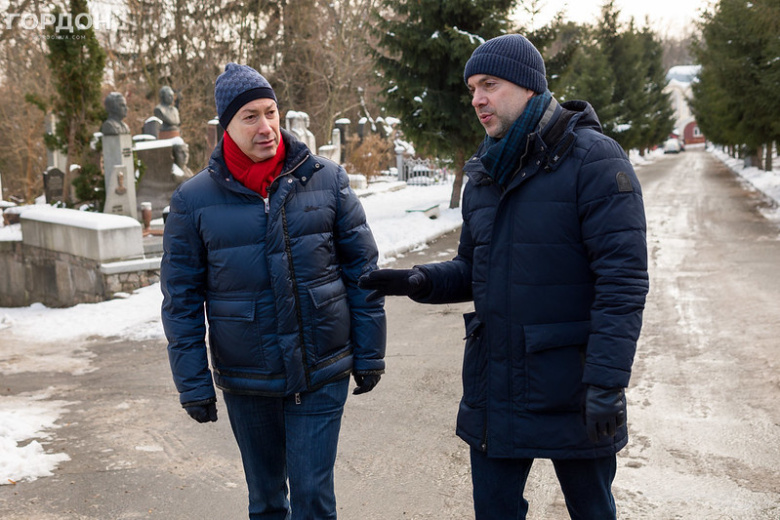 Journalist Dmitry Gordon and Alexei Arestovich
Photo: Facebook page of Dmytro Gordon
According to polls, the majority in Ukraine believe that the country should not make territorial concessions for the sake of peace. Former advisor to the office of the president, Oleksiy Arestovich, presented his peace plan, in which he expressed the idea that now it is not worth fighting for the occupied territories, but to sit down with Russia at the negotiating table.
▇ Now that Ukraine has no serious advance and the Russians are emboldened, whoever proposes a truce has every chance of being perceived as the “weak party”.
There could be negotiations on the end of hostilities – this, in my opinion, is the most likely scenario for the future. This is what is called a frozen war, and something that Zelenskyy dislikes very much.
But this may be the most realistic option for ending the war, because it is impossible to reach a compromise that would suit both sides on the status of the occupied territories.
But this will not mean that Ukraine has “reconciled” with the situation. And NATO membership is necessary for security guarantees, and Arestovich is right.
Kissinger’s plan, which he is promoting, is an idea that should be considered. But there are a lot of nuances, and those nuances are very important.
Former U.S. Secretary of State Henry Kissinger proposed in December 2022 a ceasefire line along the borders that existed before Russia’s military aggression began on February 24, 2022. Crimea would become a subject of negotiations already after the ceasefire. “At the same time Ukraine should already be tied to NATO, neutrality as an alternative no longer makes sense,” Kissinger wrote. He also suggested holding “referendums on self-determination with international supervision in particularly disputed territories that have changed hands several times over the centuries.”
How is Arestovich viewed in Ukraine and why did he decide to become an alternative to Zelenskyy?
▇ According to polls at the end of September, 71 percent of respondents do not trust Arestovich. Fifteen percent partially trust him. And only two percent fully trust him.
He sees public sentiment changing and criticism of the president growing, including over corruption scandals. The war is dragging on indefinitely, and this also causes people’s discontent. Some want to find someone to blame for the fact that there is no victory. And someone simply says: “Since it is so, let’s get out of this war”. And here Arestovich, apparently, saw a chance for himself.
Even before, when he was on Zelenskyy’s team, many people did not perceive Arestovich because of his political past. Because he changed his worldview position more than once, even contacted Dugin. He was both a scout and an actor, and a practicing psychologist.
Arestovich has an amazing ability to create scandals and conflicts. Suffice it to recall how he spoke aggressively about women (Arestovich said that women are “creatures” who one wants to first “fuck” and then “offend” and “strangle without ceasing”. He also said that women “should look at a man as an idol” – JAMnews).
That’s how those 70 percent who, for various reasons, dislike or distrust Arestovich came together.
Will there be presidential elections in Ukraine in spring 2024?
In a recent video message, Zelenskyy said that “now is not the time for elections,” but at the same time he did not explicitly say that there will be none. He is certainly listening to opinion polls, and most Ukrainians – about 70% – are against elections during a time of war.
▇ Because of the elections, there is a risk of splitting society, and that is dangerous, still fighting each other politically in a war with an external enemy.
For now, we can say with high probability that it is unlikely that there will be a decision to hold elections in March 2024.
“Simon Shuster in vain described Zelenskyy in TIME as a lonely and angry at the West politician”
When presidential spokesman Igor Zhovkva was asked if there was a conflict between Zelensky and his entourage, he answered succinctly: “Bullshit.”
I think that Shuster overdramatized the situation, maybe even out of an attempt to arouse sympathy for Zelenskyy, to show how difficult it is for him now.
▇ I personally know a number of people in Zelensky’s team, but I don’t know a single one who thinks: “No, we lost the war, we have to make peace with Russia.”
Although there are probably discussions among consultants close to Zelenskyy that we should not be so categorical in our rhetoric. We cannot talk only about victory, about “we will completely liberate all the territories.” We have to be realistic. We should talk about the fact that we can achieve this goal, but not immediately.
As for Zelenskyy’s reaction to the West’s mistakes, I would call it not anger, but irritation. Zelenskyy is an emotional person, and sometimes it betrays him. But rationally, both Zelenskyy himself and all his entourage understand perfectly well that we depend on the West and cannot quarrel with it.
▇ But the tactics towards the West need to change. Frontal attack, pressure, and demands for help no longer work.
About the “Zelenskyy phenomenon”
What is the Zelenskyy phenomenon? He was clearly not ready for the role that fell to him. But he learned quickly. His strong advantage is his will. He sometimes lacks experience, but he has the will.
He can take decisive action, such as shutting down oligarch Medvedchuk’s pro-Russian TV stations before the war. Had they been operating at the time of the Russian invasion, it would have been a disaster.
▇ The war “revived” him. He began to act quite differently from what was expected of him.
Just before the war, I was told by people who knew him personally that “he would run away, he was weak.” But he acted quite differently. He showed both a strong will and personal courage.
“The Kremlin is clearly on a course to delay the war until after the U.S. presidential election.”
NBC News reports that “current and former U.S. officials” have begun “delicate negotiations” with Ukraine’s leadership to end the war. This allegedly comes amid U.S. concerns that the war in Ukraine has reached a stalemate.
What “former officials” are negotiating? That’s private counseling at best. Rumors and leaks, where no specific names and facts are mentioned, should be treated with a very high degree of skepticism.
It’s also worth listening to what Russia is saying. Here is Peskov’s reaction to the above article by Zaluzhny: “Russia will strive to realize all its goals.”
▇ The Russian Federation is not going to conduct any negotiations. Moreover, the Kremlin has clearly set a course to prolong the war until after the US presidential election.
There will be peace talks sooner or later, but when both sides are ready for them. At the moment, neither Ukraine nor Russia is ready. The window of opportunity closed after Bucha and Irpen, and at the moment it remains closed.
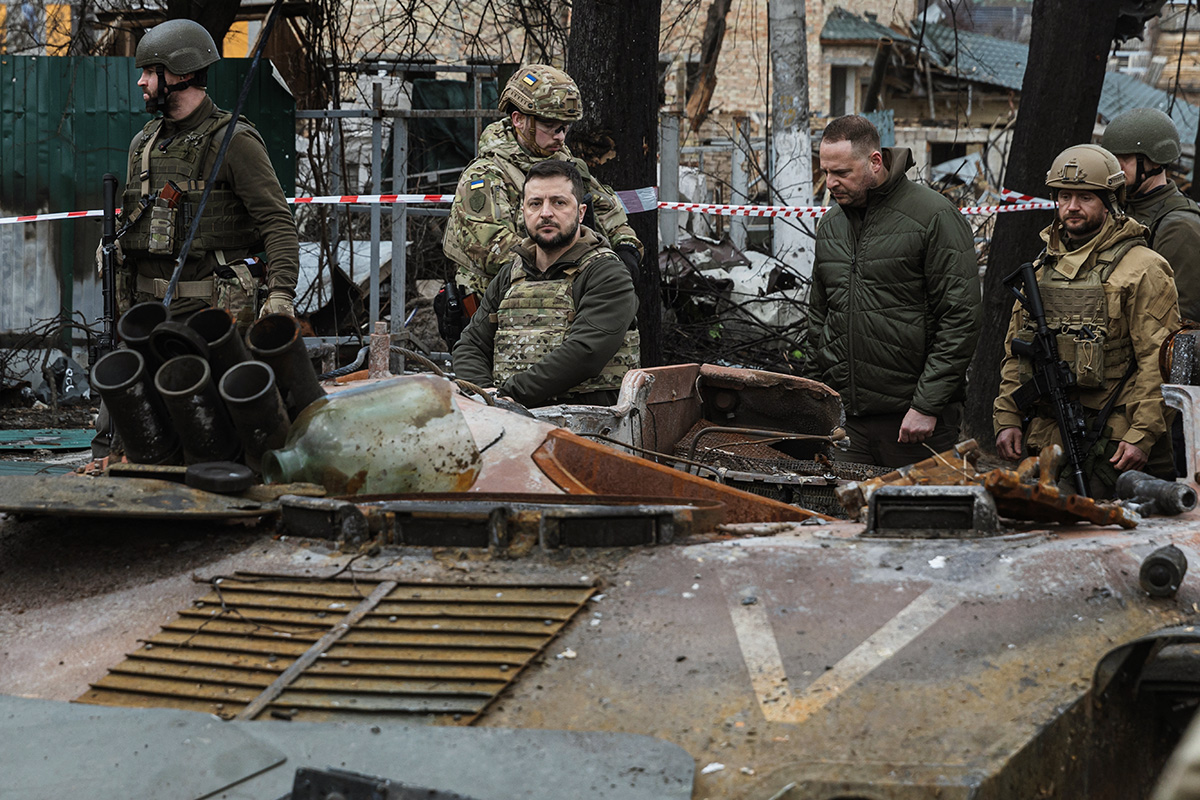
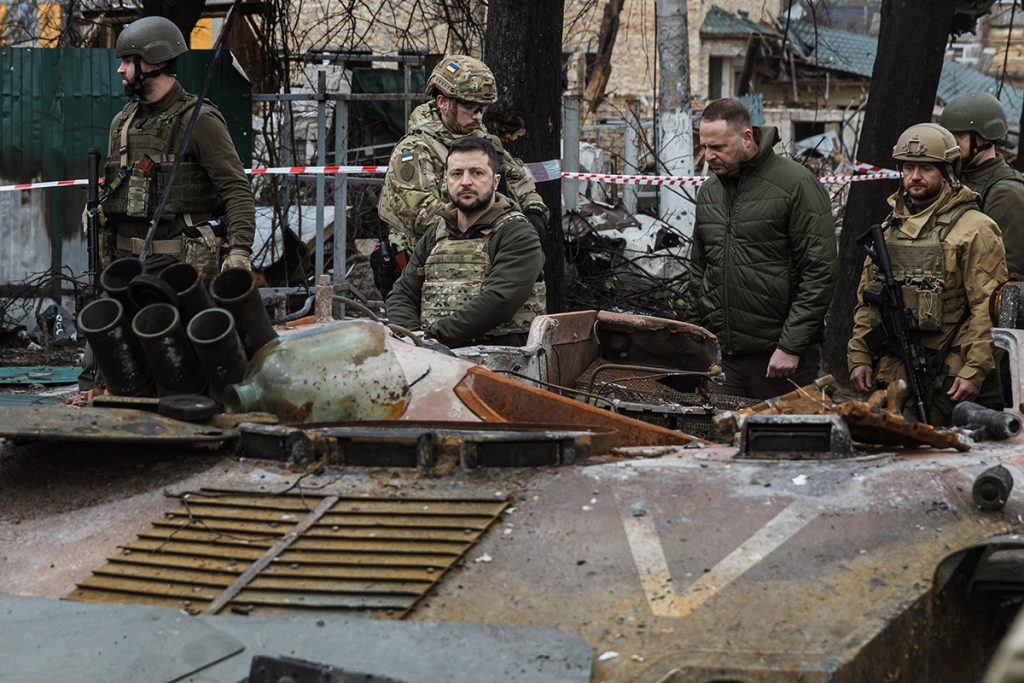 Zelenskyy walks past a destroyed Russian military vehicle during a visit to Bucha, the 40th day of Russia’s war against Ukraine, April 4, 2022. Photo: REUTERS/Marko Djurica
Elections in Ukraine, Zelenskyy, Zaluzhny, Arestovich
Three countries have signed the Charter of the Economic Cooperation Organization (ECO) Research Centre to be established in Baku, ECO Secretary General Ambassador Khusrav Noziri said in an exclusive interview, according to Azerbaijan in Focus, reporting Trend.
“The proposal on the establishment of the ECO Research Center (ECO-RC) belongs to the Republic of Azerbaijan and this was reflected in the Baku Declaration of the 9th Summit of ECO (May 5, 2006, Baku). During subsequent gatherings of the Economic Cooperation Organization (ECO) this idea was further elaborated. The Charter of the ECO Research Centre was ready for signing by the Member States at the 14th Summit of Heads of State and Government of ECO countries held in March 2021 in virtual format. Currently, three countries have signed the said Charter (Azerbaijan, Türkiye and Pakistan). The ECO Research Center will be located in Baku,” he said.
Noziri noted that the main goal of the Centre is conduct of economic research and development of proposals and recommendations on relevant issues in sustainable socio-economic development that serve the interests of ECO member states as well as contribute to increased cooperation among these states.
“The existing ECO Economic Journal (EEJ) is expected to be part of the ECO Research Center. 26th meeting of the Ministers of Foreign Affairs of the ECO countries held in Tashkent on January 24, 2023 unequivocally supported the continuation of activities aimed at transforming the ECO Economic Journal borne by the Chief Editor’s office into an internationally recognized, widely disseminated and reputable publication and called on the Secretariat to accelerate the procedure for financing of the project proposal for the new concept of the Journal,” he said.
Khusrav Noziri went on to add that currently the ECO Secretariat in cooperation with the ECO Trade and Development Bank (ETDB) arranged allocation of a substantial amount for the transformation of the Journal.
“After several years of pause the Journal resumed its work, publishing its editions for the years 2022 and 2023. There are plans to place the results of the work done by the ECO Research Center at the web-site of the ECO Economic Journal along with publications by the Member States and ECO Secretariat. It is anticipated that the work of the ECO Research Center and ECO Economic Journal will be focused around the current priorities of the Member States such as transit and transport, energy, water, food security, diversification of economy, green economy, climate change and others,” he concluded.
The post ECO Secretary General talks on goals of Research Center in Baku appeared first on Azerbaijan In Focus.
The increasing energy demand within the European Union, a major global consumer, drives the initiation of new projects, according to Azerbaijan in Focus, reporting Trend. As a result of this, Azerbaijan’s importance in Europe rose. Specifically, Azerbaijan assumes a distinctive role in developing cutting-edge technologies for energy transmission.
In December 2022, a fresh project was endorsed in Bucharest under the Global Gateway Initiative. Named the Black Sea Energy Submarine Cable, this project aims to establish secure energy sources for Europe. To support the project, a Strategic Partnership Agreement was inked in Bucharest involving the European Commission, Azerbaijan, Romania, Hungary, and Georgia.
The main priority of the project is to deliver renewable energy to Romania through underwater electrical cable passing through Azerbaijan and Georgia. It is anticipated that the project, with an initial budget of $2.3 billion, will be operational by 2029.
In her statement regarding the agreement, President of the European Commission Ursula von der Leyen stated that this project will bring the EU countries closer to the South Caucasus. The two South Caucasus countries, Azerbaijan and Georgia, have already proven how essential partners they are in crucial projects for Europe by implementing several energy and transit initiatives, including the Baku-Tbilisi-Ceyhan project. In the future, after ensuring peace and stability in the region, the possibility of Armenia joining the project is not ruled out.
The fact that all three countries possess substantial potential in alternative energy makes them crucial strategic partners for Europe. This project signifies the transmission of next-generation energy to the West, with Azerbaijan playing a key role in it.
Overall, Azerbaijan’s renewable energy potential amounts to 27 gigawatts on land and 157 gigawatts offshore. By 2027, 4 gigawatts of this potential will be realized, with 80 percent earmarked for export, a figure expected to increase to 25 gigawatts shortly. Azerbaijan plans to establish an additional transmission capacity of 6 gigawatts by 2027. In a few months, a comprehensive technical-economic justification for a new underwater cable project ensuring energy security will be ready. Currently, the technical-economic rationale is being prepared for 4 gigawatts of renewable energy sources.
As Julian Bowden, Senior Visiting Research Fellow at Oxford Institute for Energy Studies (OIES) told Trend earlier, the Black Sea cable project will cement Azerbaijan’s role as a reliable energy supplier. He noted that Azerbaijani gas has already played a crucial role in European decarbonization path, even though it is a fossil fuel; however, it is way better than coal.
In turn, Ariel Cohen, PhD, Senior Fellow at the Atlantic Council Eurasia Center and the Managing Director of Energy, Growth and Security Program at the International Tax and Investment Center, pointed out that Azerbaijan is set to become major green electricity exporter to Europe.
“Azerbaijan has signed 10-gigawatt worth of Memoranda of Understanding deals, and even if 1/3 or one half of those is materialized, this will be a major source of energy for Europe. The idea is to export such electricity by cable to the Georgian coast and then across the Black Sea to Romania. Some of it will go to Türkiye via a grid. This would boost the amount of gas available for exports and would make Azerbaijan a major electricity exporter,” he explained.
And, indeed, this project could extend beyond the countries that have already signed this agreement because the interconnection to power grids throughout Europe is well-developed. When integrated into the European energy system, electricity generated in Azerbaijan can reach any part of Europe, with its source being Azerbaijan’s renewable energy.
Considering the increasing demand for diverse energy resources, particularly renewables, Turkmenistan and Kazakhstan, alongside Azerbaijan, may join the green corridor initiative to export their substantial green energy resources to Europe. Turkmenistan has expressed its readiness to supply electricity to Azerbaijan and Turkey across the Caspian Sea. Currently, the country provides electricity to neighboring nations such as Uzbekistan and Kyrgyzstan. Recently, the foundation stone for a new 1,574 MW power plant was laid on the Turkmen coast near Turkmenbashi.
As of the end of 2022, Kazakhstan operates 130 renewable energy facilities with a combined capacity of 2,400 MW. In the previous year, the country’s renewable energy production reached 5.11 billion kWh, constituting 4.53 percent of total electrical energy production. This figure is expected to reach 5 percent in 2023. Additionally, in 2022, 12 renewable energy facilities with a total capacity of 385 MW and an investment of 180 billion tenge ($374 million) were commissioned. This year, 15 facilities with a total capacity of 276 MW are expected to become operational.
Azerbaijan and Kazakhstan are actively engaged in a promising project, working on laying a fiber-optic connection line on the Caspian seabed. This initiative alone holds the potential to significantly contribute to the development of digital infrastructure for connectivity services, establishing a digital telecommunication corridor between Europe and Asia.
Azerbaijan’s current efforts for Europe are demonstrating the most efficient approach to alleviate the escalating energy crisis in the region. The consensus supporting this notion and the interest in collaboration with Azerbaijan continue to rise. In this regard, prospects for Central Asian economies to join any initiatives carried out by Azerbaijan are only bright.
The post Caspian-EU green corridor – unlocking Central Asia’s potential appeared first on Azerbaijan In Focus.