NPR News: 11-12-2023 2AM EST
Categories
 The South Caucasus News - SouthCaucasusNews.com
Discussions on the India-Middle Europe Corridor (IMEC) are expected to figure in the upcoming 2+2 dialogue between India and the US in New Delhi on 9-10 November. This will be the first occasion that the two partners of the ambitious project could draw the contours on the future of the project, after the 7 October attack carried out by Hamas on Israel and the subsequent war launched by Israel in Gaza.
The impact of the development in the Middle East, which has widened the faultlines between Israel and the Arab world, on the prospect of the IMEC’s fruition is significant. The project would invariably be delayed. Worse still, if not handled carefully, it may never see the light of the day.
Launched on the sidelines of the G20 summit in New Delhi in September 2023, with India, the U.S., Saudi Arabia, UAE, France, Germany, Italy and the EU signing the MoU, the IMEC is critically linked to the Abraham Accords, a series of agreements signed in the latter half of 2020, to normalize relations between Israel and several Arab states. It is also linked to the upgradation of the frosty relationship between U.S. President Joe Biden and Saudi Crown Prince Mohammed bin Salman, from an awkward fist bump in 2022 to a firm handshake as they came together to announce the IMEC.
The IMEC proposes to bolster transportation and communication links between Europe and Asia through rail and shipping networks. IMEC’s ambitions transcend the narrow scope of trade and economics to include everything from electricity grids to cybersecurity – building on conversations that have taken place in security forums like the Quad. A former Indian diplomat wrote, “If the lofty ambitions outlined in New Delhi can become a reality, they would make a singular contribution to a safer, more habitable planet.”
America does not benefit materially from being part of the project. The project spans between India and Europe. However, the US interest in becoming a firm part of the same project may be seen as a counter to China’s Belt and Road Initiative (BRI), a global infrastructure-building project that connects China with Southeast Asia, Central Asia, Russia and Europe. Although the comparisons between the two projects could be somewhat misplaced—the BRI being in existence for far longer and much grander in its objectives—the IMEC is certainly of immense importance to India, the U.S. and also Israel. A White House readout of the meeting between President Biden and Israel’s Prime Minister Benjamin Netanyahu in September 2023 noted that they had spoken about progress towards establishing “a more integrated, prosperous, and peaceful Middle East region, including through efforts to deepen and expand normalisation with countries in the region”.
The IMEC aims to connect India to Europe with a route that runs through the UAE, Saudi Arabia, Jordan, Israel and Greece. Comprising two corridors, the IMEC’s Eastern Corridor will connect India to the Gulf region and the Northern Corridor will connect the Gulf region to Europe. Three Indian ports (Mundra and Kandla in Gujarat, and Jawaharlal Nehru Port in Mumbai) will be connected to five ports in the Middle East (Fujairah, Jebel Ali, and Abu Dhabi in the UAE and Dammam and Ras Al Khair ports in Saudi Arabia). Further connectivity from the five ports in the UAE and Saudi Arabia will be through rail route connectivity to Israel’s Haifa port. The IMEC proposes to use both the already existing Brownfield projects and to-be-constructed Greenfield projects.
For the freight from Haifa port onward to Europe, the northern corridor comes into the picture. This corridor will start with the sea route from Haifa to three ports in Europe: Piraeus in Greece, Messina in South Italy, and Marseille in France. From those ports, the existing European rail networks will take the freight to their final destinations.
Except for the potential geography of a corridor, however, the IMEC’s MoU document is thin in detail. Time frames, identification of key government agencies who will underwrite the investments, and the investments to be made by respective partners are all undecided. Sizeable portions of the proposed rail corridor are absent and so are discussions to bring harmonization of standards. Thus, making the IMEC happen remains enormously complex. An action plan was expected in the next 60 days since the launch of the project. That is unlikely to happen anytime soon.
At the time of its announcement, experts had pointed out the geopolitical complexities of navigating ties between partner countries such as the US, Israel and Saudi Arabia who often don’t see eye to eye. The possibility of the tactical cooperation, thus, going awry was high. This reality appeared to have struck far too soon.
The war in Gaza has threatened to trigger a broader conflict that draws in the Gulf states, who had hoped for de-escalation in the region, allowing them to focus on ambitious plans to diversify their economies. It certainly has had a significant impact on Israel’s normalization of relations with the Arab countries. In the immediate aftermath of the 7 October incident, the UAE and Bahrain criticised the attacks by Hamas. However, as days progressed and Israel’s military campaign in Gaza continued to claim civilian lives, the position changed.
Bahrain on 2 November recalled its ambassador from Israel and suspended trade ties with Tel Aviv. Israeli ambassador too has left Manama. In a statement, the Bahraini Parliament has reiterated its ‘historic and firm position in support of the Palestinian cause and the legitimate rights of the brotherly Palestinian people’.
The UAE is one of the United States’ closest partners in the Middle East and hosts U.S. forces, has pursued a more independent and assertive foreign policy over the past decade. It wants to weaken the Hamas. Although odd UAE officials have reiterated their faith in the validity of the Abraham Accords, the Emirate has termed Israel’s response as ‘disproportionate’ and a failure of Tel Aviv’s two-decades-old containment policy on the Palestinian issue. Diplomatic Advisor to the UAE President said on 4 November that the U.S. needs to push for a quick end to the Israel-Hamas war and a new process to resolve the decades-old Israeli-Palestinian issue or Washington will be seen as ineffective.
Countries like Kuwait, Oman and Qatar have been critical of Israel. Qatar, an American ally, supports the Hamas and Doha is home to some of the Hamas leadership including Ismail Haniyeh. The emirate donates up to $30m a month to Gaza. Saudi Arabia has tried to strike a balance, although it has called out the “Israeli occupation forces”, without condemning the Hamas attacks., the worsening humanitarian crisis and the Israeli refusal to announce either a ceasefire or even consider a humanitarian pause won’t make the task of the most committed supporters of the Accords a smooth affair. The war in Gaza puts enormous stress on the prospects of Saudi-Iran rapprochement.
President Biden saw a wider conspiracy in the Hamas attack on Israel, i.e. to prevent a peace deal between Riyadh and Israel. “I was about to sit down with the Saudis….the Saudis wanted to recognise Israel,” he said. There is little evidence for this claim. But the U.S. has spent much of its energy on the deal between Riyadh and Tel Aviv to takeoff, in return for a defence pact between Riyadh and Washington. The U.S. has reasons to feel that the Israeli war and its compulsion to support and finance it, are making the IMEC’s road bumpier than usual. In the prospect of the war escalating into a regional conflict, the project could come to a grinding halt.
On 3 November, India’s foreign minister S. Jaishankar said that while the situation in West Asia is very complex, the master plan for the IMEC corridor is still intact. “IMEC is very much a part of the global legacy and has been a trade route for hundreds of years. There is enormous interest in Europe for the IMEC and for a seamless logistics passage to India”, he said in New Delhi. The minister’s statement brings out the enormous stake New Delhi has in the project. Prime Minister Modi has said that this transport corridor ‘will become the basis of world trade for hundreds of years to come’.
Once complete, IMEC would help promote economic integration between India and Europe. Since the current destination for most of India’s engineering exports is primarily the Middle East and Europe, the IMEC would be able to increase these exports manifold. In addition, the IMEC could potentially facilitate the export of India’s IT services to Europe and the Middle East. The IMEC would also offer India the opportunity to create green hydrogen and green ammonia hubs near the coasts and supply the commodities via shipping and rail networks to the Middle East and eventually Europe. The inclusion of electricity grids in the framework of the Corridor is particularly significant from an Indian perspective, making the export deliverables much more efficient and cost-effective thereby adding to their competitiveness.
In any connectivity project involving multiple partners, each member state plays a critical part in the execution and operationalisation of the project. Neither India, the U.S. nor the European interest in the project can guarantee its initiation. The war in Gaza doesn’t necessarily mark the end of the road for the IMEC. However, it certainly has the potential of inordinately delaying or even derailing the project. Two conditions need to be fulfilled to revive the IMEC’s prospects. Firstly, the war in Gaza must come to a halt urgently. Secondly, quiet diplomacy rather than publicity-seeking announcements should be the strategy to ensure that the project remains on track.
Source: This article was published by Mantraya
Additional References
Nikhil Inamdar, “Can India-Europe corridor rival China’s Belt and Road?”, BBC, 2 October 2023, https://www.bbc.com/news/world-asia-india-66957019.
“Why Saudi Arabia and the UAE want to keep links with Israel”, Economist, 22 October 2023, https://www.economist.com/middle-east-and-africa/2023/10/22/are-the-abraham-accords-over.
“India-Middle East-EU corridor to have multiple routes, but hurdles remain”, The Hindu, 16 September 2023, https://www.thehindu.com/news/national/multiple-routes-proposed-in-india-middle-east-eu-corridor-but-multi-billion-dollar-project-comes-with-its-share-of-challenges/article67315835.ece
By Joshua Kucera
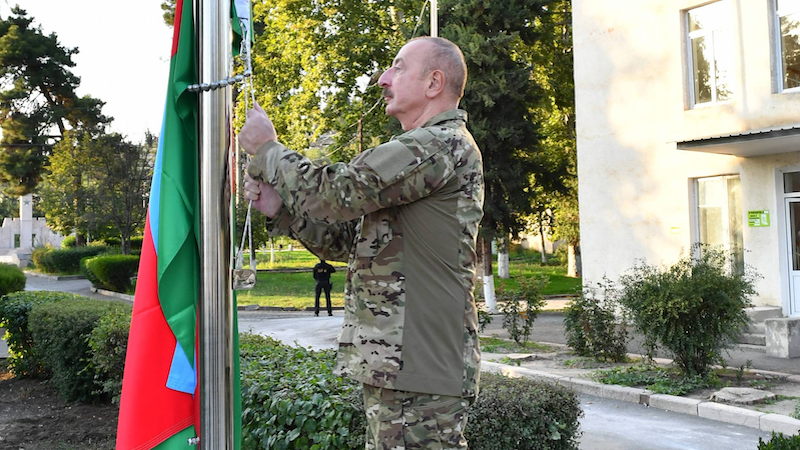
(RFE/RL) — Azerbaijani President Ilham Aliyev stood in the main square of the conquered capital of the disputed region of Nagorno-Karabakh on October 15. He raised the Azerbaijani flag up the pole, a symbolic completion of the country’s long-awaited victory over Armenian occupation.
Aliyev was being filmed but was entirely alone in the frame. “All the promises I made during the last 20 years and all the tasks I set before myself have been fulfilled,” he said into the camera.
It raised the question: If all the tasks have been fulfilled, then what now?
The quest to recapture Nagorno-Karabakh from the Armenian forces that occupied it since the early 1990s has represented the guiding light of Aliyev’s entire presidency; it is the issue to which all other priorities were to be subordinated.
“The struggle to restore independence, territorial integrity, and sovereignty has been the main motive in the last, more than 20 years, ever since our lands became occupied,” Elchin Amirbayov, a senior Aliyev envoy for special assignments, told RFE/RL. “Now the issue is over. We restored our pride. We also restored historical justice.”
But many observers are not sure that the issue is over. For decades, rallying the nation against the Armenian enemy and the injustice of the occupation was a surefire method to mobilize a population even as economic and social discontent rose. Giving that up, many say, will be difficult.
In his speeches, Aliyev still devotes considerable time to Armenians’ past misdeeds. At the flag-raising ceremony in October, he spoke of “Armenian savagery” and gloated over the fates of the former de facto leaders who are now sitting behind bars in Baku.
“The one unifying mobilizing ideology in the country is that the Armenians are the enemy. You’ve mobilized people and there’s no sign of demobilizing people on that. So, there is a temptation just to keep on pushing,” said Tom de Waal, an analyst at Carnegie Europe. “It’s a serious issue.”
There remain many levers on which to push. Armenia and Azerbaijan are still negotiating over a peace agreement that would demarcate their shared border and establish transportation routes connecting the two countries. Azerbaijan has also been raising the issue of ethnic Azerbaijanis who used to live in what is now Armenia, arguing that they should be allowed to return. All those issues are centered in the Armenian province of Syunik, which Azerbaijanis know as Zangezur, and has local Armenians concerned that Baku has further designs on their territory.
“They say ‘peace’ but all day long on TV, in parliament, they are talking about Zangezur,” said Altay Goyushev, the head of the Baku Research Institute think tank. “This hate toward Armenians, it could be diminished at least a little bit but I don’t see that, it keeps on going.”
Baku and Yerevan were locked in a conflict over the region of Nagorno-Karabakh for decades. Armenian-backed separatists seized the mainly ethnic Armenian-populated region from Azerbaijan during a war in the early 1990s that killed some 30,000 people. Diplomatic efforts to settle the conflict brought little progress, and the two sides fought another war in 2020 that lasted six weeks before a Russian-brokered cease-fire, resulting in Armenia losing control over parts of the region and seven adjacent districts.
In 2022, the two countries began to negotiate an end to the conflict. But the process did not go quickly enough for Baku, and, in September, Azerbaijan launched a military offensive that resulted in the capitulation of the ethnic Armenian de facto Karabakh leadership and the exodus of nearly the entire population of the territory.
Negotiations for a peace agreement are still continuing, though the momentum has slowed.
The diplomatic process “is not over because Aliyev doesn’t want it to be over, he wants to keep this sentiment alive,” Goyushev said. “As long as Aliyev is in power there is always going to be war, because he understands that this war rhetoric is the only thing that brings him public support.”
Aliyev and other senior officials frequently warn Armenians against “revanchism,” which has become a post-2020 buzzword in Baku. While this revanchist sentiment is strongest among Armenia’s political opposition, Armenian Prime Minister Nikol Pashinian dabbles in it as well, Amirbayov argued.
France, Armenia’s closest ally in Europe, is preparing a resolution for the United Nations Security Council. French Foreign Minister Catherine Colonna said the “deportation” of the Armenians of Karabakh was a “serious crime [that] cannot go unanswered.” Amirbayov, the Aliyev envoy, said that Pashinian was “misusing” France’s seat as a permanent member of the Security Council. “They are not going in the right direction,” he said.
“The first step which would send us a signal [that Armenia has given up revanchism] would be a clear expression by Pashinian — not only in declarations but in real actions — that he does not consider the outcome of the latest military confrontation as something that he has to contest,” Amirbayov said.
In the vacuum that has emerged after the Karabakh victory, it will be tempting for the government to continue to rely on nationalism, said Shujaat Ahmadzada, a nonresident research fellow at the Baku-based Topchubashov Center, which focuses on international relations and security.
“There is no clear answer about how to reconstruct the national identity, which had been centered around the (once utopian) dream of ‘the day that Karabakh will be free,'” Ahmadzada said in a text interview over WhatsApp. “Now Karabakh is ‘free,’ and the identity is somehow a mix of shock/denial of reality, as well as joy.”
Azerbaijani nationalism could turn to the issue of the return of ethnic Azerbaijanis to Syunik in the south and other parts of Armenia, or on agitating for the rights of Iran’s substantial ethnic Azerbaijani minority, Ahmadzada said. But neither could mobilize the same level of public support as Karabakh, which most Azerbaijanis felt acutely, he said.
Instead, according to Ahmadzada, it is more likely that Baku will rely on an approach combining “continued commemoration and celebration of the [Karabakh] victory, an increase in statism (similar to some Central Asian republics), and the evolution of the Armenian-Azerbaijani conflict into a long-lasting (but low-intensity) rivalry, akin to the India-Pakistan rivalry that almost never ends,” Ahmadzada said.
But it remains unclear whether that mix could be a reliable mobilizing factor in the face of persistent economic and social discontent in the country. That discontent had been rising, but the 2020 war tamped it down, rallying the public and restoring Aliyev’s popularity, Baku-based analyst Goyushev said.
The currency of victory depreciates rapidly, though, and the euphoria of 2020 “didn’t last long,” Goyushev said. Even this year, public attention was again focused on social problems such as the protests in the village of Soyudlu over pollution, which faced a heavy crackdown by security forces.
Many Azerbaijanis have also become wary of Azerbaijan’s continuing pressure on Armenia, which has spilled over the border from the formerly occupied territories into Armenia itself. A September 2022 offensive against targets inside Armenia led to public complaints that Azerbaijan was “changing from the country which tried to restore its territorial integrity to the country, which is actually an invader, an occupier,” Goyushev said.
And the public reaction to this September’s offensive and the Karabakh leaders’ capitulation was much more muted than three years ago, he said: 2020 “was a game changer, and this was something which was expected.”
Political science shows how authoritarian leaders maintain power by balancing three “pillars”: repression, co-optation, and legitimacy, said Laurence Broers, an associate fellow at the London-based Chatham House’s Russia and Eurasia Program.
Azerbaijan’s abundant resources have foregrounded co-optation as the main pillar, but they are finite and the dynastic succession in 2003 — where Ilham Aliyev took over from his late father, President Heydar Aliyev — had always left lingering doubts about legitimacy, he argued.
But the 2020 war “rebalanced the system by providing a massive buy-in for the population on the country’s standout consensus issue,” Broers said. “So, we are seeing the rebranding of the elite’s legitimacy formula — or rather Aliyev’s, since this is very much about him.”
“But the question now is whether he can let go of that, or whether Azerbaijani citizens are going to have to celebrate victory over peace for years to come,” Broers continued. “If Azerbaijan does go down that route, it’s very hard to see a landing zone for an agreement with Armenia because that would require a new equilibrium of equality with Armenia incompatible with the hierarchy of winner and loser in the victory narrative.”
One of the few official articulations of a new national idea has been put forward by a pro-government member of parliament, Zahid Oruc.
With the raising of the flag in Xankendi (which Armenians call Stepanakert), Azerbaijan is entering the period of the “Fourth Republic,” Oruc wrote in an article on the website Moderator.az. (The first three republics were the pre-Soviet Azerbaijan Democratic Republic, the Azerbaijan Soviet Socialist Republic, and post-1991 independent Azerbaijan.)
“The era of tragedy and loss has come to an end,” he wrote. Oruc’s vision of the new era for Azerbaijan was largely centered around foreign policy and geopolitics.
“The Great Eurasian Project — a new alliance of Turkey, Russia, Iran, Azerbaijan, Armenia, and Georgia — will be realized, the world will be reorganized in the wake of the wars in Russia-Ukraine and the Middle East, and a transition from a multipolar (in fact Western-centric) world to a new architecture is taking place,” he wrote. “It is the first time in history that Azerbaijan controls its own destiny, rather than being divided at the negotiating table.”
Another rallying point could be the return of the Azerbaijani population to Nagorno-Karabakh.
In the first war between the two sides, over 600,000 ethnic Azerbaijanis were displaced from the territories that Armenians seized. The Azerbaijani government is now spending billions on demining and rebuilding those areas to make them ready for the return of their former residents. That should serve as a unifying force for Azerbaijanis now, Amirbayov said.
“I think now the idea of Azerbaijan, the national idea which will be pursued by the government would be to try to consolidate peace, try to live as a country which is independent but which has never had a chance to live in possession of all of its territories,” he said. “The most important challenge for the decades to come would be to inject normal life back into those liberated territories.”
President Aliyev has spoken in these terms as well. In another post-offensive speech on September 29, Aliyev described the return of the displaced people as “the number one task for us.” Within three years, he said, 100,000 of them would be resettled.
But Aliyev also spent more than half that speech recounting a long litany of what he referred to as Armenians’ past crimes in the territory and added a warning against revanchism. “The Armenian leadership, those who stand behind them, and those who may think about some unacceptable plans against Azerbaijan — my advice is not to test our patience again,” he said.
Focusing on the return of the displaced holds risks as well as potential. One Azerbaijani media outlet recently reported that of 1,200 former residents of Karabakh’s Lacin region (also known as Lachin) who had returned to great fanfare from the government, about half had left because of poor conditions. The story was discussed widely on Azerbaijani social media, Goyushev said, an indication of public skepticism about the prospects for large-scale returns to Karabakh.
“Everybody understands that the government is going to face a big problem now, because there is no infrastructure [in the retaken territories], nothing,” he said.
And talk of victory is likely to remain the most reliable way to rally people, Goyushev said.
“So I think we are going to see more criticism of the government due to social issues, economic issues,” he said. “And the government is going to try to divert the public. I don’t know if he will attack Armenia or not. But I do know that he will continue this military rhetoric.”
By Maria Maalouf
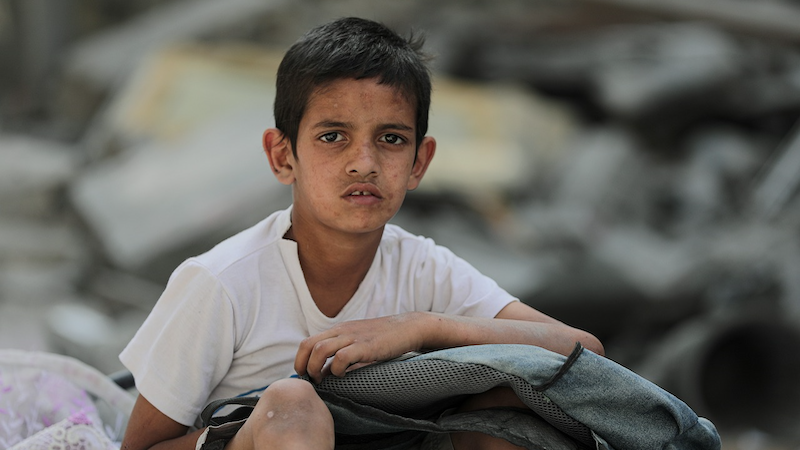
The war in Gaza between Israel and Hamas represents a serious challenge to the US. It is a difficult test for the network of contacts Washington has been building throughout previous decades to ensure a balance in its interests between Arab countries and Israel.
Obviously the US is failing to achieve this strategic equilibrium in its relationship between the Arabs and the Israelis. There are many accusations by most of the nations of the world, especially Arab and Muslim states, that Washington is endorsing Israel’s attacks against civilians in Gaza. They point to the US supplying Israel with the weapons being used to kill Palestinians in Gaza. They also charge the US with giving $14 billion to Israel to carry on the war, and say that the sending of two aircraft carriers to the eastern Mediterranean shields Israel from any armed assault by any power.
Arab media outlets view the US as culpable in the Oct. 7 attack. They also perceive the US as responsible for the military conflagration that the Middle East is undergoing at present. Arab media platforms refuse to believe the US is serious about making peace in the Middle East, and say it is doing nothing to end the fighting between Israel and Hamas. Accordingly, Washington is not an honest broker for peace in the Middle East. Shamefully, US Secretary of State Antony Blinken’s shuttle diplomacy in the region has been unable to convince the Israeli government to accept a limited cease-fire to deliver urgent humanitarian assistance.
There is also the increase in the number of attacks against US military bases in both Syria and Iraq. The potential is high that there will be more targeting of US military facilities in both countries if the war in Gaza continues. All Arab nations are worried that the Gaza war could escalate into a wider regional crisis. Arabs are hearing the voices coming from the US that perceive the war against Hamas as a war against Iran. The strategic rationale for the Arab nations is that extending the war by attacking Iran could push the whole Middle East into a state of turbulence and chaos, causing a great deal of instability. This will force many people to label the US as the real enemy of the Arabs and Muslims.
Arab countries believe that Israel is acting in a brutal way and that the US is doing nothing to stop it. The Middle East is about to explode. The West is unethical in its attitudes toward the Middle East. It endorses Israel’s savagery against the Palestinians, while pretending it defends human rights and democracy. The Arabs assert that Western hypocrisy about freedom and liberty paved the way for their complicity in Israel’s barbarity toward the Palestinians.
Against the backdrop of Arabs’ loss of faith in the US, Russia is gaining influence in the region. Moscow can tell the peoples of the Middle East that it renounces Israel’s killing of innocent Palestinians and, therefore, is a friend of Arabs and Muslims. Other countries, such as China, can also gain prestige in the Middle East as the US is denounced by the region’s Arab population.
The war in Gaza may revive the two-state solution. However, Arab nations doubt Washington’s sincerity in creating a Palestinian state. They were dismayed by the refusal of the US Congress to give aid to the Palestinians on the grounds that it would go to Hamas. This, of course, was not true.
On the other hand, war is an uncertain development. No war in history has an assured outcome. Hence, any substantial political outcomes must take into account not only US strategic objectives, which include the defense of Israel, but also the local conditions in which the strategy for achieving those objectives must play out. Considering the US failed to effectively define its goals separate from Israel, any analyst must focus on several strategic trends operating now in the Middle East.
First, Turkiye will try to make its role more significant. Ankara and President Recep Tayyip Erdogan will express greater solidarity with Hamas. This will strain US-Turkish relations further. Second, the continuation of the Saudi-Iranian detente will be inevitable. The two countries will focus on Gaza and not on their regional rivalry. Third, the role of Qatar most likely will be enhanced. Washington so far has been unable to persuade Qatar to cease its relationship with at least the political wing of Hamas. Qatar will pressure the US to force Israel to stop the war in Gaza in return for its changing relations with the leaders of Hamas.
Fourth, a fair question is how successful and decisive will the Israeli ground offensive be? Israel has not declared victory. It pulled out of previous wars, including conflicts with Lebanese Hezbollah in 1996 and 2006, before finishing its military purposes, due to political and diplomatic factors. Hamas could be hoping for the same outcome. This suggests that the group could still be operating underground and maintaining parts of its military infrastructure when the war ends.
Fifth, how much damage could be caused by several statements by Israeli officials, such as the one attributed to Minister of Heritage Amichai Eliyahu, who said dropping an atomic bomb on Gaza was “a possibility”? This could quickly invite Moscow to affirm nuclear deterrence similar to what happened on Oct. 22-23, 1973 when the US and the Soviet Union raised their nuclear preparedness during the Ramadan War.
Certainly, Arab countries will endorse such a potential nuclear strategic move by the Kremlin. Sixth, how much dispute will occur if Israel takes actions to reoccupy and govern Gaza? This could cause friction between the US and Israel. Blinken played down these prospects. Yet, it seems that Israel is determined to remain in Gaza for a long time. Prime Minister Benjamin Netanyahu told ABC News that “for an indefinite period, Israel will have the overall security responsibility” for the enclave.
The war in Gaza has seriously undermined US credibility and deterrence. Washington cannot prevail on Israel to hold off the fight in Gaza even for a few hours. In conclusion, the US will not gain any political or strategic advantage from the Gaza war. It could even lose economically if the conflict goes on for a long time and the price of oil rises to a record high.
• Maria Maalouf is a Lebanese journalist, broadcaster, publisher, and writer.
For the G7 countries, the primary source of worry appears to be Russia rather than China.
The Foreign Ministers of the G7 countries comprising Canada, France, Germany, Italy, Japan, the United Kingdom, the US, and the High Representative of the European Union, met in Tokyo on November 8.
The Joint Statement issued after the meeting severely criticised the Russian invasion of Ukraine and also threatened to impose harsh sanctions on Russia. But it was accommodative in its approach to China.
On Russia, the statement said: “Our steadfast commitment to supporting Ukraine’s fight for its independence, sovereignty, and territorial integrity will never waver. We continue to condemn in the strongest possible terms Russia’s ongoing aggression, and we commit to standing by Ukraine for as long as it takes while increasing economic pressure and imposing robust sanctions and other restrictions against Russia.”
“A just and lasting peace cannot be realized without the immediate, complete, and unconditional withdrawal of Russia’s troops and military equipment from the internationally recognized territory of Ukraine. We continue to support Ukraine in further developing President Volodymyr Zelenskyy’s Peace Formula. We are increasing our efforts to help Ukraine meet its winter preparedness needs, including by continuing to provide critical energy assistance.”
“Russia’s irresponsible nuclear rhetoric and its announced deployment of nuclear weapons in Belarus are unacceptable. Any use of chemical, biological, or nuclear weapons by Russia would be met with severe consequences. We deeply regret Russia’s decision to revoke its ratification of the Comprehensive Nuclear-Test-Ban Treaty. We strongly support the International Atomic Energy Agency’s (IAEA) continued presence and unfettered access at all of Ukraine’s civil nuclear sites.”
“We will reinforce our coordination on sanctions to restrict Russia’s access to critical goods and technology. We will take further action to prevent the evasion and circumvention of our measures against Russia.”
“We reiterate our call for third parties to immediately cease providing material support to Russia’s aggression, or face severe costs. In order to reduce the revenues that Russian extracts from its exports, we will accelerate our consultation on energy, metals, and all non-industrial diamonds, including those mined, processed or produced in Russia.”
“Russia must cease its aggression and must bear the legal consequences of all its internationally wrongful acts, including compensation for the damage caused to Ukraine. We are united in our determination to ensure full accountability.”
“In light of the urgency of disrupting Russia’s attempts to destroy the Ukrainian economy and Russia’s continued failure to abide by its international law obligations, we are exploring all possible avenues to aid Ukraine, consistent with our respective legal systems and international law.”
“We reaffirm that, consistent with our respective legal systems, Russia’s sovereign assets in our jurisdictions will remain immobilized until Russia pays for the damage it has caused to Ukraine. We reiterate our commitment to holding those responsible to account consistent with international law, including by supporting the efforts of international mechanisms, such as the International Criminal Court.”
“We recommit to supporting Ukraine’s immediate, medium, and long-term recovery and reconstruction in the face of Russia’s efforts to inflict immense suffering on the people of Ukraine. We are also working to involve our private sectors in the sustainable economic recovery of Ukraine. We welcome and underscore the significance of Ukraine itself continuing to implement domestic reform efforts, especially in the fields of anti-corruption, justice system reform, decentralization, and promotion of the rule of law, in line with the European path that Ukraine has embraced together with other partners, including Moldova, Georgia, as well as countries in the Western Balkans.”
“We reaffirm our commitment to address the growing needs of vulnerable countries and populations impacted by Russia’s aggression. Russia’s weaponization of food has compounded economic vulnerabilities, exacerbated already dire humanitarian crises, and escalated global food insecurity and malnutrition worldwide. We deplore Russia’s systematic targeting of Ukrainian Black Sea Ports and civilian infrastructure and welcome steps by Ukraine to strengthen export routes free of Russian control.”
“We continue to support fully the export of Ukrainian agriproducts, including through the EU-Ukraine Solidarity Lanes, Danube ports, and its humanitarian maritime corridor. We reaffirm our aim to limit Russia’s energy revenues and future extractive capabilities, building on the measures we have taken so far.”
“We continue to reduce our reliance on Russian energy, so that Russia is no longer able to weaponize its energy resources against us. We commit to working with nations around the world to enhance global food and energy security.”
Contrast this with the G7 statement on China:
On relations with China, the Joint statement says: “We stand prepared to build constructive and stable relations with China, recognizing the importance of engaging candidly and expressing our concerns directly to China. We act in our national interests. We acknowledge the need to work together with China on global challenges as well as areas of common interest, and call on China to engage with us on these issues.”
“Our policy approaches are not designed to harm China nor do we seek to thwart China’s economic progress and development. We are not decoupling or turning inwards. At the same time, we recognize that economic resilience requires de-risking and diversifying. With a view to enabling sustainable economic relations with China, and strengthening the international trading system, we will continue to push for a level playing field for our workers and companies.”
“We will seek to address the challenges posed by China’s non- market policies and practices, which distort the global economy. We will counter malign practices, such as illegitimate technology transfer or data disclosure.”
“We will foster resilience to economic coercion. We also recognize the necessity of protecting certain advanced technologies that could be used to threaten our national security without unduly limiting trade and investment.”
“We call on China to act as a responsible member of the international community. In this regard, we welcome China’s participation in the Ukraine-led peace process. We further call on China not to assist Russia in its war against Ukraine, to press Russia to stop its military aggression, and to support a just and lasting peace in Ukraine.”
“We underscore that China has a responsibility to uphold the purposes and principles of the UN Charter in their entirety. We remain seriously concerned about the situation in the East and South China Seas, strongly opposing any unilateral attempts to change the status quo by force or coercion. We reemphasize the universal and unified character of the United Nations Convention on the Law of the Sea (UNCLOS) and reaffirm UNCLOS’s important role in setting out the legal framework that governs all activities in the oceans and the seas.”
” We reiterate that the award rendered by the Arbitral Tribunal on July 12, 2016, is a significant milestone, which is legally binding upon the parties to those proceedings, and a useful basis for peacefully resolving disputes between the parties.”
“We reaffirm the importance of peace and stability across the Taiwan Strait as indispensable to security and prosperity in the international community and call for the peaceful resolution of cross- Strait issues. There is no change in the basic position of the G7 members on Taiwan, including stated one China policies.”
“We reiterate our support for Taiwan’s meaningful participation in international organizations, including in the World Health Assembly and WHO technical meetings.”
“We also remain concerned about the human rights situation in China, including in Xinjiang and Tibet. We further call on China to uphold its commitments under the Sino-British Joint Declaration and the Basic Law, which enshrine rights and freedoms and a high degree of autonomy for Hong Kong.”
“We call on China to act in accordance with its obligations under the Vienna Convention on Diplomatic Relations and the Vienna Convention on Consular Relations and not to conduct interference activities, aimed at undermining the security and safety of our communities, the integrity of our democratic institutions, and our economic prosperity.”
The possible reasons for the difference in the approach to Russia and China could be two: (1) Disadvantages of fighting on two fronts at the same time (2) The West’s, especially America’s, economy is closely intertwined with China’s and a full-scale confrontation may have dire economic consequences. In contrast, the West’s economic dependence on Russia is much less and not critical. Russia can be punished at much less cost or no cost at all.