

Day: November 9, 2023
Like so many Armenians who moved from Syria to Armenia, Hagop was a millionaire before destiny decided that he would cut men’s hair for a living in the suburbs of Yerevan. Before the war, he had never been to Armenia. Life in the Levant on the shores of the Mediterranean was too good, and a $300 plane ride to the homeland seemed like an unnecessary expense. However, as is axiomatic of life, misfortune eventually struck, and an ironic, cruel world forced Hagop to make his one-way journey to Armenia. He arrived not as a millionaire, but as a poor man who would perhaps forever be despondent as he reminisced about his glorious past.
Yet Hagop, like many Syrian Armenians, was remarkably resilient. Although Armenia, the homeland, was still foreign to him, at 40 years old he did what he could to survive. He quickly relearned an old skill of cutting men’s hair. After mastering a few types of haircuts, he opened a modest barber shop in one of the many narrow allies of the city. He wasn’t particularly skilled, but he knew enough to lure in older men who couldn’t care less about what type of haircut they got. For some locals, Hagop’s broken Eastern Armenian was all they needed to hear to trust him. For them, Hagop was from abroad; hence, he was dependable. One of our nation’s enduring defects is trusting in everything that is from abroad.
When some clients would ask Hagop about his experience, he would falsely claim that he used to own a four-chair women’s salon before moving to Armenia. Impressed by this piece of information, the client would sit somewhere in the shop and Hagop, by winning over another naive customer, would move one step closer to regaining his millionaire status. To quell all doubts among his new customers, he would often employ superfluous theatrics when cutting hair. He would pretend to do impressive tricks with his scissors or act annoyed by how much the customer is moving his head. Without exception, while completing the final touches of the six-minute haircut, he would put some sort of gel on the freshly-cut head of hair and proceed to tell the customer that they wouldn’t find this gel anywhere in Armenia. It’s imported from abroad – where everything is apparently better.
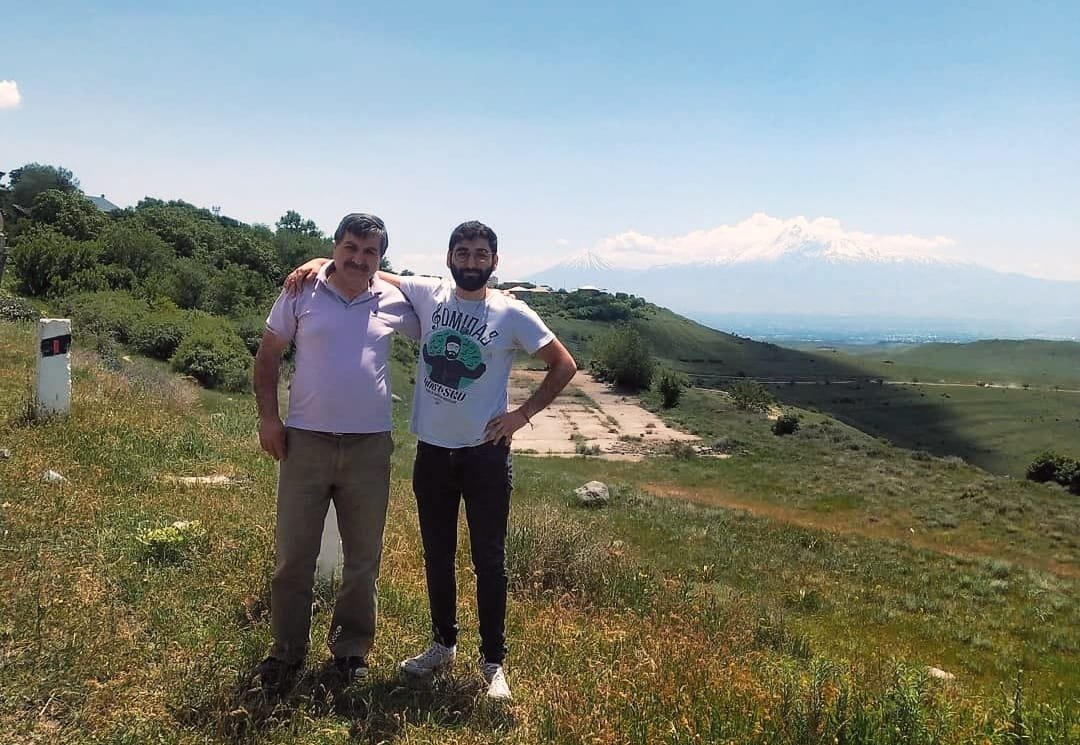 Krikor Sahagian with his father
Recently, when my father visited Armenia for a few weeks, he wanted to get a haircut. Back in Jerusalem, my poor mother could never convince him to preemptively get one before his hair got embarrassingly messy. My father would delay this affair for as long as he could. I assume it was because my dad didn’t feel like he had anything to prove to anyone. In his mind, he had built a decent life for himself and his family – which is difficult to achieve among those who are hell bent on making it without surrendering any of their principles. Most importantly, my dad had married the most beautiful Armenian woman in the entire Middle East. Thus, to my mom’s discontent, my father never cared about how he looked. Physically, he only tended to his iconic mustache that had become an indivisible part of his identity.
However, there was a second, simpler reason why my dad delayed his visit to the barbershop. Jerusalem did not have an Armenian barber. At the barbershop, he was forced to speak in Arabic or Hebrew about things that were hardly near and dear to his heart. For the simpleminded like myself and many others, hearing local gossip at the barber is always interesting. While my dad would engage in these conversations, deep down he did not care. Instead, with his broken Arabic and great difficulty, he would always try to shift the conversation to Armenia. As a child, I would sometimes go with him, and I would hear my dad speak about our small homeland and about how he was eventually going to sell everything and move there to a tiny village overlooking Ararat with his consumerist wife and his four spoiled sons. The poor Palestinian barbers, deprived of freedom and the ability to travel, would never find out for themselves about how much my dad exaggerated the beauty of Armenia.
For 63 years, my dad went to a barber and spoke to them in a foreign tongue about everywhere but home. This recently changed, however, when my dad and Hagop the barber crossed paths. My dad has been to Armenia more than a dozen times, but work and the hustle and bustle of life would only allow him to visit for a maximum of 10 days at a time. He had never visited a barber in Yerevan – until his last visit, when my mom told him calmly and affectionately that he would not be welcome back unless he got a haircut during his trip.
I accompanied my dad during this visit. We entered Hagop’s shop without much fanfare. Initially, we did not realize that my dad had never been to an Armenian barber – until my dad sat on the chair and Hagop asked him in Armenian how he wanted his hair cut. Back in the Middle East, the answer was simple: tarteeb, meaning “to put into order.” Usually, he did not go into further detail when speaking in Arabic, because it required too much mental effort to dig deep and find the right words.
However, when he was asked the question this time, for a split second my dad froze and realized that he had never answered this question in Armenian. He cracked his characteristic cynical smile and told Hagop that this was the first time he was visiting a barber with whom he could speak Armenian – not just Armenian, but Western Armenian. Hagop did not get the novelty of it. I assume he did not believe my dad either, because coming from the large Armenian community of Aleppo, he could not understand how the Armenian community in Jerusalem did not have a single local Armenian barber.
Throughout the haircut, the two bonded. Naturally, politics flooded the conversation between the two men, who for decades had felt the turmoil and turbulence of the region on their skin. They laughed as they spared no political leader both in the Middle East, Armenia, or even the world. Every politician was either a criminal, a crook, a thief or simply an idiot. As a person who is yet to give up on my naive idealism, I am often shocked to discover how pessimistic older people, who have seen so much, could be towards a world that despite its many flaws is still so beautiful to me. Hagop lamented the fact that he, as a Syrian national, could never make his pilgrimage to Jerusalem to reaffirm his Christian faith, which, based on my modest observations, did not seem very visible to begin with. My father similarly bemoaned the fact that he could not visit Syria. He would have loved to eat the exquisite cuisine the country was so famous for and admire all the things that the Armenian community had built in one of the great metropolises of the world.
The haircut ended way before the conversation did. My dad and Hagop were quite different and did not agree on almost anything. Yet for the first time ever, I felt like my dad was trying to draw out his visit to the barber. He had years and decades worth of conversation that had been built up inside him that could only be released while visiting a barber who could speak Armenian and feel the subtle nuances of tone and meaning in his voice. My dad was elated. At 63, he had finally experienced a haircut at an Armenian barbershop.
The haircut was so good, that my mom approved of it quite quickly. As he left the shop, my dad told Hagop how great his visit to the homeland had been this time. Hagop expressed his cordial farewells to my dad, surely thinking that he is just another naive Diasporan Armenian, who wouldn’t speak so highly of Armenia had he lived here.
Author information
Krikor Sahagian
Krikor Sahagian moved to Armenia from Jerusalem in 2017. He holds a master’s degree in political science, but works as a videographer and filmmaker based in Yerevan. His interests include photography and writing. As an ardent believer in repatriation, he mostly writes about Armenia, its people, and the sense of purpose and meaning that the country fills his heart with.
| Twitter |
The post My father’s visit to the barber in Yerevan appeared first on The Armenian Weekly.
We are living in dangerous times, when extremes have become a powerful presence, creating uncontrolled instability. Our modern history offers compelling evidence. The Committee of Union and Progress (Young Turks) came to power in the pre-WWI Ottoman Empire, when a wave of constitutional reforms reduced the power of the corrupt sultanate. The CUP used its power to drive the crumbling empire into wars and genocidal policies in a vain attempt to restore the territorial glory of the Ottoman past. Instead, they degenerated into the lowest form of human existence, with the genocides of the indigenous Armenians, Assyrians and Greeks and the depopulation of Christian communities, creating an infrastructure void due to their central economic role. Another extreme followed with Mustafa Kemal Atatürk’s secular but ultranationalist policies that Turkified the nation while building institutional discrimination against the remaining non-Turks.
Extremists often gain power based on a reaction. Hitler assumed power in the 1933 election on a promise to restore the dignity and prosperity of a nation that had not recovered from its crushing defeat in 1918. His warped sense of national pride quickly became a racist policy of exterminating the substantial Jewish community during the Holocaust, leading Germany into utter destruction once again. One of the reasons the West undertook post-war reconstruction in Germany and Japan was to prevent another reactive government from taking advantage of a frustrated and defeated population. The investment eventually resulted in stable and trusted allies in modern Germany and Japan. Radical policies and leadership rarely solve problems but rather create them. A quick review of of extreme leadership in Rwanda, Cambodia, Bosnia and Darfur illustrates their tragic connection with genocide. Quite often they provoke economic decline and instability, such as the recent history in Venezuela.
The work of extremes is not always violence but rather manifests in political ineffectiveness. The United States is not immune to this phenomenon. Many Americans are frustrated by the gridlock and inefficiency of the political process in Washington, caused not only by the conflict between the two political parties but the growing ideological divide and obstructionist thinking within our nation. There was a time when the predominant political thinking in Washington ranged between left and right of center. President Kennedy was a moderate who would probably have an identity problem with the Democratic Party today. Likewise, Eisenhower and the Bushes would have similar challenges with today’s Republican Party. We just witnessed about half a dozen representatives hold up the election of a House speaker for nearly a month. There was a time when it was considered a vital responsibility of partisan colleagues to “reach across the aisle” to empower our democracy. That aisle gets wider as the fringes of each party gain power. Representatives who dare to vote in a bipartisan manner are deemed disloyal. Regardless of which party is in power, the opposition sees its role as obstructionism rather than collaboration and compromise. Meanwhile, polls show that most Americans reside in the middle of the ideological spectrum and are frustrated with the low productivity of Congress. Politics is a dirty business, but our system of remarkable checks and balances works best when we find ways to work together. Extremism only produces a lack of results and reduction in public confidence that we see today. Ambivalence is a dangerous attribute in a democracy.
The contemporary Armenian nation has been severely impacted by external extremist thinking. Putin has been very clear about his belief that the collapse of the Soviet Union was a profoundly negative event. His long tenure as the leader of the Russian Federation has been driven by the desire to restore some form of Russian hegemony. As we have learned, painfully, he and Lavrov have a unique definition for the term “ally,” closer to a vassal state or a subordinated “strategic partnership.” While Putin has worked to recover former Soviet territory either by overt aggression (Abkhazia, South Ossetia, eastern Ukraine) or through regional influence (Belarus, Central Asia, the Caucasus), Russia has become isolated and weakened. In desperation, Russia has looked east to China to align with another extremist power, setting a dangerous global dynamic. Putin is enabled by an autocratic political process with virtual authority, particularly in foreign affairs.
Turkey’s Erdogan is slightly constrained by the remnants of a pseudo-democracy that he has worked diligently to weaken over the past two decades. Erdogan is enamored by Turkey’s criminal Ottoman past and talks openly of returning some of its former glory. After decades of secular societal institutions, Erdogan advocates a more Islamic Turkey. Perhaps his most dangerous beliefs lie in the Ottoman pan-Turkic policies, which fueled the Armenian Genocide and today have led to a radical alignment with Azerbaijan. His regional thinking on Nakhichevan, “Zangezur,” “one nation, two states” and other issues is aligned with the racist policy of pan-Turkic political and territorial unity. The Republic of Armenia is in his sights, just as the western highlands and Cilicia were the target of the Ittihads. These are not reasonable people. His administration has an insatiable appetite to remove all non-Turks in its path of regional unity – a constant and dramatic reminder that the Turks have not honored any agreement they have signed. The Republic of Turkey has made a mockery of the Treaty of Lausanne that diminished Armenian rights. Its meddling in the Armenian church is a clear, systemic, decades-long violation. The November 2020 ceasefire agreement in Artsakh has been ignored from day one. We evolved from negotiations for guarantees of the rights and security of Artsakh’s Armenians to the deportation of an entire population. The Azeris and Turks will honor no agreement, given their global strategy. We should work towards peace but never become dependent on trusting their commitments. We must be wary of the extremes they harbor in their foreign policy towards Armenia.
We are negotiating with extremists who have little appetite for compromise. The only buffer is the fragile support of western nations and duplicitous Russia. Compromise is usually the recipe for peace and stability. In a sea of uncertainty, Armenia must pursue parallel paths of forming alliances with reliable security partners and building military infrastructure while negotiating with unreliable parties. Will that formula work?
The behavior of Israel is on the minds of many Armenians today. It has been difficult for Armenians to understand the Jewish state’s deadly relationship with Azerbaijan and refusal to recognize the Armenian Genocide, given our shared histories. Hamas is an extremist group, but it came to power partially because of the brutal and oppressive policies that Gaza has been subjected to over the last 30 years. Netanyahu’s policies are extreme and supported by those who feel justified in pursuing territorial encroachment and subjugation. The war in Gaza has degenerated from the right to self-defense, to retaliation, to unthinkable carnage. The killing of innocent Israelis by Hamas is unconscionable, but is the killing of thousands of Palestinian civilians any different? Netanyahu’s policies will not bring peace to Israel. His actions are creating new recruits for the Palestinian cause, who are growing up with destruction, death and hopelessness. There are many who disagree with the policies of Israel and are clearly not anti-Semitic. The answer lies with reasonable people in Israel, Gaza and the West Bank understanding that the Jews and Palestinians are not leaving. Moderate policies in Israel will empower moderate leadership in Palestine. Gaza is a virtual prison with all support infrastructure controlled externally. Over 80-percent of residents depend on humanitarian aid and have lost hope. Hamas has radical views of Israel, and Israel has policies that have significantly divided their nation. This is tragic, but change can only happen with moderate thinking. We have two extremes fighting each other, and it will result in more problems than solutions. Do we desire peace enough to compromise?
Armenia is facing a similar dilemma. We are negotiating with extremists who have little appetite for compromise. The only buffer is the fragile support of western nations and duplicitous Russia. Compromise is usually the recipe for peace and stability. In a sea of uncertainty, Armenia must pursue parallel paths of forming alliances with reliable security partners and building military infrastructure while negotiating with unreliable parties. Will that formula work, considering our adversaries lack credibility? What is the required threshold of trust? Can physical guarantees (i.e. peacekeepers) overcome the credibility gap of extremists?
I have always felt that labeling contributes to division. We should vote or advocate on an issue-to-issue basis, not based on pseudo loyalty to a party or person. On some issues, I support a liberal position, and others a more conservative policy. I find it unfortunate when we are packaged into a convenient label with generalizations. If we focus on the mission, we will rarely fail. As Armenians, we tend to spend too much time criticizing others rather than articulating a path that supports a vision. Investing in neutralizing others is polarizing and widens the gap to eventual compromise. Avoiding the edges of the political spectrum offers all of the best possibilities for stability.
Author information
Stepan Piligian
Columnist
Stepan was raised in the Armenian community of Indian Orchard, MA at the St. Gregory Parish. A former member of the AYF Central Executive and the Eastern Prelacy Executive Council, he also served many years as a delegate to the Eastern Diocesan Assembly. Currently , he serves as a member of the board and executive committee of the National Association for Armenian Studies and Research (NAASR). He also serves on the board of the Armenian Heritage Foundation. Stepan is a retired executive in the computer storage industry and resides in the Boston area with his wife Susan. He has spent many years as a volunteer teacher of Armenian history and contemporary issues to the young generation and adults at schools, camps and churches. His interests include the Armenian diaspora, Armenia, sports and reading.
|
The post A world of extremes produces problems, not solutions appeared first on The Armenian Weekly.
#POTUS POTUS #DOJ DOJ #FBI FBI #CIA CIA #DIA DIA #ODNI ODNI #News #Times #NewsAndTimes #NT #TNT Putin Russia #Putin #Russia #GRU GRU #Israel Israel #World World #USA USAhttps://t.co/M7N7c6GyMF
Links – The News And Times – https://t.co/2HGdNir81K | Audio Posts – Saved Web Pages…— Michael Novakhov (@mikenov) November 9, 2023
Москва удивлена тем, что Евросоюз обвиняет российскую сторону в убийстве гражданина Грузии Тамаза Гинтури произошедшем на оккупированной территории в районе села Кирбали, заявила пресс-секретарь МИД России Мария Захарова. «Удивлены этой позицией ЕС, там проигнорированы очевидные факты и развернутые разъяснения осетинской стороны, которые были даны. Самое шокирующее, что в Брюсселе безапелляционно пытаются переложить ответственность за случившееся […]