
Day: November 6, 2023
Greetings from Georgia, which – surprisingly – did not go through any fresh, self-invented political crisis last week. But do not despair: just as the autumn sun has been more than clement, and the political temperature is expected to follow suit this week, when the EU Commission is slated to deliver its recommendation about granting Georgia its much-desired EU candidacy. Depending on the outcome, we will either have a week of “told-you-so” posturing and finger-pointing or a routine two-day fight on who takes the credit. Most likely, though, the EC would muddle through, leaving everyone with a dizzy feeling that they won but with a sour aftertaste and perhaps even a hangover.
Until then, we have only average scandals and new(ish) sexist insults on the menu. The week’s highlight has been less prominent male MPs from the ruling party finally getting much-craved attention by coming up with creatively derogative phrases to describe their female colleagues. And, in general, that’s all you could see on TV these days: things getting spicy in the plenary room of the Georgian parliament or the walls of smaller self-government bodies, MPs showing the usual unrestrained aggression… Blame it on our southern temper or on global warming, if you must. But turns out that Georgians can be very good at self-control, even if it’s mainly at the wrong time and in the wrong place.
Here is Nini and weekly Dispatch, and please cover your ears and nose – because it’s getting quite noisy and stinky in here.
Why Georgians are afraid of drinking lemonade
“Gurjaani residents are demanding public toilets to be opened. The issue has been quite problematic, locals explain. The respondents say that the absence of restrooms has defiled various parts of the town. According to the head of infrastructure service of the Gurjaani mayor’s office, toilets have been installed in the Papa and Bebo Gardens [local parks] as part of Renewed Regions [government program], but they are not functioning. If in the future some company shows interest in leasing the toilets, the issue will be resolved,” reads the October 27 report of Gurjaani TV, a local media agency covering the Gurjaani municipality of Georgia’s eastern Kakheti region.
News like these occasionally appear in Georgia’s regional media. What’s the deal in reporting “real day-to-day issues,” some may ask? And yet, it is a big deal. It takes some real taboo-breaking courage to publicly complain about issues like this in a nation that never pees outside the home. At least, not avowedly so.
Take a closer look at the news report above. The reason the locals are asking for public toilets is that they are bothered by the stench. But they (prudishly?) avoid saying what the source of that stench is. The act of satisfying the natural needs in a public space is left inside the mental parenthesis. And while the brave citizens gesticulate and resort to euphemisms, local authorities, appear to regard public toilets as some luxury that only works if profit-seeking investors take interest.
Yet there were times when the issue would get more detailed coverage.
“Why are [locals] afraid to drink lemonade?” was once the opening line of a viral news report that, again, addressed the absence of a public bathroom at a railway station in one of Georgia’s western provinces. “Men will walk over there and do it; what are women supposed to do?” one aged woman complained to the reporter, exposing a very gendered nature of the problem. “Should I carry a can with me?” asked another respondent, a decent man to whom “walking over there” did not seem like the best option. The main concern of that report, however, was again the stink. And, as usual, local authorities looked unbothered – those toilets had been under construction for over a year and didn’t appear to be opening their doors anytime soon.
To pee or not to pee
It’s hard to trace when exactly we all got so ashamed of our own nature. But that shame has been creating problems for years. Long rides in intercity transport used to be a scary experience because there were hardly any public toilets on the road. If there were some, visitors had to use them at their own risk and immediately erase those moments from memory.
Then, finally, tourists (may God bless their existence!) complained, and the issue got media attention. The articles would describe the horrors experienced by big tourist groups as they struggled to find a place to empty their bladders. Eventually, steps were taken to address the issue. At least, temporarily: Tbilisi Mayor recently announced dismantling 36 automatic restrooms installed across the capital city a couple of years ago after locals vandalized them beyond repair. A representative of the City Box restroom company later added with deep frustration that the “public was not ready to have modern restrooms.”
Will toilets, this time more resilient ones, be making a comeback to Tbilisi streets anytime soon? We don’t know, but even if they do, the general problem won’t be going anywhere. After all, there are still places across Georgia where tourists don’t venture long enough for nature to issue its insistent call.
They’ll be asking for a shower cabin next
Take, for example, a remote suburb in Tbilisi known for overpopulation. Fearful of turning into a concrete jungle, the local community recaptured one of the last remaining green areas from developers and pushed the authorities to build a big park. The park was ceremonially opened, and the locals happily started crowding the place. It was then that one woman finally decided to climb one step higher on her pyramid of needs. Having worked up a rare championing spirit, she dared to ask on social media why no one thought of installing a toilet in a busy public space.
You know how it happens with taboo issues: the question quickly got everyone’s attention, and many felt an irrepressible urge – this time, to weigh in. Commenters swiftly divided themselves into two opposing camps. One, more male-dominated, camp refused to take the issue seriously, even mockingly asking why not have a shower cabin put into that park as well. Another camp, mainly composed of women, seemed more considerate of the delicate yet pressing needs. They agreed that they, too, sometimes struggled to find the right place whenever their kids wanted to go. Because where we don’t have tourists, we still have kids to project our needs to, god bless them!
But the trick didn’t work this time: another group of responsible citizens shared kind advice on how to carry a “bottle” around for toddler emergencies. Lost in democratic conjecture, the decision was postponed indefinitely.
Just drink less water
The problem remains, and so does the question: where do Georgians go whenever nature calls? One theory is that the nation developed some exceptional self-mastery. Take an hours-long trip in a Georgian marshrutka (vans used for public transportation), and you won’t hear anyone ever asking for a pit stop. They all depend on the driver’s initiative and mercy – if he (it is usually a he) is inclined to show any. If he doesn’t, that’s not a problem either: people appear to have learned to control their water intake while their bodies have evolved to repress basic needs once they leave their comfort zone. The policy of (self-)containment works at its best; no one shows any impure desires, and everyone continues to live as honorable citizens.
Or do they? Because, then, what is it that defiles those towns? Or where does that stench come from? Is it perhaps the bitter tears from self-denial that are tinged with ammoniac? Or is it that the country’s most dignified citizens repress their legitimate urges at the wrong time, only to release them in the wrong place? And who knows, maybe the worrying trend isn’t limited to a toilet problem?
Anyway, give us some time. Life has been bitter for many of the country’s broken citizens. We are still learning. We’ve learned to make lemonade whenever life has offered us lemons. But, turns out, we are yet to learn how to drink that lemonade without fearing the consequences.
The policy brief “The ticking clock for Georgia’s European Future” written by Ivane Chkhikvadze of the Open Society Foundation, and commissioned by the think-tank Zentrum Liberal Moderne offers an insight into the state of affairs related to Georgia’s European candidacy bid and recommendations concluding that “the situation in Georgia is paradoxical: the country has an anti-European government and a pro-European population” and stressing that in formulating the decision on candidate, the EU will “have to consider what leverage it will retain over the country’s government if Georgia is granted candidate status.”
The report comes just days ahead of the European Commission’s assessment of Georgia’s progress in implementing the 12 priorities set by the EU for Georgia to achieve EU candidate status in December this year. On November 8 EC will present a so-called enlargement report, containing the assessment and relevant recommendations on Georgia.
Reforms and implementation of 12 EU priorities
The report notes that Georgia missed out on candidate status last year, along with Moldova and Ukraine, which got it, and that according to the EU Commission’s June interim report, Georgia had only fully met three of 12 conditions, making no progress on recommendations such as de-oligarchization, independent media or political depolarization. On the contrary, the government attempted to pass a Russian-style law on foreign agents, suppressed independent media, re-established flights with Russia, strengthened the judicial “clan” and took other controversial steps. „It was the decline of democracy and lack of political will related to EU accession that caused the EU to grant Georgia only a European perspective at the June 2022 summit and make candidacy subject to fulfillment of 12 conditions,“- says the report.
The US sanctioning of Georgian judges for corrupt practices shows the seriousness of the problems in the judiciary. According to the report, the GD government’s protection of the judges indicates that the Georgian judiciary is run by a clan with close ties to the government. This was followed by the sanctioning of the former Prosecutor General Otar Pratskhaladze, for cooperating with the Russian Federal Service and influencing Georgian society and politics in favor of Russia. The report notes that the National Bank helped Partskhaladze to avoid sanctions as its acting president Natela Turnava issued an exceptional order, changing the regulations and effectively shielding Parstkhaladze from the effect of sanctions.
Reviewing the trend of democratic decline in Georgia, the report notes developments such as the ruling party’s withdrawal from the so-called Charles Michel Agreement in 2020, the appointment of judges to the Supreme Court contrary to EU recommendations (as a result, Georgia lost €75 million of conditional EU micro-financial assistance), the continued impunity for the organizers of the violence of July 5, 2021 against media representatives, the amendments to the so-called Surveillance Law that contradict EU requirements, verbal attacks on diplomats from EU member states and the US, the illegal interception of personal correspondence and wiretapping of diplomats, and attacks on the independent media.
With regard to the 12 EU priorities, it is noted that although the timeframes for their implementation were short, the main problem was the failure of the government to demonstrate the political will and the “right track” for their implementation. As a result, only those priorities that didn’t prevent the ruling party from expanding its power base were fully implemented (appointment of an independent ombudsman, gender quality, transposition of ECHR rulings into national legislation), while little or no progress was made on priorities “that might jeopardize the Georgian Dream’s hold on power, such as ensuring the independence of the judiciary and the media, fighting elite corruption and involving civil society in decision-making”.
On the other hand, the report stresses that the Georgian population is overwhelmingly pro-European, as evidenced by opinion polls.
The report therefore argues that it is important that any decision by the EU – positive, negative or with additional conditions – be accompanied by a detailed communication explaining the basis for it, and advises that civil society and political actors be consulted in the process of formulating it. In particular, the report stresses the importance of any additional conditionality being clearly defined and measurable, with no room for interpretation. It points out that whatever the EU decides on the candidacy, it should consider “whether it will still have effective leverage over the Georgian government to encourage pro-European reforms”.
The Russian Factor
According to the report, the war of aggression unleashed by Russia against Ukraine did not allow for Georgian authorities to pursue “a balanced policy between Russia and the EU”, as it “erased the shades of grey” making the countries to chose between supporting Ukraine and condemning Russia’s aggression, or siding with Russia.
According to the report, it is becoming increasingly clear that the line between Georgian Dream’s “pragmatic policy” towards Russia and its “flattering behavior towards Russia” is becoming blurred.
It is noted, that for its part, “Russia often praises the Georgian government for its policy and even rewards it”, the cancellation in May 2023 of the visa regime for Georgian citizens that had been in place since 1999 being a case in point.
Although Georgian government has sent humanitarian aid to Ukraine and provided shelter to 24,000 Ukrainian refugees, and supported statements on Ukraine in international organizations, “the political support for Ukraine is virtually non-existent in Georgia, which (along with Cyprus, Malta, Bosnia and Herzegovina, Serbia and North Macedonia1) is one of the very few European countries whose head of state or government has not traveled to Ukraine to show solidarity since the war began. The government also refused to join the EU’s Ukraine-related sanctions against Russia.
Another area of concern is Georgia’s alignment with the EU’s Common Foreign and Security Policy, which has declined over the years. [Although not part of the official recommendations, CFSP alignment is an important criterion for political affinity with the Union-ed]
 Source: Civil.ge
The report makes note of such important developments as losing traditional friends by Georgia in the EU, withdrawal of GD party from the European Socialists’ Party in May this year (ahead of its imminent expulsion), siding with Hungary’s anti-liberal Viktor Orban, increasing dependence on Russia in economy and energy areas, as well as general rapprochement (restoration of direct flights, abolishment of visas, allowing an influx of Russian citizens and businesses”
Meanwhile, “according to data from the UN Department of Economic and Social Affairs (UN DESA), the number of Georgian emigrants emigrating per year increased by 7% from 2010 to 2020, and a total of 861,000 15 Georgians emigrated in that decade (23% of the country’s population).”
According to official data, 54,509 17 of Georgian nationals left the country in 2022. In recent years, the numbers of applications for asylum in EU countries from Georgian citizens and numbers of Georgian citizens participating in the US Green Card lottery have increased significantly.
 Source: https://libmod.de/wp-content/uploads/LibMod_IP_Georgia.pdf
Why the EU matters
The report notes that “the currency of the EU candidacy topic is largely due to the fact that parliamentary elections are due to be held in Georgia in autumn of 2024” stressing that it’s going to be an important factor in the upcoming elections, with political parties positioning themselves to “reap political capital from the respective success or failure.”
The ruling party’s goal is to gain candidate status on its own terms, notes the report, “which amounts to gaining status without introducing democratic reforms or building/strengthening independent institutions, which might jeopardize its hold on power.” At the same time, the Georgian Dream party needs to acquire candidate status in order to keep pro-European voters, states the report.
If candidate status is denied, the ruling party will try to blame the EU, the opposition and civil society. The report predicts that the government will also use propaganda, broadcast on state television channels, “to present the Georgian population with an artificial choice between peace and European Union accession, with the explicit expectation that the country’s population, traumatized by the 2008 war, will choose peace”.
As for the opposition, it has been unable to agree on a positive agenda, and if the country does not get candidate status, it will try to blame the ruling party and rally its pro-European voters to its side.
The European Union should bear in mind that the overwhelming majority of Georgians are pro-EU when it takes its decision on Georgia’s candidate status at the end of the year, the report argues. The EU should put in place the right communication strategy and messages, while ensuring that it retains the leverage it needs to persuade the country’s government to pursue democratic reforms. The European Union should also ensure that it retains the leverage it needs to persuade the country’s government to pursue democratic reforms, the report concludes.
The Human Rights Center published a report on the use of special means by the police during March 7-9 demonstrations where citizens protested the draft bills “On Transparency of Foreign Influence” and “On Registration of Foreign Agents”, initiated by members of the parliamentary majority.
The HRC monitors who observed the rally on March 7-9 assessed it as peaceful. At around 20:00, on March 7 the Parliament adopted the bill “On Transparency of Foreign Influence” in the first reading. By that time, the number of participants in the rally had exceeded 10,000. Riot police blocked the entrances to the Parliament and prevented demonstrators from moving through the streets. At 20:20, without warning, the police used pepper spray and water cannons to disperse the rally participants on Chichinadze Street.
During the March 7-9 rallies, the warning of the use of special means was announced only after the fact – when the participants had no time to disperse. According to HRC observers, the police used special means (pepper spray and water cannons) during the rallies without taking into account the principle of necessity. In one case, a police officer was seen spraying pepper spray directly into the eyes of a demonstrator. In addition, footage circulated by the media showed the police mixing pepper spray with water cannon, which violates international standards and creates a risk of intentional harm to people.
According to the Law of Georgia on Police “water cannons, armored car, and other special transportation means are used to suppress mass violations of the legal order, to repel a group attack on the state and/or public facilities, to stop a vehicle by force if the driver does not obey a police officer’s demand to stop; to detain an armed criminal”. The report notes that none of the above grounds were found during the protests. Thus, the police used a water cannon without any legal basis to disperse the participants of a peaceful assembly.
According to international standards, pepper spray may not be used at a distance of less than one meter (optimum distance is 1.25 to 2 meters), as well as against the rally participant who is not behaving aggressively. Indiscriminate use of force by the police against anyone can lead to an escalation of the conflict, as was the case during the March protests.
HRC stresses that during the rallies on March 7-9, the actions of some participants exceeded the scope of the right to peaceful assembly and demonstration. However, according to the OSCE Guidelines, even if inappropriate behavior or isolated instances of violence by one or more participants in the demonstration are observed at the rally, a peaceful demonstration does not automatically acquire the character of a violent assembly, which in turn would be considered a legal basis for restricting the freedom of assembly. Indiscriminate use of force by the police against anyone can lead to an escalation of the conflict, as was the case during the protests.
HRC recommends:
To the Special Investigation Service:
● ensure timely, comprehensive, and impartial investigation of cases related to possible
abuse of authority by law enforcement officers.
To the Office of the General Prosecutor of Georgia:
● thoroughly investigate the legality of the order regarding the use of special means as
well as the scope of the use of such means.
To the Ministry of Internal Affairs:
● respect the freedom of assembly enshrined in the Constitution of Georgia and not to
interfere unjustifiably in the protected scope of this right;
● before using special means, in accordance with the requirements of the legislation of
Georgia, the authorized representatives of the Ministry of Internal Affairs shall issue a
preliminary warning and give the participants of the rally a reasonable time to comply and
disperse;
● ensure the use of special means in accordance with the principle of proportional force,
only in cases of extreme necessity;
● follow the requirements of the national legislation and international standards when
dispersing public assemblies through the use of special means;
● train the employees of the Ministry regarding the use of special means and to ensure
that such means are used in accordance with the guidelines approved by the Minister of
Internal Affairs.
Also Read:
On November 3, Georgian Foreign Minister Ilia Darchiashvili met with the Latvian Foreign Minister Krišjānis Kariņš in Riga. At the meeting, “special attention was paid to the agenda of Georgia’s integration into the European Union,” the Georgian MFA reported.
Glad to meet my Latvian counterpart @krisjaniskarins. We had an interesting exchange of views regarding the bilateral cooperation between Georgia and Latvia and the prospects for its further development. We also focused on EU enlargement and Georgia’s European integration… pic.twitter.com/xQjRlipmCI
— Ilia Darchiashvili (@iliadarch) November 3, 2023
According to the Georgian Foreign Ministry, FM Darchiashvili briefed his Latvian counterpart on the progress made in implementing the European Commission’s 12 recommendations and stressed the importance of EU member states’ support for Georgia’s EU candidacy.
“Meeting Georgian colleague Ilia Darchiashvili to discuss reforms and progress in receiving EU candidate status. In its path towards the EU, Georgia needs to demonstrate alignment with the EU foreign policy, especially in relation to Russia,” the Latvian FM tweeted.
Meeting Georgia
colleague @iliadarch to discuss reforms and progress in receiving EU candidate status. In its path towards the EU,
foreign policy, especially in relation to Russia. pic.twitter.com/Fy3aE0wQXl
— Krišjānis Kariņš (@krisjaniskarins) November 3, 2023
Georgian MFA stated that at the end of the meeting, FM Ilia Darchiashvili invited FM Krišjānis Kariņš to Georgia.
Also Read:
Palmer Report has led the way in political analysis. Now we’re gearing up to cover the 2024 election, up and down the ballot. Help support Palmer Report’s 2024 efforts by donating now.
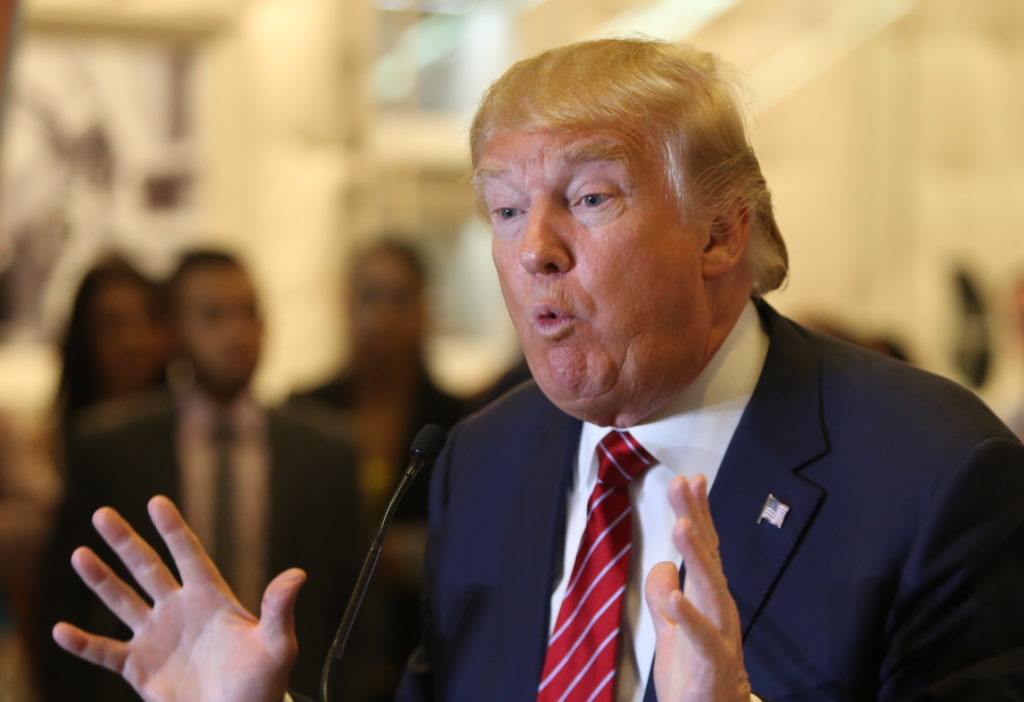
How freaked out and messed up is Donald Trump over having to testify in his New York civil fraud trial tomorrow? He’s melting down on his social network in manic fashion, and he’s reaching the point where nothing he’s saying even makes any sense.
For instance Trump posted this today: “Sloppy Chris & “Aida” got booed off the stage yesterday at the big, and very successful, Republican Party event in Florida. I didn’t even know that Aida was still in the race.”
It might take you a minute to figure out that “Sloppy Chris” is Chris Christie, and that “Aida” is Asa Hutchinson. But Trump didn’t bother to specify this at any point in his rant, because he really isn’t ranting for an audience. He’s just ranting out of frustration, and is that far removed from whether his words end up being any decipherable messaging. Trump is out of his mind about having to take the stand, and it shows.
Palmer Report has led the way in political analysis. Now we’re gearing up to cover the 2024 election, up and down the ballot. Help support Palmer Report’s 2024 efforts by donating now.
Palmer Report has led the way in political analysis. Now we’re gearing up to cover the 2024 election, up and down the ballot. Help support Palmer Report’s 2024 efforts by donating now.
How freaked out and messed up is Donald Trump over having to testify in his New York civil fraud trial tomorrow? He’s melting down on his social network in manic fashion, and he’s reaching the point where nothing he’s saying even makes any sense.
For instance Trump posted this today: “Sloppy Chris & “Aida” got booed off the stage yesterday at the big, and very successful, Republican Party event in Florida. I didn’t even know that Aida was still in the race.”
It might take you a minute to figure out that “Sloppy Chris” is Chris Christie, and that “Aida” is Asa Hutchinson. But Trump didn’t bother to specify this at any point in his rant, because he really isn’t ranting for an audience. He’s just ranting out of frustration, and is that far removed from whether his words end up being any decipherable messaging. Trump is out of his mind about having to take the stand, and it shows.
Palmer Report has led the way in political analysis. Now we’re gearing up to cover the 2024 election, up and down the ballot. Help support Palmer Report’s 2024 efforts by donating now.
Russia launches nuclear-capable missile after Putin pulls out of nuclear test treatyhttps://t.co/QhccqDiM8s pic.twitter.com/yopmKTB4vZ
— The Washington Times (@WashTimes) November 6, 2023
2 police officers hurt, one critically, in terror stabbing near Jerusalem’s Old City
#Israel #Jerusalem #Palestinians Read more: https://t.co/i4GtEiTKwh pic.twitter.com/lWjpAsbOOl— Agencia AJN (@AgenciaAJN) November 6, 2023
Zelensky unsure if Trump would support Ukraine if elected https://t.co/B90qVzQh6V pic.twitter.com/1X5cnG7n7S
— The Hill (@thehill) November 6, 2023