
Статистические данные говорят о том, что экономика России развивается предсказуемо и стабильно, заявил президент РФ Владимира Путин на совещании по экономическим вопросам.
 The South Caucasus News - SouthCaucasusNews.com
This past Sunday, October 29, was a day of grand celebration for the Turkish nation. It was the 100th anniversary of the founding of the Turkish Republic, established by Mustafa Kemal Ataturk after the “war of independence.” Kemal had served in the Ottoman army in both eastern and western campaigns. He skillfully took advantage of the victorious allies’ confusion and duplicity to drive the “foreigners” out, eventually establishing the new Turkish Republic. Kemal was revered for his introduction of “democracy” to Turkey and the transition to secular institutions, in sharp contrast to his Ottoman predecessors. Pictures of Kemal adorned nearly every building and home in Turkey in reverence to the man they called “father of the Turks.” The West eventually warmed to the western-leaning Turkish nation, particularly during the post-World War II period, and Turkey joined NATO in 1952. Turkey also joined the U.N. coalition in the Korean War and enjoyed the support of the western alliance, which transformed Turkey’s military into a modern fighting unit. Turkey has earned deep friendships in the Pentagon and State Department, as it has received investments from the military industrial complex for serving as a buffer to the Soviet Union for decades. Despite its questionable loyalty to NATO under current President Recep Erdogan and its obstructionist role in Syria against United States interests, Turkey has been forgiven countless times, as it charts its own regional hegemony. Turkey has played both sides in the Ukraine war by circumventing western sanctions against Russia and attempting to serve as a self-serving broker between both sides.
The truth of the founding of the Turkish Republic is quite different from the romantic notion of a people fighting for their independence that Turkey has projected. The reality is that Ottoman Turkey was a defeated nation as a result of World War I and committed at least three genocides (Armenian, Assyrian and Greek) to further its warped vision.
Turkey has succeeded in winning powerful friends, but not everyone has been allured by its veneer. The truth of the founding of the Turkish Republic is quite different from the romantic notion of a people fighting for their independence that Turkey has projected. The reality is that Ottoman Turkey was a defeated nation as a result of World War I and committed at least three genocides (Armenian, Assyrian and Greek) to further its warped vision. Once the allies (primarily French and British) secured their mandate in the Middle East, they had no appetite to fight the Turks, who were allowed to brutally expel the western Greeks. The allies were apparently satisfied with their bounty and withdrew from Turkish territory. The Armenians are all too familiar with the treacherous French abandonment of Cilicia after using the Armenian Legion to secure the region and encouraging Genocide survivors to return. The Ataturk that the Armenians know committed atrocities in the villages of Cilicia, purging the region of its last Armenian inhabitants. A similar cleansing took place in the postwar period in the northern Pontus region, home to an indigenous Greek nation. Ataturk went about the business of completing what the Committee of Union and Progress, or Young Turks, had not finished. Troops under his command attacked the western borders of the young Armenian republic in 1920, forcing the capitulation of independence and the loss of Kars, Ardahan and Ararat. His murderous campaigns killed thousands of Greeks and Armenians as Smyrna (Izmir) burned.
The truth is that the Turkish Republic of 1923 was founded on the blood and wealth of millions of Christians native to Asia Minor and Anatolia. Turkish independence was far less about a people seeking freedom and more about purging the nation of non-Turks. In those decades, non-Turks were defined as Christians who were of the Armenian, Greek, Assyrian and Chaldean faiths. By the end of the first decade of the Turkish Republic, these centuries-old native communities were depopulated. What remained of the Armenian community slowly centered around the neighborhoods of Istanbul. The Armenian highlands were eerily silenced by the absence of an ancient indigenous culture. The completion of the Christian purge occurred on the watch of the “revered” Ataturk. Ataturk’s brutal methods against the innocent should never be confused with freedom fighting and civilized leadership. The Kurds, who were a prominent ethnic grouping in the east, particularly in the southeast, were subjected to overt attempts at cultural assimilation as they were officially referred to as “mountain Turks.” When these attempts failed, the Kurds were subjected to atrocities such as the Dersim massacres in the 1930s, which was covered up for decades by the Republic officials.
Perhaps the most destructive legacy of the Turkish Republic, aside from the atrocities that led to its formation, is the institutional deception created by Ataturk and continued to this day. The Ittihads were the authors of genocide, and Kemal Ataturk continued their work by designing the coverup. In the post-genocide period, billions of dollars of the property and other forms of wealth of Armenians who had been murdered or deported were confiscated under the “abandonment” laws created by Kemal and redistributed for the resettlement of Turks, providing a financial foundation for the republic. Ataturk and his Republican colleagues were not only allowed to murder hundreds of thousands of Christians, but he also completed the robbery of their earthly possessions.
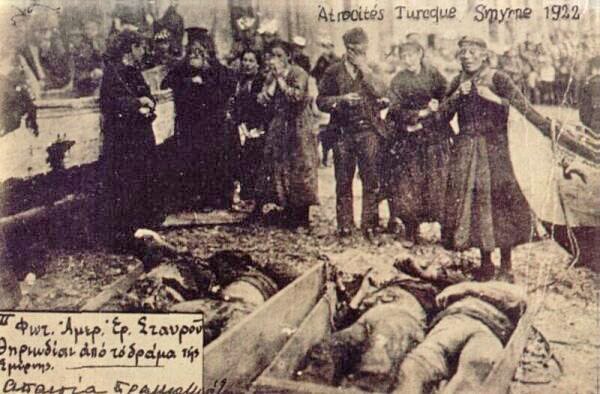 Greek refugees mourning victims of the Smyrna massacres
The western world, having little interest in this unpunished act of barbarism and exhausted by war, moved on to a postwar environment. The United States, still in the infancy of becoming a world power, entered a period of isolationism by rejecting a U.S. mandate over Armenia, the Wilsonian mandate, and limiting its activity in these former war zones. Ataturk, under the cover of his westernization of Turkey into a secular “democracy,” commanded a virtual dictatorship that used pseudo-democratic institutions to legitimize his activities. The Armenian Genocide was a taboo topic in the Turkish Republic, and Armenians were portrayed as disloyal traitors to the Turkish nation. Turks would openly comment that the Genocide was justified based on Armenian behavior. These attitudes were embedded overtly and subtly by the educational system, creating an atmosphere of institutional discrimination manifested to this day. For example, although the Treaty of Lausanne guarantees the minorities in Turkey the freedom of religion, Turkey has closed for 50 years the only Armenian seminary and openly meddles in the affairs and the election of the Patriarch. In street vernacular, the word Armenian (Ermenie) is considered an insult. During a political campaign several years ago, former President Abdullah Gul was accused of having an Armenian mother. It was a “scandalous” tactic to put him on the defensive and discredit his career. This is the legacy of the Turkish Republic. We are all familiar with how Erdogan has been working to destroy not only any semblance of democracy but to push Turkey closer to an Islamic state. This would be a reversal of one of Ataturk’s legacies and has created significant division within Turkish society. His pan-Turkic fanaticism is displayed through his “one nation two states” platform with rogue Azerbaijan while promoting racism against Armenians.
The criminal legacy of the Turkish Republic goes beyond genocide, confiscation and coverup. Children in Turkey learn a revisionist, distorted view of history that supports their denial. I came across a small but significant example this week. My wife and I are in Washington, D.C. attending a family wedding. Our plan was to stay a few extra days and enjoy the sights with my cousin and his wife from California. On Sunday, which happened to be Turkish Independence Day, we decided to have dinner at an Italian restaurant. Our waitress was a very pleasant young woman. She had a heavy accent that seemed Middle Eastern, so we asked where she was born. She replied that she was Turkish. After our meal, I wanted to engage in further dialogue with her. I asked where she was from, and she replied, “Izmir.” I asked her if she was familiar with its past as Smyrna. She politely replied that it was a long time ago when there were “rebels” in the area. I mentioned that many innocent people died, and she was puzzled and said the campaign was part of their independence war that they were celebrating on that day. I showed her a map on my phone and said my grandfather was from Sivas, and grandmother, from Adana. She seemed pleased, probably thinking we had something in common. At that point I asked her a question. “Why do you think we know so much about Turkey and its history? I can tell you we are not Turks or Greeks.” She didn’t respond, and I told her we are “Ermenie.” Her tone changed as her “education” kicked in. She told me that during that time there was a major problem with “disloyalty” and people left. She added that if we are interested in that era there is an “Ottoman restaurant” nearby. My wife, who was seething at this point, said we would not go there. Thus, we ended our Turkish Independence Day encounter. This young woman, a native of Izmir, is a 21st-century product of the corrupt Turkish education system as it relates to World War I and Armenians that continues teaching children lies and creates discriminatory attitudes. It started in Ataturk’s time and has continued in order to prevent the truth from enabling justice. The Azerbaijanis, who have stolen everything in their creation, have learned this propaganda technique from their cousins to the west. They openly teach hatred of Armenians to their young, copying the institutional discrimination policies that have existed in Turkey for a century.
If Turkey is truly ready – and I highly doubt it – to open a new beginning with Armenia, then it should start by peeling back the layers of lies. It will be challenging, because the layers have been professionally designed for decades. There can be little hope for a “normalization” as long as the educational system characterizes Armenians as “disloyal” or “rebellious” people not worthy of respect, or as long as Erdogan describes Armenians as “remnants of the sword,” or states that Turkey will finish what our “grandfathers started.” Signing a treaty with Turkey must be accompanied by systemic change to dismantle discriminatory policies and behavior. There is nothing “normal” about establishing relations with a country that has worked to diminish your presence on this earth and has designed an educational system to perpetuate the crime. In the meantime, their 100th anniversary will be celebrated with congratulatory rhetoric, but we know the truth. We will not be silenced.
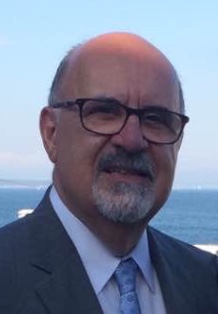
Stepan was raised in the Armenian community of Indian Orchard, MA at the St. Gregory Parish. A former member of the AYF Central Executive and the Eastern Prelacy Executive Council, he also served many years as a delegate to the Eastern Diocesan Assembly. Currently , he serves as a member of the board and executive committee of the National Association for Armenian Studies and Research (NAASR). He also serves on the board of the Armenian Heritage Foundation. Stepan is a retired executive in the computer storage industry and resides in the Boston area with his wife Susan. He has spent many years as a volunteer teacher of Armenian history and contemporary issues to the young generation and adults at schools, camps and churches. His interests include the Armenian diaspora, Armenia, sports and reading.
The post The Turkish Republic’s criminal legacy appeared first on The Armenian Weekly.
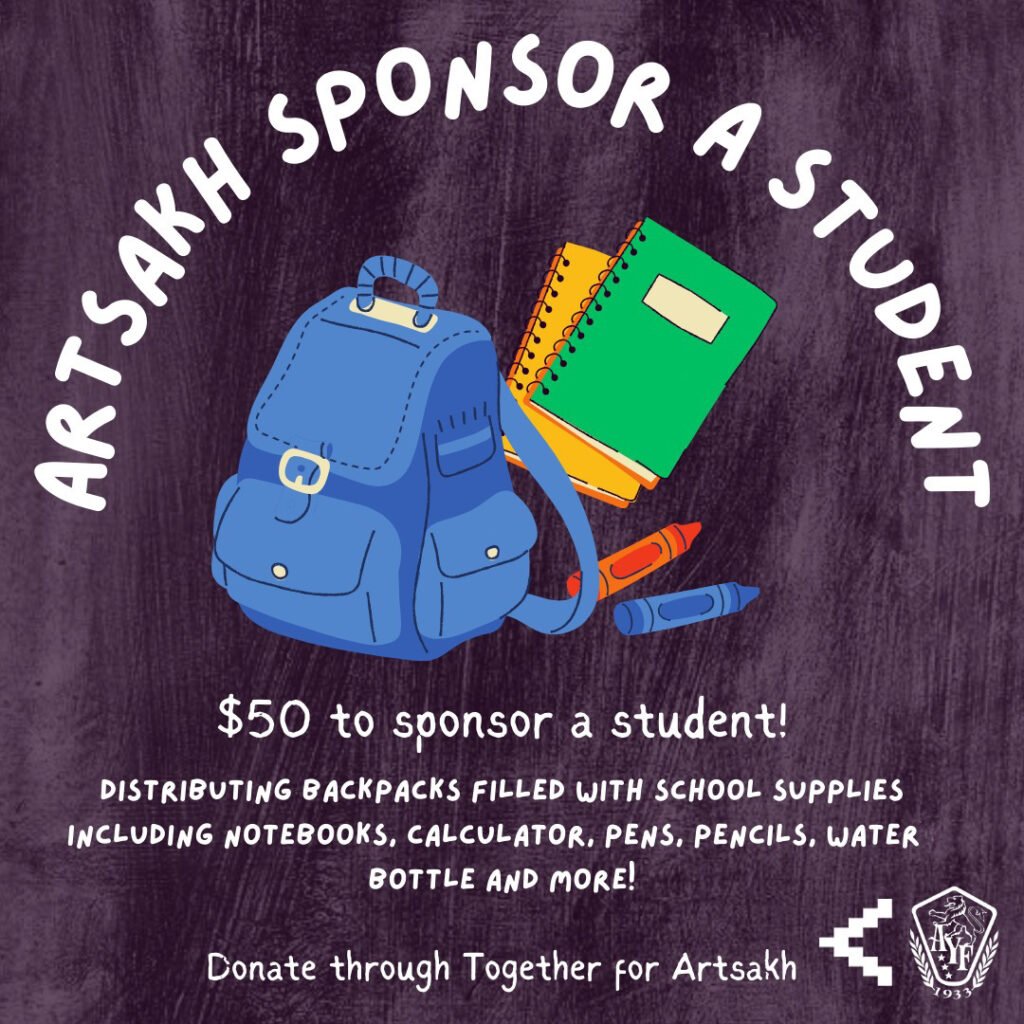 Following the attack on Artsakh on September 19-20, virtually all of the Armenian residents of Artsakh were forced to relocate to Armenia. Promptly, many individuals and organizations mobilized to address their needs and facilitate their integration into Armenia’s society, economy and daily routines. With a similar objective in mind, the Armenian Youth Federation-Youth Organization of the Armenian Revolutionary Federation (AYF-YOARF) Central Executive has initiated a fundraising campaign aimed at supporting families and school-aged children from Artsakh, called the “Sponsor a Student” initiative.
Shortly after the mass attacks and relocation, a member of the Central Executive traveled to Armenia to gain a better understanding of the situation and the ongoing necessities of the affected families. Numerous families, seeking to enroll their children in schools, were turned away due to full capacity or inadequate resources for students.
The Central Executive decided that as the youth organization of the ARF, it is important and necessary to support our fellow youth of Artsakh and ensure that we maintain their right and access to education through these extremely difficult times in our nation’s history.
Therefore, the Central Executive has launched a fundraising program to purchase backpacks filled with school supplies to distribute to the displaced Artsakh youth throughout Armenia. The backpacks will include all the essentials to help alleviate these students’ transition to starting school in Armenia.
A donation of $50 will sponsor supplies for one student. The Central Executive has set a first round goal of $25,000 to sponsor 500 students.
Upon reaching this goal, future rounds will be announced to continue providing additional support to those children who have not yet received supplies.
We encourage you to join us and donate to our Sponsor a Student initiative, to support the children of Artsakh who have gone through enough difficulties and trauma for a lifetime. We also ask that you challenge your friends, colleagues and family members to do the same.

Founded in 1933, The Armenian Youth Federation is an international, non-profit, youth organization of the Armenian Revolutionary Federation (ARF). The AYF-YOARF Eastern United States stands on five pillars that guide its central activities and initiatives: Educational, Hai Tahd, Social, Athletic and Cultural. The AYF also promotes a fraternal attitude of respect for ideas and individuals amongst its membership. Unity and cooperation are essential traits that allow members of the organization to work together to realize the AYF’s objectives.
The post AYF initiates Artsakh “Sponsor a Student” program appeared first on The Armenian Weekly.
Armenia
During the special session of the Yerevan Council of Elders, four deputy mayors were elected. Armen Pambukhchyan from the “Civil Contract” faction was elected as the first deputy mayor of Yerevan, receiving 32 votes in favor and 5 abstentions. Levon Hovhannisyan (“Civil Contract”), Suren Grigoryan (“Civil Contract”) and Sargis Madatyan (”Republican”) were also elected as deputy mayors. The “National Progress” faction did not participate in the voting process, while the “Public Voice” faction participated but chose to abstain. The “Mother Armenia” alliance did not attend the special session.
During the parliamentary committee hearing on the 2024 state budget, Armenian PM Nikol Pashinyan expressed hope that the land border between Armenia and Turkey will be opened soon for diplomatic passport holders and citizens of third countries. Pashinyan mentioned that infrastructure works are underway, particularly in Margara, where a checkpoint is being re-equipped and restored.
Artsakh
Two young individuals from Artsakh, Mkhitar Lernik Ohanjanyan and Gor Ernesti Hakobyan, were detained by the police on October 28 without prior notice. They were taken into custody for allegedly participating in opposition rallies in Yerevan. Gegham Manukyan, a deputy of the National Assembly “Hayastan” faction, expressed his strong disapproval of the law enforcement’s behavior, calling it enemy-like and unlawful. Artsakh citizens Gor Hakobyan, Manvel Petrosyan and Samvel Mirzoyan have also been arrested.
In an interview with Artsakh Public TV, Artsakh President Samvel Shahramanyan said that Azerbaijan’s recent attack on Artsakh was not related to his election as president. Shahramanyan described how Azerbaijan’s base near Shushi approached a Russian base, warning them about imminent artillery shelling. He said the Artsakh authorities accepted Azerbaijan’s demand to dissolve the Artsakh Armed Forces in order to save lives. The Artsakh president stressed the importance of discussions about Artsakh’s status and the return of its citizens.
Iran
On Tuesday, Minister of Labor and Social Affairs of Armenia, Narek Mkrtchyan, and Iran’s Deputy Minister of Labor, Cooperatives, and Social Welfare, Mehrdad Azimi, met in Karaj, Iran. They both highlighted the importance of enhancing cooperation in the field of “skill diplomacy” and the need for bilateral cooperation in developing skill training programs.
Russia
Russian Foreign Ministry spokeswoman Maria Zakharova announced that the Armenian charge d’affaires was summoned on October 25 to address what Russia sees as an “anti-Russian campaign” in Armenian media. Zakharova criticized an interview given by Armenian Prime Minister Nikol Pashinyan to U.S. media, stating that it contained provocative questions aimed at damaging Moscow-Yerevan relations.

Hoory Minoyan was an active member of the Armenian community in Los Angeles until she moved to Armenia prior to the 44-day war. She graduated with a master’s in International Affairs from Boston University, where she was also the recipient of the William R. Keylor Travel Grant. The research and interviews she conducted while in Armenia later became the foundation of her Master’s thesis, “Shaping Identity Through Conflict: The Armenian Experience.” Hoory continues to follow her passion for research and writing by contributing to the Armenian Weekly.
The post The Region in Brief appeared first on The Armenian Weekly.
I grew up wanting two birthday parties—not for twice the amount of presents and cake, but because the idea of having my Armenian and non-Armenian communities under the same roof made me squirm. I felt like I had to be two different people at the same time, but I couldn’t fit neatly into either role. I would either try to be the most knowledgeable person about all things Armenian or pose as the exact opposite. In school, my peers didn’t understand my home life, where uncles gave lengthy toasts over dinner, aunts raised their voices three octaves when they pinched my cheeks and scolded me when I sat on the bed.
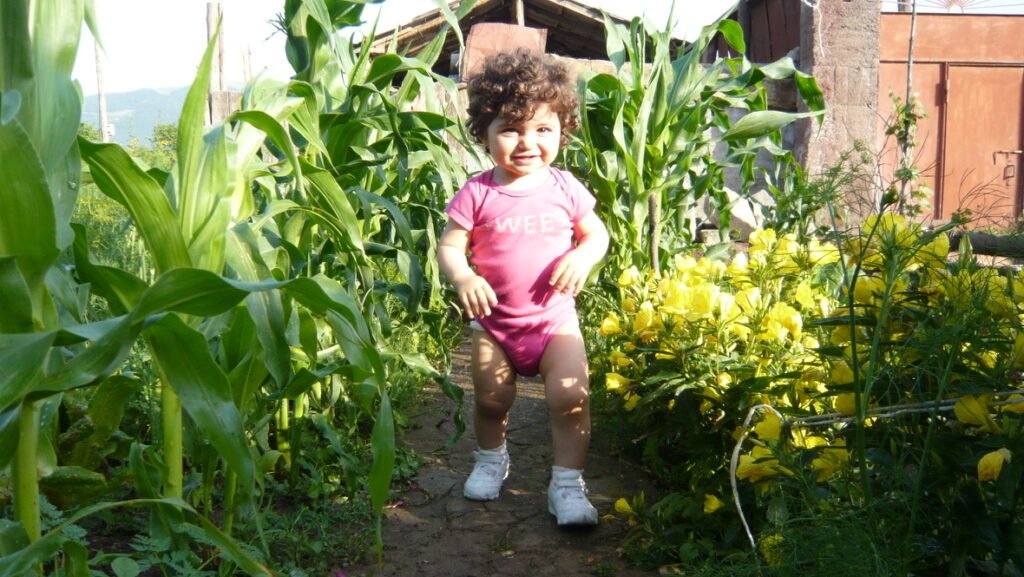 Maral Zeitlian’s first steps in her grandmother’s garden in Tatev
I come from late night family barbecues on a school night. Twelve-hour flights to Yerevan connecting through Moscow. Throwing up on the six-hour drive from Yerevan to Tatev. Taking my first steps in my Tatik’s garden. I did a good job hiding these roots when I was in the third grade, but whenever a substitute teacher mispronounced my name during attendance, people shortened my name to “Mar,” or I chose to speak English with my grandmother instead of Armenian, I felt embarrassed, like I was giving in to assimilation.
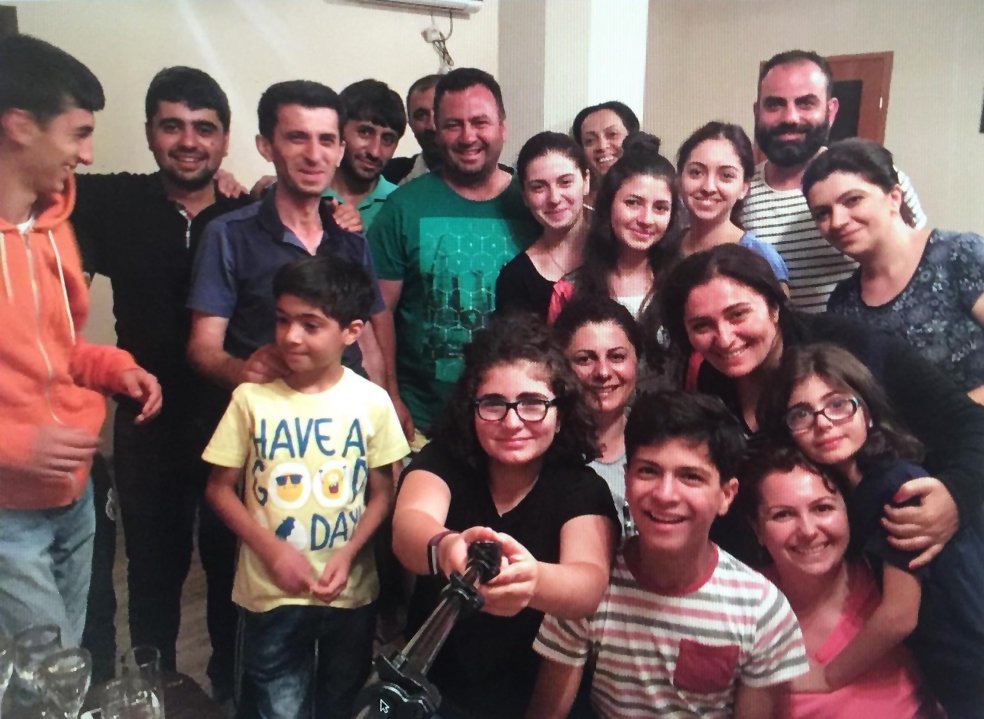 A family photo at the house in Tatev where Maral Zeitlian’s mother grew up
As I got older, I understood that being Armenian is the biggest part of my identity, and I shouldn’t hide it. Soon, I was recognized for being patriotic. I corrected people when they said my name wrong and educated my peers about the Armenian Genocide.
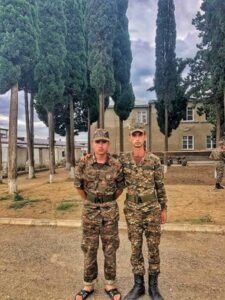 Maral Zeitlian’s cousins who fought on the frontlines of the 2020 Artsakh War
As a child, I didn’t realize how difficult it must have been for my mom, who moved to New York on her own without speaking a word of English. While her whole family was together in Armenia, she joined them over Skype during one of the most difficult periods. My cousins were on the front lines for two years, and it horrified us knowing that they could have been one of the thousands of soldiers who died during the 2020 Artsakh War.
I used to wish my mom and I could be with our whole family, embracing our loud company after all of the loss. I still wish that sometimes, but I’ve also realized how privileged I am not to have experienced what my family went through. Being in Armenia wouldn’t necessarily help my home for the better. Living in America has opened up so many opportunities to spread awareness and educate people. I don’t have to feel helpless anymore.
I know that being Armenian doesn’t depend on where we live as diasporan Armenians, but on keeping our culture alive and never giving up fighting for our homeland.
Hiding my identity as an Armenian girl became the very reason I joined every organization I possibly could and gave them every idea I thought of. I have organized protests and fundraisers, delivered speeches, written articles, and most importantly, I never lost hope. I never stopped speaking our language. I never stopped being curious, and I never stopped wanting to learn more. Here I am now, growing as an Armenian and as a person. I am still in pain and distraught over everything that has been happening for the past 108 years, but I know that being Armenian doesn’t depend on where we live as diasporan Armenians, but on keeping our culture alive and never giving up fighting for our homeland. These are the things that make Armenians loud, welcoming and kind. I want Armenians who believe that they have to change the way they say their names to learn that their real name and their real self is the one they don’t have to be ashamed of.
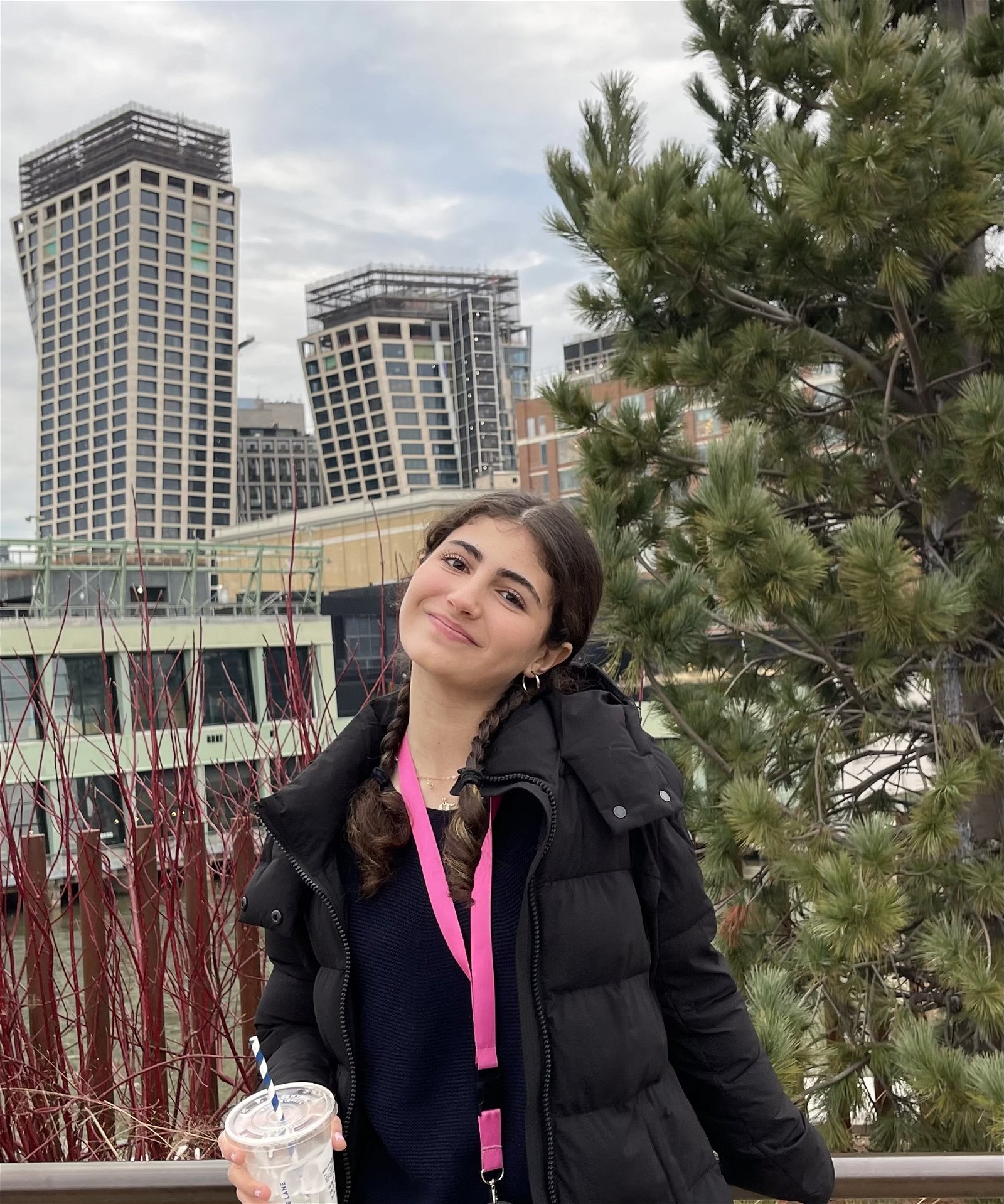
Maral Zeitlian is a student at Fiorello H. LaGuardia High School in New York City. She is a member of the AYF Manhattan Moush Junior Chapter.
The post My Name is Armenia Girl appeared first on The Armenian Weekly.
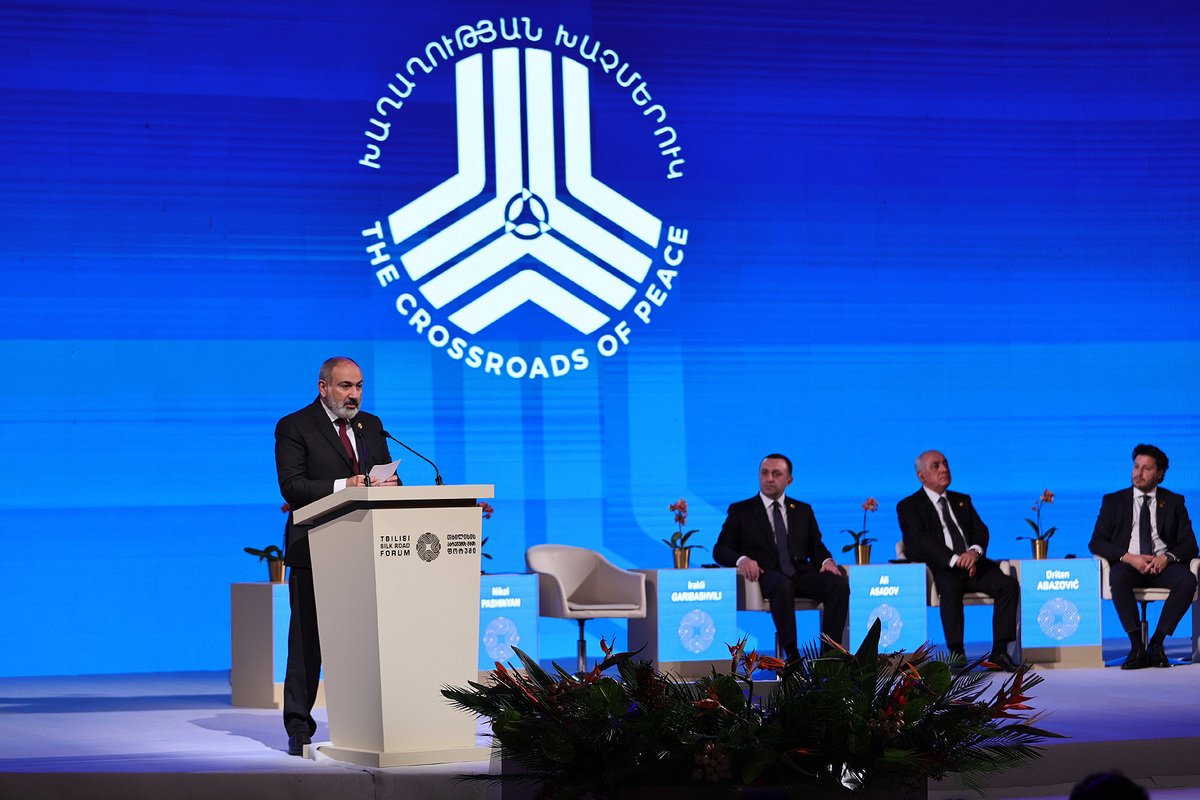 Armenian PM Nikol Pashinyan’s speech during the Silk Road International Conference in Tbilisi (Photo: Office of the Prime Minister of the Republic of Armenia)
YEREVAN—Armenian Prime Minister Nikol Pashinyan attended the “Silk Road” international conference in Tbilisi on October 26, along with other high-ranking officials and representatives from various countries and international organizations, where he presented Armenia’s “Crossroads of Peace” project, emphasizing the importance of regional cooperation and connectivity.
PM Pashinyan began by highlighting the historical significance of the Silk Road, symbolizing prosperity, peace and cooperation among nations. Pashinyan stressed the vital role of open roads in building and maintaining peace, stating that the South Caucasus region, including Armenia, needs peace, open borders, and strong economic, political and cultural ties.
The “Crossroads of Peace” project, according to Pashinyan, aims to enhance communication between Armenia, Turkey, Azerbaijan and Iran through infrastructure development, including roads, railways, pipelines, cables and electricity lines. He pointed out that some regional railways and highways have been inactive for 30 years, and reactivating them could establish efficient routes connecting the Caspian Sea to the Mediterranean.
Pashinyan invited governments and private investors to consider the project, emphasizing its potential benefits for all countries in the region. He stated that all infrastructures would operate under the sovereignty of the countries through which they pass, with border and customs control ensured by each country, promoting reciprocity and equality. This approach appears to be a direct response to Azerbaijan’s demand for control over the “Zangezur corridor.”
The operation of the “Zangezur transit corridor” remains a top priority for Azerbaijan. Baku’s goal is to establish transit between Azerbaijan and its Nakhichevan exclave, which requires access to the “Zangezur corridor” through Armenia. Azerbaijan aims for minimal security checks, tariffs and transit fees, potentially pressuring Armenia into accepting its terms.
The Armenian PM also discussed Armenia’s readiness to work on peace and normalization agreements with Azerbaijan, emphasizing mutual recognition of territorial integrity and border delimitation based on the 1991 Alma-Ata Declaration.
Pashinyan underlined the alignment of the “Crossroads of Peace” project with the Silk Road’s logic and expressed Armenia’s readiness to facilitate safe transportation of people, vehicles, goods and infrastructure.
On the other hand, Azerbaijani officials like Foreign Policy Advisor to the President of Azerbaijan Hikmet Hajiyev recently confirmed that military annexation of the “Zangezur corridor” is “no longer their objective.” Instead, according to Hajiyev, Azerbaijan is focusing on building transportation connections through Iran. Construction of a new road in partnership with Iran has already begun. However, the possibility of maintaining a transport link between Azerbaijan and Nakhichevan through Armenia still depends on Armenia’s willingness, without extraterritorial concessions, to allow Azerbaijan to bypass Armenian border controls, Hajiyev said.
Following this reasoning, Aliyev issued a decree regarding the ongoing efforts to link the Horadiz-Jabrail-Zangilan-Agband highway with Iran and the construction of a bridge over the Araz River. The State Highway Agency has been allocated 14 million manats from the presidential reserve fund for these initiatives.
As Pashinyan flip-flops Armenia’s diplomatic relationships with its traditional allies such as Russia and introduces what he sees as novel concepts, Azerbaijan’s decision to abstain from engaging in discussions aimed at advancing the peace process and its ongoing military maneuvers alongside Turkey, its closest ally, imply that Azerbaijan lacks the desire to reach a peaceful settlement. Such an agreement, according to Pashinyan, should ideally be grounded in three fundamental principles: the mutual acknowledgment of each other’s territorial integrity, the delineation and marking of borders as per the Alma-Ata Declaration, and the opening of all regional communications under the sovereign authority of the concerned parties.
All the while, state representatives and international organizations such as the Lemkin Institute for Genocide Prevention and Stratfor Forecasting Inc. have warned of new escalations in the region.
The Lemkin Institute for Genocide Prevention has issued a Red Flag Alert regarding the potential for Azerbaijan to invade Armenia, particularly its southern Syunik Province. This invasion could be driven by the desire to create a land corridor connecting Azerbaijan to Nakhichevan, a goal shared with Turkey, posing a significant threat to Armenia’s territorial integrity. Recent political developments, including the seizure of Artsakh by Azerbaijan and well-established Armenophobia in the region, raise concerns about a potential genocide. These fears stem from a pattern of massacre, atrocity and forced displacement targeting Armenian identity.
Despite the potential risks, there is a growing concern that Azerbaijan might resort to force. Several factors contribute to this possibility, including Azerbaijan’s military advantage, belief in a limited international response, distractions in the global community and President Ilham Aliyev’s confidence in military success.
Stratfor reports that Azerbaijan is more likely to pursue smaller territorial incursions and cross-border shelling to pressure Armenia into an agreement, rather than a full-scale invasion to seize southern Armenia and establish the “Zangezur corridor” by force. Recent statements and missed meetings between Armenian and Azerbaijani officials reflect growing tensions and divergent geopolitical orientations.
Azerbaijan could continue with smaller-scale incursions and shelling, considering that a full-scale invasion could lead to greater risks and complications. Azerbaijan already maintains alternative transit routes and would risk regional stability, Turkish support and international consequences by launching a major invasion.
Armenia and Azerbaijan’s leaders have not met for significant discussions since July, and both countries appear to be aligning with different geopolitical partners. Armenia’s Prime Minister Pashinyan signaled a desire to reorient Armenia’s foreign policy toward the West during an address to the European Parliament on October 17, while Azerbaijan seeks regional support for its vision of a peace settlement, including from Turkey, Russia and Iran.
Given the factors mentioned above, the world appears to face conflicting viewpoints and disagreements at a critical “crossroad,” making it challenging to evaluate the current and future developments. As Turkish President Recep Tayyip Erdogan announced, “This marks a pivotal moment for the region. We are on the verge of either a major conflict or significant peace.”
Hoory Minoyan was an active member of the Armenian community in Los Angeles until she moved to Armenia prior to the 44-day war. She graduated with a master’s in International Affairs from Boston University, where she was also the recipient of the William R. Keylor Travel Grant. The research and interviews she conducted while in Armenia later became the foundation of her Master’s thesis, “Shaping Identity Through Conflict: The Armenian Experience.” Hoory continues to follow her passion for research and writing by contributing to the Armenian Weekly.
The post Pashinyan presents “Crossroads of Peace,” pursuing regional connectivity appeared first on The Armenian Weekly.